Three on Four International

Organized by Era

80 listings in Organized by Era, $3.29 to $2,549.33. Each one is shown in its own photos and described in full below; buy on eBay.

Prices and availability as of November 3, 2026.

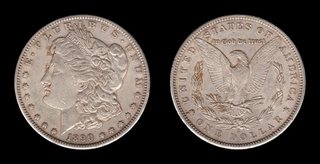
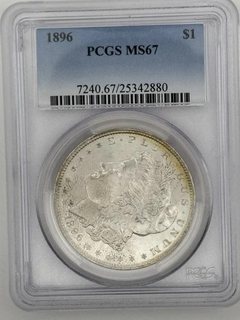
1896-P Morgan Silver Dollar $1 PCGS MS67 Philadelphia Mint 90% Silver

1896-P Morgan Silver Dollar · PCGS MS67 · Philadelphia Mint · 90% silver · designed by Englishman George T. Morgan

$2,549.33 1896 PCGS MS67

Description

An 1896-P Morgan silver dollar from the Philadelphia Mint (no mint mark), certified and sealed by PCGS at MS67. The certification number on the label can be checked on the PCGS website. The photos show this exact coin and holder.

Mint specifications: 90% silver, 10% copper; 26.73 grams; 38.1 mm; 0.7734 troy oz of pure silver. These are the Mint's standard figures; the coin has not been removed from its holder.

Read the full description

The 1896-P

Philadelphia struck 9,976,000 Morgan dollars in 1896.

The Philadelphia Mint, America's first, was created by the Coinage Act of April 2, 1792, and in March 1793 delivered the nation's first circulating coins, 11,178 copper cents. The very first Morgan dollar was struck here on March 11, 1878. Philadelphia coins of this era carry no mint mark.

The Year 1896

On April 6, 1896, King George I opened the first modern Olympic Games in Athens, and Boston's James Connolly won the triple jump to become the first modern Olympic champion. A dollar in 1896 had the buying power of about $39 today.

The Morgan Dollar

Isn't it remarkable that one of America's best-known collectible coins was designed by an Englishman, who went on to become Chief Engraver of the United States Mint?

George T. Morgan, from the Birmingham area of England, joined the US Mint in 1876 on the recommendation of Britain's Royal Mint. His model for Liberty was Anna Willess Williams of Philadelphia. In 1918 the Pittman Act melted over 270 million silver dollars, and sold much of the silver to Britain to back its currency in India.

Grade And Authenticity

MS (Mint State) 67 means no wear; within MS 60 to 70, the number rises as marks decrease and luster and strike improve. PCGS, founded in 1986, guarantees its grades. The seller also tested the metal through the holder with a calibrated Sigma Metalytics verifier (consistent with silver), inspected the holder for tampering (none found), and confirmed the certification number on the PCGS website.

Authenticity Guarantee

This coin is covered by eBay's Authenticity Guarantee for coins: after purchase it goes first to eBay's authentication partner, PCGS, which inspects it against this listing, then on to you. There is no extra cost to the buyer, and shipping to and from the authenticator is included in the free shipping.

Also In Our Store

  • Silver Eagles carrying the Walking Liberty design of German-born sculptor Adolph A. Weinman.
  • Victorian advertising trade cards, chromolithographed in the Morgan years.
  • Peace dollars, designed by Sicilian-born Anthony de Francisci, and more world coins and banknotes.

Disclaimer

Specifications and detailed item descriptions are provided as a courtesy only and are not guaranteed to be one hundred percent accurate. Please do your own research. There are generally no receipts available for any items from original purchases. Any dimensions and/or weights are approximate. The absence of a more detailed condition report does not imply there are no condition issues with the item(s). Please inspect images carefully as they are part of the official item description and best representation of the actual condition. Additional images may be available upon request depending on time and availability. Not responsible for internet mis-translations or mis-identification of maker's marks if found or assumptions of makers or materials — item descriptions will indicate if it is assumed. If you see a problem, please message us immediately and we will do our best to sort out a solution and confirm the information. With the exception of eBay rules, no returns are accepted.
View on eBay

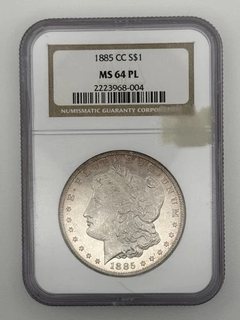
1885-CC Morgan Silver Dollar $1 Coin —Carson City— NGC MS64 PL Proof-Like

1885-CC Morgan Silver Dollar, Carson City Mint, NGC MS64 PL (Proof-Like)

$1,585.33 1885 NGC MS64 PL

Genuine 1885-CC Morgan silver dollar, certified and graded MS64 PL by NGC.

The PL (Proof-Like) designation means the fields are reflective, like a mirror.

Struck at the Carson City Mint in Nevada, with a mintage of only 228,000.

Designed by George T. Morgan. 90% silver, 10% copper; 26.73 g; 38.10 mm. Silver content checked with a Sigma Metalytics precious metals tester.

NGC certification #: 2223968-004 (verify at ngccoin.com).

Light toning at the rim. The holder has residue from an old sticker at the right side of the label; see photos.

Ships under eBay's Authenticity Guarantee: we send it by USPS with full insurance and signature to eBay's authenticator, which then ships it to you.

The images and any video show the actual item and are part of the official listing description, so please review them closely. Measurements and weights are approximate, and any maker or material we haven't confirmed is described as assumed. Questions? Message us; we answer quickly.

View on eBay

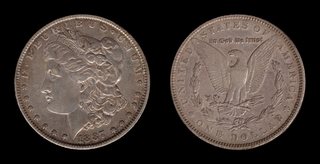
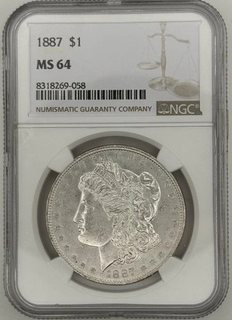
1887-P Morgan Silver Dollar $1 NGC MS64 Philadelphia Mint 90% Silver

1887-P Morgan Silver Dollar · NGC MS64 · Philadelphia Mint · 90% silver · designed by Englishman George T. Morgan

$879.95 1887 NGC MS64

Description

An 1887-P Morgan silver dollar from the Philadelphia Mint (no mint mark), certified and sealed by NGC at MS64. The certification number on the label can be checked on the NGC website. The photos show this exact coin and holder.

Mint specifications: 90% silver, 10% copper; 26.73 grams; 38.1 mm; 0.7734 troy oz of pure silver. These are the Mint's standard figures; the coin has not been removed from its holder.

Read the full description

The 1887-P

Philadelphia struck 20,290,000 Morgan dollars in 1887.

The Philadelphia Mint, America's first, was created by the Coinage Act of April 2, 1792, and in March 1793 delivered the nation's first circulating coins, 11,178 copper cents. The very first Morgan dollar was struck here on March 11, 1878. Philadelphia coins of this era carry no mint mark.

The Year 1887

In December 1887, Sherlock Holmes and Dr. Watson made their first appearance, in Arthur Conan Doyle's "A Study in Scarlet," published in London's Beeton's Christmas Annual. A dollar in 1887 had the buying power of roughly $33 to $36 today.

The Morgan Dollar

Isn't it remarkable that one of America's best-known collectible coins was designed by an Englishman, who went on to become Chief Engraver of the United States Mint?

George T. Morgan, from the Birmingham area of England, joined the US Mint in 1876 on the recommendation of Britain's Royal Mint. His model for Liberty was Anna Willess Williams of Philadelphia. In 1918 the Pittman Act melted over 270 million silver dollars, and sold much of the silver to Britain to back its currency in India.

Grade And Authenticity

MS (Mint State) 64 means no wear; within MS 60 to 70, the number rises as marks decrease and luster and strike improve. NGC, founded in 1987, has been the American Numismatic Association's official grading service since 1995 and has offices in Hong Kong, Shanghai, Munich and London. The seller also tested the metal through the holder with a calibrated Sigma Metalytics verifier (consistent with silver), inspected the holder for tampering (none found), and confirmed the certification number on the NGC website.

Authenticity Guarantee

This coin is covered by eBay's Authenticity Guarantee for coins: after purchase it goes first to eBay's authentication partner, PCGS, which inspects it against this listing, then on to you. There is no extra cost to the buyer, and shipping to and from the authenticator is included in the free shipping.

Also In Our Store

  • Silver Eagles carrying the Walking Liberty design of German-born sculptor Adolph A. Weinman.
  • Victorian advertising trade cards, chromolithographed in the Morgan years.
  • Peace dollars, designed by Sicilian-born Anthony de Francisci, and more world coins and banknotes.

Disclaimer

Specifications and detailed item descriptions are provided as a courtesy only and are not guaranteed to be one hundred percent accurate. Please do your own research. There are generally no receipts available for any items from original purchases. Any dimensions and/or weights are approximate. The absence of a more detailed condition report does not imply there are no condition issues with the item(s). Please inspect images carefully as they are part of the official item description and best representation of the actual condition. Additional images may be available upon request depending on time and availability. Not responsible for internet mis-translations or mis-identification of maker's marks if found or assumptions of makers or materials — item descriptions will indicate if it is assumed. If you see a problem, please message us immediately and we will do our best to sort out a solution and confirm the information. With the exception of eBay rules, no returns are accepted.
View on eBay

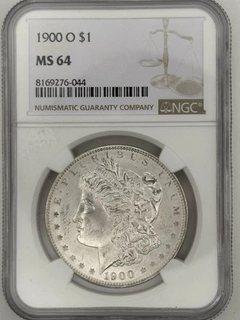
1900-O Morgan Silver Dollar $1 NGC MS64 New Orleans Mint 90% Silver

1900-O Morgan Silver Dollar · NGC MS64 · New Orleans Mint · 90% silver · designed by Englishman George T. Morgan

$875.54 1900 NGC MS64

Description

A 1900-O Morgan silver dollar from the New Orleans Mint, certified and sealed by NGC at MS64. The certification number on the label can be checked on the NGC website. The photos show this exact coin and holder.

Mint specifications: 90% silver, 10% copper; 26.73 grams; 38.1 mm; 0.7734 troy oz of pure silver. These are the Mint's standard figures; the coin has not been removed from its holder.

Read the full description

The 1900-O

New Orleans struck 12,590,000 Morgan dollars in 1900.

The New Orleans Mint opened in 1838, struck half dollars for the Confederacy in 1861, and began striking Morgans in 1879. Since 1981 the building has been part of the Louisiana State Museum.

The Year 1900

On April 15, 1900, the Paris Exposition Universelle opened, drawing over 50 million visitors to a moving walkway, the Grand Palais and the Pont Alexandre III. A dollar in 1900 had the buying power of about $39 today.

The Morgan Dollar

Isn't it remarkable that one of America's best-known collectible coins was designed by an Englishman, who went on to become Chief Engraver of the United States Mint?

George T. Morgan, from the Birmingham area of England, joined the US Mint in 1876 on the recommendation of Britain's Royal Mint. His model for Liberty was Anna Willess Williams of Philadelphia. In 1918 the Pittman Act melted over 270 million silver dollars, and sold much of the silver to Britain to back its currency in India.

Grade And Authenticity

MS (Mint State) 64 means no wear; within MS 60 to 70, the number rises as marks decrease and luster and strike improve. NGC, founded in 1987, has been the American Numismatic Association's official grading service since 1995 and has offices in Hong Kong, Shanghai, Munich and London. The seller also tested the metal through the holder with a calibrated Sigma Metalytics verifier (consistent with silver), inspected the holder for tampering (none found), and confirmed the certification number on the NGC website.

Authenticity Guarantee

This coin is covered by eBay's Authenticity Guarantee for coins: after purchase it goes first to eBay's authentication partner, PCGS, which inspects it against this listing, then on to you. There is no extra cost to the buyer, and shipping to and from the authenticator is included in the free shipping.

Also In Our Store

  • Victorian advertising trade cards, chromolithographed in the Morgan years.
  • Holiday postcards from the Golden Age of Postcards, many printed in Germany.
  • Peace dollars, designed by Sicilian-born Anthony de Francisci, and more world coins and banknotes.

Disclaimer

Specifications and detailed item descriptions are provided as a courtesy only and are not guaranteed to be one hundred percent accurate. Please do your own research. There are generally no receipts available for any items from original purchases. Any dimensions and/or weights are approximate. The absence of a more detailed condition report does not imply there are no condition issues with the item(s). Please inspect images carefully as they are part of the official item description and best representation of the actual condition. Additional images may be available upon request depending on time and availability. Not responsible for internet mis-translations or mis-identification of maker's marks if found or assumptions of makers or materials — item descriptions will indicate if it is assumed. If you see a problem, please message us immediately and we will do our best to sort out a solution and confirm the information. With the exception of eBay rules, no returns are accepted.
View on eBay

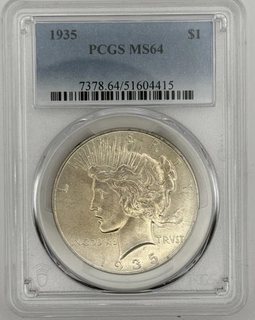
1935-P Peace Silver Dollar $1 PCGS MS64 Philadelphia Mint 90% Silver

1935-P Peace Silver Dollar · PCGS MS64 · Philadelphia Mint · 90% silver · designed by Sicilian-born Anthony de Francisci

$835.23 1935 PCGS MS64

Description

A 1935-P Peace silver dollar from the Philadelphia Mint (no mint mark), certified and sealed by PCGS at MS64. The certification number on the label can be checked on the PCGS website. The photos show this exact coin and holder.

Mint specifications: 90% silver, 10% copper; 26.73 grams; 38.1 mm; 0.7734 troy oz of pure silver. These are the Mint's standard figures; the coin has not been removed from its holder.

Read the full description

The 1935 Peace Dollar

Philadelphia struck 1,576,000 Peace dollars in 1935, the final year Peace dollars were struck for circulation. The Philadelphia Mint, America's first, was created by the Coinage Act of 1792 and delivered the nation's first circulating coins in March 1793. Every one of the 1,006,473 Peace dollars dated 1921 was struck here.

The Year 1935

In 1935 Canada issued its first circulating silver dollar, the George V Silver Jubilee "voyageur" dollar. On July 16, 1935, the world's first parking meters went into service in Oklahoma City, charging a nickel for curbside parking. A dollar in 1935 had the buying power of about $23.50 today.

The Peace Dollar

Isn't it remarkable that the coin America struck to celebrate peace after the First World War was designed by a young Sicilian immigrant, and modeled on his Italian-born wife?

Anthony de Francisci, born in Palermo, Sicily, in 1887, won the design competition in December 1921; Liberty's face is based on his wife, Teresa, born in Laurenzana, Italy. The coin followed the Pittman Act of 1918, which melted 270 million silver dollars and sold their silver to Britain to steady the currency of British India, and the 1921 resolution formally ending America's war with Germany and Austria-Hungary. English-born Chief Engraver George T. Morgan removed a broken sword from the first reverse before Christmas 1921.

Grade And Authenticity

MS (Mint State) 64 means no wear, on a scale where the number rises as marks decrease and luster and strike improve. PCGS, founded in 1986, guarantees its grades. The seller also tested the metal through the holder with a calibrated Sigma Metalytics verifier (consistent with silver), inspected the holder for tampering (none found), and confirmed the certification number on the PCGS website.

This coin is covered by eBay's Authenticity Guarantee: after purchase it goes first to eBay's authentication partner, PCGS, which inspects it against this listing, then on to you at no extra cost. Shipping to and from the authenticator is included in the free shipping.

Also In Our Store

  • Original Buffalo nickels, including a 1935.
  • Holiday postcards from the Golden Age of Postcards, many printed in Germany.
  • Morgan dollars, designed by English-born George T. Morgan, and more world coins and banknotes.

Disclaimer

Specifications and detailed item descriptions are provided as a courtesy only and are not guaranteed to be one hundred percent accurate. Please do your own research. There are generally no receipts available for any items from original purchases. Any dimensions and/or weights are approximate. The absence of a more detailed condition report does not imply there are no condition issues with the item(s). Please inspect images carefully as they are part of the official item description and best representation of the actual condition. Additional images may be available upon request depending on time and availability. Not responsible for internet mis-translations or mis-identification of maker's marks if found or assumptions of makers or materials — item descriptions will indicate if it is assumed. If you see a problem, please message us immediately and we will do our best to sort out a solution and confirm the information. With the exception of eBay rules, no returns are accepted.
View on eBay

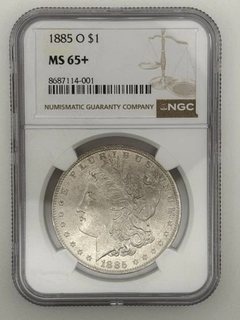
1885-O Morgan Silver Dollar $1 NGC MS65+ New Orleans Mint 90% Silver

1885-O Morgan Silver Dollar · NGC MS65+ · New Orleans Mint · 90% silver · designed by Englishman George T. Morgan

$465.77 1885 NGC MS65+

Description

An 1885-O Morgan silver dollar from the New Orleans Mint, certified and sealed by NGC at MS65+. The certification number on the label can be checked on the NGC website. The photos show this exact coin and holder.

Mint specifications: 90% silver, 10% copper; 26.73 grams; 38.1 mm; 0.7734 troy oz of pure silver. These are the Mint's standard figures; the coin has not been removed from its holder.

Read the full description

The 1885-O

New Orleans struck 9,185,000 Morgan dollars in 1885.

The New Orleans Mint opened in 1838, struck half dollars for the Confederacy in 1861, and began striking Morgans in 1879. Since 1981 the building has been part of the Louisiana State Museum.

The Year 1885

On June 17, 1885, the Statue of Liberty arrived in New York Harbor from France aboard the French ship Isère, packed in more than 200 crates. Her crown of rays later inspired Liberty's crown on the Peace dollar. A dollar in 1885 had the buying power of roughly $33 to $36 today.

The Morgan Dollar

Isn't it remarkable that one of America's best-known collectible coins was designed by an Englishman, who went on to become Chief Engraver of the United States Mint?

George T. Morgan, from the Birmingham area of England, joined the US Mint in 1876 on the recommendation of Britain's Royal Mint. His model for Liberty was Anna Willess Williams of Philadelphia. In 1918 the Pittman Act melted over 270 million silver dollars, and sold much of the silver to Britain to back its currency in India.

Grade And Authenticity

MS (Mint State) 65 means no wear; within MS 60 to 70, the number rises as marks decrease and luster and strike improve. The "+" is NGC's Plus designation, "awarded by NGC to coins at the high end of their assigned grade, approaching the quality requirements for the next grade." NGC, founded in 1987, has been the American Numismatic Association's official grading service since 1995 and has offices in Hong Kong, Shanghai, Munich and London. The seller also tested the metal through the holder with a calibrated Sigma Metalytics verifier (consistent with silver), inspected the holder for tampering (none found), and confirmed the certification number on the NGC website.

Also In Our Store

  • Peace dollars by Sicilian-born Anthony de Francisci, whose Liberty wears a crown of rays inspired by the Statue of Liberty.
  • Victorian advertising trade cards, chromolithographed in the Morgan years.
  • Holiday postcards from the Golden Age of Postcards, many printed in Germany, and more world coins and banknotes.

Disclaimer

Specifications and detailed item descriptions are provided as a courtesy only and are not guaranteed to be one hundred percent accurate. Please do your own research. There are generally no receipts available for any items from original purchases. Any dimensions and/or weights are approximate. The absence of a more detailed condition report does not imply there are no condition issues with the item(s). Please inspect images carefully as they are part of the official item description and best representation of the actual condition. Additional images may be available upon request depending on time and availability. Not responsible for internet mis-translations or mis-identification of maker's marks if found or assumptions of makers or materials — item descriptions will indicate if it is assumed. If you see a problem, please message us immediately and we will do our best to sort out a solution and confirm the information. With the exception of eBay rules, no returns are accepted.
View on eBay

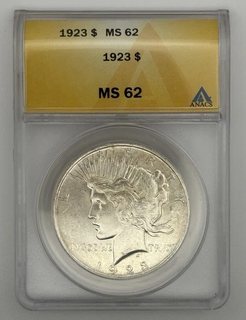
1923-P Peace Silver Dollar $1 ANACS MS62 Philadelphia Mint 90% Silver

1923-P Peace Silver Dollar · ANACS MS62 · Philadelphia Mint · 90% silver · designed by Sicilian-born Anthony de Francisci

$444.56 1923 ANACS MS62

Description

A 1923-P Peace silver dollar from the Philadelphia Mint (no mint mark), certified and sealed by ANACS at MS62. The certification number on the label can be checked on the grading company's website. The photos show this exact coin and holder.

Mint specifications: 90% silver, 10% copper; 26.73 grams; 38.1 mm; 0.7734 troy oz of pure silver. These are the Mint's standard figures; the coin has not been removed from its holder.

Read the full description

The 1923 Peace Dollar

Philadelphia struck 30,800,000 Peace dollars in 1923.

Philadelphia, America's first mint, was created by the Coinage Act of April 2, 1792, and George Washington chose the scientist David Rittenhouse as its first director. Every one of the 1,006,473 Peace dollars dated 1921 was struck here. Philadelphia coins carry no mint mark.

The Year 1923

In November 1923, one US dollar was worth 4,210,500,000,000 German paper marks. The same year, the giant HOLLYWOODLAND sign went up in the hills above Los Angeles. A dollar in 1923 had the buying power of about $19 today.

The Peace Dollar

Isn't it remarkable that the coin America struck to celebrate peace after the First World War was designed by a young Sicilian immigrant, and modeled on his Italian-born wife?

Anthony de Francisci, born in Palermo, Sicily, in 1887, came to the United States in 1905 and in December 1921 won an invitation-only design competition. Liberty's face is based on his wife, Teresa, born in Laurenzana in Italy's Basilicata region. Numismatist Farran Zerbe proposed it to restore the 270 million silver dollars melted under the Pittman Act of 1918, their silver sold to Britain to steady the currency of British India. In July 1921 the Knox–Porter Resolution formally ended America's war with Germany and Austria-Hungary, and the first Peace dollar was struck that December 28.

Grade And Authenticity

MS (Mint State) 62 means no wear at all, and the number rises as marks decrease and luster and strike improve. ANACS, founded in June 1972 as the American Numismatic Association's authentication service to fight counterfeit and altered coins, began grading in 1979 and is the oldest of the major services. The seller also tested the metal through the holder with a calibrated Sigma Metalytics verifier (consistent with silver), inspected the holder for tampering (none found), and confirmed the certification number on the ANACS website.

Also In Our Store

  • A 1923 German 500-million-mark banknote from that year's hyperinflation.
  • Holiday postcards from the Golden Age of Postcards, many printed in Germany.
  • Morgan dollars, designed by English-born George T. Morgan, and more world coins and banknotes.

Disclaimer

Specifications and detailed item descriptions are provided as a courtesy only and are not guaranteed to be one hundred percent accurate. Please do your own research. There are generally no receipts available for any items from original purchases. Any dimensions and/or weights are approximate. The absence of a more detailed condition report does not imply there are no condition issues with the item(s). Please inspect images carefully as they are part of the official item description and best representation of the actual condition. Additional images may be available upon request depending on time and availability. Not responsible for internet mis-translations or mis-identification of maker's marks if found or assumptions of makers or materials — item descriptions will indicate if it is assumed. If you see a problem, please message us immediately and we will do our best to sort out a solution and confirm the information. With the exception of eBay rules, no returns are accepted.
View on eBay

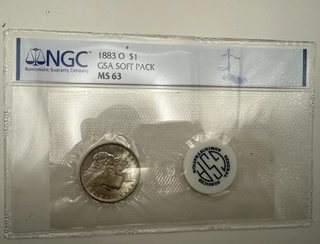
1883-O Morgan Silver Dollar $1 Coin — NGC Graded MS63 GSA SOFT PACK —New Orleans

1883-O Morgan Silver Dollar, NGC MS63, GSA SOFT PACK

$395.17 1883 NGC MS63

A 1883-O Morgan silver dollar struck at the New Orleans Mint, certified by NGC at MS63. The label reads “GSA SOFT PACK.” The certification number, 8227097-013 and MS-63, can be checked on the NGC website. The photos show this exact coin and holder.

GSA coins come from the US Treasury’s hoard of silver dollars, sold to the public by the General Services Administration in the 1970s.

The metal was tested through the holder with a Sigma Metalytics verifier and is consistent with silver.

Read the full description

Disclaimer

The images and any video show the actual item and are part of the official listing description, so please review them closely. Measurements and weights are approximate, and any maker or material we haven’t confirmed is described as assumed. Questions? Message us; we answer quickly.

View on eBay

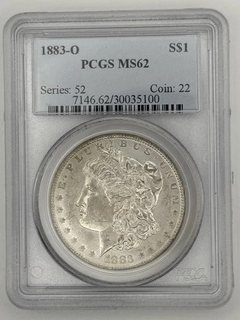
1883-O Morgan Silver Dollar $1 PCGS MS62 New Orleans Mint 90% Silver

1883-O Morgan Silver Dollar · PCGS MS62 · New Orleans Mint · 90% silver · designed by Englishman George T. Morgan

$369.12 1883 PCGS MS62

Description

An 1883-O Morgan silver dollar, certified and sealed by PCGS at MS62. The certification number on the label can be checked on the PCGS website. The photos show this exact coin and holder.

Mint specifications: 90% silver, 10% copper; 26.73 grams; 38.1 mm; 0.7734 troy oz of pure silver. These are the Mint's standard figures; the coin has not been removed from its holder.

Read the full description

The 1883-O

New Orleans struck 8,725,000 Morgan dollars in 1883. PCGS estimates about 400,000 survive in Mint State. Strike quality on this date varies, often soft at the centers, so please judge this coin from the photos.

The New Orleans Mint opened in 1838, struck half dollars for the Confederacy in 1861, and began striking Morgans in 1879. Since 1981 the building has been part of the Louisiana State Museum.

The Year 1883

The first Orient Express left Paris for Vienna, and the Brooklyn Bridge opened. Near Tulsa, where our store is based, Catoosa opened its first post office; today barges from Catoosa's river port reach New Orleans, where this coin was struck. A dollar in 1883 had the buying power of roughly $31 to $35 today.

The Morgan Dollar

Isn't it remarkable that one of America's best-known collectible coins was designed by an Englishman, who went on to become Chief Engraver of the United States Mint?

George T. Morgan, from the Birmingham area of England, joined the US Mint in 1876 on the recommendation of Britain's Royal Mint. His model for Liberty was Anna Willess Williams of Philadelphia. In 1918 the Pittman Act melted over 270 million silver dollars, and sold much of the silver to Britain to back its currency in India.

Grade And Authenticity

MS (Mint State) 62 means no wear, with some marks. PCGS, founded in 1986, guarantees its grades. The seller also tested the metal through the holder with a calibrated Sigma Metalytics verifier (consistent with silver), inspected the holder for tampering (none found), and confirmed the certification number on the PCGS website.

Also In Our Store

  • Victorian advertising trade cards, chromolithographed in the Morgan years.
  • Holiday postcards from the Golden Age of Postcards, many printed in Germany.
  • Peace dollars, designed by Sicilian-born Anthony de Francisci, and more world coins and banknotes.

Disclaimer

Specifications and detailed item descriptions are provided as a courtesy only and are not guaranteed to be one hundred percent accurate. Please do your own research. There are generally no receipts available for any items from original purchases. Any dimensions and/or weights are approximate. The absence of a more detailed condition report does not imply there are no condition issues with the item(s). Please inspect images carefully as they are part of the official item description and best representation of the actual condition. Additional images may be available upon request depending on time and availability. Not responsible for internet mis-translations or mis-identification of maker's marks if found or assumptions of makers or materials — item descriptions will indicate if it is assumed. If you see a problem, please message us immediately and we will do our best to sort out a solution and confirm the information. With the exception of eBay rules, no returns are accepted.
View on eBay

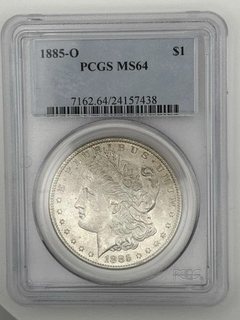
1885-O Morgan Silver Dollar $1 PCGS MS64 New Orleans Mint 90% Silver

1885-O Morgan Silver Dollar · PCGS MS64 · New Orleans Mint · 90% silver · designed by Englishman George T. Morgan

$367.78 1885 PCGS MS64

Description

An 1885-O Morgan silver dollar from the New Orleans Mint, certified and sealed by PCGS at MS64. The certification number on the label can be checked on the PCGS website. The photos show this exact coin and holder.

Mint specifications: 90% silver, 10% copper; 26.73 grams; 38.1 mm; 0.7734 troy oz of pure silver. These are the Mint's standard figures; the coin has not been removed from its holder.

Read the full description

The 1885-O

New Orleans struck 9,185,000 Morgan dollars in 1885.

The New Orleans Mint opened in 1838, struck half dollars for the Confederacy in 1861, and began striking Morgans in 1879. Since 1981 the building has been part of the Louisiana State Museum.

The Year 1885

On June 17, 1885, the Statue of Liberty arrived in New York Harbor from France aboard the French ship Isère, packed in more than 200 crates. Her crown of rays later inspired Liberty's crown on the Peace dollar. A dollar in 1885 had the buying power of roughly $33 to $36 today.

The Morgan Dollar

Isn't it remarkable that one of America's best-known collectible coins was designed by an Englishman, who went on to become Chief Engraver of the United States Mint?

George T. Morgan, from the Birmingham area of England, joined the US Mint in 1876 on the recommendation of Britain's Royal Mint. His model for Liberty was Anna Willess Williams of Philadelphia. In 1918 the Pittman Act melted over 270 million silver dollars, and sold much of the silver to Britain to back its currency in India.

Grade And Authenticity

MS (Mint State) 64 means no wear; within MS 60 to 70, the number rises as marks decrease and luster and strike improve. PCGS, founded in 1986, guarantees its grades. The seller also tested the metal through the holder with a calibrated Sigma Metalytics verifier (consistent with silver), inspected the holder for tampering (none found), and confirmed the certification number on the PCGS website.

Also In Our Store

  • Peace dollars by Sicilian-born Anthony de Francisci, whose Liberty wears a crown of rays inspired by the Statue of Liberty.
  • Victorian advertising trade cards, chromolithographed in the Morgan years.
  • Holiday postcards from the Golden Age of Postcards, many printed in Germany, and more world coins and banknotes.

Disclaimer

Specifications and detailed item descriptions are provided as a courtesy only and are not guaranteed to be one hundred percent accurate. Please do your own research. There are generally no receipts available for any items from original purchases. Any dimensions and/or weights are approximate. The absence of a more detailed condition report does not imply there are no condition issues with the item(s). Please inspect images carefully as they are part of the official item description and best representation of the actual condition. Additional images may be available upon request depending on time and availability. Not responsible for internet mis-translations or mis-identification of maker's marks if found or assumptions of makers or materials — item descriptions will indicate if it is assumed. If you see a problem, please message us immediately and we will do our best to sort out a solution and confirm the information. With the exception of eBay rules, no returns are accepted.
View on eBay

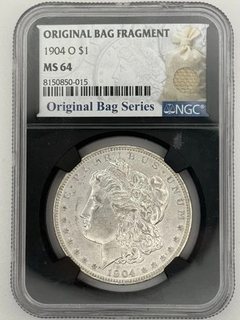
1904-O Morgan Silver Dollar $1 Coin —New Orleans Mint— Graded by NGC at MS64

1904-O Morgan Silver Dollar · NGC MS64 · New Orleans Mint · 90% silver · designed by Englishman George T. Morgan

$345.66 1904 NGC MS64

Description

A 1904-O Morgan silver dollar, certified and sealed by NGC at MS64. The certification number on the label can be checked on the NGC website. The photos show this exact coin and holder.

The holder carries NGC's special "Original Bag Fragment" label, set with a small, real piece of vintage canvas cut from historical U.S. Treasury, Federal Reserve and early bank bags. It is not represented as the bag this particular coin came from.

Mint specifications: 90% silver, 10% copper; 26.73 grams; 38.1 mm; 0.7734 troy oz of pure silver. These are the Mint's standard figures; the coin has not been removed from its holder.

Read the full description

The 1904-O

New Orleans struck 3,720,000 Morgan dollars in 1904. It was the last year of regular Morgan production; the silver set aside by Congress ran out, and no more Morgans were struck until 1921.

The New Orleans Mint opened in 1838, struck half dollars for the Confederacy in 1861, and began striking Morgans in 1879. Since 1981 the building has been part of the Louisiana State Museum.

The Year 1904

On April 30, 1904, the St. Louis World's Fair opened to honor the centennial of the Louisiana Purchase, formally handed over at New Orleans' Cabildo, in the city where this coin was struck. The following year the Ida Glenn No. 1 struck oil south of Tulsa, where our store is based, launching the boom that made Tulsa "the Oil Capital of the World." A dollar in 1904 had the buying power of about $36 today.

The Morgan Dollar

Isn't it remarkable that one of America's best-known collectible coins was designed by an Englishman, who went on to become Chief Engraver of the United States Mint?

George T. Morgan, from the Birmingham area of England, joined the US Mint in 1876 on the recommendation of Britain's Royal Mint. His model for Liberty was Anna Willess Williams of Philadelphia. In 1918 the Pittman Act melted over 270 million silver dollars, and sold much of the silver to Britain to back its currency in India.

Grade And Authenticity

MS (Mint State) 64 means no wear at all, and the number rises as marks decrease and luster and strike improve. NGC, founded in 1987 by John Albanese, is the official grading service of the American Numismatic Association, with offices in Hong Kong, Shanghai, Munich and London. The seller also tested the metal through the holder with a calibrated Sigma Metalytics verifier (consistent with silver), inspected the holder for tampering (none found), and confirmed the certification number on the NGC website.

Also In Our Store

  • Victorian advertising trade cards, chromolithographed in the Morgan years.
  • Holiday postcards from the Golden Age of Postcards, many printed in Germany.
  • Peace dollars, designed by Sicilian-born Anthony de Francisci, and more world coins and banknotes.

Disclaimer

Specifications and detailed item descriptions are provided as a courtesy only and are not guaranteed to be one hundred percent accurate. Please do your own research. There are generally no receipts available for any items from original purchases. Any dimensions and/or weights are approximate. The absence of a more detailed condition report does not imply there are no condition issues with the item(s). Please inspect images carefully as they are part of the official item description and best representation of the actual condition. Additional images may be available upon request depending on time and availability. Not responsible for internet mis-translations or mis-identification of maker's marks if found or assumptions of makers or materials — item descriptions will indicate if it is assumed. If you see a problem, please message us immediately and we will do our best to sort out a solution and confirm the information. With the exception of eBay rules, no returns are accepted.
View on eBay

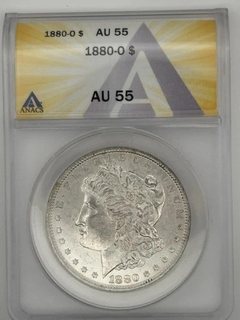
1880-O Morgan Silver Dollar US $1 Coin — New Orleans Mint — ANACS Graded AU55

1880-O Morgan Silver Dollar · ANACS AU55 · New Orleans Mint · 90% silver · designed by Englishman George T. Morgan

$335.76 1880 ANACS AU55

Description

An 1880-O Morgan silver dollar, certified and sealed by ANACS at AU55. The certification number on the label can be checked on the ANACS website. The photos show this exact coin and holder.

Mint specifications: 90% silver, 10% copper; 26.73 grams; 38.1 mm; 0.7734 troy oz of pure silver. These are the Mint's standard figures; the coin has not been removed from its holder.

Read the full description

The 1880-O

New Orleans struck 5,305,000 Morgan dollars in 1880.

The New Orleans Mint opened in 1838, struck half dollars for the Confederacy in 1861, and began striking Morgans in 1879. Since 1981 the building has been part of the Louisiana State Museum.

The Year 1880

On January 27, Thomas Edison received a US patent for his incandescent electric lamp, the invention that brought practical electric light into homes. On October 1 the Melbourne International Exhibition opened in Australia, drawing 33 countries and over 1.3 million visitors. A dollar in 1880 had the buying power of roughly $31 to $34 today.

The Morgan Dollar

Isn't it remarkable that one of America's best-known collectible coins was designed by an Englishman, who went on to become Chief Engraver of the United States Mint?

George T. Morgan, from the Birmingham area of England, joined the US Mint in 1876 on the recommendation of Britain's Royal Mint. His model for Liberty was Anna Willess Williams of Philadelphia. In 1918 the Pittman Act melted over 270 million silver dollars, and sold much of the silver to Britain to back its currency in India.

Grade And Authenticity

AU (About Uncirculated) 55 means only traces of wear. ANACS, founded in 1972 as the American Numismatic Association's authentication service, is the oldest of the major grading services. The seller also tested the metal through the holder with a calibrated Sigma Metalytics verifier (consistent with silver), inspected the holder for tampering (none found), and confirmed the certification number on the ANACS website.

Also In Our Store

  • Victorian advertising trade cards, chromolithographed in the Morgan years.
  • Holiday postcards from the Golden Age of Postcards, many printed in Germany.
  • Peace dollars, designed by Sicilian-born Anthony de Francisci, and more world coins and banknotes.

Disclaimer

Specifications and detailed item descriptions are provided as a courtesy only and are not guaranteed to be one hundred percent accurate. Please do your own research. There are generally no receipts available for any items from original purchases. Any dimensions and/or weights are approximate. The absence of a more detailed condition report does not imply there are no condition issues with the item(s). Please inspect images carefully as they are part of the official item description and best representation of the actual condition. Additional images may be available upon request depending on time and availability. Not responsible for internet mis-translations or mis-identification of maker's marks if found or assumptions of makers or materials — item descriptions will indicate if it is assumed. If you see a problem, please message us immediately and we will do our best to sort out a solution and confirm the information. With the exception of eBay rules, no returns are accepted.
View on eBay

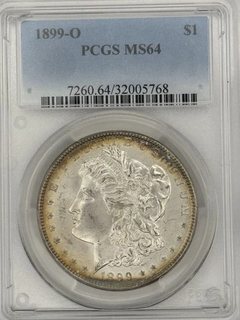
1899-O Morgan Silver Dollar $1 Coin —New Orleans Mint— PCGS Graded MS64

1899-O Morgan Silver Dollar · PCGS MS64 · New Orleans Mint · 90% silver · designed by Englishman George T. Morgan

$287.67 1899 PCGS MS64

Description

An 1899-O Morgan silver dollar from the New Orleans Mint, certified and sealed by PCGS at MS64. The certification number on the label can be checked on the PCGS website. The photos show this exact coin and holder.

Mint specifications: 90% silver, 10% copper; 26.73 grams; 38.1 mm; 0.7734 troy oz of pure silver. These are the Mint's standard figures; the coin has not been removed from its holder.

Read the full description

The 1899-O

New Orleans struck 12,290,000 Morgan dollars in 1899.

The New Orleans Mint opened in 1838, struck half dollars for the Confederacy in 1861, and began striking Morgans in 1879. Since 1981 the building has been part of the Louisiana State Museum.

The Year 1899

On March 27, 1899, Guglielmo Marconi sent the first wireless radio signal across the English Channel between England and France. A dollar in 1899 had the buying power of about $39 today.

The Morgan Dollar

Isn't it remarkable that one of America's best-known collectible coins was designed by an Englishman, who went on to become Chief Engraver of the United States Mint?

George T. Morgan, from the Birmingham area of England, joined the US Mint in 1876 on the recommendation of Britain's Royal Mint. His model for Liberty was Anna Willess Williams of Philadelphia. In 1918 the Pittman Act melted over 270 million silver dollars, and sold much of the silver to Britain to back its currency in India.

Grade And Authenticity

MS (Mint State) 64 means no wear; within MS 60 to 70, the number rises as marks decrease and luster and strike improve. PCGS, founded in 1986, guarantees its grades. The seller also tested the metal through the holder with a calibrated Sigma Metalytics verifier (consistent with silver), inspected the holder for tampering (none found), and confirmed the certification number on the PCGS website.

Also In Our Store

  • Victorian advertising trade cards, chromolithographed in the Morgan years.
  • Holiday postcards from the Golden Age of Postcards, many printed in Germany.
  • Peace dollars, designed by Sicilian-born Anthony de Francisci, and more world coins and banknotes.

Disclaimer

Specifications and detailed item descriptions are provided as a courtesy only and are not guaranteed to be one hundred percent accurate. Please do your own research. There are generally no receipts available for any items from original purchases. Any dimensions and/or weights are approximate. The absence of a more detailed condition report does not imply there are no condition issues with the item(s). Please inspect images carefully as they are part of the official item description and best representation of the actual condition. Additional images may be available upon request depending on time and availability. Not responsible for internet mis-translations or mis-identification of maker's marks if found or assumptions of makers or materials — item descriptions will indicate if it is assumed. If you see a problem, please message us immediately and we will do our best to sort out a solution and confirm the information. With the exception of eBay rules, no returns are accepted.
View on eBay

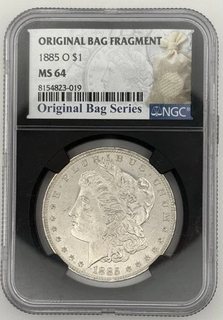
1885-O Morgan Silver Dollar US $1 Coin —New Orleans Mint— Graded by NGC at MS64

1885-O Morgan Silver Dollar · NGC MS64 · New Orleans Mint · 90% silver · designed by Englishman George T. Morgan

$263.22 1885 NGC MS64

Description

An 1885-O Morgan silver dollar from the New Orleans Mint, certified and sealed by NGC at MS64. The certification number on the label can be checked on the NGC website. The photos show this exact coin and holder.

Mint specifications: 90% silver, 10% copper; 26.73 grams; 38.1 mm; 0.7734 troy oz of pure silver. These are the Mint's standard figures; the coin has not been removed from its holder.

The NGC holder carries a special "Original Bag Fragment" label, set with a small, real piece of vintage canvas cut from historical U.S. Treasury, Federal Reserve and early bank bags, the sacks silver dollars were packed, shipped and stored in. The fragment is a historical relic paired with the coin, not the bag this particular coin came from.

Read the full description

The 1885-O

New Orleans struck 9,185,000 Morgan dollars in 1885.

The New Orleans Mint opened in 1838, struck half dollars for the Confederacy in 1861, and began striking Morgans in 1879. Since 1981 the building has been part of the Louisiana State Museum.

The Year 1885

On June 17, 1885, the Statue of Liberty arrived in New York Harbor from France aboard the French ship Isère, packed in more than 200 crates. Her crown of rays later inspired Liberty's crown on the Peace dollar. A dollar in 1885 had the buying power of roughly $33 to $36 today.

The Morgan Dollar

Isn't it remarkable that one of America's best-known collectible coins was designed by an Englishman, who went on to become Chief Engraver of the United States Mint?

George T. Morgan, from the Birmingham area of England, joined the US Mint in 1876 on the recommendation of Britain's Royal Mint. His model for Liberty was Anna Willess Williams of Philadelphia. In 1918 the Pittman Act melted over 270 million silver dollars, and sold much of the silver to Britain to back its currency in India.

Grade And Authenticity

MS (Mint State) 64 means no wear; within MS 60 to 70, the number rises as marks decrease and luster and strike improve. NGC, founded in 1987, has been the American Numismatic Association's official grading service since 1995 and has offices in Hong Kong, Shanghai, Munich and London. The seller also tested the metal through the holder with a calibrated Sigma Metalytics verifier (consistent with silver), inspected the holder for tampering (none found), and confirmed the certification number on the NGC website.

Also In Our Store

  • Peace dollars by Sicilian-born Anthony de Francisci, whose Liberty wears a crown of rays inspired by the Statue of Liberty.
  • Victorian advertising trade cards, chromolithographed in the Morgan years.
  • Holiday postcards from the Golden Age of Postcards, many printed in Germany, and more world coins and banknotes.

Disclaimer

Specifications and detailed item descriptions are provided as a courtesy only and are not guaranteed to be one hundred percent accurate. Please do your own research. There are generally no receipts available for any items from original purchases. Any dimensions and/or weights are approximate. The absence of a more detailed condition report does not imply there are no condition issues with the item(s). Please inspect images carefully as they are part of the official item description and best representation of the actual condition. Additional images may be available upon request depending on time and availability. Not responsible for internet mis-translations or mis-identification of maker's marks if found or assumptions of makers or materials — item descriptions will indicate if it is assumed. If you see a problem, please message us immediately and we will do our best to sort out a solution and confirm the information. With the exception of eBay rules, no returns are accepted.
View on eBay

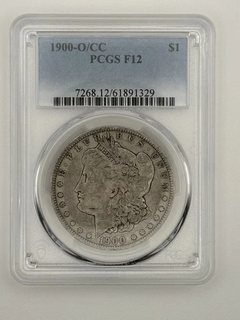
1900-O/CC Morgan Silver Dollar US $1 Coin —New Orleans Mint— PCGS Graded F12

1900-O/CC Morgan Silver Dollar · PCGS F12 · New Orleans Mint · 90% silver · designed by Englishman George T. Morgan

$259.67 1900 PCGS F12

Description

A 1900-O/CC Morgan silver dollar from the New Orleans Mint, certified and sealed by PCGS at F12. The certification number on the label can be checked on the PCGS website. The photos show this exact coin and holder.

Mint specifications: 90% silver, 10% copper; 26.73 grams; 38.1 mm; 0.7734 troy oz of pure silver. These are the Mint's standard figures; the coin has not been removed from its holder.

Read the full description

The 1900-O/Cc

New Orleans struck 12,590,000 Morgan dollars in 1900.

This is the famous O-over-CC variety. The Carson City Mint stopped striking coins in 1893, leaving reverse dies already prepared with its CC mint mark; rather than waste them, the Mint punched an "O" over the "CC" and sent them to New Orleans. It is often called the last Carson City silver dollar. The New Orleans Mint, designed by William Strickland and opened in 1838, struck its last coins in 1909; since 1981 it has been part of the Louisiana State Museum.

The Year 1900

On April 15, 1900, the Paris Exposition Universelle opened, drawing over 50 million visitors to a moving walkway, the Grand Palais and the Pont Alexandre III. A dollar in 1900 had the buying power of about $39 today.

The Morgan Dollar

Isn't it remarkable that one of America's best-known collectible coins was designed by an Englishman, who went on to become Chief Engraver of the United States Mint?

George T. Morgan, from the Birmingham area of England, joined the US Mint in 1876 on the recommendation of Britain's Royal Mint. His model for Liberty was Anna Willess Williams of Philadelphia. In 1918 the Pittman Act melted over 270 million silver dollars, and sold much of the silver to Britain to back its currency in India.

Grade And Authenticity

F (Fine) 12 shows heavy but even wear. PCGS, founded in 1986, guarantees its grades. The seller also tested the metal through the holder with a calibrated Sigma Metalytics verifier (consistent with silver), inspected the holder for tampering (none found), and confirmed the certification number on the PCGS website.

Also In Our Store

  • Victorian advertising trade cards, chromolithographed in the Morgan years.
  • Holiday postcards from the Golden Age of Postcards, many printed in Germany.
  • Peace dollars, designed by Sicilian-born Anthony de Francisci, and more world coins and banknotes.

Disclaimer

Specifications and detailed item descriptions are provided as a courtesy only and are not guaranteed to be one hundred percent accurate. Please do your own research. There are generally no receipts available for any items from original purchases. Any dimensions and/or weights are approximate. The absence of a more detailed condition report does not imply there are no condition issues with the item(s). Please inspect images carefully as they are part of the official item description and best representation of the actual condition. Additional images may be available upon request depending on time and availability. Not responsible for internet mis-translations or mis-identification of maker's marks if found or assumptions of makers or materials — item descriptions will indicate if it is assumed. If you see a problem, please message us immediately and we will do our best to sort out a solution and confirm the information. With the exception of eBay rules, no returns are accepted.
View on eBay

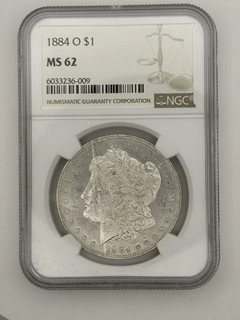
1884-O Morgan Silver Dollar $1 Coin — New Orleans Mint — NGC Graded MS62

1884-O Morgan Silver Dollar · NGC MS62 · New Orleans Mint · 90% silver · designed by Englishman George T. Morgan

$247.44 1884 NGC MS62

Description

An 1884-O Morgan silver dollar, certified and sealed by NGC at MS62. The certification number on the label can be checked on the NGC website. The photos show this exact coin and holder.

Mint specifications: 90% silver, 10% copper; 26.73 grams; 38.1 mm; 0.7734 troy oz of pure silver. These are the Mint's standard figures; the coin has not been removed from its holder.

Read the full description

The 1884-O

New Orleans struck 9,730,000 Morgan dollars in 1884.

The New Orleans Mint opened in 1838, struck half dollars for the Confederacy in 1861, and began striking Morgans in 1879. Since 1981 the building has been part of the Louisiana State Museum.

The Year 1884

On December 16, New Orleans, where this coin was struck, opened the World Cotton Centennial, a world's fair whose Main Building was the largest roofed structure yet built, lit by 5,000 electric lights. A dollar in 1884 had the buying power of roughly $32 to $36 today.

The Morgan Dollar

Isn't it remarkable that one of America's best-known collectible coins was designed by an Englishman, who went on to become Chief Engraver of the United States Mint?

George T. Morgan, from the Birmingham area of England, joined the US Mint in 1876 on the recommendation of Britain's Royal Mint. His model for Liberty was Anna Willess Williams of Philadelphia. In 1918 the Pittman Act melted over 270 million silver dollars, and sold much of the silver to Britain to back its currency in India.

Grade And Authenticity

MS (Mint State) 62 means no wear, with some marks. NGC, founded in 1987, has been the official grading service of the American Numismatic Association since 1995, with offices in Hong Kong, Shanghai, Munich and London. The seller also tested the metal through the holder with a calibrated Sigma Metalytics verifier (consistent with silver), inspected the holder for tampering (none found), and confirmed the certification number on the NGC website.

Also In Our Store

  • Victorian advertising trade cards, chromolithographed in the Morgan years.
  • Holiday postcards from the Golden Age of Postcards, many printed in Germany.
  • Peace dollars, designed by Sicilian-born Anthony de Francisci, and more world coins and banknotes.

Disclaimer

Specifications and detailed item descriptions are provided as a courtesy only and are not guaranteed to be one hundred percent accurate. Please do your own research. There are generally no receipts available for any items from original purchases. Any dimensions and/or weights are approximate. The absence of a more detailed condition report does not imply there are no condition issues with the item(s). Please inspect images carefully as they are part of the official item description and best representation of the actual condition. Additional images may be available upon request depending on time and availability. Not responsible for internet mis-translations or mis-identification of maker's marks if found or assumptions of makers or materials — item descriptions will indicate if it is assumed. If you see a problem, please message us immediately and we will do our best to sort out a solution and confirm the information. With the exception of eBay rules, no returns are accepted.
View on eBay

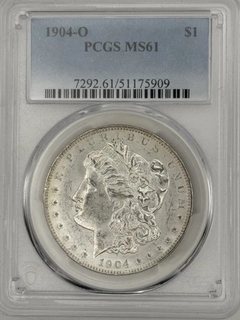
1904-O Morgan Silver Dollar $1 Coin —New Orleans Mint— Graded by PCGS at MS61

1904-O Morgan Silver Dollar · PCGS MS61 · New Orleans Mint · 90% silver · designed by Englishman George T. Morgan

$236.44 1904 PCGS MS61

Description

A 1904-O Morgan silver dollar, certified and sealed by PCGS at MS61. The certification number on the label can be checked on the PCGS website. The photos show this exact coin and holder.

Mint specifications: 90% silver, 10% copper; 26.73 grams; 38.1 mm; 0.7734 troy oz of pure silver. These are the Mint's standard figures; the coin has not been removed from its holder.

Read the full description

The 1904-O

New Orleans struck 3,720,000 Morgan dollars in 1904. It was the last year of regular Morgan production; the silver set aside by Congress ran out, and no more Morgans were struck until 1921.

The New Orleans Mint opened in 1838, struck half dollars for the Confederacy in 1861, and began striking Morgans in 1879. Since 1981 the building has been part of the Louisiana State Museum.

The Year 1904

On April 30, 1904, the St. Louis World's Fair opened to honor the centennial of the Louisiana Purchase, formally handed over at New Orleans' Cabildo, in the city where this coin was struck. The following year the Ida Glenn No. 1 struck oil south of Tulsa, where our store is based, launching the boom that made Tulsa "the Oil Capital of the World." A dollar in 1904 had the buying power of about $36 today.

The Morgan Dollar

Isn't it remarkable that one of America's best-known collectible coins was designed by an Englishman, who went on to become Chief Engraver of the United States Mint?

George T. Morgan, from the Birmingham area of England, joined the US Mint in 1876 on the recommendation of Britain's Royal Mint. His model for Liberty was Anna Willess Williams of Philadelphia. In 1918 the Pittman Act melted over 270 million silver dollars, and sold much of the silver to Britain to back its currency in India.

Grade And Authenticity

MS (Mint State) 61 means no wear at all, and the number rises as marks decrease and luster and strike improve. PCGS, founded in 1986, guarantees its grades. The seller also tested the metal through the holder with a calibrated Sigma Metalytics verifier (consistent with silver), inspected the holder for tampering (none found), and confirmed the certification number on the PCGS website.

Also In Our Store

  • Victorian advertising trade cards, chromolithographed in the Morgan years.
  • Holiday postcards from the Golden Age of Postcards, many printed in Germany.
  • Peace dollars, designed by Sicilian-born Anthony de Francisci, and more world coins and banknotes.

Disclaimer

Specifications and detailed item descriptions are provided as a courtesy only and are not guaranteed to be one hundred percent accurate. Please do your own research. There are generally no receipts available for any items from original purchases. Any dimensions and/or weights are approximate. The absence of a more detailed condition report does not imply there are no condition issues with the item(s). Please inspect images carefully as they are part of the official item description and best representation of the actual condition. Additional images may be available upon request depending on time and availability. Not responsible for internet mis-translations or mis-identification of maker's marks if found or assumptions of makers or materials — item descriptions will indicate if it is assumed. If you see a problem, please message us immediately and we will do our best to sort out a solution and confirm the information. With the exception of eBay rules, no returns are accepted.
View on eBay

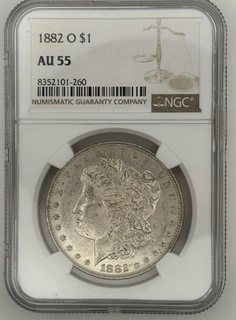
1882-O Morgan Silver Dollar Coin US $1 — New Orleans Mint — NGC Graded AU55

1882-O Morgan Silver Dollar · NGC AU55 · New Orleans Mint · 90% silver · designed by Englishman George T. Morgan

$187.77 1882 NGC AU55

Description

An 1882-O Morgan silver dollar, certified and sealed by NGC at AU55. The certification number on the label can be checked on the NGC website. The photos show this exact coin and holder.

Mint specifications: 90% silver, 10% copper; 26.73 grams; 38.1 mm; 0.7734 troy oz of pure silver. These are the Mint's standard figures; the coin has not been removed from its holder.

Read the full description

The 1882-O

New Orleans struck 6,090,000 Morgan dollars in 1882.

The New Orleans Mint opened in 1838, struck half dollars for the Confederacy in 1861, and began striking Morgans in 1879. Since 1981 the building has been part of the Louisiana State Museum.

The Year 1882

On August 29, Australia beat England at the Oval, prompting a mock obituary for English cricket that gave birth to "The Ashes." The same year the Krewe of Proteus was founded in New Orleans, where this coin was struck; it is today the oldest continuously parading Old Line Mardi Gras krewe. A dollar in 1882 had the buying power of roughly $31 to $34 today.

The Morgan Dollar

Isn't it remarkable that one of America's best-known collectible coins was designed by an Englishman, who went on to become Chief Engraver of the United States Mint?

George T. Morgan, from the Birmingham area of England, joined the US Mint in 1876 on the recommendation of Britain's Royal Mint. His model for Liberty was Anna Willess Williams of Philadelphia. In 1918 the Pittman Act melted over 270 million silver dollars, and sold much of the silver to Britain to back its currency in India.

Grade And Authenticity

AU (About Uncirculated) 55 means only traces of wear. NGC, founded in 1987, has been the official grading service of the American Numismatic Association since 1995, with offices in Hong Kong, Shanghai, Munich and London. The seller also tested the metal through the holder with a calibrated Sigma Metalytics verifier (consistent with silver), inspected the holder for tampering (none found), and confirmed the certification number on the NGC website.

Also In Our Store

  • Victorian advertising trade cards, chromolithographed in the Morgan years.
  • Holiday postcards from the Golden Age of Postcards, many printed in Germany.
  • Peace dollars, designed by Sicilian-born Anthony de Francisci, and more world coins and banknotes.

Disclaimer

Specifications and detailed item descriptions are provided as a courtesy only and are not guaranteed to be one hundred percent accurate. Please do your own research. There are generally no receipts available for any items from original purchases. Any dimensions and/or weights are approximate. The absence of a more detailed condition report does not imply there are no condition issues with the item(s). Please inspect images carefully as they are part of the official item description and best representation of the actual condition. Additional images may be available upon request depending on time and availability. Not responsible for internet mis-translations or mis-identification of maker's marks if found or assumptions of makers or materials — item descriptions will indicate if it is assumed. If you see a problem, please message us immediately and we will do our best to sort out a solution and confirm the information. With the exception of eBay rules, no returns are accepted.
View on eBay

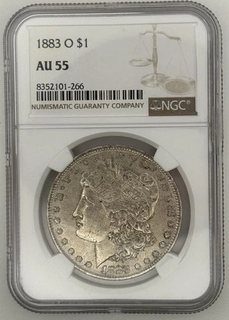
1883-O Morgan Silver Dollar $1 Coin — New Orleans Mint — NGC Graded AU55

1883-O Morgan Silver Dollar · NGC AU55 · New Orleans Mint · 90% silver · designed by Englishman George T. Morgan

$187.22 1883 NGC AU55

Description

An 1883-O Morgan silver dollar, certified and sealed by NGC at AU55. The certification number on the label can be checked on the NGC website. The photos show this exact coin and holder.

Mint specifications: 90% silver, 10% copper; 26.73 grams; 38.1 mm; 0.7734 troy oz of pure silver. These are the Mint's standard figures; the coin has not been removed from its holder.

Read the full description

The 1883-O

New Orleans struck 8,725,000 Morgan dollars in 1883.

The New Orleans Mint opened in 1838, struck half dollars for the Confederacy in 1861, and began striking Morgans in 1879. Since 1981 the building has been part of the Louisiana State Museum.

The Year 1883

The first Orient Express left Paris for Vienna, and the Brooklyn Bridge opened. Near Tulsa, where our store is based, Catoosa opened its first post office; today barges from Catoosa's river port reach New Orleans, where this coin was struck. A dollar in 1883 had the buying power of roughly $31 to $35 today.

The Morgan Dollar

Isn't it remarkable that one of America's best-known collectible coins was designed by an Englishman, who went on to become Chief Engraver of the United States Mint?

George T. Morgan, from the Birmingham area of England, joined the US Mint in 1876 on the recommendation of Britain's Royal Mint. His model for Liberty was Anna Willess Williams of Philadelphia. In 1918 the Pittman Act melted over 270 million silver dollars, and sold much of the silver to Britain to back its currency in India.

Grade And Authenticity

AU (About Uncirculated) 55 means only traces of wear. NGC, founded in 1987, has been the official grading service of the American Numismatic Association since 1995, with offices in Hong Kong, Shanghai, Munich and London. The seller also tested the metal through the holder with a calibrated Sigma Metalytics verifier (consistent with silver), inspected the holder for tampering (none found), and confirmed the certification number on the NGC website.

Also In Our Store

  • Victorian advertising trade cards, chromolithographed in the Morgan years.
  • Holiday postcards from the Golden Age of Postcards, many printed in Germany.
  • Peace dollars, designed by Sicilian-born Anthony de Francisci, and more world coins and banknotes.

Disclaimer

Specifications and detailed item descriptions are provided as a courtesy only and are not guaranteed to be one hundred percent accurate. Please do your own research. There are generally no receipts available for any items from original purchases. Any dimensions and/or weights are approximate. The absence of a more detailed condition report does not imply there are no condition issues with the item(s). Please inspect images carefully as they are part of the official item description and best representation of the actual condition. Additional images may be available upon request depending on time and availability. Not responsible for internet mis-translations or mis-identification of maker's marks if found or assumptions of makers or materials — item descriptions will indicate if it is assumed. If you see a problem, please message us immediately and we will do our best to sort out a solution and confirm the information. With the exception of eBay rules, no returns are accepted.
View on eBay

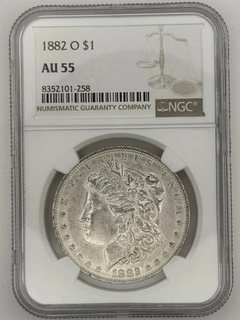
1882-O Morgan Silver Dollar US $1 Coin —New Orleans Mint— Graded by NGC at AU55

1882-O Morgan Silver Dollar · NGC AU55 · New Orleans Mint · 90% silver · designed by Englishman George T. Morgan

$186.87 1882 NGC AU55

Description

An 1882-O Morgan silver dollar, certified and sealed by NGC at AU55. The certification number on the label can be checked on the NGC website. The photos show this exact coin and holder.

Mint specifications: 90% silver, 10% copper; 26.73 grams; 38.1 mm; 0.7734 troy oz of pure silver. These are the Mint's standard figures; the coin has not been removed from its holder.

Read the full description

The 1882-O

New Orleans struck 6,090,000 Morgan dollars in 1882.

The New Orleans Mint opened in 1838, struck half dollars for the Confederacy in 1861, and began striking Morgans in 1879. Since 1981 the building has been part of the Louisiana State Museum.

The Year 1882

On August 29, Australia beat England at the Oval, prompting a mock obituary for English cricket that gave birth to "The Ashes." The same year the Krewe of Proteus was founded in New Orleans, where this coin was struck; it is today the oldest continuously parading Old Line Mardi Gras krewe. A dollar in 1882 had the buying power of roughly $31 to $34 today.

The Morgan Dollar

Isn't it remarkable that one of America's best-known collectible coins was designed by an Englishman, who went on to become Chief Engraver of the United States Mint?

George T. Morgan, from the Birmingham area of England, joined the US Mint in 1876 on the recommendation of Britain's Royal Mint. His model for Liberty was Anna Willess Williams of Philadelphia. In 1918 the Pittman Act melted over 270 million silver dollars, and sold much of the silver to Britain to back its currency in India.

Grade And Authenticity

AU (About Uncirculated) 55 means only traces of wear. NGC, founded in 1987, has been the official grading service of the American Numismatic Association since 1995, with offices in Hong Kong, Shanghai, Munich and London. The seller also tested the metal through the holder with a calibrated Sigma Metalytics verifier (consistent with silver), inspected the holder for tampering (none found), and confirmed the certification number on the NGC website.

Also In Our Store

  • Victorian advertising trade cards, chromolithographed in the Morgan years.
  • Holiday postcards from the Golden Age of Postcards, many printed in Germany.
  • Peace dollars, designed by Sicilian-born Anthony de Francisci, and more world coins and banknotes.

Disclaimer

Specifications and detailed item descriptions are provided as a courtesy only and are not guaranteed to be one hundred percent accurate. Please do your own research. There are generally no receipts available for any items from original purchases. Any dimensions and/or weights are approximate. The absence of a more detailed condition report does not imply there are no condition issues with the item(s). Please inspect images carefully as they are part of the official item description and best representation of the actual condition. Additional images may be available upon request depending on time and availability. Not responsible for internet mis-translations or mis-identification of maker's marks if found or assumptions of makers or materials — item descriptions will indicate if it is assumed. If you see a problem, please message us immediately and we will do our best to sort out a solution and confirm the information. With the exception of eBay rules, no returns are accepted.
View on eBay

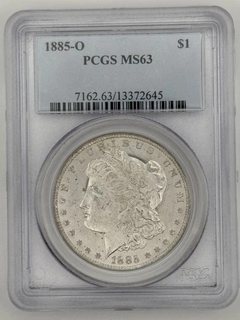
1885-O Morgan Silver Dollar $1 Coin —New Orleans Mint— PCGS Graded at MS63

1885-O Morgan Silver Dollar · PCGS MS63 · New Orleans Mint · 90% silver · designed by Englishman George T. Morgan

$151.36 1885 PCGS MS63

Description

An 1885-O Morgan silver dollar from the New Orleans Mint, certified and sealed by PCGS at MS63. The certification number on the label can be checked on the PCGS website. The photos show this exact coin and holder.

Mint specifications: 90% silver, 10% copper; 26.73 grams; 38.1 mm; 0.7734 troy oz of pure silver. These are the Mint's standard figures; the coin has not been removed from its holder.

Read the full description

The 1885-O

New Orleans struck 9,185,000 Morgan dollars in 1885.

The New Orleans Mint opened in 1838, struck half dollars for the Confederacy in 1861, and began striking Morgans in 1879. Since 1981 the building has been part of the Louisiana State Museum.

The Year 1885

On June 17, 1885, the Statue of Liberty arrived in New York Harbor from France aboard the French ship Isère, packed in more than 200 crates. Her crown of rays later inspired Liberty's crown on the Peace dollar. A dollar in 1885 had the buying power of roughly $33 to $36 today.

The Morgan Dollar

Isn't it remarkable that one of America's best-known collectible coins was designed by an Englishman, who went on to become Chief Engraver of the United States Mint?

George T. Morgan, from the Birmingham area of England, joined the US Mint in 1876 on the recommendation of Britain's Royal Mint. His model for Liberty was Anna Willess Williams of Philadelphia. In 1918 the Pittman Act melted over 270 million silver dollars, and sold much of the silver to Britain to back its currency in India.

Grade And Authenticity

MS (Mint State) 63 means no wear; within MS 60 to 70, the number rises as marks decrease and luster and strike improve. PCGS, founded in 1986, guarantees its grades. The seller also tested the metal through the holder with a calibrated Sigma Metalytics verifier (consistent with silver), inspected the holder for tampering (none found), and confirmed the certification number on the PCGS website.

Also In Our Store

  • Peace dollars by Sicilian-born Anthony de Francisci, whose Liberty wears a crown of rays inspired by the Statue of Liberty.
  • Victorian advertising trade cards, chromolithographed in the Morgan years.
  • Holiday postcards from the Golden Age of Postcards, many printed in Germany, and more world coins and banknotes.

Disclaimer

Specifications and detailed item descriptions are provided as a courtesy only and are not guaranteed to be one hundred percent accurate. Please do your own research. There are generally no receipts available for any items from original purchases. Any dimensions and/or weights are approximate. The absence of a more detailed condition report does not imply there are no condition issues with the item(s). Please inspect images carefully as they are part of the official item description and best representation of the actual condition. Additional images may be available upon request depending on time and availability. Not responsible for internet mis-translations or mis-identification of maker's marks if found or assumptions of makers or materials — item descriptions will indicate if it is assumed. If you see a problem, please message us immediately and we will do our best to sort out a solution and confirm the information. With the exception of eBay rules, no returns are accepted.
View on eBay

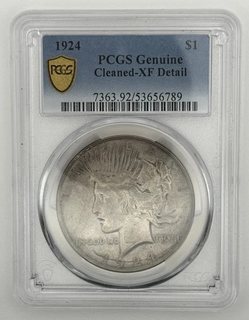
1924-P Peace Dollar $1 Coin — PCGS Graded as Genuine Cleaned-XF Detail

1924-P Peace Silver Dollar · PCGS Genuine, Cleaned – XF Details · Philadelphia Mint · 90% silver · designed by Sicilian-born Anthony de Francisci

$147.36 1924

Description

A 1924-P Peace silver dollar from the Philadelphia Mint (no mint mark), certified by PCGS as Genuine, Cleaned – XF Details. The certification number on the label can be checked on the PCGS website. The photos show this exact coin and holder.

Mint specifications: 90% silver, 10% copper; 26.73 grams; 38.1 mm; 0.7734 troy oz of pure silver. These are the Mint's standard figures; the coin has not been removed from its holder.

Read the full description

The 1924 Peace Dollar

Philadelphia struck 11,811,000 Peace dollars in 1924. The Philadelphia Mint, America's first, was created by the Coinage Act of 1792 and delivered the nation's first circulating coins in March 1793. Every one of the 1,006,473 Peace dollars dated 1921 was struck here.

The Year 1924

From January 25 to February 5, 1924, Chamonix, France, hosted 304 athletes from 16 nations at what the IOC later named the first Winter Olympic Games. A dollar in 1924 had the buying power of about $19 today.

The Peace Dollar

Isn't it remarkable that the coin America struck to celebrate peace after the First World War was designed by a young Sicilian immigrant, and modeled on his Italian-born wife?

Anthony de Francisci, born in Palermo, Sicily, in 1887, won the design competition in December 1921; Liberty's face is based on his wife, Teresa, born in Laurenzana, Italy. The coin followed the Pittman Act of 1918, which melted 270 million silver dollars and sold their silver to Britain to steady the currency of British India, and the 1921 resolution formally ending America's war with Germany and Austria-Hungary. English-born Chief Engraver George T. Morgan removed a broken sword from the first reverse before Christmas 1921.

Grade And Authenticity

PCGS does not give a numeric grade to cleaned coins, but it will authenticate them and assign a "details" grade: this label means genuine, cleaned at some point in its life, with wear equal to Extremely Fine (XF 40 shows light wear). PCGS, founded in 1986, guarantees its grades. The coin is offered as a genuine, certified example, priced to reflect the cleaning. The seller also tested the metal through the holder with a calibrated Sigma Metalytics verifier (consistent with silver), inspected the holder for tampering (none found), and confirmed the certification number on the PCGS website.

Also In Our Store

  • Morgan dollars, designed by English-born George T. Morgan, who removed the broken sword from the Peace dollar.
  • Victorian advertising trade cards, chromolithographed in the Morgan years.
  • Holiday postcards from the Golden Age of Postcards, many printed in Germany, and more world coins and banknotes.

Disclaimer

Specifications and detailed item descriptions are provided as a courtesy only and are not guaranteed to be one hundred percent accurate. Please do your own research. There are generally no receipts available for any items from original purchases. Any dimensions and/or weights are approximate. The absence of a more detailed condition report does not imply there are no condition issues with the item(s). Please inspect images carefully as they are part of the official item description and best representation of the actual condition. Additional images may be available upon request depending on time and availability. Not responsible for internet mis-translations or mis-identification of maker's marks if found or assumptions of makers or materials — item descriptions will indicate if it is assumed. If you see a problem, please message us immediately and we will do our best to sort out a solution and confirm the information. With the exception of eBay rules, no returns are accepted.
View on eBay

1922-P Peace Dollar $1 Silver Coin —Philadelphia Mint— CAC AU58

1922-P Peace Silver Dollar · CACG AU58 · Philadelphia Mint · 90% silver · designed by Sicilian-born Anthony de Francisci

$144.27 1922

Description

A 1922-P Peace silver dollar from the Philadelphia Mint (no mint mark), certified and sealed by CAC Grading (CACG) at AU58. The certification number on the label can be checked on the grading company's website. The photos show this exact coin and holder.

This coin was graded by CAC Grading (CACG), which applies the standard behind CAC's well-known green sticker. The back of the holder carries a QR code linking to CACgrading.com.

Mint specifications: 90% silver, 10% copper; 26.73 grams; 38.1 mm; 0.7734 troy oz of pure silver. These are the Mint's standard figures; the coin has not been removed from its holder.

Read the full description

The 1922 Peace Dollar

Philadelphia struck 51,737,000 Peace dollars in 1922.

Philadelphia, America's first mint, was created by the Coinage Act of April 2, 1792, and George Washington chose the scientist David Rittenhouse as its first director. Every one of the 1,006,473 Peace dollars dated 1921 was struck here. Philadelphia coins carry no mint mark.

The Year 1922

On November 4, 1922, Howard Carter's team uncovered the first step of Tutankhamun's tomb in Egypt's Valley of the Kings, reaching its treasure-filled antechamber on November 26. A dollar in 1922 had the buying power of about $19 today.

The Peace Dollar

Isn't it remarkable that the coin America struck to celebrate peace after the First World War was designed by a young Sicilian immigrant, and modeled on his Italian-born wife?

Anthony de Francisci, born in Palermo, Sicily, in 1887, came to the United States in 1905 and in December 1921 won an invitation-only design competition. Liberty's face is based on his wife, Teresa, born in Laurenzana in Italy's Basilicata region. Numismatist Farran Zerbe proposed it to restore the 270 million silver dollars melted under the Pittman Act of 1918, their silver sold to Britain to steady the currency of British India. In July 1921 the Knox–Porter Resolution formally ended America's war with Germany and Austria-Hungary, and the first Peace dollar was struck that December 28.

Grade And Authenticity

AU (About Uncirculated) 58 shows only traces of wear. CAC, founded in 2007 by John Albanese, spent years re-examining coins already graded by PCGS and NGC and adding a green sticker, the "green bean," when it judged a coin "solid for the grade it was assigned." On October 2, 2023, CAC Grading (CACG) began grading coins itself under the same standard. The seller also tested the metal through the holder with a calibrated Sigma Metalytics verifier (consistent with silver), inspected the holder for tampering (none found), and confirmed the certification number on the CACG website.

Also In Our Store

  • Morgan dollars, designed by English-born George T. Morgan.
  • Holiday postcards from the Golden Age of Postcards, many printed in Germany.
  • Victorian advertising trade cards, and more world coins and banknotes.

Disclaimer

Specifications and detailed item descriptions are provided as a courtesy only and are not guaranteed to be one hundred percent accurate. Please do your own research. There are generally no receipts available for any items from original purchases. Any dimensions and/or weights are approximate. The absence of a more detailed condition report does not imply there are no condition issues with the item(s). Please inspect images carefully as they are part of the official item description and best representation of the actual condition. Additional images may be available upon request depending on time and availability. Not responsible for internet mis-translations or mis-identification of maker's marks if found or assumptions of makers or materials — item descriptions will indicate if it is assumed. If you see a problem, please message us immediately and we will do our best to sort out a solution and confirm the information. With the exception of eBay rules, no returns are accepted.
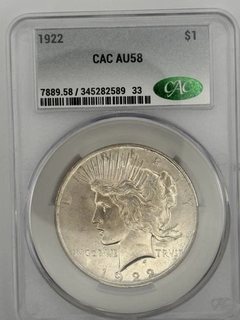
View on eBay

1922 Peace $1 Silver Dollar NGC MS63 Original Bag Fragment Philadelphia

1922-P Peace Silver Dollar · NGC MS63 · Philadelphia Mint · 90% silver · designed by Sicilian-born Anthony de Francisci

$138.88 1922 NGC MS63

Description

A 1922-P Peace silver dollar from the Philadelphia Mint (no mint mark), certified and sealed by NGC at MS63. The certification number on the label can be checked on the grading company's website. The photos show this exact coin and holder.

The holder carries NGC's special "Original Bag Fragment" label, set with a small, real piece of vintage canvas cut from historical U.S. Treasury, Federal Reserve and early bank bags. It is not represented as the bag this particular coin came from.

Mint specifications: 90% silver, 10% copper; 26.73 grams; 38.1 mm; 0.7734 troy oz of pure silver. These are the Mint's standard figures; the coin has not been removed from its holder.

Read the full description

The 1922 Peace Dollar

Philadelphia struck 51,737,000 Peace dollars in 1922.

Philadelphia, America's first mint, was created by the Coinage Act of April 2, 1792, and George Washington chose the scientist David Rittenhouse as its first director. Every one of the 1,006,473 Peace dollars dated 1921 was struck here. Philadelphia coins carry no mint mark.

The Year 1922

On November 4, 1922, Howard Carter's team uncovered the first step of Tutankhamun's tomb in Egypt's Valley of the Kings, reaching its treasure-filled antechamber on November 26. A dollar in 1922 had the buying power of about $19 today.

The Peace Dollar

Isn't it remarkable that the coin America struck to celebrate peace after the First World War was designed by a young Sicilian immigrant, and modeled on his Italian-born wife?

Anthony de Francisci, born in Palermo, Sicily, in 1887, came to the United States in 1905 and in December 1921 won an invitation-only design competition. Liberty's face is based on his wife, Teresa, born in Laurenzana in Italy's Basilicata region. Numismatist Farran Zerbe proposed it to restore the 270 million silver dollars melted under the Pittman Act of 1918, their silver sold to Britain to steady the currency of British India. In July 1921 the Knox–Porter Resolution formally ended America's war with Germany and Austria-Hungary, and the first Peace dollar was struck that December 28.

Grade And Authenticity

MS (Mint State) 63 means no wear at all, and the number rises as marks decrease and luster and strike improve. NGC, founded in 1987 by John Albanese, is the official grading service of the American Numismatic Association, with offices in Hong Kong, Shanghai, Munich and London. The seller also tested the metal through the holder with a calibrated Sigma Metalytics verifier (consistent with silver), inspected the holder for tampering (none found), and confirmed the certification number on the NGC website.

Also In Our Store

  • Morgan dollars, designed by English-born George T. Morgan.
  • Holiday postcards from the Golden Age of Postcards, many printed in Germany.
  • Victorian advertising trade cards, and more world coins and banknotes.

Disclaimer

Specifications and detailed item descriptions are provided as a courtesy only and are not guaranteed to be one hundred percent accurate. Please do your own research. There are generally no receipts available for any items from original purchases. Any dimensions and/or weights are approximate. The absence of a more detailed condition report does not imply there are no condition issues with the item(s). Please inspect images carefully as they are part of the official item description and best representation of the actual condition. Additional images may be available upon request depending on time and availability. Not responsible for internet mis-translations or mis-identification of maker's marks if found or assumptions of makers or materials — item descriptions will indicate if it is assumed. If you see a problem, please message us immediately and we will do our best to sort out a solution and confirm the information. With the exception of eBay rules, no returns are accepted.
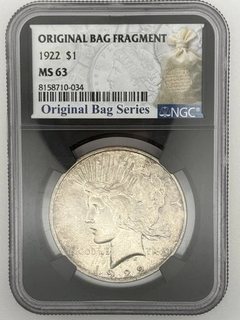
View on eBay

1926-S Peace Silver Dollar $1 ANACS MS60 Details Cleaned VAM-4A Top 50 Variety

1926-S Peace Silver Dollar · ANACS MS60 Details, Cleaned · VAM-4A Top 50 · San Francisco Mint · 90% silver · designed by Sicilian-born Anthony de Francisci

$138.63 1926 ANACS MS60

Description

A 1926-S Peace silver dollar from the San Francisco Mint, certified and sealed by ANACS. The label reads: 1926-S $ · VAM-4A TOP 50 · CLEANED · MS 60 DETAILS. The certification number on the label can be checked on the ANACS website. The photos show this exact coin and holder.

Mint specifications: 90% silver, 10% copper; 26.73 grams; 38.1 mm; 0.7734 troy oz of pure silver. These are the Mint's standard figures; the coin has not been removed from its holder.

Read the full description

The 1926-S Peace Dollar

San Francisco struck 6,980,000 Peace dollars in 1926. The San Francisco Mint opened in 1854 to turn California Gold Rush gold into coin. Its 1874 building, built with sandstone imported from British Columbia, survived the 1906 earthquake and fire while holding a third of the nation's gold reserves.

The Year 1926

In 1926 Tulsa's Cyrus Avery, the "Father of Route 66," won the number 66 for the Chicago–Los Angeles highway. Route 66 celebrates its 100th anniversary in 2026, and near Tulsa the Blue Whale of Catoosa reopened with a new visitor center on May 30, 2026. A dollar in 1926 had the buying power of about $18 today.

The Peace Dollar

Isn't it remarkable that the coin America struck to celebrate peace after the First World War was designed by a young Sicilian immigrant, and modeled on his Italian-born wife?

Anthony de Francisci, born in Palermo, Sicily, in 1887, won the design competition in December 1921; Liberty's face is based on his wife, Teresa, born in Laurenzana, Italy. The coin followed the Pittman Act of 1918, which melted 270 million silver dollars and sold their silver to Britain to steady the currency of British India, and the 1921 resolution formally ending America's war with Germany and Austria-Hungary. English-born Chief Engraver George T. Morgan removed a broken sword from the first reverse before Christmas 1921.

Grade And Authenticity

"MS 60 DETAILS, CLEANED" means ANACS found the coin genuine, with Mint State detail, but cleaned at some point in its life, so it carries a details grade; it is priced to reflect the cleaning. "VAM-4A" is a Van Allen–Mallis die-variety attribution; the 1926-S VAM-4 "Dot" is one of the "Top 50" Peace dollar VAMs, a list collectors pursue as a set. ANACS, founded in 1972 as the American Numismatic Association's authentication service, began grading in 1979. The seller also tested the metal through the holder with a calibrated Sigma Metalytics verifier (consistent with silver), inspected the holder for tampering (none found), and confirmed the certification number on the ANACS website.

Also In Our Store

  • Morgan dollars, designed by English-born George T. Morgan, who removed the broken sword from the Peace dollar.
  • Victorian advertising trade cards, chromolithographed in the Morgan years.
  • Holiday postcards from the Golden Age of Postcards, many printed in Germany, and more world coins and banknotes.

Disclaimer

Specifications and detailed item descriptions are provided as a courtesy only and are not guaranteed to be one hundred percent accurate. Please do your own research. There are generally no receipts available for any items from original purchases. Any dimensions and/or weights are approximate. The absence of a more detailed condition report does not imply there are no condition issues with the item(s). Please inspect images carefully as they are part of the official item description and best representation of the actual condition. Additional images may be available upon request depending on time and availability. Not responsible for internet mis-translations or mis-identification of maker's marks if found or assumptions of makers or materials — item descriptions will indicate if it is assumed. If you see a problem, please message us immediately and we will do our best to sort out a solution and confirm the information. With the exception of eBay rules, no returns are accepted.
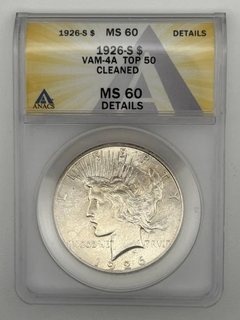
View on eBay

1922-P Peace Silver Dollar $1 Coin —Philadelphia Mint— Graded by CAC at AU58

1922-P Peace Silver Dollar · CACG AU58 · Philadelphia Mint · 90% silver · designed by Sicilian-born Anthony de Francisci

$135.33 1922

Description

A 1922-P Peace silver dollar from the Philadelphia Mint (no mint mark), certified and sealed by CAC Grading (CACG) at AU58. The certification number on the label can be checked on the grading company's website. The photos show this exact coin and holder.

This coin was graded by CAC Grading (CACG), which applies the standard behind CAC's well-known green sticker. The back of the holder carries a QR code linking to CACgrading.com.

Mint specifications: 90% silver, 10% copper; 26.73 grams; 38.1 mm; 0.7734 troy oz of pure silver. These are the Mint's standard figures; the coin has not been removed from its holder.

Read the full description

The 1922 Peace Dollar

Philadelphia struck 51,737,000 Peace dollars in 1922.

Philadelphia, America's first mint, was created by the Coinage Act of April 2, 1792, and George Washington chose the scientist David Rittenhouse as its first director. Every one of the 1,006,473 Peace dollars dated 1921 was struck here. Philadelphia coins carry no mint mark.

The Year 1922

On November 4, 1922, Howard Carter's team uncovered the first step of Tutankhamun's tomb in Egypt's Valley of the Kings, reaching its treasure-filled antechamber on November 26. A dollar in 1922 had the buying power of about $19 today.

The Peace Dollar

Isn't it remarkable that the coin America struck to celebrate peace after the First World War was designed by a young Sicilian immigrant, and modeled on his Italian-born wife?

Anthony de Francisci, born in Palermo, Sicily, in 1887, came to the United States in 1905 and in December 1921 won an invitation-only design competition. Liberty's face is based on his wife, Teresa, born in Laurenzana in Italy's Basilicata region. Numismatist Farran Zerbe proposed it to restore the 270 million silver dollars melted under the Pittman Act of 1918, their silver sold to Britain to steady the currency of British India. In July 1921 the Knox–Porter Resolution formally ended America's war with Germany and Austria-Hungary, and the first Peace dollar was struck that December 28.

Grade And Authenticity

AU (About Uncirculated) 58 shows only traces of wear. CAC, founded in 2007 by John Albanese, spent years re-examining coins already graded by PCGS and NGC and adding a green sticker, the "green bean," when it judged a coin "solid for the grade it was assigned." On October 2, 2023, CAC Grading (CACG) began grading coins itself under the same standard. The seller also tested the metal through the holder with a calibrated Sigma Metalytics verifier (consistent with silver), inspected the holder for tampering (none found), and confirmed the certification number on the CACG website.

Also In Our Store

  • Morgan dollars, designed by English-born George T. Morgan.
  • Holiday postcards from the Golden Age of Postcards, many printed in Germany.
  • Victorian advertising trade cards, and more world coins and banknotes.

Disclaimer

Specifications and detailed item descriptions are provided as a courtesy only and are not guaranteed to be one hundred percent accurate. Please do your own research. There are generally no receipts available for any items from original purchases. Any dimensions and/or weights are approximate. The absence of a more detailed condition report does not imply there are no condition issues with the item(s). Please inspect images carefully as they are part of the official item description and best representation of the actual condition. Additional images may be available upon request depending on time and availability. Not responsible for internet mis-translations or mis-identification of maker's marks if found or assumptions of makers or materials — item descriptions will indicate if it is assumed. If you see a problem, please message us immediately and we will do our best to sort out a solution and confirm the information. With the exception of eBay rules, no returns are accepted.
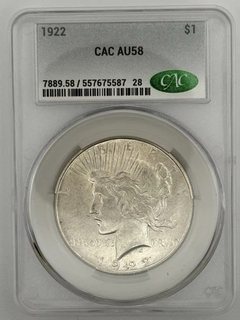
View on eBay

1923-P Peace Silver Dollar $1 Coin —100 Yr. Ann— NGC Graded Brilliant Unc

1923-P Peace Silver Dollar · NGC Brilliant Uncirculated · Philadelphia Mint · 90% silver · designed by Sicilian-born Anthony de Francisci

$133.23 1923

Description

A 1923-P Peace silver dollar from the Philadelphia Mint (no mint mark), graded Brilliant Uncirculated by NGC. The certification number on the label can be checked on the grading company's website. The photos show this exact coin and holder.

The holder carries NGC's special "Morgan to Peace Dollar 100th Anniversary" label, showing a 1921 Morgan dollar and a 1921 Peace dollar side by side over the American flag, marking a century since the Morgan dollar gave way to the Peace dollar.

Mint specifications: 90% silver, 10% copper; 26.73 grams; 38.1 mm; 0.7734 troy oz of pure silver. These are the Mint's standard figures; the coin has not been removed from its holder.

Read the full description

The 1923 Peace Dollar

Philadelphia struck 30,800,000 Peace dollars in 1923.

Philadelphia, America's first mint, was created by the Coinage Act of April 2, 1792, and George Washington chose the scientist David Rittenhouse as its first director. Every one of the 1,006,473 Peace dollars dated 1921 was struck here. Philadelphia coins carry no mint mark.

The Year 1923

In November 1923, one US dollar was worth 4,210,500,000,000 German paper marks. The same year, the giant HOLLYWOODLAND sign went up in the hills above Los Angeles. A dollar in 1923 had the buying power of about $19 today.

The Peace Dollar

Isn't it remarkable that the coin America struck to celebrate peace after the First World War was designed by a young Sicilian immigrant, and modeled on his Italian-born wife?

Anthony de Francisci, born in Palermo, Sicily, in 1887, came to the United States in 1905 and in December 1921 won an invitation-only design competition. Liberty's face is based on his wife, Teresa, born in Laurenzana in Italy's Basilicata region. Numismatist Farran Zerbe proposed it to restore the 270 million silver dollars melted under the Pittman Act of 1918, their silver sold to Britain to steady the currency of British India. In July 1921 the Knox–Porter Resolution formally ended America's war with Germany and Austria-Hungary, and the first Peace dollar was struck that December 28.

Grade And Authenticity

NGC defines "Brilliant Uncirculated" as MS 60 or higher: an uncirculated coin, without a specific number assigned. NGC, founded in 1987 by John Albanese, is the official grading service of the American Numismatic Association, with offices in Hong Kong, Shanghai, Munich and London. The seller also tested the metal through the holder with a calibrated Sigma Metalytics verifier (consistent with silver), inspected the holder for tampering (none found), and confirmed the certification number on the NGC website.

Also In Our Store

  • A 1923 German 500-million-mark banknote from that year's hyperinflation.
  • Holiday postcards from the Golden Age of Postcards, many printed in Germany.
  • Morgan dollars, designed by English-born George T. Morgan, and more world coins and banknotes.

Disclaimer

Specifications and detailed item descriptions are provided as a courtesy only and are not guaranteed to be one hundred percent accurate. Please do your own research. There are generally no receipts available for any items from original purchases. Any dimensions and/or weights are approximate. The absence of a more detailed condition report does not imply there are no condition issues with the item(s). Please inspect images carefully as they are part of the official item description and best representation of the actual condition. Additional images may be available upon request depending on time and availability. Not responsible for internet mis-translations or mis-identification of maker's marks if found or assumptions of makers or materials — item descriptions will indicate if it is assumed. If you see a problem, please message us immediately and we will do our best to sort out a solution and confirm the information. With the exception of eBay rules, no returns are accepted.
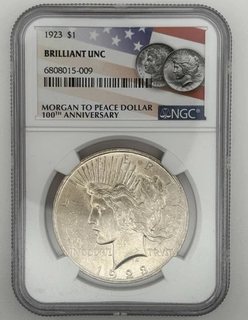
View on eBay

1881-S Morgan Silver Dollar US $1 Coin — SFO Mint — Graded by PCGS at MS62

1881-S Morgan Silver Dollar · PCGS MS62 · San Francisco Mint · 90% silver · designed by Englishman George T. Morgan

$129.55 1881 PCGS MS62

Description

An 1881-S Morgan silver dollar, certified and sealed by PCGS at MS62. The certification number on the label can be checked on the PCGS website. The photos show this exact coin and holder.

The coin is housed in a special PCGS holder with a holographic honeycomb-and-bee frame. The PCGS grade label (1881-S $1, MS62, cert 7130.62/61251665) is on the other side of the holder; please see the photos.

Mint specifications: 90% silver, 10% copper; 26.73 grams; 38.1 mm; 0.7734 troy oz of pure silver. These are the Mint's standard figures; the coin has not been removed from its holder.

Read the full description

The 1881-S

San Francisco struck 12,760,000 Morgan dollars in 1881.

The San Francisco Mint opened in 1854 to turn California Gold Rush gold into coin. Its 1874 building, designed by Alfred B. Mullett with sandstone imported from British Columbia, survived the 1906 earthquake and fire while holding $300 million, a third of the nation's gold reserves.

The Year 1881

On February 8, King Kalākaua of Hawaii sailed from San Francisco, where this coin was struck, on his celebrated voyage around the world. Two years later the San Francisco Mint struck Hawaii's own silver coins, designed by US Chief Engraver Charles E. Barber. A dollar in 1881 had the buying power of roughly $31 to $34 today.

The Morgan Dollar

Isn't it remarkable that one of America's best-known collectible coins was designed by an Englishman, who went on to become Chief Engraver of the United States Mint?

George T. Morgan, from the Birmingham area of England, joined the US Mint in 1876 on the recommendation of Britain's Royal Mint. His model for Liberty was Anna Willess Williams of Philadelphia. In 1918 the Pittman Act melted over 270 million silver dollars, and sold much of the silver to Britain to back its currency in India.

Grade And Authenticity

MS (Mint State) 62 means no wear, with some marks. PCGS, founded in 1986, guarantees its grades. The seller also tested the metal through the holder with a calibrated Sigma Metalytics verifier (consistent with silver), inspected the holder for tampering (none found), and confirmed the certification number on the PCGS website.

Also In Our Store

  • Victorian advertising trade cards, chromolithographed in the Morgan years.
  • Holiday postcards from the Golden Age of Postcards, many printed in Germany.
  • Peace dollars, designed by Sicilian-born Anthony de Francisci, and more world coins and banknotes.

Disclaimer

Specifications and detailed item descriptions are provided as a courtesy only and are not guaranteed to be one hundred percent accurate. Please do your own research. There are generally no receipts available for any items from original purchases. Any dimensions and/or weights are approximate. The absence of a more detailed condition report does not imply there are no condition issues with the item(s). Please inspect images carefully as they are part of the official item description and best representation of the actual condition. Additional images may be available upon request depending on time and availability. Not responsible for internet mis-translations or mis-identification of maker's marks if found or assumptions of makers or materials — item descriptions will indicate if it is assumed. If you see a problem, please message us immediately and we will do our best to sort out a solution and confirm the information. With the exception of eBay rules, no returns are accepted.
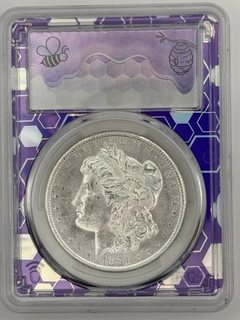
View on eBay

1921–P Morgan Silver Dollar $1 Coin -Philadelphia Mint — PCGS Graded MS62

1921-P Morgan Silver Dollar · PCGS MS62 · Philadelphia Mint · 90% silver · designed by Englishman George T. Morgan

$117.11 1921 PCGS MS62

Description

A 1921-P Morgan silver dollar from the Philadelphia Mint (no mint mark), certified and sealed by PCGS at MS62. The certification number on the label can be checked on the PCGS website. The photos show this exact coin and holder.

Mint specifications: 90% silver, 10% copper; 26.73 grams; 38.1 mm; 0.7734 troy oz of pure silver. These are the Mint's standard figures; the coin has not been removed from its holder.

Read the full description

The 1921

Philadelphia struck 44,690,000 Morgan dollars in 1921, part of the Mint's 86,730,000 that year, the largest single-year silver dollar mintage in US history, struck to replace the coins melted under the Pittman Act.

Philadelphia, America's first mint, was created by the Coinage Act of April 2, 1792. The very first Morgan dollar was struck here at 3:17 p.m. on March 11, 1878. Philadelphia coins of this era carry no mint mark.

The Year 1921

On May 5, 1921, Coco Chanel launched Chanel No. 5 at her boutique on the rue Cambon in Paris, and on August 5 Pittsburgh's KDKA aired the first radio broadcast of a major league baseball game. A dollar in 1921 had the buying power of about $18 today.

The Morgan Dollar

Isn't it remarkable that one of America's best-known collectible coins was designed by an Englishman, who went on to become Chief Engraver of the United States Mint?

George T. Morgan, from the Birmingham area of England, joined the US Mint in 1876 on the recommendation of Britain's Royal Mint. After German wartime propaganda set off a run on silver in British India, the Pittman Act of 1918 melted over 270 million silver dollars and sold much of the silver to Britain. The law required the melted dollars to be replaced, so in 1921 Morgan's design returned for one final year, struck while Morgan himself was Chief Engraver, before the Peace dollar took over.

Grade And Authenticity

MS (Mint State) 62 means no wear at all, and the number rises as marks decrease and luster and strike improve. PCGS, founded in 1986, guarantees its grades. The seller also tested the metal through the holder with a calibrated Sigma Metalytics verifier (consistent with silver), inspected the holder for tampering (none found), and confirmed the certification number on the PCGS website.

Also In Our Store

  • Silver Eagles carrying the Walking Liberty design of German-born sculptor Adolph A. Weinman.
  • Holiday postcards from the Golden Age of Postcards, many printed in Germany.
  • Peace dollars, designed by Sicilian-born Anthony de Francisci, and more world coins and banknotes.

Disclaimer

Specifications and detailed item descriptions are provided as a courtesy only and are not guaranteed to be one hundred percent accurate. Please do your own research. There are generally no receipts available for any items from original purchases. Any dimensions and/or weights are approximate. The absence of a more detailed condition report does not imply there are no condition issues with the item(s). Please inspect images carefully as they are part of the official item description and best representation of the actual condition. Additional images may be available upon request depending on time and availability. Not responsible for internet mis-translations or mis-identification of maker's marks if found or assumptions of makers or materials — item descriptions will indicate if it is assumed. If you see a problem, please message us immediately and we will do our best to sort out a solution and confirm the information. With the exception of eBay rules, no returns are accepted.
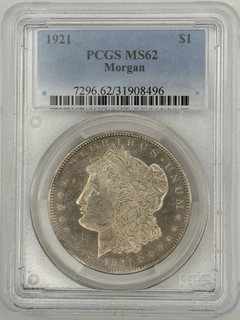
View on eBay

1890-S Morgan Silver Dollar 90% Silver San Francisco US $1 Never Cleaned KM#110

1890-S Morgan Silver Dollar, San Francisco Mint, 90% Silver, 0.7734 oz Silver, Sherman Silver Purchase Act Year, Original Never-Cleaned Surfaces, KM#110 [Est. XF-40]

$95.90 1890 Est. XF-40

Description

An 1890-S Morgan silver dollar struck at the San Francisco Mint, with the S mint mark on the reverse above the D and O of DOLLAR, KM#110. Designed by George T. Morgan: Liberty facing left, wearing a cap with a wreath of cotton and wheat, LIBERTY on the headband and E PLURIBUS UNUM above; on the reverse an eagle with outstretched wings holding an olive branch and arrows within a wreath, with IN GOD WE TRUST above. 90% silver, 10% copper, 26.73 grams standard, 0.7734 oz of pure silver, 38.1 mm, reeded edge. The close-ups show the date, the hair above the ear, the eagle's breast and the S mint mark.

Read the full description

Historical Context

The Bland-Allison Act of 1878 required the Treasury to buy two to four million dollars' worth of silver every month and coin it into silver dollars, and George T. Morgan's design carried that silver from 1878 to 1904. The Sherman Silver Purchase Act of 1890 then raised the Treasury's purchases to 4,500,000 troy ounces of silver a month. San Francisco struck 8,230,373 Morgan dollars in 1890, coins known for a strong strike.

Buying Power

In 1890 this dollar had the buying power of about $37.03 today.

Condition

[Est. XF-40] Circulated, original and never cleaned, in light gray. Light wear on the cheek, the hair above the ear and the center of the eagle's breast; the hair strands above the forehead, the cotton blossoms and the wing feathers are well defined, with full rims. Rust-orange deposits on the obverse left of the hair, by the eye and at the nose and lips, and on the reverse by the left wreath and the arrows (see the photos). The S mint mark is single, with no repunching. Tested on a Sigma Metalytics precious metal verifier: reading consistent with silver. Grade estimated; not professionally graded. Currently still legal tender, but worth far more to collectors and for its silver than its face value.

Also In Our Store

More Morgan and Peace silver dollars: https://www.ebay.com/str/tfauctionsintl?_nkw=silver+dollar

Disclaimer

The images and any video show the actual item and are part of the official listing description, so please review them closely. Measurements and weights are approximate, and any maker or material we haven't confirmed is described as assumed. Questions? Message us; we answer quickly.

View on eBay

ca1900 Au Bon Marche Paris Trade Card La Poule aux Oeufs d'Or Exposition 1900

ca1900 Au Bon Marche Paris Trade Card La Poule aux Oeufs d'Or Exposition 1900 — "AU BON MARCHÉ" at the top; a fable scene: a village girl with a basket of eggs and a young man in a red waistcoat at a farm gate, a hen at their feet. Approx. 4.30 x 6.38 in.

$94.42 1900

Description

"AU BON MARCHÉ" at the top; a fable scene: a village girl with a basket of eggs and a young man in a red waistcoat at a farm gate, a hen at their feet. Caption: "La Poule aux Oeufs d'Or" (The Hen That Laid the Golden Eggs), no. 2, with French verse below.

The back is printed in green: "AU BON MARCHÉ, Maison Aristide Boucicaut, Paris," with an engraving of the store and its "Annexe" on a busy street. "Magasins de Nouveautés. Les plus importants du monde entier. A visiter comme l'une des plus remarquables curiosités de Paris. Interprètes dans toutes les langues. Exposition Universelle 1900. Hors Concours — Membre du Jury." Printer: "Imp. B. Sirven, Toulouse-Paris."

Approx. 4.30 x 6.38 in.

Read the full description

Historical Context

The great Paris department store. The back invites visitors to see the store as "one of the most remarkable curiosities of Paris," with "interpreters in every language," and names its founder, Aristide Boucicaut.

Paris 1900. At the Exposition Universelle of 1900 the store was "Hors Concours — Membre du Jury": too distinguished to compete, it sat on the jury instead.

A fable for children. The front illustrates La Fontaine's fable of the hen that laid golden eggs, from a numbered series.

Condition

Front: very good, bright color with a slick finish. Back: light foxing, crisp green printing. Please see the photos, which are part of the description.

About The Printing

This is an original chromolithograph, and it was slow, exacting work. Each color had to be drawn onto its own separate stone by hand — in monochrome, the artist judging how much stipple each area needed so the colors would combine correctly only once every stone had been printed. The sheet then went through the press once for every color it carries, often a dozen or more, and every pass had to register exactly against the last. A pass out of register showed.
Under magnification the image resolves into irregular hand-drawn stipple, each ink carrying its own dot pattern, the colors mixing in the eye rather than on the paper. There is no regular halftone screen and no four-color rosette, which is what a modern reproduction would show. Modern process printing simulates every color from four inks; chromolithography laid each color down as its own.

The front has a slick, glossy finish, and the back is printed in a single green ink.

Provenance

From my family's estate collections, built over more than 60 years by knowledgeable antiques collectors and traders. Stored in a climate-controlled environment.

Also In Our Store

More Victorian advertising trade cards are in our store.

Disclaimer

The images and any video show the actual item and are part of the official listing description, so please review them closely. Measurements and weights are approximate, and any maker or material we haven't confirmed is described as assumed. Questions? Message us; we answer quickly.
View on eBay

1887 Morgan Silver Dollar 90% Silver US $1 Coin Original Never Cleaned KM#110

1887 Morgan Silver Dollar, Philadelphia Mint, 90% Silver, 0.7734 oz Silver, Natural Gray Toning, Original Never-Cleaned Surfaces, KM#110 [Est. VF-35]

$93.87 1887 Est. VF-35

Description

An 1887 Morgan silver dollar struck at the Philadelphia Mint (no mint mark), KM#110. Designed by George T. Morgan: Liberty facing left, wearing a cap with a wreath of cotton and wheat, LIBERTY on the headband and E PLURIBUS UNUM above; on the reverse an eagle with outstretched wings holding an olive branch and arrows within a wreath, with IN GOD WE TRUST above. 90% silver, 10% copper, 26.73 grams standard, 0.7734 oz of pure silver, 38.1 mm, reeded edge. The close-ups show the date, the hair above the ear, the eagle's breast and the wreath with no mint mark.

Read the full description

Historical Context

The Bland-Allison Act of 1878 required the Treasury to buy two to four million dollars' worth of silver every month and coin it into silver dollars, and George T. Morgan's design carried that silver from 1878 to 1904. Philadelphia struck 20,290,000 Morgan dollars in 1887.

Buying Power

In 1887 this dollar had the buying power of about $35.47 today.

Condition

[Est. VF-35] Circulated, original and never cleaned, with natural gray toning that darkens toward the rims. Wear on the cheek, the hair above the ear and the cotton blossoms; LIBERTY on the headband is sharp and the hair strands above the forehead still show. The eagle's breast feathers are mostly worn flat and the tops of the wings show wear. Light handling marks (see the close-ups). Checked for the 1887/6 overdate (VAM-2) and the Alligator Eye (VAM-12): none seen. Tested on a Sigma Metalytics precious metal verifier: reading consistent with silver. Grade estimated; not professionally graded. Currently still legal tender, but worth far more to collectors and for its silver than its face value.

Also In Our Store

More Morgan and Peace silver dollars: https://www.ebay.com/str/tfauctionsintl?_nkw=silver+dollar

Disclaimer

The images and any video show the actual item and are part of the official listing description, so please review them closely. Measurements and weights are approximate, and any maker or material we haven't confirmed is described as assumed. Questions? Message us; we answer quickly.

View on eBay

1886 Morgan Silver Dollar 90% Silver US $1 Coin Philadelphia KM#110 XF Details

1886 Morgan Silver Dollar, Philadelphia Mint, 90% Silver, 0.7734 oz Silver, Struck the Year the Statue of Liberty Was Dedicated, Record Mintage, KM#110 [Est. XF-40 Details, Cleaned]

$92.86 1886 Est. XF-40 Details, Cleaned

Description

An 1886 Morgan silver dollar struck at the Philadelphia Mint (no mint mark), KM#110. Designed by George T. Morgan: Liberty facing left, wearing a cap with a wreath of cotton and wheat, LIBERTY on the headband and E PLURIBUS UNUM above; on the reverse an eagle with outstretched wings holding an olive branch and arrows within a wreath, with IN GOD WE TRUST above. 90% silver, 10% copper, 26.73 grams standard, 0.7734 oz of pure silver, 38.1 mm, reeded edge. The close-ups show the date, the hair above the ear, the eagle's breast and the wreath with no mint mark.

Read the full description

Historical Context

The Bland-Allison Act of 1878 required the Treasury to buy two to four million dollars' worth of silver every month and coin it into silver dollars, and George T. Morgan's design carried that silver from 1878 to 1904. In 1886 Philadelphia struck 19,963,000, a record for the denomination at the time. That same year, on October 28, 1886, President Grover Cleveland dedicated the Statue of Liberty in New York Harbor.

Buying Power

In 1886 this dollar had the buying power of about $35.64 today.

Condition

[Est. XF-40 Details, Cleaned] Circulated. Fine hairlines across both sides show an old cleaning, done before the coin came to us. Light wear on the cheek, the hair above the ear and the eagle's breast; the cotton blossoms and wing feathers are well defined and the rims are full. Small red-brown spots in the cotton leaves of the hair and on the reverse at the L of DOLLAR, left of the D and by the M of AMERICA (see the close-ups). Checked for the 1886 VAM-1C clashed reverse: none seen. Tested on a Sigma Metalytics precious metal verifier: reading consistent with silver. Grade estimated; not professionally graded. Currently still legal tender, but worth far more to collectors and for its silver than its face value.

Also In Our Store

More Morgan and Peace silver dollars: https://www.ebay.com/str/tfauctionsintl?_nkw=silver+dollar

Disclaimer

The images and any video show the actual item and are part of the official listing description, so please review them closely. Measurements and weights are approximate, and any maker or material we haven't confirmed is described as assumed. Questions? Message us; we answer quickly.

View on eBay

ca1885 Trade Card Jacob Rosenberg Boots Shoes Girl with Pug Dog Large XL

ca1885 Trade Card Jacob Rosenberg Boots Shoes Girl with Pug Dog Large XL — A girl in a white dress, red stockings and a red bonnet sits on an overstuffed brown sofa with her arm around a pug. Approx. 5.72 x 7.56 in.

$70.68

Description

A girl in a white dress, red stockings and a red bonnet sits on an overstuffed brown sofa with her arm around a pug. Imprint at the top: "Jacob Rosenberg, Wholesale & Retail Dealer in Boots and Shoes, 1124 & 1126 S. Fourth St.," with German felt shoes and repairing noted. Stock number "1005." The back is blank.

Approx. 5.72 x 7.56 in.

Read the full description

Historical Context

A neighborhood shoe store. Rosenberg sold wholesale and retail from a double storefront on South Fourth Street and took in custom work and repairs.

A girl and her pug. Dog collectors prize pug cards, and this is one of the largest cards in the group.

Condition

Front: excellent, bright color, light edge wear. Back: blank and toned. Please see the photos, which are part of the description.

About The Printing

This is an original chromolithograph, and it was slow, exacting work. Each color had to be drawn onto its own separate stone by hand — in monochrome, the artist judging how much stipple each area needed so the colors would combine correctly only once every stone had been printed. The sheet then went through the press once for every color it carries, often a dozen or more, and every pass had to register exactly against the last. A pass out of register showed.

Under magnification the image resolves into irregular hand-drawn stipple, each ink carrying its own dot pattern, the colors mixing in the eye rather than on the paper. There is no regular halftone screen and no four-color rosette, which is what a modern reproduction would show. Modern process printing simulates every color from four inks; chromolithography laid each color down as its own.

The Rosenberg imprint is printed in black, and the back is blank.

Provenance

From my family's estate collections, built over more than 60 years by knowledgeable antiques collectors and traders. Stored in a climate-controlled environment.

Also In Our Store

More Jacob Rosenberg cards in our store: https://www.ebay.com/str/tfauctionsintl?_nkw=rosenberg

More Victorian advertising trade cards are in our store.

Disclaimer

The images and any video show the actual item and are part of the official listing description, so please review them closely. Measurements and weights are approximate, and any maker or material we haven't confirmed is described as assumed. Questions? Message us; we answer quickly.

View on eBay

1942-D Walking Liberty Half Dollar 90% Silver Denver US 50C Midway Year KM#142

1942-D Walking Liberty Half Dollar, Denver Mint, 90% Silver, 0.3617 oz Silver, Struck the Year of the Battle of Midway, Full Rims and Bold Lettering, Adolph Weinman Design, KM#142 [Est. F-15]

$63.58 1942 Est. F-15

Description

A 1942-D Walking Liberty half dollar struck at the Denver Mint, with the D mint mark on the reverse near the rim at about 8 o'clock, KM#142. The obverse shows Liberty striding toward the rising sun, draped in the flag and carrying branches of laurel and oak; the reverse shows an eagle perched on a mountain crag with a pine sapling. 90% silver, 12.5 grams standard, 30.6 mm, reeded edge. The close-ups show the date, Liberty, the D mint mark and the eagle.

Read the full description

Historical Context

Sculptor Adolph A. Weinman designed the Walking Liberty half dollar, struck from 1916 to 1947. His Liberty returned in 1986 on the American Silver Eagle, so the design is still being struck today. Denver struck 10,973,800 in 1942, under a quarter of Philadelphia's 47.8 million. That June the U.S. Navy turned the Pacific war at the Battle of Midway.

Buying Power

In 1942 this half dollar had the buying power of about $10.24 today.

Condition

[Est. F-15] Circulated, original, with light gray toning. Full rims and bold lettering; the date, IN GOD WE TRUST and HALF DOLLAR are sharp. Liberty's head and hand are worn smooth, the skirt lines show on the lower gown, the eagle's breast is worn flat and the wing feathers show in part. Light marks consistent with circulation (see the close-ups). Checked for the 1942-D/S over-mint-mark variety: the D appears single. Grade estimated; not professionally graded. Currently still legal tender, but its silver content and collector value are far higher than face value.

Also In Our Store

More coins: https://www.ebay.com/str/tfauctionsintl?_nkw=coin

Disclaimer

The images and any video show the actual item and are part of the official listing description, so please review them closely. Measurements and weights are approximate, and any maker or material we haven't confirmed is described as assumed. Questions? Message us; we answer quickly.

View on eBay

1943 Walking Liberty Half Dollar 90% Silver US 50C Philadelphia WWII KM#142

1943 Walking Liberty Half Dollar, Philadelphia Mint, 90% Silver, 0.3617 oz Silver, Highest Mintage of the Series, World War II Year, Adolph Weinman Design Used Today on the American Silver Eagle, KM#142 [Est. F-12]

$61.37 1943 Est. F-12

Description

A 1943 Walking Liberty half dollar struck at the Philadelphia Mint (no mint mark: the field below the pine branch on the reverse is empty), KM#142. The obverse shows Liberty striding toward the rising sun, draped in the flag and carrying branches of laurel and oak; the reverse shows an eagle perched on a mountain crag with a pine sapling. 90% silver, 12.5 grams standard, 30.6 mm, reeded edge. The close-ups show the date, Liberty, the empty mint mark spot and the eagle.

Read the full description

Historical Context

Sculptor Adolph A. Weinman designed the Walking Liberty half dollar, struck from 1916 to 1947. His Liberty returned in 1986 on the American Silver Eagle, so the design is still being struck today. Philadelphia struck 53,190,000 in 1943, the highest mintage of the series. That year the war took the copper out of the cent, struck in zinc-coated steel, but the half dollar stayed 90% silver.

Buying Power

In 1943 this half dollar had the buying power of about $9.65 today.

Condition

[Est. F-12] Circulated, with gray toning that deepens to violet and brown in the recesses. Full rims and clear lettering; the date is readable but worn low. Liberty's head, hand and upper body are worn smooth and the skirt lines show only in part; the eagle's feathers are worn, with the wing outlines clear. Fine scratches and light marks across both sides (see the close-ups). Checked the date and IN GOD WE TRUST for doubling: none seen. Grade estimated; not professionally graded. Currently still legal tender, but its silver content and collector value are far higher than face value.

Also In Our Store

More coins: https://www.ebay.com/str/tfauctionsintl?_nkw=coin

Disclaimer

The images and any video show the actual item and are part of the official listing description, so please review them closely. Measurements and weights are approximate, and any maker or material we haven't confirmed is described as assumed. Questions? Message us; we answer quickly.

View on eBay

1890s Garland Stoves Trade Card Child Fishing Michigan Stove Co Oak-Michigan

1890s Garland Stoves Trade Card Child Fishing Michigan Stove Co Oak-Michigan — A small child in a big pink bonnet sits on the end of a dock, fishing line in the water, under a pale sky. Approx. 4.44 x 5.92 in.

$50.22

Description

A small child in a big pink bonnet sits on the end of a dock, fishing line in the water, under a pale sky. The Garland Stoves and Ranges trademark sits at lower left.

The back shows the "Oak-Michigan" heating stove "For Hard or Soft Coal, Coke or Wood," with the Michigan Stoves & Ranges eagle crest at upper left: "The Best Medium-Priced Oak Stove in Existence. The Michigan Stove Company, Largest Makers of Stoves and Ranges in the World. Detroit, Chicago, Buffalo, New York City."

Approx. 4.44 x 5.92 in.

Read the full description

Historical Context

A Detroit stove giant. The Michigan Stove Company sold its Garland stoves and ranges across the country, and the back calls the firm the largest maker of stoves and ranges in the world.

Heat for the parlor. The Oak-Michigan is a classic Victorian oak stove, with nickel trim and an ornate finial, built to burn coal, coke or wood.

Condition

Front: light toning, clean image. Back: clean and bright, crisp stove engraving. Please see the photos, which are part of the description.

About The Printing

This is an original chromolithograph, and it was slow, exacting work. Each color had to be drawn onto its own separate stone by hand — in monochrome, the artist judging how much stipple each area needed so the colors would combine correctly only once every stone had been printed. The sheet then went through the press once for every color it carries, often a dozen or more, and every pass had to register exactly against the last. A pass out of register showed.

Under magnification the image resolves into irregular hand-drawn stipple, each ink carrying its own dot pattern, the colors mixing in the eye rather than on the paper. There is no regular halftone screen and no four-color rosette, which is what a modern reproduction would show. Modern process printing simulates every color from four inks; chromolithography laid each color down as its own.

The back is printed in black.

Provenance

From my family's estate collections, built over more than 60 years by knowledgeable antiques collectors and traders. Stored in a climate-controlled environment.

Also In Our Store

More Victorian advertising trade cards are in our store.

Disclaimer

The images and any video show the actual item and are part of the official listing description, so please review them closely. Measurements and weights are approximate, and any maker or material we haven't confirmed is described as assumed. Questions? Message us; we answer quickly.

View on eBay

ca1955 Lehigh Portland Cement Ink Blotter F B Tommy Thomas Wichita Kansas

ca1955 Lehigh Portland Cement Ink Blotter F B Tommy Thomas Wichita Kansas — A red and blue blotter for Lehigh Cements: bricklayers at work and a bag of Lehigh Mortar Cement. Approx. 5.93 x 3.43 in.

$31.33

Description

A red and blue blotter for Lehigh Cements: bricklayers at work and a bag of Lehigh Mortar Cement. "F. B. (Tommy) Thomas, 121 North Gordon, Wichita 12, Kansas," with an office at 922 Walnut Street, Kansas City 6, Mo. Lehigh Portland Cement Company. The back is plain pink blotting paper.

Approx. 5.93 x 3.43 in.

Read the full description

Historical Context

A salesman's calling card. Ink blotters were handed out by salesmen and kept on desks for years, the name always in sight.

Postal zones. "Wichita 12" and "Kansas City 6" are the postal zone numbers used before ZIP codes arrived in 1963.

Condition

Excellent. Clean front, pink blotter back. Please see the photos, which are part of the description.

About The Printing

This is a color print of the twentieth century, made by a modern commercial method. The exact process cannot be determined with certainty from a scan, so none is claimed here. Under magnification the image resolves into a regular dot pattern or flat solid inks, rather than the irregular hand-drawn stipple of an 1880s chromolithograph.

That is exactly what a piece of this date should show, so it is not a sign of reproduction here. The evidence of an original is the piece itself: its printed text, its imprints and the wear of its age.

The back is plain pink blotting paper.

Provenance

From my family's estate collections, built over more than 60 years by knowledgeable antiques collectors and traders. Stored in a climate-controlled environment.

Also In Our Store

More vintage advertising blotters and cards are in our store.

Disclaimer

The images and any video show the actual item and are part of the official listing description, so please review them closely. Measurements and weights are approximate, and any maker or material we haven't confirmed is described as assumed. Questions? Message us; we answer quickly.

View on eBay

ca1885 Victorian Sunday School Card Put on the Whole Armour of God Girl Daisies

ca1885 Victorian Sunday School Card Put on the Whole Armour of God Girl Daisies — A little girl in a blue bonnet in a diamond frame, surrounded by daisies, inside a floral border. Approx. 5.40 x 3.61 in.

$30.98

Description

A little girl in a blue bonnet in a diamond frame, surrounded by daisies, inside a floral border. Verse: "Put on the whole armour of God." (Ephesians 6:11).

The back is embossed with flowers and carries a faint purple rubber stamp: "Sunday School Cards, John Burns Book Co., St. L. Mo." (best reading).

Approx. 5.40 x 3.61 in.

Read the full description

Historical Context

A reward for Sunday school. Cards like this were given to children for learning a verse or for attendance, and many were saved in Bibles and albums.

A St. Louis religious publisher. The stamp names the John Burns Book Co. of St. Louis as the seller.

Condition

Front: very good, embossed, bright color. Back: embossed, light toning, faint stamp. Please see the photos, which are part of the description.

About The Printing

This is an original chromolithograph, and it was slow, exacting work. Each color had to be drawn onto its own separate stone by hand — in monochrome, the artist judging how much stipple each area needed so the colors would combine correctly only once every stone had been printed. The sheet then went through the press once for every color it carries, often a dozen or more, and every pass had to register exactly against the last. A pass out of register showed.

Under magnification the image resolves into irregular hand-drawn stipple, each ink carrying its own dot pattern, the colors mixing in the eye rather than on the paper. There is no regular halftone screen and no four-color rosette, which is what a modern reproduction would show. Modern process printing simulates every color from four inks; chromolithography laid each color down as its own.

The card is embossed, and the back carries a rubber stamp.

Provenance

From my family's estate collections, built over more than 60 years by knowledgeable antiques collectors and traders. Stored in a climate-controlled environment.

Also In Our Store

More Victorian advertising trade cards are in our store.

Disclaimer

The images and any video show the actual item and are part of the official listing description, so please review them closely. Measurements and weights are approximate, and any maker or material we haven't confirmed is described as assumed. Questions? Message us; we answer quickly.

View on eBay

Victorian Trade Card J H Harkins Millinery Fancy Goods Allentown PA Rose Cushion

Victorian Trade Card J H Harkins Millinery Fancy Goods Allentown PA Rose Cushion — Original Victorian advertising trade card, chromolithograph, c. 1880s-90s. Approx. 3.10 x 2.05 in.

$27.42

Description

J. H. Harkins, Millinery and Fancy Goods, Allentown, Pennsylvania

A pink rose with a bud and green leaves rests on a tufted turquoise satin cushion, trimmed with gold cord and tassels, against a bronze-gold ground. The merchant's card lies on the cushion beneath the rose: J. H. HARKINS, Millinery AND FANCY GOODS, 33 Hamilton St., Allentown, Pa.

The reverse is blank.

Read the full description

Historical Context

A milliner sold hats and the trimmings that went on them — ribbons, flowers, feathers, lace — and fancy goods covered the rest of what a well-dressed woman might want from a small shop. The satin cushion and the rose are the shop's own stock, shown at their most luxurious.

This is a single-shop card from one street address. A national brand might print millions; a card like this was printed for one milliner on Hamilton Street and handed out to her customers.

Condition

Toning and age typical of the period. The right edge is rough, with paper loss and small tears; a large brown stain on the blank reverse; minor corner wear. The rose and cushion on the front remain bright and the imprint fully legible. Please view the images carefully.

About The Printing

This is an original chromolithograph, and it was slow, exacting work. Each color had to be drawn onto its own separate stone by hand — in monochrome, the artist judging how much stipple each area needed so the colors would combine correctly only once every stone had been printed. The sheet then went through the press once for every color it carries, often a dozen or more, and every pass had to register exactly against the last. A pass out of register showed.

Under magnification the image resolves into irregular hand-drawn stipple, each ink carrying its own dot pattern, the colors mixing in the eye rather than on the paper. There is no regular halftone screen and no four-color rosette, which is what a modern reproduction would show. Modern process printing simulates every color from four inks; chromolithography laid each color down as its own.

Provenance

From my family's estate collections, built over more than 60 years by knowledgeable antiques collectors and traders. Stored in a climate-controlled environment.

Also In Our Store

More Victorian advertising trade cards are in our store.

Disclaimer

The images and any video show the actual item and are part of the official listing description, so please review them closely. Measurements and weights are approximate, and any maker or material we haven't confirmed is described as assumed. Questions? Message us; we answer quickly.

View on eBay

Mid-Century Motor Oil Advertising Card Treat Your Motor Rich Fresh Oil Koch NYC

Mid-Century Motor Oil Advertising Card Treat Your Motor Rich Fresh Oil Koch NYC — Vintage advertising card, printed in two flat colors, mid-century. Approx. 5.35 x 3.50 in.

$27.10

Description

“Treat Your Motor to Plenty of Rich, Fresh Oil” — Koch, N.Y.C.

Bold hand-drawn lettering fills the card: treat your motor to plenty of rich, fresh oil.. remember- THE BETTER YOU TREAT YOUR MOTOR.. THE LESS TROUBLE IT WILL GIVE YOU! A cartoon beside it shows a stemmed goblet tipping a golden stream of oil into a boxy engine, a flower-shaped fan at its base, all in black and yellow with a yellow band along the foot. A credit in the lower left reads © KOCH N.Y.C.

The reverse is blank. No oil company or garage is named anywhere on the card.

Read the full description

Historical Context

This is a stock card, drawn to be sold to garages and service stations who wanted something to hand customers at an oil change. The joke is the one the whole design is built on: pour your engine a glass of the good stuff, like a guest you want to keep happy.

It belongs to a different world from the Victorian cards in this collection. By the time this was printed the car was an ordinary part of life, and the advice — change your oil, it costs less than a repair — is advice every mechanic is still giving.

Condition

Clean, with light toning; minor edge and corner wear. No advertiser imprint, stamp or writing on either side. Please view the images carefully.

About The Printing

This is a twentieth-century commercial printing, not a Victorian chromolithograph. It is printed in two flat inks, black and yellow, laid down as solid areas of color with crisp edges rather than blended tone.

Under magnification the ink sits in solid fields with no dot structure and no four-color rosette. The exact press method cannot be determined with certainty from a scan, so none is claimed here.

Provenance

From my family's estate collections, built over more than 60 years by knowledgeable antiques collectors and traders. Stored in a climate-controlled environment.

Also In Our Store

More Victorian advertising trade cards are in our store.

Disclaimer

The images and any video show the actual item and are part of the official listing description, so please review them closely. Measurements and weights are approximate, and any maker or material we haven't confirmed is described as assumed. Questions? Message us; we answer quickly.

View on eBay

ca1885 Die-Cut Fan Trade Card W L Linder Clothing Burlington Iowa Roses

ca1885 Die-Cut Fan Trade Card W L Linder Clothing Burlington Iowa Roses — A die-cut card in the shape of a folding fan, with a yellow and a pink rose and green leaves over the pale ribs, a butterfly at top, and a scalloped edge all the way around. Approx. 4.37 x 5.70 in.

$27.08

Description

A die-cut card in the shape of a folding fan, with a yellow and a pink rose and green leaves over the pale ribs, a butterfly at top, and a scalloped edge all the way around.

The back is printed in black: "W. L. LINDER, Undersells Everybody in Men's, Boys' and Children's CLOTHING, 214 Jefferson Street, Burlington, Iowa."

Approx. 4.37 x 5.70 in.

Read the full description

Historical Context

A Burlington clothier. W. L. Linder sold men's, boys' and children's clothing on Jefferson Street in Burlington, Iowa, and promised to undersell everybody.

Die-cut novelties. Shaped cards cost more to make than plain rectangles and were saved as keepsakes.

Condition

Die-cut, irregular outline, cut closely around the fan. Front: a crease across the left side of the fan and small surface losses. Back: light toning. Please see the photos, which are part of the description.

About The Printing

This is an original chromolithograph, and it was slow, exacting work. Each color had to be drawn onto its own separate stone by hand — in monochrome, the artist judging how much stipple each area needed so the colors would combine correctly only once every stone had been printed. The sheet then went through the press once for every color it carries, often a dozen or more, and every pass had to register exactly against the last. A pass out of register showed.

Under magnification the image resolves into irregular hand-drawn stipple, each ink carrying its own dot pattern, the colors mixing in the eye rather than on the paper. There is no regular halftone screen and no four-color rosette, which is what a modern reproduction would show. Modern process printing simulates every color from four inks; chromolithography laid each color down as its own.

The card is die-cut with a scalloped edge, and the back is printed in black.

Provenance

From my family's estate collections, built over more than 60 years by knowledgeable antiques collectors and traders. Stored in a climate-controlled environment.

Also In Our Store

More Victorian advertising trade cards are in our store.

Disclaimer

The images and any video show the actual item and are part of the official listing description, so please review them closely. Measurements and weights are approximate, and any maker or material we haven't confirmed is described as assumed. Questions? Message us; we answer quickly.

View on eBay

1880s Trade Card Wheelock's China Store Peoria Illinois Mill Bridge Roses

1880s Trade Card Wheelock's China Store Peoria Illinois Mill Bridge Roses — A Victorian stock trade card imprinted for a Peoria china store. Approx. 4.55 x 3.00 in.

$22.46

Description

A Victorian stock trade card imprinted for a Peoria china store. A gilt-framed vignette shows a country scene: a stone arched bridge with a man fishing from it, a horse-drawn hay wagon, and a red-roofed mill with its water wheel beside a river. Pink roses and orange blossoms spill in from the left and white daisies from the upper right, on a sky-blue ground. Printed at lower right: "Don't Fail to Visit Wheelock's China Store, 313 Main St., Peoria, Ill. Special Attention given to the out of town Trade." Design number "1314" at lower left. The reverse is blank.

Approx. 4.55 x 3.00 in.

Read the full description

Historical Context

A Peoria storefront. Peoria sits on the Illinois River, a trading town for the farms around it, and "Special Attention given to the out of town Trade" shows this store courting customers from the surrounding countryside. A china store sold the dinnerware, glass and lamps that furnished a Victorian home.

Stock cards, made to order. Lithographers printed picture cards like this by the thousand, with a design number in the margin, and left space for a local merchant's name to be added in black. The "1314" at lower left is that number.

The trade card craze. In the 1880s cheap color printing put picture cards on every store counter, and families pasted them into scrapbooks by the hundred.

Condition

Very good front. Bright colors. Corners lightly worn; a small nick at the top edge near the center. A small grey smudge in the blue area at right of center. The blank reverse is toned and mottled, with spots of old album residue and paper scuffing at the right side and lower left and a small ink mark at center left. Please see the photos, which are part of the description.

About The Printing

This is an original chromolithograph, and it was slow, exacting work. Each color had to be drawn onto its own separate stone by hand — in monochrome, the artist judging how much stipple each area needed so the colors would combine correctly only once every stone had been printed. The sheet then went through the press once for every color it carries, often a dozen or more, and every pass had to register exactly against the last. A pass out of register showed.

Under magnification the image resolves into irregular hand-drawn stipple, each ink carrying its own dot pattern, the colors mixing in the eye rather than on the paper. There is no regular halftone screen and no four-color rosette, which is what a modern reproduction would show. Modern process printing simulates every color from four inks; chromolithography laid each color down as its own.

The store imprint was added in black over the printed picture, and the reverse is blank.

Provenance

From my family's estate collections, built over more than 60 years by knowledgeable antiques collectors and traders. Stored in a climate-controlled environment.

Also In Our Store

More Victorian advertising trade cards for Illinois merchants and china, glass and household goods are in our store.

Disclaimer

The images and any video show the actual item and are part of the official listing description, so please review them closely. Measurements and weights are approximate, and any maker or material we haven't confirmed is described as assumed. Questions? Message us; we answer quickly.

View on eBay

ca1885 Tiger Mower Advertising Card Onion Skin Signs of Fortune Misfortune Rare

ca1885 Tiger Mower Advertising Card Onion Skin Signs of Fortune Misfortune Rare — "THE TIGER MOWER" with a line drawing of the horse-drawn mowing machine and its cutter bar. Approx. 3.08 x 4.67 in.

$22.08

Description

"THE TIGER MOWER" with a line drawing of the horse-drawn mowing machine and its cutter bar. "The Most Durable and Lightest Running Mower Made. 4-ft. 3-in., 4-ft. 6-in., 5-ft. and 6-ft. Cut."

The back is printed with "The Signs of Fortune and Misfortune, As Implicitly Believed by Some, Contemptuously Disbelieved by Many, but Just a Little Heeded by All," a list of old superstitions: "Dream of eggs, sign of money," "If you sing before breakfast you'll cry before supper," "Finding a horse-shoe or a four-leaved clover brings good luck," and many more.

Approx. 3.08 x 4.67 in.

Read the full description

Historical Context

A survivor. This card is printed on paper as thin as onion skin, and it is remarkable that it has lasted well over a century. Farm-implement advertising on paper this fragile seldom survives.

Haying by horse power. The mower's cutter bar sizes, from 4 ft. 3 in. to 6 ft., were the selling points for farmers choosing a machine.

Superstitions for the farmhouse. The back gave the farm family something to keep: a page of folk sayings about luck, love and the weather.

Condition

Fragile and sold as is. Thin onion-skin paper with staining, edge tears and small chips on both sides, and soft creases. Text and illustration remain legible. It will ship in a rigid holder between stiff boards. Please see the photos, which are part of the description.

About The Printing

This card is printed in a single black ink by letterpress from a line cut, on very thin, translucent paper. Under magnification the illustration resolves into engraved lines and hatching, not a dot screen.

Provenance

From my family's estate collections, built over more than 60 years by knowledgeable antiques collectors and traders. Stored in a climate-controlled environment.

Also In Our Store

More Victorian advertising trade cards are in our store.

Disclaimer

The images and any video show the actual item and are part of the official listing description, so please review them closely. Measurements and weights are approximate, and any maker or material we haven't confirmed is described as assumed. Questions? Message us; we answer quickly.

View on eBay

1906 Barber Dime 90% Silver US 10C Coin Philadelphia Liberty Head KM#113

1906 Barber Dime, Philadelphia Mint, 90% Silver, 0.0723 oz Silver, Full Obverse Rims and Bold Date, Struck the Year Theodore Roosevelt Won the Nobel Peace Prize, Charles Barber Design, KM#113 [Est. G-4]

$21.73 1906 Est. G-4

Description

A 1906 Barber dime struck at the Philadelphia Mint (no mint mark below the wreath), KM#113. The obverse shows Liberty facing right, wearing a cap, a laurel wreath and a headband inscribed LIBERTY, with UNITED STATES OF AMERICA around and the date below. The reverse shows ONE DIME within a wreath of corn, wheat, maple and oak leaves. 90% silver, 2.50 grams standard, 17.9 mm, reeded edge. The close-ups show the date, Liberty, ONE DIME with the empty mint mark spot, and the green spots at the right edge.

Read the full description

Historical Context

Chief Engraver Charles E. Barber designed the dime, quarter and half dollar introduced in 1892; his dime was struck until 1916. Philadelphia struck 19,958,406 Barber dimes in 1906. That December Theodore Roosevelt became the first American to win a Nobel Prize, for the Peace Prize; he was also pushing the Mint for new coin designs, the start of a movement that replaced Barber's dime with the Mercury dime in 1916.

Buying Power

In 1906 this dime had the buying power of about $3.70 today.

Condition

[Est. G-4] Circulated, with gray toning. Full obverse rims; UNITED STATES OF AMERICA, the date and ONE DIME are clear. LIBERTY on the headband is worn away, as is usual at this grade, and the wreath is worn flat. Many fine scratches across Liberty's head and the fields, and green spots along the right edge of both sides (see the close-ups). Grade estimated; not professionally graded. Currently still legal tender, but its silver content and collector value are far higher than face value.

Also In Our Store

More coins: https://www.ebay.com/str/tfauctionsintl?_nkw=coin

Disclaimer

The images and any video show the actual item and are part of the official listing description, so please review them closely. Measurements and weights are approximate, and any maker or material we haven't confirmed is described as assumed. Questions? Message us; we answer quickly.

View on eBay

1880s Trade Card Jacob Rosenberg Boots and Shoes Children at Fence with Hoop

1880s Trade Card Jacob Rosenberg Boots and Shoes Children at Fence with Hoop — A large Victorian trade card imprinted for a shoe dealer. Approx. 5.70 x 7.60 in.

$19.44

Description

A large Victorian trade card imprinted for a shoe dealer. Three children by a split-rail fence: a girl in a straw bonnet, red-and-white cape and long brown dress holds a book and leads a toddler in a white dress with a red sash, red stockings and a straw hat, while a boy in blue lies sprawled on the path beside his red hoop. A large house and trees stand behind. The imprint at upper right reads: "Compliments of JACOB ROSENBERG, Wholesale & Retail Dealer in BOOTS AND SHOES, 1124 & 1126 S. Fourth St. Agency for German Felt Shoes and Slippers, Custom Work and Repairing a Specialty." Stock number "1009" at lower left. No city is printed. The back is blank.

Vertical, approx. 5.70 x 7.60 in.

Read the full description

Historical Context

A neighborhood shoe store. Rosenberg sold wholesale and retail from a double storefront on South Fourth Street, took in custom work and repairs, and advertised an agency for German felt shoes and slippers.

Stock card, local imprint. Designs like this were printed in quantity with open space for a merchant's name; Rosenberg's advertising fills the sky. The number 1009 at lower left is a stock design number.

Children at play. Sweet scenes of children, here a tumble with a hoop on the way home from school, were among the most popular trade card subjects of the 1880s.

Condition

As-is, with honest wear. Front: a diagonal crease across the lower right corner, running into the picture, with a small chip at the corner tip; a short crease at the left edge about halfway down; wear at the upper corners; overall toning to the margins. Back: blank and toned, with a darker vertical band near the left edge; long diagonal creases at the upper left and lower left corners, a small corner chip at lower left, and short edge creases at the right side and bottom. Colors remain strong. No writing. Please see the photos, which are part of the description.

About The Printing

This is an original chromolithograph, and it was slow, exacting work. Each color had to be drawn onto its own separate stone by hand — in monochrome, the artist judging how much stipple each area needed so the colors would combine correctly only once every stone had been printed. The sheet then went through the press once for every color it carries, often a dozen or more, and every pass had to register exactly against the last. A pass out of register showed.

Under magnification the image resolves into irregular hand-drawn stipple, each ink carrying its own dot pattern, the colors mixing in the eye rather than on the paper. There is no regular halftone screen and no four-color rosette, which is what a modern reproduction would show. Modern process printing simulates every color from four inks; chromolithography laid each color down as its own.

The Rosenberg advertising is printed in black type in the sky of the design.

Provenance

From my family's estate collections, built over more than 60 years by knowledgeable antiques collectors and traders. Stored in a climate-controlled environment.

Also In Our Store

More Victorian advertising trade cards for local merchants, with children and other popular subjects, are in our store.

Disclaimer

The images and any video show the actual item and are part of the official listing description, so please review them closely. Measurements and weights are approximate, and any maker or material we haven't confirmed is described as assumed. Questions? Message us; we answer quickly.

View on eBay

1916 Japan 1 Yen Silver Note Takenouchi no Sukune P-30c 297143 [Est. VF]

1916 Japan 1 Yen Banknote, Bank of Japan, Pick P-30c, {405} 297143 [Est. VF]

$17.63 1916 Est. VF

Description

A Bank of Japan convertible silver note, 1 yen, ND (1916), with Takenouchi no Sukune. Block 405, serial 297143. Pick P-30c (Numista N#208109).

Read the full description

Historical Context

A convertible silver note, once exchangeable for 1 yen in silver. Takenouchi no Sukune is a legendary statesman of the early Japanese chronicles.

Condition

[Est. VF] Light circulation with folds; see the photos. Grade estimated; not professionally graded.

Legal Tender

Still legal tender in Japan at face value (on the Bank of Japan list of valid notes), but worth more to collectors.

Disclaimer

The images and any video show the actual item and are part of the official listing description, so please review them closely. Measurements and weights are approximate, and any maker or material we haven't confirmed is described as assumed. Questions? Message us; we answer quickly.

View on eBay

1944 Japan 5 Sen WWII Samurai Kusunoki Statue Banknote P-52a Block 5 [Est. UNC]

1944 Japan 5 Sen Banknote, Bank of Japan, WWII, Kusunoki Masashige statue, Pick P-52a, Block 5 [Est. UNC]

$17.47 1944 Est. UNC

Description

A Bank of Japan 5 sen note, ND (1944), Pick P-52a (Numista N#205534). The front shows the equestrian statue of Kusunoki Masashige with two red seals, on an orange underprint; the back is brown with the 5 sen value and a paulownia crest. Block 5, printed in red at upper left and lower right; no serial number on this type. The close-ups show the statue and the seals.

Read the full description

Historical Context

Issued from November 1, 1944, in the last year of World War II. Kusunoki Masashige was a 14th-century samurai remembered in Japan for his loyalty to the emperor; his statue stands outside the Imperial Palace in Tokyo.

Condition

[Est. UNC] Uncirculated (checked in hand). Wartime paper with its natural cream-to-tan tone; see the photos. Grade estimated; not professionally graded.

Legal Tender

No longer legal tender: amounts under 1 yen were voided at the end of 1953 (Bank of Japan). Sold as a collectible.

Disclaimer

The images and any video show the actual item and are part of the official listing description, so please review them closely. Measurements and weights are approximate, and any maker or material we haven't confirmed is described as assumed. Questions? Message us; we answer quickly.

View on eBay

1917 Buffalo Nickel Indian Head 5C US Coin Philadelphia Full Date WWI KM#134

1917 Buffalo Nickel (Indian Head), Philadelphia Mint, Copper-Nickel, Full Date, Struck the Year America Entered World War I, James Earle Fraser Design, KM#134 [Est. VG-10]

$16.43 1917 Est. VG-10

Description

A 1917 Buffalo nickel struck at the Philadelphia Mint (no mint mark; on this series it would sit on the reverse below FIVE CENTS), KM#134. The obverse shows a Native American man facing right, with LIBERTY at the right and the date at lower left; the small F below the date is the designer's initial, not a mint mark. The reverse shows an American bison standing on a mound, with UNITED STATES OF AMERICA and E PLURIBUS UNUM above and FIVE CENTS below. Copper-nickel: 75% copper and 25% nickel, 5.00 grams standard, 21.2 mm, plain edge. The close-ups show the date and F initial, the portrait, the bison and FIVE CENTS.

Read the full description

Historical Context

Sculptor James Earle Fraser designed the Buffalo nickel, struck from 1913 to 1938; he said the portrait combined the features of several Native American men who sat for him. Philadelphia struck 51,424,029 in 1917. That April 6 the United States entered World War I.

Buying Power

In 1917 this nickel had the buying power of about $1.30 today.

Condition

[Est. VG-10] Circulated, with even nickel-gray surfaces. The full date is readable, which counts on this series, where the raised date often wears away. LIBERTY is clear and the hair braid and feathers show their outlines. On the reverse the bison's head and shoulder fur show some detail, the horn is worn flat and FIVE CENTS is bold. Light scratches and marks on both sides, including fine lines across the bison (see the close-ups). Checked the date and LIBERTY for doubling: none seen. Grade estimated; not professionally graded. Currently still legal tender, but value to collectors is far higher due to its age.

Also In Our Store

More coins: https://www.ebay.com/str/tfauctionsintl?_nkw=coin

Disclaimer

The images and any video show the actual item and are part of the official listing description, so please review them closely. Measurements and weights are approximate, and any maker or material we haven't confirmed is described as assumed. Questions? Message us; we answer quickly.

View on eBay

1920s Journal-Post Want Ad Card Lady in Garden Paper Lanterns Phone Main 4000

1920s Journal-Post Want Ad Card Lady in Garden Paper Lanterns Phone Main 4000 — A small vintage advertising card for the want ads of the Journal-Post. Approx. 2.45 x 3.90 in.

$16.02

Description

A small vintage advertising card for the want ads of the Journal-Post. A young woman with upswept dark hair, in a red sleeveless bodice and a full white skirt trimmed with red bows, glances back over her shoulder in a garden at dusk hung with Japanese-style paper lanterns. Below, in bold black type: "DO YOU WANT GOOD, RELIABLE HELP? A JOURNAL-POST WANT AD WILL PUT YOU IN TOUCH WITH THE RIGHT KIND. PHONE MAIN 4000." Small print at the foot: a circled-C copyright mark with a circled H and the number 1157, and "MADE IN U.S.A." The back is blank.

Vertical, approx. 2.45 x 3.90 in.

Read the full description

Historical Context

A Kansas City want ad? The card names no city. The best-known paper of the name is the Kansas City Journal-Post. Walter S. Dickey bought the Kansas City Journal and, in 1922, the Kansas City Post, and the two were combined as the Kansas City Journal-Post on October 4, 1928. The paper's last issue appeared on March 31, 1942.

Help wanted. Before employment agencies and job boards, a classified ad was how a household found a cook, a maid or a nurse, and newspapers promoted their want-ad columns with giveaways like this card.

Pocket-size advertising. Small enough for a purse or a desk drawer, the card kept the paper's telephone number at hand. "PHONE MAIN 4000" dates from the era of named telephone exchanges.

Condition

Very good. Front bright and clean, corners lightly rounded, light edge wear, and a tiny orange mark at the bottom edge. The blank back is lightly toned with faint mottling. Please see the photos, which are part of the description.

About The Printing

This is a color lithograph of the twentieth century, printed by a more modern commercial method. The exact process cannot be determined with certainty from a scan, so none is claimed here. Under magnification the image resolves into a regular, fine dot pattern rather than the irregular hand-drawn stipple of an 1880s chromolithograph.

That screen is exactly what a card of this date should show, so it is not a sign of reproduction here. The evidence of an original is the card itself: its printed text, its imprints and the wear of its age.

The want-ad text is printed in solid black type over the color picture.

Provenance

From my family's estate collections, built over more than 60 years by knowledgeable antiques collectors and traders. Stored in a climate-controlled environment.

Also In Our Store

More Journal-Post cards in our store: https://www.ebay.com/str/tfauctionsintl?_nkw=journal-post

A companion Journal-Post want-ad card with a different illustration, and more vintage advertising cards, are in our store.

Disclaimer

The images and any video show the actual item and are part of the official listing description, so please review them closely. Measurements and weights are approximate, and any maker or material we haven't confirmed is described as assumed. Questions? Message us; we answer quickly.

View on eBay

1920s Journal-Post Want Ad Advertising Card Lady in Fur Stole Phone Main 4000

1920s Journal-Post Want Ad Advertising Card Lady in Fur Stole Phone Main 4000 — A small vintage advertising card for the want ads of the Journal-Post. Approx. 2.50 x 3.90 in.

$15.26

Description

A small vintage advertising card for the want ads of the Journal-Post. A young woman with bobbed dark hair, in a white gown with a green sash and a dark fur stole over a mauve wrap, holds a posy of purple flowers in an elegant room with a shaded lamp, a fruit compote and a striped chair. Below, in bold black type: "DO YOU WANT GOOD, RELIABLE HELP? A JOURNAL-POST WANT AD WILL PUT YOU IN TOUCH WITH THE RIGHT KIND. PHONE MAIN 4000." Small print at the foot: "MADE IN U.S.A." and a circled-C copyright mark with a circled H and the number 1161 (best reading). The back is blank.

Vertical, approx. 2.50 x 3.90 in.

Read the full description

Historical Context

A Kansas City want ad? The card names no city. The best-known paper of the name is the Kansas City Journal-Post. Walter S. Dickey bought the Kansas City Journal and, in 1922, the Kansas City Post, and the two were combined as the Kansas City Journal-Post on October 4, 1928. The paper's last issue appeared on March 31, 1942.

Help wanted. Before employment agencies and job boards, a classified ad was how a household found a cook, a maid or a nurse, and newspapers promoted their want-ad columns with giveaways like this card.

Pocket-size advertising. Small enough for a purse or a desk drawer, the card kept the paper's telephone number at hand. "PHONE MAIN 4000" dates from the era of named telephone exchanges.

Condition

Very good. Front bright and clean, corners lightly rounded, light edge wear, and a few tiny brown age spots in the margins. The blank back is lightly toned, with a few small brown spots (foxing) toward the upper left. No writing. Please see the photos, which are part of the description.

About The Printing

This is a color lithograph of the twentieth century, printed by a more modern commercial method. The exact process cannot be determined with certainty from a scan, so none is claimed here. Under magnification the image resolves into a regular, fine dot pattern rather than the irregular hand-drawn stipple of an 1880s chromolithograph.

That screen is exactly what a card of this date should show, so it is not a sign of reproduction here. The evidence of an original is the card itself: its printed text, its imprints and the wear of its age.

The want-ad text is printed in solid black type over the color picture.

Provenance

From my family's estate collections, built over more than 60 years by knowledgeable antiques collectors and traders. Stored in a climate-controlled environment.

Also In Our Store

More Journal-Post cards in our store: https://www.ebay.com/str/tfauctionsintl?_nkw=journal-post

A companion Journal-Post want-ad card with a different illustration, and more vintage advertising cards, are in our store.

Disclaimer

The images and any video show the actual item and are part of the official listing description, so please review them closely. Measurements and weights are approximate, and any maker or material we haven't confirmed is described as assumed. Questions? Message us; we answer quickly.

View on eBay

1916 Japan 1 Yen Silver Note Takenouchi no Sukune P-30c 717239 [Est. VF]

1916 Japan 1 Yen Banknote, Bank of Japan, Pick P-30c, {443} 717239 [Est. VF]

$14.84 1916 Est. VF

Description

A Bank of Japan convertible silver note, 1 yen, ND (1916), with Takenouchi no Sukune. Block 443, serial 717239. Pick P-30c (Numista N#208109).

Read the full description

Historical Context

A convertible silver note, once exchangeable for 1 yen in silver. Takenouchi no Sukune is a legendary statesman of the early Japanese chronicles.

Condition

[Est. VF] Light circulation; see the photos. Grade estimated; not professionally graded.

Legal Tender

Still legal tender in Japan at face value (on the Bank of Japan list of valid notes), but worth more to collectors.

Disclaimer

The images and any video show the actual item and are part of the official listing description, so please review them closely. Measurements and weights are approximate, and any maker or material we haven't confirmed is described as assumed. Questions? Message us; we answer quickly.

View on eBay

1946 Japan 10 Yen Diet Building Banknote P-87 1192822 [Est. XF-AU]

1946 Japan 10 Yen Banknote, Bank of Japan, Pick P-87, 1192822 [Est. XF-AU]

$14.46 1946 Est. XF-AU

Description

A Bank of Japan 10 yen, ND (1946), with the National Diet Building and a green NIPPON back. Serial 1192822. Pick P-87 (Numista N#208698).

Read the full description

Historical Context

Issued in 1946, during the Allied occupation of Japan, with the National Diet Building as its main design.

Condition

[Est. XF-AU] Lightly handled; see the photos. Grade estimated; not professionally graded.

Legal Tender

Still legal tender in Japan at face value (on the Bank of Japan list of valid notes), but worth more to collectors.

Disclaimer

The images and any video show the actual item and are part of the official listing description, so please review them closely. Measurements and weights are approximate, and any maker or material we haven't confirmed is described as assumed. Questions? Message us; we answer quickly.

View on eBay

1880s Stock Trade Card Boys in Shoe Sleigh Pulled by Dog Holly Winter Scene

1880s Stock Trade Card Boys in Shoe Sleigh Pulled by Dog Holly Winter Scene — A Victorian stock trade card with no advertiser imprint on either side. Approx. 4.40 x 2.80 in.

$14.38

Description

A Victorian stock trade card with no advertiser imprint on either side. Two small boys ride a giant black shoe fitted as a sleigh, the older one in a brown hat and red scarf driving with reins and a switch, the younger clinging behind him. A shaggy golden dog in a red harness pulls them at a run across the ice, while a hat flies off behind a load of holly with red berries. Behind them stand a snow-roofed farmhouse and bare winter trees under a blue-grey sky. Dark borders at top and bottom. There is no printed text on the front or the back; the reverse is blank.

Approx. 4.40 x 2.80 in.

Read the full description

Historical Context

A card waiting for a name. Lithographers printed picture cards in quantity and sold them to merchants, who had their names added for their own customers. This one was never imprinted, so it survives exactly as it left the printer.

Dogs and children. A dog in harness pulling children in a shoe brings together two favorite Victorian subjects, with holly for the holidays, and it crosses over to dog, winter and Christmas collectors.

The trade card craze. In the 1880s cheap color printing put picture cards on every store counter, and families pasted them into scrapbooks by the hundred.

Condition

Very good. Bright colors and clean front; corners sharp with light wear. A small dark spot in the sky at upper left. The blank reverse is toned with an overall mottled, wavy staining pattern. Please see the photos, which are part of the description.

About The Printing

This is an original chromolithograph, and it was slow, exacting work. Each color had to be drawn onto its own separate stone by hand — in monochrome, the artist judging how much stipple each area needed so the colors would combine correctly only once every stone had been printed. The sheet then went through the press once for every color it carries, often a dozen or more, and every pass had to register exactly against the last. A pass out of register showed.

Under magnification the image resolves into irregular hand-drawn stipple, each ink carrying its own dot pattern, the colors mixing in the eye rather than on the paper. There is no regular halftone screen and no four-color rosette, which is what a modern reproduction would show. Modern process printing simulates every color from four inks; chromolithography laid each color down as its own.

The reverse is blank.

Provenance

From my family's estate collections, built over more than 60 years by knowledgeable antiques collectors and traders. Stored in a climate-controlled environment.

Also In Our Store

More Victorian trade cards with dogs, children and winter scenes are in our store.

Disclaimer

The images and any video show the actual item and are part of the official listing description, so please review them closely. Measurements and weights are approximate, and any maker or material we haven't confirmed is described as assumed. Questions? Message us; we answer quickly.

View on eBay

1942 Japanese Invasion Money Malaya 50 Cents Palm P-M4b Block MT [Est. AU-UNC]

1942 Japanese Invasion Money, Malaya 50 Cents Banknote, Japanese Government (occupation issue), Pick P-M4b, block MT [Est. AU-UNC]

$9.37 1942 Est. AU-UNC

Description

A Japanese Government 50 cents for Malaya, ND (1942), block MT, with a traveler's palm. Pick P-M4b (Numista N#208702).

Read the full description

Historical Context

During the Japanese occupation of Malaya (1942-1945) the Japanese Government issued these dollar and cent notes in place of the Malayan dollar. Malaya notes carry block letters beginning with M. The notes became worthless after the war, and many were kept as souvenirs.

Condition

[Est. AU-UNC] Bright and fresh looking; see the photos. Grade estimated; not professionally graded.

Legal Tender

Not legal tender. Japanese occupation money was not redeemed after the war. Sold as a collectible.

Disclaimer

The images and any video show the actual item and are part of the official listing description, so please review them closely. Measurements and weights are approximate, and any maker or material we haven't confirmed is described as assumed. Questions? Message us; we answer quickly.

View on eBay

1942 Japanese Invasion Money Philippines 5 Centavos P-103a Block PG [Est. UNC]

1942 Japanese Invasion Money, Philippines 5 Centavos Banknote, Japanese Government (occupation issue), Pick P-103a, block PG [Est. UNC]

$8.58 1942 Est. UNC

Description

A Japanese Government 5 centavos for the Philippines, ND (1942), block PG. Pick P-103a (Numista N#204413).

Read the full description

Historical Context

Issued by the Japanese Government during the occupation of the Philippines (1942-1945). Philippine notes carry block letters beginning with P. As the occupation went on, these notes lost nearly all their value.

Condition

[Est. UNC] Looks uncirculated; see the photos. Grade estimated; not professionally graded.

Legal Tender

Not legal tender. Japanese occupation money was not redeemed after the war. Sold as a collectible.

Disclaimer

The images and any video show the actual item and are part of the official listing description, so please review them closely. Measurements and weights are approximate, and any maker or material we haven't confirmed is described as assumed. Questions? Message us; we answer quickly.

View on eBay

1928-D Lincoln Wheat Cent Penny Denver Mint US 1c Coin Original Brown KM#132

1928-D Lincoln Wheat Cent (Penny), Denver Mint, Bronze, Original Brown Surfaces, Low Denver Mintage of 31 Million, Struck the Year Sliced Bread Went on Sale, KM#132 [Est. VG-10]

$8.47 1928 Est. VG-10

Description

A 1928 Lincoln Wheat cent struck at the Denver Mint, with the D mint mark below the date, KM#132. The obverse shows Abraham Lincoln facing right, with IN GOD WE TRUST above, LIBERTY at left and the date at right; the reverse shows ONE CENT and UNITED STATES OF AMERICA between two wheat ears, with E PLURIBUS UNUM at the top. Bronze: 95% copper and 5% tin and zinc, 3.11 grams standard, 19 mm, plain edge. The close-ups show the date and D mint mark, the portrait, ONE CENT and a wheat ear.

Read the full description

Historical Context

Victor David Brenner designed the Lincoln cent for the centennial of Lincoln's birth in 1909; the wheat-ears reverse ran until 1958. In 1928 Denver struck 31,170,000 cents, less than a quarter of Philadelphia's 134 million. That July a bakery in Chillicothe, Missouri, sold the first commercially sliced bread, cut on Otto Rohwedder's new machine.

Buying Power

In 1928 this one cent had the buying power of about 20 cents today.

Condition

[Est. VG-10] Original and never cleaned, with even brown surfaces and no luster. Full rims; IN GOD WE TRUST, the date and ONE CENT are clear, and LIBERTY is weak at the L. Lincoln's cheek and jaw are worn smooth, with some hair detail left above the ear; the wheat lines show faintly on the upper parts of both ears. The D mint mark is clear. Light marks on the obverse and a few fine scratches across ONE CENT on the reverse (see the close-ups). Checked for documented 1928-D varieties and errors: none seen. Grade estimated; not professionally graded. Currently still legal tender, but value to collectors is far higher due to its age.

Also In Our Store

More coins: https://www.ebay.com/str/tfauctionsintl?_nkw=coin

Disclaimer

The images and any video show the actual item and are part of the official listing description, so please review them closely. Measurements and weights are approximate, and any maker or material we haven't confirmed is described as assumed. Questions? Message us; we answer quickly.

View on eBay

1944 Japan 1 Yen Takenouchi no Sukune Ube Shrine Note P-54a Block 46 [Est. F-VF]

1944 Japan 1 Yen Banknote, Bank of Japan, Pick P-54a, block {46} [Est. F-VF]

$8.17 1944 Est. F-VF

Description

A Bank of Japan 1 yen, ND (1944), with Takenouchi no Sukune and the Ube Shrine. Block 46; no serial number on this type. Pick P-54a (Numista N#265116).

Read the full description

Historical Context

A wartime 1 yen note. Takenouchi no Sukune is a legendary statesman of the early Japanese chronicles.

Condition

[Est. F-VF] Circulated and wrinkled; see the photos. Grade estimated; not professionally graded.

Legal Tender

May still be legal tender in Japan (the Bank of Japan lists the Takenouchi 1 yen as valid from 1943; not confirmed for this Pick number). Sold as a collectible.

Disclaimer

The images and any video show the actual item and are part of the official listing description, so please review them closely. Measurements and weights are approximate, and any maker or material we haven't confirmed is described as assumed. Questions? Message us; we answer quickly.

View on eBay

1942 Japanese Invasion Money Malaya 10 Cents JIM P-M3b Block M/AN [Est. AU-UNC]

1942 Japanese Invasion Money, Malaya 10 Cents Banknote, Japanese Government (occupation issue), Pick P-M3b, fractional block M/AN [Est. AU-UNC]

$8.17 1942 Est. AU-UNC

Description

A Japanese Government 10 cents for Malaya, ND (1942), fractional block M/AN. Pick P-M3b (Numista N#205568).

Read the full description

Historical Context

During the Japanese occupation of Malaya (1942-1945) the Japanese Government issued these dollar and cent notes in place of the Malayan dollar. Malaya notes carry block letters beginning with M. The notes became worthless after the war, and many were kept as souvenirs.

Condition

[Est. AU-UNC] Bright and fresh looking; see the photos. Grade estimated; not professionally graded.

Legal Tender

Not legal tender. Japanese occupation money was not redeemed after the war. Sold as a collectible.

Disclaimer

The images and any video show the actual item and are part of the official listing description, so please review them closely. Measurements and weights are approximate, and any maker or material we haven't confirmed is described as assumed. Questions? Message us; we answer quickly.

View on eBay

1942 Japanese Invasion Money Philippines 10 Pesos P-108 PD Handstamp [Est. VG-F]

1942 Japanese Invasion Money, Philippines 10 Pesos Banknote, Japanese Government (occupation issue), Pick P-108, block PD [Est. VG-F]

$7.92 1942 Est. VG-F

Description

A Japanese Government 10 pesos for the Philippines, ND (1942), block PD. Purple handstamp on the back: the first line reads "Japanese War Notes"; the second line shows "FIVE" and the rest is not legible. Pick P-108 (Numista N#205029).

Read the full description

Historical Context

Issued by the Japanese Government during the occupation of the Philippines (1942-1945). Philippine notes carry block letters beginning with P. As the occupation went on, these notes lost nearly all their value.

Condition

[Est. VG-F] Circulated; see the photos, including the handstamp. Grade estimated; not professionally graded.

Legal Tender

Not legal tender. Japanese occupation money was not redeemed after the war. Sold as a collectible.

Disclaimer

The images and any video show the actual item and are part of the official listing description, so please review them closely. Measurements and weights are approximate, and any maker or material we haven't confirmed is described as assumed. Questions? Message us; we answer quickly.

View on eBay

1938 Japan 50 Sen Mt Fuji Cherry Blossoms Banknote P-58a Block 1242 [Est. G-VG]

1938 Japan 50 Sen Banknote, Imperial Japanese Government, Pick P-58a, block {1242} [Est. G-VG]

$7.46 1938 Est. G-VG

Description

A Imperial Japanese Government 50 sen, Showa 13 (1938), with Mt Fuji and cherry blossoms. Also dated Koki 2598 in the imperial calendar. Block 1242. Pick P-58a (Numista N#210259).

Read the full description

Historical Context

Dated Showa 13 (1938), the year after the war with China began. Amounts under 1 yen stopped being legal tender at the end of 1953.

Condition

[Est. G-VG] Well circulated: dark stain on the left of the back, edge wear and small edge losses; see the photos. Grade estimated; not professionally graded.

Legal Tender

No longer legal tender: amounts under 1 yen were voided at the end of 1953 (Bank of Japan). Sold as a collectible.

Disclaimer

The images and any video show the actual item and are part of the official listing description, so please review them closely. Measurements and weights are approximate, and any maker or material we haven't confirmed is described as assumed. Questions? Message us; we answer quickly.

View on eBay

1928-D Lincoln Cent Wheat Ears Penny Denver US $0.01 Coin Full Date KM#132

1928-D Lincoln Wheat Cent (Penny), Denver Mint, Bronze, Original Brown Surfaces, Full Date and Mint Mark, Struck the Year Amelia Earhart Flew the Atlantic, KM#132 [Est. G-6]

$7.38 1928 Est. G-6

Description

A 1928 Lincoln Wheat cent struck at the Denver Mint, with the D mint mark below the date, KM#132. The obverse shows Abraham Lincoln facing right, with IN GOD WE TRUST above, LIBERTY at left and the date at right; the reverse shows ONE CENT and UNITED STATES OF AMERICA between two wheat ears, with E PLURIBUS UNUM at the top. Bronze: 95% copper and 5% tin and zinc, 3.11 grams standard, 19 mm, plain edge. The close-ups show the date and D mint mark, the portrait, ONE CENT and a wheat ear.

Read the full description

Historical Context

Victor David Brenner designed the Lincoln cent for the centennial of Lincoln's birth in 1909; the wheat-ears reverse ran until 1958. Denver struck 31,170,000 cents in 1928. That June Amelia Earhart became the first woman to fly across the Atlantic, as a passenger aboard the Friendship, and came home famous.

Buying Power

In 1928 this one cent had the buying power of about 20 cents today.

Condition

[Est. G-6] Original and never cleaned, with even brown surfaces. Heavily worn but complete: the date, the D mint mark, LIBERTY, IN GOD WE TRUST and ONE CENT are all readable, with full rims. Lincoln's portrait is worn to an outline with little hair detail, the wheat ears are worn nearly flat with only traces of the lines, and the left side of E PLURIBUS UNUM runs into the rim. Scattered light marks (see the close-ups). Checked for documented 1928-D varieties and errors: none seen. Grade estimated; not professionally graded. Currently still legal tender, but value to collectors is far higher due to its age.

Also In Our Store

More coins: https://www.ebay.com/str/tfauctionsintl?_nkw=coin

Disclaimer

The images and any video show the actual item and are part of the official listing description, so please review them closely. Measurements and weights are approximate, and any maker or material we haven't confirmed is described as assumed. Questions? Message us; we answer quickly.

View on eBay

1942 Japanese Invasion Money Burma 10 Rupees JIM Note P-16 Block BA [Est. VF]

1942 Japanese Invasion Money, Burma 10 Rupees Banknote, Japanese Government (occupation issue), Pick P-16, block BA [Est. VF]

$7.29 1942 Est. VF

Description

A Japanese Government 10 rupees for Burma, ND (1942-1944), block BA. Pick P-16 (Numista N#203976).

Read the full description

Historical Context

Issued by the Japanese Government during the occupation of Burma (1942-1945). Burma notes carry block letters beginning with B. The notes became worthless after the war.

Condition

[Est. VF] Light folds and a dark speck in the top-left margin of the back; see the photos. Grade estimated; not professionally graded.

Legal Tender

Not legal tender. Japanese occupation money was not redeemed after the war. Sold as a collectible.

Disclaimer

The images and any video show the actual item and are part of the official listing description, so please review them closely. Measurements and weights are approximate, and any maker or material we haven't confirmed is described as assumed. Questions? Message us; we answer quickly.

View on eBay

1943 Japan 10 Yen WWII Wartime Note Wake no Kiyomaro Shrine P-51a [Est. F-VF]

1943 Japan 10 Yen Banknote, Bank of Japan, Pick P-51a, {429} 689871 [Est. F-VF]

$7.17 1943 Est. F-VF

Description

A Bank of Japan 10 yen, ND (1943), with Wake no Kiyomaro and a blue shrine back. Block 429, serial 689871. Pick P-51a (Numista N#204400).

Read the full description

Historical Context

A wartime 10 yen note. Wake no Kiyomaro (733-799) was a court official remembered for his loyalty to the throne.

Condition

[Est. F-VF] Circulated, with a small brown spot at the right edge of the front; see the photos. Grade estimated; not professionally graded.

Legal Tender

No longer legal tender: not on the Bank of Japan list of notes still valid. Sold as a collectible.

Disclaimer

The images and any video show the actual item and are part of the official listing description, so please review them closely. Measurements and weights are approximate, and any maker or material we haven't confirmed is described as assumed. Questions? Message us; we answer quickly.

View on eBay

1943 Japan 50 Sen Yasukuni Shrine Mt Takachiho Banknote P-59b Block 724 [Est. F]

1943 Japan 50 Sen Banknote, Imperial Japanese Government, Pick P-59b, block (724) [Est. F]

$6.92 1943 Est. F

Description

A Imperial Japanese Government 50 sen, Showa 18 (1943), with the Yasukuni Shrine torii on the front and Mt Takachiho on the back. Block 724. Pick P-59b (Numista N#208853).

Read the full description

Historical Context

A wartime government note dated Showa 18 (1943). Amounts under 1 yen stopped being legal tender at the end of 1953.

Condition

[Est. F] Circulated; see the photos. Grade estimated; not professionally graded.

Legal Tender

No longer legal tender: amounts under 1 yen were voided at the end of 1953 (Bank of Japan). Sold as a collectible.

Disclaimer

The images and any video show the actual item and are part of the official listing description, so please review them closely. Measurements and weights are approximate, and any maker or material we haven't confirmed is described as assumed. Questions? Message us; we answer quickly.

View on eBay

1942 Japanese Invasion Money Burma 1 Rupee Pagoda JIM P-14 Block BD [Est. VF-XF]

1942 Japanese Invasion Money, Burma 1 Rupee Banknote, Japanese Government (occupation issue), Pick P-14, block BD [Est. VF-XF]

$6.84 1942 Est. VF-XF

Description

A Japanese Government 1 rupee for Burma, ND (1942), block BD, with a pagoda. Pick P-14 (Numista N#207646).

Read the full description

Historical Context

Issued by the Japanese Government during the occupation of Burma (1942-1945). Burma notes carry block letters beginning with B. The notes became worthless after the war.

Condition

[Est. VF-XF] Light circulation; see the photos. Grade estimated; not professionally graded.

Legal Tender

Not legal tender. Japanese occupation money was not redeemed after the war. Sold as a collectible.

Disclaimer

The images and any video show the actual item and are part of the official listing description, so please review them closely. Measurements and weights are approximate, and any maker or material we haven't confirmed is described as assumed. Questions? Message us; we answer quickly.

View on eBay

1943 Japan 10 Yen Wake no Kiyomaro Shrine Banknote P-51a 640069 [Est. F]

1943 Japan 10 Yen Banknote, Bank of Japan, Pick P-51a, {53} 640069 [Est. F]

$6.84 1943 Est. F

Description

A Bank of Japan 10 yen, ND (1943), with Wake no Kiyomaro and a blue shrine back. Block 53, serial 640069. Pick P-51a (Numista N#204400).

Read the full description

Historical Context

A wartime 10 yen note. Wake no Kiyomaro (733-799) was a court official remembered for his loyalty to the throne.

Condition

[Est. F] Circulated, with brown spots at the lower left of the back and an edge wave and small tear at the top center; see the photos. Grade estimated; not professionally graded.

Legal Tender

No longer legal tender: not on the Bank of Japan list of notes still valid. Sold as a collectible.

Disclaimer

The images and any video show the actual item and are part of the official listing description, so please review them closely. Measurements and weights are approximate, and any maker or material we haven't confirmed is described as assumed. Questions? Message us; we answer quickly.

View on eBay

1944-S Lincoln Wheat Penny WWII Shell Case Cent San Francisco US 1c RB KM#A132

1944-S Lincoln Wheat Cent (Penny), San Francisco Mint, World War II Shell-Case Brass, Red-Brown with Full Wheat Lines, D-Day Year, KM#A132 [Est. AU-58 RB]

$6.79 1944 Est. AU-58 RB

Description

A 1944 Lincoln Wheat cent struck at the San Francisco Mint, with the S mint mark below the date, KM#A132. The obverse shows Abraham Lincoln facing right, with IN GOD WE TRUST above, LIBERTY at left and the date at right; the reverse shows ONE CENT and UNITED STATES OF AMERICA between two wheat ears, with E PLURIBUS UNUM at the top. Brass: 95% copper and 5% zinc, 3.11 grams standard, 19 mm, plain edge. The close-ups show the date and S mint mark, the portrait, ONE CENT and a wheat ear.

Read the full description

Historical Context

Victor David Brenner designed the Lincoln cent for the centennial of Lincoln's birth in 1909; the wheat-ears reverse ran until 1958. In 1943 the Mint struck cents in zinc-coated steel to save copper for the war. From 1944 to 1946 it went back to a copper alloy made partly from melted spent cartridge cases, which is why these years are called shell-case cents. San Francisco struck 282,760,000 cents in 1944, the year of the D-Day landings in Normandy.

Buying Power

In 1944 this one cent had the buying power of about 19 cents today.

Condition

[Est. AU-58 RB] Little or no wear, with mostly red-orange color mellowing to brown on Lincoln's face and in spots on the reverse. Full, sharp wheat lines and strong hair detail. Scattered light marks and fine lines on Lincoln's head, a few small dark spots and a short dark line in the left field of the reverse (see the close-ups). The S mint mark appears single. Grade estimated; not professionally graded. Currently still legal tender, but value to collectors is far higher due to its age.

Also In Our Store

More coins: https://www.ebay.com/str/tfauctionsintl?_nkw=coin

Disclaimer

The images and any video show the actual item and are part of the official listing description, so please review them closely. Measurements and weights are approximate, and any maker or material we haven't confirmed is described as assumed. Questions? Message us; we answer quickly.

View on eBay

1776-2026 P & D Semiquincentennial Enduring Liberty Half Dollar Pair 50C 2 Coins

2026 Semiquincentennial "Enduring Liberty" Half Dollars, Pair: One Philadelphia (P) and One Denver (D), Dual Date 1776~2026, Uncirculated from Mint Rolls [Est. MS-62]

$6.76 2026 Est. MS-62

Description

Two 2026 half dollars issued for the 250th anniversary of American independence: one struck at Philadelphia (P mint mark) and one at Denver (D mint mark), so you get both mints in one lot. The mint mark sits at the lower left of the obverse, below IN GOD WE TRUST. The obverse shows the face of the Statue of Liberty with the rays of her crown, the dual date 1776~2026, UNITED STATES OF AMERICA and IN GOD WE TRUST. The reverse shows a torch being passed from one hand to another, with KNOWLEDGE IS THE ONLY GUARDIAN OF TRUE LIBERTY around the top, E PLURIBUS UNUM and HALF DOLLAR. Copper-nickel clad over a copper core, reeded edge (standard half dollar specifications: 11.34 grams, 30.61 mm). Photos: both obverses (D left, P right) and both reverses, then each side on its own, both mint marks, the date and a close-up of the marks on the P coin.

Read the full description

Historical Context

July 4, 2026 marks 250 years since the Declaration of Independence was adopted in Philadelphia on July 4, 1776; these halves were struck for that Semiquincentennial, with the dual date on the obverse.

Condition

[Est. MS-62] Both coins are uncirculated: taken from mint rolls, never used in circulation. Disclosed: the P coin has a line of small marks across Liberty's cheek and nose, where the reeded edge of another coin struck it in the bag (see the close-up, photo 8). The D coin shows light contact lines on the neck and in the fields. Both show the bag marks that are normal for coins from mint bags and rolls. Grade estimated; not professionally graded. Currently legal tender.

Also In Our Store

More coins: https://www.ebay.com/str/tfauctionsintl?_nkw=coin

Disclaimer

The images and any video show the actual item and are part of the official listing description, so please review them closely. Measurements and weights are approximate, and any maker or material we haven't confirmed is described as assumed. Questions? Message us; we answer quickly.

View on eBay

1947-S Lincoln Wheat Penny San Francisco Mint US $0.01 Coin Red-Brown KM#132

1947-S Lincoln Wheat Cent (Penny), San Francisco Mint, Bronze, Red-Brown with Full Wheat Lines, Jackie Robinson's Rookie Year, KM#132 [Est. AU-58 RB]

$6.33 1947 Est. AU-58 RB

Description

A 1947 Lincoln Wheat cent struck at the San Francisco Mint, with the S mint mark below the date, KM#132. The obverse shows Abraham Lincoln facing right, with IN GOD WE TRUST above, LIBERTY at left and the date at right; the reverse shows ONE CENT and UNITED STATES OF AMERICA between two wheat ears, with E PLURIBUS UNUM at the top. Bronze: 95% copper and 5% tin and zinc, 3.11 grams standard, 19 mm, plain edge. The close-ups show the date and S mint mark, the portrait, ONE CENT and a wheat ear.

Read the full description

Historical Context

Victor David Brenner designed the Lincoln cent for the centennial of Lincoln's birth in 1909; the wheat-ears reverse ran until 1958. After the wartime shell-case years, the cent went back to its prewar bronze in 1947, and San Francisco struck 99,000,000 that year. On April 15, 1947, Jackie Robinson took the field for the Brooklyn Dodgers and broke baseball's color line.

Buying Power

In 1947 this one cent had the buying power of about 15 cents today.

Condition

[Est. AU-58 RB] Little or no wear, red-orange with brown toning. Full wheat lines and strong hair detail. Fine scratches across Lincoln's head and neck and a few in the right obverse field, plus a few tiny dark spots near the rims (see the close-ups). The S mint mark appears single. Grade estimated; not professionally graded. Currently still legal tender, but value to collectors is far higher due to its age.

Also In Our Store

More coins: https://www.ebay.com/str/tfauctionsintl?_nkw=coin

Disclaimer

The images and any video show the actual item and are part of the official listing description, so please review them closely. Measurements and weights are approximate, and any maker or material we haven't confirmed is described as assumed. Questions? Message us; we answer quickly.

View on eBay

1942 Japanese Invasion Money Malaya 1 Dollar JIM P-M5c Block MO [Est. XF-AU]

1942 Japanese Invasion Money, Malaya 1 Dollar Banknote, Japanese Government (occupation issue), Pick P-M5c, block MO [Est. XF-AU]

$5.63 1942 Est. XF-AU

Description

A Japanese Government 1 dollar for Malaya, ND (1942), block MO, with breadfruit and coconut trees. Pick P-M5c (Numista N#204451).

Read the full description

Historical Context

During the Japanese occupation of Malaya (1942-1945) the Japanese Government issued these dollar and cent notes in place of the Malayan dollar. Malaya notes carry block letters beginning with M. The notes became worthless after the war, and many were kept as souvenirs.

Condition

[Est. XF-AU] Lightly handled; see the photos. Grade estimated; not professionally graded.

Legal Tender

Not legal tender. Japanese occupation money was not redeemed after the war. Sold as a collectible.

Disclaimer

The images and any video show the actual item and are part of the official listing description, so please review them closely. Measurements and weights are approximate, and any maker or material we haven't confirmed is described as assumed. Questions? Message us; we answer quickly.

View on eBay

1942 Japanese Invasion Money Philippines 10 Pesos JIM P-108 Block PD [Est. G-VG]

1942 Japanese Invasion Money, Philippines 10 Pesos Banknote, Japanese Government (occupation issue), Pick P-108, block PD [Est. G-VG]

$5.58 1942 Est. G-VG

Description

A Japanese Government 10 pesos for the Philippines, ND (1942), block PD. Pick P-108 (Numista N#205029).

Read the full description

Historical Context

Issued by the Japanese Government during the occupation of the Philippines (1942-1945). Philippine notes carry block letters beginning with P. As the occupation went on, these notes lost nearly all their value.

Condition

[Est. G-VG] Well circulated, with tears and losses along the top edge and edge wear; see the photos. Grade estimated; not professionally graded.

Legal Tender

Not legal tender. Japanese occupation money was not redeemed after the war. Sold as a collectible.

Disclaimer

The images and any video show the actual item and are part of the official listing description, so please review them closely. Measurements and weights are approximate, and any maker or material we haven't confirmed is described as assumed. Questions? Message us; we answer quickly.

View on eBay

1943 Japan 50 Sen Yasukuni Shrine Mt Takachiho Banknote P-59b Block 277 [Est. F]

1943 Japan 50 Sen Banknote, Imperial Japanese Government, Pick P-59b, block (277) [Est. F]

$5.58 1943 Est. F

Description

A Imperial Japanese Government (seifu shihei) 50 sen, Showa 18 (1943), with the Yasukuni Shrine torii on the front and Mt Takachiho on the back. Block 277. Pick P-59b (Numista N#208853).

Read the full description

Historical Context

A wartime government note dated Showa 18 (1943). Amounts under 1 yen stopped being legal tender at the end of 1953.

Condition

[Est. F] Circulated; see the photos. Grade estimated; not professionally graded.

Legal Tender

No longer legal tender: amounts under 1 yen were voided at the end of 1953 (Bank of Japan). Sold as a collectible.

Disclaimer

The images and any video show the actual item and are part of the official listing description, so please review them closely. Measurements and weights are approximate, and any maker or material we haven't confirmed is described as assumed. Questions? Message us; we answer quickly.

View on eBay

1947 Japan 10 Sen Doves Diet Building Banknote P-84 Block 1813 [Est. VF]

1947 Japan 10 Sen Banknote, Bank of Japan, Pick P-84, block 1813 [Est. VF]

$5.46 1947 Est. VF

Description

A Bank of Japan 10 sen, ND (1947), with doves on the front and the National Diet Building on the back. No serial number on this type; block 1813. Pick P-84 (Numista N#204479).

Read the full description

Historical Context

In the years after World War II the Bank of Japan issued small-change notes such as this 10 sen. Amounts under 1 yen stopped being legal tender at the end of 1953.

Condition

[Est. VF] Light circulation; see the photos for folds and edges. Grade estimated; not professionally graded.

Legal Tender

No longer legal tender: amounts under 1 yen were voided at the end of 1953 (Bank of Japan). Sold as a collectible.

Disclaimer

The images and any video show the actual item and are part of the official listing description, so please review them closely. Measurements and weights are approximate, and any maker or material we haven't confirmed is described as assumed. Questions? Message us; we answer quickly.

View on eBay

1947 Japan 10 Sen Doves Diet Building Banknote P-84 Block 13333 [Est. VF]

1947 Japan 10 Sen Banknote, Bank of Japan, Pick P-84, block 13333 [Est. VF]

$5.37 1947 Est. VF

Description

A Bank of Japan 10 sen, ND (1947), with doves on the front and the National Diet Building on the back. No serial number on this type; block number 13333 (four 3s). Pick P-84 (Numista N#204479).

Read the full description

Historical Context

In the years after World War II the Bank of Japan issued small-change notes such as this 10 sen. Amounts under 1 yen stopped being legal tender at the end of 1953.

Condition

[Est. VF] Light circulation; see the photos for folds and edges. Grade estimated; not professionally graded.

Legal Tender

No longer legal tender: amounts under 1 yen were voided at the end of 1953 (Bank of Japan). Sold as a collectible.

Disclaimer

The images and any video show the actual item and are part of the official listing description, so please review them closely. Measurements and weights are approximate, and any maker or material we haven't confirmed is described as assumed. Questions? Message us; we answer quickly.

View on eBay

1938 Japan 50 Sen Mt Fuji Cherry Blossoms Banknote P-58a Block 698 [Est. VG]

1938 Japan 50 Sen Banknote, Imperial Japanese Government, Pick P-58a, block {698} [Est. VG]

$5.29 1938 Est. VG

Description

A Imperial Japanese Government 50 sen, Showa 13 (1938), with Mt Fuji and cherry blossoms. Also dated Koki 2598 in the imperial calendar. Block 698. Pick P-58a (Numista N#210259).

Read the full description

Historical Context

Dated Showa 13 (1938), the year after the war with China began. Amounts under 1 yen stopped being legal tender at the end of 1953.

Condition

[Est. VG] Circulated, with a small split at the top of the center fold; see the photos. Grade estimated; not professionally graded.

Legal Tender

No longer legal tender: amounts under 1 yen were voided at the end of 1953 (Bank of Japan). Sold as a collectible.

Disclaimer

The images and any video show the actual item and are part of the official listing description, so please review them closely. Measurements and weights are approximate, and any maker or material we haven't confirmed is described as assumed. Questions? Message us; we answer quickly.

View on eBay

1936 Buffalo Nickel Indian Head 5C US Coin Philadelphia Bold Date Fraser KM#134

1936 Buffalo Nickel (Indian Head), Philadelphia Mint, Copper-Nickel, Bold Full Date, Highest Mintage of the Series, Jesse Owens Olympic Year, KM#134 [Est. F-12]

$4.93 1936 Est. F-12

Description

A 1936 Buffalo nickel struck at the Philadelphia Mint (no mint mark; on this series it would sit on the reverse below FIVE CENTS), KM#134. The obverse shows a Native American man facing right, with LIBERTY at the right and the date at lower left; the small F below the date is the designer's initial, not a mint mark. The reverse shows an American bison standing on a mound, with UNITED STATES OF AMERICA and E PLURIBUS UNUM above and FIVE CENTS below. Copper-nickel: 75% copper and 25% nickel, 5.00 grams standard, 21.2 mm, plain edge. The close-ups show the date and F initial, the portrait, the bison and FIVE CENTS.

Read the full description

Historical Context

Sculptor James Earle Fraser designed the Buffalo nickel, struck from 1913 to 1938; he said the portrait combined the features of several Native American men who sat for him. Philadelphia struck about 119 million in 1936, the highest mintage of the series. That August Jesse Owens won four gold medals at the Berlin Olympics.

Buying Power

In 1936 this nickel had the buying power of about $1.20 today.

Condition

[Est. F-12] Circulated, with gray surfaces and red-brown deposits in the recesses of the portrait, the feathers and the date, with a few on the bison (see the close-ups). Bold full date and clear LIBERTY; the hair braid, the bison's head and its fur show good detail, and the horn is worn. Light marks and fine scratches on both sides. Checked the date and LIBERTY for doubling: none seen. Grade estimated; not professionally graded. Currently still legal tender, but value to collectors is far higher due to its age.

Also In Our Store

More coins: https://www.ebay.com/str/tfauctionsintl?_nkw=coin

Disclaimer

The images and any video show the actual item and are part of the official listing description, so please review them closely. Measurements and weights are approximate, and any maker or material we haven't confirmed is described as assumed. Questions? Message us; we answer quickly.

View on eBay

1941-S Lincoln Wheat Penny San Francisco US 1c Coin Sharp Wheat KM#132 Coated

1941-S Lincoln Wheat Cent (Penny), San Francisco Mint, Bronze, Sharp Wheat Lines, Struck the Year Mount Rushmore Was Finished, KM#132 [Est. XF Details, Coated]

$4.37 1941 Est. XF Details, Coated

Description

A 1941 Lincoln Wheat cent struck at the San Francisco Mint, with the S mint mark below the date, KM#132. The obverse shows Abraham Lincoln facing right, with IN GOD WE TRUST above, LIBERTY at left and the date at right; the reverse shows ONE CENT and UNITED STATES OF AMERICA between two wheat ears, with E PLURIBUS UNUM at the top. Bronze: 95% copper and 5% tin and zinc, 3.11 grams standard, 19 mm, plain edge. The close-ups show the date and S mint mark, the portrait with its coating, ONE CENT and a wheat ear.

Read the full description

Historical Context

Victor David Brenner designed the Lincoln cent for the centennial of Lincoln's birth in 1909; the wheat-ears reverse ran until 1958. San Francisco struck 92,360,000 cents in 1941. Work on Mount Rushmore ended on October 31, 1941, leaving Lincoln's face carved in granite beside Washington, Jefferson and Theodore Roosevelt; Pearl Harbor came five weeks later.

Buying Power

In 1941 this one cent had the buying power of about 23 cents today.

Condition

[Est. XF Details, Coated] A clear coating of some kind, unidentified, gives the coin a glossy shine. On the obverse it has lifted and wrinkled at its edges, with dark, mottled discoloration underneath, heaviest on Lincoln's head and in the left field (see the portrait close-up). LIBERTY, IN GOD WE TRUST and the date are clear; the S mint mark sits under the edge of the coating. The reverse is brown, with full, sharp wheat lines, light wear and a few small marks. Grade estimated; not professionally graded. Currently still legal tender, but value to collectors is far higher due to its age.

Also In Our Store

More coins: https://www.ebay.com/str/tfauctionsintl?_nkw=coin

Disclaimer

The images and any video show the actual item and are part of the official listing description, so please review them closely. Measurements and weights are approximate, and any maker or material we haven't confirmed is described as assumed. Questions? Message us; we answer quickly.

View on eBay

1942 Japanese Invasion Money Philippines 50 Centavos JIM P-105 Block PI [Est. F]

1942 Japanese Invasion Money, Philippines 50 Centavos Banknote, Japanese Government (occupation issue), Pick P-105, block PI [Est. F]

$3.92 1942 Est. F

Description

A Japanese Government 50 centavos for the Philippines, ND (1942), block PI, with a plantation scene. Pick P-105 (Numista N#206394).

Read the full description

Historical Context

Issued by the Japanese Government during the occupation of the Philippines (1942-1945). Philippine notes carry block letters beginning with P. As the occupation went on, these notes lost nearly all their value.

Condition

[Est. F] Circulated, with heavy toning and a brown stain on the left half of the front; see the photos. Grade estimated; not professionally graded.

Legal Tender

Not legal tender. Japanese occupation money was not redeemed after the war. Sold as a collectible.

Disclaimer

The images and any video show the actual item and are part of the official listing description, so please review them closely. Measurements and weights are approximate, and any maker or material we haven't confirmed is described as assumed. Questions? Message us; we answer quickly.

View on eBay

1944 Japan 10 Sen Hakko Ichiu Peace Tower Banknote P-53a Block 7 [Est. F]

1944 Japan 10 Sen Banknote, Bank of Japan, Pick P-53a, block {7} [Est. F]

$3.29 1944 Est. F

Description

A Bank of Japan 10 sen, ND (1944), with the Hakko Ichiu tower (Peace Tower) in Miyazaki. Block 7. Pick P-53a (Numista N#208598).

Read the full description

Historical Context

A wartime small-change note issued by the Bank of Japan in 1944. Amounts under 1 yen stopped being legal tender at the end of 1953.

Condition

[Est. F] Circulated with a fold; see the photos. Grade estimated; not professionally graded.

Legal Tender

No longer legal tender: amounts under 1 yen were voided at the end of 1953 (Bank of Japan). Sold as a collectible.

Disclaimer

The images and any video show the actual item and are part of the official listing description, so please review them closely. Measurements and weights are approximate, and any maker or material we haven't confirmed is described as assumed. Questions? Message us; we answer quickly.

View on eBay

No listings match that search.