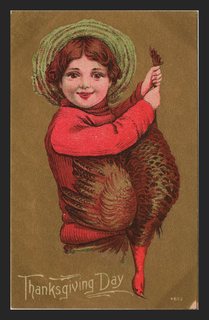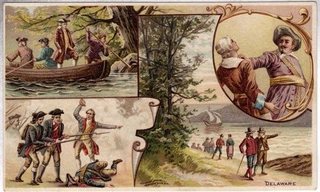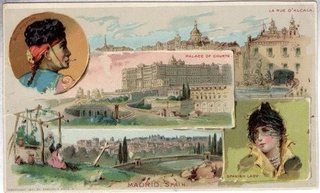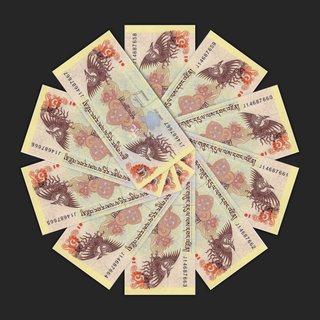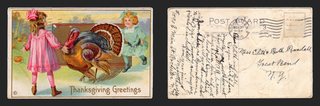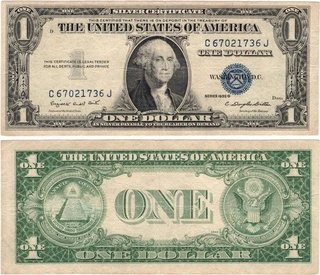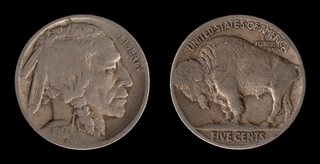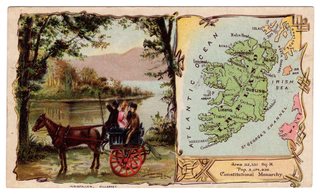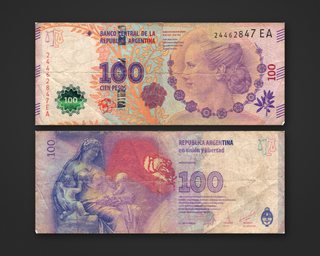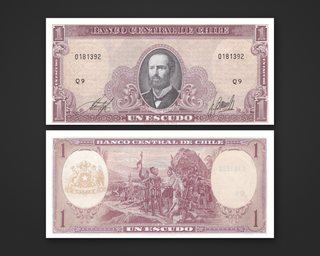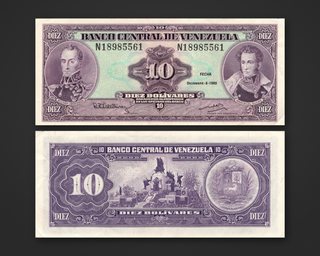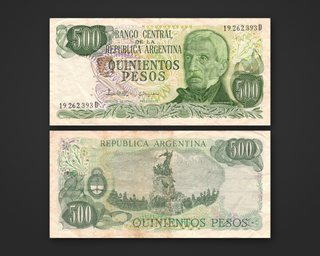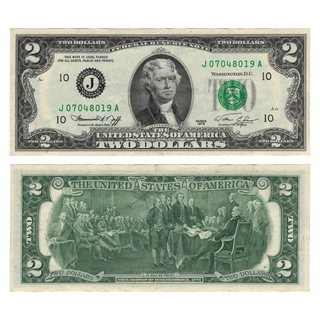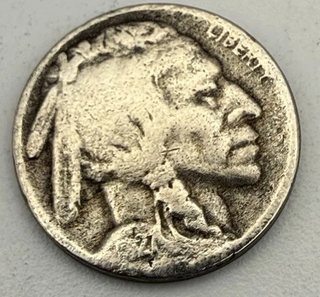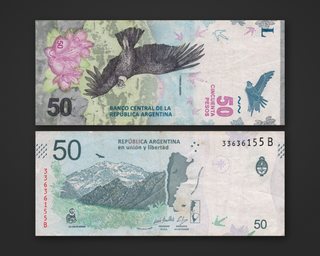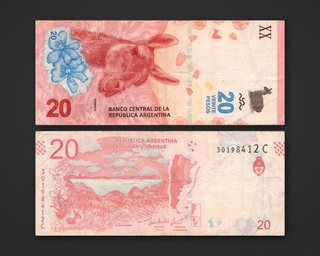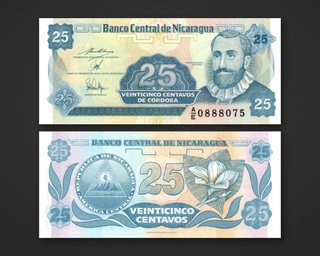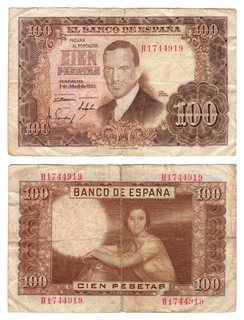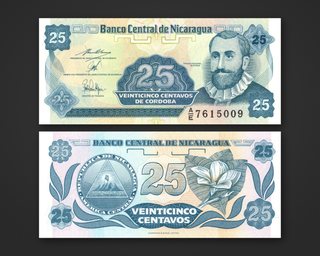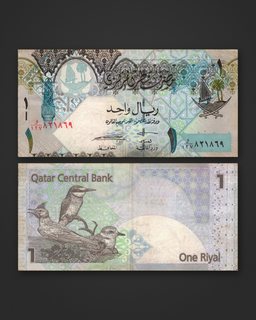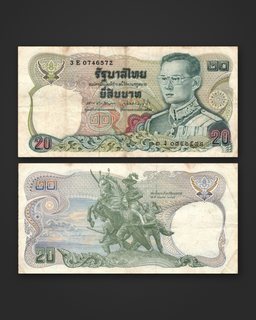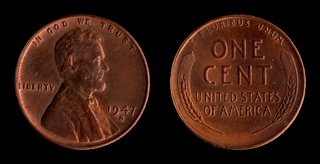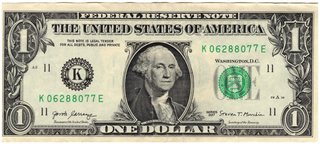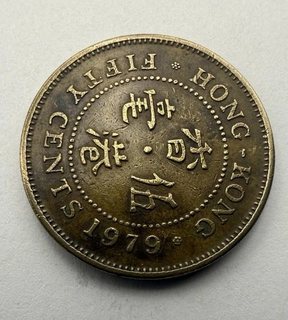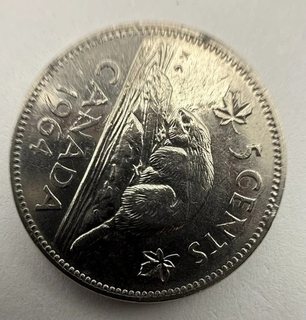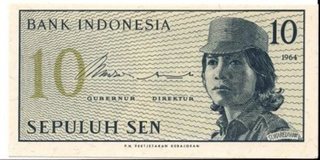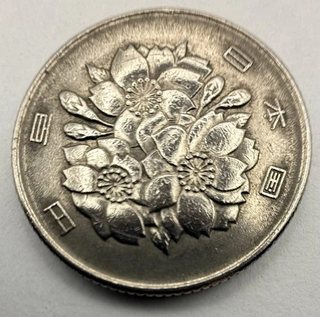
Three on Four International

All items

Every listing in the store on one page: 578 items, $2.36 to $2,549.33. Search by year, country, grade or any word, sort by price or year, and buy on eBay.

Prices and availability as of November 3, 2026.

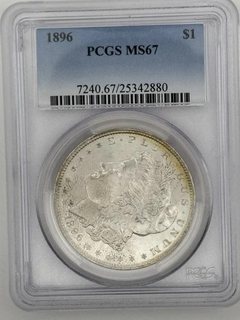
1896-P Morgan Silver Dollar $1 PCGS MS67 Philadelphia Mint 90% Silver

1896-P Morgan Silver Dollar · PCGS MS67 · Philadelphia Mint · 90% silver · designed by Englishman George T. Morgan

$2,549.33 1896 PCGS MS67 Morgan Silver Dollars

Description

An 1896-P Morgan silver dollar from the Philadelphia Mint (no mint mark), certified and sealed by PCGS at MS67. The certification number on the label can be checked on the PCGS website. The photos show this exact coin and holder.

Mint specifications: 90% silver, 10% copper; 26.73 grams; 38.1 mm; 0.7734 troy oz of pure silver. These are the Mint's standard figures; the coin has not been removed from its holder.

Read the full description

The 1896-P

Philadelphia struck 9,976,000 Morgan dollars in 1896.

The Philadelphia Mint, America's first, was created by the Coinage Act of April 2, 1792, and in March 1793 delivered the nation's first circulating coins, 11,178 copper cents. The very first Morgan dollar was struck here on March 11, 1878. Philadelphia coins of this era carry no mint mark.

The Year 1896

On April 6, 1896, King George I opened the first modern Olympic Games in Athens, and Boston's James Connolly won the triple jump to become the first modern Olympic champion. A dollar in 1896 had the buying power of about $39 today.

The Morgan Dollar

Isn't it remarkable that one of America's best-known collectible coins was designed by an Englishman, who went on to become Chief Engraver of the United States Mint?

George T. Morgan, from the Birmingham area of England, joined the US Mint in 1876 on the recommendation of Britain's Royal Mint. His model for Liberty was Anna Willess Williams of Philadelphia. In 1918 the Pittman Act melted over 270 million silver dollars, and sold much of the silver to Britain to back its currency in India.

Grade And Authenticity

MS (Mint State) 67 means no wear; within MS 60 to 70, the number rises as marks decrease and luster and strike improve. PCGS, founded in 1986, guarantees its grades. The seller also tested the metal through the holder with a calibrated Sigma Metalytics verifier (consistent with silver), inspected the holder for tampering (none found), and confirmed the certification number on the PCGS website.

Authenticity Guarantee

This coin is covered by eBay's Authenticity Guarantee for coins: after purchase it goes first to eBay's authentication partner, PCGS, which inspects it against this listing, then on to you. There is no extra cost to the buyer, and shipping to and from the authenticator is included in the free shipping.

Also In Our Store

  • Silver Eagles carrying the Walking Liberty design of German-born sculptor Adolph A. Weinman.
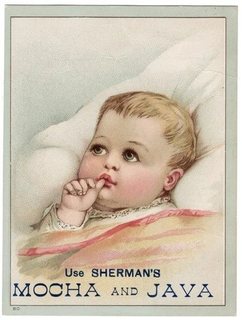
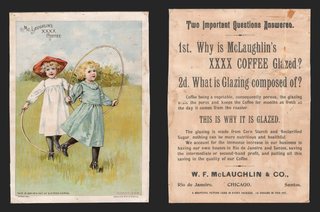
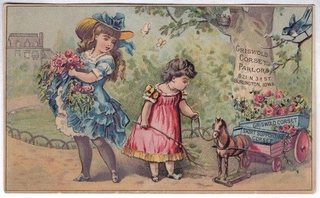
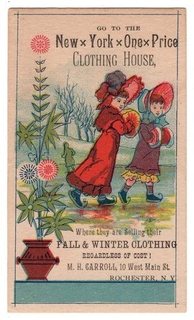
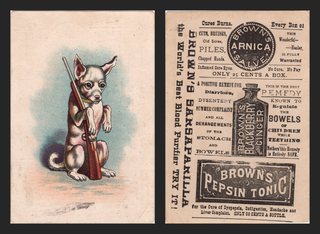
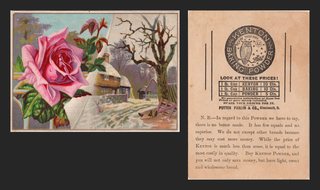
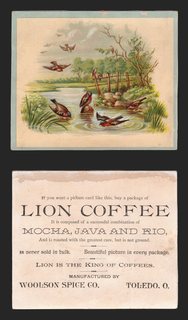
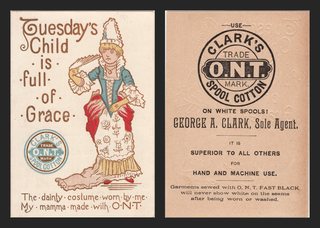
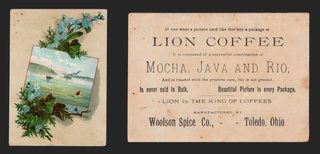
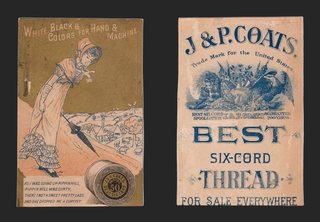
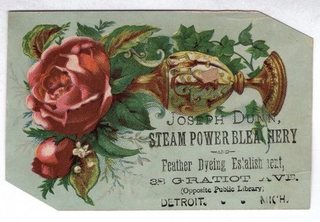
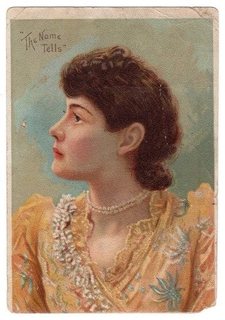
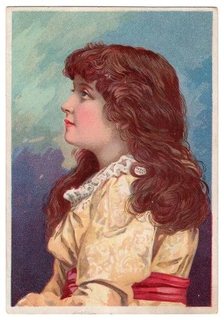
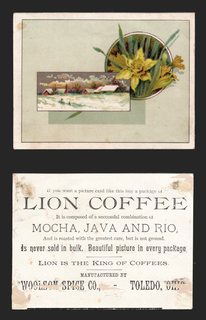
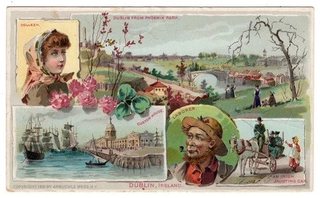
  • Victorian advertising trade cards, chromolithographed in the Morgan years.
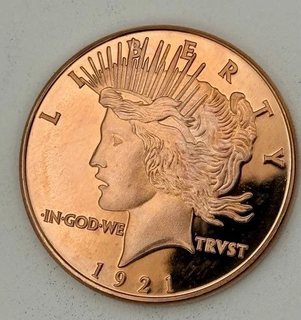
  • Peace dollars, designed by Sicilian-born Anthony de Francisci, and more world coins and banknotes.

Disclaimer

Specifications and detailed item descriptions are provided as a courtesy only and are not guaranteed to be one hundred percent accurate. Please do your own research. There are generally no receipts available for any items from original purchases. Any dimensions and/or weights are approximate. The absence of a more detailed condition report does not imply there are no condition issues with the item(s). Please inspect images carefully as they are part of the official item description and best representation of the actual condition. Additional images may be available upon request depending on time and availability. Not responsible for internet mis-translations or mis-identification of maker's marks if found or assumptions of makers or materials — item descriptions will indicate if it is assumed. If you see a problem, please message us immediately and we will do our best to sort out a solution and confirm the information. With the exception of eBay rules, no returns are accepted.
View on eBay

1885-CC Morgan Silver Dollar $1 Coin —Carson City— NGC MS64 PL Proof-Like

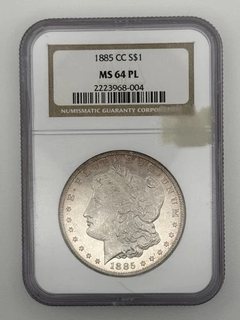
1885-CC Morgan Silver Dollar, Carson City Mint, NGC MS64 PL (Proof-Like)

$1,585.33 1885 NGC MS64 PL Morgan Silver Dollars

Genuine 1885-CC Morgan silver dollar, certified and graded MS64 PL by NGC.

The PL (Proof-Like) designation means the fields are reflective, like a mirror.

Struck at the Carson City Mint in Nevada, with a mintage of only 228,000.

Designed by George T. Morgan. 90% silver, 10% copper; 26.73 g; 38.10 mm. Silver content checked with a Sigma Metalytics precious metals tester.

NGC certification #: 2223968-004 (verify at ngccoin.com).

Light toning at the rim. The holder has residue from an old sticker at the right side of the label; see photos.

Ships under eBay's Authenticity Guarantee: we send it by USPS with full insurance and signature to eBay's authenticator, which then ships it to you.

The images and any video show the actual item and are part of the official listing description, so please review them closely. Measurements and weights are approximate, and any maker or material we haven't confirmed is described as assumed. Questions? Message us; we answer quickly.

View on eBay

Rolex Precision Ladies 3408 Stainless Steel Manual Wind Watch Cal 1400 Vintage

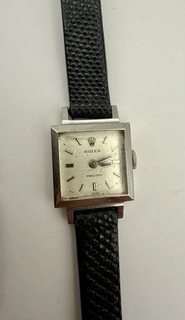
Genuine Rolex Ladies Model 3408 Mechanical Watch

$1,489.87 Wrist Watches

Authenticity: I purchased this watch for my wife's birthday as she had been wanting one for years, but it was not in the cards as she needed a daily wear everywhere watch that could get wet. This watch has already been through the eBay authentication process and passed. The verification card will be included.

  • Description: This is a classic Stainless Steel Rolex Precision Ladies mechanical Movement Wristwatch from circa mid-1960s. 1400 Caliber Rolex Movement Ref. 3408. It is an absolutely elegant and beautiful watch and perfect for formal occassions. It is not water resistant and should not be worn in the shower or pool and no watch is truly waterproof (they are only water resistant and this model from the mid-1960s is not).
  • Function and Materials: It has a manual windup mechanism. Case is Stainless Steel. The case measures approximately 18mm by 18mm square and is less than 0.50" thick. The band is a Speidel USA Genuine Karung Snake 3/8 skin band and an additional modern stainless steel band is included should you wish to swap it out. The watch shows little signs of wear consistent with its overall age. The watch is is excellent working condition and is authentic. Will require daily winding.
Read the full description

Thank you!

Ref: 1.0100

View on eBay

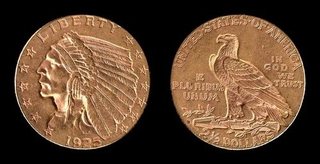
1925-D $2.50 Indian Head Gold Quarter Eagle $2 1/2 90% Gold US Coin AU KM#128

1925-D Indian Head $2.50 Gold Quarter Eagle, Denver Mint, 90% Gold, 0.1209 oz Gold, 1925's Only Quarter Eagle Issue, 578,000 Struck, Bela Lyon Pratt Incuse Design, KM#128 [Est. AU]

$935.13 1925 Est. AU Gold (.900 – .9999 Fine)

Description

A 1925-D Indian Head quarter eagle ($2 1/2 gold piece) struck at the Denver Mint, with the D mint mark on the reverse left of the arrowheads, KM#128. The obverse shows a Native American chief in a feathered war bonnet facing left, with LIBERTY above, 13 stars, the date below and Pratt's initials B.L.P. above the date. The reverse shows a standing eagle on a bundle of arrows with an olive branch, with UNITED STATES OF AMERICA, E PLURIBUS UNUM, IN GOD WE TRUST and 2 1/2 DOLLARS. The design is incuse: sunk into the coin instead of raised, so the flat fields are the highest part. 90% gold, 10% copper, 4.18 grams and 18 mm standard, reeded edge, 0.1209 oz of pure gold. Measured: 4.15 grams, 17.75 to 17.78 mm, 1.10 mm thick. Tested on a Sigma Metalytics precious metal verifier, 22K gold setting: resistivity 10.70 µΩ·cm, conductivity 9.3 MS/m, reading inside the window. The close-ups show the date with the B.L.P. initials, the portrait, the eagle and the D mint mark.

Read the full description

Historical Context

President Theodore Roosevelt pushed for new, more artistic US coins, and Boston physician Dr. William Sturgis Bigelow suggested the incuse design for sculptor Bela Lyon Pratt, inspired by ancient Egyptian art. The quarter eagle first appeared in 1908. After a pause from 1916 through 1924, production resumed in 1925, and that year only the Denver Mint struck quarter eagles: 578,000 coins and no proofs. It was the last of Denver's three quarter eagle issues, after 1911 and 1914. David Akers, a leading authority on US gold coins, considered the 1925-D the hardest date in the series to find in Gem Mint State, because unstable dies and soft strikes troubled the issue.

Buying Power

In 1925 this $2 1/2 gold piece had the buying power of about $48.13 today.

Condition

[Est. AU] Circulated, with light wear on the cheekbone, the war bonnet and the eagle's shoulder and wing (see the photos). Light marks and fine scratches in the fields, as usual on this incuse design. A small red-brown spot below the lower lip, and a few tiny raised specks in the reverse field above IN GOD WE TRUST. The D mint mark is clear, although PCGS notes it is often faint on this issue. Checked for documented varieties: PCGS lists none for 1925-D. Grade estimated; not professionally graded. Currently still legal tender, but worth far more for its gold and to collectors than its $2.50 face value.

Also In Our Store

More gold coins: https://www.ebay.com/str/tfauctionsintl?_nkw=gold+coin

Disclaimer

The images and any video show the actual item and are part of the official listing description, so please review them closely. Measurements and weights are approximate, and any maker or material we haven't confirmed is described as assumed. Questions? Message us; we answer quickly.

View on eBay

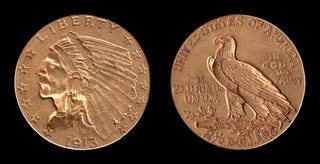
1913 $2.50 Indian Head Gold Quarter Eagle $2 1/2 90% Gold US Coin AU KM#128

1913 Indian Head $2.50 Gold Quarter Eagle, Philadelphia Mint, 90% Gold, 0.1209 oz Gold, Bela Lyon Pratt Incuse Design, 722,000 Struck, KM#128 [Est. AU]

$925.23 1913 Est. AU Gold (.900 – .9999 Fine)

Description

A 1913 Indian Head quarter eagle ($2 1/2 gold piece) struck at the Philadelphia Mint, KM#128. It has no mint mark; on this series the mint mark sits on the reverse, left of the arrowheads. The obverse shows a Native American chief in a feathered war bonnet facing left, with LIBERTY above, 13 stars, the date below and Pratt's initials B.L.P. above the date. The reverse shows a standing eagle on a bundle of arrows with an olive branch, with UNITED STATES OF AMERICA, E PLURIBUS UNUM, IN GOD WE TRUST and 2 1/2 DOLLARS. The design is incuse: sunk into the coin instead of raised, so the flat fields are the highest part. 90% gold, 10% copper, 4.18 grams and 18 mm standard, reeded edge, 0.1209 oz of pure gold. Measured: 4.17 grams, 17.78 mm. Tested on a Sigma Metalytics precious metal verifier, 22K gold setting: resistivity 10.58 µΩ·cm, conductivity 9.5 MS/m, reading inside the window. The close-ups show the date with the B.L.P. initials, the portrait, the eagle and the mint mark area.

Read the full description

Historical Context

President Theodore Roosevelt pushed for new, more artistic US coins. Boston physician and art collector Dr. William Sturgis Bigelow suggested the incuse design, inspired by ancient Egyptian art, and recommended Boston sculptor Bela Lyon Pratt, who had worked with Augustus Saint-Gaudens. The new quarter eagle appeared in 1908 and was struck until 1929. Critics such as Philadelphia numismatist S.H. Chapman complained that dirt would collect in the sunken design. Philadelphia struck 722,000 in 1913, plus 165 proofs. On December 23, 1913, President Woodrow Wilson signed the Federal Reserve Act; twenty years later, in 1933, Franklin Roosevelt ended US gold coinage.

Buying Power

In 1913 this $2 1/2 gold piece had the buying power of about $85.08 today.

Condition

[Est. AU] Circulated, with light wear on the cheekbone, the war bonnet and the eagle's shoulder and wing (see the photos). Light marks and fine scratches in the fields, as usual on this incuse design. Faint dark toning in fine dotted lines on the band of the war bonnet (see the portrait close-up). Small dark spots on the reverse by the T of UNITED and left of PLURIBUS. Checked for documented varieties: PCGS lists none for 1913. Grade estimated; not professionally graded. Currently still legal tender, but worth far more for its gold and to collectors than its $2.50 face value.

Also In Our Store

More gold coins: https://www.ebay.com/str/tfauctionsintl?_nkw=gold+coin

Disclaimer

The images and any video show the actual item and are part of the official listing description, so please review them closely. Measurements and weights are approximate, and any maker or material we haven't confirmed is described as assumed. Questions? Message us; we answer quickly.

View on eBay

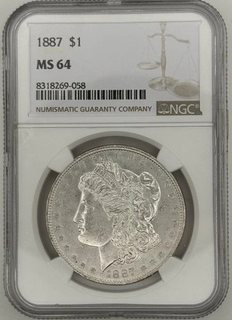
1887-P Morgan Silver Dollar $1 NGC MS64 Philadelphia Mint 90% Silver

1887-P Morgan Silver Dollar · NGC MS64 · Philadelphia Mint · 90% silver · designed by Englishman George T. Morgan

$879.95 1887 NGC MS64 Morgan Silver Dollars

Description

An 1887-P Morgan silver dollar from the Philadelphia Mint (no mint mark), certified and sealed by NGC at MS64. The certification number on the label can be checked on the NGC website. The photos show this exact coin and holder.

Mint specifications: 90% silver, 10% copper; 26.73 grams; 38.1 mm; 0.7734 troy oz of pure silver. These are the Mint's standard figures; the coin has not been removed from its holder.

Read the full description

The 1887-P

Philadelphia struck 20,290,000 Morgan dollars in 1887.

The Philadelphia Mint, America's first, was created by the Coinage Act of April 2, 1792, and in March 1793 delivered the nation's first circulating coins, 11,178 copper cents. The very first Morgan dollar was struck here on March 11, 1878. Philadelphia coins of this era carry no mint mark.

The Year 1887

In December 1887, Sherlock Holmes and Dr. Watson made their first appearance, in Arthur Conan Doyle's "A Study in Scarlet," published in London's Beeton's Christmas Annual. A dollar in 1887 had the buying power of roughly $33 to $36 today.

The Morgan Dollar

Isn't it remarkable that one of America's best-known collectible coins was designed by an Englishman, who went on to become Chief Engraver of the United States Mint?

George T. Morgan, from the Birmingham area of England, joined the US Mint in 1876 on the recommendation of Britain's Royal Mint. His model for Liberty was Anna Willess Williams of Philadelphia. In 1918 the Pittman Act melted over 270 million silver dollars, and sold much of the silver to Britain to back its currency in India.

Grade And Authenticity

MS (Mint State) 64 means no wear; within MS 60 to 70, the number rises as marks decrease and luster and strike improve. NGC, founded in 1987, has been the American Numismatic Association's official grading service since 1995 and has offices in Hong Kong, Shanghai, Munich and London. The seller also tested the metal through the holder with a calibrated Sigma Metalytics verifier (consistent with silver), inspected the holder for tampering (none found), and confirmed the certification number on the NGC website.

Authenticity Guarantee

This coin is covered by eBay's Authenticity Guarantee for coins: after purchase it goes first to eBay's authentication partner, PCGS, which inspects it against this listing, then on to you. There is no extra cost to the buyer, and shipping to and from the authenticator is included in the free shipping.

Also In Our Store

  • Silver Eagles carrying the Walking Liberty design of German-born sculptor Adolph A. Weinman.
  • Victorian advertising trade cards, chromolithographed in the Morgan years.
  • Peace dollars, designed by Sicilian-born Anthony de Francisci, and more world coins and banknotes.

Disclaimer

Specifications and detailed item descriptions are provided as a courtesy only and are not guaranteed to be one hundred percent accurate. Please do your own research. There are generally no receipts available for any items from original purchases. Any dimensions and/or weights are approximate. The absence of a more detailed condition report does not imply there are no condition issues with the item(s). Please inspect images carefully as they are part of the official item description and best representation of the actual condition. Additional images may be available upon request depending on time and availability. Not responsible for internet mis-translations or mis-identification of maker's marks if found or assumptions of makers or materials — item descriptions will indicate if it is assumed. If you see a problem, please message us immediately and we will do our best to sort out a solution and confirm the information. With the exception of eBay rules, no returns are accepted.
View on eBay

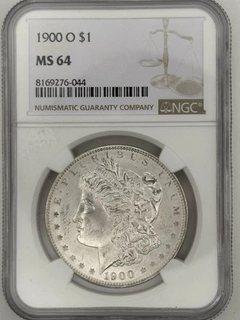
1900-O Morgan Silver Dollar $1 NGC MS64 New Orleans Mint 90% Silver

1900-O Morgan Silver Dollar · NGC MS64 · New Orleans Mint · 90% silver · designed by Englishman George T. Morgan

$875.54 1900 NGC MS64 Morgan Silver Dollars

Description

A 1900-O Morgan silver dollar from the New Orleans Mint, certified and sealed by NGC at MS64. The certification number on the label can be checked on the NGC website. The photos show this exact coin and holder.

Mint specifications: 90% silver, 10% copper; 26.73 grams; 38.1 mm; 0.7734 troy oz of pure silver. These are the Mint's standard figures; the coin has not been removed from its holder.

Read the full description

The 1900-O

New Orleans struck 12,590,000 Morgan dollars in 1900.

The New Orleans Mint opened in 1838, struck half dollars for the Confederacy in 1861, and began striking Morgans in 1879. Since 1981 the building has been part of the Louisiana State Museum.

The Year 1900

On April 15, 1900, the Paris Exposition Universelle opened, drawing over 50 million visitors to a moving walkway, the Grand Palais and the Pont Alexandre III. A dollar in 1900 had the buying power of about $39 today.

The Morgan Dollar

Isn't it remarkable that one of America's best-known collectible coins was designed by an Englishman, who went on to become Chief Engraver of the United States Mint?

George T. Morgan, from the Birmingham area of England, joined the US Mint in 1876 on the recommendation of Britain's Royal Mint. His model for Liberty was Anna Willess Williams of Philadelphia. In 1918 the Pittman Act melted over 270 million silver dollars, and sold much of the silver to Britain to back its currency in India.

Grade And Authenticity

MS (Mint State) 64 means no wear; within MS 60 to 70, the number rises as marks decrease and luster and strike improve. NGC, founded in 1987, has been the American Numismatic Association's official grading service since 1995 and has offices in Hong Kong, Shanghai, Munich and London. The seller also tested the metal through the holder with a calibrated Sigma Metalytics verifier (consistent with silver), inspected the holder for tampering (none found), and confirmed the certification number on the NGC website.

Authenticity Guarantee

This coin is covered by eBay's Authenticity Guarantee for coins: after purchase it goes first to eBay's authentication partner, PCGS, which inspects it against this listing, then on to you. There is no extra cost to the buyer, and shipping to and from the authenticator is included in the free shipping.

Also In Our Store

  • Victorian advertising trade cards, chromolithographed in the Morgan years.
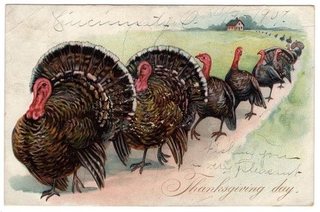
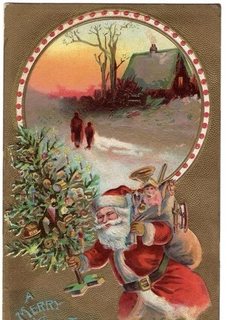
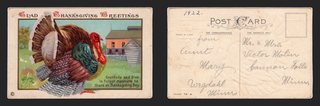
  • Holiday postcards from the Golden Age of Postcards, many printed in Germany.
  • Peace dollars, designed by Sicilian-born Anthony de Francisci, and more world coins and banknotes.

Disclaimer

Specifications and detailed item descriptions are provided as a courtesy only and are not guaranteed to be one hundred percent accurate. Please do your own research. There are generally no receipts available for any items from original purchases. Any dimensions and/or weights are approximate. The absence of a more detailed condition report does not imply there are no condition issues with the item(s). Please inspect images carefully as they are part of the official item description and best representation of the actual condition. Additional images may be available upon request depending on time and availability. Not responsible for internet mis-translations or mis-identification of maker's marks if found or assumptions of makers or materials — item descriptions will indicate if it is assumed. If you see a problem, please message us immediately and we will do our best to sort out a solution and confirm the information. With the exception of eBay rules, no returns are accepted.
View on eBay

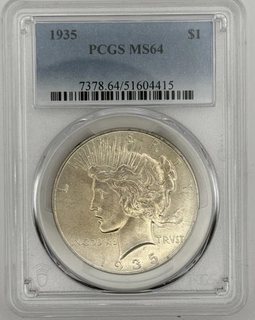
1935-P Peace Silver Dollar $1 PCGS MS64 Philadelphia Mint 90% Silver

1935-P Peace Silver Dollar · PCGS MS64 · Philadelphia Mint · 90% silver · designed by Sicilian-born Anthony de Francisci

$835.23 1935 PCGS MS64 Peace Silver Dollars

Description

A 1935-P Peace silver dollar from the Philadelphia Mint (no mint mark), certified and sealed by PCGS at MS64. The certification number on the label can be checked on the PCGS website. The photos show this exact coin and holder.

Mint specifications: 90% silver, 10% copper; 26.73 grams; 38.1 mm; 0.7734 troy oz of pure silver. These are the Mint's standard figures; the coin has not been removed from its holder.

Read the full description

The 1935 Peace Dollar

Philadelphia struck 1,576,000 Peace dollars in 1935, the final year Peace dollars were struck for circulation. The Philadelphia Mint, America's first, was created by the Coinage Act of 1792 and delivered the nation's first circulating coins in March 1793. Every one of the 1,006,473 Peace dollars dated 1921 was struck here.

The Year 1935

In 1935 Canada issued its first circulating silver dollar, the George V Silver Jubilee "voyageur" dollar. On July 16, 1935, the world's first parking meters went into service in Oklahoma City, charging a nickel for curbside parking. A dollar in 1935 had the buying power of about $23.50 today.

The Peace Dollar

Isn't it remarkable that the coin America struck to celebrate peace after the First World War was designed by a young Sicilian immigrant, and modeled on his Italian-born wife?

Anthony de Francisci, born in Palermo, Sicily, in 1887, won the design competition in December 1921; Liberty's face is based on his wife, Teresa, born in Laurenzana, Italy. The coin followed the Pittman Act of 1918, which melted 270 million silver dollars and sold their silver to Britain to steady the currency of British India, and the 1921 resolution formally ending America's war with Germany and Austria-Hungary. English-born Chief Engraver George T. Morgan removed a broken sword from the first reverse before Christmas 1921.

Grade And Authenticity

MS (Mint State) 64 means no wear, on a scale where the number rises as marks decrease and luster and strike improve. PCGS, founded in 1986, guarantees its grades. The seller also tested the metal through the holder with a calibrated Sigma Metalytics verifier (consistent with silver), inspected the holder for tampering (none found), and confirmed the certification number on the PCGS website.

This coin is covered by eBay's Authenticity Guarantee: after purchase it goes first to eBay's authentication partner, PCGS, which inspects it against this listing, then on to you at no extra cost. Shipping to and from the authenticator is included in the free shipping.

Also In Our Store

  • Original Buffalo nickels, including a 1935.
  • Holiday postcards from the Golden Age of Postcards, many printed in Germany.
  • Morgan dollars, designed by English-born George T. Morgan, and more world coins and banknotes.

Disclaimer

Specifications and detailed item descriptions are provided as a courtesy only and are not guaranteed to be one hundred percent accurate. Please do your own research. There are generally no receipts available for any items from original purchases. Any dimensions and/or weights are approximate. The absence of a more detailed condition report does not imply there are no condition issues with the item(s). Please inspect images carefully as they are part of the official item description and best representation of the actual condition. Additional images may be available upon request depending on time and availability. Not responsible for internet mis-translations or mis-identification of maker's marks if found or assumptions of makers or materials — item descriptions will indicate if it is assumed. If you see a problem, please message us immediately and we will do our best to sort out a solution and confirm the information. With the exception of eBay rules, no returns are accepted.
View on eBay

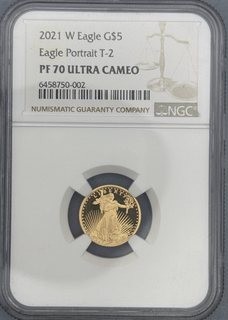
2021-W $5 American Gold Eagle 1/10 oz Proof NGC PF70 Ultra Cameo Type 2 22K

2021-W $5 American Gold Eagle Proof, NGC PF70 Ultra Cameo, Cert #6458750-002, 1/10 Troy oz Fine Gold, 22 Karat, Liberty by Dublin-born Augustus Saint-Gaudens

$711.21 2021 NGC PF70 American Gold Eagles

Description

A 2021-W $5 American Gold Eagle proof, certified and sealed by NGC (Numismatic Guaranty Company) at PF70 Ultra Cameo, on an NGC label reading "Eagle Portrait T-2". It carries the W mint mark of West Point, below the date. Mint specifications: 22 karat (91.67% gold, 3% silver, the rest copper); 1/10 troy oz of fine gold; 3.393 grams; 16.5 mm; $5 face value; reeded edge. The coin is sealed in its holder and has not been removed to be weighed or measured. NGC certification #: 6458750-002 (the number can be checked on the NGC website). The photos show this exact coin and holder: holder front and back, both sides of the coin, the label and the date. Photos are taken through the holder plastic, which softens fine detail at a distance; the close-ups show the coin more clearly.

Read the full description

Historical Context

2021 is the only year with two Gold Eagle reverses: the original family-of-eagles design (Type 1) until mid-year, then the new eagle portrait (Type 2). This is a Type 2 proof struck at West Point, New York, with the W mint mark. Proofs are struck more than once from polished dies on specially prepared blanks. The Gold Eagle program was created by the Gold Bullion Coin Act of 1985 (Public Law 99-185, December 17, 1985); the first coins went on sale in October 1986.

The obverse is Augustus Saint-Gaudens' Liberty from the $20 gold coin commissioned by President Theodore Roosevelt and first struck in 1907. Saint-Gaudens, born in Dublin, Ireland, died on August 3, 1907, before the designs were finalized for production. London-born Chief Engraver Charles E. Barber then lowered the relief so the coin could be struck with a single blow.

The reverse, introduced in mid-2021 for the program's 35th anniversary, is a close-up of an eagle's head designed by Jennie Norris (JN) and sculpted by Renata Gordon (RG).

Condition

NGC PF70 Ultra Cameo, certification #6458750-002, sealed in the grading company's holder. PF (Proof) 70 is the top of the 1-70 scale; Ultra Cameo marks strong contrast between frosted design and mirrored fields. Holder: see the photos for its condition.

Also In Our Store

More gold coins: https://www.ebay.com/str/tfauctionsintl?_nkw=gold

  • Indian Head $2.50 gold quarter eagles (1913 and 1925-D) and a 1945 Mexico 2½ pesos gold coin.
  • American Silver Eagles, whose Walking Liberty is by Adolph A. Weinman, a student of Saint-Gaudens.

Disclaimer

The images and any video show the actual item and are part of the official listing description, so please review them closely. Measurements and weights are approximate, and any maker or material we haven't confirmed is described as assumed. Questions? Message us; we answer quickly.

View on eBay

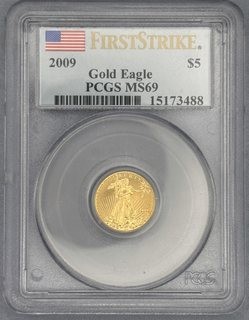
2009 $5 American Gold Eagle 1/10 oz PCGS MS69 First Strike 22K Gold Coin

2009 $5 American Gold Eagle, PCGS MS69, Cert #15173488, 1/10 Troy oz Fine Gold, 22 Karat, Liberty by Dublin-born Augustus Saint-Gaudens

$545.22 2009 PCGS MS69 American Gold Eagles

Description

A 2009 $5 American Gold Eagle, certified and sealed by PCGS (Professional Coin Grading Service) at MS69, on a PCGS First Strike label with a US flag. Bullion-strike Gold Eagles carry no mint mark. Mint specifications: 22 karat (91.67% gold, 3% silver, the rest copper); 1/10 troy oz of fine gold; 3.393 grams; 16.5 mm; $5 face value; reeded edge. The coin is sealed in its holder and has not been removed to be weighed or measured. PCGS certification #: 15173488 (the number can be checked on the PCGS website). The photos show this exact coin and holder: holder front and back, both sides of the coin, the label and the date, and the spots. Photos are taken through the holder plastic, which softens fine detail at a distance; the close-ups show the coin more clearly.

Read the full description

Historical Context

2009 brought record demand for gold after the 2008 financial crisis. The Mint needed every gold blank it could get for bullion coins, so it struck no proof Gold Eagles dated 2009. PCGS gives its First Strike label to coins received within the first 30 days of release; the back insert reads "Delivered Within First 30 Days of Initial Release." The Gold Eagle program was created by the Gold Bullion Coin Act of 1985 (Public Law 99-185, December 17, 1985); the first coins went on sale in October 1986.

The obverse is Augustus Saint-Gaudens' Liberty from the $20 gold coin commissioned by President Theodore Roosevelt and first struck in 1907. Saint-Gaudens, born in Dublin, Ireland, died on August 3, 1907, before the designs were finalized for production. London-born Chief Engraver Charles E. Barber then lowered the relief so the coin could be struck with a single blow.

The reverse, by Miley Busiek (initials MB), shows a male eagle carrying an olive branch over a nest with a female eagle and two eaglets. It was used from 1986 until mid-2021.

Condition

PCGS MS69, certification #15173488, sealed in the grading company's holder. MS (Mint State) 69 means no wear, one point below the top of the 1-70 scale. Disclosed: small copper-colored spots on the reverse. The largest sits right of UNUM, above the branch; a small dark spot is right of the eagle's head, below AMERICA; and there is orange toning along the rim at the left (see the close-ups, photos 7 to 9). Copper spots are common on 22-karat gold coins because of the copper in the alloy, and they can form after grading. Holder: see the photos for its condition.

Also In Our Store

More gold coins: https://www.ebay.com/str/tfauctionsintl?_nkw=gold

  • Indian Head $2.50 gold quarter eagles (1913 and 1925-D) and a 1945 Mexico 2½ pesos gold coin.
  • American Silver Eagles, whose Walking Liberty is by Adolph A. Weinman, a student of Saint-Gaudens.

Disclaimer

The images and any video show the actual item and are part of the official listing description, so please review them closely. Measurements and weights are approximate, and any maker or material we haven't confirmed is described as assumed. Questions? Message us; we answer quickly.

View on eBay

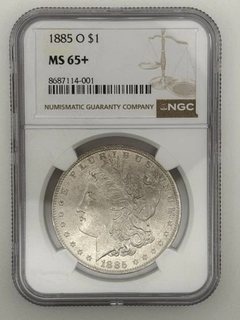
1885-O Morgan Silver Dollar $1 NGC MS65+ New Orleans Mint 90% Silver

1885-O Morgan Silver Dollar · NGC MS65+ · New Orleans Mint · 90% silver · designed by Englishman George T. Morgan

$465.77 1885 NGC MS65+ Morgan Silver Dollars

Description

An 1885-O Morgan silver dollar from the New Orleans Mint, certified and sealed by NGC at MS65+. The certification number on the label can be checked on the NGC website. The photos show this exact coin and holder.

Mint specifications: 90% silver, 10% copper; 26.73 grams; 38.1 mm; 0.7734 troy oz of pure silver. These are the Mint's standard figures; the coin has not been removed from its holder.

Read the full description

The 1885-O

New Orleans struck 9,185,000 Morgan dollars in 1885.

The New Orleans Mint opened in 1838, struck half dollars for the Confederacy in 1861, and began striking Morgans in 1879. Since 1981 the building has been part of the Louisiana State Museum.

The Year 1885

On June 17, 1885, the Statue of Liberty arrived in New York Harbor from France aboard the French ship Isère, packed in more than 200 crates. Her crown of rays later inspired Liberty's crown on the Peace dollar. A dollar in 1885 had the buying power of roughly $33 to $36 today.

The Morgan Dollar

Isn't it remarkable that one of America's best-known collectible coins was designed by an Englishman, who went on to become Chief Engraver of the United States Mint?

George T. Morgan, from the Birmingham area of England, joined the US Mint in 1876 on the recommendation of Britain's Royal Mint. His model for Liberty was Anna Willess Williams of Philadelphia. In 1918 the Pittman Act melted over 270 million silver dollars, and sold much of the silver to Britain to back its currency in India.

Grade And Authenticity

MS (Mint State) 65 means no wear; within MS 60 to 70, the number rises as marks decrease and luster and strike improve. The "+" is NGC's Plus designation, "awarded by NGC to coins at the high end of their assigned grade, approaching the quality requirements for the next grade." NGC, founded in 1987, has been the American Numismatic Association's official grading service since 1995 and has offices in Hong Kong, Shanghai, Munich and London. The seller also tested the metal through the holder with a calibrated Sigma Metalytics verifier (consistent with silver), inspected the holder for tampering (none found), and confirmed the certification number on the NGC website.

Also In Our Store

  • Peace dollars by Sicilian-born Anthony de Francisci, whose Liberty wears a crown of rays inspired by the Statue of Liberty.
  • Victorian advertising trade cards, chromolithographed in the Morgan years.
  • Holiday postcards from the Golden Age of Postcards, many printed in Germany, and more world coins and banknotes.

Disclaimer

Specifications and detailed item descriptions are provided as a courtesy only and are not guaranteed to be one hundred percent accurate. Please do your own research. There are generally no receipts available for any items from original purchases. Any dimensions and/or weights are approximate. The absence of a more detailed condition report does not imply there are no condition issues with the item(s). Please inspect images carefully as they are part of the official item description and best representation of the actual condition. Additional images may be available upon request depending on time and availability. Not responsible for internet mis-translations or mis-identification of maker's marks if found or assumptions of makers or materials — item descriptions will indicate if it is assumed. If you see a problem, please message us immediately and we will do our best to sort out a solution and confirm the information. With the exception of eBay rules, no returns are accepted.
View on eBay

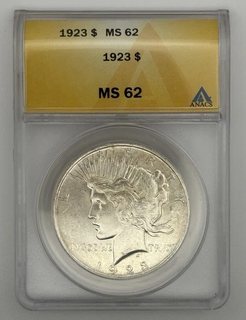
1923-P Peace Silver Dollar $1 ANACS MS62 Philadelphia Mint 90% Silver

1923-P Peace Silver Dollar · ANACS MS62 · Philadelphia Mint · 90% silver · designed by Sicilian-born Anthony de Francisci

$444.56 1923 ANACS MS62 Peace Silver Dollars

Description

A 1923-P Peace silver dollar from the Philadelphia Mint (no mint mark), certified and sealed by ANACS at MS62. The certification number on the label can be checked on the grading company's website. The photos show this exact coin and holder.

Mint specifications: 90% silver, 10% copper; 26.73 grams; 38.1 mm; 0.7734 troy oz of pure silver. These are the Mint's standard figures; the coin has not been removed from its holder.

Read the full description

The 1923 Peace Dollar

Philadelphia struck 30,800,000 Peace dollars in 1923.

Philadelphia, America's first mint, was created by the Coinage Act of April 2, 1792, and George Washington chose the scientist David Rittenhouse as its first director. Every one of the 1,006,473 Peace dollars dated 1921 was struck here. Philadelphia coins carry no mint mark.

The Year 1923

In November 1923, one US dollar was worth 4,210,500,000,000 German paper marks. The same year, the giant HOLLYWOODLAND sign went up in the hills above Los Angeles. A dollar in 1923 had the buying power of about $19 today.

The Peace Dollar

Isn't it remarkable that the coin America struck to celebrate peace after the First World War was designed by a young Sicilian immigrant, and modeled on his Italian-born wife?

Anthony de Francisci, born in Palermo, Sicily, in 1887, came to the United States in 1905 and in December 1921 won an invitation-only design competition. Liberty's face is based on his wife, Teresa, born in Laurenzana in Italy's Basilicata region. Numismatist Farran Zerbe proposed it to restore the 270 million silver dollars melted under the Pittman Act of 1918, their silver sold to Britain to steady the currency of British India. In July 1921 the Knox–Porter Resolution formally ended America's war with Germany and Austria-Hungary, and the first Peace dollar was struck that December 28.

Grade And Authenticity

MS (Mint State) 62 means no wear at all, and the number rises as marks decrease and luster and strike improve. ANACS, founded in June 1972 as the American Numismatic Association's authentication service to fight counterfeit and altered coins, began grading in 1979 and is the oldest of the major services. The seller also tested the metal through the holder with a calibrated Sigma Metalytics verifier (consistent with silver), inspected the holder for tampering (none found), and confirmed the certification number on the ANACS website.

Also In Our Store

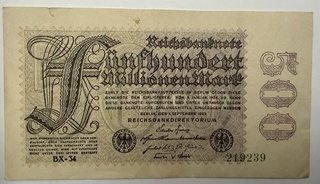
  • A 1923 German 500-million-mark banknote from that year's hyperinflation.
  • Holiday postcards from the Golden Age of Postcards, many printed in Germany.
  • Morgan dollars, designed by English-born George T. Morgan, and more world coins and banknotes.

Disclaimer

Specifications and detailed item descriptions are provided as a courtesy only and are not guaranteed to be one hundred percent accurate. Please do your own research. There are generally no receipts available for any items from original purchases. Any dimensions and/or weights are approximate. The absence of a more detailed condition report does not imply there are no condition issues with the item(s). Please inspect images carefully as they are part of the official item description and best representation of the actual condition. Additional images may be available upon request depending on time and availability. Not responsible for internet mis-translations or mis-identification of maker's marks if found or assumptions of makers or materials — item descriptions will indicate if it is assumed. If you see a problem, please message us immediately and we will do our best to sort out a solution and confirm the information. With the exception of eBay rules, no returns are accepted.
View on eBay

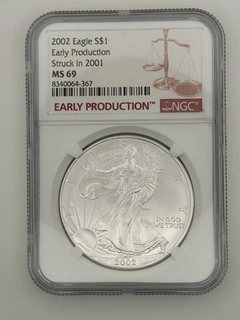
2002 American Silver Eagle Early Release Label $1 Coin — Graded by NGC at MS69

2002 American Silver Eagle · NGC MS69 · 1 troy oz .999 fine silver · Walking Liberty by German-born Adolph A. Weinman

$425.41 2002 NGC MS69 American Silver Eagles

Description

A 2002 American Silver Eagle, certified and sealed by NGC at MS69, with NGC's "Early Production" label, which notes the coin was struck in 2001. The certification number on the label, 8340064-367, can be checked on the NGC website. The photos show this exact coin and holder.

Mint specifications: 1 troy oz of .999 fine silver; 40.6 mm; $1 face value. These are the Mint's standard figures; the coin has not been removed from its holder.

Read the full description

The 2002 Silver Eagle

The Mint struck 10,539,026 bullion Silver Eagles dated 2002. Bullion Silver Eagles carry no mint mark. The program was authorized by the Liberty Coin Act, signed by President Reagan on July 9, 1985, and the first Silver Eagle was struck in San Francisco on October 29, 1986.

The Design

The obverse is Adolph A. Weinman's Walking Liberty, first used on the half dollar of 1916–1947. Weinman was born in Durmersheim, near Karlsruhe, Germany, came to America at 14, and studied under Dublin-born sculptor Augustus Saint-Gaudens. When Walking Liberty first appeared in 1916, English-born George T. Morgan, designer of the Morgan dollar, was the Mint's assistant engraver; he became Chief Engraver the next year.

The reverse heraldic eagle is by John Mercanti, used from 1986 to 2021.

Grade And Authenticity

MS (Mint State) 69 means no wear, one point below the top of the 1–70 scale. NGC, founded in 1987, has been the American Numismatic Association's official grading service since 1995. The seller also tested the metal through the holder with a calibrated Sigma Metalytics verifier (consistent with silver), inspected the holder for tampering (none found), and confirmed the certification number on the NGC website.

Also In Our Store

  • A Walking Liberty coin cutout cuff bracelet, featuring Weinman's design.
  • Morgan dollars by English-born George T. Morgan, and Peace dollars by Sicilian-born Anthony de Francisci, who studied under Weinman.
  • More US and world coins and banknotes.

Disclaimer

Specifications and detailed item descriptions are provided as a courtesy only and are not guaranteed to be one hundred percent accurate. Please do your own research. There are generally no receipts available for any items from original purchases. Any dimensions and/or weights are approximate. The absence of a more detailed condition report does not imply there are no condition issues with the item(s). Please inspect images carefully as they are part of the official item description and best representation of the actual condition. Additional images may be available upon request depending on time and availability. Not responsible for internet mis-translations or mis-identification of maker's marks if found or assumptions of makers or materials — item descriptions will indicate if it is assumed. If you see a problem, please message us immediately and we will do our best to sort out a solution and confirm the information. With the exception of eBay rules, no returns are accepted.
View on eBay

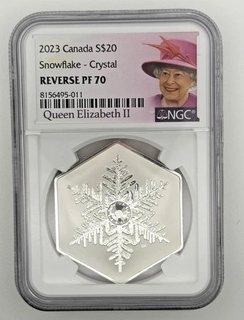
2023 Canada $20 1oz .9999 Silver Snowflake RevProof PF 70 NGC QE II [READ DESC!]

2023 Canada $20 Snowflake · NGC PF70 Reverse Proof · Royal Canadian Mint · 99.99% pure silver with clear crystal · hexagon shape

$420.23 2023 NGC PF70 Silver (.999 & .9999 Fine)

Description

A 2023 Canada $20 Snowflake silver coin with a clear crystal, certified and sealed by NGC at PF70 as a reverse proof, on an NGC label with a portrait of Queen Elizabeth II, reading "Snowflake - Crystal, Reverse PF 70." The certification number on the label, 8156495-011, can be checked on the NGC website. The photos show this exact coin and holder.

Specifications: 99.99% pure silver with a clear crystal; 32.41 grams (about 1.04 troy oz); 42 mm hexagon; $20 face value; mintage 8,500. These are the Royal Canadian Mint's figures; the coin has not been removed from its holder.

Read the full description

The Snowflake

The reverse is a magnified stellar dendrite ice crystal, with frosted branches and a crystal at the center, by Canadian nature and macro photographer Don Komarechka, whose "DK" initials appear on the reverse. Komarechka has written two books on snowflakes and macro photography, his snowflake images have appeared on Royal Canadian Mint silver coins in 2017, 2018, 2023 and 2024, and he now lives near Varna, Bulgaria. The six-sided coin echoes the snowflake.

The Crown And The Mint

The obverse carries Queen Elizabeth II by Susanna Blunt, with her "SB" initials at the shoulder, in the transitional version made after the Queen's death: below "ELIZABETH II" are the dates 1952 and 2022, separated by four pearls for the four effigies that appeared on Canadian coins during her reign. It was used on 2023 collector and bullion coins, and Canadian coins released from 2024 on carry King Charles III, by Steven Rosati.

The Royal Canadian Mint opened on January 2, 1908, as the Ottawa branch of Britain's Royal Mint and became the Royal Canadian Mint in 1931. Its Silver Maple Leaf bullion coins have been 99.99% silver since 1988, and in 2007 it struck the world's first 99.999% pure gold bullion coins. Britain's Royal Mint also has a link to American coins: in 1876 it recommended the English engraver George T. Morgan to the US Mint, where he went on to design the Morgan silver dollar.

Grade And Authenticity

PF (Proof) 70 is the top of the 1–70 scale. NGC, founded in 1987, has been the American Numismatic Association's official grading service since 1995. The seller also tested the metal through the holder with a calibrated Sigma Metalytics verifier (consistent with silver), inspected the holder for tampering (none found), and confirmed the certification number on the NGC website.

Also In Our Store

Visit TF Auctions Intl: https://www.ebay.com/str/tfauctionsintl

  • Morgan dollars by English-born George T. Morgan.
  • A 2026 Silver Britannia from Britain's Royal Mint, with King Charles III.
  • More world coins and banknotes.

Disclaimer

Specifications and detailed item descriptions are provided as a courtesy only and are not guaranteed to be one hundred percent accurate. Please do your own research. There are generally no receipts available for any items from original purchases. Any dimensions and/or weights are approximate. The absence of a more detailed condition report does not imply there are no condition issues with the item(s). Please inspect images carefully as they are part of the official item description and best representation of the actual condition. Additional images may be available upon request depending on time and availability. Not responsible for internet mis-translations or mis-identification of maker's marks if found or assumptions of makers or materials — item descriptions will indicate if it is assumed. If you see a problem, please message us immediately and we will do our best to sort out a solution and confirm the information. With the exception of eBay rules, no returns are accepted.
View on eBay

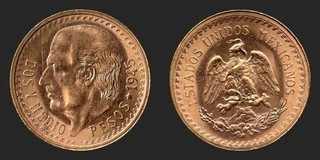
1945 Mexico 2.5 Pesos Gold Dos y Medio Pesos Hidalgo Oro .900 Fine KM#463 [UNC]

1945 Mexico 2.5 Pesos (Dos y Medio Pesos) Gold Coin, Miguel Hidalgo, .900 Fine Gold, 0.0603 oz AGW, KM#463, Ungraded [UNC]

$398.47 1945 Gold (.900 – .9999 Fine)

Description

A Mexican 2.5 pesos gold coin dated 1945, struck at the Mexico City Mint (often listed as 1945-Mo; no mint mark appears on the coin).

Obverse: Shows Miguel Hidalgo y Costilla, the father of Mexican independence, with DOS Y MEDIO PESOS and the date.

Reverse: Shows the national arms, the eagle on a cactus with a snake, inside ESTADOS UNIDOS MEXICANOS.

Edge: Reeded.

Read the full description

Specifications

Standard: 2.0833 grams, .900 gold, 0.0603 Troy oz actual gold weight, 15.5 mm diameter, 0.86 mm thick (Numista N#18813).

This coin, measured in hand: 2.07 grams on a consumer grade 0.01 g scale; 0.86-0.87 mm thick measured with calipers; diameter also measured with calipers and consistent with 15.5 mm specifications.

Professional Grade Sigma Precious Metal Verifier reads within range for 90% (.900) gold / balance copper (resistivity 10.89 µΩ·cm, conductivity 9.2 MS/m).

Historical Context

Mexico struck most 2.5 pesos gold coins between 1918 and 1948. From 1951 to 1972 the mint restruck the 2.5 pesos as bullion, more than 5 million coins, all dated 1945; the 1945 date today covers both the original 1945 strikes and those later restrikes. There is no reliable way to tell them apart by sight. These coins are valued for their gold content, and are prized by collectors around the world for their classic Hidalgo design and rich and significant history.

Condition

[UNC] Uncirculated, with original satin mint luster that brightens across the fields as the coin is tilted and shows no wear on the high detailed points; bag and handling marks are visible from years of storage alongside other gold coins, including fine hairline marks across the obverse field near DOS and Hidalgo's head. Never cleaned or polished. Grade estimated; not professionally graded.

Provenance

Family history: this coin has been in the family since the approximate year of issue or shortly after, before 1950, which is earlier than the 1951 start of the restrikes. We have no paperwork to prove the date, so the coin is described and priced as a standard 1945 2.5 pesos. From my family's estate collections, handed down from my grandmother to my parents at the time of their wedding more than 60 years ago and now to me.

Shipping

Ships free by USPS Priority Mail, fully insured, signature required. Ships in an airtight capsule (not shown).

Disclaimer

The images and any video show the actual item and are part of the official listing description, so please review them closely. Measurements and weights are approximate, and any maker or material we haven't confirmed is described as assumed. Questions? Message us; we answer quickly.

Moneda de oro de 2.5 pesos (Dos y Medio Pesos) de México, 1945, Miguel Hidalgo, oro de .900, 0.0603 oz Troya de oro, KM#463, sin circular, sin certificar [UNC] — Envío Priority asegurado con firma.

Mexiko 2,5 Pesos (Dos y Medio Pesos) Goldmünze 1945, Miguel Hidalgo, Gold .900, 0,0603 oz Feingold, KM#463, unzirkuliert, nicht zertifiziert [UNC] — Versicherter Priority-Versand mit Unterschrift.

View on eBay

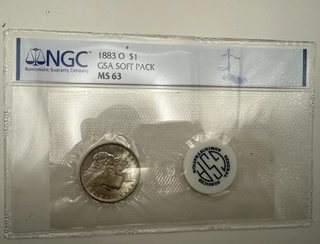
1883-O Morgan Silver Dollar $1 Coin — NGC Graded MS63 GSA SOFT PACK —New Orleans

1883-O Morgan Silver Dollar, NGC MS63, GSA SOFT PACK

$395.17 1883 NGC MS63 Morgan Silver Dollars

A 1883-O Morgan silver dollar struck at the New Orleans Mint, certified by NGC at MS63. The label reads “GSA SOFT PACK.” The certification number, 8227097-013 and MS-63, can be checked on the NGC website. The photos show this exact coin and holder.

GSA coins come from the US Treasury’s hoard of silver dollars, sold to the public by the General Services Administration in the 1970s.

The metal was tested through the holder with a Sigma Metalytics verifier and is consistent with silver.

Read the full description

Disclaimer

The images and any video show the actual item and are part of the official listing description, so please review them closely. Measurements and weights are approximate, and any maker or material we haven’t confirmed is described as assumed. Questions? Message us; we answer quickly.

View on eBay

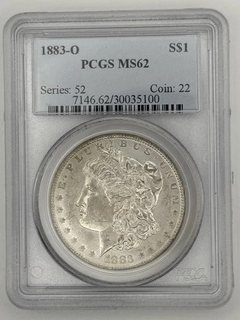
1883-O Morgan Silver Dollar $1 PCGS MS62 New Orleans Mint 90% Silver

1883-O Morgan Silver Dollar · PCGS MS62 · New Orleans Mint · 90% silver · designed by Englishman George T. Morgan

$369.12 1883 PCGS MS62 Morgan Silver Dollars

Description

An 1883-O Morgan silver dollar, certified and sealed by PCGS at MS62. The certification number on the label can be checked on the PCGS website. The photos show this exact coin and holder.

Mint specifications: 90% silver, 10% copper; 26.73 grams; 38.1 mm; 0.7734 troy oz of pure silver. These are the Mint's standard figures; the coin has not been removed from its holder.

Read the full description

The 1883-O

New Orleans struck 8,725,000 Morgan dollars in 1883. PCGS estimates about 400,000 survive in Mint State. Strike quality on this date varies, often soft at the centers, so please judge this coin from the photos.

The New Orleans Mint opened in 1838, struck half dollars for the Confederacy in 1861, and began striking Morgans in 1879. Since 1981 the building has been part of the Louisiana State Museum.

The Year 1883

The first Orient Express left Paris for Vienna, and the Brooklyn Bridge opened. Near Tulsa, where our store is based, Catoosa opened its first post office; today barges from Catoosa's river port reach New Orleans, where this coin was struck. A dollar in 1883 had the buying power of roughly $31 to $35 today.

The Morgan Dollar

Isn't it remarkable that one of America's best-known collectible coins was designed by an Englishman, who went on to become Chief Engraver of the United States Mint?

George T. Morgan, from the Birmingham area of England, joined the US Mint in 1876 on the recommendation of Britain's Royal Mint. His model for Liberty was Anna Willess Williams of Philadelphia. In 1918 the Pittman Act melted over 270 million silver dollars, and sold much of the silver to Britain to back its currency in India.

Grade And Authenticity

MS (Mint State) 62 means no wear, with some marks. PCGS, founded in 1986, guarantees its grades. The seller also tested the metal through the holder with a calibrated Sigma Metalytics verifier (consistent with silver), inspected the holder for tampering (none found), and confirmed the certification number on the PCGS website.

Also In Our Store

  • Victorian advertising trade cards, chromolithographed in the Morgan years.
  • Holiday postcards from the Golden Age of Postcards, many printed in Germany.
  • Peace dollars, designed by Sicilian-born Anthony de Francisci, and more world coins and banknotes.

Disclaimer

Specifications and detailed item descriptions are provided as a courtesy only and are not guaranteed to be one hundred percent accurate. Please do your own research. There are generally no receipts available for any items from original purchases. Any dimensions and/or weights are approximate. The absence of a more detailed condition report does not imply there are no condition issues with the item(s). Please inspect images carefully as they are part of the official item description and best representation of the actual condition. Additional images may be available upon request depending on time and availability. Not responsible for internet mis-translations or mis-identification of maker's marks if found or assumptions of makers or materials — item descriptions will indicate if it is assumed. If you see a problem, please message us immediately and we will do our best to sort out a solution and confirm the information. With the exception of eBay rules, no returns are accepted.
View on eBay

1885-O Morgan Silver Dollar $1 PCGS MS64 New Orleans Mint 90% Silver

1885-O Morgan Silver Dollar · PCGS MS64 · New Orleans Mint · 90% silver · designed by Englishman George T. Morgan

$367.78 1885 PCGS MS64 Morgan Silver Dollars

Description

An 1885-O Morgan silver dollar from the New Orleans Mint, certified and sealed by PCGS at MS64. The certification number on the label can be checked on the PCGS website. The photos show this exact coin and holder.

Mint specifications: 90% silver, 10% copper; 26.73 grams; 38.1 mm; 0.7734 troy oz of pure silver. These are the Mint's standard figures; the coin has not been removed from its holder.

Read the full description

The 1885-O

New Orleans struck 9,185,000 Morgan dollars in 1885.

The New Orleans Mint opened in 1838, struck half dollars for the Confederacy in 1861, and began striking Morgans in 1879. Since 1981 the building has been part of the Louisiana State Museum.

The Year 1885

On June 17, 1885, the Statue of Liberty arrived in New York Harbor from France aboard the French ship Isère, packed in more than 200 crates. Her crown of rays later inspired Liberty's crown on the Peace dollar. A dollar in 1885 had the buying power of roughly $33 to $36 today.

The Morgan Dollar

Isn't it remarkable that one of America's best-known collectible coins was designed by an Englishman, who went on to become Chief Engraver of the United States Mint?

George T. Morgan, from the Birmingham area of England, joined the US Mint in 1876 on the recommendation of Britain's Royal Mint. His model for Liberty was Anna Willess Williams of Philadelphia. In 1918 the Pittman Act melted over 270 million silver dollars, and sold much of the silver to Britain to back its currency in India.

Grade And Authenticity

MS (Mint State) 64 means no wear; within MS 60 to 70, the number rises as marks decrease and luster and strike improve. PCGS, founded in 1986, guarantees its grades. The seller also tested the metal through the holder with a calibrated Sigma Metalytics verifier (consistent with silver), inspected the holder for tampering (none found), and confirmed the certification number on the PCGS website.

Also In Our Store

  • Peace dollars by Sicilian-born Anthony de Francisci, whose Liberty wears a crown of rays inspired by the Statue of Liberty.
  • Victorian advertising trade cards, chromolithographed in the Morgan years.
  • Holiday postcards from the Golden Age of Postcards, many printed in Germany, and more world coins and banknotes.

Disclaimer

Specifications and detailed item descriptions are provided as a courtesy only and are not guaranteed to be one hundred percent accurate. Please do your own research. There are generally no receipts available for any items from original purchases. Any dimensions and/or weights are approximate. The absence of a more detailed condition report does not imply there are no condition issues with the item(s). Please inspect images carefully as they are part of the official item description and best representation of the actual condition. Additional images may be available upon request depending on time and availability. Not responsible for internet mis-translations or mis-identification of maker's marks if found or assumptions of makers or materials — item descriptions will indicate if it is assumed. If you see a problem, please message us immediately and we will do our best to sort out a solution and confirm the information. With the exception of eBay rules, no returns are accepted.
View on eBay

1904-O Morgan Silver Dollar $1 Coin —New Orleans Mint— Graded by NGC at MS64

1904-O Morgan Silver Dollar · NGC MS64 · New Orleans Mint · 90% silver · designed by Englishman George T. Morgan

$345.66 1904 NGC MS64 Morgan Silver Dollars

Description

A 1904-O Morgan silver dollar, certified and sealed by NGC at MS64. The certification number on the label can be checked on the NGC website. The photos show this exact coin and holder.

The holder carries NGC's special "Original Bag Fragment" label, set with a small, real piece of vintage canvas cut from historical U.S. Treasury, Federal Reserve and early bank bags. It is not represented as the bag this particular coin came from.

Mint specifications: 90% silver, 10% copper; 26.73 grams; 38.1 mm; 0.7734 troy oz of pure silver. These are the Mint's standard figures; the coin has not been removed from its holder.

Read the full description

The 1904-O

New Orleans struck 3,720,000 Morgan dollars in 1904. It was the last year of regular Morgan production; the silver set aside by Congress ran out, and no more Morgans were struck until 1921.

The New Orleans Mint opened in 1838, struck half dollars for the Confederacy in 1861, and began striking Morgans in 1879. Since 1981 the building has been part of the Louisiana State Museum.

The Year 1904

On April 30, 1904, the St. Louis World's Fair opened to honor the centennial of the Louisiana Purchase, formally handed over at New Orleans' Cabildo, in the city where this coin was struck. The following year the Ida Glenn No. 1 struck oil south of Tulsa, where our store is based, launching the boom that made Tulsa "the Oil Capital of the World." A dollar in 1904 had the buying power of about $36 today.

The Morgan Dollar

Isn't it remarkable that one of America's best-known collectible coins was designed by an Englishman, who went on to become Chief Engraver of the United States Mint?

George T. Morgan, from the Birmingham area of England, joined the US Mint in 1876 on the recommendation of Britain's Royal Mint. His model for Liberty was Anna Willess Williams of Philadelphia. In 1918 the Pittman Act melted over 270 million silver dollars, and sold much of the silver to Britain to back its currency in India.

Grade And Authenticity

MS (Mint State) 64 means no wear at all, and the number rises as marks decrease and luster and strike improve. NGC, founded in 1987 by John Albanese, is the official grading service of the American Numismatic Association, with offices in Hong Kong, Shanghai, Munich and London. The seller also tested the metal through the holder with a calibrated Sigma Metalytics verifier (consistent with silver), inspected the holder for tampering (none found), and confirmed the certification number on the NGC website.

Also In Our Store

  • Victorian advertising trade cards, chromolithographed in the Morgan years.
  • Holiday postcards from the Golden Age of Postcards, many printed in Germany.
  • Peace dollars, designed by Sicilian-born Anthony de Francisci, and more world coins and banknotes.

Disclaimer

Specifications and detailed item descriptions are provided as a courtesy only and are not guaranteed to be one hundred percent accurate. Please do your own research. There are generally no receipts available for any items from original purchases. Any dimensions and/or weights are approximate. The absence of a more detailed condition report does not imply there are no condition issues with the item(s). Please inspect images carefully as they are part of the official item description and best representation of the actual condition. Additional images may be available upon request depending on time and availability. Not responsible for internet mis-translations or mis-identification of maker's marks if found or assumptions of makers or materials — item descriptions will indicate if it is assumed. If you see a problem, please message us immediately and we will do our best to sort out a solution and confirm the information. With the exception of eBay rules, no returns are accepted.
View on eBay

1880-O Morgan Silver Dollar US $1 Coin — New Orleans Mint — ANACS Graded AU55

1880-O Morgan Silver Dollar · ANACS AU55 · New Orleans Mint · 90% silver · designed by Englishman George T. Morgan

$335.76 1880 ANACS AU55 Morgan Silver Dollars

Description

An 1880-O Morgan silver dollar, certified and sealed by ANACS at AU55. The certification number on the label can be checked on the ANACS website. The photos show this exact coin and holder.

Mint specifications: 90% silver, 10% copper; 26.73 grams; 38.1 mm; 0.7734 troy oz of pure silver. These are the Mint's standard figures; the coin has not been removed from its holder.

Read the full description

The 1880-O

New Orleans struck 5,305,000 Morgan dollars in 1880.

The New Orleans Mint opened in 1838, struck half dollars for the Confederacy in 1861, and began striking Morgans in 1879. Since 1981 the building has been part of the Louisiana State Museum.

The Year 1880

On January 27, Thomas Edison received a US patent for his incandescent electric lamp, the invention that brought practical electric light into homes. On October 1 the Melbourne International Exhibition opened in Australia, drawing 33 countries and over 1.3 million visitors. A dollar in 1880 had the buying power of roughly $31 to $34 today.

The Morgan Dollar

Isn't it remarkable that one of America's best-known collectible coins was designed by an Englishman, who went on to become Chief Engraver of the United States Mint?

George T. Morgan, from the Birmingham area of England, joined the US Mint in 1876 on the recommendation of Britain's Royal Mint. His model for Liberty was Anna Willess Williams of Philadelphia. In 1918 the Pittman Act melted over 270 million silver dollars, and sold much of the silver to Britain to back its currency in India.

Grade And Authenticity

AU (About Uncirculated) 55 means only traces of wear. ANACS, founded in 1972 as the American Numismatic Association's authentication service, is the oldest of the major grading services. The seller also tested the metal through the holder with a calibrated Sigma Metalytics verifier (consistent with silver), inspected the holder for tampering (none found), and confirmed the certification number on the ANACS website.

Also In Our Store

  • Victorian advertising trade cards, chromolithographed in the Morgan years.
  • Holiday postcards from the Golden Age of Postcards, many printed in Germany.
  • Peace dollars, designed by Sicilian-born Anthony de Francisci, and more world coins and banknotes.

Disclaimer

Specifications and detailed item descriptions are provided as a courtesy only and are not guaranteed to be one hundred percent accurate. Please do your own research. There are generally no receipts available for any items from original purchases. Any dimensions and/or weights are approximate. The absence of a more detailed condition report does not imply there are no condition issues with the item(s). Please inspect images carefully as they are part of the official item description and best representation of the actual condition. Additional images may be available upon request depending on time and availability. Not responsible for internet mis-translations or mis-identification of maker's marks if found or assumptions of makers or materials — item descriptions will indicate if it is assumed. If you see a problem, please message us immediately and we will do our best to sort out a solution and confirm the information. With the exception of eBay rules, no returns are accepted.
View on eBay

1899-O Morgan Silver Dollar $1 Coin —New Orleans Mint— PCGS Graded MS64

1899-O Morgan Silver Dollar · PCGS MS64 · New Orleans Mint · 90% silver · designed by Englishman George T. Morgan

$287.67 1899 PCGS MS64 Morgan Silver Dollars

Description

An 1899-O Morgan silver dollar from the New Orleans Mint, certified and sealed by PCGS at MS64. The certification number on the label can be checked on the PCGS website. The photos show this exact coin and holder.

Mint specifications: 90% silver, 10% copper; 26.73 grams; 38.1 mm; 0.7734 troy oz of pure silver. These are the Mint's standard figures; the coin has not been removed from its holder.

Read the full description

The 1899-O

New Orleans struck 12,290,000 Morgan dollars in 1899.

The New Orleans Mint opened in 1838, struck half dollars for the Confederacy in 1861, and began striking Morgans in 1879. Since 1981 the building has been part of the Louisiana State Museum.

The Year 1899

On March 27, 1899, Guglielmo Marconi sent the first wireless radio signal across the English Channel between England and France. A dollar in 1899 had the buying power of about $39 today.

The Morgan Dollar

Isn't it remarkable that one of America's best-known collectible coins was designed by an Englishman, who went on to become Chief Engraver of the United States Mint?

George T. Morgan, from the Birmingham area of England, joined the US Mint in 1876 on the recommendation of Britain's Royal Mint. His model for Liberty was Anna Willess Williams of Philadelphia. In 1918 the Pittman Act melted over 270 million silver dollars, and sold much of the silver to Britain to back its currency in India.

Grade And Authenticity

MS (Mint State) 64 means no wear; within MS 60 to 70, the number rises as marks decrease and luster and strike improve. PCGS, founded in 1986, guarantees its grades. The seller also tested the metal through the holder with a calibrated Sigma Metalytics verifier (consistent with silver), inspected the holder for tampering (none found), and confirmed the certification number on the PCGS website.

Also In Our Store

  • Victorian advertising trade cards, chromolithographed in the Morgan years.
  • Holiday postcards from the Golden Age of Postcards, many printed in Germany.
  • Peace dollars, designed by Sicilian-born Anthony de Francisci, and more world coins and banknotes.

Disclaimer

Specifications and detailed item descriptions are provided as a courtesy only and are not guaranteed to be one hundred percent accurate. Please do your own research. There are generally no receipts available for any items from original purchases. Any dimensions and/or weights are approximate. The absence of a more detailed condition report does not imply there are no condition issues with the item(s). Please inspect images carefully as they are part of the official item description and best representation of the actual condition. Additional images may be available upon request depending on time and availability. Not responsible for internet mis-translations or mis-identification of maker's marks if found or assumptions of makers or materials — item descriptions will indicate if it is assumed. If you see a problem, please message us immediately and we will do our best to sort out a solution and confirm the information. With the exception of eBay rules, no returns are accepted.
View on eBay

1964 Kennedy Half Dollar Lot of 10 Only 90% Silver Year Satin UNC [Est. MS+]

1964 Kennedy Half Dollars, Lot of 10: Five Philadelphia and Five Denver, 90% Silver, Matched Satin Luster with Light Natural Toning [Est. MS+]

$284.17 1964 Est. MS+ Kennedy Half Dollars (1964)

Description

Ten 1964 Kennedy half dollars, hand-matched for the same satin luster and light natural toning: five from the Philadelphia Mint (no mint mark) and five from Denver (D mint mark, on the reverse to the left of the eagle's tail). Each coin: 12.50 grams, 90% silver, 10% copper, 0.3617 troy oz of silver, 30.6 mm, reeded edge. Raw coins, never professionally graded.

Read the full description

Historical Context

Congress authorized the Kennedy half dollar in December 1963, weeks after President Kennedy's assassination, and the first coins were released in March 1964. Chief Engraver Gilroy Roberts sculpted the portrait (his GR monogram is on the truncation of the neck); Frank Gasparro designed the reverse from the Presidential Seal (his FG is near the eagle's tail feathers). 1964 is the only year the Kennedy half was struck in 90% silver for circulation; from 1965 the silver content dropped to 40%.

Condition

Uncirculated, our conservative estimate MS+ (not professionally graded). Satin luster with light natural toning, from soft gray to light golden; scattered contact marks typical of roll coins. See the photos of each coin, obverse and reverse.

Disclaimer

The images and any video show the actual item and are part of the official listing description, so please review them closely. Measurements and weights are approximate, and any maker or material we haven't confirmed is described as assumed. Questions? Message us; we answer quickly.

View on eBay

2023-W American Silver Eagle Proof $1 Coin — 1oz .999 NGC — PF70 Ultra Cameo

2023-W American Silver Eagle Proof · NGC PF70 Ultra Cameo · West Point Mint · 1 troy oz .999 fine silver · Walking Liberty by German-born Adolph A. Weinman

$275.79 2023 NGC PF70 American Silver Eagles

Description

A 2023-W proof American Silver Eagle, certified and sealed by NGC at PF70 Ultra Cameo, in an NGC holder with Mount Rushmore label artwork (see photos). The certification number on the label, 6795805-139, can be checked on the NGC website. The photos show this exact coin and holder.

Mint specifications: 1 troy oz of .999 fine silver; 40.6 mm; $1 face value. These are the Mint's standard figures; the coin has not been removed from its holder.

Read the full description

The 2023-W Proof

The Mint struck 560,403 proof Silver Eagles dated 2023. The "W" mint mark means West Point, New York: built in 1937 as "the Fort Knox of Silver," it became an official US Mint on March 31, 1988.

The Design

The obverse is Adolph A. Weinman's Walking Liberty, first used on the half dollar of 1916–1947. Weinman was born in Durmersheim, near Karlsruhe, Germany, came to America at 14, and studied under Dublin-born sculptor Augustus Saint-Gaudens. When Walking Liberty first appeared in 1916, English-born George T. Morgan, designer of the Morgan dollar, was the Mint's assistant engraver; he became Chief Engraver the next year.

The reverse, an eagle landing on a branch, is by Emily Damstra. It was introduced in 2021 for the program's 35th anniversary.

Grade And Authenticity

PF (Proof) 70 is the top of the 1–70 scale. NGC's Ultra Cameo designation marks a pronounced contrast between the frosted design and the mirrored fields. NGC, founded in 1987, has been the American Numismatic Association's official grading service since 1995. The seller also tested the metal through the holder with a calibrated Sigma Metalytics verifier (consistent with silver), inspected the holder for tampering (none found), and confirmed the certification number on the NGC website.

Also In Our Store

  • A Walking Liberty coin cutout cuff bracelet, featuring Weinman's design.
  • Morgan dollars by English-born George T. Morgan, and Peace dollars by Sicilian-born Anthony de Francisci, who studied under Weinman.
  • More US and world coins and banknotes.

Disclaimer

Specifications and detailed item descriptions are provided as a courtesy only and are not guaranteed to be one hundred percent accurate. Please do your own research. There are generally no receipts available for any items from original purchases. Any dimensions and/or weights are approximate. The absence of a more detailed condition report does not imply there are no condition issues with the item(s). Please inspect images carefully as they are part of the official item description and best representation of the actual condition. Additional images may be available upon request depending on time and availability. Not responsible for internet mis-translations or mis-identification of maker's marks if found or assumptions of makers or materials — item descriptions will indicate if it is assumed. If you see a problem, please message us immediately and we will do our best to sort out a solution and confirm the information. With the exception of eBay rules, no returns are accepted.
View on eBay

1885-O Morgan Silver Dollar US $1 Coin —New Orleans Mint— Graded by NGC at MS64

1885-O Morgan Silver Dollar · NGC MS64 · New Orleans Mint · 90% silver · designed by Englishman George T. Morgan

$263.22 1885 NGC MS64 Morgan Silver Dollars

Description

An 1885-O Morgan silver dollar from the New Orleans Mint, certified and sealed by NGC at MS64. The certification number on the label can be checked on the NGC website. The photos show this exact coin and holder.

Mint specifications: 90% silver, 10% copper; 26.73 grams; 38.1 mm; 0.7734 troy oz of pure silver. These are the Mint's standard figures; the coin has not been removed from its holder.

The NGC holder carries a special "Original Bag Fragment" label, set with a small, real piece of vintage canvas cut from historical U.S. Treasury, Federal Reserve and early bank bags, the sacks silver dollars were packed, shipped and stored in. The fragment is a historical relic paired with the coin, not the bag this particular coin came from.

Read the full description

The 1885-O

New Orleans struck 9,185,000 Morgan dollars in 1885.

The New Orleans Mint opened in 1838, struck half dollars for the Confederacy in 1861, and began striking Morgans in 1879. Since 1981 the building has been part of the Louisiana State Museum.

The Year 1885

On June 17, 1885, the Statue of Liberty arrived in New York Harbor from France aboard the French ship Isère, packed in more than 200 crates. Her crown of rays later inspired Liberty's crown on the Peace dollar. A dollar in 1885 had the buying power of roughly $33 to $36 today.

The Morgan Dollar

Isn't it remarkable that one of America's best-known collectible coins was designed by an Englishman, who went on to become Chief Engraver of the United States Mint?

George T. Morgan, from the Birmingham area of England, joined the US Mint in 1876 on the recommendation of Britain's Royal Mint. His model for Liberty was Anna Willess Williams of Philadelphia. In 1918 the Pittman Act melted over 270 million silver dollars, and sold much of the silver to Britain to back its currency in India.

Grade And Authenticity

MS (Mint State) 64 means no wear; within MS 60 to 70, the number rises as marks decrease and luster and strike improve. NGC, founded in 1987, has been the American Numismatic Association's official grading service since 1995 and has offices in Hong Kong, Shanghai, Munich and London. The seller also tested the metal through the holder with a calibrated Sigma Metalytics verifier (consistent with silver), inspected the holder for tampering (none found), and confirmed the certification number on the NGC website.

Also In Our Store

  • Peace dollars by Sicilian-born Anthony de Francisci, whose Liberty wears a crown of rays inspired by the Statue of Liberty.
  • Victorian advertising trade cards, chromolithographed in the Morgan years.
  • Holiday postcards from the Golden Age of Postcards, many printed in Germany, and more world coins and banknotes.

Disclaimer

Specifications and detailed item descriptions are provided as a courtesy only and are not guaranteed to be one hundred percent accurate. Please do your own research. There are generally no receipts available for any items from original purchases. Any dimensions and/or weights are approximate. The absence of a more detailed condition report does not imply there are no condition issues with the item(s). Please inspect images carefully as they are part of the official item description and best representation of the actual condition. Additional images may be available upon request depending on time and availability. Not responsible for internet mis-translations or mis-identification of maker's marks if found or assumptions of makers or materials — item descriptions will indicate if it is assumed. If you see a problem, please message us immediately and we will do our best to sort out a solution and confirm the information. With the exception of eBay rules, no returns are accepted.
View on eBay

Vintage Silver Cuff Bracelet 1935 Walking Liberty Half Mercury Dime Cutout Coins

Vintage Silver Cuff Bracelet with Hand-Cut 1935 Walking Liberty Half Dollar and 1938 and 1942 Mercury Dimes, 90% Silver Coins

$262.44 1935 Bracelets

Description

A cuff bracelet set with three hand-cut genuine US coins: a 1935 Walking Liberty half dollar at the center, flanked by Mercury dimes dated 1938 (left) and 1942 (right), so it was made in or after 1942. The coins are 90% silver, 10% copper. The band is unmarked and assumed to be sterling silver; it is soft and adjustable, consistent with sterling.

Read the full description

Historical Context

Both coins came from the same artist: sculptor Adolph A. Weinman designed the Walking Liberty half dollar and the Mercury dime, introduced together in 1916.

Condition

Natural patina, not polished; it can be polished bright, but we have left that choice to you. The band can be gently adjusted to fit.

Dimensions

Approx. 2.5 in. wide x 1.5 in. deep x 1.5 in. high; inside length approx. 5.5 in. Weight 22.88 g.

Provenance

From my family's estate collections, built over more than 60 years by knowledgeable antiques collectors and traders. Stored in a climate-controlled environment.

Disclaimer

The images and any video show the actual item and are part of the official listing description, so please review them closely. Measurements and weights are approximate, and any maker or material we haven't confirmed is described as assumed. Questions? Message us; we answer quickly.

View on eBay

1900-O/CC Morgan Silver Dollar US $1 Coin —New Orleans Mint— PCGS Graded F12

1900-O/CC Morgan Silver Dollar · PCGS F12 · New Orleans Mint · 90% silver · designed by Englishman George T. Morgan

$259.67 1900 PCGS F12 Morgan Silver Dollars

Description

A 1900-O/CC Morgan silver dollar from the New Orleans Mint, certified and sealed by PCGS at F12. The certification number on the label can be checked on the PCGS website. The photos show this exact coin and holder.

Mint specifications: 90% silver, 10% copper; 26.73 grams; 38.1 mm; 0.7734 troy oz of pure silver. These are the Mint's standard figures; the coin has not been removed from its holder.

Read the full description

The 1900-O/Cc

New Orleans struck 12,590,000 Morgan dollars in 1900.

This is the famous O-over-CC variety. The Carson City Mint stopped striking coins in 1893, leaving reverse dies already prepared with its CC mint mark; rather than waste them, the Mint punched an "O" over the "CC" and sent them to New Orleans. It is often called the last Carson City silver dollar. The New Orleans Mint, designed by William Strickland and opened in 1838, struck its last coins in 1909; since 1981 it has been part of the Louisiana State Museum.

The Year 1900

On April 15, 1900, the Paris Exposition Universelle opened, drawing over 50 million visitors to a moving walkway, the Grand Palais and the Pont Alexandre III. A dollar in 1900 had the buying power of about $39 today.

The Morgan Dollar

Isn't it remarkable that one of America's best-known collectible coins was designed by an Englishman, who went on to become Chief Engraver of the United States Mint?

George T. Morgan, from the Birmingham area of England, joined the US Mint in 1876 on the recommendation of Britain's Royal Mint. His model for Liberty was Anna Willess Williams of Philadelphia. In 1918 the Pittman Act melted over 270 million silver dollars, and sold much of the silver to Britain to back its currency in India.

Grade And Authenticity

F (Fine) 12 shows heavy but even wear. PCGS, founded in 1986, guarantees its grades. The seller also tested the metal through the holder with a calibrated Sigma Metalytics verifier (consistent with silver), inspected the holder for tampering (none found), and confirmed the certification number on the PCGS website.

Also In Our Store

  • Victorian advertising trade cards, chromolithographed in the Morgan years.
  • Holiday postcards from the Golden Age of Postcards, many printed in Germany.
  • Peace dollars, designed by Sicilian-born Anthony de Francisci, and more world coins and banknotes.

Disclaimer

Specifications and detailed item descriptions are provided as a courtesy only and are not guaranteed to be one hundred percent accurate. Please do your own research. There are generally no receipts available for any items from original purchases. Any dimensions and/or weights are approximate. The absence of a more detailed condition report does not imply there are no condition issues with the item(s). Please inspect images carefully as they are part of the official item description and best representation of the actual condition. Additional images may be available upon request depending on time and availability. Not responsible for internet mis-translations or mis-identification of maker's marks if found or assumptions of makers or materials — item descriptions will indicate if it is assumed. If you see a problem, please message us immediately and we will do our best to sort out a solution and confirm the information. With the exception of eBay rules, no returns are accepted.
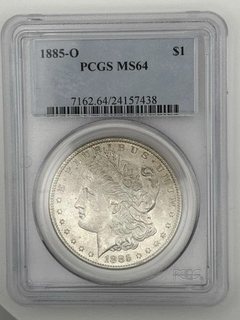
View on eBay

2026-W American Silver Eagle $1 Graded by NGC as Early Releases at MS70

2026-W American Silver Eagle · NGC MS70 Early Releases · West Point Mint · 1 troy oz .999 fine silver · Walking Liberty by German-born Adolph A. Weinman

$255.77 2026 NGC MS70 American Silver Eagles

Description

A 2026-W American Silver Eagle, certified and sealed by NGC at MS70 with the Early Releases designation, on a label reading "Struck at West Point Mint." The certification number on the label, 8695566-010, can be checked on the NGC website. The photos show this exact coin and holder.

Mint specifications: 1 troy oz of .999 fine silver; 40.6 mm; $1 face value. These are the Mint's standard figures; the coin has not been removed from its holder.

Read the full description

The 2026-W

The "W" mint mark means West Point, New York: built in 1937 as "the Fort Knox of Silver," it became an official US Mint on March 31, 1988. NGC gives the Early Releases designation to coins it or an NGC-approved depository received within their first 30 days of issue.

The Year 2026

2026 marks the 250th anniversary of American independence; the Mint's Semiquincentennial coins carry the dates "1776 ~ 2026." It is also the 100th anniversary of Route 66, whose number was won by Tulsa's Cyrus Avery, the "Father of Route 66"; our store is based in Tulsa.

The Design

The obverse is Adolph A. Weinman's Walking Liberty, first used on the half dollar of 1916–1947. Weinman was born in Durmersheim, near Karlsruhe, Germany, came to America at 14, and studied under Dublin-born sculptor Augustus Saint-Gaudens. When Walking Liberty first appeared in 1916, English-born George T. Morgan, designer of the Morgan dollar, was the Mint's assistant engraver; he became Chief Engraver the next year. The reverse, an eagle landing on a branch, is by Emily Damstra, introduced in 2021.

Grade And Authenticity

MS (Mint State) 70 is the top of the 1–70 scale. NGC, founded in 1987, has been the American Numismatic Association's official grading service since 1995. The seller also tested the metal through the holder with a calibrated Sigma Metalytics verifier (consistent with silver), inspected the holder for tampering (none found), and confirmed the certification number on the NGC website.

Also In Our Store

  • 1776–2026 Semiquincentennial "Enduring Liberty" half dollars.
  • Morgan dollars by English-born George T. Morgan, and Peace dollars by Sicilian-born Anthony de Francisci, who studied under Weinman.
  • A Walking Liberty coin cutout cuff bracelet, featuring Weinman's design.

Disclaimer

Specifications and detailed item descriptions are provided as a courtesy only and are not guaranteed to be one hundred percent accurate. Please do your own research. There are generally no receipts available for any items from original purchases. Any dimensions and/or weights are approximate. The absence of a more detailed condition report does not imply there are no condition issues with the item(s). Please inspect images carefully as they are part of the official item description and best representation of the actual condition. Additional images may be available upon request depending on time and availability. Not responsible for internet mis-translations or mis-identification of maker's marks if found or assumptions of makers or materials — item descriptions will indicate if it is assumed. If you see a problem, please message us immediately and we will do our best to sort out a solution and confirm the information. With the exception of eBay rules, no returns are accepted.
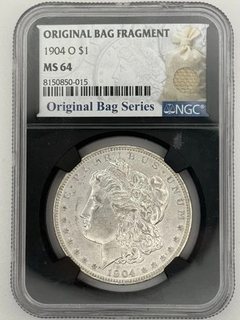
View on eBay

1884-O Morgan Silver Dollar $1 Coin — New Orleans Mint — NGC Graded MS62

1884-O Morgan Silver Dollar · NGC MS62 · New Orleans Mint · 90% silver · designed by Englishman George T. Morgan

$247.44 1884 NGC MS62 Morgan Silver Dollars

Description

An 1884-O Morgan silver dollar, certified and sealed by NGC at MS62. The certification number on the label can be checked on the NGC website. The photos show this exact coin and holder.

Mint specifications: 90% silver, 10% copper; 26.73 grams; 38.1 mm; 0.7734 troy oz of pure silver. These are the Mint's standard figures; the coin has not been removed from its holder.

Read the full description

The 1884-O

New Orleans struck 9,730,000 Morgan dollars in 1884.

The New Orleans Mint opened in 1838, struck half dollars for the Confederacy in 1861, and began striking Morgans in 1879. Since 1981 the building has been part of the Louisiana State Museum.

The Year 1884

On December 16, New Orleans, where this coin was struck, opened the World Cotton Centennial, a world's fair whose Main Building was the largest roofed structure yet built, lit by 5,000 electric lights. A dollar in 1884 had the buying power of roughly $32 to $36 today.

The Morgan Dollar

Isn't it remarkable that one of America's best-known collectible coins was designed by an Englishman, who went on to become Chief Engraver of the United States Mint?

George T. Morgan, from the Birmingham area of England, joined the US Mint in 1876 on the recommendation of Britain's Royal Mint. His model for Liberty was Anna Willess Williams of Philadelphia. In 1918 the Pittman Act melted over 270 million silver dollars, and sold much of the silver to Britain to back its currency in India.

Grade And Authenticity

MS (Mint State) 62 means no wear, with some marks. NGC, founded in 1987, has been the official grading service of the American Numismatic Association since 1995, with offices in Hong Kong, Shanghai, Munich and London. The seller also tested the metal through the holder with a calibrated Sigma Metalytics verifier (consistent with silver), inspected the holder for tampering (none found), and confirmed the certification number on the NGC website.

Also In Our Store

  • Victorian advertising trade cards, chromolithographed in the Morgan years.
  • Holiday postcards from the Golden Age of Postcards, many printed in Germany.
  • Peace dollars, designed by Sicilian-born Anthony de Francisci, and more world coins and banknotes.

Disclaimer

Specifications and detailed item descriptions are provided as a courtesy only and are not guaranteed to be one hundred percent accurate. Please do your own research. There are generally no receipts available for any items from original purchases. Any dimensions and/or weights are approximate. The absence of a more detailed condition report does not imply there are no condition issues with the item(s). Please inspect images carefully as they are part of the official item description and best representation of the actual condition. Additional images may be available upon request depending on time and availability. Not responsible for internet mis-translations or mis-identification of maker's marks if found or assumptions of makers or materials — item descriptions will indicate if it is assumed. If you see a problem, please message us immediately and we will do our best to sort out a solution and confirm the information. With the exception of eBay rules, no returns are accepted.
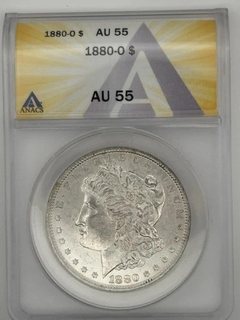
View on eBay

1904-O Morgan Silver Dollar $1 Coin —New Orleans Mint— Graded by PCGS at MS61

1904-O Morgan Silver Dollar · PCGS MS61 · New Orleans Mint · 90% silver · designed by Englishman George T. Morgan

$236.44 1904 PCGS MS61 Morgan Silver Dollars

Description

A 1904-O Morgan silver dollar, certified and sealed by PCGS at MS61. The certification number on the label can be checked on the PCGS website. The photos show this exact coin and holder.

Mint specifications: 90% silver, 10% copper; 26.73 grams; 38.1 mm; 0.7734 troy oz of pure silver. These are the Mint's standard figures; the coin has not been removed from its holder.

Read the full description

The 1904-O

New Orleans struck 3,720,000 Morgan dollars in 1904. It was the last year of regular Morgan production; the silver set aside by Congress ran out, and no more Morgans were struck until 1921.

The New Orleans Mint opened in 1838, struck half dollars for the Confederacy in 1861, and began striking Morgans in 1879. Since 1981 the building has been part of the Louisiana State Museum.

The Year 1904

On April 30, 1904, the St. Louis World's Fair opened to honor the centennial of the Louisiana Purchase, formally handed over at New Orleans' Cabildo, in the city where this coin was struck. The following year the Ida Glenn No. 1 struck oil south of Tulsa, where our store is based, launching the boom that made Tulsa "the Oil Capital of the World." A dollar in 1904 had the buying power of about $36 today.

The Morgan Dollar

Isn't it remarkable that one of America's best-known collectible coins was designed by an Englishman, who went on to become Chief Engraver of the United States Mint?

George T. Morgan, from the Birmingham area of England, joined the US Mint in 1876 on the recommendation of Britain's Royal Mint. His model for Liberty was Anna Willess Williams of Philadelphia. In 1918 the Pittman Act melted over 270 million silver dollars, and sold much of the silver to Britain to back its currency in India.

Grade And Authenticity

MS (Mint State) 61 means no wear at all, and the number rises as marks decrease and luster and strike improve. PCGS, founded in 1986, guarantees its grades. The seller also tested the metal through the holder with a calibrated Sigma Metalytics verifier (consistent with silver), inspected the holder for tampering (none found), and confirmed the certification number on the PCGS website.

Also In Our Store

  • Victorian advertising trade cards, chromolithographed in the Morgan years.
  • Holiday postcards from the Golden Age of Postcards, many printed in Germany.
  • Peace dollars, designed by Sicilian-born Anthony de Francisci, and more world coins and banknotes.

Disclaimer

Specifications and detailed item descriptions are provided as a courtesy only and are not guaranteed to be one hundred percent accurate. Please do your own research. There are generally no receipts available for any items from original purchases. Any dimensions and/or weights are approximate. The absence of a more detailed condition report does not imply there are no condition issues with the item(s). Please inspect images carefully as they are part of the official item description and best representation of the actual condition. Additional images may be available upon request depending on time and availability. Not responsible for internet mis-translations or mis-identification of maker's marks if found or assumptions of makers or materials — item descriptions will indicate if it is assumed. If you see a problem, please message us immediately and we will do our best to sort out a solution and confirm the information. With the exception of eBay rules, no returns are accepted.
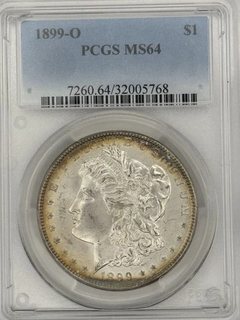
View on eBay

1878 España Spain 5 Pesetas Plata Silver Alfonso XII DE-M KM#676 [Est. BC+/MBC]

1878 Spain 5 Pesetas, .900 silver, Alfonso XII (second portrait), assayers DE-M, Madrid, KM#676 [Est. F-VF]

$233.93 1878 Est. BC+/MBC Spain

Description

An 1878 Spanish silver 5 pesetas of King Alfonso XII, second portrait, Madrid Mint, assayers D.E. and M (DE-M). Standard: .900 silver, 25 g, 37 mm (Numista N#2553). This coin: 24.47 g; 37.24 mm; 2.35 mm thick; a Sigma Metalytics verifier reads within range for 90% silver on its pre-1900 setting; 2.12 µΩ·cm / 47.4 MS/m (photos at the end). Continuous fleur-de-lis edge. The photos and video show this exact coin: the coin in the pictures is the coin you will receive.

Read the full description

Historical Context

1878 is the year the United States struck its first Morgan silver dollar, designed by Englishman George T. Morgan, while the Madrid Mint was striking these silver "duros" of Alfonso XII.

Condition

[Est. F-VF] Even circulation wear on the hair, cheek and shield; many fine hairlines; gray-brown toning with darker deposits in the legends and on the edge; a small rim bump below the date. The date stars are present, but their digits are worn and cannot be read. Not certified; grade is the seller's estimate. Please judge from the photos and video.

Shipping

Ships free within the US by USPS Ground Advantage with tracking.

Disclaimer

The images and any video show the actual item and are part of the official listing description, so please review them closely. Measurements and weights are approximate, and any maker or material we haven't confirmed is described as assumed. Questions? Message us; we answer quickly.

View on eBay

1888 España Spain 5 Pesetas Plata Silver Alfonso XIII Pelón MP-M [Est. MBC]

1888 Spain 5 Pesetas, .900 silver, Alfonso XIII "Pelón" infant portrait, date stars 18-88, MP-M, Madrid, KM#689 [Est. VF-XF]

$188.88 1888 Est. MBC Spain

Description

An 1888 Spanish silver 5 pesetas with the infant portrait of King Alfonso XIII, nicknamed "Pelón" (the bald one). Madrid Mint (six-pointed star), assayers M.P. and M (the common MP-M variety), date stars reading 88. Standard: .900 silver, 25 g, 37 mm (Numista N#4009). This coin: 24.76 g; 37.36 mm; 2.42 mm thick; a Sigma Metalytics verifier reads within range for 90% silver. Continuous fleur-de-lis edge. The photos and video show this exact coin: the coin in the pictures is the coin you will receive.

Read the full description

Historical Context

Alfonso XIII was born at the Royal Palace of Madrid on May 17, 1886, the posthumous son of Alfonso XII, and was king from birth. His mother, Maria Christina of Austria, served as regent until 1902, which is why this coin shows a king not yet two years old.

Condition

[Est. VF-XF] Wear on the hair and cheek; many fine hairlines in both fields; a few dark toning spots on the face and reverse. Not certified; grade is the seller's estimate. Please judge from the photos and video.

Shipping

Ships free within the US by USPS Ground Advantage with tracking.

Disclaimer

The images and any video show the actual item and are part of the official listing description, so please review them closely. Measurements and weights are approximate, and any maker or material we haven't confirmed is described as assumed. Questions? Message us; we answer quickly.

View on eBay

1882-O Morgan Silver Dollar Coin US $1 — New Orleans Mint — NGC Graded AU55

1882-O Morgan Silver Dollar · NGC AU55 · New Orleans Mint · 90% silver · designed by Englishman George T. Morgan

$187.77 1882 NGC AU55 Morgan Silver Dollars

Description

An 1882-O Morgan silver dollar, certified and sealed by NGC at AU55. The certification number on the label can be checked on the NGC website. The photos show this exact coin and holder.

Mint specifications: 90% silver, 10% copper; 26.73 grams; 38.1 mm; 0.7734 troy oz of pure silver. These are the Mint's standard figures; the coin has not been removed from its holder.

Read the full description

The 1882-O

New Orleans struck 6,090,000 Morgan dollars in 1882.

The New Orleans Mint opened in 1838, struck half dollars for the Confederacy in 1861, and began striking Morgans in 1879. Since 1981 the building has been part of the Louisiana State Museum.

The Year 1882

On August 29, Australia beat England at the Oval, prompting a mock obituary for English cricket that gave birth to "The Ashes." The same year the Krewe of Proteus was founded in New Orleans, where this coin was struck; it is today the oldest continuously parading Old Line Mardi Gras krewe. A dollar in 1882 had the buying power of roughly $31 to $34 today.

The Morgan Dollar

Isn't it remarkable that one of America's best-known collectible coins was designed by an Englishman, who went on to become Chief Engraver of the United States Mint?

George T. Morgan, from the Birmingham area of England, joined the US Mint in 1876 on the recommendation of Britain's Royal Mint. His model for Liberty was Anna Willess Williams of Philadelphia. In 1918 the Pittman Act melted over 270 million silver dollars, and sold much of the silver to Britain to back its currency in India.

Grade And Authenticity

AU (About Uncirculated) 55 means only traces of wear. NGC, founded in 1987, has been the official grading service of the American Numismatic Association since 1995, with offices in Hong Kong, Shanghai, Munich and London. The seller also tested the metal through the holder with a calibrated Sigma Metalytics verifier (consistent with silver), inspected the holder for tampering (none found), and confirmed the certification number on the NGC website.

Also In Our Store

  • Victorian advertising trade cards, chromolithographed in the Morgan years.
  • Holiday postcards from the Golden Age of Postcards, many printed in Germany.
  • Peace dollars, designed by Sicilian-born Anthony de Francisci, and more world coins and banknotes.

Disclaimer

Specifications and detailed item descriptions are provided as a courtesy only and are not guaranteed to be one hundred percent accurate. Please do your own research. There are generally no receipts available for any items from original purchases. Any dimensions and/or weights are approximate. The absence of a more detailed condition report does not imply there are no condition issues with the item(s). Please inspect images carefully as they are part of the official item description and best representation of the actual condition. Additional images may be available upon request depending on time and availability. Not responsible for internet mis-translations or mis-identification of maker's marks if found or assumptions of makers or materials — item descriptions will indicate if it is assumed. If you see a problem, please message us immediately and we will do our best to sort out a solution and confirm the information. With the exception of eBay rules, no returns are accepted.
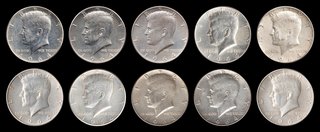
View on eBay

1883-O Morgan Silver Dollar $1 Coin — New Orleans Mint — NGC Graded AU55

1883-O Morgan Silver Dollar · NGC AU55 · New Orleans Mint · 90% silver · designed by Englishman George T. Morgan

$187.22 1883 NGC AU55 Morgan Silver Dollars

Description

An 1883-O Morgan silver dollar, certified and sealed by NGC at AU55. The certification number on the label can be checked on the NGC website. The photos show this exact coin and holder.

Mint specifications: 90% silver, 10% copper; 26.73 grams; 38.1 mm; 0.7734 troy oz of pure silver. These are the Mint's standard figures; the coin has not been removed from its holder.

Read the full description

The 1883-O

New Orleans struck 8,725,000 Morgan dollars in 1883.

The New Orleans Mint opened in 1838, struck half dollars for the Confederacy in 1861, and began striking Morgans in 1879. Since 1981 the building has been part of the Louisiana State Museum.

The Year 1883

The first Orient Express left Paris for Vienna, and the Brooklyn Bridge opened. Near Tulsa, where our store is based, Catoosa opened its first post office; today barges from Catoosa's river port reach New Orleans, where this coin was struck. A dollar in 1883 had the buying power of roughly $31 to $35 today.

The Morgan Dollar

Isn't it remarkable that one of America's best-known collectible coins was designed by an Englishman, who went on to become Chief Engraver of the United States Mint?

George T. Morgan, from the Birmingham area of England, joined the US Mint in 1876 on the recommendation of Britain's Royal Mint. His model for Liberty was Anna Willess Williams of Philadelphia. In 1918 the Pittman Act melted over 270 million silver dollars, and sold much of the silver to Britain to back its currency in India.

Grade And Authenticity

AU (About Uncirculated) 55 means only traces of wear. NGC, founded in 1987, has been the official grading service of the American Numismatic Association since 1995, with offices in Hong Kong, Shanghai, Munich and London. The seller also tested the metal through the holder with a calibrated Sigma Metalytics verifier (consistent with silver), inspected the holder for tampering (none found), and confirmed the certification number on the NGC website.

Also In Our Store

  • Victorian advertising trade cards, chromolithographed in the Morgan years.
  • Holiday postcards from the Golden Age of Postcards, many printed in Germany.
  • Peace dollars, designed by Sicilian-born Anthony de Francisci, and more world coins and banknotes.

Disclaimer

Specifications and detailed item descriptions are provided as a courtesy only and are not guaranteed to be one hundred percent accurate. Please do your own research. There are generally no receipts available for any items from original purchases. Any dimensions and/or weights are approximate. The absence of a more detailed condition report does not imply there are no condition issues with the item(s). Please inspect images carefully as they are part of the official item description and best representation of the actual condition. Additional images may be available upon request depending on time and availability. Not responsible for internet mis-translations or mis-identification of maker's marks if found or assumptions of makers or materials — item descriptions will indicate if it is assumed. If you see a problem, please message us immediately and we will do our best to sort out a solution and confirm the information. With the exception of eBay rules, no returns are accepted.
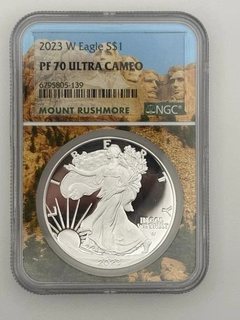
View on eBay

1882-O Morgan Silver Dollar US $1 Coin —New Orleans Mint— Graded by NGC at AU55

1882-O Morgan Silver Dollar · NGC AU55 · New Orleans Mint · 90% silver · designed by Englishman George T. Morgan

$186.87 1882 NGC AU55 Morgan Silver Dollars

Description

An 1882-O Morgan silver dollar, certified and sealed by NGC at AU55. The certification number on the label can be checked on the NGC website. The photos show this exact coin and holder.

Mint specifications: 90% silver, 10% copper; 26.73 grams; 38.1 mm; 0.7734 troy oz of pure silver. These are the Mint's standard figures; the coin has not been removed from its holder.

Read the full description

The 1882-O

New Orleans struck 6,090,000 Morgan dollars in 1882.

The New Orleans Mint opened in 1838, struck half dollars for the Confederacy in 1861, and began striking Morgans in 1879. Since 1981 the building has been part of the Louisiana State Museum.

The Year 1882

On August 29, Australia beat England at the Oval, prompting a mock obituary for English cricket that gave birth to "The Ashes." The same year the Krewe of Proteus was founded in New Orleans, where this coin was struck; it is today the oldest continuously parading Old Line Mardi Gras krewe. A dollar in 1882 had the buying power of roughly $31 to $34 today.

The Morgan Dollar

Isn't it remarkable that one of America's best-known collectible coins was designed by an Englishman, who went on to become Chief Engraver of the United States Mint?

George T. Morgan, from the Birmingham area of England, joined the US Mint in 1876 on the recommendation of Britain's Royal Mint. His model for Liberty was Anna Willess Williams of Philadelphia. In 1918 the Pittman Act melted over 270 million silver dollars, and sold much of the silver to Britain to back its currency in India.

Grade And Authenticity

AU (About Uncirculated) 55 means only traces of wear. NGC, founded in 1987, has been the official grading service of the American Numismatic Association since 1995, with offices in Hong Kong, Shanghai, Munich and London. The seller also tested the metal through the holder with a calibrated Sigma Metalytics verifier (consistent with silver), inspected the holder for tampering (none found), and confirmed the certification number on the NGC website.

Also In Our Store

  • Victorian advertising trade cards, chromolithographed in the Morgan years.
  • Holiday postcards from the Golden Age of Postcards, many printed in Germany.
  • Peace dollars, designed by Sicilian-born Anthony de Francisci, and more world coins and banknotes.

Disclaimer

Specifications and detailed item descriptions are provided as a courtesy only and are not guaranteed to be one hundred percent accurate. Please do your own research. There are generally no receipts available for any items from original purchases. Any dimensions and/or weights are approximate. The absence of a more detailed condition report does not imply there are no condition issues with the item(s). Please inspect images carefully as they are part of the official item description and best representation of the actual condition. Additional images may be available upon request depending on time and availability. Not responsible for internet mis-translations or mis-identification of maker's marks if found or assumptions of makers or materials — item descriptions will indicate if it is assumed. If you see a problem, please message us immediately and we will do our best to sort out a solution and confirm the information. With the exception of eBay rules, no returns are accepted.
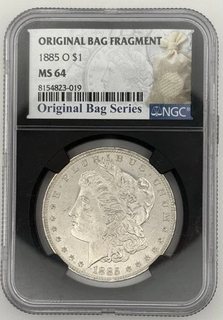
View on eBay

Large Porcelain Hinged Jewelry Trinket Box Pink Yellow Roses RS Prussia Style

Large Vintage Porcelain Hinged Jewelry Box with Pink and Yellow Roses, Gold-Tone Rope-Twist Frame and Clasp, RS Wreath and Star Mark, R.S. Prussia Style, About 11 Inches Wide, From My Grandmother's Dresser

$164.64 Jewelry/Trinket Boxes

Description

A large porcelain jewelry box with a domed, canted-corner lid on a shaped base, set in a gold-tone metal frame with a rope-twist edge, a rear hinge and a front clasp. Pink and yellow roses with green leaves on a soft pink, blue and white ground, shading to peach at the rims, with gold lines. The rose spray repeats inside the lid and on the inside floor. The roses are a printed transfer, as the close-ups show. About 11 in wide, 7 in deep and 5.75 in high; about 3.1 lb.

Read the full description

The Mark

Red-brown RS inside a leafy wreath with a star above, on the underside. The mark does not include the word "Prussia" or a country name. The R.S. wreath mark is known to have been copied, and we have found no evidence that settles the maker or country either way, so we describe this piece as R.S. Prussia style and make no claim that it is original or reproduction. Please see the photo of the mark.

Condition

Excellent vintage condition. Light crazing in the outer glaze across the yellow roses. A small glaze bubble and a few rough spots from manufacture. Please see all images; they are part of the description.

Provenance

This jewelry box sat on my grandmother's dresser when I was a young child and has been in our family for more than 50 years.

Also In Our Store

Disclaimer

The images and any video show the actual item and are part of the official listing description, so please review them closely. Measurements and weights are approximate, and any maker or material we haven't confirmed is described as assumed. Questions? Message us; we answer quickly.

View on eBay

1964 Kennedy Half Dollar Lot of 5 Brilliant UNC 90% Silver 4 P 1 D [Est. MS+]

1964 Kennedy Half Dollars, Lot of 5: Four Philadelphia and One Denver, 90% Silver, Matched Brilliant Uncirculated [Est. MS+]

$162.11 1964 Est. MS+ Kennedy Half Dollars (1964)

Description

Five 1964 Kennedy half dollars, hand-matched for the same bright, mirror-like luster: four from the Philadelphia Mint (no mint mark) and one from Denver (D mint mark, on the reverse to the left of the eagle's tail). Each coin: 12.50 grams, 90% silver, 10% copper, 0.3617 troy oz of silver, 30.6 mm, reeded edge. Raw coins, never professionally graded.

Read the full description

Historical Context

Congress authorized the Kennedy half dollar in December 1963, weeks after President Kennedy's assassination, and the first coins were released in March 1964. Chief Engraver Gilroy Roberts sculpted the portrait (his GR monogram is on the truncation of the neck); Frank Gasparro designed the reverse from the Presidential Seal (his FG is near the eagle's tail feathers). 1964 is the only year the Kennedy half was struck in 90% silver for circulation; from 1965 the silver content dropped to 40%.

Condition

Uncirculated, our conservative estimate MS+ (not professionally graded). Bright luster with scattered light contact marks typical of roll coins. The Denver coin has a long thin contact mark above WE TRUST and light surface marks near LIBERTY. See the photos of each coin, obverse and reverse.

Disclaimer

The images and any video show the actual item and are part of the official listing description, so please review them closely. Measurements and weights are approximate, and any maker or material we haven't confirmed is described as assumed. Questions? Message us; we answer quickly.

View on eBay

1926 1927 Nestle Lactogen Die Cut Can Booklet Calendar Infant Feeding Physician

Nestlé's Lactogen — Die-Cut Can Booklet with 1926-1927 Calendar

$157.27 1926 Booklets

Vintage advertising booklet, die-cut in the shape of a Lactogen can, printed in one dark blue ink on tan stock, issued 1925. Approx. 3.60 x 5.00 in. closed, 7.20 x 5.00 in. open flat. Stapled.

The front cover is the can itself: “LACTOGEN,” A Basic Diet for Infants, A NESTLÉ Product, with the trademark of a bird feeding its young in a nest, and the line Prepared in U.S. America by Nestlé's Food Co. Inc., 130 William St., New York, N.Y., U.S.A. The back cover is a calendar for 1926 and 1927.

Inside are three spreads written for doctors. The first compares the Advantages of “Lactogen” Over Cow's Milk point by point, and sets out An Interesting Parallel quoting Dr. Kerley's Practice of Pediatrics, with an analysis table comparing Lactogen, dry and diluted, with average breast milk after Dunn's Pediatrics of 1917. It notes that the Complete “Lactogen” Book is mailed to physicians upon request. The second spread is a Differential Diagnosis Table of Nutritional Disturbances of Infancy, credited to “Infant Feeding,” 1922, by C. G. Grulee, A.M., M.D., LL.D. The third is an Obstetric Table for calculating a due date from the first day of the last menstruation, based on an average gestation of 280 days.

Read the full description

Historical Context

This was not written for mothers. It was a desk piece for a doctor, with a calendar on the back so it stayed on the desk all year, and tables inside he might actually reach for. Every time he used them, the can was on the cover.

The obstetric table is still correct: the 280-day rule it uses is the one obstetricians use today. The diagnosis table is very much of its time, and it is what makes the booklet a real document of how American infant feeding was argued over in the 1920s.

Condition

Light edge wear and faint surface soiling; both staples present; the covers and all three inside spreads are complete and the text fully legible. Please view the images carefully.

About The Printing

This is a twentieth-century commercial printing, not a Victorian chromolithograph. It is printed in a single dark blue ink on tan stock, laid down as solid areas of color with crisp edges rather than blended tone.

Under magnification the ink sits in solid fields with no dot structure and no four-color rosette. The exact press method cannot be determined with certainty from a scan, so none is claimed here.

Provenance

This item comes from the personal collections of my family estate, accumulated over more than 200 years — including items that came west by wagon train to Colorado and later to Oklahoma. Now that my parents have passed we cannot keep all of these cherished items. They were well-educated antiques collectors/traders and continued to build their collections over more than 60 years. The vast majority of the pieces are from the Victorian Era, however there are plenty of older and newer items. Everything has been stored in a climate-controlled environment over time.

Disclaimer

Specifications and detailed item descriptions are provided as a courtesy only and are not guaranteed to be one hundred percent accurate. Please do your own research. There are generally no receipts available for any items from original purchases. Any dimensions and/or weights are approximate. The absence of a more detailed condition report does not imply there are no condition issues with the item(s). Please inspect images carefully as they are part of the official item description and best representation of the actual condition. Additional images may be available upon request depending on time and availability. Not responsible for internet mis-translations or mis-identification of maker's marks if found or assumptions of makers or materials — item descriptions will indicate if it is assumed. If you see a problem, please message us immediately and we will do our best to sort out a solution and confirm the information. With the exception of eBay rules, no returns are accepted.
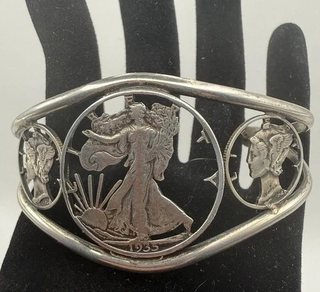
View on eBay

1885-O Morgan Silver Dollar $1 Coin —New Orleans Mint— PCGS Graded at MS63

1885-O Morgan Silver Dollar · PCGS MS63 · New Orleans Mint · 90% silver · designed by Englishman George T. Morgan

$151.36 1885 PCGS MS63 Morgan Silver Dollars

Description

An 1885-O Morgan silver dollar from the New Orleans Mint, certified and sealed by PCGS at MS63. The certification number on the label can be checked on the PCGS website. The photos show this exact coin and holder.

Mint specifications: 90% silver, 10% copper; 26.73 grams; 38.1 mm; 0.7734 troy oz of pure silver. These are the Mint's standard figures; the coin has not been removed from its holder.

Read the full description

The 1885-O

New Orleans struck 9,185,000 Morgan dollars in 1885.

The New Orleans Mint opened in 1838, struck half dollars for the Confederacy in 1861, and began striking Morgans in 1879. Since 1981 the building has been part of the Louisiana State Museum.

The Year 1885

On June 17, 1885, the Statue of Liberty arrived in New York Harbor from France aboard the French ship Isère, packed in more than 200 crates. Her crown of rays later inspired Liberty's crown on the Peace dollar. A dollar in 1885 had the buying power of roughly $33 to $36 today.

The Morgan Dollar

Isn't it remarkable that one of America's best-known collectible coins was designed by an Englishman, who went on to become Chief Engraver of the United States Mint?

George T. Morgan, from the Birmingham area of England, joined the US Mint in 1876 on the recommendation of Britain's Royal Mint. His model for Liberty was Anna Willess Williams of Philadelphia. In 1918 the Pittman Act melted over 270 million silver dollars, and sold much of the silver to Britain to back its currency in India.

Grade And Authenticity

MS (Mint State) 63 means no wear; within MS 60 to 70, the number rises as marks decrease and luster and strike improve. PCGS, founded in 1986, guarantees its grades. The seller also tested the metal through the holder with a calibrated Sigma Metalytics verifier (consistent with silver), inspected the holder for tampering (none found), and confirmed the certification number on the PCGS website.

Also In Our Store

  • Peace dollars by Sicilian-born Anthony de Francisci, whose Liberty wears a crown of rays inspired by the Statue of Liberty.
  • Victorian advertising trade cards, chromolithographed in the Morgan years.
  • Holiday postcards from the Golden Age of Postcards, many printed in Germany, and more world coins and banknotes.

Disclaimer

Specifications and detailed item descriptions are provided as a courtesy only and are not guaranteed to be one hundred percent accurate. Please do your own research. There are generally no receipts available for any items from original purchases. Any dimensions and/or weights are approximate. The absence of a more detailed condition report does not imply there are no condition issues with the item(s). Please inspect images carefully as they are part of the official item description and best representation of the actual condition. Additional images may be available upon request depending on time and availability. Not responsible for internet mis-translations or mis-identification of maker's marks if found or assumptions of makers or materials — item descriptions will indicate if it is assumed. If you see a problem, please message us immediately and we will do our best to sort out a solution and confirm the information. With the exception of eBay rules, no returns are accepted.
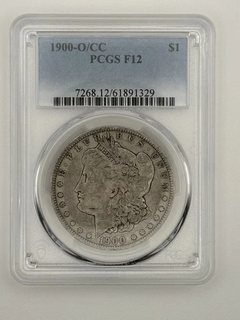
View on eBay

1976-S Bicentennial Eisenhower $1 Coin —San Francisco Mint— Graded PCGS at MS66

1776–1976-S Eisenhower Dollar · Bicentennial · PCGS MS66 · San Francisco Mint · 40% silver

$149.95 1976 PCGS MS66 Eisenhower Dollars

Description

A 1776–1976-S Bicentennial Eisenhower dollar in 40% silver, certified and sealed by PCGS at MS66. The certification number on the label, 58430981, can be checked on the PCGS website. The photos show this exact coin and holder.

Read the full description

The Bicentennial Dollar

For the Bicentennial the Mint dual-dated the dollar "1776–1976." The reverse, the Liberty Bell over the Moon, was designed by Dennis R. Williams, a 22-year-old art student and the youngest person to that point to design a US coin; Frank Gasparro, who also designed the obverse, modified it. The 40% silver dollars were struck at San Francisco and sold as uncirculated and proof coins. All of the silver pieces have the Type I lettering.

The San Francisco Mint

The San Francisco Mint opened in 1854 for the Gold Rush. In the 1906 earthquake its building survived under Superintendent Frank A. Leach, holding a third of the nation's gold reserves.

The Eisenhower Dollar

On December 31, 1970, minutes before midnight, President Nixon signed the law that created the Eisenhower dollar, took the silver out of the half dollar, and authorized the GSA sale of the Treasury's Carson City silver dollars.

Grade And Authenticity

MS (Mint State) 66 means no wear; within MS 60 to 70, the number rises as marks decrease and luster and strike improve. PCGS was founded by seven dealers in California and opened for business on February 3, 1986, with a guarantee of grading accuracy. The seller also tested the metal through the holder with a calibrated Sigma Metalytics verifier (consistent with silver), inspected the holder for tampering (none found), and confirmed the certification number on the PCGS website.

Also In Our Store

  • 1970-S Kennedy proof half dollars, the last silver-clad year, ended by the same 1970 law.
  • An 1883-O Morgan dollar in its original GSA soft pack.
  • More Eisenhower dollars, including 1971, 1972 and 1974 dates.

Disclaimer

Specifications and detailed item descriptions are provided as a courtesy only and are not guaranteed to be one hundred percent accurate. Please do your own research. There are generally no receipts available for any items from original purchases. Any dimensions and/or weights are approximate. The absence of a more detailed condition report does not imply there are no condition issues with the item(s). Please inspect images carefully as they are part of the official item description and best representation of the actual condition. Additional images may be available upon request depending on time and availability. Not responsible for internet mis-translations or mis-identification of maker's marks if found or assumptions of makers or materials — item descriptions will indicate if it is assumed. If you see a problem, please message us immediately and we will do our best to sort out a solution and confirm the information. With the exception of eBay rules, no returns are accepted.
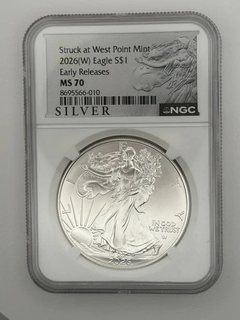
View on eBay

1924-P Peace Dollar $1 Coin — PCGS Graded as Genuine Cleaned-XF Detail

1924-P Peace Silver Dollar · PCGS Genuine, Cleaned – XF Details · Philadelphia Mint · 90% silver · designed by Sicilian-born Anthony de Francisci

$147.36 1924 Peace Silver Dollars

Description

A 1924-P Peace silver dollar from the Philadelphia Mint (no mint mark), certified by PCGS as Genuine, Cleaned – XF Details. The certification number on the label can be checked on the PCGS website. The photos show this exact coin and holder.

Mint specifications: 90% silver, 10% copper; 26.73 grams; 38.1 mm; 0.7734 troy oz of pure silver. These are the Mint's standard figures; the coin has not been removed from its holder.

Read the full description

The 1924 Peace Dollar

Philadelphia struck 11,811,000 Peace dollars in 1924. The Philadelphia Mint, America's first, was created by the Coinage Act of 1792 and delivered the nation's first circulating coins in March 1793. Every one of the 1,006,473 Peace dollars dated 1921 was struck here.

The Year 1924

From January 25 to February 5, 1924, Chamonix, France, hosted 304 athletes from 16 nations at what the IOC later named the first Winter Olympic Games. A dollar in 1924 had the buying power of about $19 today.

The Peace Dollar

Isn't it remarkable that the coin America struck to celebrate peace after the First World War was designed by a young Sicilian immigrant, and modeled on his Italian-born wife?

Anthony de Francisci, born in Palermo, Sicily, in 1887, won the design competition in December 1921; Liberty's face is based on his wife, Teresa, born in Laurenzana, Italy. The coin followed the Pittman Act of 1918, which melted 270 million silver dollars and sold their silver to Britain to steady the currency of British India, and the 1921 resolution formally ending America's war with Germany and Austria-Hungary. English-born Chief Engraver George T. Morgan removed a broken sword from the first reverse before Christmas 1921.

Grade And Authenticity

PCGS does not give a numeric grade to cleaned coins, but it will authenticate them and assign a "details" grade: this label means genuine, cleaned at some point in its life, with wear equal to Extremely Fine (XF 40 shows light wear). PCGS, founded in 1986, guarantees its grades. The coin is offered as a genuine, certified example, priced to reflect the cleaning. The seller also tested the metal through the holder with a calibrated Sigma Metalytics verifier (consistent with silver), inspected the holder for tampering (none found), and confirmed the certification number on the PCGS website.

Also In Our Store

  • Morgan dollars, designed by English-born George T. Morgan, who removed the broken sword from the Peace dollar.
  • Victorian advertising trade cards, chromolithographed in the Morgan years.
  • Holiday postcards from the Golden Age of Postcards, many printed in Germany, and more world coins and banknotes.

Disclaimer

Specifications and detailed item descriptions are provided as a courtesy only and are not guaranteed to be one hundred percent accurate. Please do your own research. There are generally no receipts available for any items from original purchases. Any dimensions and/or weights are approximate. The absence of a more detailed condition report does not imply there are no condition issues with the item(s). Please inspect images carefully as they are part of the official item description and best representation of the actual condition. Additional images may be available upon request depending on time and availability. Not responsible for internet mis-translations or mis-identification of maker's marks if found or assumptions of makers or materials — item descriptions will indicate if it is assumed. If you see a problem, please message us immediately and we will do our best to sort out a solution and confirm the information. With the exception of eBay rules, no returns are accepted.
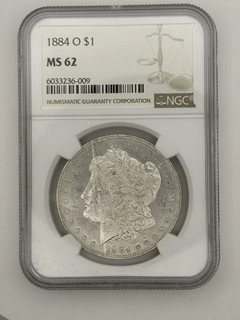
View on eBay

1922-P Peace Dollar $1 Silver Coin —Philadelphia Mint— CAC AU58

1922-P Peace Silver Dollar · CACG AU58 · Philadelphia Mint · 90% silver · designed by Sicilian-born Anthony de Francisci

$144.27 1922 Peace Silver Dollars

Description

A 1922-P Peace silver dollar from the Philadelphia Mint (no mint mark), certified and sealed by CAC Grading (CACG) at AU58. The certification number on the label can be checked on the grading company's website. The photos show this exact coin and holder.

This coin was graded by CAC Grading (CACG), which applies the standard behind CAC's well-known green sticker. The back of the holder carries a QR code linking to CACgrading.com.

Mint specifications: 90% silver, 10% copper; 26.73 grams; 38.1 mm; 0.7734 troy oz of pure silver. These are the Mint's standard figures; the coin has not been removed from its holder.

Read the full description

The 1922 Peace Dollar

Philadelphia struck 51,737,000 Peace dollars in 1922.

Philadelphia, America's first mint, was created by the Coinage Act of April 2, 1792, and George Washington chose the scientist David Rittenhouse as its first director. Every one of the 1,006,473 Peace dollars dated 1921 was struck here. Philadelphia coins carry no mint mark.

The Year 1922

On November 4, 1922, Howard Carter's team uncovered the first step of Tutankhamun's tomb in Egypt's Valley of the Kings, reaching its treasure-filled antechamber on November 26. A dollar in 1922 had the buying power of about $19 today.

The Peace Dollar

Isn't it remarkable that the coin America struck to celebrate peace after the First World War was designed by a young Sicilian immigrant, and modeled on his Italian-born wife?

Anthony de Francisci, born in Palermo, Sicily, in 1887, came to the United States in 1905 and in December 1921 won an invitation-only design competition. Liberty's face is based on his wife, Teresa, born in Laurenzana in Italy's Basilicata region. Numismatist Farran Zerbe proposed it to restore the 270 million silver dollars melted under the Pittman Act of 1918, their silver sold to Britain to steady the currency of British India. In July 1921 the Knox–Porter Resolution formally ended America's war with Germany and Austria-Hungary, and the first Peace dollar was struck that December 28.

Grade And Authenticity

AU (About Uncirculated) 58 shows only traces of wear. CAC, founded in 2007 by John Albanese, spent years re-examining coins already graded by PCGS and NGC and adding a green sticker, the "green bean," when it judged a coin "solid for the grade it was assigned." On October 2, 2023, CAC Grading (CACG) began grading coins itself under the same standard. The seller also tested the metal through the holder with a calibrated Sigma Metalytics verifier (consistent with silver), inspected the holder for tampering (none found), and confirmed the certification number on the CACG website.

Also In Our Store

  • Morgan dollars, designed by English-born George T. Morgan.
  • Holiday postcards from the Golden Age of Postcards, many printed in Germany.
  • Victorian advertising trade cards, and more world coins and banknotes.

Disclaimer

Specifications and detailed item descriptions are provided as a courtesy only and are not guaranteed to be one hundred percent accurate. Please do your own research. There are generally no receipts available for any items from original purchases. Any dimensions and/or weights are approximate. The absence of a more detailed condition report does not imply there are no condition issues with the item(s). Please inspect images carefully as they are part of the official item description and best representation of the actual condition. Additional images may be available upon request depending on time and availability. Not responsible for internet mis-translations or mis-identification of maker's marks if found or assumptions of makers or materials — item descriptions will indicate if it is assumed. If you see a problem, please message us immediately and we will do our best to sort out a solution and confirm the information. With the exception of eBay rules, no returns are accepted.
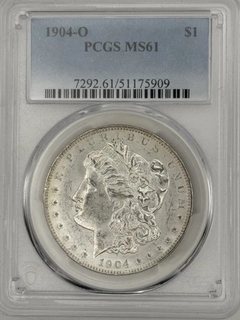
View on eBay

1922 Peace $1 Silver Dollar NGC MS63 Original Bag Fragment Philadelphia

1922-P Peace Silver Dollar · NGC MS63 · Philadelphia Mint · 90% silver · designed by Sicilian-born Anthony de Francisci

$138.88 1922 NGC MS63 Peace Silver Dollars

Description

A 1922-P Peace silver dollar from the Philadelphia Mint (no mint mark), certified and sealed by NGC at MS63. The certification number on the label can be checked on the grading company's website. The photos show this exact coin and holder.

The holder carries NGC's special "Original Bag Fragment" label, set with a small, real piece of vintage canvas cut from historical U.S. Treasury, Federal Reserve and early bank bags. It is not represented as the bag this particular coin came from.

Mint specifications: 90% silver, 10% copper; 26.73 grams; 38.1 mm; 0.7734 troy oz of pure silver. These are the Mint's standard figures; the coin has not been removed from its holder.

Read the full description

The 1922 Peace Dollar

Philadelphia struck 51,737,000 Peace dollars in 1922.

Philadelphia, America's first mint, was created by the Coinage Act of April 2, 1792, and George Washington chose the scientist David Rittenhouse as its first director. Every one of the 1,006,473 Peace dollars dated 1921 was struck here. Philadelphia coins carry no mint mark.

The Year 1922

On November 4, 1922, Howard Carter's team uncovered the first step of Tutankhamun's tomb in Egypt's Valley of the Kings, reaching its treasure-filled antechamber on November 26. A dollar in 1922 had the buying power of about $19 today.

The Peace Dollar

Isn't it remarkable that the coin America struck to celebrate peace after the First World War was designed by a young Sicilian immigrant, and modeled on his Italian-born wife?

Anthony de Francisci, born in Palermo, Sicily, in 1887, came to the United States in 1905 and in December 1921 won an invitation-only design competition. Liberty's face is based on his wife, Teresa, born in Laurenzana in Italy's Basilicata region. Numismatist Farran Zerbe proposed it to restore the 270 million silver dollars melted under the Pittman Act of 1918, their silver sold to Britain to steady the currency of British India. In July 1921 the Knox–Porter Resolution formally ended America's war with Germany and Austria-Hungary, and the first Peace dollar was struck that December 28.

Grade And Authenticity

MS (Mint State) 63 means no wear at all, and the number rises as marks decrease and luster and strike improve. NGC, founded in 1987 by John Albanese, is the official grading service of the American Numismatic Association, with offices in Hong Kong, Shanghai, Munich and London. The seller also tested the metal through the holder with a calibrated Sigma Metalytics verifier (consistent with silver), inspected the holder for tampering (none found), and confirmed the certification number on the NGC website.

Also In Our Store

  • Morgan dollars, designed by English-born George T. Morgan.
  • Holiday postcards from the Golden Age of Postcards, many printed in Germany.
  • Victorian advertising trade cards, and more world coins and banknotes.

Disclaimer

Specifications and detailed item descriptions are provided as a courtesy only and are not guaranteed to be one hundred percent accurate. Please do your own research. There are generally no receipts available for any items from original purchases. Any dimensions and/or weights are approximate. The absence of a more detailed condition report does not imply there are no condition issues with the item(s). Please inspect images carefully as they are part of the official item description and best representation of the actual condition. Additional images may be available upon request depending on time and availability. Not responsible for internet mis-translations or mis-identification of maker's marks if found or assumptions of makers or materials — item descriptions will indicate if it is assumed. If you see a problem, please message us immediately and we will do our best to sort out a solution and confirm the information. With the exception of eBay rules, no returns are accepted.
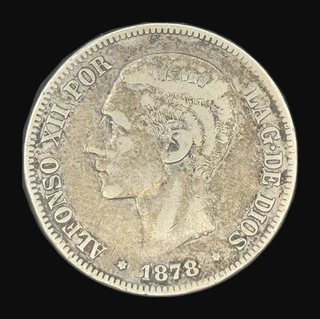
View on eBay

1926-S Peace Silver Dollar $1 ANACS MS60 Details Cleaned VAM-4A Top 50 Variety

1926-S Peace Silver Dollar · ANACS MS60 Details, Cleaned · VAM-4A Top 50 · San Francisco Mint · 90% silver · designed by Sicilian-born Anthony de Francisci

$138.63 1926 ANACS MS60 Peace Silver Dollars

Description

A 1926-S Peace silver dollar from the San Francisco Mint, certified and sealed by ANACS. The label reads: 1926-S $ · VAM-4A TOP 50 · CLEANED · MS 60 DETAILS. The certification number on the label can be checked on the ANACS website. The photos show this exact coin and holder.

Mint specifications: 90% silver, 10% copper; 26.73 grams; 38.1 mm; 0.7734 troy oz of pure silver. These are the Mint's standard figures; the coin has not been removed from its holder.

Read the full description

The 1926-S Peace Dollar

San Francisco struck 6,980,000 Peace dollars in 1926. The San Francisco Mint opened in 1854 to turn California Gold Rush gold into coin. Its 1874 building, built with sandstone imported from British Columbia, survived the 1906 earthquake and fire while holding a third of the nation's gold reserves.

The Year 1926

In 1926 Tulsa's Cyrus Avery, the "Father of Route 66," won the number 66 for the Chicago–Los Angeles highway. Route 66 celebrates its 100th anniversary in 2026, and near Tulsa the Blue Whale of Catoosa reopened with a new visitor center on May 30, 2026. A dollar in 1926 had the buying power of about $18 today.

The Peace Dollar

Isn't it remarkable that the coin America struck to celebrate peace after the First World War was designed by a young Sicilian immigrant, and modeled on his Italian-born wife?

Anthony de Francisci, born in Palermo, Sicily, in 1887, won the design competition in December 1921; Liberty's face is based on his wife, Teresa, born in Laurenzana, Italy. The coin followed the Pittman Act of 1918, which melted 270 million silver dollars and sold their silver to Britain to steady the currency of British India, and the 1921 resolution formally ending America's war with Germany and Austria-Hungary. English-born Chief Engraver George T. Morgan removed a broken sword from the first reverse before Christmas 1921.

Grade And Authenticity

"MS 60 DETAILS, CLEANED" means ANACS found the coin genuine, with Mint State detail, but cleaned at some point in its life, so it carries a details grade; it is priced to reflect the cleaning. "VAM-4A" is a Van Allen–Mallis die-variety attribution; the 1926-S VAM-4 "Dot" is one of the "Top 50" Peace dollar VAMs, a list collectors pursue as a set. ANACS, founded in 1972 as the American Numismatic Association's authentication service, began grading in 1979. The seller also tested the metal through the holder with a calibrated Sigma Metalytics verifier (consistent with silver), inspected the holder for tampering (none found), and confirmed the certification number on the ANACS website.

Also In Our Store

  • Morgan dollars, designed by English-born George T. Morgan, who removed the broken sword from the Peace dollar.
  • Victorian advertising trade cards, chromolithographed in the Morgan years.
  • Holiday postcards from the Golden Age of Postcards, many printed in Germany, and more world coins and banknotes.

Disclaimer

Specifications and detailed item descriptions are provided as a courtesy only and are not guaranteed to be one hundred percent accurate. Please do your own research. There are generally no receipts available for any items from original purchases. Any dimensions and/or weights are approximate. The absence of a more detailed condition report does not imply there are no condition issues with the item(s). Please inspect images carefully as they are part of the official item description and best representation of the actual condition. Additional images may be available upon request depending on time and availability. Not responsible for internet mis-translations or mis-identification of maker's marks if found or assumptions of makers or materials — item descriptions will indicate if it is assumed. If you see a problem, please message us immediately and we will do our best to sort out a solution and confirm the information. With the exception of eBay rules, no returns are accepted.
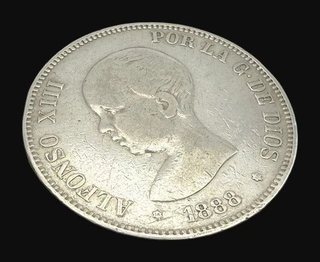
View on eBay

1922-P Peace Silver Dollar $1 Coin —Philadelphia Mint— Graded by CAC at AU58

1922-P Peace Silver Dollar · CACG AU58 · Philadelphia Mint · 90% silver · designed by Sicilian-born Anthony de Francisci

$135.33 1922 Peace Silver Dollars

Description

A 1922-P Peace silver dollar from the Philadelphia Mint (no mint mark), certified and sealed by CAC Grading (CACG) at AU58. The certification number on the label can be checked on the grading company's website. The photos show this exact coin and holder.

This coin was graded by CAC Grading (CACG), which applies the standard behind CAC's well-known green sticker. The back of the holder carries a QR code linking to CACgrading.com.

Mint specifications: 90% silver, 10% copper; 26.73 grams; 38.1 mm; 0.7734 troy oz of pure silver. These are the Mint's standard figures; the coin has not been removed from its holder.

Read the full description

The 1922 Peace Dollar

Philadelphia struck 51,737,000 Peace dollars in 1922.

Philadelphia, America's first mint, was created by the Coinage Act of April 2, 1792, and George Washington chose the scientist David Rittenhouse as its first director. Every one of the 1,006,473 Peace dollars dated 1921 was struck here. Philadelphia coins carry no mint mark.

The Year 1922

On November 4, 1922, Howard Carter's team uncovered the first step of Tutankhamun's tomb in Egypt's Valley of the Kings, reaching its treasure-filled antechamber on November 26. A dollar in 1922 had the buying power of about $19 today.

The Peace Dollar

Isn't it remarkable that the coin America struck to celebrate peace after the First World War was designed by a young Sicilian immigrant, and modeled on his Italian-born wife?

Anthony de Francisci, born in Palermo, Sicily, in 1887, came to the United States in 1905 and in December 1921 won an invitation-only design competition. Liberty's face is based on his wife, Teresa, born in Laurenzana in Italy's Basilicata region. Numismatist Farran Zerbe proposed it to restore the 270 million silver dollars melted under the Pittman Act of 1918, their silver sold to Britain to steady the currency of British India. In July 1921 the Knox–Porter Resolution formally ended America's war with Germany and Austria-Hungary, and the first Peace dollar was struck that December 28.

Grade And Authenticity

AU (About Uncirculated) 58 shows only traces of wear. CAC, founded in 2007 by John Albanese, spent years re-examining coins already graded by PCGS and NGC and adding a green sticker, the "green bean," when it judged a coin "solid for the grade it was assigned." On October 2, 2023, CAC Grading (CACG) began grading coins itself under the same standard. The seller also tested the metal through the holder with a calibrated Sigma Metalytics verifier (consistent with silver), inspected the holder for tampering (none found), and confirmed the certification number on the CACG website.

Also In Our Store

  • Morgan dollars, designed by English-born George T. Morgan.
  • Holiday postcards from the Golden Age of Postcards, many printed in Germany.
  • Victorian advertising trade cards, and more world coins and banknotes.

Disclaimer

Specifications and detailed item descriptions are provided as a courtesy only and are not guaranteed to be one hundred percent accurate. Please do your own research. There are generally no receipts available for any items from original purchases. Any dimensions and/or weights are approximate. The absence of a more detailed condition report does not imply there are no condition issues with the item(s). Please inspect images carefully as they are part of the official item description and best representation of the actual condition. Additional images may be available upon request depending on time and availability. Not responsible for internet mis-translations or mis-identification of maker's marks if found or assumptions of makers or materials — item descriptions will indicate if it is assumed. If you see a problem, please message us immediately and we will do our best to sort out a solution and confirm the information. With the exception of eBay rules, no returns are accepted.
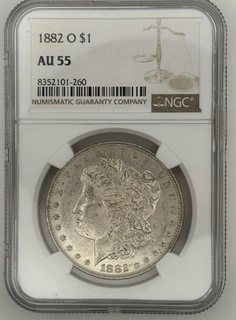
View on eBay

1923-P Peace Silver Dollar $1 Coin —100 Yr. Ann— NGC Graded Brilliant Unc

1923-P Peace Silver Dollar · NGC Brilliant Uncirculated · Philadelphia Mint · 90% silver · designed by Sicilian-born Anthony de Francisci

$133.23 1923 Peace Silver Dollars

Description

A 1923-P Peace silver dollar from the Philadelphia Mint (no mint mark), graded Brilliant Uncirculated by NGC. The certification number on the label can be checked on the grading company's website. The photos show this exact coin and holder.

The holder carries NGC's special "Morgan to Peace Dollar 100th Anniversary" label, showing a 1921 Morgan dollar and a 1921 Peace dollar side by side over the American flag, marking a century since the Morgan dollar gave way to the Peace dollar.

Mint specifications: 90% silver, 10% copper; 26.73 grams; 38.1 mm; 0.7734 troy oz of pure silver. These are the Mint's standard figures; the coin has not been removed from its holder.

Read the full description

The 1923 Peace Dollar

Philadelphia struck 30,800,000 Peace dollars in 1923.

Philadelphia, America's first mint, was created by the Coinage Act of April 2, 1792, and George Washington chose the scientist David Rittenhouse as its first director. Every one of the 1,006,473 Peace dollars dated 1921 was struck here. Philadelphia coins carry no mint mark.

The Year 1923

In November 1923, one US dollar was worth 4,210,500,000,000 German paper marks. The same year, the giant HOLLYWOODLAND sign went up in the hills above Los Angeles. A dollar in 1923 had the buying power of about $19 today.

The Peace Dollar

Isn't it remarkable that the coin America struck to celebrate peace after the First World War was designed by a young Sicilian immigrant, and modeled on his Italian-born wife?

Anthony de Francisci, born in Palermo, Sicily, in 1887, came to the United States in 1905 and in December 1921 won an invitation-only design competition. Liberty's face is based on his wife, Teresa, born in Laurenzana in Italy's Basilicata region. Numismatist Farran Zerbe proposed it to restore the 270 million silver dollars melted under the Pittman Act of 1918, their silver sold to Britain to steady the currency of British India. In July 1921 the Knox–Porter Resolution formally ended America's war with Germany and Austria-Hungary, and the first Peace dollar was struck that December 28.

Grade And Authenticity

NGC defines "Brilliant Uncirculated" as MS 60 or higher: an uncirculated coin, without a specific number assigned. NGC, founded in 1987 by John Albanese, is the official grading service of the American Numismatic Association, with offices in Hong Kong, Shanghai, Munich and London. The seller also tested the metal through the holder with a calibrated Sigma Metalytics verifier (consistent with silver), inspected the holder for tampering (none found), and confirmed the certification number on the NGC website.

Also In Our Store

  • A 1923 German 500-million-mark banknote from that year's hyperinflation.
  • Holiday postcards from the Golden Age of Postcards, many printed in Germany.
  • Morgan dollars, designed by English-born George T. Morgan, and more world coins and banknotes.

Disclaimer

Specifications and detailed item descriptions are provided as a courtesy only and are not guaranteed to be one hundred percent accurate. Please do your own research. There are generally no receipts available for any items from original purchases. Any dimensions and/or weights are approximate. The absence of a more detailed condition report does not imply there are no condition issues with the item(s). Please inspect images carefully as they are part of the official item description and best representation of the actual condition. Additional images may be available upon request depending on time and availability. Not responsible for internet mis-translations or mis-identification of maker's marks if found or assumptions of makers or materials — item descriptions will indicate if it is assumed. If you see a problem, please message us immediately and we will do our best to sort out a solution and confirm the information. With the exception of eBay rules, no returns are accepted.
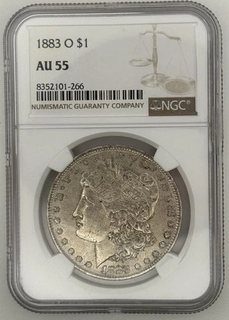
View on eBay

Sweden 100 Kronor Greta Garbo 3 Consecutive UNC K220678074-076 P-71 Banknotes

Lot of 3 Consecutive Sweden 100 Kronor Banknotes, Greta Garbo, Sveriges Riksbank, Pick P-71, Serials K220678074, K220678075, K220678076, Crisp Uncirculated, UV Reactive [UNC]

$131.86 Sweden

Description

Three Sweden 100 kronor banknotes in consecutive serial order: K220678074, K220678075 and K220678076, issued by Sveriges Riksbank, the central bank of Sweden. The front shows Greta Garbo, the Swedish-born star of silent films and early talking movies of the 1920s and 1930s; the back shows a Stockholm city scene. Pick P-71, part of Sweden's "Cultural Journey" banknote series introduced in 2015. The 100 kronor Garbo note was issued 3 October 2016. Printing ND (2022), signed Bo Broman and Stefan Ingves; 35 million printed. All three ship together as one lot, in serial order.

Read the full description

Historical Context

Sweden replaced its banknotes between 2015 and 2017 with a new series honoring Swedish cultural figures of the 1900s. Greta Garbo, born in Stockholm, became one of Hollywood's biggest stars, and her 100 kronor note pairs her portrait with her home city. Consecutive runs are popular with collectors because they come straight from the same bundle.

Condition

[UNC] Crisp, uncirculated paper, confirmed in hand. Not professionally graded. Not star or replacement notes; no errors found.

UV CHECK: UV-reactive fibers, a large "100" block and the three crowns on the front glow brightly under ultraviolet light (UV reactive, confirmed).

Legal Tender

Yes. The 100 kronor Garbo note is current legal tender in Sweden (Sveriges Riksbank lists it among valid banknotes). Collector demand is strong all the same.

Disclaimer

The images and any video show the actual item and are part of the official listing description, so please review them closely. Measurements and weights are approximate, and any maker or material we haven't confirmed is described as assumed. Questions? Message us; we answer quickly.

View on eBay

1881-S Morgan Silver Dollar US $1 Coin — SFO Mint — Graded by PCGS at MS62

1881-S Morgan Silver Dollar · PCGS MS62 · San Francisco Mint · 90% silver · designed by Englishman George T. Morgan

$129.55 1881 PCGS MS62 Morgan Silver Dollars

Description

An 1881-S Morgan silver dollar, certified and sealed by PCGS at MS62. The certification number on the label can be checked on the PCGS website. The photos show this exact coin and holder.

The coin is housed in a special PCGS holder with a holographic honeycomb-and-bee frame. The PCGS grade label (1881-S $1, MS62, cert 7130.62/61251665) is on the other side of the holder; please see the photos.

Mint specifications: 90% silver, 10% copper; 26.73 grams; 38.1 mm; 0.7734 troy oz of pure silver. These are the Mint's standard figures; the coin has not been removed from its holder.

Read the full description

The 1881-S

San Francisco struck 12,760,000 Morgan dollars in 1881.

The San Francisco Mint opened in 1854 to turn California Gold Rush gold into coin. Its 1874 building, designed by Alfred B. Mullett with sandstone imported from British Columbia, survived the 1906 earthquake and fire while holding $300 million, a third of the nation's gold reserves.

The Year 1881

On February 8, King Kalākaua of Hawaii sailed from San Francisco, where this coin was struck, on his celebrated voyage around the world. Two years later the San Francisco Mint struck Hawaii's own silver coins, designed by US Chief Engraver Charles E. Barber. A dollar in 1881 had the buying power of roughly $31 to $34 today.

The Morgan Dollar

Isn't it remarkable that one of America's best-known collectible coins was designed by an Englishman, who went on to become Chief Engraver of the United States Mint?

George T. Morgan, from the Birmingham area of England, joined the US Mint in 1876 on the recommendation of Britain's Royal Mint. His model for Liberty was Anna Willess Williams of Philadelphia. In 1918 the Pittman Act melted over 270 million silver dollars, and sold much of the silver to Britain to back its currency in India.

Grade And Authenticity

MS (Mint State) 62 means no wear, with some marks. PCGS, founded in 1986, guarantees its grades. The seller also tested the metal through the holder with a calibrated Sigma Metalytics verifier (consistent with silver), inspected the holder for tampering (none found), and confirmed the certification number on the PCGS website.

Also In Our Store

  • Victorian advertising trade cards, chromolithographed in the Morgan years.
  • Holiday postcards from the Golden Age of Postcards, many printed in Germany.
  • Peace dollars, designed by Sicilian-born Anthony de Francisci, and more world coins and banknotes.

Disclaimer

Specifications and detailed item descriptions are provided as a courtesy only and are not guaranteed to be one hundred percent accurate. Please do your own research. There are generally no receipts available for any items from original purchases. Any dimensions and/or weights are approximate. The absence of a more detailed condition report does not imply there are no condition issues with the item(s). Please inspect images carefully as they are part of the official item description and best representation of the actual condition. Additional images may be available upon request depending on time and availability. Not responsible for internet mis-translations or mis-identification of maker's marks if found or assumptions of makers or materials — item descriptions will indicate if it is assumed. If you see a problem, please message us immediately and we will do our best to sort out a solution and confirm the information. With the exception of eBay rules, no returns are accepted.
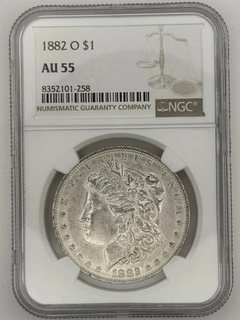
View on eBay

Guglielmo Cini Sterling Silver Butterfly/Mariposa Brooch Pin Large Signed 26.37g

Large vintage sterling silver butterfly brooch by Italian-born silversmith Guglielmo Cini, signed Cini Sterling. About 3 in. wide and 26.37 g, with a hand-hammered finish and its original dark oxidized patina.

$128.83 Brooches

Description

A sculptural butterfly with domed, layered wings, raised wing-spot detail, a segmented body and curled antennae. The hammered surface with dark oxidized recesses is typical of Cini's work. Long pin stem with a C-clasp catch that rotates freely over the pin, signed in a rectangular cartouche on the back: maker's logo, "Guglielmo Cini" and "Sterling".

Read the full description

About The Maker

Guglielmo Cini was born in Italy and trained in Florence. He opened his own silver shop in Boston, Massachusetts, around 1922, moved to Laguna Beach, California, in 1957, and worked until about 1970.

Condition

Good vintage condition. The original oxidized patina has been left as found and not polished. A few tiny specks of what appears to be old polish residue sit in the recesses; they are visible in the enlarged images but hard to see in hand. Pin and clasp work.

Dimensions

Approx. 3 in. wide x 2.16 in. high x 0.25 in. deep (including pin and clasp). Weight 26.37 g.

Provenance

From my family's estate collections, built over more than 60 years by knowledgeable antiques collectors and traders. Stored in a climate-controlled environment.

Disclaimer

The images and any video show the actual item and are part of the official listing description, so please review them closely. Measurements and weights are approximate, and any maker or material we haven't confirmed is described as assumed. Questions? Message us; we answer quickly.

View on eBay

Vintage Ornate Silver-Tone Filigree Bar Brooch Large Faceted Blue Glass Stone

Vintage Ornate Silver-Tone Filigree Bar Brooch with a Large Emerald-Cut Blue Glass Stone and Beaded Floral Detail

$119.59 Brooches

Description

A long, pointed bar brooch of pierced floral filigree with beaded detail, centered on a large emerald-cut faceted blue stone, assumed to be glass. The metal did not test as .925 sterling and has not been identified; it is described as silver-tone. Early to mid-20th century style.

Read the full description

Condition

Good vintage condition with light wear (see images).

Provenance

From my family's estate collections, built over more than 60 years by knowledgeable antiques collectors and traders. Stored in a climate-controlled environment.

Disclaimer

The images and any video show the actual item and are part of the official listing description, so please review them closely. Measurements and weights are approximate, and any maker or material we haven't confirmed is described as assumed. Questions? Message us; we answer quickly.

View on eBay

1921–P Morgan Silver Dollar $1 Coin -Philadelphia Mint — PCGS Graded MS62

1921-P Morgan Silver Dollar · PCGS MS62 · Philadelphia Mint · 90% silver · designed by Englishman George T. Morgan

$117.11 1921 PCGS MS62 Morgan Silver Dollars

Description

A 1921-P Morgan silver dollar from the Philadelphia Mint (no mint mark), certified and sealed by PCGS at MS62. The certification number on the label can be checked on the PCGS website. The photos show this exact coin and holder.

Mint specifications: 90% silver, 10% copper; 26.73 grams; 38.1 mm; 0.7734 troy oz of pure silver. These are the Mint's standard figures; the coin has not been removed from its holder.

Read the full description

The 1921

Philadelphia struck 44,690,000 Morgan dollars in 1921, part of the Mint's 86,730,000 that year, the largest single-year silver dollar mintage in US history, struck to replace the coins melted under the Pittman Act.

Philadelphia, America's first mint, was created by the Coinage Act of April 2, 1792. The very first Morgan dollar was struck here at 3:17 p.m. on March 11, 1878. Philadelphia coins of this era carry no mint mark.

The Year 1921

On May 5, 1921, Coco Chanel launched Chanel No. 5 at her boutique on the rue Cambon in Paris, and on August 5 Pittsburgh's KDKA aired the first radio broadcast of a major league baseball game. A dollar in 1921 had the buying power of about $18 today.

The Morgan Dollar

Isn't it remarkable that one of America's best-known collectible coins was designed by an Englishman, who went on to become Chief Engraver of the United States Mint?

George T. Morgan, from the Birmingham area of England, joined the US Mint in 1876 on the recommendation of Britain's Royal Mint. After German wartime propaganda set off a run on silver in British India, the Pittman Act of 1918 melted over 270 million silver dollars and sold much of the silver to Britain. The law required the melted dollars to be replaced, so in 1921 Morgan's design returned for one final year, struck while Morgan himself was Chief Engraver, before the Peace dollar took over.

Grade And Authenticity

MS (Mint State) 62 means no wear at all, and the number rises as marks decrease and luster and strike improve. PCGS, founded in 1986, guarantees its grades. The seller also tested the metal through the holder with a calibrated Sigma Metalytics verifier (consistent with silver), inspected the holder for tampering (none found), and confirmed the certification number on the PCGS website.

Also In Our Store

  • Silver Eagles carrying the Walking Liberty design of German-born sculptor Adolph A. Weinman.
  • Holiday postcards from the Golden Age of Postcards, many printed in Germany.
  • Peace dollars, designed by Sicilian-born Anthony de Francisci, and more world coins and banknotes.

Disclaimer

Specifications and detailed item descriptions are provided as a courtesy only and are not guaranteed to be one hundred percent accurate. Please do your own research. There are generally no receipts available for any items from original purchases. Any dimensions and/or weights are approximate. The absence of a more detailed condition report does not imply there are no condition issues with the item(s). Please inspect images carefully as they are part of the official item description and best representation of the actual condition. Additional images may be available upon request depending on time and availability. Not responsible for internet mis-translations or mis-identification of maker's marks if found or assumptions of makers or materials — item descriptions will indicate if it is assumed. If you see a problem, please message us immediately and we will do our best to sort out a solution and confirm the information. With the exception of eBay rules, no returns are accepted.
View on eBay

1923-S Peace Silver Dollar Coin (Est. XF40)

1923-S Peace Silver Dollar · Ungraded, Est. XF40 · San Francisco Mint · 90% silver · designed by Sicilian-born Anthony de Francisci

$107.77 1923 Est. XF40 Peace Silver Dollars

Description

A 1923-S Peace silver dollar from the San Francisco Mint. This coin is not professionally graded; the seller's visual estimate is [Est. XF40]. Please judge from the photos, which show this exact coin and are part of the description.

Mint specifications: 90% silver, 10% copper; 26.73 grams; 38.1 mm; 0.7734 troy oz of pure silver. These are the Mint's standard figures.

Read the full description

The 1923-S Peace Dollar

San Francisco struck 19,020,000 Peace dollars in 1923. The San Francisco Mint opened in 1854 to turn California Gold Rush gold into coin. Its 1874 building, built with sandstone imported from British Columbia, survived the 1906 earthquake and fire while holding a third of the nation's gold reserves.

The Year 1923

In November 1923 one US dollar was worth 4,210,500,000,000 German paper marks. In San Francisco, where this coin was struck, the Steinhart Aquarium opened in Golden Gate Park on September 29, 1923. A dollar in 1923 had the buying power of about $19 today.

The Peace Dollar

Isn't it remarkable that the coin America struck to celebrate peace after the First World War was designed by a young Sicilian immigrant, and modeled on his Italian-born wife?

Anthony de Francisci, born in Palermo, Sicily, in 1887, won the design competition in December 1921; Liberty's face is based on his wife, Teresa, born in Laurenzana, Italy. The coin followed the Pittman Act of 1918, which melted 270 million silver dollars and sold their silver to Britain to steady the currency of British India, and the 1921 resolution formally ending America's war with Germany and Austria-Hungary. English-born Chief Engraver George T. Morgan removed a broken sword from the first reverse before Christmas 1921.

Grade And Authenticity

This coin has not been professionally graded; [Est. XF40] is the seller's visual estimate on the 1–70 Sheldon scale, where XF (Extremely Fine) 40 shows light wear. Please judge from the photos.

Also In Our Store

Visit TF Auctions Intl: https://www.ebay.com/str/tfauctionsintl

  • A 1923 German 500-million-mark banknote from that year's hyperinflation.
  • Holiday postcards from the Golden Age of Postcards, many printed in Germany.
  • Morgan dollars, designed by English-born George T. Morgan, and more world coins and banknotes.

Disclaimer

Specifications and detailed item descriptions are provided as a courtesy only and are not guaranteed to be one hundred percent accurate. Please do your own research. There are generally no receipts available for any items from original purchases. Any dimensions and/or weights are approximate. The absence of a more detailed condition report does not imply there are no condition issues with the item(s). Please inspect images carefully as they are part of the official item description and best representation of the actual condition. Additional images may be available upon request depending on time and availability. Not responsible for internet mis-translations or mis-identification of maker's marks if found or assumptions of makers or materials — item descriptions will indicate if it is assumed. If you see a problem, please message us immediately and we will do our best to sort out a solution and confirm the information. With the exception of eBay rules, no returns are accepted.
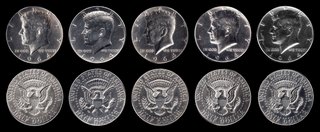
View on eBay

1923-S Peace Silver Dollar Coin (Est. XF40)

1923-S Peace Silver Dollar · Ungraded, Est. XF40 · San Francisco Mint · 90% silver · designed by Sicilian-born Anthony de Francisci

$99.95 1923 Est. XF40 Peace Silver Dollars

Description

A 1923-S Peace silver dollar from the San Francisco Mint. This coin is not professionally graded; the seller's visual estimate is [Est. XF40]. Please judge from the photos, which show this exact coin and are part of the description.

Mint specifications: 90% silver, 10% copper; 26.73 grams; 38.1 mm; 0.7734 troy oz of pure silver. These are the Mint's standard figures.

Read the full description

The 1923-S Peace Dollar

San Francisco struck 19,020,000 Peace dollars in 1923. The San Francisco Mint opened in 1854 to turn California Gold Rush gold into coin. Its 1874 building, built with sandstone imported from British Columbia, survived the 1906 earthquake and fire while holding a third of the nation's gold reserves.

The Year 1923

In November 1923 one US dollar was worth 4,210,500,000,000 German paper marks. In San Francisco, where this coin was struck, the Steinhart Aquarium opened in Golden Gate Park on September 29, 1923. A dollar in 1923 had the buying power of about $19 today.

The Peace Dollar

Isn't it remarkable that the coin America struck to celebrate peace after the First World War was designed by a young Sicilian immigrant, and modeled on his Italian-born wife?

Anthony de Francisci, born in Palermo, Sicily, in 1887, won the design competition in December 1921; Liberty's face is based on his wife, Teresa, born in Laurenzana, Italy. The coin followed the Pittman Act of 1918, which melted 270 million silver dollars and sold their silver to Britain to steady the currency of British India, and the 1921 resolution formally ending America's war with Germany and Austria-Hungary. English-born Chief Engraver George T. Morgan removed a broken sword from the first reverse before Christmas 1921.

Grade And Authenticity

This coin has not been professionally graded; [Est. XF40] is the seller's visual estimate on the 1–70 Sheldon scale, where XF (Extremely Fine) 40 shows light wear. Please judge from the photos.

Also In Our Store

  • A 1923 German 500-million-mark banknote from that year's hyperinflation.
  • Holiday postcards from the Golden Age of Postcards, many printed in Germany.
  • Morgan dollars, designed by English-born George T. Morgan, and more world coins and banknotes.

Disclaimer

Specifications and detailed item descriptions are provided as a courtesy only and are not guaranteed to be one hundred percent accurate. Please do your own research. There are generally no receipts available for any items from original purchases. Any dimensions and/or weights are approximate. The absence of a more detailed condition report does not imply there are no condition issues with the item(s). Please inspect images carefully as they are part of the official item description and best representation of the actual condition. Additional images may be available upon request depending on time and availability. Not responsible for internet mis-translations or mis-identification of maker's marks if found or assumptions of makers or materials — item descriptions will indicate if it is assumed. If you see a problem, please message us immediately and we will do our best to sort out a solution and confirm the information. With the exception of eBay rules, no returns are accepted.
View on eBay

2026 American Silver Eagle $1-1 oz .999 Fine Silver BU Type 2 Eagle Landing ASE

2026 American Silver Eagle, 1 oz .999 Fine Silver, $1, Uncirculated with a Matte Finish, Weinman Walking Liberty with his AW Monogram, Damstra Eagle Landing Reverse (Type 2), the 40th Year of the Silver Eagle

$99.87 2026 Silver (.999 & .9999 Fine)

Description

A 2026 American Silver Eagle, the US Mint's 1 oz silver bullion coin, uncirculated. Obverse: Adolph A. Weinman's Walking Liberty, from his 1916 half dollar, striding toward the sun wrapped in the flag, with LIBERTY, IN GOD WE TRUST and the date. The small AW below IN GOD WE TRUST is Weinman's own monogram, an A inside a W, added to the obverse with the 2021 redesign; it is not a mint mark, and bullion Silver Eagles carry no mint mark. Reverse: Emily Damstra's eagle landing with an oak branch (the Type 2 design, used since mid-2021), with E PLURIBUS UNUM, ONE DOLLAR and 1 OZ. FINE SILVER. Mint standard: 1 troy oz of .999 fine silver, 31.103 grams, 40.6 mm, 2.98 mm thick, reeded edge. Measured: 31.20 grams, 40.60 mm, 2.60 mm thick. Tested on a Sigma Metalytics precious metal verifier, Silver .999 setting, both sides: resistivity 1.65 µΩ·cm, conductivity 60.7 MS/m, inside the window. The close-ups show the date, the AW monogram, Liberty and the eagle; the last two photos show the display box closed and open.

Read the full description

Historical Context

The Liberty Coin Act of 1985 created the American Silver Eagle, and the first were struck in 1986, so 2026 is the program's 40th year. It is also America's 250th year. Weinman, born in Germany, came to America as a boy and became one of its leading sculptors; his Walking Liberty has been on the Silver Eagle since the start.

Condition

[Est. BU] Uncirculated with a matte, satin-like finish, ungraded. A small pale bluish spot in the reverse field left of the eagle's leg, and faint bluish specks and a few fine lines in the obverse field to the right of Liberty, as seen in the photos. Grade estimated; not professionally graded. US legal tender with a $1 face value, worth far more for its silver. Ships in an airtight capsule inside a dark blue velvet presentation box with an eagle emblem on the lid and UNITED STATES MINT inside the lid. The box did not come with this coin (bullion Silver Eagles are not sold in boxes), and no certificate is included.

Also In Our Store

Morgan and Peace silver dollars and more silver: https://www.ebay.com/str/tfauctionsintl?_nkw=silver

Disclaimer

The images and any video show the actual item and are part of the official listing description, so please review them closely. Measurements and weights are approximate, and any maker or material we haven't confirmed is described as assumed. Questions? Message us; we answer quickly.

View on eBay

1970-S Kennedy Half Dollar 50C Proof —JFK— Graded by PCGS at PR69 (Silver)

1970-S Kennedy Half Dollar Proof · PCGS PR69 · San Francisco Mint · 40% silver clad · designed by Philadelphia-born Gilroy Roberts and Frank Gasparro

$96.64 1970 PCGS PR69 Kennedy Half Dollars

Description

A 1970-S Kennedy half dollar proof from the San Francisco Mint, certified and sealed by PCGS at PR69, without the Cameo designation. The certification number on the label can be checked on the PCGS website. The photos show this exact coin and holder.

The holder's back carries PCGS's NFC symbol: tap it with a recent iPhone or Android phone to bring up the PCGS certification record.

Mint specifications: 40% silver clad (outer layers 80% silver and 20% copper, bonded to a core of 79% copper and 21% silver); 11.50 grams; 30.6 mm. These are the Mint's standard figures; the coin has not been removed from its holder.

Read the full description

The 1970-S Proof Half

In 1970 no half dollars were struck for circulation; this San Francisco proof was one of 2,632,810 struck for proof sets. The Kennedy half was 40% silver clad from 1965 to 1970 and had no silver from 1971, making 1970 the final silver-clad year. The San Francisco Mint opened in 1854 to coin California Gold Rush gold; its current building on Hermann Street, opened in 1937, focuses primarily on proof coins like this one.

The Year 1970

On December 31, 1970, minutes before midnight, President Nixon signed the law that took the silver out of the half dollar, authorized the GSA sale of the Treasury's Carson City silver dollars, and created the Eisenhower dollar. In 1970 a dollar had the buying power of about $8.30 today, so this half dollar's 50 cents was worth about $4.15.

The Kennedy Half Dollar

President John F. Kennedy was assassinated on November 22, 1963, and when his memorial half dollar went on sale on March 24, 1964, a line a block long formed at the Treasury windows. Gilroy Roberts adapted his Kennedy medal portrait for the front, and Frank Gasparro adapted the presidential seal for the back. Only months before his death, Kennedy declared "Ich bin ein Berliner" in West Berlin, visited his family's ancestral home in Ireland, and went on to Italy.

Grade And Authenticity

A proof is struck specially for collectors, with mirror-like fields, and PR69 is one point below a perfect 70. PCGS, founded in 1986, guarantees its grades. The seller also tested the metal through the holder with a calibrated Sigma Metalytics verifier (consistent with the 40% silver-clad composition), inspected the holder for tampering (none found), confirmed the certification number on the PCGS website, and tapped the NFC chip with an iPhone, which opened the matching PCGS record.

Also In Our Store

  • Eisenhower dollars and GSA-sold Morgan dollars from that same 1970 law.
  • Holiday postcards from the Golden Age of Postcards, many printed in Germany.
  • Peace dollars, designed by Sicilian-born Anthony de Francisci, and more world coins and banknotes.

Disclaimer

Specifications and detailed item descriptions are provided as a courtesy only and are not guaranteed to be one hundred percent accurate. Please do your own research. There are generally no receipts available for any items from original purchases. Any dimensions and/or weights are approximate. The absence of a more detailed condition report does not imply there are no condition issues with the item(s). Please inspect images carefully as they are part of the official item description and best representation of the actual condition. Additional images may be available upon request depending on time and availability. Not responsible for internet mis-translations or mis-identification of maker's marks if found or assumptions of makers or materials — item descriptions will indicate if it is assumed. If you see a problem, please message us immediately and we will do our best to sort out a solution and confirm the information. With the exception of eBay rules, no returns are accepted.
View on eBay

1923-P Peace Silver Dollar Coin (Est. AU50)

1923-P Peace Silver Dollar · Ungraded, Est. AU50 · Philadelphia Mint · 90% silver · designed by Sicilian-born Anthony de Francisci

$96.63 1923 Est. AU50 Peace Silver Dollars

Description

A 1923-P Peace silver dollar from the Philadelphia Mint (no mint mark). This coin is not professionally graded; the seller's visual estimate is [Est. AU50]. Please judge from the photos, which show this exact coin and are part of the description.

Condition: original, uncleaned surfaces with even gray-brown toning; only light wear on the high points, with the hair detail and the designer's AF monogram still sharp. Luster is subdued under the toning, and there are a few small dark toning spots in the fields.

Mint specifications: 90% silver, 10% copper; 26.73 grams; 38.1 mm; 0.7734 troy oz of pure silver. These are the Mint's standard figures.

Read the full description

The 1923 Peace Dollar

Philadelphia struck 30,800,000 Peace dollars in 1923.

Philadelphia, America's first mint, was created by the Coinage Act of April 2, 1792, and George Washington chose the scientist David Rittenhouse as its first director. Every one of the 1,006,473 Peace dollars dated 1921 was struck here. Philadelphia coins carry no mint mark.

The Year 1923

In November 1923, one US dollar was worth 4,210,500,000,000 German paper marks. The same year, the giant HOLLYWOODLAND sign went up in the hills above Los Angeles. A dollar in 1923 had the buying power of about $19 today.

The Peace Dollar

Isn't it remarkable that the coin America struck to celebrate peace after the First World War was designed by a young Sicilian immigrant, and modeled on his Italian-born wife?

Anthony de Francisci, born in Palermo, Sicily, in 1887, came to the United States in 1905 and in December 1921 won an invitation-only design competition. Liberty's face is based on his wife, Teresa, born in Laurenzana in Italy's Basilicata region. Numismatist Farran Zerbe proposed it to restore the 270 million silver dollars melted under the Pittman Act of 1918, their silver sold to Britain to steady the currency of British India. In July 1921 the Knox–Porter Resolution formally ended America's war with Germany and Austria-Hungary, and the first Peace dollar was struck that December 28.

Grade And Authenticity

This coin has not been professionally graded. [Est. AU50] is the seller's visual estimate on the 1–70 Sheldon scale: XF (Extremely Fine) 40 shows light wear; AU (About Uncirculated) 50–58 shows only traces of wear. Please judge from the photos.

Also In Our Store

  • A 1923 German 500-million-mark banknote from that year's hyperinflation.
  • Holiday postcards from the Golden Age of Postcards, many printed in Germany.
  • Morgan dollars, designed by English-born George T. Morgan, and more world coins and banknotes.

Disclaimer

Specifications and detailed item descriptions are provided as a courtesy only and are not guaranteed to be one hundred percent accurate. Please do your own research. There are generally no receipts available for any items from original purchases. Any dimensions and/or weights are approximate. The absence of a more detailed condition report does not imply there are no condition issues with the item(s). Please inspect images carefully as they are part of the official item description and best representation of the actual condition. Additional images may be available upon request depending on time and availability. Not responsible for internet mis-translations or mis-identification of maker's marks if found or assumptions of makers or materials — item descriptions will indicate if it is assumed. If you see a problem, please message us immediately and we will do our best to sort out a solution and confirm the information. With the exception of eBay rules, no returns are accepted.
View on eBay

1890-S Morgan Silver Dollar 90% Silver San Francisco US $1 Never Cleaned KM#110

1890-S Morgan Silver Dollar, San Francisco Mint, 90% Silver, 0.7734 oz Silver, Sherman Silver Purchase Act Year, Original Never-Cleaned Surfaces, KM#110 [Est. XF-40]

$95.90 1890 Est. XF-40 Morgan Silver Dollars

Description

An 1890-S Morgan silver dollar struck at the San Francisco Mint, with the S mint mark on the reverse above the D and O of DOLLAR, KM#110. Designed by George T. Morgan: Liberty facing left, wearing a cap with a wreath of cotton and wheat, LIBERTY on the headband and E PLURIBUS UNUM above; on the reverse an eagle with outstretched wings holding an olive branch and arrows within a wreath, with IN GOD WE TRUST above. 90% silver, 10% copper, 26.73 grams standard, 0.7734 oz of pure silver, 38.1 mm, reeded edge. The close-ups show the date, the hair above the ear, the eagle's breast and the S mint mark.

Read the full description

Historical Context

The Bland-Allison Act of 1878 required the Treasury to buy two to four million dollars' worth of silver every month and coin it into silver dollars, and George T. Morgan's design carried that silver from 1878 to 1904. The Sherman Silver Purchase Act of 1890 then raised the Treasury's purchases to 4,500,000 troy ounces of silver a month. San Francisco struck 8,230,373 Morgan dollars in 1890, coins known for a strong strike.

Buying Power

In 1890 this dollar had the buying power of about $37.03 today.

Condition

[Est. XF-40] Circulated, original and never cleaned, in light gray. Light wear on the cheek, the hair above the ear and the center of the eagle's breast; the hair strands above the forehead, the cotton blossoms and the wing feathers are well defined, with full rims. Rust-orange deposits on the obverse left of the hair, by the eye and at the nose and lips, and on the reverse by the left wreath and the arrows (see the photos). The S mint mark is single, with no repunching. Tested on a Sigma Metalytics precious metal verifier: reading consistent with silver. Grade estimated; not professionally graded. Currently still legal tender, but worth far more to collectors and for its silver than its face value.

Also In Our Store

More Morgan and Peace silver dollars: https://www.ebay.com/str/tfauctionsintl?_nkw=silver+dollar

Disclaimer

The images and any video show the actual item and are part of the official listing description, so please review them closely. Measurements and weights are approximate, and any maker or material we haven't confirmed is described as assumed. Questions? Message us; we answer quickly.

View on eBay

1970-S Kennedy Half Dollar Proof NGC PF69 Cameo — JFK Label

1970-S Kennedy Half Dollar Proof · NGC PF69 Cameo · JFK label · San Francisco Mint · 40% silver clad · designed by Philadelphia-born Gilroy Roberts and Frank Gasparro

$94.64 1970 NGC PF69 Kennedy Half Dollars

Description

A 1970-S Kennedy half dollar proof from the San Francisco Mint, certified and sealed by NGC at PF69 Cameo. The certification number on the label can be checked on the NGC website. The photos show this exact coin and holder.

The holder carries NGC's John F. Kennedy label: his photograph captioned "35th President of the US," a waving U.S. flag, and a facsimile of his signature.

Mint specifications: 40% silver clad (outer layers 80% silver and 20% copper, bonded to a core of 79% copper and 21% silver); 11.50 grams; 30.6 mm. These are the Mint's standard figures; the coin has not been removed from its holder.

Read the full description

The 1970-S Proof Half

In 1970 no half dollars were struck for circulation; this San Francisco proof was one of 2,632,810 struck for proof sets. The Kennedy half was 40% silver clad from 1965 to 1970 and had no silver from 1971, making 1970 the final silver-clad year. The San Francisco Mint opened in 1854 to coin California Gold Rush gold; its current building on Hermann Street, opened in 1937, focuses primarily on proof coins like this one.

The Year 1970

On December 31, 1970, minutes before midnight, President Nixon signed the law that took the silver out of the half dollar, authorized the GSA sale of the Treasury's Carson City silver dollars, and created the Eisenhower dollar. In 1970 a dollar had the buying power of about $8.30 today, so this half dollar's 50 cents was worth about $4.15.

The Kennedy Half Dollar

President John F. Kennedy was assassinated on November 22, 1963, and when his memorial half dollar went on sale on March 24, 1964, a line a block long formed at the Treasury windows. Gilroy Roberts adapted his Kennedy medal portrait for the front, and Frank Gasparro adapted the presidential seal for the back. Only months before his death, Kennedy declared "Ich bin ein Berliner" in West Berlin, visited his family's ancestral home in Ireland, and went on to Italy.

Grade And Authenticity

A proof is struck specially for collectors, with mirror-like fields; "Cameo" means the portrait and lettering are frosted against those fields, and PF69 is one point below a perfect 70. NGC, founded in 1987, is the official grading service of the American Numismatic Association, with offices in Hong Kong, Shanghai, Munich and London. The seller also tested the metal through the holder with a calibrated Sigma Metalytics verifier (consistent with the 40% silver-clad composition), inspected the holder for tampering (none found), and confirmed the certification number on the NGC website.

Also In Our Store

  • Eisenhower dollars and GSA-sold Morgan dollars from that same 1970 law.
  • Holiday postcards from the Golden Age of Postcards, many printed in Germany.
  • Peace dollars, designed by Sicilian-born Anthony de Francisci, and more world coins and banknotes.

Disclaimer

Specifications and detailed item descriptions are provided as a courtesy only and are not guaranteed to be one hundred percent accurate. Please do your own research. There are generally no receipts available for any items from original purchases. Any dimensions and/or weights are approximate. The absence of a more detailed condition report does not imply there are no condition issues with the item(s). Please inspect images carefully as they are part of the official item description and best representation of the actual condition. Additional images may be available upon request depending on time and availability. Not responsible for internet mis-translations or mis-identification of maker's marks if found or assumptions of makers or materials — item descriptions will indicate if it is assumed. If you see a problem, please message us immediately and we will do our best to sort out a solution and confirm the information. With the exception of eBay rules, no returns are accepted.
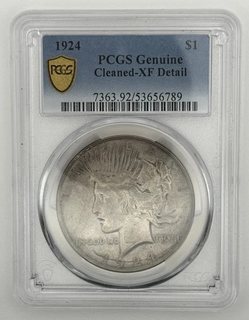
View on eBay

1970-S Kennedy Half Dollar Proof NGC Graded PF69 Cameo — JFK Label

1970-S Kennedy Half Dollar Proof · NGC PF69 Cameo · JFK label · San Francisco Mint · 40% silver clad · designed by Philadelphia-born Gilroy Roberts and Frank Gasparro

$94.64 1970 NGC PF69 Kennedy Half Dollars

Description

A 1970-S Kennedy half dollar proof from the San Francisco Mint, certified and sealed by NGC at PF69 Cameo. The certification number on the label can be checked on the NGC website. The photos show this exact coin and holder.

The holder carries NGC's John F. Kennedy label: his photograph captioned "35th President of the US," a waving U.S. flag, and a facsimile of his signature.

Mint specifications: 40% silver clad (outer layers 80% silver and 20% copper, bonded to a core of 79% copper and 21% silver); 11.50 grams; 30.6 mm. These are the Mint's standard figures; the coin has not been removed from its holder.

Read the full description

The 1970-S Proof Half

In 1970 no half dollars were struck for circulation; this San Francisco proof was one of 2,632,810 struck for proof sets. The Kennedy half was 40% silver clad from 1965 to 1970 and had no silver from 1971, making 1970 the final silver-clad year. The San Francisco Mint opened in 1854 to coin California Gold Rush gold; its current building on Hermann Street, opened in 1937, focuses primarily on proof coins like this one.

The Year 1970

On December 31, 1970, minutes before midnight, President Nixon signed the law that took the silver out of the half dollar, authorized the GSA sale of the Treasury's Carson City silver dollars, and created the Eisenhower dollar. In 1970 a dollar had the buying power of about $8.30 today, so this half dollar's 50 cents was worth about $4.15.

The Kennedy Half Dollar

President John F. Kennedy was assassinated on November 22, 1963, and when his memorial half dollar went on sale on March 24, 1964, a line a block long formed at the Treasury windows. Gilroy Roberts adapted his Kennedy medal portrait for the front, and Frank Gasparro adapted the presidential seal for the back. Only months before his death, Kennedy declared "Ich bin ein Berliner" in West Berlin, visited his family's ancestral home in Ireland, and went on to Italy.

Grade And Authenticity

A proof is struck specially for collectors, with mirror-like fields; "Cameo" means the portrait and lettering are frosted against those fields, and PF69 is one point below a perfect 70. NGC, founded in 1987, is the official grading service of the American Numismatic Association, with offices in Hong Kong, Shanghai, Munich and London. The seller also tested the metal through the holder with a calibrated Sigma Metalytics verifier (consistent with the 40% silver-clad composition), inspected the holder for tampering (none found), and confirmed the certification number on the NGC website.

Also In Our Store

  • Eisenhower dollars and GSA-sold Morgan dollars from that same 1970 law.
  • Holiday postcards from the Golden Age of Postcards, many printed in Germany.
  • Peace dollars, designed by Sicilian-born Anthony de Francisci, and more world coins and banknotes.

Disclaimer

Specifications and detailed item descriptions are provided as a courtesy only and are not guaranteed to be one hundred percent accurate. Please do your own research. There are generally no receipts available for any items from original purchases. Any dimensions and/or weights are approximate. The absence of a more detailed condition report does not imply there are no condition issues with the item(s). Please inspect images carefully as they are part of the official item description and best representation of the actual condition. Additional images may be available upon request depending on time and availability. Not responsible for internet mis-translations or mis-identification of maker's marks if found or assumptions of makers or materials — item descriptions will indicate if it is assumed. If you see a problem, please message us immediately and we will do our best to sort out a solution and confirm the information. With the exception of eBay rules, no returns are accepted.
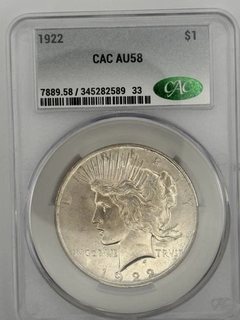
View on eBay

ca1900 Au Bon Marche Paris Trade Card La Poule aux Oeufs d'Or Exposition 1900

ca1900 Au Bon Marche Paris Trade Card La Poule aux Oeufs d'Or Exposition 1900 — "AU BON MARCHÉ" at the top; a fable scene: a village girl with a basket of eggs and a young man in a red waistcoat at a farm gate, a hen at their feet. Approx. 4.30 x 6.38 in.

$94.42 1900 Advertising Sales Trade Cards

Description

"AU BON MARCHÉ" at the top; a fable scene: a village girl with a basket of eggs and a young man in a red waistcoat at a farm gate, a hen at their feet. Caption: "La Poule aux Oeufs d'Or" (The Hen That Laid the Golden Eggs), no. 2, with French verse below.

The back is printed in green: "AU BON MARCHÉ, Maison Aristide Boucicaut, Paris," with an engraving of the store and its "Annexe" on a busy street. "Magasins de Nouveautés. Les plus importants du monde entier. A visiter comme l'une des plus remarquables curiosités de Paris. Interprètes dans toutes les langues. Exposition Universelle 1900. Hors Concours — Membre du Jury." Printer: "Imp. B. Sirven, Toulouse-Paris."

Approx. 4.30 x 6.38 in.

Read the full description

Historical Context

The great Paris department store. The back invites visitors to see the store as "one of the most remarkable curiosities of Paris," with "interpreters in every language," and names its founder, Aristide Boucicaut.

Paris 1900. At the Exposition Universelle of 1900 the store was "Hors Concours — Membre du Jury": too distinguished to compete, it sat on the jury instead.

A fable for children. The front illustrates La Fontaine's fable of the hen that laid golden eggs, from a numbered series.

Condition

Front: very good, bright color with a slick finish. Back: light foxing, crisp green printing. Please see the photos, which are part of the description.

About The Printing

This is an original chromolithograph, and it was slow, exacting work. Each color had to be drawn onto its own separate stone by hand — in monochrome, the artist judging how much stipple each area needed so the colors would combine correctly only once every stone had been printed. The sheet then went through the press once for every color it carries, often a dozen or more, and every pass had to register exactly against the last. A pass out of register showed.

Under magnification the image resolves into irregular hand-drawn stipple, each ink carrying its own dot pattern, the colors mixing in the eye rather than on the paper. There is no regular halftone screen and no four-color rosette, which is what a modern reproduction would show. Modern process printing simulates every color from four inks; chromolithography laid each color down as its own.

The front has a slick, glossy finish, and the back is printed in a single green ink.

Provenance

From my family's estate collections, built over more than 60 years by knowledgeable antiques collectors and traders. Stored in a climate-controlled environment.

Also In Our Store

More Victorian advertising trade cards are in our store.

Disclaimer

The images and any video show the actual item and are part of the official listing description, so please review them closely. Measurements and weights are approximate, and any maker or material we haven't confirmed is described as assumed. Questions? Message us; we answer quickly.

View on eBay

1887 Morgan Silver Dollar 90% Silver US $1 Coin Original Never Cleaned KM#110

1887 Morgan Silver Dollar, Philadelphia Mint, 90% Silver, 0.7734 oz Silver, Natural Gray Toning, Original Never-Cleaned Surfaces, KM#110 [Est. VF-35]

$93.87 1887 Est. VF-35 Morgan Silver Dollars

Description

An 1887 Morgan silver dollar struck at the Philadelphia Mint (no mint mark), KM#110. Designed by George T. Morgan: Liberty facing left, wearing a cap with a wreath of cotton and wheat, LIBERTY on the headband and E PLURIBUS UNUM above; on the reverse an eagle with outstretched wings holding an olive branch and arrows within a wreath, with IN GOD WE TRUST above. 90% silver, 10% copper, 26.73 grams standard, 0.7734 oz of pure silver, 38.1 mm, reeded edge. The close-ups show the date, the hair above the ear, the eagle's breast and the wreath with no mint mark.

Read the full description

Historical Context

The Bland-Allison Act of 1878 required the Treasury to buy two to four million dollars' worth of silver every month and coin it into silver dollars, and George T. Morgan's design carried that silver from 1878 to 1904. Philadelphia struck 20,290,000 Morgan dollars in 1887.

Buying Power

In 1887 this dollar had the buying power of about $35.47 today.

Condition

[Est. VF-35] Circulated, original and never cleaned, with natural gray toning that darkens toward the rims. Wear on the cheek, the hair above the ear and the cotton blossoms; LIBERTY on the headband is sharp and the hair strands above the forehead still show. The eagle's breast feathers are mostly worn flat and the tops of the wings show wear. Light handling marks (see the close-ups). Checked for the 1887/6 overdate (VAM-2) and the Alligator Eye (VAM-12): none seen. Tested on a Sigma Metalytics precious metal verifier: reading consistent with silver. Grade estimated; not professionally graded. Currently still legal tender, but worth far more to collectors and for its silver than its face value.

Also In Our Store

More Morgan and Peace silver dollars: https://www.ebay.com/str/tfauctionsintl?_nkw=silver+dollar

Disclaimer

The images and any video show the actual item and are part of the official listing description, so please review them closely. Measurements and weights are approximate, and any maker or material we haven't confirmed is described as assumed. Questions? Message us; we answer quickly.

View on eBay

1886 Morgan Silver Dollar 90% Silver US $1 Coin Philadelphia KM#110 XF Details

1886 Morgan Silver Dollar, Philadelphia Mint, 90% Silver, 0.7734 oz Silver, Struck the Year the Statue of Liberty Was Dedicated, Record Mintage, KM#110 [Est. XF-40 Details, Cleaned]

$92.86 1886 Est. XF-40 Details, Cleaned Morgan Silver Dollars

Description

An 1886 Morgan silver dollar struck at the Philadelphia Mint (no mint mark), KM#110. Designed by George T. Morgan: Liberty facing left, wearing a cap with a wreath of cotton and wheat, LIBERTY on the headband and E PLURIBUS UNUM above; on the reverse an eagle with outstretched wings holding an olive branch and arrows within a wreath, with IN GOD WE TRUST above. 90% silver, 10% copper, 26.73 grams standard, 0.7734 oz of pure silver, 38.1 mm, reeded edge. The close-ups show the date, the hair above the ear, the eagle's breast and the wreath with no mint mark.

Read the full description

Historical Context

The Bland-Allison Act of 1878 required the Treasury to buy two to four million dollars' worth of silver every month and coin it into silver dollars, and George T. Morgan's design carried that silver from 1878 to 1904. In 1886 Philadelphia struck 19,963,000, a record for the denomination at the time. That same year, on October 28, 1886, President Grover Cleveland dedicated the Statue of Liberty in New York Harbor.

Buying Power

In 1886 this dollar had the buying power of about $35.64 today.

Condition

[Est. XF-40 Details, Cleaned] Circulated. Fine hairlines across both sides show an old cleaning, done before the coin came to us. Light wear on the cheek, the hair above the ear and the eagle's breast; the cotton blossoms and wing feathers are well defined and the rims are full. Small red-brown spots in the cotton leaves of the hair and on the reverse at the L of DOLLAR, left of the D and by the M of AMERICA (see the close-ups). Checked for the 1886 VAM-1C clashed reverse: none seen. Tested on a Sigma Metalytics precious metal verifier: reading consistent with silver. Grade estimated; not professionally graded. Currently still legal tender, but worth far more to collectors and for its silver than its face value.

Also In Our Store

More Morgan and Peace silver dollars: https://www.ebay.com/str/tfauctionsintl?_nkw=silver+dollar

Disclaimer

The images and any video show the actual item and are part of the official listing description, so please review them closely. Measurements and weights are approximate, and any maker or material we haven't confirmed is described as assumed. Questions? Message us; we answer quickly.

View on eBay

1921-P Morgan Silver Dollar [Est. AU Details Polished] Designed by an Englishman

1921-P Morgan Silver Dollar · Ungraded, Est. AU Details – Polished · Philadelphia Mint · 90% silver · designed by Englishman George T. Morgan

$91.26 1921 Est. AU Details Polished Morgan Silver Dollars

Description

A 1921-P Morgan silver dollar from the Philadelphia Mint (no mint mark). This coin is not professionally graded; the seller's visual estimate is [Est. AU Details – Polished]. The photos show this exact coin, including high-resolution 1200 dpi scans, and are part of the description.

Condition: polished to a bright, mirror-like silver finish; not dipped. A grading service would not assign a numeric grade; it would call it "AU Details – Cleaned." The hair above Liberty's forehead and ear is sharp and well separated, and the cotton blossoms, leaves, wing feathers and eagle's head are crisp; the eagle's breast is flat, typical of the soft strike on 1921 Philadelphia dollars. The coin circulated: bag marks and light contact marks in the fields and on Liberty's cheek, and a few very small rim nicks visible under magnification. Bright and well centered, with the full design visible.

Mint specifications: 90% silver, 10% copper; 26.73 grams; 38.1 mm; 0.7734 troy oz of pure silver. These are the Mint's standard figures.

Read the full description

The 1921-P

Philadelphia struck 44,690,000 Morgan dollars in 1921. That year the Mint struck 86,730,000 Morgan dollars in all, the largest single-year silver dollar mintage in US history. The Philadelphia Mint, America's first, struck the very first Morgan dollar on March 11, 1878.

The Year 1921

On May 5, 1921, Coco Chanel launched Chanel No. 5 at her boutique on the rue Cambon in Paris, and on August 5 Pittsburgh's KDKA aired the first radio broadcast of a major league baseball game. A dollar in 1921 had the buying power of about $18 today.

The Morgan Dollar

Isn't it remarkable that one of America's best-known collectible coins was designed by an Englishman, who went on to become Chief Engraver of the United States Mint?

George T. Morgan, from the Birmingham area of England, joined the US Mint in 1876 on the recommendation of Britain's Royal Mint. The Pittman Act of 1918 melted over 270 million silver dollars, much of their silver sold to Britain to back its currency in India, and in 1921 Morgan's design returned for one final year to replace them.

WHY A POLISHED DOLLAR?

Collectors are often told never to buy a polished coin, and for a coin bound for a grading slab, that is good advice. This coin is for a different kind of collector: one who wants to hold history, not look at it through plastic. Pick it up and feel the weight of the silver, tap it gently and hear it ring, and turn it in the light to watch the mirror finish catch it. Then wonder how many hands it passed through between the bank in 1921 and yours.

Grade And Authenticity

AU (About Uncirculated) 50–58 shows only traces of wear; "Details" means a grading service would not give this coin a numeric grade because it has been polished. The seller tested the metal with a calibrated Sigma Metalytics verifier set for 90% silver (consistent with silver); the last photo shows the verifier with this coin.

Also In Our Store

  • Silver Eagles carrying the Walking Liberty design of German-born sculptor Adolph A. Weinman.
  • Victorian advertising trade cards, chromolithographed in the Morgan years.
  • Peace dollars, designed by Sicilian-born Anthony de Francisci, and more world coins and banknotes.

Disclaimer

Specifications and detailed item descriptions are provided as a courtesy only and are not guaranteed to be one hundred percent accurate. Please do your own research. There are generally no receipts available for any items from original purchases. Any dimensions and/or weights are approximate. The absence of a more detailed condition report does not imply there are no condition issues with the item(s). Please inspect images carefully as they are part of the official item description and best representation of the actual condition. Additional images may be available upon request depending on time and availability. Not responsible for internet mis-translations or mis-identification of maker's marks if found or assumptions of makers or materials — item descriptions will indicate if it is assumed. If you see a problem, please message us immediately and we will do our best to sort out a solution and confirm the information. With the exception of eBay rules, no returns are accepted.
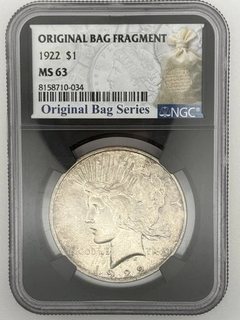
View on eBay

Sterling Silver Blue Goldstone Cabochon Floral Cocktail Ring Size 7.5 Adj

Vintage Sterling Silver Cocktail Ring with a Blue Goldstone Cabochon and Engraved Floral Band, Adjustable, Size 7.5

$89.63 Rings

Description

A sterling silver ring, stamped Sterling, with a round blue goldstone cabochon on an engraved floral band. Blue goldstone is a man-made glass filled with tiny metallic crystals that sparkle in the light.

Read the full description

Condition

Good vintage condition.

Size And Weight

Adjustable; currently US size 7.5 and can be adjusted by hand. Weight 3.99 g including the stone.

Provenance

From my family's estate collections, built over more than 60 years by knowledgeable antiques collectors and traders. Stored in a climate-controlled environment.

Disclaimer

The images and any video show the actual item and are part of the official listing description, so please review them closely. Measurements and weights are approximate, and any maker or material we haven't confirmed is described as assumed. Questions? Message us; we answer quickly.

View on eBay

1923-P Peace Silver Dollar Coin (Est. XF40)

1923-P Peace Silver Dollar · Ungraded, Est. XF40 · Philadelphia Mint · 90% silver · designed by Sicilian-born Anthony de Francisci

$88.89 1923 Est. XF40 Peace Silver Dollars

Description

A 1923-P Peace silver dollar from the Philadelphia Mint (no mint mark). This coin is not professionally graded; the seller's visual estimate is [Est. XF40]. Please judge from the photos, which show this exact coin and are part of the description.

Condition: bright original luster; even circulation wear, with scattered contact marks typical of a silver dollar that circulated.

Mint specifications: 90% silver, 10% copper; 26.73 grams; 38.1 mm; 0.7734 troy oz of pure silver. These are the Mint's standard figures.

Read the full description

The 1923 Peace Dollar

Philadelphia struck 30,800,000 Peace dollars in 1923. The Philadelphia Mint, America's first, was created by the Coinage Act of 1792 and delivered the nation's first circulating coins in March 1793. Every one of the 1,006,473 Peace dollars dated 1921 was struck here.

The Year 1923

In November 1923 one US dollar was worth 4,210,500,000,000 German paper marks. The same year, the HOLLYWOODLAND sign went up in the hills above Los Angeles, its 43-foot letters lit by 4,000 light bulbs. A dollar in 1923 had the buying power of about $19 today.

The Peace Dollar

Isn't it remarkable that the coin America struck to celebrate peace after the First World War was designed by a young Sicilian immigrant, and modeled on his Italian-born wife?

Anthony de Francisci, born in Palermo, Sicily, in 1887, won the design competition in December 1921; Liberty's face is based on his wife, Teresa, born in Laurenzana, Italy. The coin followed the Pittman Act of 1918, which melted 270 million silver dollars and sold their silver to Britain to steady the currency of British India, and the 1921 resolution formally ending America's war with Germany and Austria-Hungary. English-born Chief Engraver George T. Morgan removed a broken sword from the first reverse before Christmas 1921.

Grade And Authenticity

This coin has not been professionally graded; [Est. XF40] is the seller's visual estimate on the 1–70 Sheldon scale, where XF (Extremely Fine) 40 shows light wear. Please judge from the photos.

Also In Our Store

  • A 1923 German 500-million-mark banknote from that year's hyperinflation.
  • Holiday postcards from the Golden Age of Postcards, many printed in Germany.
  • Morgan dollars, designed by English-born George T. Morgan, and more world coins and banknotes.

Disclaimer

Specifications and detailed item descriptions are provided as a courtesy only and are not guaranteed to be one hundred percent accurate. Please do your own research. There are generally no receipts available for any items from original purchases. Any dimensions and/or weights are approximate. The absence of a more detailed condition report does not imply there are no condition issues with the item(s). Please inspect images carefully as they are part of the official item description and best representation of the actual condition. Additional images may be available upon request depending on time and availability. Not responsible for internet mis-translations or mis-identification of maker's marks if found or assumptions of makers or materials — item descriptions will indicate if it is assumed. If you see a problem, please message us immediately and we will do our best to sort out a solution and confirm the information. With the exception of eBay rules, no returns are accepted.
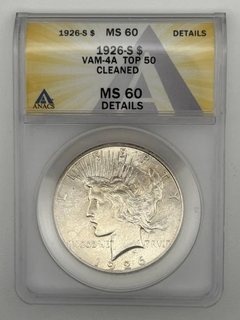
View on eBay

2026 Great Britain Silver Britannia £2 1 oz .999 Fine Silver Coin BU

2026 Great Britain Silver Britannia £2 1 oz .999 Fine Silver Coin BU

$84.77 2026 Silver (.999 & .9999 Fine)

Item Description

Key Features

Specifications

Ref: 1.0165

  • This listing is for one (1) authentic 2026 1 Tory oz Great Britain Silver Britannia Coin in Brilliant Uncirculated (BU) condition. I shines and reflects light like a mirror and there is not a visible mark on it, even under magnification.
  • This iconic bullion coin from the British Royal Mint features the classical standing figure of Britannia holding her trident and shield. The 2026 design incorporates the Mint's advanced security features, including the micro-text border, a latent image indicator, and a surface animation waves background.
  • Obverse (Other Side): Features the official coinage portrait of His Majesty King Charles III, along with the monetary denomination of 2 Pounds.
  • Purity: Struck from 1 troy ounce of .999 pure fine silver.
  • Security: State-of-the-art security features built directly into the reverse artwork.
  • Legal Tender: Backed as official British legal tender with a face value of £2.
  • Composition: Silver
  • Fineness: 0.999
  • Precious Metal Content per Unit: 1 Troy oz
  • Year: 2026
  • Brand/Mint: British Royal Mint
  • Strike Type: Business / Brilliant Uncirculated (BU)
  • Country/Region of Manufacture: United Kingdom
  • Denomination: £2 (Two Pounds)
  • The coin will be packaged in holder/capsule as shown in pictures and well wrapped to avoid damage in transit. Shipping will include tracking and insurance to cover the value of the coin as well.
  • Please see pictures are they are part of the official item description.
  • Check our store frequently as we have hundreds of US and foreign coins and banknotes that are slowly being added each day along with some other collectible items. Thank you!

View on eBay

Vintage Sterling Silver 925 Ring Dark Blue Oval Stone Bypass Setting Size 7

Vintage Sterling Silver Ring with a Dark Blue Oval Faceted Stone in a Bypass Setting, Marked 925, Size 7

$79.87 Rings

Description

A sterling silver ring, marked 925, with a dark blue to near-black oval faceted stone held in four prongs, set between sculpted bypass shoulders. The stone has not been tested or certified; it may be a sapphire, but it is described here as an unidentified stone.

Read the full description

Condition

Good vintage condition with light wear to the band.

Size

US ring size 7.

Provenance

From my family's estate collections, built over more than 60 years by knowledgeable antiques collectors and traders. Stored in a climate-controlled environment.

Disclaimer

The images and any video show the actual item and are part of the official listing description, so please review them closely. Measurements and weights are approximate, and any maker or material we haven't confirmed is described as assumed. Questions? Message us; we answer quickly.

View on eBay

Vintage Silver-Toned Chain Mail Mesh Coin Purse Ornate Scalloped Floral Frame

Antique Silver-Toned Chain Mail Mesh Coin Purse with Ornate Scalloped Floral Frame, circa 1900

$79.87 Silver (Silver Toned) Purses

Description

A tiny, palm-sized coin purse of fine chain-mail mesh on an ornate scalloped frame with floral decoration and a clasp, attributed to around 1900. Shown filled with cotton to hold its shape.

Read the full description

Condition

Good for its age. Slight damage on the back: a small area of misaligned or missing mesh links, repairable by a skilled metalsmith (see images). No maker's or silver marks found, and the metal has not been tested, so it is described as silver-toned.

Dimensions

Approx. 3.75 x 2.5 x 0.75 in. Weight 44.94 g.

Provenance

From my family's estate collections, built over more than 60 years by knowledgeable antiques collectors and traders. Stored in a climate-controlled environment.

Disclaimer

The images and any video show the actual item and are part of the official listing description, so please review them closely. Measurements and weights are approximate, and any maker or material we haven't confirmed is described as assumed. Questions? Message us; we answer quickly.

View on eBay

Vintage Retro Style Sterling Silver Bow Brooch Blue Glass Flower

Vintage Retro-Style Sterling Silver Ribbon Bow Brooch with a Blue Glass and Rhinestone Flower

$79.53 Brooches

Description

A large ribbon bow of wide, curled sterling silver bands, topped by a flower of six pear-shaped blue stones around a clear rhinestone center. The blue stones are assumed to be glass. Marked Sterling (see images) and tested as .925 sterling silver. Bow brooches like this were a popular style from the 1940s on.

Read the full description

Condition

Clean, with light wear. The warm lighting gives the silver a golden tint in some images; the piece is silver in color.

Provenance

From my family's estate collections, built over more than 60 years by knowledgeable antiques collectors and traders. Stored in a climate-controlled environment.

Disclaimer

The images and any video show the actual item and are part of the official listing description, so please review them closely. Measurements and weights are approximate, and any maker or material we haven't confirmed is described as assumed. Questions? Message us; we answer quickly.

View on eBay

2005 Costa Rica 10000 Colones Emma Gamboa Banknote P-267d [Est. UNC]

14 September 2005 Costa Rica 10000 Colones Banknote, Emma Gamboa and Four Volcanoes / Puma and Jaguar, Pick P-267d, Serial A40335532 [Est. UNC]

$77.47 2005 Est. UNC Costa Rica

Description

Issued by the Banco Central de Costa Rica and printed by Oberthur Fiduciaire (Francois-Charles Oberthur imprint). Front: Emma Gamboa with the volcanoes Rincon de la Vieja, Irazu, Arenal and Poas; back: a puma, with a jaguar in the underprint. Emma Gamboa watermark. Serial A40335532. Measured on the 1200 dpi scan: 157.2 x 67.7 mm. The close-ups show the serial, the date, Emma Gamboa, the puma, the signatures and the volcanoes. The last image adds a millimeter scale.

Read the full description

Historical Context

Emma Gamboa Alvarado (1901-1976) was a teacher and education scholar who earned a PhD at Ohio State in 1951, helped found the national teachers' association and served as vice-minister of education. She was declared Benemerita de la Patria in 1980. The colon has been Costa Rica's currency since 1896 and has never been redenominated.

Condition

[Est. UNC] No folds, creases or handling marks. The paper is bright and crisp, with sharp corners and clean edges. No tears, holes, stains or writing. Grade estimated from the scans; not professionally graded.

Legal Tender

No longer legal tender: withdrawn on 31 December 2012; it can still be exchanged or deposited at Costa Rican financial institutions with no time limit (BCCR).

Disclaimer

The images and any video show the actual item and are part of the official listing description, so please review them closely. Measurements and weights are approximate, and any maker or material we haven't confirmed is described as assumed. Questions? Message us; we answer quickly.

View on eBay

1971 1976 1978 Eisenhower Ike Dollar Lot of 3 First Year Bicentennial Last Year

1971, 1776-1976 and 1978 Eisenhower Dollars, Lot of 3: First Year, Bicentennial and Last Year of the Ike Dollar, Philadelphia Mint, Copper-Nickel Clad, Original Never Cleaned

$76.76 1971 Eisenhower Dollars

Description

Three Philadelphia Eisenhower dollars that bracket the whole series: the 1971 first year, a 1776-1976 Bicentennial with the Type 1 Liberty Bell reverse, and the 1978 last year. Frank Gasparro designed the obverse and the Apollo 11 eagle reverse; Dennis R. Williams designed the Bicentennial reverse. Each coin: copper-nickel clad, 22.7 grams, 38.1 mm, reeded edge. You receive the exact three coins pictured.

Read the full description

Historical Context

The 1971 coin came two years after Apollo 11, whose insignia inspired the eagle-on-the-Moon reverse (mintage 47,799,000). The Bicentennial coins were struck in 1975 and 1976 with the dual date (117,337,000). The 1978 coin is the final year (25,702,000) before the Susan B. Anthony dollar replaced it in 1979.

Buying Power

In 1971 one dollar had the buying power of about $8.25 today; in 1978, about $5.12.

Condition

1971 [Est. AU50], 1776-1976 [Est. AU50], 1978 [Est. AU50]. Circulated, original and never cleaned; light wear on the high points and contact marks typical of circulated dollars (see the photos). Bicentennial checked: Type 1 lettering. Grades estimated; not professionally graded.

Also In Our Store

More coins: https://www.ebay.com/str/tfauctionsintl?_nkw=coin

Disclaimer

The images and any video show the actual item and are part of the official listing description, so please review them closely. Measurements and weights are approximate, and any maker or material we haven't confirmed is described as assumed. Questions? Message us; we answer quickly.

View on eBay

Antique Advertising Trade Card for Gail Borden's Eagle Brand Condensed Milk

Antique Victorian Advertising Trade Card for Gail Borden's Eagle Brand Condensed Milk

$74.58 Advertising Sales Trade Cards

Antique Advertising Trade Card for Gail Borden's Eagle Brand Condensed Milk

  • Time Period: Late 19th Century, Copyright 1887
  • Origin: New York, USA
Read the full description

Background

Gail Borden Jr. patented his process for making condensed milk in 1856, revolutionizing the dairy industry and providing a shelf-stable milk product for consumers. The Eagle Brand Condensed Milk, established by Borden, quickly became a household name, particularly valued for its convenience and safety compared to fresh milk, which was often prone to spoilage. The company's marketing often featured idyllic scenes of healthy children and families, associating their product with purity and well-being.

This particular advertisement, likely a trade card or a similar piece of ephemera, showcases the popular Victorian aesthetic with its detailed lithography and sentimental imagery. Such cards were widely distributed to promote products and were often collected by households. The depiction of a child and a kitten alongside the milk can was a common marketing strategy to evoke feelings of domesticity, care, and nourishment, appealing to mothers and families.

More Background & Description

Gail Borden Jr. patented his process for making condensed milk in 1856, revolutionizing food preservation and infant nutrition. His "Eagle Brand" became a household name, offering a shelf-stable milk product that was particularly vital in times when fresh milk was scarce or unsafe. The New York Condensed Milk Company, founded by Borden, was instrumental in popularizing this innovation across the United States.

This advertisement trade card, dates from the late 19th century, as indicated by the "COPYRIGHT 1887" mark. Such cards were common promotional items, distributed to consumers to build brand recognition and provide product information. The imagery of the eagle, a symbol of American strength and freedom, was strategically used to associate these qualities with the Eagle Brand, while the detailed instructions highlight its versatility and importance as a food source, especially for infants.

Ref: 1.0516

  • Please reivew pictures carefully as they are part of the item description and condition.
  • Dimensions: H: 5.5" x W: 3.5"
  • Composition: Heavy cardstock with color printing.
  • Please visit our store as we are constantly adding more items of all types. Thank you!

View on eBay

ca1885 Trade Card Jacob Rosenberg Boots Shoes Girl with Pug Dog Large XL

ca1885 Trade Card Jacob Rosenberg Boots Shoes Girl with Pug Dog Large XL — A girl in a white dress, red stockings and a red bonnet sits on an overstuffed brown sofa with her arm around a pug. Approx. 5.72 x 7.56 in.

$70.68 Advertising Sales Trade Cards

Description

A girl in a white dress, red stockings and a red bonnet sits on an overstuffed brown sofa with her arm around a pug. Imprint at the top: "Jacob Rosenberg, Wholesale & Retail Dealer in Boots and Shoes, 1124 & 1126 S. Fourth St.," with German felt shoes and repairing noted. Stock number "1005." The back is blank.

Approx. 5.72 x 7.56 in.

Read the full description

Historical Context

A neighborhood shoe store. Rosenberg sold wholesale and retail from a double storefront on South Fourth Street and took in custom work and repairs.

A girl and her pug. Dog collectors prize pug cards, and this is one of the largest cards in the group.

Condition

Front: excellent, bright color, light edge wear. Back: blank and toned. Please see the photos, which are part of the description.

About The Printing

This is an original chromolithograph, and it was slow, exacting work. Each color had to be drawn onto its own separate stone by hand — in monochrome, the artist judging how much stipple each area needed so the colors would combine correctly only once every stone had been printed. The sheet then went through the press once for every color it carries, often a dozen or more, and every pass had to register exactly against the last. A pass out of register showed.

Under magnification the image resolves into irregular hand-drawn stipple, each ink carrying its own dot pattern, the colors mixing in the eye rather than on the paper. There is no regular halftone screen and no four-color rosette, which is what a modern reproduction would show. Modern process printing simulates every color from four inks; chromolithography laid each color down as its own.

The Rosenberg imprint is printed in black, and the back is blank.

Provenance

From my family's estate collections, built over more than 60 years by knowledgeable antiques collectors and traders. Stored in a climate-controlled environment.

Also In Our Store

More Jacob Rosenberg cards in our store: https://www.ebay.com/str/tfauctionsintl?_nkw=rosenberg

More Victorian advertising trade cards are in our store.

Disclaimer

The images and any video show the actual item and are part of the official listing description, so please review them closely. Measurements and weights are approximate, and any maker or material we haven't confirmed is described as assumed. Questions? Message us; we answer quickly.

View on eBay

Vintage Sterling Silver Grape Cluster Brooch with Leaves and Stem Mexican Style

Vintage Sterling Silver Grape Cluster Brooch with Leaves and Stem, Mexican Style

$69.61 Brooches

Description

A sculptural grape cluster of domed silver grapes with two veined leaves and a ribbed stem. Tested as .925 sterling silver. The style is typical of mid-century Mexican silver; the maker and origin are not confirmed.

Read the full description

Condition

Light tarnish; it polished to a mirror shine in the past.

Dimensions

Approx. 1.9 in. wide x 2.1 in. high x 0.7 in. deep. Weight 10.67 g.

Provenance

From my family's estate collections, built over more than 60 years by knowledgeable antiques collectors and traders. Stored in a climate-controlled environment.

Disclaimer

The images and any video show the actual item and are part of the official listing description, so please review them closely. Measurements and weights are approximate, and any maker or material we haven't confirmed is described as assumed. Questions? Message us; we answer quickly.

View on eBay

Vintage Sterling Silver 925 Butterfly Brooch Green Cabochons Mexican Style

Vintage Sterling Silver Butterfly Brooch with Green Cabochon Stones, Mexican Style, Marked 925

$69.31 Brooches

Description

A small butterfly brooch with chased wings, raised silver ball accents and four round green cabochons, assumed to be glass or stone (not tested). Marked 925 on the back. The style is typical of mid-20th-century Mexican silver; the maker and origin are not confirmed.

Read the full description

Condition

Structurally sound, with tarnish and wear. It can be cleaned and polished, or left with its aged look.

Dimensions

Approx. 1.25 in. x 1.25 in. x 0.25 to 0.5 in. deep. Weight 4.79 g.

Provenance

From my family's estate collections, built over more than 60 years by knowledgeable antiques collectors and traders. Stored in a climate-controlled environment.

Disclaimer

The images and any video show the actual item and are part of the official listing description, so please review them closely. Measurements and weights are approximate, and any maker or material we haven't confirmed is described as assumed. Questions? Message us; we answer quickly.

View on eBay

1913 John Winsch Silk Ribbon Thanksgiving Postcard Embossed Turkey Grapes Gold

Seldom-Seen 1913 John Winsch "A Peaceful Thanksgiving" Postcard, Extremely Detailed Embossed Gold-Rimmed Oval of a Turkey with Grapes, Pumpkins and Autumn Leaves, Factory Die-Cut Red Silk Ribbon on a Two-Layer Card, German Kurrent Message from Sister Rosilie, Unposted — a Small Piece of History and Artistic Expression Ready to Frame; They Just Don't Make Them Like This Anymore

$67.97 1913 Thanksgiving Postcards

Description

A two-layer Thanksgiving postcard from John Winsch, and one of the most elaborate holiday cards of its day. A deeply embossed oval, rimmed in gold, frames a wild turkey among purple grapes, autumn leaves, pumpkins and Indian corn. A length of red silk ribbon runs through die-cut slots across the top and ties in a bow at the left; the slots and tucked ends show it was made this way at the factory. The white border is embossed with grape clusters and vine leaves, uncolored, so they stand out as pure relief, and green bands cut across the corners. The greeting "A Peaceful Thanksgiving" is in red, blue and gold, its lettering embossed as well. Printed along the bottom edge: "DESIGN COPYRIGHTED. JOHN WINSCH. 1913." Size approx. 5.50 x 3.55 in. (140 x 90 mm).

The back is a divided back with a blue "POST CARD" and a stamp box reading "Domestic One cent, Foreign Two cents." It was never mailed. The message, in old German Kurrent script, fills both halves. It reads (transcription with help from a Kurrent reader, checked against the card): "Liebe Schwester, zuerst unseren herzlichen Dank, die Blumen und auch das Bild sind gut angekommen und was die Freude so recht groß gemacht hat, erreicht es genau an unserem Hochzeitstag. Recht du hast mir eine große Freude damit gemacht. Möge der liebe Gott auch recht viel Freude erleben lassen an eure Kinder, das wünschet auch von Herzen deine Schwester Rosilie mit tausend Grüße an euch allen."

In English: "Dear sister, first our heartfelt thanks — the flowers and the picture arrived safely, and what made the joy so great is that they arrived exactly on our wedding anniversary. You have given me a great joy. May dear God let you have much joy in your children; so wishes from the heart your sister Rosilie, with a thousand greetings to you all."

Read the full description

Historical Context

Winsch. The Winsch Publishing Company of Stapleton, New York, produced thousands of postcards from 1910 to 1915, printed in Germany; many were designed by the artist Samuel Schmucker. This card is unsigned, so no artist is claimed.

Two languages, one family. A Thanksgiving card made for the American market, carrying a sister's anniversary thanks in German script — a family keeping its language while taking up an American holiday.

For the frame. With its ribbon, gold and relief, this card displays as well as it stores.

Condition

Very good. The silk ribbon is bright and intact, the bow full, and the embossing crisp. Light toning and soft corners; the white border is clean. Back lightly toned, with the full ink message and a faint erased pencil mark at the top.

About The Printing

Deep embossing lifts the oval above the scanner's plane of focus, so its dot structure cannot be read reliably from our scans, and no printing method is claimed here. The grape and leaf relief in the border is blind-embossed — raised with no ink at all — and the oval carries a raised gold rim.

Provenance

From my family's estate collections, built over more than 60 years by knowledgeable antiques collectors and traders. Stored in a climate-controlled environment.

Also In Our Store

More Thanksgiving postcards from this group are in our store.

Disclaimer

The images and any video show the actual item and are part of the official listing description, so please review them closely. Measurements and weights are approximate, and any maker or material we haven't confirmed is described as assumed. Questions? Message us; we answer quickly.

View on eBay

1942-D Walking Liberty Half Dollar 90% Silver WWII Original Never Cleaned KM#142

1942-D Walking Liberty Half Dollar, Denver Mint, 90% Silver, 0.3617 oz Silver, Struck the First Full Year of America in World War II, Skirt Lines and Sandal Detail Showing, Original Never-Cleaned Surfaces with Light Toning, Adolph Weinman Design Used Today on the American Silver Eagle, KM#142 [Est. VF-20]

$67.42 1942 Est. VF-20 Walking Liberty Half Dollars

Description

A 1942-D Walking Liberty half dollar struck at the Denver Mint, with the D mint mark on the reverse near the rim at about 8 o'clock, KM#142. The obverse shows Liberty striding toward the rising sun, draped in the flag and carrying branches of laurel and oak; the reverse shows an eagle perched on a mountain crag with a pine sapling. 90% silver, 12.5 grams standard, 30.6 mm, reeded edge. The close-ups show the date, Liberty, the D mint mark and the eagle.

Read the full description

Historical Context

Sculptor Adolph A. Weinman designed the Walking Liberty half dollar, struck from 1916 to 1947. In 1942, the first full year after Pearl Harbor, Denver struck about 11 million of them, under a quarter of Philadelphia's 48 million. Weinman's Liberty returned in 1986 as the obverse of the American Silver Eagle, so this classic design is still being struck today.

Buying Power

In 1942 this half dollar had the buying power of about $10.24 today.

Condition

[Est. VF-20] Circulated, original and never cleaned or polished, with light gray toning and hints of blue. Full rims and bold lettering; LIBERTY, IN GOD WE TRUST, the date and HALF DOLLAR are sharp. The skirt lines on Liberty's legs, the sandal, the sun's rays and the eagle's wing feathers show clearly; Liberty's head, hand and the eagle's breast are worn smooth. Light marks consistent with circulation (see the close-ups). Checked for the 1942-D/S over-mint-mark variety: the D appears single. Grade estimated; not professionally graded. Currently still legal tender, but its silver content and collector value are far higher than face value.

Also In Our Store

More coins: https://www.ebay.com/str/tfauctionsintl?_nkw=coin

Disclaimer

The images and any video show the actual item and are part of the official listing description, so please review them closely. Measurements and weights are approximate, and any maker or material we haven't confirmed is described as assumed. Questions? Message us; we answer quickly.

View on eBay

1953 Great Britain Coronation Crown 5 Shillings Pair:Original + Polished Display

1953 Great Britain Coronation Crown, 5 Shillings, Queen Elizabeth II, Copper-Nickel, KM#894 — Matched Pair: One Polished Display Coin and One Original Unpolished Coin

$65.53 1953 Great Britain/England/UK

Description

Two 1953 Coronation crowns (5 shillings), struck by the Royal Mint for the coronation of Queen Elizabeth II. Obverse: the Queen on horseback in the uniform of Colonel-in-Chief of the Grenadier Guards. Reverse: four shields (England twice, Scotland and Ireland) around a central crown, with the rose, thistle, shamrock and leek between them. The edge is lettered FAITH AND TRUTH I WILL BEAR UNTO YOU, shown in the video. Copper-nickel, about 28.28 g and 38.6 mm each. You receive both coins shown.

Read the full description

Historical Context

Queen Elizabeth II was crowned at Westminster Abbey on June 2, 1953. That same morning, London learned that Edmund Hillary and Tenzing Norgay of the British Everest expedition had reached the summit of Mount Everest on May 29, news held back and released to the public on Coronation Day.

Condition

Coin 1, polished display coin (left in the images): polished to a bright mirror finish on both sides for display. Design detail on the shields, crown and lettering remains crisp (see close-ups). Some contact marks remain on the raised horse and rider on the obverse, and a tiny dark speck on the obverse rim. Not a proof: proofs have frosted designs against mirror fields; this coin is bright all over.

Coin 2, original coin (right in the images): never cleaned or polished, original surfaces and luster.

Please judge both coins from the images and video, which show these exact coins.

Also In Our Store

More world coins: https://www.ebay.com/str/tfauctionsintl?_nkw=coin

Disclaimer

The images and any video show the actual item and are part of the official listing description, so please review them closely. Measurements and weights are approximate, and any maker or material we haven't confirmed is described as assumed. Questions? Message us; we answer quickly.

View on eBay

1964-D Kennedy Half Dollar Matched Toned Pair 90% Silver 2 Coins [Est. MS+]

1964-D Kennedy Half Dollars, Matched Pair: Two Denver Coins with the Same Natural Gray Toning, 90% Silver [Est. MS+]

$65.22 1964 Est. MS+ Kennedy Half Dollars (1964)

Description

Two 1964-D Kennedy half dollars from the Denver Mint (D mint mark, on the reverse to the left of the eagle's tail), matched for the same natural gray toning. One shows iridescent toning on the reverse around the mint mark. Each coin: 12.50 grams, 90% silver, 10% copper, 0.3617 troy oz of silver, 30.6 mm, reeded edge. Raw coins, never professionally graded.

Read the full description

Historical Context

Congress authorized the Kennedy half dollar in December 1963, weeks after President Kennedy's assassination, and the first coins were released in March 1964. Chief Engraver Gilroy Roberts sculpted the portrait (his GR monogram is on the truncation of the neck); Frank Gasparro designed the reverse from the Presidential Seal (his FG is near the eagle's tail feathers). 1964 is the only year the Kennedy half was struck in 90% silver for circulation; from 1965 the silver content dropped to 40%.

Condition

Uncirculated, our conservative estimate MS+ (not professionally graded). Natural gray toning; scattered light contact marks. See the photos of both coins, obverse and reverse.

Disclaimer

The images and any video show the actual item and are part of the official listing description, so please review them closely. Measurements and weights are approximate, and any maker or material we haven't confirmed is described as assumed. Questions? Message us; we answer quickly.

View on eBay

Vintage Ladies Sterling Silver Ring Red Stone Openwork Knot Band Size 5.75

Vintage Ladies Sterling Silver Ring with a Red Stone, Assumed Garnet, and Openwork Knot Band, Size 5.75

$64.51 Rings

Description

A delicate sterling silver ring with a small round red faceted stone, assumed to be garnet, in a four-prong setting between openwork knot-pattern shoulders. Marked "SU" and with a second mark that could not be identified. The metal and stone have not been tested.

Read the full description

Condition

Good vintage condition with light wear.

Size And Weight

US ring size 5.75. Weight 1.58 g including the stone.

Provenance

From my family's estate collections, built over more than 60 years by knowledgeable antiques collectors and traders. Stored in a climate-controlled environment.

Disclaimer

The images and any video show the actual item and are part of the official listing description, so please review them closely. Measurements and weights are approximate, and any maker or material we haven't confirmed is described as assumed. Questions? Message us; we answer quickly.

View on eBay

1942-D Walking Liberty Half Dollar 90% Silver Denver US 50C Midway Year KM#142

1942-D Walking Liberty Half Dollar, Denver Mint, 90% Silver, 0.3617 oz Silver, Struck the Year of the Battle of Midway, Full Rims and Bold Lettering, Adolph Weinman Design, KM#142 [Est. F-15]

$63.58 1942 Est. F-15 Walking Liberty Half Dollars

Description

A 1942-D Walking Liberty half dollar struck at the Denver Mint, with the D mint mark on the reverse near the rim at about 8 o'clock, KM#142. The obverse shows Liberty striding toward the rising sun, draped in the flag and carrying branches of laurel and oak; the reverse shows an eagle perched on a mountain crag with a pine sapling. 90% silver, 12.5 grams standard, 30.6 mm, reeded edge. The close-ups show the date, Liberty, the D mint mark and the eagle.

Read the full description

Historical Context

Sculptor Adolph A. Weinman designed the Walking Liberty half dollar, struck from 1916 to 1947. His Liberty returned in 1986 on the American Silver Eagle, so the design is still being struck today. Denver struck 10,973,800 in 1942, under a quarter of Philadelphia's 47.8 million. That June the U.S. Navy turned the Pacific war at the Battle of Midway.

Buying Power

In 1942 this half dollar had the buying power of about $10.24 today.

Condition

[Est. F-15] Circulated, original, with light gray toning. Full rims and bold lettering; the date, IN GOD WE TRUST and HALF DOLLAR are sharp. Liberty's head and hand are worn smooth, the skirt lines show on the lower gown, the eagle's breast is worn flat and the wing feathers show in part. Light marks consistent with circulation (see the close-ups). Checked for the 1942-D/S over-mint-mark variety: the D appears single. Grade estimated; not professionally graded. Currently still legal tender, but its silver content and collector value are far higher than face value.

Also In Our Store

More coins: https://www.ebay.com/str/tfauctionsintl?_nkw=coin

Disclaimer

The images and any video show the actual item and are part of the official listing description, so please review them closely. Measurements and weights are approximate, and any maker or material we haven't confirmed is described as assumed. Questions? Message us; we answer quickly.

View on eBay

Victorian Advertising Card with a Fairy Child and Maison Demorest Patterns

Antique Victorian Advertising Trade Card Featuring a Fairy Child and Maison Demorest Patterns

$62.68 Advertising Sales Trade Cards

Vintage A. Block Dry Goods Store Advertising Trade Business Card from Keyport, New Jersey

  • Time Period: Circa 1880s-1890s Ivictorian Era)
  • Origin: Keyport, New Jersey, United States
  • Composition: Cardstock with color printing
  • Dimensions: H: 4.75" x W: 3"
  • Please reivew pictures carefully as they are part of the item description and condition.
Read the full description

Description

This trade card served as an advertisement for fashion patterns, using a sentimental image of a fairy child and the phrase "He Loves Me A Little" to evoke a sense of romance and domesticity. Such ephemera provides a fascinating glimpse into the popular culture, artistic styles, and marketing strategies of the Victorian period, making them sought after by collectors of antique paper goods and advertising.

Company Background

Maison Demorest was a prominent fashion and pattern company in the late 19th and early 20th centuries, founded by Ellen Louise Demorest. They were known for their "Reliable Patterns," which were widely distributed and advertised through various means, including trade cards like this one. These cards often featured charming illustrations to attract customers and promote their sewing patterns, which were essential for home dressmaking during the Victorian era. Mme. Demorest's Reliable Patterns were a popular brand of sewing patterns during the late 19th and early 20th centuries, founded by Jane Conklin. These patterns enabled home sewers to create fashionable garments, and their availability in dry goods stores made them accessible to a broad audience. The agency for these patterns signifies A. Block's role in providing not just materials but also the means for creating finished goods, reflecting a common business model of the era.

Histrorical Context

Dry goods stores were a staple of commerce in the 19th and early 20th centuries, offering a wide array of textiles, clothing, and household items. These establishments served as crucial community hubs, providing essential goods and often acting as agents for popular pattern companies, like Mme. Demorest's, which allowed individuals to create fashionable clothing at home. The variety of items listed on this card indicates a comprehensive general store catering to the needs of its local clientele.

Ref: 1.0522

  • Please visit our store as we are constantly adding more items of all types. Thank you!

View on eBay

1906 Our National Birds Eagle Turkey Thanksgiving Postcard Undivided Back RI

November 1906 "Our National Birds" American Eagle and Thanksgiving Turkey Embossed Postcard with Gold Highlights, Undivided Back, Mailed East Greenwich, Rhode Island to Attleboro, Massachusetts with RECEIVED Backstamp, 1¢ Franklin Series 1902 Stamp, Signed Clara

$62.46 1906 Thanksgiving Postcards

Description

A clever patriotic Thanksgiving card. Under the heading "Our National Birds," an American eagle with spread wings perches on a rock at left, labeled "The American Eagle," and a strutting tom turkey stands at right, labeled "The Thanksgiving Turkey." The verse beneath reads: "May one give us peace in all our states, The other a piece for all our plates." Both birds are embossed and picked out in gold lines that catch the light — the images show the color, but the shimmer has to be seen in hand. Signed in pencil on the front, "Clara." Size approx. 5.35 x 3.35 in. (135 x 85 mm).

The back is an undivided back — "POST CARD" in brown with "THIS SIDE FOR THE ADDRESS" — which is why Clara signed the front. 1-cent green Benjamin Franklin stamp, Series 1902, tied by an East Greenwich, R.I. postmark of November 19; an Attleboro, Mass. receiving stamp dated 1906 and an oval "RECEIVED" marking sit beside it. Addressed in ink to Mrs. S. Smith, 45 Thacher Street, Attleboro, Mass.

Read the full description

Historical Context

Before the message side. Until March 1, 1907, US postcards could carry only the address on the back; messages had to go on the front, as Clara's does here. Divided backs came in that spring.

The turkey's champion. Benjamin Franklin, whose face is on this card's stamp, wrote to his daughter in January 1784 that the eagle was "a Bird of bad moral Character" and the turkey "a much more respectable Bird." He did not propose the turkey as the national bird, but he would have liked this card.

Two states, two marks. Sent from East Greenwich, Rhode Island, and backstamped on arrival in Attleboro, Massachusetts, the card carries both ends of its journey.

Condition

Good to very good. A faint crease runs through the left side of the front near the eagle, visible mainly under bright light or magnification; it shows in the eagle close-up. Light corner wear and even toning. Back clean apart from a small dark spot at the upper left; postmarks clear.

About The Printing

This card is printed in halftone. Under magnification the black and the colors resolve into a regular, even grid of dots rather than the irregular hand-drawn stipple of a chromolithograph, as expected for a card of this date. The birds are embossed and outlined in gold, and the embossing shows through on the back.

Provenance

From my family's estate collections, built over more than 60 years by knowledgeable antiques collectors and traders. Stored in a climate-controlled environment.

Also In Our Store

More Thanksgiving postcards from this group are in our store.

Disclaimer

The images and any video show the actual item and are part of the official listing description, so please review them closely. Measurements and weights are approximate, and any maker or material we haven't confirmed is described as assumed. Questions? Message us; we answer quickly.

View on eBay

1940s Mutoscope Pin-Up Arcade Card Sure Show Me a Diamond I'll Play Ball Mozert

A 1940s Mutoscope pin-up arcade card with a baseball joke for a caption: "SURE. SHOW ME A DIAMOND AND I'LL PLAY BALL." A dark-haired young woman with a sly smile stands with her hands on her hips, leaning forward, in a white short-sleeved top with a green belt, black cuffed shorts and black ankle-strap heels, against a solid bright red ground.

$61.51 Pin Up Girl Cards

Printed imprints on the front: "A MUTOSCOPE CARD" at lower left, "PRINTED IN U. S. A." at lower right, and a small "© B&B USA" mark at right. The art is not signed on the card. Collector checklists list this title in the 1945 Mutoscope "Artist Pin-Up Girls" set and attribute the art to Zoë Mozert.

Size: approx. 3.25 x 5.25 in (from the scan).

Read the full description

Historical Context

Zoë Mozert (1907–1993), born in Colorado Springs, Colorado, often served as her own model, using cameras and mirrors to capture the pose. She signed an exclusive calendar contract with Brown & Bigelow in 1941, painted the "Victory Girls" series during the war, and created the poster art for the film The Outlaw. By 1950 she was counted among the "big four" of American pin-up art with Rolf Armstrong, Earl Moran and Gil Elvgren. The "B&B" mark on this card is Brown & Bigelow's.

Mutoscope cards were sold one at a time from coin-operated vending machines in arcades and amusement parks during the 1940s. Most of them carried pin-up art, and the series were issued as named sets through the decade. The 1945 "Artist Pin-Up Girls" set ran to 64 cards. This one carries a baseball theme in its caption.

More vintage paper, Victorian trade cards, antique postcards and US silver dollars are in our store: https://www.ebay.com/str/tfauctionsintl

Condition

Very good. Bright, solid color. A small crease or dent along the top edge near the upper right corner; corners otherwise sharp to slightly soft. Please see the photos, which are part of the description.

About The Printing

This card is printed in halftone: under magnification the color resolves into a regular, even grid of dots, the photomechanical process used for mass-produced cards of the period. The caption and imprints are printed in black. The card is flat, not embossed.

Provenance

From my family's estate collections, built over more than 60 years by knowledgeable antiques collectors and traders. Stored in a climate-controlled environment.

Disclaimer

Specifications and detailed item descriptions are provided as a courtesy only and are not guaranteed to be one hundred percent accurate. Please do your own research. There are generally no receipts available for any items from original purchases. Any dimensions and/or weights are approximate. The absence of a more detailed condition report does not imply there are no condition issues with the item(s). Please inspect images carefully as they are part of the official item description and best representation of the actual condition. Additional images may be available upon request depending on time and availability. Not responsible for internet mis-translations or mis-identification of maker's marks if found or assumptions of makers or materials — item descriptions will indicate if it is assumed. If you see a problem, please message us immediately and we will do our best to sort out a solution and confirm the information. With the exception of eBay rules, no returns are accepted.
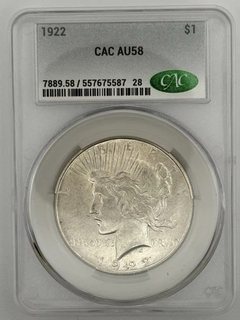
View on eBay

1943 Walking Liberty Half Dollar 90% Silver US 50C Philadelphia WWII KM#142

1943 Walking Liberty Half Dollar, Philadelphia Mint, 90% Silver, 0.3617 oz Silver, Highest Mintage of the Series, World War II Year, Adolph Weinman Design Used Today on the American Silver Eagle, KM#142 [Est. F-12]

$61.37 1943 Est. F-12 Walking Liberty Half Dollars

Description

A 1943 Walking Liberty half dollar struck at the Philadelphia Mint (no mint mark: the field below the pine branch on the reverse is empty), KM#142. The obverse shows Liberty striding toward the rising sun, draped in the flag and carrying branches of laurel and oak; the reverse shows an eagle perched on a mountain crag with a pine sapling. 90% silver, 12.5 grams standard, 30.6 mm, reeded edge. The close-ups show the date, Liberty, the empty mint mark spot and the eagle.

Read the full description

Historical Context

Sculptor Adolph A. Weinman designed the Walking Liberty half dollar, struck from 1916 to 1947. His Liberty returned in 1986 on the American Silver Eagle, so the design is still being struck today. Philadelphia struck 53,190,000 in 1943, the highest mintage of the series. That year the war took the copper out of the cent, struck in zinc-coated steel, but the half dollar stayed 90% silver.

Buying Power

In 1943 this half dollar had the buying power of about $9.65 today.

Condition

[Est. F-12] Circulated, with gray toning that deepens to violet and brown in the recesses. Full rims and clear lettering; the date is readable but worn low. Liberty's head, hand and upper body are worn smooth and the skirt lines show only in part; the eagle's feathers are worn, with the wing outlines clear. Fine scratches and light marks across both sides (see the close-ups). Checked the date and IN GOD WE TRUST for doubling: none seen. Grade estimated; not professionally graded. Currently still legal tender, but its silver content and collector value are far higher than face value.

Also In Our Store

More coins: https://www.ebay.com/str/tfauctionsintl?_nkw=coin

Disclaimer

The images and any video show the actual item and are part of the official listing description, so please review them closely. Measurements and weights are approximate, and any maker or material we haven't confirmed is described as assumed. Questions? Message us; we answer quickly.

View on eBay

1919-D Walking Liberty Half Dollar 90% Silver - Original Never Cleaned KM#142

1919-D Walking Liberty Half Dollar, Denver Mint, 90% Silver, 0.3617 oz Silver, Low Mintage of 1,165,000, Original Never-Cleaned Surfaces, Adolph Weinman Design Used Today on the American Silver Eagle, KM#142 [Est. AG-3]

$59.19 1919 Est. AG-3 Walking Liberty Half Dollars

Description

A 1919-D Walking Liberty half dollar struck at the Denver Mint, with the D mint mark on the reverse near the rim at about 8 o'clock, KM#142. The obverse shows Liberty striding toward the rising sun, draped in the flag and carrying branches of laurel and oak; the reverse shows an eagle perched on a mountain crag with a pine sapling. 90% silver, 12.5 grams standard, 30.6 mm. The close-ups show the date, Liberty, the D mint mark and the eagle.

Read the full description

Historical Context

Sculptor Adolph A. Weinman designed the Walking Liberty half dollar, struck from 1916 to 1947. Denver struck only 1,165,000 in 1919, one of the lower mintages of the series. Weinman's Liberty returned in 1986 as the obverse of the American Silver Eagle bullion coin, so this design is still being struck more than a century later.

Buying Power

In 1919 this half dollar had the buying power of about $9.65 today.

Condition

[Est. AG-3] Original and never cleaned or polished, with even gray silver toning and no luster. Heavily worn: Liberty's figure, the sun and IN GOD WE TRUST are clear; LIBERTY, the date and HALF DOLLAR are worn into the rims, with the final 9 of the date and the D mint mark visible (see the close-ups). A long scratch across the eagle's wing and light marks on both sides. Grade estimated; not professionally graded. Currently still legal tender, but its silver content and collector value are far higher than face value.

Also In Our Store

More coins: https://www.ebay.com/str/tfauctionsintl?_nkw=coin

Disclaimer

The images and any video show the actual item and are part of the official listing description, so please review them closely. Measurements and weights are approximate, and any maker or material we haven't confirmed is described as assumed. Questions? Message us; we answer quickly.

View on eBay

1940s Mutoscope Pin-Up Arcade Card Inflation Control Earl Moran Brown & Bigelow

A 1940s Mutoscope pin-up arcade card titled "Inflation Control." A smiling brunette with long, tousled hair bends forward at the waist toward the viewer, one arm sweeping up and back and the other reaching toward the floor, in a black two-piece swimsuit and black ankle-strap heels. She is set against a bright orange-red ground with a soft painted shadow behind her. The caption "INFLATION CONTROL" is printed at lower left.

$58.73 Pin Up Girl Cards

Printed imprints on the front: "A MUTOSCOPE CARD" and "PRINTED IN U. S. A." at lower left, and a small "© B&B USA" mark at lower right. The art is not signed on the card. Collector checklists list this title in the 1945 Mutoscope "Artist Pin-Up Girls" set and attribute the art to Earl Moran.

Size: approx. 3.25 x 5.25 in (from the scan).

Read the full description

Historical Context

Earl Moran (1893–1984), born in Belle Plaine, Iowa, signed an exclusive contract with the calendar publisher Brown & Bigelow in 1932, and by 1937 his pin-ups had sold millions of calendars. Life magazine made him a national name in 1940, and from 1946 a young Marilyn Monroe posed for him for four years. The "B&B" mark on this card is Brown & Bigelow's.

Mutoscope cards were sold one at a time from coin-operated vending machines in arcades and amusement parks during the 1940s. Most of them carried pin-up art, and the series were issued as named sets through the decade. The 1945 "Artist Pin-Up Girls" set ran to 64 cards.

More vintage paper, Victorian trade cards, antique postcards and US silver dollars are in our store: https://www.ebay.com/str/tfauctionsintl

Condition

Very good. Bright, clean color. Corners sharp to very slightly soft; edges clean. Please see the photos, which are part of the description.

About The Printing

This card is printed in halftone: under magnification the color resolves into a regular, even grid of dots, the photomechanical process used for mass-produced cards of the period. The caption and imprints are printed in black. The card is flat, not embossed.

Provenance

From my family's estate collections, built over more than 60 years by knowledgeable antiques collectors and traders. Stored in a climate-controlled environment.

Disclaimer

Specifications and detailed item descriptions are provided as a courtesy only and are not guaranteed to be one hundred percent accurate. Please do your own research. There are generally no receipts available for any items from original purchases. Any dimensions and/or weights are approximate. The absence of a more detailed condition report does not imply there are no condition issues with the item(s). Please inspect images carefully as they are part of the official item description and best representation of the actual condition. Additional images may be available upon request depending on time and availability. Not responsible for internet mis-translations or mis-identification of maker's marks if found or assumptions of makers or materials — item descriptions will indicate if it is assumed. If you see a problem, please message us immediately and we will do our best to sort out a solution and confirm the information. With the exception of eBay rules, no returns are accepted.
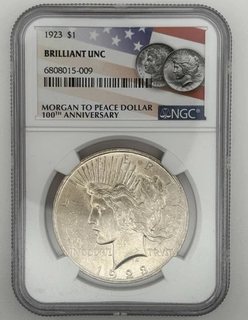
View on eBay

1910 Taggart Patriotic Thanksgiving Postcard Turkey Uncle Sam Hat Embossed Conn

November 1910 M.W. Taggart (Design Copyright 1909, Ser. T.P. 609) Patriotic Embossed Thanksgiving Postcard, Turkey in an Uncle Sam Hat with Stars-and-Stripes Shield, Eagle and Wishbone, Mailed from Connecticut to Master Melvin Hutchinson, North Raynham, Massachusetts, 1¢ Franklin Stamp, from Aunt Hattie

$58.05 1910 Thanksgiving Postcards

Description

A proud tom turkey in a stars-and-stripes Uncle Sam top hat, carrying a cane, struts across a bright red band. At left, a gold column holds a red, white and blue shield topped by an eagle; at upper right hangs a gold wishbone tied with a bow. The greeting "Thanksgiving Greetings" runs along the red band with blue initial blocks for the T and G. The turkey's feathers, the shield and the hat are embossed. Printed small in the red band: "SER. T.P. 609" at lower left and "DESIGN COPYRIGHT 1909, BY M.W. TAGGART, N.Y." at lower right. Size approx. 5.35 x 3.45 in. (136 x 87 mm).

The back is a divided back with a rose "POST CARD" and "This Space For Writing Messages." 1-cent green Benjamin Franklin stamp with a machine cancel; circular postmark of a Connecticut town ending "-NFIELD" (Enfield or Plainfield; the first letters are faint), Nov 25, 8 AM, 1910. Addressed in pencil to Master Melvin Hutchinson, No. Raynham, Mass., and signed "Aunt Hattie x."

Read the full description

Historical Context

Patriotic Thanksgiving. Turkeys dressed as Uncle Sam made the holiday a national one on the card itself, and they draw patriotic collectors as well as holiday collectors.

A boy's mail. "Master" was the courtesy title for a young boy. Melvin Hutchinson of North Raynham received this card from his Aunt Hattie in 1910; a second card to him, from his "Florence baby" cousin in 1911, is also in our store.

Condition

Very good. Bright, clean colors and crisp embossing. Wear at the lower left and lower right corners, where the red band shows small chips. Back clean with light toning, a small rust-colored spot at the lower left of the message side, and the pencil address and signature as described.

About The Printing

This card is printed in halftone. Under magnification the colors resolve into a regular, even grid of dots rather than the irregular hand-drawn stipple of a chromolithograph. The wishbone, column and lettering accents are in gold, and the design is embossed so the turkey stands up in relief on the back.

Provenance

From my family's estate collections, built over more than 60 years by knowledgeable antiques collectors and traders. Stored in a climate-controlled environment.

Also In Our Store

More Thanksgiving postcards from this group are in our store.

Disclaimer

The images and any video show the actual item and are part of the official listing description, so please review them closely. Measurements and weights are approximate, and any maker or material we haven't confirmed is described as assumed. Questions? Message us; we answer quickly.

View on eBay

1940s Mutoscope Pin-Up Arcade Card Here's a Hot Dish Earl Moran Chef Hat Kitchen

A 1940s Mutoscope pin-up arcade card titled "HERE'S A HOT DISH." A smiling redhead in a white chef's toque, a sheer green apron and pink briefs leans over a green stove, stirring a pink mixing bowl with a long spoon and glancing back over her shoulder at the viewer, against a mauve-pink ground with a deep painted shadow.

$57.77 Pin Up Girl Cards

Printed imprints on the front: "A MUTOSCOPE CARD" and "PRINTED IN U. S. A." along the bottom, and a small "© B&B USA" mark at lower right. The art is not signed on the card. Collector checklists list this title in the 1945 Mutoscope "Artist Pin-Up Girls" set and attribute the art to Earl Moran.

Size: approx. 3.25 x 5.25 in (from the scan).

Read the full description

Historical Context

Earl Moran (1893–1984), born in Belle Plaine, Iowa, signed an exclusive contract with the calendar publisher Brown & Bigelow in 1932, and by 1937 his pin-ups had sold millions of calendars. Life magazine made him a national name in 1940, and from 1946 a young Marilyn Monroe posed for him for four years. The "B&B" mark on this card is Brown & Bigelow's.

Mutoscope cards were sold one at a time from coin-operated vending machines in arcades and amusement parks during the 1940s. Most of them carried pin-up art, and the series were issued as named sets through the decade. The 1945 "Artist Pin-Up Girls" set ran to 64 cards.

More vintage paper, Victorian trade cards, antique postcards and US silver dollars are in our store: https://www.ebay.com/str/tfauctionsintl

Condition

Very good. Bright color. Corners sharp to slightly soft, the lower left a little softer. Please see the photos, which are part of the description.

About The Printing

This card is printed in halftone: under magnification the color resolves into a regular, even grid of dots, the photomechanical process used for mass-produced cards of the period. The caption and imprints are printed in black. The card is flat, not embossed.

Provenance

From my family's estate collections, built over more than 60 years by knowledgeable antiques collectors and traders. Stored in a climate-controlled environment.

Disclaimer

Specifications and detailed item descriptions are provided as a courtesy only and are not guaranteed to be one hundred percent accurate. Please do your own research. There are generally no receipts available for any items from original purchases. Any dimensions and/or weights are approximate. The absence of a more detailed condition report does not imply there are no condition issues with the item(s). Please inspect images carefully as they are part of the official item description and best representation of the actual condition. Additional images may be available upon request depending on time and availability. Not responsible for internet mis-translations or mis-identification of maker's marks if found or assumptions of makers or materials — item descriptions will indicate if it is assumed. If you see a problem, please message us immediately and we will do our best to sort out a solution and confirm the information. With the exception of eBay rules, no returns are accepted.
View on eBay

1964-D Kennedy Half Dollar 90% Silver - Original Never Polished KM#202 [Est. MS]

1964-D Kennedy Half Dollar, Denver Mint, 90% Silver, 0.3617 oz Silver, First-Year Issue and Last Year of 90% Silver Halves for Circulation, Strong Hair Detail, Original Never-Polished Surfaces with Light Toning, KM#202 [Est. MS-60]

$54.64 1964 Est. MS Kennedy Half Dollars

Description

A 1964-D Kennedy half dollar struck at the Denver Mint, with the D mint mark on the reverse to the left of the eagle's claw and olive branch, KM#202. The obverse shows John F. Kennedy facing left, with LIBERTY around the rim, IN GOD WE TRUST and the date; the reverse shows the Presidential Seal eagle with a shield, an arc of 50 stars and E PLURIBUS UNUM. 90% silver, 12.5 grams standard, 30.61 mm, reeded edge. The close-ups show the date, the hair detail, the D mint mark and the eagle.

Read the full description

Historical Context

After President Kennedy was assassinated on November 22, 1963, Congress authorized a half dollar in his memory on December 30, 1963. Gilroy Roberts engraved the obverse and Frank Gasparro the reverse. 1964 is the first year of the Kennedy half and the only year it was struck in 90% silver for circulation; from 1965 the half dropped to 40% silver. Denver struck about 156 million in 1964.

Buying Power

In 1964 this half dollar had the buying power of about $5.39 today.

Condition

[Est. MS-60] Uncirculated and original, never polished or cleaned, with even gray toning in blue and gold tones that mutes the luster. Strong hair detail with the individual strands showing across the head; the eagle's feathers, shield lines and stars are crisp. Light contact marks and fine hairline scratches in the fields from decades of storage, mostly on the obverse, and a few small dark specks near the date (see the close-ups). Checked for the 1964-D doubled die obverse (FS-101) and the 1964-D/D repunched mint mark (FS-501): none seen; the D is single. Grade estimated; not professionally graded. Currently still legal tender, but its silver content and collector value are far higher than face value.

Also In Our Store

More coins: https://www.ebay.com/str/tfauctionsintl?_nkw=coin

Disclaimer

The images and any video show the actual item and are part of the official listing description, so please review them closely. Measurements and weights are approximate, and any maker or material we haven't confirmed is described as assumed. Questions? Message us; we answer quickly.

View on eBay

1940 Mutoscope Glorified Glamour Girls Pin-Up Card And the Wind Blew Gil Elvgren

A 1940 Mutoscope pin-up arcade card titled "AND THE WIND BLEW." A redhead in a dark two-piece swimsuit reclines against a sunlit rock at the seashore, face turned up to the sun and eyes closed, while the wind streams her long hair and a red scarf out behind her. A yellow beach wrap lies at lower left on a violet rug, with blue sea, surf, clouds and gulls beyond.

$53.33 1940 Pin Up Girl Cards

Printed imprints on the front: "A MUTOSCOPE CARD" at lower left and "© MADE IN U.S.A." at lower right. This card does not carry the "B&B" mark found on the later cards. The art is not signed on the card. Collector checklists list this title in the 1940 Mutoscope "Glorified Glamour Girls" set and attribute the art to Gil Elvgren.

Size: approx. 3.25 x 5.25 in (from the scan).

Read the full description

Historical Context

Gil Elvgren (1914–1980), born in Saint Paul, Minnesota, became one of the best-known pin-up artists in America. In 1937 he began painting calendar pin-ups for Louis F. Dow, and stayed with Dow until about 1944; he then worked with Brown & Bigelow from 1945 to 1972, and his clients ranged from Coca-Cola to General Electric. This card comes from his Dow years, which fits the absence of a Brown & Bigelow mark.

Mutoscope cards were sold one at a time from coin-operated vending machines in arcades and amusement parks during the 1940s. Most of them carried pin-up art, and the series were issued as named sets through the decade. "Glorified Glamour Girls" of 1940 was the first of the 1940s pin-up sets, with 32 cards.

More vintage paper, Victorian trade cards, antique postcards and US silver dollars are in our store: https://www.ebay.com/str/tfauctionsintl

Condition

Very good. Bright color. Corners sharp to slightly soft, with a small nick at the lower right corner. Please see the photos, which are part of the description.

About The Printing

This card is printed in halftone: under magnification the color resolves into a regular, even grid of dots, the photomechanical process used for mass-produced cards of the period. The caption and imprints are printed in black. The card is flat, not embossed.

Provenance

From my family's estate collections, built over more than 60 years by knowledgeable antiques collectors and traders. Stored in a climate-controlled environment.

Disclaimer

Specifications and detailed item descriptions are provided as a courtesy only and are not guaranteed to be one hundred percent accurate. Please do your own research. There are generally no receipts available for any items from original purchases. Any dimensions and/or weights are approximate. The absence of a more detailed condition report does not imply there are no condition issues with the item(s). Please inspect images carefully as they are part of the official item description and best representation of the actual condition. Additional images may be available upon request depending on time and availability. Not responsible for internet mis-translations or mis-identification of maker's marks if found or assumptions of makers or materials — item descriptions will indicate if it is assumed. If you see a problem, please message us immediately and we will do our best to sort out a solution and confirm the information. With the exception of eBay rules, no returns are accepted.
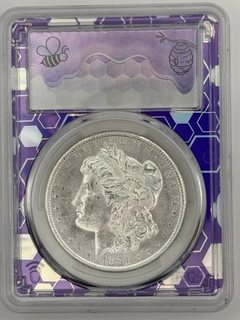
View on eBay

ca1885 Trade Card Fidler & Gould Confections Des Moines Iowa Boy Dove Window

ca1885 Trade Card Fidler & Gould Confections Des Moines Iowa Boy Dove Window — A boy in a sailor-collared suit leans from a brick window framed in roses to release a white dove carrying a letter. Approx. 5.94 x 4.41 in.

$50.78 Advertising Sales Trade Cards

Description

A boy in a sailor-collared suit leans from a brick window framed in roses to release a white dove carrying a letter. Imprint at the foot: "FIDLER & GOULD, Confections, Des Moines, Iowa." The back is blank.

Approx. 5.94 x 4.41 in.

Read the full description

Historical Context

A Des Moines sweet shop. Fidler & Gould had a stock picture card imprinted with their name, a common way for a local confectioner to advertise.

Sending a message. The boy with his dove and letter is a charming subject for collectors of birds, children and Iowa history.

Condition

Front: very good to excellent, bright color, light edge wear. Blank back with foxing spots. Please see the photos, which are part of the description.

About The Printing

This is an original chromolithograph, and it was slow, exacting work. Each color had to be drawn onto its own separate stone by hand — in monochrome, the artist judging how much stipple each area needed so the colors would combine correctly only once every stone had been printed. The sheet then went through the press once for every color it carries, often a dozen or more, and every pass had to register exactly against the last. A pass out of register showed.

Under magnification the image resolves into irregular hand-drawn stipple, each ink carrying its own dot pattern, the colors mixing in the eye rather than on the paper. There is no regular halftone screen and no four-color rosette, which is what a modern reproduction would show. Modern process printing simulates every color from four inks; chromolithography laid each color down as its own.

The confectioner's imprint is printed in black, and the back is blank.

Provenance

From my family's estate collections, built over more than 60 years by knowledgeable antiques collectors and traders. Stored in a climate-controlled environment.

Also In Our Store

More Victorian advertising trade cards are in our store.

Disclaimer

The images and any video show the actual item and are part of the official listing description, so please review them closely. Measurements and weights are approximate, and any maker or material we haven't confirmed is described as assumed. Questions? Message us; we answer quickly.

View on eBay

1890s Garland Stoves Trade Card Child Fishing Michigan Stove Co Oak-Michigan

1890s Garland Stoves Trade Card Child Fishing Michigan Stove Co Oak-Michigan — A small child in a big pink bonnet sits on the end of a dock, fishing line in the water, under a pale sky. Approx. 4.44 x 5.92 in.

$50.22 Advertising Sales Trade Cards

Description

A small child in a big pink bonnet sits on the end of a dock, fishing line in the water, under a pale sky. The Garland Stoves and Ranges trademark sits at lower left.

The back shows the "Oak-Michigan" heating stove "For Hard or Soft Coal, Coke or Wood," with the Michigan Stoves & Ranges eagle crest at upper left: "The Best Medium-Priced Oak Stove in Existence. The Michigan Stove Company, Largest Makers of Stoves and Ranges in the World. Detroit, Chicago, Buffalo, New York City."

Approx. 4.44 x 5.92 in.

Read the full description

Historical Context

A Detroit stove giant. The Michigan Stove Company sold its Garland stoves and ranges across the country, and the back calls the firm the largest maker of stoves and ranges in the world.

Heat for the parlor. The Oak-Michigan is a classic Victorian oak stove, with nickel trim and an ornate finial, built to burn coal, coke or wood.

Condition

Front: light toning, clean image. Back: clean and bright, crisp stove engraving. Please see the photos, which are part of the description.

About The Printing

This is an original chromolithograph, and it was slow, exacting work. Each color had to be drawn onto its own separate stone by hand — in monochrome, the artist judging how much stipple each area needed so the colors would combine correctly only once every stone had been printed. The sheet then went through the press once for every color it carries, often a dozen or more, and every pass had to register exactly against the last. A pass out of register showed.

Under magnification the image resolves into irregular hand-drawn stipple, each ink carrying its own dot pattern, the colors mixing in the eye rather than on the paper. There is no regular halftone screen and no four-color rosette, which is what a modern reproduction would show. Modern process printing simulates every color from four inks; chromolithography laid each color down as its own.

The back is printed in black.

Provenance

From my family's estate collections, built over more than 60 years by knowledgeable antiques collectors and traders. Stored in a climate-controlled environment.

Also In Our Store

More Victorian advertising trade cards are in our store.

Disclaimer

The images and any video show the actual item and are part of the official listing description, so please review them closely. Measurements and weights are approximate, and any maker or material we haven't confirmed is described as assumed. Questions? Message us; we answer quickly.

View on eBay

Vintage Sterling Silver 3-Petal Flower Brooch Green Glass Cabochon Branch Stem

Vintage Sterling Silver Three-Petal Flower Brooch with a Green Glass Cabochon and Branch Stem Pin

$49.55 Brooches

Description

A modernist flower brooch: three domed, hand-shaped silver petals around an oval green cabochon, with a textured branch forming the stem. The stone is assumed to be glass. Small stamped marks appear on the front of the petals (see images); they have not been identified, and there is no clear maker's mark. Tested as .925 sterling silver.

Read the full description

Condition

Good vintage condition with light surface wear and tarnish in the recesses.

Provenance

From my family's estate collections, built over more than 60 years by knowledgeable antiques collectors and traders. Stored in a climate-controlled environment.

Disclaimer

The images and any video show the actual item and are part of the official listing description, so please review them closely. Measurements and weights are approximate, and any maker or material we haven't confirmed is described as assumed. Questions? Message us; we answer quickly.

View on eBay

Vintage MCM Silver-Tone Flat Dot Metal Mesh Coin Purse Scalloped Kiss Lock Frame

Vintage Mid-Century Silver-Tone Flat Dot Metal Mesh Coin Purse with Scalloped Frame and Ball Kiss-Lock Clasp

$48.87 Silver (Silver Toned) Purses

Description

A small coin purse of bright flat dot metal mesh on a scalloped frame with a ball kiss-lock clasp. Mid-century style, possibly earlier. Unmarked, so the maker, metal content and exact date are unknown; the metal has not been tested.

Read the full description

Condition

Excellent, with very little wear and a mirror-like shine.

Dimensions

Approx. 3.25 in. high x 3.5 in. wide x up to 0.75 in. deep. Weight 41.09 g.

Provenance

From my family's estate collections, built over more than 60 years by knowledgeable antiques collectors and traders. Stored in a climate-controlled environment.

Disclaimer

The images and any video show the actual item and are part of the official listing description, so please review them closely. Measurements and weights are approximate, and any maker or material we haven't confirmed is described as assumed. Questions? Message us; we answer quickly.

View on eBay

Vintage Joseph Wiesner Signed Flower Basket Brooch Blue Teardrop Rhinestones

Vintage Wiesner Signed Silver-Tone Flower Basket Brooch with Blue Teardrop and Clear Rhinestones

$47.83 Brooches

Description

A flower basket brooch in silver-tone metal: blue teardrop rhinestones bloom from a pavé basket with a curved handle, all set with small clear rhinestones. Signed WIESNER on a round plaque on the back (see images).

Read the full description

Condition

Very good overall. Stones are missing: at least one blue teardrop and a few small clear rhinestones (see images).

Dimensions

Approx. 1.75 in. x 1.75 in. x 0.25 to 0.45 in. deep. Weight 7.91 g.

Provenance

From my family's estate collections, built over more than 60 years by knowledgeable antiques collectors and traders. Stored in a climate-controlled environment.

Disclaimer

The images and any video show the actual item and are part of the official listing description, so please review them closely. Measurements and weights are approximate, and any maker or material we haven't confirmed is described as assumed. Questions? Message us; we answer quickly.

View on eBay

1909 Embossed Santa Hexagon Portrait Holly Silver Christmas Postcard Germany

DESCRIPTION

$47.67 1909 Christmas Postcards

An embossed Christmas postcard on a silver ground textured with fine radiating lines. At center, a gilt-edged hexagonal panel holds a portrait of an Old World Santa Claus in a red-violet robe and a red fur-trimmed hood with a long red tassel, his white beard full and his face weathered and kind. Embossed sprays of holly with clusters of red berries reach in from either side. At lower left, a black panel edged in gold carries small gold squares in the corners, in the Arts and Crafts manner. Red script greeting at upper right: "To wish you a merry Christmas." No publisher's name, logo or copyright line on the front. Size approx. 5.50 x 3.50 in. (140 x 89 mm).

The back is a divided back with "POST CARD" in green between leafy ornaments, "THIS SIDE FOR CORRESPONDENCE" and "THE ADDRESS TO BE WRITTEN ON THIS SIDE." The stamp box reads "PLACE POSTAGE STAMP HERE — DOMESTIC ONE CENT — FOREIGN TWO CENTS," with "PRINTED IN GERMANY" running vertically beside it. Never mailed: no stamp and no postmark. Dated in brown ink "Dec 25 1909" in the stamp box, headed "Breckenridge, Colorado," addressed to Wilbur McClure, Pittsburg, Kansas, and signed "Carp and Irena Bull" (best reading; the first name is uncertain). Two old pencil prices at the top, 17.50 (circled) and 4.50.

Read the full description

Historical Context

Christmas Day in Colorado. Written on Christmas Day 1909 in Breckenridge, Colorado, and addressed to Pittsburg, Kansas. With no stamp or postmark, it was presumably delivered by hand or tucked into an envelope or parcel.

Printed in Germany, the year the tariff came. German printers dominated early postcard printing, producing inexpensive, high-quality lithographs for American publishers. The same year this card was written, the Payne-Aldrich Tariff of 1909 taxed imported postcards at a much higher rate, and with the First World War American printers took over most of the market.

For Old World Santa collectors. A robed, hooded Santa in a gilt hexagon, with an Arts and Crafts panel below.

The Golden Age of Postcards. Usually dated 1907 to 1915, when Americans sent hundreds of millions of postcards every year.

Condition

Very good. Silver ground bright, embossing crisp. A fine curved scratch or hairline in the silver near the top right corner and a faint crease line near the lower left corner of the front, with a small white abrasion near the left edge by the holly and light scuffing on the black panel. Corners softly rounded with light wear; edges slightly toned. Back clean with light, even toning, the ink inscription and two old pencil prices.

About The Printing

This is an original chromolithograph, and it was slow, exacting work. Each color had to be drawn onto its own separate stone by hand — in monochrome, the artist judging how much stipple each area needed so the colors would combine correctly only once every stone had been printed. The sheet then went through the press once for every color it carries, often a dozen or more, and every pass had to register exactly against the last. A pass out of register showed.

Under magnification the image resolves into irregular hand-drawn stipple, each ink carrying its own dot pattern, the colors mixing in the eye rather than on the paper. There is no regular halftone screen and no four-color rosette, which is what a modern reproduction would show. Modern process printing simulates every color from four inks; chromolithography laid each color down as its own.

The holly is embossed, the silver ground carries an embossed line texture, and the hexagon and panel are edged in gold.

Provenance

From my family's estate collections, built over more than 60 years by knowledgeable antiques collectors and traders. Stored in a climate-controlled environment.

Also In Our Store

Another 1909 embossed Christmas card with holly, this one mailed from Baxter Springs, Kansas: https://www.ebay.com/itm/158180868901

Another embossed Christmas card with holly and silver metallic ink: https://www.ebay.com/itm/158180794660

The immigrant story behind early American imagery runs through our US silver dollars too: the Morgan dollar was designed by English-born George T. Morgan, the Peace dollar by Sicilian-born Anthony de Francisci.

Disclaimer

Specifications and detailed item descriptions are provided as a courtesy only and are not guaranteed to be one hundred percent accurate. Please do your own research. There are generally no receipts available for any items from original purchases. Any dimensions and/or weights are approximate. The absence of a more detailed condition report does not imply there are no condition issues with the item(s). Please inspect images carefully as they are part of the official item description and best representation of the actual condition. Additional images may be available upon request depending on time and availability. Not responsible for internet mis-translations or mis-identification of maker's marks if found or assumptions of makers or materials — item descriptions will indicate if it is assumed. If you see a problem, please message us immediately and we will do our best to sort out a solution and confirm the information. With the exception of eBay rules, no returns are accepted.
View on eBay

1964-D Kennedy Half Dollar Lot of 2 Only 90% Silver Year Survivors [Est. AU+]

1964-D Kennedy Half Dollars, Lot of 2: Both Denver Mint, 90% Silver, Naturally Toned, Circulated [Est. AU+]

$47.51 1964 Est. AU+ Kennedy Half Dollars (1964)

Description

Two 1964 Kennedy half dollars from the Denver Mint (D mint mark, on the reverse to the left of the eagle's tail). Each coin: 12.50 grams, 90% silver, 10% copper, 0.3617 troy oz of silver, 30.6 mm, reeded edge. Raw coins, never professionally graded.

Read the full description

Historical Context

Congress authorized the Kennedy half dollar in December 1963, weeks after President Kennedy's assassination, and the first coins were released in March 1964. Chief Engraver Gilroy Roberts sculpted the portrait (his GR monogram is on the truncation of the neck); Frank Gasparro designed the reverse from the Presidential Seal (his FG is near the eagle's tail feathers). 1964 is the only year the Kennedy half was struck in 90% silver for circulation; from 1965 the silver content dropped to 40%.

Condition

Our conservative estimate AU+ (not professionally graded). One coin has gray-tan toning, a dark spot on the cheek near the jaw and a small rim nick at about 5 o'clock on the reverse. The other has blue-gray toning and a long scratch across the obverse, from the left field through the portrait toward LIBERTY. See the photos of both coins.

Disclaimer

The images and any video show the actual item and are part of the official listing description, so please review them closely. Measurements and weights are approximate, and any maker or material we haven't confirmed is described as assumed. Questions? Message us; we answer quickly.

View on eBay

Victorian Trade Card Garfield Tea Syrup Dressed Pigs Patent Medicine Laxative

DESCRIPTION

$47.48 Advertising Sales Trade Cards

A comic card of two well-dressed pigs out for a stroll. She wears a flowered bonnet, a yellow dress with puffed sleeves, a white apron and a blue bow, and carries a red parasol; he wears a bowler hat, a tailcoat with a flower in the buttonhole, a yellow waistcoat, a blue bow tie and striped trousers, and leans on a cane. Lettered across the top: "Garfield-Tea Syrup" (the final letters run off the right edge, as cut).

The back is printed in black: "Garfield Tea. Purifies the Blood, Cleanses the System, Restores the Complexion, Cures Constipation and Sick Headache. Garfield-Tea Syrup, A Pleasant Laxative. Best Medicine for Babies and Children." It lists a 6 oz. bottle, "105 doses for infants", and a 14 oz. bottle, "40 doses for adults", and offers free samples of Garfield Tea, Syrup and Headache Powder with the booklet "How to keep the Baby Well," thirty-two pages "printed on enameled paper, moiré cover, sent free."

Approx. 2.40 x 3.35 in.

Read the full description

Historical Context

Patent medicine on parade. One remedy to purify the blood, clear the complexion, cure constipation and headache, and serve as the "Best Medicine for Babies and Children": claims like these ran freely before the federal Pure Food and Drug Act of 1906. Garfield Tea and Garfield Tea Syrup were made by the Garfield Tea Company of Brooklyn, New York, and examples of the products are held in the Smithsonian's National Museum of American History.

Pigs in their Sunday best. Dressed animals were among the most popular trade card subjects, and this courting couple, parasol and cane in hand, is a fine example for collectors of pigs and comic animals.

Condition

Very good for its age. Front: bright color; a faint vertical crease line near the right edge in the lower half; the card was cut close at the right, so the end of the heading runs off the edge; light toning; corners sharp to lightly worn. Back: light toning; a small grey smudge by "Cures"; a small dark fleck in "Garfield" in the lower text; a faint round dent in the left margin near the top; partial printing from the neighboring card along the left edge. Please see the photos, which are part of the description.

About The Printing

This is an original chromolithograph, and it was slow, exacting work. Each color had to be drawn onto its own separate stone by hand — in monochrome, the artist judging how much stipple each area needed so the colors would combine correctly only once every stone had been printed. The sheet then went through the press once for every color it carries, often a dozen or more, and every pass had to register exactly against the last. A pass out of register showed.

Under magnification the image resolves into irregular hand-drawn stipple, each ink carrying its own dot pattern, the colors mixing in the eye rather than on the paper. There is no regular halftone screen and no four-color rosette, which is what a modern reproduction would show. Modern process printing simulates every color from four inks; chromolithography laid each color down as its own.

The back is printed in black type, separate from the color work on the front.

Provenance

From my family's estate collections, built over more than 60 years by knowledgeable antiques collectors and traders. Stored in a climate-controlled environment.

Also In Our Store

More Victorian advertising trade cards for patent medicines, coffee and baking soda are in our store.

Disclaimer

Specifications and detailed item descriptions are provided as a courtesy only and are not guaranteed to be one hundred percent accurate. Please do your own research. There are generally no receipts available for any items from original purchases. Any dimensions and/or weights are approximate. The absence of a more detailed condition report does not imply there are no condition issues with the item(s). Please inspect images carefully as they are part of the official item description and best representation of the actual condition. Additional images may be available upon request depending on time and availability. Not responsible for internet mis-translations or mis-identification of maker's marks if found or assumptions of makers or materials — item descriptions will indicate if it is assumed. If you see a problem, please message us immediately and we will do our best to sort out a solution and confirm the information. With the exception of eBay rules, no returns are accepted.
View on eBay

Victorian Trade Card Advertising Leighton Bros. Boot and Shoe Store

Antique Victorian Vintage Advertising Trade Card for Leighton Bros. Boot and Shoe Store

$47.25 Advertising Sales Trade Cards

Company Backgroud

Leighton Bros. was a retailer of boots, shoes, and hats, operating from Bangor, Maine. This business trade card served as a form of advertisement, using a charming, imaginative scene to attract customers and promote their business. The specific imagery of children in a shoe might have been intended to evoke a sense of comfort, family, or perhaps even the idea of finding the perfect fit.

  • Time Period: Late 19th Century (Victorian Era)
  • Origin: Bangor, Maine, United States
  • Composition: Cardstock with color printing, card back is blank
  • Dimensions: H:3" x W: 4.5" (appoximately)
  • Please reivew pictures carefully as they are part of the item description and condition.
Read the full description

Historical Context

Business trade cards like these were a popular form of advertising in the late 19th and early 20th centuries, often featuring colorful illustrations and company information. They were distributed as promotional items, similar to modern flyers or business cards, and were collected by many people, especially children. These cards provide valuable insights into the commercial practices and artistic styles of the era.

Ref: 1.0530

  • Please visit our store as we are constantly adding more items of all types. Thank you!

View on eBay

1892 McLaughlin's XXXX Coffee Trade Card Cherries Are Ripe Girls Cosack Large

1892 McLaughlin's XXXX Coffee Trade Card Cherries Are Ripe Girls Cosack Large — "Cherries Are Ripe": a girl in a yellow pinafore stands on a stone wall reaching into a cherry tree while her friend in an orange dress waits below. Approx. 5.00 x 6.52 in.

$47.02 1892 Advertising Sales Trade Cards

Description

"Cherries Are Ripe": a girl in a yellow pinafore stands on a stone wall reaching into a cherry tree while her friend in an orange dress waits below. Foot: "This is one of a set of eighteen cards" and the Cosack & Co. printer's line, copyright 1892.

The back, printed in black, is headed "Two Important Questions Answered. 1st. Why is McLaughlin's XXXX Coffee Glazed? 2d. What is Glazing composed of?" It explains that the glaze of corn starch and reclarified sugar "seals the pores and keeps the Coffee for months as fresh as the day it comes from the roaster," and is signed "W. F. McLaughlin & Co., Rio de Janeiro, Chicago, Santos." The foot reads "A beautiful picture card in every package. 18 designs in this set."

Approx. 5.00 x 6.52 in.

Read the full description

Historical Context

Glazed coffee. Chicago roaster W. F. McLaughlin & Co. sold its XXXX brand roasted in the whole bean and coated with a glaze, and the back of this card makes the case in the company's own words. The firm names its own houses in Rio de Janeiro and Santos, Brazil, the coffee ports.

Collect the set. McLaughlin's issued its picture cards in numbered series, packed one to a package, and families saved them in albums.

Condition

Front: excellent, bright color. Back: light toning. Please see the photos, which are part of the description.

About The Printing

This is an original chromolithograph, and it was slow, exacting work. Each color had to be drawn onto its own separate stone by hand — in monochrome, the artist judging how much stipple each area needed so the colors would combine correctly only once every stone had been printed. The sheet then went through the press once for every color it carries, often a dozen or more, and every pass had to register exactly against the last. A pass out of register showed.

Under magnification the image resolves into irregular hand-drawn stipple, each ink carrying its own dot pattern, the colors mixing in the eye rather than on the paper. There is no regular halftone screen and no four-color rosette, which is what a modern reproduction would show. Modern process printing simulates every color from four inks; chromolithography laid each color down as its own.

The back is printed in black.

Provenance

From my family's estate collections, built over more than 60 years by knowledgeable antiques collectors and traders. Stored in a climate-controlled environment.

Also In Our Store

More McLaughlin's cards in our store: https://www.ebay.com/str/tfauctionsintl?_nkw=mclaughlin

More Victorian advertising trade cards are in our store.

Disclaimer

The images and any video show the actual item and are part of the official listing description, so please review them closely. Measurements and weights are approximate, and any maker or material we haven't confirmed is described as assumed. Questions? Message us; we answer quickly.

View on eBay

1892 McLaughlin's XXXX Coffee Trade Card The First Step Baby Walking Cosack

1892 McLaughlin's XXXX Coffee Trade Card The First Step Baby Walking Cosack — "The First Step": in a cottage kitchen a mother kneels with open arms as two older children help the baby take its first steps. Approx. 6.77 x 5.08 in.

$46.68 1892 Advertising Sales Trade Cards

Description

"The First Step": in a cottage kitchen a mother kneels with open arms as two older children help the baby take its first steps. Foot: "This is one of a set of eighteen cards," Cosack & Co., copyright 1892.

The back, printed in black, is headed "Two Important Questions Answered. 1st. Why is McLaughlin's XXXX Coffee Glazed? 2d. What is Glazing composed of?" It explains that the glaze of corn starch and reclarified sugar "seals the pores and keeps the Coffee for months as fresh as the day it comes from the roaster," and is signed "W. F. McLaughlin & Co., Rio de Janeiro, Chicago, Santos." The foot reads "A beautiful picture card in every package. 18 designs in this set."

Approx. 6.77 x 5.08 in.

Read the full description

Historical Context

Glazed coffee. Chicago roaster W. F. McLaughlin & Co. sold its XXXX brand roasted in the whole bean and coated with a glaze, and the back of this card makes the case in the company's own words. The firm names its own houses in Rio de Janeiro and Santos, Brazil, the coffee ports.

Collect the set. McLaughlin's issued its picture cards in numbered series, packed one to a package, and families saved them in albums.

Condition

Front: excellent, bright color. Back: light toning. Please see the photos, which are part of the description.

About The Printing

This is an original chromolithograph, and it was slow, exacting work. Each color had to be drawn onto its own separate stone by hand — in monochrome, the artist judging how much stipple each area needed so the colors would combine correctly only once every stone had been printed. The sheet then went through the press once for every color it carries, often a dozen or more, and every pass had to register exactly against the last. A pass out of register showed.

Under magnification the image resolves into irregular hand-drawn stipple, each ink carrying its own dot pattern, the colors mixing in the eye rather than on the paper. There is no regular halftone screen and no four-color rosette, which is what a modern reproduction would show. Modern process printing simulates every color from four inks; chromolithography laid each color down as its own.

The back is printed in black.

Provenance

From my family's estate collections, built over more than 60 years by knowledgeable antiques collectors and traders. Stored in a climate-controlled environment.

Also In Our Store

More McLaughlin's cards in our store: https://www.ebay.com/str/tfauctionsintl?_nkw=mclaughlin

More Victorian advertising trade cards are in our store.

Disclaimer

The images and any video show the actual item and are part of the official listing description, so please review them closely. Measurements and weights are approximate, and any maker or material we haven't confirmed is described as assumed. Questions? Message us; we answer quickly.

View on eBay

ca1955 Cytora Roche-Organon Pharmaceutical Ink Blotter Nutley NJ Hematinic

ca1955 Cytora Roche-Organon Pharmaceutical Ink Blotter Nutley NJ Hematinic — "MORE THAN A HEMATINIC": a bottle of Cytora tablets with a list of what a daily dose provides, from folic acid and ferrous sulfate to liver concentrate and B vitamins. Approx. 6.93 x 3.39 in.

$46.12 Blotters

Description

"MORE THAN A HEMATINIC": a bottle of Cytora tablets with a list of what a daily dose provides, from folic acid and ferrous sulfate to liver concentrate and B vitamins. "Roche-Organon Inc., Nutley 10, N.J." The back is blue blotting paper.

Approx. 6.93 x 3.39 in.

Read the full description

Historical Context

Advertising for doctors. Drug makers sent blotters like this to physicians' offices, where they stayed on the desk.

"Nutley 10, N.J." is a postal zone address from before ZIP codes.

Condition

Front: very good, white margins. Back: blue blotter with a light wrinkle. Please see the photos, which are part of the description.

About The Printing

This is a color print of the twentieth century, made by a modern commercial method. The exact process cannot be determined with certainty from a scan, so none is claimed here. Under magnification the image resolves into a regular dot pattern or flat solid inks, rather than the irregular hand-drawn stipple of an 1880s chromolithograph.

That is exactly what a piece of this date should show, so it is not a sign of reproduction here. The evidence of an original is the piece itself: its printed text, its imprints and the wear of its age.

The back is blue blotting paper.

Provenance

From my family's estate collections, built over more than 60 years by knowledgeable antiques collectors and traders. Stored in a climate-controlled environment.

Also In Our Store

More vintage advertising blotters and cards are in our store.

Disclaimer

The images and any video show the actual item and are part of the official listing description, so please review them closely. Measurements and weights are approximate, and any maker or material we haven't confirmed is described as assumed. Questions? Message us; we answer quickly.

View on eBay

Victorian Trade Card Advertising Sherman's Mocha and Java Coffee

Antique Victorian Trade Card Advertising Sherman's Mocha and Java Coffee

$45.64 Advertising Sales Trade Cards

Description

Sherman's Mocha and Java likely refers to a brand of coffee or a related product, using the image of a healthy, content baby to associate their product with well-being and domestic comfort. The use of such imagery was common in advertising during this period, aiming to evoke positive emotions and create a memorable brand association. These cards are now sought after by collectors for their historical significance and artistic merit.

  • Time Period: Late 19th Century (Victorian Era)
  • Origin: United States
  • Composition: Cardstock with color printing, back of card is blank
  • Dimensions: H: 4.75" x W: 3.5" (approximately)
  • Please reivew pictures carefully as they are part of the item description and condition.
Read the full description

Historical Context

Victorian promotional trade cards were a popular form of advertising in the late 19th and early 20th centuries, often featuring colorful illustrations of children, animals, or sentimental scenes. These cards were distributed by businesses to showcase their products and services, serving as both an advertisement and a collectible item. They were frequently given away with purchases, encouraging brand loyalty and providing a tangible reminder of the company.

Ref: 1.0526

  • Please visit our store as we are constantly adding more items of all types. Thank you!

View on eBay

2023 Paraguay 2000 Guaranies Polymer Speratti Banknote P-228e [Est. UNC]

Ano 2023 Paraguay 2000 Guaranies Banknote, Adela and Celsa Speratti / Students Marching with Flags, Pick P-228e, Serial E17123485 [Est. UNC]

$45.23 2023 Est. UNC Paraguay

Description

Polymer note issued by the Banco Central del Paraguay. Front: the teachers Adela and Celsa Speratti, with a clear window shaped like an open book; back: students marching with Paraguayan flags. Security features include a tinted window, an embossed window and a see-through BCP register. Serial E17123485. Measured on the 1200 dpi scan: 156.5 x 67.6 mm. The close-ups show the serial, the date, the Speratti sisters, the youth parade, the signatures, the window and the seal. The last image adds a millimeter scale.

Read the full description

Historical Context

The 2000 was Paraguay's first polymer note, introduced in December 2009 to replace the worn 1000 note. Adela (1865-1902) and Celsa (1868-1918) Speratti were pioneering teachers who ran Paraguay's first graded girls' school from 1890.

Condition

[Est. UNC] Polymer note with no creases or ink wear seen, sharp corners and a clear, unclouded window. No marks or tape. Grade estimated from the scans; not professionally graded.

Legal Tender

Still legal tender: current notes keep full value and will circulate alongside the new family the Central Bank presented in October 2026 until full replacement, expected around 2028-2029.

Disclaimer

The images and any video show the actual item and are part of the official listing description, so please review them closely. Measurements and weights are approximate, and any maker or material we haven't confirmed is described as assumed. Questions? Message us; we answer quickly.

View on eBay

Antique 1909 Happy New Year Embossed Postcard Gnomes Clock Silver & Gold Yale OK

DESCRIPTION

$44.87 1909 New Year’s Postcards

An antique embossed New Year postcard, mailed in December 1909. Three bearded gnomes in pointed caps (green, gold and red) celebrate on top of a brick wall against a silver metallic sky. One in a blue coat holds up a sack, a second laughs with arms raised, and the third, in a green coat, blows a long gold horn. Two money sacks float at upper left; the upper one is marked "1000" in red, and gold coins spill from the lower one. A gnome's plaid slipper rests on a large clock face with gold Roman numerals and a gold scalloped rim, both hands pointing straight up to midnight. The silver center of the dial carries the greeting in gold script: "Happy New Year". Deeply embossed; the clock, horn, lettering and brick trim are picked out in gold. No publisher name, series number or country of printing on either side. Size approx. 3.45 x 5.50 in. (from the scan).

The back is a divided back with the headings "This Space For Writing Messages" and "This side for the Address only" and a large "POST CARD" in brown. Green 1-cent Benjamin Franklin stamp, affixed upside down, cancelled with bars. Circular postmark WAKEFIELD, MICH., DEC [30] P.M. 1909 (day partly struck; 30 is the best reading). Addressed in pencil to Miss Tillie Chadek (best reading of the surname), Yale, Okla.

The message, in pencil sideways in the message space, reads (best reading): "Dearest Tillie, Was so glad to get a card as it worried me as to your getting home. How is your ma? I do hope she is better. Tom has been very sick with bronchitis [best reading], is still in bed. I certainly had my hands full since I came home. I will write later about it. I told Charly N. that your [?] for days, so that's what I wanted so he won't forget me so quick. Love to all, [signature not clearly legible]." Along the top edge: "Did you get a postal from Elda Utley [best reading]?"

Read the full description

Historical Context

From the iron range to a new state. Wakefield, in Gogebic County on Michigan's Upper Peninsula, grew up on the Gogebic iron range after iron ore was found at Sunday Lake in 1881; it was incorporated as a village in 1887.

Oklahoma postal history. Yale, in Payne County, had its post office from 1895 and had become a railroad, farming and cotton-processing town. Oklahoma had been a state for barely two years when this card arrived: Oklahoma Territory and Indian Territory entered the Union together as the 46th state on November 16, 1907.

Made for America, in the German style. German printers dominated early postcard printing, and many cards of the period used embossing, metallic foils and decoration of the kind seen here. The same year this card was mailed, the 1909 Payne-Aldrich Tariff taxed imported postcards much more heavily, and World War I ended the German supply.

The Golden Age of Postcards. From 1907 to 1915 Americans mailed hundreds of millions of cards a year.

Condition

Good antique condition for a mailed card. Front: bright colors and strong embossing; rubbing and small paper loss to the silver sky at the top left corner; light wear to the other corners and edges; light rubbing to the gilt in places. Back: light even toning; pencil message and address as described; a few small red specks near the message; embossing shows through as raised relief. Postally used.

About The Printing

This is an original chromolithograph, and it was slow, exacting work. Each color had to be drawn onto its own separate stone by hand — in monochrome, the artist judging how much stipple each area needed so the colors would combine correctly only once every stone had been printed. The sheet then went through the press once for every color it carries, often a dozen or more, and every pass had to register exactly against the last. A pass out of register showed.

Under magnification the image resolves into irregular hand-drawn stipple, each ink carrying its own dot pattern, the colors mixing in the eye rather than on the paper. There is no regular halftone screen and no four-color rosette, which is what a modern reproduction would show. Modern process printing simulates every color from four inks; chromolithography laid each color down as its own.

The card is also deeply embossed, with gold on the clock, horn and lettering and a silver metallic sky.

Provenance

From my family's estate collections, built over more than 60 years by knowledgeable antiques collectors and traders. Stored in a climate-controlled environment.

Also In Our Store

The immigrant story behind early American imagery runs through our US silver dollars too: the Morgan dollar was designed by English-born George T. Morgan, the Peace dollar by Sicilian-born Anthony de Francisci.

Disclaimer

Specifications and detailed item descriptions are provided as a courtesy only and are not guaranteed to be one hundred percent accurate. Please do your own research. There are generally no receipts available for any items from original purchases. Any dimensions and/or weights are approximate. The absence of a more detailed condition report does not imply there are no condition issues with the item(s). Please inspect images carefully as they are part of the official item description and best representation of the actual condition. Additional images may be available upon request depending on time and availability. Not responsible for internet mis-translations or mis-identification of maker's marks if found or assumptions of makers or materials — item descriptions will indicate if it is assumed. If you see a problem, please message us immediately and we will do our best to sort out a solution and confirm the information. With the exception of eBay rules, no returns are accepted.
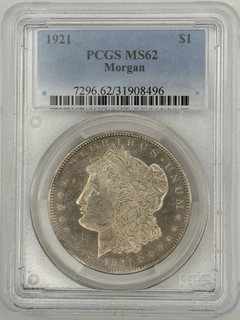
View on eBay

1961 Franklin Half Dollar 90% Silver Philadelphia 50C KM#199 [Est. VF+]

1961 Franklin Half Dollar, Philadelphia Mint, 90% Silver, Liberty Bell Reverse, KM#199 [Est. VF+]

$44.61 1961 Est. VF+ Franklin Halfs (1948-1963)

Description

A 1961 Franklin half dollar from the Philadelphia Mint (no mint mark; on this series the D or S sits above the bell's beam). The obverse shows Benjamin Franklin in profile; the reverse shows the Liberty Bell with its crack and a small eagle at the right. Mint specifications: 12.50 grams, 90% silver, 10% copper, 0.3617 troy oz of silver, 30.6 mm, reeded edge.

Read the full description

Historical Context

Chief Engraver John R. Sinnock designed the coin (his JRS initials are below the shoulder); it was released in 1948, after his death, and struck until 1963, when the Kennedy half replaced it. The Mint Act of 1792 required an eagle on the half dollar, which is why a small one sits beside the bell.

Condition

Our conservative estimate VF+ (not professionally graded). Even circulation wear on Franklin's cheek and hair; light scratches on the bell; natural gray toning. See the photos.

Disclaimer

The images and any video show the actual item and are part of the official listing description, so please review them closely. Measurements and weights are approximate, and any maker or material we haven't confirmed is described as assumed. Questions? Message us; we answer quickly.

View on eBay

1892 McLaughlin's XXXX Coffee Trade Card Two Girls Jump Rope Hoop Cosack Large

1892 McLaughlin's XXXX Coffee Trade Card Two Girls Jump Rope Hoop Cosack Large — Two little girls in a meadow, one in white with a red hat and one in blue, skipping with a long rope. Approx. 5.15 x 7.01 in.

$44.18 1892 Advertising Sales Trade Cards

Description

Two little girls in a meadow, one in white with a red hat and one in blue, skipping with a long rope. "McLaughlin's XXXX Coffee" at upper left; foot: "This is one of a set of sixteen cards," Cosack & Co., 1892.

The back, printed in black, is headed "Two Important Questions Answered. 1st. Why is McLaughlin's XXXX Coffee Glazed? 2d. What is Glazing composed of?" It explains that the glaze of corn starch and reclarified sugar "seals the pores and keeps the Coffee for months as fresh as the day it comes from the roaster," and is signed "W. F. McLaughlin & Co., Rio de Janeiro, Chicago, Santos." The foot reads "A beautiful picture card in every package. 16 designs in this set."

Approx. 5.15 x 7.01 in.

Read the full description

Historical Context

Glazed coffee. Chicago roaster W. F. McLaughlin & Co. sold its XXXX brand roasted in the whole bean and coated with a glaze, and the back of this card makes the case in the company's own words. The firm names its own houses in Rio de Janeiro and Santos, Brazil, the coffee ports.

Collect the set. McLaughlin's issued its picture cards in numbered series, packed one to a package, and families saved them in albums.

Condition

Front: excellent, bright color. Back: toned, with a spot. Please see the photos, which are part of the description.

About The Printing

This is an original chromolithograph, and it was slow, exacting work. Each color had to be drawn onto its own separate stone by hand — in monochrome, the artist judging how much stipple each area needed so the colors would combine correctly only once every stone had been printed. The sheet then went through the press once for every color it carries, often a dozen or more, and every pass had to register exactly against the last. A pass out of register showed.

Under magnification the image resolves into irregular hand-drawn stipple, each ink carrying its own dot pattern, the colors mixing in the eye rather than on the paper. There is no regular halftone screen and no four-color rosette, which is what a modern reproduction would show. Modern process printing simulates every color from four inks; chromolithography laid each color down as its own.

The back is printed in black.

Provenance

From my family's estate collections, built over more than 60 years by knowledgeable antiques collectors and traders. Stored in a climate-controlled environment.

Also In Our Store

More McLaughlin's cards in our store: https://www.ebay.com/str/tfauctionsintl?_nkw=mclaughlin

More Victorian advertising trade cards are in our store.

Disclaimer

The images and any video show the actual item and are part of the official listing description, so please review them closely. Measurements and weights are approximate, and any maker or material we haven't confirmed is described as assumed. Questions? Message us; we answer quickly.

View on eBay

Raphael Tuck Thanksgiving Day Postcard Series 123 Turkeys Embossed Saxony 1907

DESCRIPTION

$44.09 1907 Thanksgiving Postcards

An embossed Thanksgiving postcard from Raphael Tuck & Sons' "Thanksgiving Day Post Cards" Series No. 123, printed in Saxony and mailed from Cincinnati in November 1907. A long procession of turkeys marches along a pale country path toward the viewer: two big toms in full display lead the line in bronze, green and brown plumage with red-pink heads, followed by smaller turkeys trailing back across a green meadow to a red farmhouse under trees on the horizon. Printed at lower right in coppery script: "Thanksgiving day." The sender added in pencil on the front "Cincinnati, O. 11-19-1907" across the top and "Wishing you a very pleasant" above the printed greeting. Size approx. 5.50 x 3.55 in.

The back is a divided back reading "TUCK'S POST CARD / CARTE POSTALE / POSTKARTE / (For Address Only.)", with the royal coat of arms, "BY APPOINTMENT", "PRINTED IN SAXONY", the Tuck easel-and-palette trademark, and the line: Raphael Tuck & Sons' "Thanksgiving Day Post Cards" Series No. 123. Art Publishers to Their Majesties the King & Queen. Green 1-cent Benjamin Franklin stamp, Series 1902 design (with "1706 Franklin 1790"); wavy machine-line cancel with a "2" and circular postmark CINCINNATI, O., NOV 20, 12-M, 1907. Addressed in ink to Mr. Keith Brannock (best reading of the surname), Bethel, Ohio, Clermont Co. The message reads (best reading): "Dear Keith:- I received and enjoyed your letter to-day. I hope you will soon be well again. You are lucky to have birds to eat while you are home. It is pretty nice of Uncle Chas. to think of me. Thomas is not very well. It makes him a little cross. I should like to see your kitten. Yours, Anna Bernice."

Read the full description

Historical Context

Made for America, printed in Saxony. Raphael Tuck & Sons was a London firm, founded in 1866, that held a Royal Warrant and issued its first postcards in 1900. Like most early Tuck cards, this one was printed in Germany, yet this series was made for an American holiday. German printers dominated early postcard printing, producing inexpensive, high-quality lithographs for American publishers.

The first year of the divided back. Until 1907 the back of a private postcard was for the address alone; on March 1, 1907, a new law let senders write messages on the left half of the back. Mailed in November of that first year, this card uses the new divided back, and the sender still added a greeting on the front. The Golden Age of Postcards is usually dated 1907 to 1915.

Ohio mail. The card went from Cincinnati to Bethel, in Clermont County, eight days before Thanksgiving 1907.

A holiday with more than one story. In the United States Thanksgiving falls on the fourth Thursday of November; Canada gives thanks on the second Monday of October (October 12 in 2026). Since November 26, 1970, Native Americans have gathered at Plymouth, Massachusetts, on Thanksgiving Day for a National Day of Mourning, remembering the Wampanoag people and the history that followed the colonists' arrival. American families still gather each November to give thanks, much as the sender and recipient of this card did more than a century ago.

Condition

Good, with honest wear. Front: rich color and strong embossing; scattered small white surface scuffs and flecks of ink loss on the two lead turkeys; faint creases/surface lines in the upper center and right side; light corner and edge wear; pencil writing on the front as described. Back: toning and some light brown staining, mostly at center and left; ink message and address as described. Postally used.

About The Printing

This is an original chromolithograph, and it was slow, exacting work. Each color had to be drawn onto its own separate stone by hand — in monochrome, the artist judging how much stipple each area needed so the colors would combine correctly only once every stone had been printed. The sheet then went through the press once for every color it carries, often a dozen or more, and every pass had to register exactly against the last. A pass out of register showed.

Under magnification the image resolves into irregular hand-drawn stipple, each ink carrying its own dot pattern, the colors mixing in the eye rather than on the paper. There is no regular halftone screen and no four-color rosette, which is what a modern reproduction would show. Modern process printing simulates every color from four inks; chromolithography laid each color down as its own.

The turkeys are embossed in high relief, visible from the back.

Provenance

From my family's estate collections, built over more than 60 years by knowledgeable antiques collectors and traders. Stored in a climate-controlled environment.

Also In Our Store

Another embossed turkey card for Thanksgiving, a 1909 design published by M.W. Taggart of New York: https://www.ebay.com/itm/158174523818

An American-made Thanksgiving card from 1927, after the German trade had ended, by Whitney Made of Worcester, Massachusetts: https://www.ebay.com/itm/158174535521

The immigrant story behind early American imagery runs through our US silver dollars too: the Morgan dollar was designed by English-born George T. Morgan, the Peace dollar by Sicilian-born Anthony de Francisci.

Disclaimer

Specifications and detailed item descriptions are provided as a courtesy only and are not guaranteed to be one hundred percent accurate. Please do your own research. There are generally no receipts available for any items from original purchases. Any dimensions and/or weights are approximate. The absence of a more detailed condition report does not imply there are no condition issues with the item(s). Please inspect images carefully as they are part of the official item description and best representation of the actual condition. Additional images may be available upon request depending on time and availability. Not responsible for internet mis-translations or mis-identification of maker's marks if found or assumptions of makers or materials — item descriptions will indicate if it is assumed. If you see a problem, please message us immediately and we will do our best to sort out a solution and confirm the information. With the exception of eBay rules, no returns are accepted.
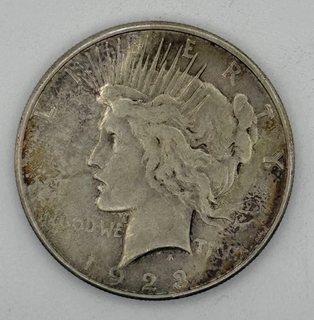
View on eBay

1910 Embossed Gold Christmas Postcard Santa Tree Toys Winter Scene Tiffin Ohio

DESCRIPTION

$41.44 1910 Christmas Postcards

An embossed Christmas postcard in vertical format on a rich metallic gold ground, textured all over with raised dots. At the top, a round vignette framed by a white band of red dots shows a winter sunset in orange, pink and yellow: a snow-covered cottage with a smoking chimney, bare trees, and two figures, an adult and a child, walking away along a snowy path. Below, Santa Claus strides forward in a red coat with white fur trim, black belt and gold buckle, carrying a small Christmas tree hung with candles, ornaments and toys over one shoulder and a full sack on his back, with a doll, a toy horse, a horn and other toys spilling from the top. At lower left, in embossed pale blue letters, the greeting begins "A MERRY" and continues below the edge of the scan; the front scan is cut off at the bottom.

The back is printed in brown with "POST CARD" and a divided back marked "This side for Correspondence." and "This side for Address." The embossing shows through. 1-cent green Benjamin Franklin stamp, affixed upside down, with a machine flag cancel (a waving flag with stars). Circular datestamp TIFFIN, OHIO, DEC 13, 6:30 PM, 1910; receiving datestamp WHARTON, OHIO, DEC 14, 7 AM, 1910. Addressed in ink to Laura E. Koontz (best reading), Wharton, Ohio, R.F.D. [route number not clear]. The message reads (best reading): "Dear Aunt. How are you this winter and how is uncle. Hope you have a good time at Xmas time. Lovingly, Gerty Lowe[...] (surname not clear). This card is from Mary Hazel." An old circled pencil mark at the upper left corner of the back.

Read the full description

Historical Context

Overnight across northwest Ohio. Mailed at Tiffin, the county seat of Seneca County, at 6:30 in the evening on December 13, 1910, the card was stamped on arrival at Wharton, a village in Wyandot County, at 7 the next morning. Wharton's post office opened as Whartonsburgh in 1852 and took the name Wharton in 1879.

Rural Free Delivery. "R.F.D." began as an experiment in 1896 and became permanent in 1902, bringing mail to farm families' own mailboxes. This is a family card, written to an aunt and uncle, with a note that it comes from Mary Hazel.

A flag on the cancel. The machine cancel is a waving flag with stars, a postal-history crossover for patriotic and cancel collectors.

European printers, American Christmas. Gold-ground embossed cards like this belong to the Golden Age of Postcards, roughly 1907 to 1915. German printers dominated the trade, prized for color, embossing and metallic foils, and European artists and printers did much to shape American popular imagery until the 1909 Payne-Aldrich Tariff and the First World War. This card is not marked with a country of printing.

Condition

Used. The front is described from a scan cut off at the bottom; a full report will follow a rescan. On the visible front: bright colors; light wear and rubbing to the gold on the raised dots; corners lightly rounded. The back is complete and shows heavy scattered foxing (rust-brown spots) over much of the surface, heaviest at the left and along the message, and some darkening along the left edge. Ink message and address; an old pencil mark at the upper left corner. Please see the photos, which are part of the description.

About The Printing

This is an original chromolithograph, and it was slow, exacting work. Each color had to be drawn onto its own separate stone by hand — in monochrome, the artist judging how much stipple each area needed so the colors would combine correctly only once every stone had been printed. The sheet then went through the press once for every color it carries, often a dozen or more, and every pass had to register exactly against the last. A pass out of register showed.

Under magnification the image resolves into irregular hand-drawn stipple, each ink carrying its own dot pattern, the colors mixing in the eye rather than on the paper. There is no regular halftone screen and no four-color rosette, which is what a modern reproduction would show. Modern process printing simulates every color from four inks; chromolithography laid each color down as its own.

The gold ground is metallic gold embossed with a regular pattern of raised dots, and Santa, the tree, the toys and the vignette frame are embossed in relief.

Provenance

From my family's estate collections, built over more than 60 years by knowledgeable antiques collectors and traders. Stored in a climate-controlled environment.

Also In Our Store

The immigrant story behind early American imagery runs through our US silver dollars too: the Morgan dollar was designed by English-born George T. Morgan, the Peace dollar by Sicilian-born Anthony de Francisci.

Disclaimer

Specifications and detailed item descriptions are provided as a courtesy only and are not guaranteed to be one hundred percent accurate. Please do your own research. There are generally no receipts available for any items from original purchases. Any dimensions and/or weights are approximate. The absence of a more detailed condition report does not imply there are no condition issues with the item(s). Please inspect images carefully as they are part of the official item description and best representation of the actual condition. Additional images may be available upon request depending on time and availability. Not responsible for internet mis-translations or mis-identification of maker's marks if found or assumptions of makers or materials — item descriptions will indicate if it is assumed. If you see a problem, please message us immediately and we will do our best to sort out a solution and confirm the information. With the exception of eBay rules, no returns are accepted.
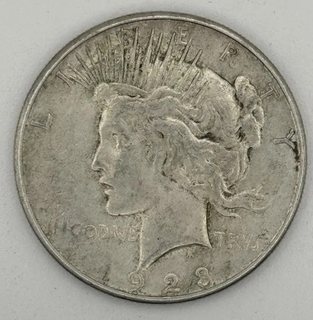
View on eBay

1891 Lion Coffee Easter Greetings Trade Card Girl Portrait Rabbits Flowers Large

1891 Lion Coffee Easter Greetings Trade Card Girl Portrait Rabbits Flowers Large — A girl with long hair in a red bodice framed in a lace diamond, with spring flowers and rabbits at her feet. Approx. 5.22 x 6.93 in.

$41.38 1891 Advertising Sales Trade Cards

Description

A girl with long hair in a red bodice framed in a lace diamond, with spring flowers and rabbits at her feet. Printer's line: "Copyrighted 1891 by Geo. S. Harris & Sons Lith., Phila."

The back is printed in soft brown: "These Beautiful Easter Greetings are found only in the one pound packages of LION COFFEE. Manufactured by Woolson Spice Co., Toledo, Ohio," around a sunburst roundel with the Lion Coffee lion and a bird in flight.

Approx. 5.22 x 6.93 in.

Read the full description

Historical Context

The coffee that came with a picture. Lion Coffee began in Toledo, Ohio, in 1864 and became part of the Woolson Spice Company in 1882. Alvin Woolson built the brand by putting picture cards in every package, and the back of this card says so.

Condition

Front: excellent, bright color. Back: light toning. Please see the photos, which are part of the description.

About The Printing

This is an original chromolithograph, and it was slow, exacting work. Each color had to be drawn onto its own separate stone by hand — in monochrome, the artist judging how much stipple each area needed so the colors would combine correctly only once every stone had been printed. The sheet then went through the press once for every color it carries, often a dozen or more, and every pass had to register exactly against the last. A pass out of register showed.

Under magnification the image resolves into irregular hand-drawn stipple, each ink carrying its own dot pattern, the colors mixing in the eye rather than on the paper. There is no regular halftone screen and no four-color rosette, which is what a modern reproduction would show. Modern process printing simulates every color from four inks; chromolithography laid each color down as its own.

The back is printed in a single brown ink.

Provenance

From my family's estate collections, built over more than 60 years by knowledgeable antiques collectors and traders. Stored in a climate-controlled environment.

Also In Our Store

More Lion Coffee cards in our store: https://www.ebay.com/str/tfauctionsintl?_nkw=lion+coffee

More Victorian advertising trade cards are in our store.

Disclaimer

The images and any video show the actual item and are part of the official listing description, so please review them closely. Measurements and weights are approximate, and any maker or material we haven't confirmed is described as assumed. Questions? Message us; we answer quickly.

View on eBay

Antique Advertising Trade Card for E.W. Hoyt & Co.'s Rubifoam and German Cologne

Antique Victorian Advertising Trade Card for E.W. Hoyt & Co.'s Rubifoam and German Cologne

$41.33 Advertising Sales Trade Cards

  • Time Period: Late 19th Century (1888)
  • Origin: Lowell, Massachusetts, USA
  • Composition: Cardstock with color printing
  • Dimensions: H:3.25" x W: 4.5" (approximately)
  • Please reivew pictures carefully as they are part of the item description and condition.
Read the full description

Comapny Background

E.W. Hoyt & Co. was a pharmaceutical company based in Lowell, Massachusetts, known for products like Hoyt's German Cologne and Rubifoam. This advertising trade card highlights their dual marketing strategy, promoting both a personal fragrance and a dental product. The inclusion of pricing and dealer information aimed to facilitate direct sales and distribution. E.W. Hoyt & Co. was a prominent manufacturer of toiletries and perfumes. The company was well known for its "Hoyt's German Cologne," a popular fragrance, and "Rubifoam," a dental product. Their advertising often emphasized the quality and purity of their goods, aiming to establish brand loyalty and combat counterfeit products. This advertising card, likely distributed in the late 19th or early 20th century, served as a promotional tool. By perfuming the card itself, the company offered a tangible sensory experience of their cologne, making the advertisement more memorable and persuasive. Such items are now collected as examples of historical ephemera and early advertising practices.

Historical Context

Victorian business trade cards were a popular form of advertising in the late 19th century, often featuring colorful illustrations and product information. Companies used these cards to promote their goods, with many being perfumed or embossed to attract consumers. They served as early forms of collectible ephemera, with designs ranging from sentimental scenes to product endorsements.

Ref: 1.0531

  • Please visit our store as we are constantly adding more items of all types. Thank you!

View on eBay

1893 Lion Coffee Easter Greetings Trade Card Boy Easter Eggs Chicks Knapp Large

1893 Lion Coffee Easter Greetings Trade Card Boy Easter Eggs Chicks Knapp Large — A smiling boy in a red jacket holds out a straw hat full of colored Easter eggs while a hen and chicks look on. Approx. 7.02 x 5.13 in.

$41.22 1893 Advertising Sales Trade Cards

Description

A smiling boy in a red jacket holds out a straw hat full of colored Easter eggs while a hen and chicks look on. Printer's line: "Copyrighted 1893" by The Knapp Co., N.Y.

The back is printed in brown: "These Beautiful Easter Greetings are found only in the one pound packages of LION COFFEE," with an angel, the lion, lilies and "Woolson Spice Co., Toledo, Ohio."

Approx. 7.02 x 5.13 in.

Read the full description

Historical Context

The coffee that came with a picture. Lion Coffee began in Toledo, Ohio, in 1864 and became part of the Woolson Spice Company in 1882. Alvin Woolson built the brand by putting picture cards in every package, and the back of this card says so.

Condition

Front: excellent, bright color. Back: light toning. Please see the photos, which are part of the description.

About The Printing

This is an original chromolithograph, and it was slow, exacting work. Each color had to be drawn onto its own separate stone by hand — in monochrome, the artist judging how much stipple each area needed so the colors would combine correctly only once every stone had been printed. The sheet then went through the press once for every color it carries, often a dozen or more, and every pass had to register exactly against the last. A pass out of register showed.

Under magnification the image resolves into irregular hand-drawn stipple, each ink carrying its own dot pattern, the colors mixing in the eye rather than on the paper. There is no regular halftone screen and no four-color rosette, which is what a modern reproduction would show. Modern process printing simulates every color from four inks; chromolithography laid each color down as its own.

The back is printed in a single brown ink.

Provenance

From my family's estate collections, built over more than 60 years by knowledgeable antiques collectors and traders. Stored in a climate-controlled environment.

Also In Our Store

More Lion Coffee cards in our store: https://www.ebay.com/str/tfauctionsintl?_nkw=lion+coffee

More Victorian advertising trade cards are in our store.

Disclaimer

The images and any video show the actual item and are part of the official listing description, so please review them closely. Measurements and weights are approximate, and any maker or material we haven't confirmed is described as assumed. Questions? Message us; we answer quickly.

View on eBay

1908 PFB Embossed Thanksgiving Postcard Turkeys Fence Germany Cromwell Conn

November 1908 PFB No. 8409 Embossed Thanksgiving Postcard, Turkeys by a Garden Fence, Printed in Germany, Mailed Cromwell to Hartford, Connecticut, 1¢ Franklin Series 1902 Stamp, "How Did You Ever Do It Sun. Evening? With Love, Annie"

$40.66 1908 Thanksgiving Postcards

Description

A painterly Thanksgiving scene: a tom turkey in full display and two hens beside a weathered picket fence, with tall grasses, red poppies and a dusky sky. "Thanksgiving Greetings" in red script at lower left. The birds and fence are embossed. Size approx. 5.40 x 3.45 in. (137 x 88 mm).

The back carries the multilingual Universal Postal Union heading ("Postkarte — Carte postale — Post card — Cartolina postale..." in a dozen languages), "Printed in Germany" along the left edge, and at lower left the PFB diamond logo with "No. 8409 Relief / No. 8412 gel." PFB issued the design both embossed ("Relief") and with a glossy gelatin coating ("gel."); this card is embossed with a shiny but matte-feeling surface, so it is offered as the Relief version 1-cent green Benjamin Franklin stamp, Series 1902; postmark Cromwell, Conn., Nov 24, 1908, 5 PM. Addressed in ink to Mr. George Pease, #46 Grand St., Hartford, Ct. The message: "How did you ever do it Sun. evening? With Love, Annie" (best reading of the name).

Read the full description

Historical Context

PFB. The PFB monogram is attributed by collectors to Paul Finkenrath of Berlin, one of the leading makers of embossed postcards; "Relief" on the back refers to the embossing.

The Golden Age of Postcards. The divided-back years, 1907 to 1915, are known as the Golden Age of Postcards, and German printers dominated the trade.

Up the river. Mailed from Cromwell to Hartford, a short run up the Connecticut River, the Tuesday before Thanksgiving 1908.

Condition

Very good. Some small areas of printing are rubbed from the high points of the embossing, as is common on these cards; colors otherwise rich. Light corner wear. Back clean with light toning; postmark and address clear.

About The Printing

This is an original chromolithograph, and it was slow, exacting work. Each color had to be drawn onto its own separate stone by hand — in monochrome, the artist judging how much stipple each area needed so the colors would combine correctly only once every stone had been printed. The sheet then went through the press once for every color it carries, often a dozen or more, and every pass had to register exactly against the last. A pass out of register showed.

Under magnification the image resolves into irregular hand-drawn stipple, each ink carrying its own dot pattern, the colors mixing in the eye rather than on the paper. There is no regular halftone screen and no four-color rosette, which is what a modern reproduction would show. Modern process printing simulates every color from four inks; chromolithography laid each color down as its own.

The turkeys and fence are embossed, and the relief shows clearly on the back.

Provenance

From my family's estate collections, built over more than 60 years by knowledgeable antiques collectors and traders. Stored in a climate-controlled environment.

Also In Our Store

Made for America, printed in Saxony: a 1907 Raphael Tuck Thanksgiving card: https://www.ebay.com/itm/158174532357

Disclaimer

The images and any video show the actual item and are part of the official listing description, so please review them closely. Measurements and weights are approximate, and any maker or material we haven't confirmed is described as assumed. Questions? Message us; we answer quickly.

View on eBay

1985 Peru 50000 Soles de Oro Pierola Banknote P-125Ba [Est. F]

23 August 1985 Peru 50000 Soles de Oro Banknote, Nicolas de Pierola / Oil Rig and Helicopter, Pick P-125Ba, Serial B7279664D [Est. F]

$39.77 1985 Est. F Peru

Description

Issued by the Banco Central de Reserva del Peru and printed by Thomas De La Rue. Front: Nicolas de Pierola with the national arms; back: an oil drilling rig with a helicopter approaching. The '50' of the value is printed in green and the '000' in orange, so the note also reads as 50 intis. Serial B7279664D. Measured on the 1200 dpi scan: 150.5 x 75.2 mm. Centering, measured on the scan: front centered (L/R 5.2/4.2, T/B 4.8/4.0 mm); back shifted left (L/R 4.0/6.2 mm). The close-ups show the serial, the date and Nicolas de Pierola. The last image adds a millimeter scale.

Read the full description

Historical Context

The inti replaced the sol de oro at 1,000 to 1 on 1 February 1985, and this note was printed after that change; the later 50 intis note kept the design with only the green 50. Nicolas de Pierola, nicknamed 'El Califa', was president of Peru in 1879-1881 and 1895-1899.

Condition

[Est. F] Well circulated, with many creases, a vertical center fold and a horizontal fold, overall soiling and rounded corners. A faint blue ink line about 20 mm long runs above the top serial on the front, and a small cluster of brown stains sits under 'BANCO' on the back. No tears, holes or tape. Grade estimated from the scans; not professionally graded.

Legal Tender

No longer legal tender: demonetized on 31 December 1986, and sol de oro notes cannot be exchanged for current soles.

Disclaimer

The images and any video show the actual item and are part of the official listing description, so please review them closely. Measurements and weights are approximate, and any maker or material we haven't confirmed is described as assumed. Questions? Message us; we answer quickly.

View on eBay

Antique Liebig Trade Card Tyrol Zither Player Austria Alps National Instruments

TITLE

$39.23 Advertising Sales Trade Cards

Antique Liebig Trade Card Tyrol Zither Player Austria Alps National Instruments

Read the full description

Description

An antique Liebig trade card from the French-language series "Instruments de musique nationaux" (National Musical Instruments). This card, "TYROL – Cithare", shows a young Tyrolean man in a feathered green hat, red waistcoat and lederhosen playing a zither on his knees in front of an Alpine chalet. A smiling young woman in a wide-brimmed hat and apron stands behind him, and an older man sits listening on a stack of logs. Snow-capped mountains rise in the background. A jar of Liebig meat extract stands at lower left, and the bottom banner reads "VÉRITABLE EXTRAIT DE VIANDE LIEBIG" (Genuine Liebig Meat Extract). "Voir au verso" (see reverse) is printed at lower right.

The back, printed in French, carries the Compagnie Liebig advertisement, with a vignette of a young artist painting a jar of Liebig extract at his easel and a large blue facsimile of the "J. v. Liebig" signature. In translation: "Liebig Company. Works at Fray-Bentos and branches (South America). Hors concours [beyond competition] since 1885. No foreign matter is added to genuine Liebig meat extract. It is an absolutely pure meat juice. Sold by grocers and provision merchants. Insist on the Liebig signature in blue ink on the label and the paper wrapping the jars." A second panel advertises Liebig meat peptone, "because of its extreme digestibility and high nutritional value", as the fortifying food for "the weak, the anaemic, invalids and especially those who suffer from the stomach", sold in the principal pharmacies. The bottom line reads "Importé par la Compagnie Liebig, Paris" (Imported by the Liebig Company, Paris).

Historical Context

Liebig's Extract of Meat Company was founded in London on December 4, 1865, by the German chemist Justus von Liebig and the engineer George Christian Giebert. Its factory at Fray Bentos, Uruguay, was turning out 500 tonnes of meat extract a year by 1875; the company later gave its name to Fray Bentos corned beef and launched Oxo cubes in 1911. From 1872 Liebig packed collectible card sets with its product, usually six cards to a theme (stories, history, geography), printed in many languages for markets across Europe. The blue signature on the back was the company's guarantee of the genuine product, and the card itself tells buyers to look for it.

Tyrol is the historic Alpine region of the Habsburg lands, a crown land from the 12th century until 1919, when it was divided between Austria (today's State of Tyrol) and Italy (South Tyrol and Trentino). This card was printed for French buyers, about a people and an instrument of the Austrian Alps, by a company founded in London by a German chemist with its factory in South America: an early piece of truly international advertising.

More Victorian trade cards, antique postcards and US silver dollars are in our store: https://www.ebay.com/str/tfauctionsintl

Condition

Good antique condition. Bright colors on the front with light wear to the corners and edges. Back clean and legible with light toning. Please see the photos, which are part of the description.

About The Printing

Liebig cards of this era were printed by chromolithography, with each color laid down from its own stone. The rich, layered color on the front is typical of the process.

Provenance

From my family's estate collections, built over more than 60 years by knowledgeable antiques collectors and traders. Stored in a climate-controlled environment.

Disclaimer

Specifications and detailed item descriptions are provided as a courtesy only and are not guaranteed to be one hundred percent accurate. Please do your own research. There are generally no receipts available for any items from original purchases. Any dimensions and/or weights are approximate. The absence of a more detailed condition report does not imply there are no condition issues with the item(s). Please inspect images carefully as they are part of the official item description and best representation of the actual condition. Additional images may be available upon request depending on time and availability. Not responsible for internet mis-translations or mis-identification of maker's marks if found or assumptions of makers or materials — item descriptions will indicate if it is assumed. If you see a problem, please message us immediately and we will do our best to sort out a solution and confirm the information. With the exception of eBay rules, no returns are accepted.
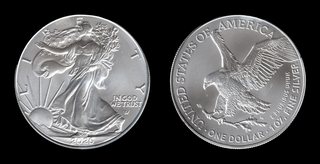
----- Not For Pasting -----

Item Specifics

- Brand: Liebig

- Country of Origin: set to France by Joseph, 2026-10-03. eBay has no "Unknown" option, and the field feeds international export paperwork. The card was imported and distributed by the Paris office; the actual printer is unknown.

- Language: French

- Original/Reprint: Original

Notes

- Set name and card read from the front; back translated by Claude (UNSUPPORTED; Joseph can check the French).

- Year: the live title says 1900. The back proves only "after 1885" (hors concours depuis 1885). Not dated, so the new title leaves the year out.

- Printing: chromolithography is assumed from the age and look (Joseph: "very safe bet"). No dot check was done (no original scan).

- Sanguinetti catalog number and year: not confirmed. A search turned up "S 0561 National Musical Instruments", but the match isn't confirmed.

- Condition: written from the screenshots only. Adjust if needed.

SOURCES (retrieved 2026-10-03)

- Liebig company facts and trade cards: https://en.wikipedia.org/wiki/Liebig%27s_Extract_of_Meat_Company (SOURCED)

- Tyrol: https://en.wikipedia.org/wiki/Tyrol_(region) (SOURCED)

Revision Log

r01 2026-10-03 Created from Joseph's front and back screenshots.

r02 2026-10-03 New title (79 characters), chosen by Joseph.

View on eBay

1776-1976 Kennedy Bicentennial Half Dollar Lot of 5 Dual Date 2 P 3 D [Est. AU+]

1776-1976 Kennedy Bicentennial Half Dollars, Lot of 5: Two Philadelphia and Three Denver, Dual Date, Independence Hall Reverse [Est. AU+]

$38.80 1976 Est. AU+ JFK Bicentennial Half Dollars

Description

Five bicentennial Kennedy half dollars with the dual date 1776-1976: two from the Philadelphia Mint (no mint mark) and three from Denver (D mint mark, on the obverse just above the date). The reverse shows Independence Hall in Philadelphia with 200 YEARS OF FREEDOM. Copper-nickel clad, as struck for circulation (not silver); standard specifications 11.34 grams, 30.61 mm, reeded edge.

Read the full description

Historical Context

For the nation's 200th birthday the Mint replaced the reverses of the quarter, half dollar and dollar for two years: coins struck in 1975 and 1976 all carry the dual date 1776-1976. Seth G. Huntington designed the Independence Hall reverse; Gilroy Roberts' Kennedy portrait stays on the obverse.

Condition

Our conservative estimate AU+ (not professionally graded). Bright luster with light contact marks and fine hairlines from circulation. See the photos of each coin, obverse and reverse.

Disclaimer

The images and any video show the actual item and are part of the official listing description, so please review them closely. Measurements and weights are approximate, and any maker or material we haven't confirmed is described as assumed. Questions? Message us; we answer quickly.

View on eBay

1918 Gassaway Signed Santa Claus Christmas Tree Postcard Christmas Wishes Posted

DESCRIPTION

$38.77 1918 Christmas Postcards

An artist-signed Santa Claus postcard, signed "Gassaway" in the printing at lower left. Santa wears a blue-green hood and has rosy cheeks, bright eyes and a full white beard. He peers over a small fir tree hung with lit red candles, glass balls and bead garlands, topped by a gold star. At right, the script greeting "Christmas Wishes" above the verse "A dear old thought / dressed up anew / A message of Christmas / from me to you." Pale blue-gray snowfall background inside a cream border. The number 3146 is printed in red at lower right. No publisher or country of printing is marked. Size approx. 5.50 x 3.40 in. (140 x 86 mm).

The back is a divided back headed "POST CARD" with scrolled ornaments, "CORRESPONDENCE" and "ADDRESS." 2-cent carmine George Washington stamp with a wavy-line machine cancel; circular datestamp "LYNN, MASS., DEC 23, 7:30 AM, 1918." Addressed in brown ink to Master Harold Brown, Center Tuftonboro, N.H. The message reads: "I didn't send much to you in the box but will get you something more the next time I go to Boston. Merry Christmas to you all from Aunt Annie." A faint old pencil mark (6.50, best reading) at the top left of the back.

Read the full description

Historical Context

Christmas after the Armistice. Aunt Annie mailed this card from Lynn, Massachusetts, on December 23, 1918, six weeks after the Armistice of November 11, 1918, ended the fighting of World War I.

Lake Winnipesaukee mail. It went north to a boy in Center Tuftonboro, one of the villages of Tuftonboro, a Carroll County town on Lake Winnipesaukee in New Hampshire.

A wartime postal rate. The US postcard rate was 1 cent for decades, but it rose to 2 cents on November 2, 1917, and went back to 1 cent on July 1, 1919, so this card was mailed during that short wartime window.

Printed in America. Before the war, German printers dominated American postcard printing; once the First World War began, American printers supplied most of the postcards sold in the United States. This card carries no "Germany" mark and was printed with a halftone screen, consistent with that shift.

For artist-signed collectors. The "Gassaway" signature in the printing gives this card appeal for collectors of signed postcard artists.

Condition

Very good. Front bright and clean, with light, even toning to the cream border and a few tiny spots in the left margin. Short diagonal crease line at the lower right corner of the front, near the 3146. Corners slightly softened. Back clean, with the ink message and address and a faint pencil mark at the top left. No tears or album residue seen.

About The Printing

This card is printed with a halftone screen. Under magnification the flesh tones of Santa's face resolve into a regular grid of dots set at an angle — about 100 lines to the inch — the mark of a photomechanical printing process rather than hand-drawn chromolithographic stipple. Other areas, like the hood and the tree, show a grainier, less regular texture, and the black drawing lines read as solid ink. There is no four-color rosette of the kind a modern reproduction would show. The card is flat, not embossed.

Provenance

From my family's estate collections, built over more than 60 years by knowledgeable antiques collectors and traders. Stored in a climate-controlled environment.

Also In Our Store

Another embossed Christmas postcard with a Santa portrait, from 1909: https://www.ebay.com/itm/158180900005

Disclaimer

Specifications and detailed item descriptions are provided as a courtesy only and are not guaranteed to be one hundred percent accurate. Please do your own research. There are generally no receipts available for any items from original purchases. Any dimensions and/or weights are approximate. The absence of a more detailed condition report does not imply there are no condition issues with the item(s). Please inspect images carefully as they are part of the official item description and best representation of the actual condition. Additional images may be available upon request depending on time and availability. Not responsible for internet mis-translations or mis-identification of maker's marks if found or assumptions of makers or materials — item descriptions will indicate if it is assumed. If you see a problem, please message us immediately and we will do our best to sort out a solution and confirm the information. With the exception of eBay rules, no returns are accepted.
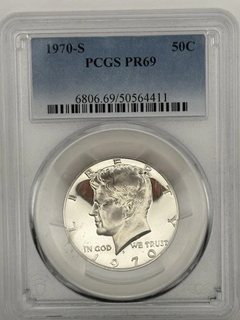
View on eBay

1853 Seated Liberty Dime Arrows 90% Silver US 10C Original Never Cleaned KM#77

1853 Seated Liberty Dime With Arrows, Philadelphia Mint, 90% Silver, 0.0721 oz Silver, First Year of the Arrows at Date Type (1853-1855) Marking the Weight Cut of the Coinage Act of 1853, Full Rims, Bold Date, Arrows and Stars, Original Never-Cleaned Surfaces, Christian Gobrecht Design, KM#77 [Est. G-6]

$38.53 1853 Est. G-6 Seated Liberty (1837-1891)

Description

An 1853 Seated Liberty dime with arrows at the date, struck at the Philadelphia Mint (no mint mark), KM#77. The obverse shows Liberty seated on a rock with a shield and a liberty cap on a pole, 13 stars around, and arrows on either side of the date. The reverse shows ONE DIME within a laurel wreath, with UNITED STATES OF AMERICA around. 90% silver, 2.49 grams standard, 17.9 mm, reeded edge. Tested on a Sigma Metalytics precious metal verifier: reading consistent with silver. The close-ups show the date with arrows, Liberty, ONE DIME and the wreath bow.

Read the full description

Historical Context

Christian Gobrecht's Seated Liberty design appeared on the dime from 1837 to 1891. By 1853 the flood of California gold had made the silver in coins worth more than their face value, so silver coins were melted or hoarded and disappeared from circulation. The Coinage Act of 1853 cut the dime from 2.67 to 2.49 grams, and the Mint placed arrows beside the date from 1853 to 1855 to mark the new lighter standard. Philadelphia struck about 12 million arrows dimes in 1853, against only 95,000 of the 1853 No Arrows dimes struck before the change.

Buying Power

In 1853 this dime had the buying power of about $4.38 today.

Condition

[Est. G-6] Circulated, original and never cleaned, with even gray toning and some light brown toning in the obverse fields. Full rims on both sides; the date, arrows, stars and UNITED STATES OF AMERICA are bold and clear, and the reverse wreath still shows leaf detail. LIBERTY on the shield is worn away, as is usual at this grade. A small rim nick at about 2 o'clock on the reverse and a few light scratches, including one across the right side of the wreath (see the close-ups). Checked for the 1853 repunched date (FS-1301): none seen. Grade estimated; not professionally graded. Currently still legal tender, but its silver content and collector value are far higher than face value.

Also In Our Store

More coins: https://www.ebay.com/str/tfauctionsintl?_nkw=coin

Disclaimer

The images and any video show the actual item and are part of the official listing description, so please review them closely. Measurements and weights are approximate, and any maker or material we haven't confirmed is described as assumed. Questions? Message us; we answer quickly.

View on eBay

ca1885 Patent Medicine Trade Card Dr H S Woodard Bloomington Illinois Flowers

ca1885 Patent Medicine Trade Card Dr H S Woodard Bloomington Illinois Flowers — A blue-green vase of red and pink flowers with pansies at its foot. Approx. 2.98 x 4.50 in.

$38.32 Advertising Sales Trade Cards

Description

A blue-green vase of red and pink flowers with pansies at its foot. Imprint: "From Dr. H. S. Woodard, Cor. Main & Empire Sts., Bloomington, Ill."

The back is printed in black: "Dr. Woodard's Medicine and Flavoring Extract Manufactory, Corner of North Main and Empire Sts., Bloomington, Ill.," listing "Pure Druggist Spices, Pepper, Choice Candies, Fruits, Nuts," and a Medicine Department for "Aches, Pains, Neuralgia, Rheumatism," promoting "Woodard's Instant Relief" ("Over 11,000 bottles sold by one man in four years") and a long list of remedies.

Approx. 2.98 x 4.50 in.

Read the full description

Historical Context

Patent medicine on parade. Instant relief for aches, pains, neuralgia and rheumatism: claims like these ran freely before the federal Pure Food and Drug Act of 1906.

Medicine and flavoring extracts. Many small-town druggists made both, sold side by side with spices and candy.

Condition

Front: very good, bright color. Back: toned with staining; text legible. Please see the photos, which are part of the description.

About The Printing

This is an original chromolithograph, and it was slow, exacting work. Each color had to be drawn onto its own separate stone by hand — in monochrome, the artist judging how much stipple each area needed so the colors would combine correctly only once every stone had been printed. The sheet then went through the press once for every color it carries, often a dozen or more, and every pass had to register exactly against the last. A pass out of register showed.

Under magnification the image resolves into irregular hand-drawn stipple, each ink carrying its own dot pattern, the colors mixing in the eye rather than on the paper. There is no regular halftone screen and no four-color rosette, which is what a modern reproduction would show. Modern process printing simulates every color from four inks; chromolithography laid each color down as its own.

The back is printed in black.

Provenance

From my family's estate collections, built over more than 60 years by knowledgeable antiques collectors and traders. Stored in a climate-controlled environment.

Also In Our Store

More Victorian advertising trade cards are in our store.

Disclaimer

The images and any video show the actual item and are part of the official listing description, so please review them closely. Measurements and weights are approximate, and any maker or material we haven't confirmed is described as assumed. Questions? Message us; we answer quickly.

View on eBay

1907 P. Sander Deep Embossed Thanksgiving Postcard Turkey Cornucopias Pastel

November 1907 P. Sander Deeply Embossed Airbrushed "Thanksgiving Greetings" Postcard, Full-Face Turkey Between Two Cornucopias of Harvest Fruit in Pastel Pink and Green, 1¢ Franklin Series 1902 Stamp, to Mrs. Hattie Howland, Wolcott, N.Y.: "It Is Quite Lonesome Here... Come Out When You Can"

$37.97 1907 Thanksgiving Postcards

Description

A tom turkey faces the viewer with its tail fanned, set between two great cornucopias spilling pumpkins, grapes and fruit, with sheaves of wheat behind. The embossing is unusually deep, and the color is a soft airbrushed blush of pink, cream and yellow-green. "Thanksgiving Greetings" is embossed at top center, and a 1907 copyright line for P. Sander, N.Y. is embossed at lower right.

The back is a divided back with a brown eagle and shield and "POST CARD." 1-cent blue-green Benjamin Franklin stamp, Series 1902 (Scott #300), perforated 12 with a straight edge at the bottom, tied by a machine cancel of Nov 26, 9 AM, 1907. Addressed in ink to Mrs. Hattie Howland, Wolcott, N.Y., R.D. The message (our transcription): "Dear Hattie: I suppose you have looked for some news from us sometime. It is quite lonesome here. Remember me to all of the people. Come out when you can. With love from Ara," with "to all" added at the lower left.

Read the full description

Historical Context

Quite lonesome. Ara wrote to Hattie two days before Thanksgiving 1907, missing the people back home: "Come out when you can."

The Golden Age of Postcards. The divided-back years, 1907 to 1915, are known as the Golden Age of Postcards, and German printers dominated the trade.

Condition

Very good. Subtle color and deep, crisp embossing; light corner wear and a few small dark specks near the pumpkin at lower right. Back clean with light toning; small pencil "15" at top.

About The Printing

The color on this card was airbrushed: sprayed onto deeply embossed stock. Under magnification it lies as a fine mist with soft edges and no dot screen at all, quite unlike the stipple of a chromolithograph or the regular dots of halftone. The turkey and cornucopias stand up in high relief on the back.

Provenance

From my family's estate collections, built over more than 60 years by knowledgeable antiques collectors and traders. Stored in a climate-controlled environment.

Also In Our Store

More Thanksgiving postcards from this group are in our store.

Disclaimer

The images and any video show the actual item and are part of the official listing description, so please review them closely. Measurements and weights are approximate, and any maker or material we haven't confirmed is described as assumed. Questions? Message us; we answer quickly.

View on eBay

ca1885 Alden Fruit Vinegar Trade Card Fruit High But Falling Dewey Waverly KS

ca1885 Alden Fruit Vinegar Trade Card Fruit High But Falling Dewey Waverly KS — A comic scene: a barefoot boy in a straw hat loses his grip in an apple tree while a woman below holds out her apron. Approx. 3.02 x 5.05 in.

$37.82 Advertising Sales Trade Cards

Description

A comic scene: a barefoot boy in a straw hat loses his grip in an apple tree while a woman below holds out her apron. Caption: "Fruit High But Falling. The Alden Fruit Vinegar."

The back is printed in black: "The highest Scientific Authorities having analyzed, say 'It is a pure wholesome Vinegar, produced by natural fermentation from fruits.' For sale by W. F. DEWEY & CO., Dealers in General Merchandise, Waverly, Kas. The Alden Fruit Vinegar A Specialty."

Approx. 3.02 x 5.05 in.

Read the full description

Historical Context

A short-lived brand. The Alden Fruit Vinegar company was founded in St. Louis in 1878 and was gone by 1907 (Library Company of Philadelphia).

A Kansas railroad town. Waverly, Kansas, was platted in 1878 on the Ottawa and Burlington Railroad (Cutler, History of the State of Kansas).

Condition

Front: very good, bright color. Back: stains; text legible. Please see the photos, which are part of the description.

About The Printing

This is an original chromolithograph, and it was slow, exacting work. Each color had to be drawn onto its own separate stone by hand — in monochrome, the artist judging how much stipple each area needed so the colors would combine correctly only once every stone had been printed. The sheet then went through the press once for every color it carries, often a dozen or more, and every pass had to register exactly against the last. A pass out of register showed.

Under magnification the image resolves into irregular hand-drawn stipple, each ink carrying its own dot pattern, the colors mixing in the eye rather than on the paper. There is no regular halftone screen and no four-color rosette, which is what a modern reproduction would show. Modern process printing simulates every color from four inks; chromolithography laid each color down as its own.

The back is printed in black.

Provenance

From my family's estate collections, built over more than 60 years by knowledgeable antiques collectors and traders. Stored in a climate-controlled environment.

Also In Our Store

More Victorian advertising trade cards are in our store.

Disclaimer

The images and any video show the actual item and are part of the official listing description, so please review them closely. Measurements and weights are approximate, and any maker or material we haven't confirmed is described as assumed. Questions? Message us; we answer quickly.

View on eBay

1912 Embossed Christmas Postcard Blue Santa on Ladder Window Gold Posted Ohio

DESCRIPTION

$37.54 1912 Christmas Postcards

A deeply embossed Christmas postcard in vertical format with an unusual blue-coated Santa Claus. Santa, in a blue coat with gold fur trim, a gold cap and gold boots, climbs a ladder up the side of a snow-covered house and peers in at the window. He leans on a long walking stick, and a doll sits on top of the sack on his back. Icicles hang from the snowy roof, a brick chimney stands at upper right, and snow drifts across the bottom. The colors are soft and shaded: a coral-pink ground fading toward white, and Santa's blue fading into the white of the window. Santa's trim, the ladder and the window frame are picked out in metallic gold. Raised gold script across the bottom: "A Merry Christmas". The front scan is cut off at the bottom edge, below the greeting.

The back is printed in brown with an eagle-and-shield emblem at upper left, "POST CARD", and a divided back marked "This side for Correspondence." and "This side for Address." The embossing shows strongly through. 1-cent green George Washington stamp with a barred killer; circular datestamp NORT[...] OHIO, DEC 23, 4:30 PM, 1912 (middle of the town name not legible). Addressed in pencil to Mr. Lloyd Wyckoff (best reading), Shauck(s) (best reading), O., Morrow Co. The message, cut off at the left in the scan, reads "[...] Merry Xmas. Geraldine D." Faint old pencil notations on the correspondence side and an old pencil mark at the upper left corner.

Read the full description

Historical Context

Santa in blue. Santa was not always dressed in red on early postcards, and a blue-coated Santa with gold trim is an uncommon variation for collectors of Santa imagery.

Two days before Christmas. The card was mailed on December 23, 1912, to Shauck, a small community in Perry Township, Morrow County, in central Ohio.

A first-year stamp. The 1-cent Washington first appeared in 1912, replacing Benjamin Franklin on the 1-cent value, so this card was mailed in that stamp's first year.

The Golden Age of Postcards. Heavily embossed, gold-trimmed cards belong to the years from about 1907 to 1915, when Americans mailed hundreds of millions of cards a year and German printers led the trade until the 1909 Payne-Aldrich Tariff and the First World War. This card is not marked with a country of printing.

Condition

Used. Condition can only be partly described from the current scans, which are cut off at the bottom of the front and the left side of the back; a full report will follow a rescan. On the visible portions: embossing deep and intact; gold bright, with light rubbing on the highest points; light corner wear. A small dark spot in the pink ground near "Merry". Back toned an even tan, with scattered light foxing spots and a few faint surface scratches at left center. Pencil address and message, faint old pencil notations and an old pencil mark on the back. Please see the photos, which are part of the description.

About The Printing

This card's color was not printed in dots at all. Under magnification there is no halftone screen, no four-color rosette and none of the hand-drawn stipple of a chromolithograph. The coral-pink ground and Santa's blue coat lie on the paper as soft, fine-grained color that shades smoothly into white: the look of color applied by airbrush. Airbrushed postcards of this period were almost always embossed as well, and this one is heavily embossed; the roof, icicles, Santa and the lettering stand in strong relief. The gold is a metallic finish with a fine sparkle.

Provenance

From my family's estate collections, built over more than 60 years by knowledgeable antiques collectors and traders. Stored in a climate-controlled environment.

Also In Our Store

Another embossed Christmas postcard with a Santa portrait, from 1909: https://www.ebay.com/itm/158180900005

Disclaimer

Specifications and detailed item descriptions are provided as a courtesy only and are not guaranteed to be one hundred percent accurate. Please do your own research. There are generally no receipts available for any items from original purchases. Any dimensions and/or weights are approximate. The absence of a more detailed condition report does not imply there are no condition issues with the item(s). Please inspect images carefully as they are part of the official item description and best representation of the actual condition. Additional images may be available upon request depending on time and availability. Not responsible for internet mis-translations or mis-identification of maker's marks if found or assumptions of makers or materials — item descriptions will indicate if it is assumed. If you see a problem, please message us immediately and we will do our best to sort out a solution and confirm the information. With the exception of eBay rules, no returns are accepted.
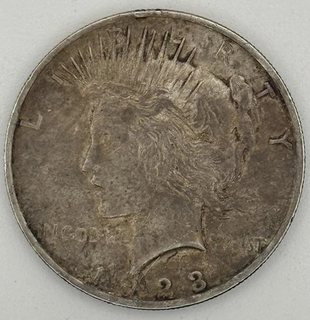
View on eBay

1911 Embossed Thanksgiving Postcard Turkey Shield Florence Station Flag Cancel

November 1911 Embossed Thanksgiving Greeting Postcard, Blue-Green Turkey with Red T Shield, Pumpkins and Gold Wishbone Reading "Wishing You Every Joy," Northampton, Mass. Florence Station Flag Cancel, M.132, 1¢ Franklin Stamp, to Master Melvin Hutchinson from His Little Cousin the "Florence Baby"

$36.69 1911 Thanksgiving Postcards

Description

A vertical design with a big iridescent blue-green turkey, its tail fanned in bronze and black, stepping across a cream ground embossed with leaves. At the top right a gold wishbone carries the words "Wishing You Every Joy" in red. Below, an illuminated red-and-gold "T" shield begins "THANKSGIVING GREETING," framed by orange blossoms, ivy and a pumpkin. Richly embossed and touched with gold. Size approx. 3.50 x 5.50 in. (90 x 140 mm).

The back is a divided back with a green "POST CARD" and "This side for the Address only," code "M.132." at lower left. 1-cent green Benjamin Franklin stamp; Northampton, Mass. machine cancel, Nov 27, 8:30 PM, 1911, with the wavy-flag killer reading "FLORENCE STATION." Addressed in ink to Master Melvin Hutchinson, North Raynham, Massachusetts. The message, written up the left side: "To my little cousin from the 'Florence baby.'"

Read the full description

Historical Context

Florence. Florence is a village in the northwest of Northampton, known for its silk mills and for the Northampton Association of Education and Industry, the 1840s community that Sojourner Truth joined in 1843. The sender signed as the "Florence baby," and the postmark agrees: Florence Station.

A pair to one boy. Melvin Hutchinson's Aunt Hattie sent him a patriotic Thanksgiving card the year before; it is also in our store.

Condition

Good to very good. Front colors and gold strong, embossing crisp; some soiling and light edge wear on the cream border. Back shows foxing and toning, heaviest at the edges, with light corner wear; postmark, flag cancel and address clear.

About The Printing

This card is printed in halftone. Under magnification the turkey's blue-green resolves into a regular, even grid of dots rather than the irregular hand-drawn stipple of a chromolithograph. The wishbone and shield are in gold, and the card is embossed throughout, so the whole design stands up in relief on the back.

Provenance

From my family's estate collections, built over more than 60 years by knowledgeable antiques collectors and traders. Stored in a climate-controlled environment.

Also In Our Store

Another M.132 card, the child chef riding a turkey, "Thanksgiving Joys," 1911: https://www.ebay.com/itm/158174533956

More Thanksgiving postcards from this group are in our store.

Disclaimer

The images and any video show the actual item and are part of the official listing description, so please review them closely. Measurements and weights are approximate, and any maker or material we haven't confirmed is described as assumed. Questions? Message us; we answer quickly.

View on eBay

1909 Embossed Christmas Postcard Santa Gold Bell Papa's Delight Holly Hoytville

DESCRIPTION

$36.56 1909 Christmas Postcards

An embossed and gilt Christmas postcard in vertical format. A large Christmas bell in textured metallic gold fills the card, with Santa Claus in an oval window cut into it. Santa, in a red coat and red stocking cap with a tassel and dark fur trim, smokes a pipe as he holds up a pair of slippers in one hand and a green plaid stocking in the other. "A MERRY XMAS" is lettered in white across the top of the bell, and a white ribbon banner across it reads "PAPA'S DELIGHT" in red. Embossed holly with red berries frames the bell, and at upper right is a small winter landscape: snow, fir trees and a pink setting sun. The cream ground carries white embossed scrollwork. The front scan is cut off at the bottom, through the base of the bell.

The back is printed in brown with "POST CARD." flanked by laurel ornaments, and a divided back marked "[THI]S SIDE FOR CORRESPONDENCE" and "THE ADDRESS TO BE WRITTEN ON THIS SIDE." The embossing shows through. 1-cent green Benjamin Franklin stamp, cancelled with wavy lines in violet ink; violet circular datestamp H[OYTVILLE], O[HIO], DEC 23, 1909 (best reading; the year slug is struck upside down). Addressed in ink to Master Lloyd Wicoff (best reading), Hoytville, O. The message, partly cut off at the left in the scan, reads: "Hello Lloyd! A Merry Christmas [to] you. Lillian E."

Read the full description

Historical Context

Papa's Delight. Under the banner, Santa holds up slippers and a stocking while puffing on his pipe, a homely Christmas-morning scene with crossover appeal for pipe and tobacciana collectors.

A northwest Ohio village. The card went to a boy, "Master Lloyd", in Hoytville, Wood County. Hoytville's post office opened as Hoyts Corners in 1872 and took the name Hoytville in 1874.

A postmark with a quirk. The datestamp is struck in violet ink, with the year slug set upside down.

European printers, American Christmas. Embossed, gilded cards like this belong to the Golden Age of Postcards, roughly 1907 to 1915. German printers dominated the trade, prized for color, embossing and metallic foils, and European artists and printers did much to shape American popular imagery until the 1909 Payne-Aldrich Tariff and the First World War. This card is not marked with a country of printing.

Condition

Used. Condition can only be partly described from the current scans, which are cut off at the bottom of the front and the left side of the back; a full report will follow a rescan. On the visible portions: bright colors and gold, with light rubbing to the gold on the high points of the embossing; corners lightly rounded. The back shows light tan foxing spots, mostly around the edges and the stamp, fine surface cracking in the paper over some of the deeper embossing, and a short vertical crease line at the left of the message. Please see the photos, which are part of the description.

About The Printing

This is an original chromolithograph, and it was slow, exacting work. Each color had to be drawn onto its own separate stone by hand — in monochrome, the artist judging how much stipple each area needed so the colors would combine correctly only once every stone had been printed. The sheet then went through the press once for every color it carries, often a dozen or more, and every pass had to register exactly against the last. A pass out of register showed.

Under magnification the image resolves into irregular hand-drawn stipple, each ink carrying its own dot pattern, the colors mixing in the eye rather than on the paper. There is no regular halftone screen and no four-color rosette, which is what a modern reproduction would show. Modern process printing simulates every color from four inks; chromolithography laid each color down as its own.

The bell is a textured metallic gold, and the bell, holly, Santa and scrollwork are embossed in relief.

Provenance

From my family's estate collections, built over more than 60 years by knowledgeable antiques collectors and traders. Stored in a climate-controlled environment.

Also In Our Store

The immigrant story behind early American imagery runs through our US silver dollars too: the Morgan dollar was designed by English-born George T. Morgan, the Peace dollar by Sicilian-born Anthony de Francisci.

Disclaimer

Specifications and detailed item descriptions are provided as a courtesy only and are not guaranteed to be one hundred percent accurate. Please do your own research. There are generally no receipts available for any items from original purchases. Any dimensions and/or weights are approximate. The absence of a more detailed condition report does not imply there are no condition issues with the item(s). Please inspect images carefully as they are part of the official item description and best representation of the actual condition. Additional images may be available upon request depending on time and availability. Not responsible for internet mis-translations or mis-identification of maker's marks if found or assumptions of makers or materials — item descriptions will indicate if it is assumed. If you see a problem, please message us immediately and we will do our best to sort out a solution and confirm the information. With the exception of eBay rules, no returns are accepted.
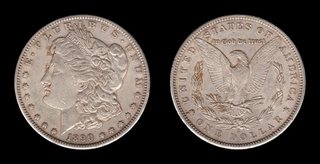
View on eBay

1908 Embossed Santa Claus Head Gold Holly Christmas Postcard Posted Oklahoma

DESCRIPTION

$35.92 1908 Christmas Postcards

A deeply embossed vertical Christmas postcard: a large close-up head of Santa Claus, almost sculpted in relief, with a lavender-white fur cap, heavy brows and a long flowing beard tinted soft pink and lavender. Two sprigs of gold holly with berries sit at his cap, and over his shoulder a gold-outlined sack holds a gold toy horn or trumpet and a small doll. His coat at the bottom is rose-red with gold outlines. Gold greeting at upper left: "A MERRY CHRISTMAS." Printed vertically in tiny letters along the left edge: "COPYRIGHT '07 P. SANDERS, N.Y." (best reading). Size: to follow.

Please note: our current front scan cuts off the bottom of the card. The photos will be replaced with a complete scan; the description covers what is visible.

The back is a divided back headed "POST CARD" with an eagle-and-shield emblem at upper left, "This side for Correspondence" and "This side for Address." 1-cent green Benjamin Franklin stamp (Series 1902) with a flag machine cancel; circular datestamp "OKLAHOMA, OKLA., DEC 24, 3 PM, 1908" — mailed on Christmas Eve 1908. Addressed by hand to Miss Jennie Schadek (best reading), Yale, Okla., R.R. #1. The message, written sideways across the correspondence side, reads (best reading): "Hello Girlie. Well Xmas is almost here but it does not seem possible. I almost know you will go to the dance. I told [F. D.?] what you had said and she said if you would drop a card to Red necktie he would sure be so glad to do you a favor. Best wishes for a Merry Xmas and Happy New Year. [...] over yesterday." Signature not legible. A faint circled pencil mark at the top corner is not legible.

Read the full description

Historical Context

Oklahoma City, before the name. Mailed on Christmas Eve 1908, a little over a year after Oklahoma became a state on November 16, 1907, when Indian Territory and Oklahoma Territory were joined. The postmark reads "Oklahoma, Okla." because that was the post office's official name: the office at Oklahoma Station was renamed Oklahoma in 1888 and did not become Oklahoma City until July 1, 1923. Oklahoma City became the state capital in 1910, two years after this card was mailed.

A Payne County town on the rails. The card went out on Rural Route 1 from Yale, in Payne County, whose post office opened in 1895 and which was reached by the Eastern Oklahoma Railway in 1902 and the Missouri, Kansas and Texas Railway in 1903. Yale is also home to the Jim Thorpe House, the former residence of the Olympic gold medalist.

An era shaped by European printers. German printers dominated early postcard printing, producing inexpensive, high-quality lithographs for American publishers. In the Golden Age of Postcards, usually dated 1907 to 1915, Americans sent hundreds of millions of postcards every year.

Condition

Fair to good, with honest age. The back is strongly toned to tan, with lighter diagonal bands across the corners, most likely where old album corner mounts once covered the surface. Small area of surface paper loss at the lower edge of the back, left of center. The front shows soft peach toning at the upper right and faint gray offset marks (ink transferred from another card) at the top. Corners lightly worn, with a small nick at the upper right corner of the back. Embossing strong and intact; gold bright. Handwritten message and address.

About The Printing

This card's soft colors were not printed in dots. Under magnification there is no halftone screen, no four-color rosette and none of the hand-drawn stipple of a chromolithograph. The pink and lavender in the beard and the peach toward the corners blend smoothly with a fine spray grain: the look of color applied by airbrush. The red coat is a solid field of ink with crisp edges. Airbrushed postcards of this period were almost always embossed, and this one is heavily embossed, with the whole head raised in relief; the holly, horn, lettering and outlines are in metallic gold.

Provenance

From my family's estate collections, built over more than 60 years by knowledgeable antiques collectors and traders. Stored in a climate-controlled environment.

Also In Our Store

Another card sent to Yale, Oklahoma, likely to the same family (surname is a best reading):

A 1909 Happy New Year card with gnomes and a clock in silver and gold: https://www.ebay.com/itm/158174121074

The immigrant story behind early American imagery runs through our US silver dollars too: the Morgan dollar was designed by English-born George T. Morgan, the Peace dollar by Sicilian-born Anthony de Francisci.

Disclaimer

Specifications and detailed item descriptions are provided as a courtesy only and are not guaranteed to be one hundred percent accurate. Please do your own research. There are generally no receipts available for any items from original purchases. Any dimensions and/or weights are approximate. The absence of a more detailed condition report does not imply there are no condition issues with the item(s). Please inspect images carefully as they are part of the official item description and best representation of the actual condition. Additional images may be available upon request depending on time and availability. Not responsible for internet mis-translations or mis-identification of maker's marks if found or assumptions of makers or materials — item descriptions will indicate if it is assumed. If you see a problem, please message us immediately and we will do our best to sort out a solution and confirm the information. With the exception of eBay rules, no returns are accepted.
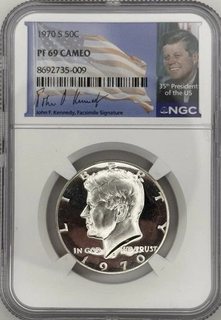
View on eBay

1912 Embossed Christmas Postcard Santa Two Girls Doll Tree Guthrie Okla Yale

DESCRIPTION

$35.87 1912 Christmas Postcards

An embossed Christmas postcard in vertical format. Santa Claus, in a red coat with white fur trim, a long red stocking cap with a tassel and tall black boots, sits in a brown armchair. A little blonde girl in a white dress, with a large white bow in her curls, sits on his knee holding a dark-haired doll in a red dress; a dark-haired girl in white, with white bows in her hair, stands in the crook of his arm. At left, a Christmas tree lit with candles and hung with tinsel and red and gold ornaments, with wrapped presents and a small trunk beneath. A framed picture hangs on the pale green wall, and embossed holly with red berries fills both upper corners inside a gold rule border. The front scan is cut off at the bottom, where the start of a script greeting is just visible; the greeting will be described after a rescan.

The back is a divided back with "POST CARD" in ornate grey type, "FOR CORRESPONDENCE" and "FOR ADDRESS ONLY", and the printed series number "Series 227 F" at lower left. The embossing shows through from the front. 1-cent green George Washington stamp (partly cut off in the scan) with a wavy-line machine cancel; circular datestamp GUTHRIE, OKLA., DEC [day not legible], 4 PM (best reading), 1912. Addressed in ink to Miss Jennie Sh[...] (surname cut off in the scan), Yale, Okla[...], Route 3. The message, written sideways across the correspondence side, reads (best reading): "Dear Jeni rec'd your welcome card. Certenly was glad to here from you again. We are [moved?] like it fine so I guess the girls with be home Xmas. Wish you could come. I wish you a merry Xmas and a happy new year. Write more [?] Route [?] From your friend Otto B." Old pencil marks at the top of the back read "45" and "18" (old prices or inventory marks).

Read the full description

Historical Context

From Oklahoma's first capital. This card was mailed from Guthrie in December 1912. Guthrie was the territorial capital and then Oklahoma's first state capital, from statehood on November 16, 1907, until June 11, 1910, when voters moved the capital to Oklahoma City.

A Payne County farm town. Yale, about twenty miles east of Stillwater, was founded in 1895 and had railroad service by 1902–03. "Route 3" is Rural Free Delivery, which began as an experiment in 1896 and became permanent in 1902, bringing mail to farm families' own mailboxes.

An Olympic connection. Yale later became the home of Jim Thorpe, who won Olympic gold in the pentathlon and decathlon at Stockholm in 1912, the year this card was mailed. His house in Yale is preserved today as the Jim Thorpe House.

A first-year stamp. The 1-cent Washington first appeared in 1912, replacing Benjamin Franklin on the 1-cent value, so this card was mailed in that stamp's first year.

The Golden Age of Postcards. From about 1907 to 1915 Americans mailed hundreds of millions of cards a year, and German printers led the trade in color and embossing until the 1909 Payne-Aldrich Tariff and the First World War. This card is not marked with a country of printing.

Condition

Used. Condition can only be partly described from the current scans, which are cut off at the bottom of the front and the right side of the back; a full report will follow a rescan. On the visible portions: corners softly rounded, with light wear at the upper left of the back; light surface wear; embossing intact and crisp. Ink message and address on the back, old pencil marks at the top, and a small brown spot near the pencil "45". Please see the photos, which are part of the description.

About The Printing

This is an original chromolithograph, and it was slow, exacting work. Each color had to be drawn onto its own separate stone by hand — in monochrome, the artist judging how much stipple each area needed so the colors would combine correctly only once every stone had been printed. The sheet then went through the press once for every color it carries, often a dozen or more, and every pass had to register exactly against the last. A pass out of register showed.

Under magnification the image resolves into irregular hand-drawn stipple, each ink carrying its own dot pattern, the colors mixing in the eye rather than on the paper. There is no regular halftone screen and no four-color rosette, which is what a modern reproduction would show. Modern process printing simulates every color from four inks; chromolithography laid each color down as its own.

The card is also embossed: Santa, the girls, the tree and the holly stand in relief.

Provenance

From my family's estate collections, built over more than 60 years by knowledgeable antiques collectors and traders. Stored in a climate-controlled environment.

Also In Our Store

Another card sent to Yale, Oklahoma — a 1909 embossed New Year card with gnomes and a clock: https://www.ebay.com/itm/158174121074

Disclaimer

Specifications and detailed item descriptions are provided as a courtesy only and are not guaranteed to be one hundred percent accurate. Please do your own research. There are generally no receipts available for any items from original purchases. Any dimensions and/or weights are approximate. The absence of a more detailed condition report does not imply there are no condition issues with the item(s). Please inspect images carefully as they are part of the official item description and best representation of the actual condition. Additional images may be available upon request depending on time and availability. Not responsible for internet mis-translations or mis-identification of maker's marks if found or assumptions of makers or materials — item descriptions will indicate if it is assumed. If you see a problem, please message us immediately and we will do our best to sort out a solution and confirm the information. With the exception of eBay rules, no returns are accepted.
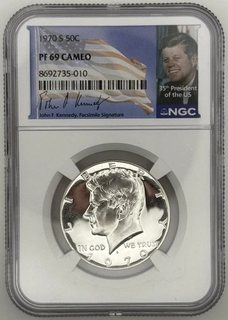
View on eBay

1910 Airbrushed Embossed Thanksgiving Postcard Turkey Faux Wood Joplin Mo Mines

November 1910 Airbrushed Embossed Faux Wood-Grain "Thanksgiving Greetings" Postcard, Turkey, Rail Fence, Roses and Cabin on Heavy Stock, Chicago Station U Machine Cancel to Midway Mines, Joplin, Missouri, 1¢ Franklin Stamp, Pencil Message from "Your Daughter"

$35.63 1910 Thanksgiving Postcards

Description

A heavy, deeply embossed card textured to look like a board of wood. A plum-and-rose turkey with a red wattle stands in a farmyard framed by a rustic rail fence, with pink roses climbing at upper left, a gold-roofed cabin, green grass, a yellow pumpkin and a gold flower at right. "Thanksgiving Greetings" is pressed into the grain at lower left. The color is soft and sprayed, in the airbrushed style. Size approx. 5.50 x 3.55 in. (139 x 90 mm).

The back is a divided back with "POST-CARD" and "(F. H., B.)" at lower left. 1-cent green Benjamin Franklin stamp with a Chicago, Ill., Station U machine cancel, Nov 23, 10:30 AM, 1910. Addressed in pencil to Mr. W. C. Johnson (best reading), Joplin, Mo., Midway Mines. The pencil message reads: "Will see all(?) next spring. Your daughter." The number "37" is stamped twice in purple, once upside down at the top edge.

Read the full description

Historical Context

Joplin's mines. Joplin sat at the center of the Tri-State Mining District and became the lead- and zinc-mining capital of the world; by 1871 mining camps had spread through the Joplin Creek valley. A daughter in Chicago writing to her father at the Midway Mines puts a piece of that story on a holiday card.

Airbrushed cards. Spray-colored, heavily embossed cards like this one have a soft, sculpted look all their own.

Condition

Good. This is an unusually thick card, and the back layer is beginning to separate from the front at the edges. Front color soft but intact, embossing crisp, corners good. Back toned with light soiling; the pencil message is faint, as is the pencil address.

About The Printing

The color on this card was airbrushed: sprayed onto deeply embossed stock pressed with a wood-grain texture. Under magnification the color lies as a fine mist with soft edges and no dot screen at all, quite unlike the stipple of a chromolithograph or the regular dots of halftone.

Provenance

From my family's estate collections, built over more than 60 years by knowledgeable antiques collectors and traders. Stored in a climate-controlled environment.

Also In Our Store

Disclaimer

The images and any video show the actual item and are part of the official listing description, so please review them closely. Measurements and weights are approximate, and any maker or material we haven't confirmed is described as assumed. Questions? Message us; we answer quickly.

View on eBay

1909 Conwell Embossed Santa Claus Trolley Car Christmas Postcard Gold Holly

DESCRIPTION

$34.95 1909 Christmas Postcards

An embossed Christmas postcard on a gold ground, framed by a raised border of holly and mistletoe hung with icicles. Santa Claus, in a red fur-trimmed suit, trudges through the snow by moonlight with a sack packed with a drum, a horn, a toy house, a jester doll and a rocking horse. Behind him an electric trolley car with glowing windows runs under its overhead wire past a snow-covered red house, fir trees and a full moon. Embossed gold greeting: "Wishing you a Jolly X'mas." Printed small at lower center: "COPYRIGHT 1909 L. R. CONWELL, N.Y." Size approx. 5.40 x 3.40 in. (137 x 86 mm).

The back is a divided back with the multilingual Universal Postal Union heading ("Postkarte — Carte postale — Weltpostverein — Union postale universelle — Post card — Correspondenzkarte — Levelező-Lap — Karta korespondencyjna — Korespondenční lístek — Briefkaart — Dopisnice — Cartolina postale — Brevkort — Открытое письмо — Brefkort — Tarjeta postal") and the number 260 at lower left. No country of printing is marked. 1-cent green Benjamin Franklin stamp; circular datestamp "...TER S... KANS." 1909, read as Baxter Springs, Kansas (month and day not legible). Addressed in pencil to Miss Ethel Bradford, Catoosa, Okla., R.F.D. #1, Box 11. The message reads (best reading): "Dear Ethel, I will write you a line this evening. We are not very well at present. I will write you a long letter in a few days. Ethel is working away from home. I have not saw her for a long time. Merry Xmas," followed by a short flourish, possibly initials (not legible).

Read the full description

Historical Context

A new state's mail. Oklahoma had been a state for barely two years when this card arrived; Indian Territory and Oklahoma Territory were joined on November 16, 1907. It crossed the line from Baxter Springs, in the southeast corner of Kansas less than two miles from the border, the first "cow town" in Kansas in the early 1870s.

Rural Free Delivery. "R.F.D." delivery to farm families began on October 1, 1896, in West Virginia and became permanent in 1902, which is how a Christmas card reached a box on a country road outside Catoosa — today a Route 66 town in Rogers County, about fourteen miles northeast of Tulsa, home of the Blue Whale of Catoosa.

For trolley collectors. The electric streetcar beside Santa gives this card crossover appeal for transportation and trolley collectors.

A dozen languages on one card. The Universal Postal Union heading on the back, running from German and French through Hungarian, Polish, Czech, Russian and Spanish, was standard on European-printed cards and shows how international the postcard trade was. German printers led it until the Payne-Aldrich Tariff of 1909 raised the duty on imported postcards sharply.

Condition

Good for its age. The gold ground shows rubbing and some flaking along the edges, most at the lower left corner, with general wear to all four corners. Small dark green mark in the gold at the upper right of the front. Embossing crisp, colors bright. On the back: faint pink offset (ink transferred from another card) in the center, faint pencil marks along the top edge, corners lightly worn. Message and address in pencil. No tears seen.

About The Printing

This is an original chromolithograph, and it was slow, exacting work. Each color had to be drawn onto its own separate stone by hand — in monochrome, the artist judging how much stipple each area needed so the colors would combine correctly only once every stone had been printed. The sheet then went through the press once for every color it carries, often a dozen or more, and every pass had to register exactly against the last. A pass out of register showed.

Under magnification the image resolves into irregular hand-drawn stipple, each ink carrying its own dot pattern, the colors mixing in the eye rather than on the paper. There is no regular halftone screen and no four-color rosette, which is what a modern reproduction would show. Modern process printing simulates every color from four inks; chromolithography laid each color down as its own.

The holly border, greeting and figures are embossed, and the frame is printed in metallic gold.

Provenance

From my family's estate collections, built over more than 60 years by knowledgeable antiques collectors and traders. Stored in a climate-controlled environment.

Also In Our Store

An earlier card to Ethel Bradford of Catoosa, addressed "Ind. T." — Indian Territory, before statehood: https://www.ebay.com/itm/158180794660

The immigrant story behind early American imagery runs through our US silver dollars too: the Morgan dollar was designed by English-born George T. Morgan, the Peace dollar by Sicilian-born Anthony de Francisci.

Disclaimer

Specifications and detailed item descriptions are provided as a courtesy only and are not guaranteed to be one hundred percent accurate. Please do your own research. There are generally no receipts available for any items from original purchases. Any dimensions and/or weights are approximate. The absence of a more detailed condition report does not imply there are no condition issues with the item(s). Please inspect images carefully as they are part of the official item description and best representation of the actual condition. Additional images may be available upon request depending on time and availability. Not responsible for internet mis-translations or mis-identification of maker's marks if found or assumptions of makers or materials — item descriptions will indicate if it is assumed. If you see a problem, please message us immediately and we will do our best to sort out a solution and confirm the information. With the exception of eBay rules, no returns are accepted.
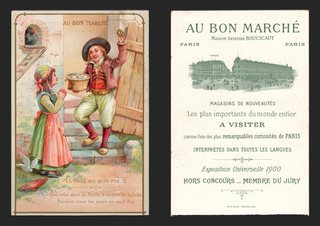
View on eBay

Victorian Trade Card Bridgeport Elastic Web Congress Shoes Insurance Certificate

Bridgeport Elastic Web Co. — Congress Shoe “Insurance Certificate”

$34.58 Advertising Sales Trade Cards

Original Victorian advertising trade card, chromolithograph, c. 1880s. Approx. 5.00 x 3.40 in.

The front is a snowy winter landscape: a red cottage with a snow-laden roof under bare trees, a rail fence, a second house in the distance, and a frozen brook edged with dried weeds in the foreground. There is no advertising on the front; a stock number, 1026, and a small printer's device sit in the lower left corner.

The reverse is the advertisement, laid out as a certificate. A TRADE MARK roundel reads BRIDGEPORT GORING WARRANTED around a shield marked K; a sawtooth seal reads NO GORING HAS A LONGER OR STRONGER GUARANTEE THAN BRIDGEPORT. Between them: INSURANCE CERTIFICATE. The text reads: The above TRADE MARK in these Congress Shoes insures the wearer perfect service of the Gore for one-and a half years from date of sale by us, and if any fails within that time, with fair usage, the shoes may be sent to us by express, and we will insert new gores and return to owner free of charge. Insist on having this certificate with every pair of Congress Shoes. BRIDGEPORT ELASTIC WEB CO., BRIDGEPORT, CONN., U.S.A. E. STERLING, Prest.

Read the full description

Historical Context

The Congress shoe was an ankle boot with elastic panels in the sides — the gores — so it pulled on without laces. The weak point was always the elastic, which stretched and failed long before the leather wore out. This company made the elastic, and the card is a guarantee on that one part: eighteen months, or they would put in new gores free.

It is an early example of a component maker selling directly to the public over the head of the manufacturer. Ask for the shoe with our elastic in it, and keep this card as your proof.

Condition

Toning and age typical of the period. Faint pencil marks at the upper right of the reverse; light surface soiling; minor edge and corner wear. The winter scene on the front is clean and the certificate text fully legible. Please view the images carefully.

About The Printing

This is an original chromolithograph, and it was slow, exacting work. Each color had to be drawn onto its own separate stone by hand — in monochrome, the artist judging how much stipple each area needed so the colors would combine correctly only once every stone had been printed. The sheet then went through the press once for every color it carries, often a dozen or more, and every pass had to register exactly against the last. A pass out of register showed.

Under magnification the image resolves into irregular hand-drawn stipple, each ink carrying its own dot pattern, the colors mixing in the eye rather than on the paper. There is no regular halftone screen and no four-color rosette, which is what a modern reproduction would show. Modern process printing simulates every color from four inks; chromolithography laid each color down as its own.

Provenance

This item comes from the personal collections of my family estate, accumulated over more than 200 years — including items that came west by wagon train to Colorado and later to Oklahoma. Now that my parents have passed we cannot keep all of these cherished items. They were well-educated antiques collectors/traders and continued to build their collections over more than 60 years. The vast majority of the pieces are from the Victorian Era, however there are plenty of older and newer items. Everything has been stored in a climate-controlled environment over time.

Disclaimer

Specifications and detailed item descriptions are provided as a courtesy only and are not guaranteed to be one hundred percent accurate. Please do your own research. There are generally no receipts available for any items from original purchases. Any dimensions and/or weights are approximate. The absence of a more detailed condition report does not imply there are no condition issues with the item(s). Please inspect images carefully as they are part of the official item description and best representation of the actual condition. Additional images may be available upon request depending on time and availability. Not responsible for internet mis-translations or mis-identification of maker's marks if found or assumptions of makers or materials — item descriptions will indicate if it is assumed. If you see a problem, please message us immediately and we will do our best to sort out a solution and confirm the information. With the exception of eBay rules, no returns are accepted.
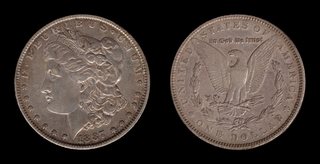
View on eBay

Vintage Mid-Century Black Filigree Round Brooch with Black Glass Stones

Vintage Mid-Century Round Domed Black Filigree Brooch with Faceted Black Glass Stones

$34.57 Brooches

Description

A large round, domed brooch of open floral filigree finished in black, set with faceted black stones assumed to be glass, in several sizes. Pin back with C-clasp.

Read the full description

Condition

Good vintage condition. The black finish shows wear, with lighter metal visible on the high points and on the back (see images). All stones appear present.

Dimensions

Approx. 2.25 in. x 2.25 in. x 0.75 in. deep. Weight 27.12 g.

Provenance

From my family's estate collections, built over more than 60 years by knowledgeable antiques collectors and traders. Stored in a climate-controlled environment.

Disclaimer

The images and any video show the actual item and are part of the official listing description, so please review them closely. Measurements and weights are approximate, and any maker or material we haven't confirmed is described as assumed. Questions? Message us; we answer quickly.

View on eBay

1985 Peru 5000 Soles de Oro Lot of 5 Consecutive Serial Banknotes P-117c [UNC]

21 June 1985 Peru 5000 Soles de Oro Banknotes, Lot of 5 with Consecutive Serials B6994702A to B6994706A, Col. Francisco Bolognesi / Miners at Work, Pick P-117c [UNC]

$33.91 1985 Peru

Description

Issued by the Banco Central de Reserva del Peru and printed by the Bundesdruckerei, Berlin. Front: Colonel Francisco Bolognesi with the national arms; back: two miners at work with an ore cart. Bolognesi watermark and UV text CINCO MIL SOLES DE ORO 5000. Five notes in serial order, B6994702A through B6994706A, sold together as one lot. Each measures about 150.0 x 75.4 mm on the 1200 dpi scan. Ships free by USPS Priority Mail. The images show the first front with all five serials, the five notes fanned, the five serials, the front and back of B6994702A (all five backs share the same design and carry no serial), and close-ups of the date, Bolognesi, the miners, the signatures and the coat of arms. The last image adds a millimeter scale.

Read the full description

Historical Context

Francisco Bolognesi (1816-1880) died defending Arica against the Chilean assault of 7 June 1880, in the War of the Pacific, after vowing to fight 'hasta quemar el ultimo cartucho' (until the last cartridge is spent). He is a Peruvian national hero and patron of the Peruvian Army. In 1985 the inti replaced the sol de oro at 1,000 to 1.

Condition

[UNC] All five: no folds, creases or handling seen; crisp bright paper with sharp corners. No marks, holes or tape. Grade estimated from in hand inspection and high resolution scans; not professionally graded or certified.

Legal Tender

No longer legal tender: demonetized on 31 December 1986, and sol de oro notes cannot be exchanged for current soles.

Disclaimer

The images and any video show the actual item and are part of the official listing description, so please review them closely. Measurements and weights are approximate, and any maker or material we haven't confirmed is described as assumed. Questions? Message us; we answer quickly.

View on eBay

1893 World's Fair Trade Card Hygienic Kalsomine Rubber Paint Chicago Uncle Sam

Hygienic Kalsomine — Rubber Paint Company, Chicago, 1893 World's Fair

$33.88 1893 Advertising Sales Trade Cards

Original Victorian advertising trade card, chromolithograph, 1893. Approx. 5.60 x 3.55 in. Printed by The Milwaukee Litho. & Engr. Co.

Uncle Sam, in striped trousers and a star-spangled coat, hands packets of Hygienic Kalsomine to a crowd of fairgoers on the steps of an exposition building — a woman in a green striped dress, a man in a top hat, a visitor in a fez, a small girl, and a boy seated on the steps below. A golden dome rises behind them and a figure of Columbia in the stars and stripes stands at the head of the stair. Lettered at the foot: USE HYGIENIC KALSOMINE.

The reverse is a full trade advertisement for the Rubber Paint Company — H. M. Hooker, President; Frank Hayes, Vice President; O. J. Buck, Superintendent; A. G. Cox, General Manager — manufacturers of Mixed Paint and Kalsomine, zinc primers, bullion floor, barn, bridge and buggy paint, colors in oil, stains, brushes, barrel paint and painters' material. Headquarters for Carter Strictly Pure White Lead. Office and factory at 36-38 Boston Ave., Chicago, telephone Main 271. A line at the foot reads: Display at Worlds Fair — N. W. Portion Manufacturers & Liberal Arts Building — Section H.

Read the full description

Historical Context

That last line dates the card exactly. The Manufactures and Liberal Arts Building was the largest structure at the World's Columbian Exposition in Chicago in 1893, and this company had a stand in the north-west portion of it, Section H. The card was printed to be handed out there.

Which makes the picture a self-portrait of the moment. Uncle Sam distributing kalsomine to the nations on the steps of the White City is not subtle, but it is exactly how Chicago felt about itself that summer — and the fez in the crowd is there because the world really had turned up.

Condition

Toning and age typical of the period. Light surface soiling; minor edge and corner wear; light soiling to the reverse. The chromolithographed image remains bright with strong color and the reverse text is fully legible. Please view the images carefully.

About The Printing

This is an original chromolithograph, and it was slow, exacting work. Each color had to be drawn onto its own separate stone by hand — in monochrome, the artist judging how much stipple each area needed so the colors would combine correctly only once every stone had been printed. The sheet then went through the press once for every color it carries, often a dozen or more, and every pass had to register exactly against the last. A pass out of register showed.

Under magnification the image resolves into irregular hand-drawn stipple, each ink carrying its own dot pattern, the colors mixing in the eye rather than on the paper. There is no regular halftone screen and no four-color rosette, which is what a modern reproduction would show. Modern process printing simulates every color from four inks; chromolithography laid each color down as its own.

Provenance

This item comes from the personal collections of my family estate, accumulated over more than 200 years — including items that came west by wagon train to Colorado and later to Oklahoma. Now that my parents have passed we cannot keep all of these cherished items. They were well-educated antiques collectors/traders and continued to build their collections over more than 60 years. The vast majority of the pieces are from the Victorian Era, however there are plenty of older and newer items. Everything has been stored in a climate-controlled environment over time.

Disclaimer

Specifications and detailed item descriptions are provided as a courtesy only and are not guaranteed to be one hundred percent accurate. Please do your own research. There are generally no receipts available for any items from original purchases. Any dimensions and/or weights are approximate. The absence of a more detailed condition report does not imply there are no condition issues with the item(s). Please inspect images carefully as they are part of the official item description and best representation of the actual condition. Additional images may be available upon request depending on time and availability. Not responsible for internet mis-translations or mis-identification of maker's marks if found or assumptions of makers or materials — item descriptions will indicate if it is assumed. If you see a problem, please message us immediately and we will do our best to sort out a solution and confirm the information. With the exception of eBay rules, no returns are accepted.
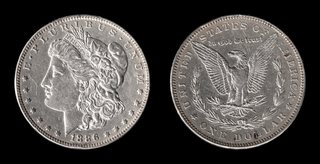
View on eBay

Antique Embossed Christmas Postcard Holly Silver Santa Children Photo Ind. T.

DESCRIPTION

$33.71 Christmas Postcards

An embossed Christmas postcard that combines a photograph with a printed holly design. A tall spray of embossed holly with green leaves and red berries runs down the left side, against sweeping bands and dots of silver metallic ink on a cream ground. At right, a silver-ruled frame holds a black-and-white photograph: children in white nightclothes at Christmas, one pulling at a sack spilling with toys (a violin and a doll among them), another reaching toward a candlelit tree, and Santa Claus in an armchair at the right. Above it a silver panel reads "A MERRY CHRISTMAS". Small printed credit at the foot of the photograph: "Copyright, 190[?], Illustrated Post. Card & Nov. Co." (last digit not legible). Pencil on the silver border: "From Mamie Bender" (best reading). Horizontal, approx. 5.50 x 3.50 in.

The back is printed in brown with an eagle-and-shield emblem, "POST CARD", and a divided back. 1-cent green Benjamin Franklin stamp (Series 1902) with a barred killer; circular datestamp WORTHINGTON, IND., DEC [day not clear], 190[6 or 8] (best reading). Addressed in pencil to Miss Ethel Bradford, Catoosa, Ind. T. The message reads (best reading): "Hello! Ethel how are you. I guess it is your time to write. and my time to send a postal so here it comes. What are you going to do Xmas? I think I will stay at home. How is your mamma and the boys? Write soon. With best wishes for a Merry Xmas to all. Mamie. Good Bye".

Read the full description

Historical Context

Oklahoma before Oklahoma. "Ind. T." is Indian Territory. Catoosa lay in the Cherokee Nation; the railroad arrived in 1881–82 and the post office opened in 1883. Indian Territory ceased to exist on November 16, 1907, when it and Oklahoma Territory entered the Union as the State of Oklahoma. With a postmark of 1906 or 1908, this card was either written in the last year of Indian Territory or by a friend still using the old address after statehood.

Route 66 country. Catoosa, in today's Rogers County about fourteen miles northeast of Tulsa, later became a stop on Route 66 and is home to the roadside landmark the Blue Whale of Catoosa.

Made for America, printed in Germany. The Illustrated Postal Card & Novelty Co. of New York (active about 1905–1914) is known to have had many of its cards printed in Leipzig before it began making its own in 1909. This card carries no country of printing. German printers led the world in color, embossing and metallic inks until the 1909 Payne-Aldrich Tariff and then the First World War ended the trade.

The Golden Age of Postcards. From 1907 to 1915 Americans mailed hundreds of millions of cards a year. The divided back, with room for a message beside the address, was permitted from March 1, 1907.

Condition

Used, with honest age wear. Corners rounded and soft, most at the lower left. Light chipping and scuffing along the top edge, best seen on the back. Light overall toning, a few small light spots on the back. Embossing and silver intact; light rubbing to the silver in places. Pencil on the front border and a full pencil message and address on the back. Postmark lightly struck. Small old pencil mark at the upper left of the back. Please see the photos, which are part of the description.

About The Printing

This card combines two printing methods. The central photograph is a halftone: under magnification it resolves into a regular, even dot screen, as photographs were reproduced at the time. It is set into a chromolithographed frame of holly, where the reds and greens resolve into irregular stipple with no regular screen. The silver is metallic ink, and the holly, berries and frame are embossed.

Provenance

From my family's estate collections, built over more than 60 years by knowledgeable antiques collectors and traders. Stored in a climate-controlled environment.

Also In Our Store

A second card to Ethel Bradford of Catoosa, mailed from Baxter Springs, Kansas, in 1909 — after statehood, and addressed "Okla.": https://www.ebay.com/itm/158180868901

The immigrant story behind this card runs through our US silver dollars too: the Morgan dollar was designed by English-born George T. Morgan, the Peace dollar by Sicilian-born Anthony de Francisci.

Disclaimer

Specifications and detailed item descriptions are provided as a courtesy only and are not guaranteed to be one hundred percent accurate. Please do your own research. There are generally no receipts available for any items from original purchases. Any dimensions and/or weights are approximate. The absence of a more detailed condition report does not imply there are no condition issues with the item(s). Please inspect images carefully as they are part of the official item description and best representation of the actual condition. Additional images may be available upon request depending on time and availability. Not responsible for internet mis-translations or mis-identification of maker's marks if found or assumptions of makers or materials — item descriptions will indicate if it is assumed. If you see a problem, please message us immediately and we will do our best to sort out a solution and confirm the information. With the exception of eBay rules, no returns are accepted.
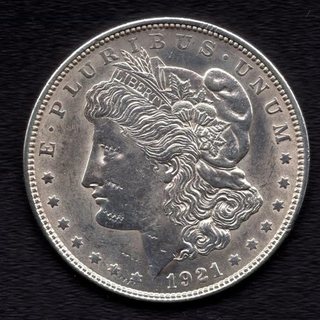
View on eBay

ca1910 P. Sander Patriotic Thanksgiving Postcard Turkey Gold Roundel Flags

ca1910 P. Sander No. 443 Patriotic Embossed "Thanksgiving Greetings" Postcard, Gold-Detailed Turkey in a Gold Roundel, Red-White-and-Blue Bunting, Flag Shields, Pink Bows and Harvest Fruit, "Van L..." Postmark Nov 28, 1¢ Franklin Stamp, J. F. Herman to Cousin Laura Benfer, Middleburg, Pa.

$33.50 Thanksgiving Postcards

Description

A bronze turkey, its feathers picked out in fine gold lines, stands in a gold roundel ringed in pale green. A red, white and blue band runs across the card behind it, with pink bows above and garlands of apples, pears and grapes below; a stars-and-stripes shield sits in each lower corner. "Thanksgiving Greetings" with ornamented blue initials across the top; red border. "P. SANDER ©" at lower left and "443" at lower right.

The back is a divided back, embossed throughout, with a red "POST CARD." 1-cent green Benjamin Franklin stamp, perforated 12 (Scott #331 or #374; they differ only in the watermark), with machine bars and a postmark reading "VAN L..." dated Nov 28, 10 AM (year and state not legible). Addressed in ink to Miss Laura Benfer, Middleburg, Pa., R.F.D. No. 3. The message (our transcription): "Dear Cousin, Wish you all a Happy Thanksgiving. Your Cousin, J. F. Herman."

Read the full description

Historical Context

Dating by the stamp. This Franklin 1-cent design was issued in December 1908, and Washington's portrait replaced Franklin's on the 1-cent value in February 1912, so the card was most likely mailed between those dates.

Condition

Very good. Outstanding gold detail and bright color; some flaking of the red border along the edges and light corner wear. Back clean apart from a couple of small ink spots; pencil "(35)."

About The Printing

This is an original chromolithograph: each color was drawn by hand onto its own stone and printed in its own pass. Under magnification the image resolves into irregular hand-drawn stipple, each ink carrying its own dot pattern, with no regular halftone screen and no four-color rosette, which is what a modern reproduction would show. The turkey, bows and fruit are embossed, and the relief shows on the back.

Provenance

From my family's estate collections, built over more than 60 years by knowledgeable antiques collectors and traders. Stored in a climate-controlled environment.

Also In Our Store

More Thanksgiving postcards from this group are in our store.

Disclaimer

The images and any video show the actual item and are part of the official listing description, so please review them closely. Measurements and weights are approximate, and any maker or material we haven't confirmed is described as assumed. Questions? Message us; we answer quickly.

View on eBay

1907 P. Sander Airbrushed Thanksgiving Postcard Turkey Mayflower Ardmore Mo

1907 P. Sander Airbrushed and Deeply Embossed "Thanksgiving Greetings" Postcard, Turkey on a Rock with Pumpkin and Harvest Fruit Watching the Mayflower at Sea, Soft Blue and Peach, Ardmore, Missouri Postmark, 1¢ Franklin Series 1902 Stamp, to Mrs. Lizzie Devier, Clifton Hill, Mo.

$32.95 1907 Thanksgiving Postcards

Description

A tom turkey stands on a rock above a pumpkin and a heap of harvest fruit, looking out to sea at a sailing ship whose masthead pennant is embossed "MAYFLOWER." The whole card is deeply embossed, and the color is sprayed on in soft blue fading to peach and orange. "Thanksgiving Greetings" is embossed at top center, and a 1907 copyright line for P. Sander, N.Y. is embossed at lower right.

The back is a divided back with a brown eagle and shield, "POST CARD," "This side for Correspondence" and "This side for Address." 1-cent blue-green Benjamin Franklin stamp, Series 1902 (Scott #300), perforated 12, tied by an Ardmore, Mo. postmark dated the 11th, 9 AM, 1907 (the month is too faint to read). Addressed in pencil to Mrs. Lizzie Devier, Clifton Hill, Mo., and signed "from your friend Sarah Johnson."

Read the full description

Historical Context

The Mayflower. With the Pilgrims' ship on the horizon and the turkey on shore, the whole Thanksgiving story fits in one embossed scene.

Airbrushed cards. Color sprayed over deep embossing gives these cards a soft, sculpted look all their own.

Condition

Very good. Soft colors clean and even, embossing crisp, light corner wear. Back clean with light toning; the pencil address and signature are clear.

About The Printing

The color on this card was airbrushed: sprayed onto deeply embossed stock. Under magnification it lies as a fine mist with soft edges and no dot screen at all, quite unlike the stipple of a chromolithograph or the regular dots of halftone. The relief shows clearly on the back.

Provenance

From my family's estate collections, built over more than 60 years by knowledgeable antiques collectors and traders. Stored in a climate-controlled environment.

Also In Our Store

More Thanksgiving postcards from this group are in our store.

Disclaimer

The images and any video show the actual item and are part of the official listing description, so please review them closely. Measurements and weights are approximate, and any maker or material we haven't confirmed is described as assumed. Questions? Message us; we answer quickly.

View on eBay

ca1910 P. Sander Patriotic Thanksgiving Postcard Turkey Gold Wreath Pink Asters

ca1910 Patriotic Embossed P. Sander Thanksgiving Postcard No. 443, Turkey in Gold Laurel Wreath with Pink Asters and Red-White-and-Blue Ribbon, Never Mailed, Full Pencil Note to a Cousin: "You Ought to See Our Little Pet Pigs... We Have Got Eight Pigs and Three Calves"

$32.92 Thanksgiving Postcards

Description

A bronze turkey stands before an embossed gold laurel wreath tied with a pink ribbon, a textured gold disk at its center. A red, white and blue ribbon runs behind the wreath and ties in a bow at the turkey's feet, and sprays of pink asters with buds fill both sides. "Thanksgiving Greetings" with ornamented initials at upper left; red border. "443" at lower left and "P. SANDER ©" at lower right.

The back is a divided back, embossed throughout, with a brown "POST CARD" and a stamp box giving the one-cent rate for "Domestic, Canada, Cuba, Mexico, Hawaii, Philippines, Porto Rico." Never stamped or mailed. Addressed in pencil to Mr. Wesley Kraft (or Krafft; faded pencil, difficult to read), with "Annie" written at the top. The message (our transcription): "Dear Cousin, I thought I would send you a card but I didn't have any card except a Thanksgiving card. You ought to see our little pet pigs and our calves. We have got eight pigs and three calves. Well I will close hoping to hear from you soon. From your cousin."

Read the full description

Historical Context

The only card on hand. A cousin used the one card in the house, a Thanksgiving card, to send the real news: eight pigs and three calves.

Condition

Very good. Bright colors and gold, crisp embossing; light corner wear. Back clean, with a light crease at the upper left corner, the pencil message, and a small pencil mark in the stamp box.

About The Printing

This is an original chromolithograph: each color was drawn by hand onto its own stone and printed in its own pass. Under magnification the image resolves into irregular hand-drawn stipple, each ink carrying its own dot pattern, with no regular halftone screen and no four-color rosette, which is what a modern reproduction would show. The wreath and ribbons are embossed, and the relief shows on the back.

Provenance

From my family's estate collections, built over more than 60 years by knowledgeable antiques collectors and traders. Stored in a climate-controlled environment.

Also In Our Store

More Thanksgiving postcards from this group are in our store.

Disclaimer

The images and any video show the actual item and are part of the official listing description, so please review them closely. Measurements and weights are approximate, and any maker or material we haven't confirmed is described as assumed. Questions? Message us; we answer quickly.

View on eBay

1913 J.J. Marks Thanksgiving Series G Embossed Postcard Turkey Haverhill Mass

November 1913 J.J. Marks "Thanksgiving Series G" Embossed Postcard, Copyright 1912, Cream Panel with Turkey and Harvest Fruit, Haverhill, Massachusetts Postmark, 1¢ Washington Stamp with Straight Edge, "Love from Eva" to Miss Ida Hall

$32.84 1913 Thanksgiving Postcards

Description

An elegant, restrained design: a cream card embossed all over with fleur-de-lis and dot patterns, framing an arched panel that reads "Thanksgiving Greetings" in brown and gold lettering. In the panel a small tom turkey stands beside a cluster of harvest fruit, with gold ornaments above and below. Size approx. 5.45 x 3.50 in. (139 x 89 mm).

The back is a divided back, printed vertically at left: "THANKSGIVING SERIES G, COPYRIGHTED 1912 BY J.J. MARKS N.Y." 1-cent green George Washington stamp, perforated at top, bottom and right with a straight edge at left; Haverhill, Mass. machine cancel, Nov 26, 7:30 AM, 1913. Addressed in ink to Miss Ida Hall, Rosemont St, Haverhill, Mass., and signed "Love from Eva."

Read the full description

Historical Context

Heavy ink. The canceling ink was so heavy and wet that it soaked through the card and shows as dark marks at the upper left of the front. It is not terribly uncommon, and it shows the reality of a busy post office in the week before Thanksgiving; the close-up shows it.

Local mail. Mailed within Haverhill on the Wednesday morning before Thanksgiving 1913.

Condition

Very good. Clean cream stock with crisp embossing and bright gold. Cancel ink bleed-through at the upper left of the front, as described. Light corner wear. Back clean, postmark and address clear.

About The Printing

This is an original chromolithograph, and it was slow, exacting work. Each color had to be drawn onto its own separate stone by hand — in monochrome, the artist judging how much stipple each area needed so the colors would combine correctly only once every stone had been printed. The sheet then went through the press once for every color it carries, often a dozen or more, and every pass had to register exactly against the last. A pass out of register showed.

Under magnification the image resolves into irregular hand-drawn stipple, each ink carrying its own dot pattern, the colors mixing in the eye rather than on the paper. There is no regular halftone screen and no four-color rosette, which is what a modern reproduction would show. Modern process printing simulates every color from four inks; chromolithography laid each color down as its own.

The whole card is embossed, the lettering and ornaments are in gold, and the patterned border stands up in relief on the back.

Provenance

From my family's estate collections, built over more than 60 years by knowledgeable antiques collectors and traders. Stored in a climate-controlled environment.

Also In Our Store

Disclaimer

The images and any video show the actual item and are part of the official listing description, so please review them closely. Measurements and weights are approximate, and any maker or material we haven't confirmed is described as assumed. Questions? Message us; we answer quickly.

View on eBay

2008 Qatar 50 Riyals Central Bank Pearl Monument Banknote P-31 [Est. F-VF]

2008 Qatar 50 Riyals Banknote, Qatar Central Bank, Ornate arches and state emblem / Qatar Central Bank building, Pick P-31, Serial 13/jim 661319 (Arabic numerals) [Est. F-VF]

$32.79 2008 Est. F-VF Qatar

Description

A Qatar Central Bank 50 riyals note, undated (2008 issue), Pick P-31, with a hologram strip at right and four tactile bars at left; signatures Abdullah Saud Al-Thani (Governor) and Yousef Hussein Kamal (Minister of Finance). The front shows ornate arches and the state emblem; the back shows the Qatar Central Bank building and the Oyster & Pearl monument, with a windowed thread. Watermark: falcon head and 50. Catalog size 152 x 70 mm. Serial 13/jim 661319 (Arabic numerals). Measured on the 1200 dpi scan: 152.4 x 69.9 mm; printed margins left 1.4, right 1.4, top 1.2, bottom 0.8 mm (design runs close to the edges, as on this series). The close-ups show the serial, the arches and state emblem and the central bank and the pearl monument. The last photo adds a millimeter scale.

Read the full description

Historical Context

The Oyster & Pearl monument on the Doha Corniche recalls pearl diving, Qatar's main trade before oil.

Condition

[Est. F-VF] Folds, light soiling and edge wear. Grade estimated; not professionally graded.

Legal Tender

No longer legal tender since 1 July 2021, when Qatar withdrew its fourth series; the Qatar Central Bank redeems these notes for ten years from the withdrawal decision. Sold as a collectible.

Disclaimer

The images and any video show the actual item and are part of the official listing description, so please review them closely. Measurements and weights are approximate, and any maker or material we haven't confirmed is described as assumed. Questions? Message us; we answer quickly.

View on eBay

1891 Lion Coffee Easter Greetings Trade Card Girl in Doorway Lilies Harris Lith

1891 Lion Coffee Easter Greetings Trade Card Girl in Doorway Lilies Harris Lith — A little girl in a pink dress with an armful of flowers stands in an arched doorway, with tall white lilies in the foreground. Approx. 5.19 x 6.91 in.

$32.72 1891 Advertising Sales Trade Cards

Description

A little girl in a pink dress with an armful of flowers stands in an arched doorway, with tall white lilies in the foreground. Printer's line: "Copyrighted 1891 by Geo. S. Harris & Sons Lith., Phila."

The back is printed in soft brown: "These Beautiful Easter Greetings are found only in the one pound packages of LION COFFEE. Manufactured by Woolson Spice Co., Toledo, Ohio," around a sunburst roundel with the Lion Coffee lion and a bird in flight.

Approx. 5.19 x 6.91 in.

Read the full description

Historical Context

The coffee that came with a picture. Lion Coffee began in Toledo, Ohio, in 1864 and became part of the Woolson Spice Company in 1882. Alvin Woolson built the brand by putting picture cards in every package, and the back of this card says so.

Condition

Front: very good, clean color. Back: light toning. Please see the photos, which are part of the description.

About The Printing

This is an original chromolithograph, and it was slow, exacting work. Each color had to be drawn onto its own separate stone by hand — in monochrome, the artist judging how much stipple each area needed so the colors would combine correctly only once every stone had been printed. The sheet then went through the press once for every color it carries, often a dozen or more, and every pass had to register exactly against the last. A pass out of register showed.

Under magnification the image resolves into irregular hand-drawn stipple, each ink carrying its own dot pattern, the colors mixing in the eye rather than on the paper. There is no regular halftone screen and no four-color rosette, which is what a modern reproduction would show. Modern process printing simulates every color from four inks; chromolithography laid each color down as its own.

The back is printed in a single brown ink.

Provenance

From my family's estate collections, built over more than 60 years by knowledgeable antiques collectors and traders. Stored in a climate-controlled environment.

Also In Our Store

More Lion Coffee cards in our store: https://www.ebay.com/str/tfauctionsintl?_nkw=lion+coffee

More Victorian advertising trade cards are in our store.

Disclaimer

The images and any video show the actual item and are part of the official listing description, so please review them closely. Measurements and weights are approximate, and any maker or material we haven't confirmed is described as assumed. Questions? Message us; we answer quickly.

View on eBay

1907 Mayflower Thanksgiving Postcard P. Sander Airbrushed Turkey Rockland Maine

November 1907 P. Sander Airbrushed Embossed "Thanksgiving Greetings" Postcard in Strong Coral and Blue, Turkey and Harvest Fruit Watching the Mayflower, Duplex Cancel Nov 27, 1907, 1¢ Franklin Series 1902 Stamp, Cousin to Cousin, to Miss Evelyn Bernet, 37 Rockland St., Rockland, Maine

$32.48 1907 Thanksgiving Postcards

Description

A tom turkey on a rock above a pumpkin and harvest fruit watches a sailing ship at sea, its pennant embossed "MAYFLOWER." The color is sprayed on: pale blue sky and birds, with a deep coral orange rising through the sea and foreground. Deeply embossed throughout, with "Thanksgiving Greetings" at top center and a 1907 copyright line for P. Sander, N.Y. at lower right.

The back is a divided back with a brown eagle and shield, "POST CARD," "This side for Correspondence" and "This side for Address." 1-cent Benjamin Franklin stamp, Series 1902 (Scott #300), affixed at an angle and tied by a duplex cancel of Nov 27, 9:30 AM, 1907. Addressed in ink to Miss Evelyn Bernet, 37 Rockland St., Rockland, Me. The message, written up the left side (our transcription): "Love and greetings to you all, from your cousin Anna E. Bernet."

Read the full description

Historical Context

The eve of the holiday. Postmarked on the Wednesday morning before Thanksgiving, which fell on November 28 in 1907.

The Mayflower. The Pilgrims' ship and the Thanksgiving turkey share one deeply embossed scene.

Condition

Good. Strong color and crisp embossing; light rubbing along the top edge, a few small gray marks, and light edge wear. Back toned and slightly wavy; message, address and cancel clear.

About The Printing

The color on this card was airbrushed: sprayed onto deeply embossed stock. Under magnification it lies as a fine mist with soft edges and no dot screen at all, quite unlike the stipple of a chromolithograph or the regular dots of halftone. The relief shows on the back.

Provenance

From my family's estate collections, built over more than 60 years by knowledgeable antiques collectors and traders. Stored in a climate-controlled environment.

Also In Our Store

More Thanksgiving postcards from this group are in our store.

Disclaimer

The images and any video show the actual item and are part of the official listing description, so please review them closely. Measurements and weights are approximate, and any maker or material we haven't confirmed is described as assumed. Questions? Message us; we answer quickly.

View on eBay

Whitney Made Thanksgiving Greetings Embossed Postcard Boy on Fence Turkey 1927

DESCRIPTION

$31.93 1927 Thanksgiving Postcards

An embossed Thanksgiving postcard by Whitney Made of Worcester, Massachusetts, mailed in November 1927. A small farm boy in a wide straw hat, white shirt, red tie and blue overalls sits on a split-rail fence, holding a dish and feeding a big tom turkey that stands beside him with its tail fanned in bronze and purple. Around them are tall sheaves of grain, a pile of orange pumpkins, green grass and, in the distance, a white farmhouse with a red roof under a blue sky with white clouds. Across the sky, in gold capitals, "Thanksgiving Greetings". A thin gold line frames the picture inside a white border. Size approx. 5.50 x 3.50 in.

The back is a divided back reading "Post Card", with a laurel spray, "CORRESPONDENCE" and "ADDRESS ONLY", and the maker's mark "Whitney Made, Worcester, Mass., Made in U.S.A." Red 2-cent George Washington stamp. Three postal markings: a circular BOSTON, MASS. dater reading NOV 24, A.M., '27; a boxed "EAST BOSTON" marking; and a circular CHELSEA, MASS., A.M., 1927 dater with wavy machine-cancel lines across the stamp. Addressed in pencil to Miss Maud Horn (best reading), E. Rochester, N.H., c/o N.B. Thayer Shoe Co. (best reading). Sender, in pencil at left: "From Mrs. Smith, 63 West Eagle St., E. Boston" (best reading). No other message.

Read the full description

Historical Context

Mailed on Thanksgiving Day. Postmarked in Boston on November 24, 1927, Thanksgiving Day itself, which had been proclaimed for Thursday, November 24 that year.

New Hampshire shoe country. The card went from East Boston to Miss Horn in care of a shoe company in East Rochester, New Hampshire, a mill village within the city of Rochester that grew up on textile and shoe manufacturing. N.B. Thayer & Co., a shoe maker, had opened a factory at East Rochester in 1906.

Made in U.S.A. German printers dominated early postcard printing, but World War I ended that supply and American printers took over. The George C. Whitney Company of Worcester grew from a family stationery business opened in 1858 into a major maker of valentines and greeting cards, produced full-color printed cards like this one, and stayed in business until 1942.

The White Border era. The white border around the picture is typical of the White Border period of American postcards, which the Smithsonian dates 1915 to 1930.

A holiday with more than one story. In the United States Thanksgiving falls on the fourth Thursday of November; Canada gives thanks on the second Monday of October (October 12 in 2026). Since November 26, 1970, Native Americans have gathered at Plymouth, Massachusetts, on Thanksgiving Day for a National Day of Mourning, remembering the Wampanoag people and the history that followed the colonists' arrival. American families still gather each November to give thanks, much as the sender and recipient of this card did nearly a century ago.

Condition

Fair to good, with visible wear. Front: a diagonal crease across the lower left corner through the grain sheaf and pumpkins, with a small crease and surface break near the left edge; light surface creasing and scuffing elsewhere; faint ink transfer from the postmarks in the sky; gold bright; corner wear. Back: light toning; a crease across the lower right through the address; pencil address and sender as described. Postally used.

About The Printing

This card is printed in halftone. Under magnification every color — the blue sky, the orange grain, the bronze turkey — resolves into a regular, even grid of dots rather than the irregular hand-drawn stipple of a chromolithograph. The title lettering and frame line are in gold, and the whole design is embossed, so the boy, the turkey and the fence stand up in relief on the back.

Provenance

From my family's estate collections, built over more than 60 years by knowledgeable antiques collectors and traders. Stored in a climate-controlled environment.

Also In Our Store

Another Thanksgiving card with a child and a tom turkey, a little chef riding the bird, copyright 1911: https://www.ebay.com/itm/158174533956

Made for America, printed in Saxony: a 1907 Raphael Tuck Thanksgiving card from the German-printed era: https://www.ebay.com/itm/158174532357

Disclaimer

Specifications and detailed item descriptions are provided as a courtesy only and are not guaranteed to be one hundred percent accurate. Please do your own research. There are generally no receipts available for any items from original purchases. Any dimensions and/or weights are approximate. The absence of a more detailed condition report does not imply there are no condition issues with the item(s). Please inspect images carefully as they are part of the official item description and best representation of the actual condition. Additional images may be available upon request depending on time and availability. Not responsible for internet mis-translations or mis-identification of maker's marks if found or assumptions of makers or materials — item descriptions will indicate if it is assumed. If you see a problem, please message us immediately and we will do our best to sort out a solution and confirm the information. With the exception of eBay rules, no returns are accepted.
View on eBay

Sweden 100 Kronor Carl Linnaeus Bee Banknote P-65c Foil Strip 0840575052-Est.AU

Sweden 100 Kronor Banknote, Carl Linnaeus, Bee and Flower Back, Sveriges Riksbank, Pick P-65c, Hologram Foil Strip, Serial 0840575052, UV Reactive [Est. AU]

$31.92 Est. AU Sweden

Description

A Sweden 100 kronor banknote from Sveriges Riksbank, the central bank of Sweden. The front shows the botanist Carl Linnaeus; the back shows a bee pollinating a flower. Serial number 0840575052. Pick P-65c, the 2001-2011 printing with the hologram foil strip (2010 printing based on coding scheme starting with 0 on serial number). Security features on this type include a portrait watermark, a security thread with microtext, the foil strip with a three-crowns hologram, and a serial number that glows yellowish-green under UV light.

Read the full description

Historical Context

Carl Linnaeus (1707-1778) created the two-part Latin naming system still used for plants and animals today. This note was replaced by the new Greta Garbo 100 kronor; the old 100s became invalid after 30 June 2017.

Condition

[Est. AU] Crisp paper with no folds or creases and sharp corners. Noticeable waviness in the paper from storage humidity. Grade estimated; not professionally graded. No errors found.

UV CHECK: Checked under a UV lamp: UV-reactive fibers and fluorescent printed areas on both sides glow under ultraviolet light (UV reactive, confirmed). UV photos are contrast-enhanced to show the security features.

Legal Tender

No. Older 100 kronor notes became invalid after 30 June 2017 (Sveriges Riksbank). It is sold as a collectible.

Disclaimer

The images and any video show the actual item and are part of the official listing description, so please review them closely. Measurements and weights are approximate, and any maker or material we haven't confirmed is described as assumed. Questions? Message us; we answer quickly.

View on eBay

Antique 1911 Thanksgiving Joys Embossed Postcard Child Chef Riding Turkey M.132

DESCRIPTION

$31.91 1911 Thanksgiving Postcards

An embossed Thanksgiving postcard, copyright 1911. On the right, a little cook in a white chef's cap and apron sits astride a big tom turkey, brandishing a large carving knife and a meat fork, while the turkey, tail fanned out behind in bronze, cream and brown, looks straight at the viewer with a wary eye. On the left, a round inset in an embossed white frame shows a farmhouse with red roofs by the water at sunset and a figure walking up the lane. Below it, a still life of harvest fruit: apples, a pear, purple grapes and a pumpkin with green leaves. At upper left, "Thanksgiving Joys" in gold capitals, the T and J in ornamental blue. The picture panel sits in a wide white border embossed with raised dots and beads. Printed at lower right of the panel: a small circular copyright mark, "©" with a name ending "…MAN" (partly legible) and "1911". No country of printing appears on either side. Size approx. 5.55 x 3.55 in.

The back is a divided back printed in green: a large "POST CARD" with flourishes, "This side for the Address only", and the code "M.132." at lower left. Green 1-cent Benjamin Franklin stamp ("U.S. Postage, One Cent"); faint Railway Post Office (R.P.O.) circular marking, route and date not legible. Addressed in blue ink to Mrs. Annie Rice (best reading of the surname), Apponaug, R.I. The message reads: "Dearest Annie:- Your card received last night, glad you are all well. We are about as usual. Did you have a good time at Gladys? Write to Loving Mama" (best reading).

Read the full description

Historical Context

A Rhode Island village. The card went to Apponaug, today a neighborhood of Warwick and home of Warwick City Hall. Signed "Loving Mama", it is a short family note sent by penny postcard.

Sorted on a moving train. It traveled by Railway Post Office: a mail car on a train, where clerks postmarked and sorted mail while the train moved between cities.

For children's and kitchen collectors. A small chef with carving knife and fork riding the dinner itself, plus a harvest still life, gives this card crossover appeal beyond Thanksgiving.

The Golden Age of Postcards. From 1907 to 1915 Americans sent hundreds of millions of postcards a year. German printers dominated early postcard printing, and many cards were embossed and finished in gold, as this one is; after the 1909 Payne-Aldrich Tariff and World War I cut off the German supply, American printers took over. This card does not name its country of printing.

A holiday with more than one story. In the United States Thanksgiving falls on the fourth Thursday of November; Canada gives thanks on the second Monday of October (October 12 in 2026). Since November 26, 1970, Native Americans have gathered at Plymouth, Massachusetts, on Thanksgiving Day for a National Day of Mourning, remembering the Wampanoag people and the history that followed the colonists' arrival. American families still gather each November to give thanks, much as the sender and recipient of this card did more than a century ago.

Condition

Very good. Front: bright color, crisp embossing and good gold; light corner wear, most noticeable at the top left; edges clean. Back: clean and bright with light toning at the edges; one small brown spot near the lower left of the message; blue-ink message and address as described. Postally used.

About The Printing

This is an original chromolithograph, and it was slow, exacting work. Each color had to be drawn onto its own separate stone by hand — in monochrome, the artist judging how much stipple each area needed so the colors would combine correctly only once every stone had been printed. The sheet then went through the press once for every color it carries, often a dozen or more, and every pass had to register exactly against the last. A pass out of register showed.

Under magnification the image resolves into irregular hand-drawn stipple, each ink carrying its own dot pattern, the colors mixing in the eye rather than on the paper. There is no regular halftone screen and no four-color rosette, which is what a modern reproduction would show. Modern process printing simulates every color from four inks; chromolithography laid each color down as its own.

The lettering is in gold, and the card is richly embossed, including the raised beaded border.

Provenance

From my family's estate collections, built over more than 60 years by knowledgeable antiques collectors and traders. Stored in a climate-controlled environment.

Also In Our Store

Another embossed Thanksgiving card, also copyright 1911 and carried by a Railway Post Office, to Arlington, Massachusetts: https://www.ebay.com/itm/158174526499

Another Thanksgiving card with a child and a tom turkey, a farm boy on a fence, mailed in 1927: https://www.ebay.com/itm/158174535521

Disclaimer

Specifications and detailed item descriptions are provided as a courtesy only and are not guaranteed to be one hundred percent accurate. Please do your own research. There are generally no receipts available for any items from original purchases. Any dimensions and/or weights are approximate. The absence of a more detailed condition report does not imply there are no condition issues with the item(s). Please inspect images carefully as they are part of the official item description and best representation of the actual condition. Additional images may be available upon request depending on time and availability. Not responsible for internet mis-translations or mis-identification of maker's marks if found or assumptions of makers or materials — item descriptions will indicate if it is assumed. If you see a problem, please message us immediately and we will do our best to sort out a solution and confirm the information. With the exception of eBay rules, no returns are accepted.
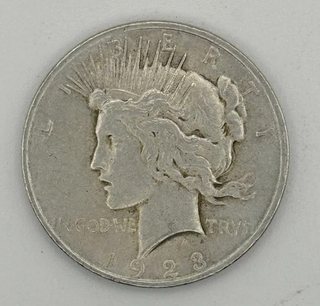
View on eBay

1935F $1 Silver Certificate Blue Seal STAR NOTE *01597902G Circ

Series 1935F $1 Silver Certificate, Blue Seal, STAR NOTE (Replacement), No Motto, George Washington, One Dollar in Silver Payable to the Bearer, Eisenhower Era, Ivy Baker Priest and Robert B. Anderson Signatures, Serial *01597902G, Fr. 1615*, Circulated [Est. F]

$31.87 Est. F Silver Certificates

Description

A Series 1935F $1 Silver Certificate with a blue Treasury seal and blue serial numbers. Signed by Ivy Baker Priest, Treasurer of the United States, and Robert B. Anderson, Secretary of the Treasury. Serial number *01597902G; face plate H8392. The star before the serial marks a replacement note, printed to take the place of a sheet spoiled in production; stars are scarcer than regular notes. Standard small size, about 6.125 x 2.625 in.

Read the full description

Historical Context

Silver certificates promised the bearer one dollar in silver on demand. That promise ended in June 1968, when the Treasury stopped redeeming them for silver; the notes remain legal tender at face value.

Condition

[Est. F] Folds through portrait; light toning. Off-center: narrowest margin at the top, 2.7 mm. Grade estimated from the scans; not professionally graded. No errors found.

Legal Tender

Yes. United States currency issued since 1861 remains legal tender at face value; this $1 Silver Certificate is still worth one dollar, though it can no longer be exchanged for silver (that ended in June 1968).

Disclaimer

The images and any video show the actual item and are part of the official listing description, so please review them closely. Measurements and weights are approximate, and any maker or material we haven't confirmed is described as assumed. Questions? Message us; we answer quickly.

View on eBay

1935E $1 Silver Certificate Blue Seal STAR NOTE *42755790E Circ

Series 1935E $1 Silver Certificate, Blue Seal, STAR NOTE (Replacement), No Motto, George Washington, One Dollar in Silver Payable to the Bearer, Eisenhower Era, Ivy Baker Priest and George M. Humphrey Signatures, Serial *42755790E, Fr. 1614*, Circulated [Est. F]

$31.43 Est. F Silver Certificates

Description

A Series 1935E $1 Silver Certificate with a blue Treasury seal and blue serial numbers. Signed by Ivy Baker Priest, Treasurer of the United States, and George M. Humphrey, Secretary of the Treasury. Serial number *42755790E; face plate N7869. The star before the serial marks a replacement note, printed to take the place of a sheet spoiled in production; stars are scarcer than regular notes. Standard small size, about 6.125 x 2.625 in.

Read the full description

Historical Context

Silver certificates promised the bearer one dollar in silver on demand. That promise ended in June 1968, when the Treasury stopped redeeming them for silver; the notes remain legal tender at face value.

Condition

[Est. F] Center fold and more; soft; light soiling/toning on reverse. Off-center: narrowest margin at the top, 1.9 mm. Grade estimated from the scans; not professionally graded. No errors found.

Legal Tender

Yes. United States currency issued since 1861 remains legal tender at face value; this $1 Silver Certificate is still worth one dollar, though it can no longer be exchanged for silver (that ended in June 1968).

Disclaimer

The images and any video show the actual item and are part of the official listing description, so please review them closely. Measurements and weights are approximate, and any maker or material we haven't confirmed is described as assumed. Questions? Message us; we answer quickly.

View on eBay

ca1885 Victorian Trade Card Rising Sun Yeast Pink Daisies Given Away Grocer

ca1885 Victorian Trade Card Rising Sun Yeast Pink Daisies Given Away Grocer — A tall spray of pink-tipped daisies and wildflowers rising from a bed of grass. Approx. 4.00 x 5.43 in.

$31.42 Advertising Sales Trade Cards

Description

A tall spray of pink-tipped daisies and wildflowers rising from a bed of grass. No printing on the front.

The back is printed in black: "This beautiful card GIVEN AWAY with every package of 'RISING SUN YEAST.' Ask your grocer for it."

Approx. 4.00 x 5.43 in.

Read the full description

Historical Context

A free picture with every package. The back says it plainly: the card was the premium, given away to bring the customer back.

Flowers for the album. Botanical cards like this were favorites for scrapbooks and still appeal to flower collectors.

Condition

Front: light toning, bright flowers. Back: toned. Please see the photos, which are part of the description.

About The Printing

This is an original chromolithograph, and it was slow, exacting work. Each color had to be drawn onto its own separate stone by hand — in monochrome, the artist judging how much stipple each area needed so the colors would combine correctly only once every stone had been printed. The sheet then went through the press once for every color it carries, often a dozen or more, and every pass had to register exactly against the last. A pass out of register showed.

Under magnification the image resolves into irregular hand-drawn stipple, each ink carrying its own dot pattern, the colors mixing in the eye rather than on the paper. There is no regular halftone screen and no four-color rosette, which is what a modern reproduction would show. Modern process printing simulates every color from four inks; chromolithography laid each color down as its own.

The back is printed in black.

Provenance

From my family's estate collections, built over more than 60 years by knowledgeable antiques collectors and traders. Stored in a climate-controlled environment.

Also In Our Store

More Victorian advertising trade cards are in our store.

Disclaimer

The images and any video show the actual item and are part of the official listing description, so please review them closely. Measurements and weights are approximate, and any maker or material we haven't confirmed is described as assumed. Questions? Message us; we answer quickly.

View on eBay

ca1955 Lehigh Portland Cement Ink Blotter F B Tommy Thomas Wichita Kansas

ca1955 Lehigh Portland Cement Ink Blotter F B Tommy Thomas Wichita Kansas — A red and blue blotter for Lehigh Cements: bricklayers at work and a bag of Lehigh Mortar Cement. Approx. 5.93 x 3.43 in.

$31.33 Blotters

Description

A red and blue blotter for Lehigh Cements: bricklayers at work and a bag of Lehigh Mortar Cement. "F. B. (Tommy) Thomas, 121 North Gordon, Wichita 12, Kansas," with an office at 922 Walnut Street, Kansas City 6, Mo. Lehigh Portland Cement Company. The back is plain pink blotting paper.

Approx. 5.93 x 3.43 in.

Read the full description

Historical Context

A salesman's calling card. Ink blotters were handed out by salesmen and kept on desks for years, the name always in sight.

Postal zones. "Wichita 12" and "Kansas City 6" are the postal zone numbers used before ZIP codes arrived in 1963.

Condition

Excellent. Clean front, pink blotter back. Please see the photos, which are part of the description.

About The Printing

This is a color print of the twentieth century, made by a modern commercial method. The exact process cannot be determined with certainty from a scan, so none is claimed here. Under magnification the image resolves into a regular dot pattern or flat solid inks, rather than the irregular hand-drawn stipple of an 1880s chromolithograph.

That is exactly what a piece of this date should show, so it is not a sign of reproduction here. The evidence of an original is the piece itself: its printed text, its imprints and the wear of its age.

The back is plain pink blotting paper.

Provenance

From my family's estate collections, built over more than 60 years by knowledgeable antiques collectors and traders. Stored in a climate-controlled environment.

Also In Our Store

More vintage advertising blotters and cards are in our store.

Disclaimer

The images and any video show the actual item and are part of the official listing description, so please review them closely. Measurements and weights are approximate, and any maker or material we haven't confirmed is described as assumed. Questions? Message us; we answer quickly.

View on eBay

Sweden 100 Kronor Linnaeus Sedel Riksbank P-65c Hologram 0750422695-Est.AU

Sweden 100 Kronor Banknote, Carl Linnaeus, Bee and Flower Back, Sveriges Riksbank, Pick P-65c, Hologram Foil Strip, Serial 0750422695, UV Reactive [Est. AU]

$31.29 Est. AU Sweden

Description

A Sweden 100 kronor banknote from Sveriges Riksbank, the central bank of Sweden. The front shows the botanist Carl Linnaeus; the back shows a bee pollinating a flower. Serial number 0750422695. Pick P-65c, the 2001-2011 printing with the hologram foil strip (2010 based on coding system starting serial number with 0). Security features on this type include a portrait watermark, a security thread with microtext, the foil strip with a three-crowns hologram, and a serial number that glows yellowish-green under UV light.

Read the full description

Historical Context

Carl Linnaeus (1707-1778) created the two-part Latin naming system still used for plants and animals today. This note was replaced by the new Greta Garbo 100 kronor; the old 100s became invalid after 30 June 2017.

Condition

[Est. AU] Crisp paper with no folds or creases and sharp corners. Noticeable waviness in the paper from storage humidity. Grade estimated; not professionally graded. No errors found.

UV CHECK: Checked under a UV lamp: UV-reactive fibers and fluorescent printed areas on both sides glow under ultraviolet light (UV reactive, confirmed). UV photos are contrast-enhanced to show the security features.

Legal Tender

No. Older 100 kronor notes became invalid after 30 June 2017 (Sveriges Riksbank). It is sold as a collectible.

Disclaimer

The images and any video show the actual item and are part of the official listing description, so please review them closely. Measurements and weights are approximate, and any maker or material we haven't confirmed is described as assumed. Questions? Message us; we answer quickly.

View on eBay

Victorian Advertising Trade Card of a Girl with Flowers and Letter [Lion Coffee]

Victorian Advertising Trade Card of a Girl with Flowers and a Letter

$31.22 Advertising Sales Trade Cards

Vintage Lion Coffee Advertising Trade Card Promoting the Coffee's Purity

Read the full description

Description

This advertising trade card, with its depiction of a young girl holding a letter and a basket of flowers, likely served as a greeting card or a promotional item for a company that dealt with correspondence or floral arrangements. The style of the girl's dress, with its puffed sleeves and ruffled hem, along with her hairstyle, places it firmly within the late Victorian or Edwardian period. Such cards are sought after by collectors for their artistic merit, historical significance, and nostalgic appeal.

More Historical Context about Lion Coffee

Lion Coffee was a popular brand in the late 19th and early 20th centuries, known for its distinctive advertising campaigns that often included collectible trade cards. These cards were a common marketing strategy to encourage repeat purchases and build brand loyalty among consumers. The brand's advertising often highlighted the quality and purity of their coffee, differentiating it from competitors. This particular advertisement promotes the idea that Lion Coffee is not glazed, implying a superior, pure flavor compared to other brands that might use a "cheap coating." The mention of a "Picture Card" being included in each package further emphasizes the collectible nature of the brand's promotional materials during the Victorian era. These cards are now sought after by collectors of ephemera and advertising history.

  • Time Period: Circa 1890-1910
  • Origin: United States
  • Composition: Cardstock with color printing
  • Dimensions: H: 4" x W: 2.5" (approximate)
  • Please reivew pictures carefully as they are part of the item description and condition.

Historical Context

Trade cards were a popular form of advertising and collectible ephemera during the late 19th and early 20th centuries. Often featuring colorful illustrations, they were distributed by manufacturers and retailers to promote their products or simply as a form of goodwill. These cards depicted a wide range of subjects, from sentimental scenes and children to patriotic motifs and product advertisements, making them a valuable window into the social and cultural history of the era. Many were beautifully printed using chromolithography, a technique that allowed for vibrant and detailed color reproduction.

Ref: 1.0523

  • Please visit our store as we are constantly adding more items of all types. Thank you!

View on eBay

Elegant Vintage 20th Century Floral Brooch with Amber and Clear Rhinestones

Elegant Vintage Gold-Tone Floral Spray Brooch with Amber Marquise, Clear and Aurora Borealis Rhinestones

$31.21 Brooches

Description

A floral spray brooch in gold-tone metal with amber marquise rhinestones, clear and smoky round rhinestones, and an aurora borealis center stone, on curled wire stems. Mid-20th-century style.

Read the full description

Condition

Excellent for its age, with no visible defects.

Dimensions

Approx. 2.0 in. high x 3.0 in. wide x 0.5 in. deep. Weight 20.92 g.

Provenance

From my family's estate collections, built over more than 60 years by knowledgeable antiques collectors and traders. Stored in a climate-controlled environment.

Disclaimer

The images and any video show the actual item and are part of the official listing description, so please review them closely. Measurements and weights are approximate, and any maker or material we haven't confirmed is described as assumed. Questions? Message us; we answer quickly.

View on eBay

ca1885 Victorian Sunday School Card Put on the Whole Armour of God Girl Daisies

ca1885 Victorian Sunday School Card Put on the Whole Armour of God Girl Daisies — A little girl in a blue bonnet in a diamond frame, surrounded by daisies, inside a floral border. Approx. 5.40 x 3.61 in.

$30.98 Advertising Sales Trade Cards

Description

A little girl in a blue bonnet in a diamond frame, surrounded by daisies, inside a floral border. Verse: "Put on the whole armour of God." (Ephesians 6:11).

The back is embossed with flowers and carries a faint purple rubber stamp: "Sunday School Cards, John Burns Book Co., St. L. Mo." (best reading).

Approx. 5.40 x 3.61 in.

Read the full description

Historical Context

A reward for Sunday school. Cards like this were given to children for learning a verse or for attendance, and many were saved in Bibles and albums.

A St. Louis religious publisher. The stamp names the John Burns Book Co. of St. Louis as the seller.

Condition

Front: very good, embossed, bright color. Back: embossed, light toning, faint stamp. Please see the photos, which are part of the description.

About The Printing

This is an original chromolithograph, and it was slow, exacting work. Each color had to be drawn onto its own separate stone by hand — in monochrome, the artist judging how much stipple each area needed so the colors would combine correctly only once every stone had been printed. The sheet then went through the press once for every color it carries, often a dozen or more, and every pass had to register exactly against the last. A pass out of register showed.

Under magnification the image resolves into irregular hand-drawn stipple, each ink carrying its own dot pattern, the colors mixing in the eye rather than on the paper. There is no regular halftone screen and no four-color rosette, which is what a modern reproduction would show. Modern process printing simulates every color from four inks; chromolithography laid each color down as its own.

The card is embossed, and the back carries a rubber stamp.

Provenance

From my family's estate collections, built over more than 60 years by knowledgeable antiques collectors and traders. Stored in a climate-controlled environment.

Also In Our Store

More Victorian advertising trade cards are in our store.

Disclaimer

The images and any video show the actual item and are part of the official listing description, so please review them closely. Measurements and weights are approximate, and any maker or material we haven't confirmed is described as assumed. Questions? Message us; we answer quickly.

View on eBay

1890s Lion Coffee Woolson Spice Christmas Greeting Trade Card Sea Captain Holly

1890s Lion Coffee Woolson Spice Christmas Greeting Trade Card Sea Captain Holly — An old sea captain in oilskins and sou'wester at a ship's wheel in driving snow, framed beside a coastal scene, with holly and berries. Approx. 6.85 x 5.43 in.

$30.82 Advertising Sales Trade Cards

Description

An old sea captain in oilskins and sou'wester at a ship's wheel in driving snow, framed beside a coastal scene, with holly and berries. Lettered "Woolson Spice Co's Christmas Greeting."

The back, printed in black: "To secure a Picture Card like this you have only to buy a package of LION COFFEE! It is composed of a successful combination of Mocha, Java and Rio," around a "MOCHA JAVA RIO" roundel, with "It is roasted with the greatest care but is not ground. LION is the King of Coffees! Manufactured by the Woolson Spice Co., Toledo, Ohio."

Approx. 6.85 x 5.43 in.

Read the full description

Historical Context

The coffee that came with a picture. Lion Coffee began in Toledo, Ohio, in 1864 and became part of the Woolson Spice Company in 1882. Alvin Woolson built the brand by putting picture cards in every package, and the back of this card says so.

A Christmas card in the coffee. Woolson issued large seasonal greeting cards for Christmas, Easter and midsummer.

Condition

Front: very good, bright color; slightly out of square as trimmed. Back: light toning. Please see the photos, which are part of the description.

About The Printing

This is an original chromolithograph, and it was slow, exacting work. Each color had to be drawn onto its own separate stone by hand — in monochrome, the artist judging how much stipple each area needed so the colors would combine correctly only once every stone had been printed. The sheet then went through the press once for every color it carries, often a dozen or more, and every pass had to register exactly against the last. A pass out of register showed.

Under magnification the image resolves into irregular hand-drawn stipple, each ink carrying its own dot pattern, the colors mixing in the eye rather than on the paper. There is no regular halftone screen and no four-color rosette, which is what a modern reproduction would show. Modern process printing simulates every color from four inks; chromolithography laid each color down as its own.

The back is printed in black.

Provenance

From my family's estate collections, built over more than 60 years by knowledgeable antiques collectors and traders. Stored in a climate-controlled environment.

Also In Our Store

More Lion Coffee cards in our store: https://www.ebay.com/str/tfauctionsintl?_nkw=lion+coffee

More Victorian advertising trade cards are in our store.

Disclaimer

The images and any video show the actual item and are part of the official listing description, so please review them closely. Measurements and weights are approximate, and any maker or material we haven't confirmed is described as assumed. Questions? Message us; we answer quickly.

View on eBay

Antique 1911 Thanksgiving Embossed Postcard Autumn Leaves Nuts and Poem No. 360

DESCRIPTION

$30.57 1911 Thanksgiving Postcards

An embossed Thanksgiving greeting postcard, copyright 1911 and mailed in November 1911. A border of autumn branches frames the card: bright red-orange leaves at upper left, clusters of brown nuts in green leafy husks at the corners, and sprays of yellow blossoms along the bottom, with pale blue shadow behind the twigs. In the center, in ornamental lettering, "A Happy Thanksgiving": the large initial T is an illuminated capital in crimson, gold and blue, and the rest of the word sits on a gold band. Below is the printed verse, its first letters in colored initial blocks, transcribed exactly as printed (including the spelling "thankfullness"):

"One day is far too short to count

Our blessings from above.

May all the year that is to come

Express our thankfullness and

love."

Printed at lower right: a small "© 1911" and the number "360". No publisher or country of printing appears on either side. Size approx. 5.45 x 3.50 in.

The back is a divided back headed "For Correspondence" and "For address only", with a large red "Post Card" with shamrock ornaments and ruled address lines. Green 1-cent Benjamin Franklin stamp ("U.S. Postage, One Cent"); Railway Post Office (R.P.O.) circular marking beginning "BOS…" (route name and date only partly legible). Addressed in ink to Mrs. George Sawyer, Arlington, Mass., Wyman St. (best reading of the street). The message, headed with a place (not legible) and the date "Nov 26 1911" (best reading), reads: "Dear Mrs Sawyer, I hope you will have a nice Thanksgiving. I know you will enjoy having all your family together. Remember me to Frank's [one word crossed out] and all the little folks. Teacher has gone home so I shall be alone. I feel quite happy today to be alone. Love from Em [best reading]."

Read the full description

Historical Context

Written for Thanksgiving 1911. The message is dated November 26, 1911, four days before Thanksgiving, which had been proclaimed for Thursday, November 30 that year.

Sorted on a moving train. The card was carried by a Railway Post Office: a mail car on a train, where postal clerks postmarked and sorted mail while the train traveled between cities. The R.P.O. marking appears to name a Boston route, fitting a card addressed to Arlington, Massachusetts.

The Golden Age of Postcards. From 1907 to 1915 Americans sent hundreds of millions of postcards a year. German printers dominated early postcard printing, and embossing and metallic decoration were the fashion until the 1909 Payne-Aldrich Tariff taxed imported postcards much more heavily and World War I ended the German supply. This card carries no country of printing.

A holiday with more than one story. In the United States Thanksgiving falls on the fourth Thursday of November; Canada gives thanks on the second Monday of October (October 12 in 2026). Since November 26, 1970, Native Americans have gathered at Plymouth, Massachusetts, on Thanksgiving Day for a National Day of Mourning, remembering the Wampanoag people and the history that followed the colonists' arrival. American families still gather each November to give thanks, much as the sender and recipient of this card did more than a century ago.

Condition

Very good. Front: bright, clean colors with strong embossing and good gold; light wear to the corners and edges; a tiny white scuff on a nut at left center. Back: light toning; embossing shows through in raised relief; ink message and address as described, with one word crossed out by the writer. Postally used.

About The Printing

This is an original chromolithograph, and it was slow, exacting work. Each color had to be drawn onto its own separate stone by hand — in monochrome, the artist judging how much stipple each area needed so the colors would combine correctly only once every stone had been printed. The sheet then went through the press once for every color it carries, often a dozen or more, and every pass had to register exactly against the last. A pass out of register showed.

Under magnification the image resolves into irregular hand-drawn stipple, each ink carrying its own dot pattern, the colors mixing in the eye rather than on the paper. There is no regular halftone screen and no four-color rosette, which is what a modern reproduction would show. Modern process printing simulates every color from four inks; chromolithography laid each color down as its own.

The leaves and lettering include broad fields of solid color, and the blue shadows resolve into an irregular, worm-like grain. The title lettering carries gold, and the whole design is embossed.

Provenance

From my family's estate collections, built over more than 60 years by knowledgeable antiques collectors and traders. Stored in a climate-controlled environment.

Also In Our Store

Another embossed Thanksgiving card, also copyright 1911 and carried by a Railway Post Office, to Apponaug, Rhode Island: https://www.ebay.com/itm/158174533956

A patriotic Thanksgiving card mailed in Massachusetts the same week in 1911, to North Raynham: https://www.ebay.com/itm/158174523818

Disclaimer

Specifications and detailed item descriptions are provided as a courtesy only and are not guaranteed to be one hundred percent accurate. Please do your own research. There are generally no receipts available for any items from original purchases. Any dimensions and/or weights are approximate. The absence of a more detailed condition report does not imply there are no condition issues with the item(s). Please inspect images carefully as they are part of the official item description and best representation of the actual condition. Additional images may be available upon request depending on time and availability. Not responsible for internet mis-translations or mis-identification of maker's marks if found or assumptions of makers or materials — item descriptions will indicate if it is assumed. If you see a problem, please message us immediately and we will do our best to sort out a solution and confirm the information. With the exception of eBay rules, no returns are accepted.
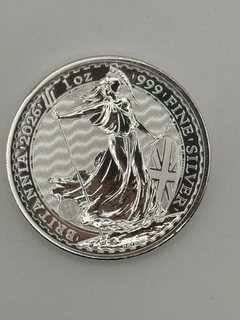
View on eBay

1969 Japan 500 Yen Iwakura Tomomi Mt Fuji Banknote P-95 XH689681K [Est. UNC]

1969 Japan 500 Yen Banknote, Bank of Japan, Pick P-95, XH689681K [Est. UNC]

$30.37 1969 Est. UNC Japan

Description

A Bank of Japan 500 yen, ND (1969), with Iwakura Tomomi and Mt Fuji on the back. Serial XH689681K. Pick P-95 (Numista N#201827).

Read the full description

Historical Context

Iwakura Tomomi (1825-1883) was a Meiji statesman who led the Iwakura Mission to the United States and Europe in 1871-1873.

Condition

[Est. UNC] Looks uncirculated; see the photos. Grade estimated; not professionally graded.

Legal Tender

Still legal tender in Japan at face value (on the Bank of Japan list of valid notes), but worth more to collectors.

Disclaimer

The images and any video show the actual item and are part of the official listing description, so please review them closely. Measurements and weights are approximate, and any maker or material we haven't confirmed is described as assumed. Questions? Message us; we answer quickly.

View on eBay

Vintage Jewels by Jenay Rhodium-Plated Floral Brooch with Blue & Clear Stones

Vintage Jewels by Jenay Rhodium-Plated Floral Brooch with Blue Marquise and Clear Rhinestones

$29.87 Brooches

Description

A floral spray brooch with silver-tone leaves and flowers, blue marquise rhinestones and clear round rhinestones, in a rhodium-plated finish. Signed Jewels by Jenay.

Read the full description

Condition

Excellent, with no visible damage.

Dimensions

Approx. 2.0 in. high x 2.5 in. wide x 0.5 in. deep. Weight 11.58 g.

Provenance

From my family's estate collections, built over more than 60 years by knowledgeable antiques collectors and traders. Stored in a climate-controlled environment.

Disclaimer

The images and any video show the actual item and are part of the official listing description, so please review them closely. Measurements and weights are approximate, and any maker or material we haven't confirmed is described as assumed. Questions? Message us; we answer quickly.

View on eBay

Victorian Illustrated Advertising Calling Card with a Written Invitation

Antique Victorian Illustrated Advertising Calling Card/Trade Card with a Written Invitation

$29.58 Advertising Sales Trade Cards

Vintage Advertising Trade Card for E. M. Mabley & Co. Clothing Store

Read the full description

Description

This beautiful card, with its depiction of a woman writing and the accompanying message, exemplifies the romantic sentimentality often found in Victorian ephemera. The detailed illustration, likely produced through chromolithography, showcases the artistic techniques and popular motifs of the era. Such items are now collected by enthusiasts of antique paper, social history, and Victorian art and are often framed for display.

  • Time Period: Circa 1890-1910 (Victorian Era)
  • Origin: Akron, Ohio, United States
  • Composition: Cardstock with color printing
  • Dimensions: H: 4.25" x W: 2.25" (approximately)
  • Please reivew pictures carefully as they are part of the item description and condition.

Company History

E. M. Mabley & Co., operating as "The Mammoth Clothing House," was a retail establishment that specialized in men's and boys' apparel, including clothing, hats, caps, and furnishings. Such large clothing houses were common in urban centers during this period, catering to a growing demand for ready- made garments and offering a wide selection of goods. The address in Akron, Ohio, places this specific business within a significant industrial and commercial hub of the time.

-Historical Context

Victorian-era calling cards and illustrated stationery were popular forms of communication and social expression during the late 19th century. These cards often featured romantic or sentimental imagery, reflecting the prevailing aesthetic and social customs of the time. They served as a means of conveying invitations, greetings, or personal messages, adding a touch of elegance to everyday correspondence. Trade cards were a popular form of advertising in the late 19th and early 20th centuries, serving as precursors to modern business cards and flyers. They were often printed on cardstock and distributed by businesses to promote their goods and services, frequently featuring decorative elements and detailed information about the establishment. These cards provide valuable insights into the commercial practices and consumer culture of the era.

Ref: 1.0524

  • Please visit our store as we are constantly adding more items of all types. Thank you!

View on eBay

"Big Bonanza Stove Polish" Advertising Trade Card by Geo. A. Hyers

"Big Bonanza Stove Polish" Advertising Trade Card by Geo. A. Hyers

$29.55 Advertising Sales Trade Cards

Description

Geo. A. Hyers was a manufacturer of stove polish, a common household product during the era when coal and wood-burning stoves were prevalent. The "Big Bonanza" brand name suggests an effort to convey value and effectiveness. The inclusion of a promotional offer, such as a cooking stove with each package (though likely a small toy or a discount voucher), was a common tactic to incentivize purchases and create memorable advertising.

  • Time Period: Circa 1890s-1910s
  • Origin: Chicago, Illinois
  • Composition: Heavy card stock
Read the full description

Background

Advertising trade cards like this one were popular in the late 19th and early 20th centuries as a form of marketing. They often featured colorful illustrations and catchy slogans to promote various products, from household goods to patent medicines. These cards served as a way for businesses to reach consumers directly, often distributed by merchants or included with product purchases.

Note: No image on back.

Ref: 1.0515

  • Please reivew pictures carefully as they are part of the item description and condition.
  • Dimensions: H: 5.5" x W: 3.5"
  • Composition: Heavy embossed cardstock with color printing and handwriting.
  • Please visit our store as we are constantly adding more items of all types. Thank you!

View on eBay

1910 P. Sander Thanksgiving Postcard Winter Mill Wild Roses Gold Scranton Pa

November 1910 P. Sander No. 443 Embossed "Thanksgiving Greetings" Postcard, Snowy Water Mill Vignette with Pink Wild Roses in a Red-and-Gold Ribbon Border of Fruit and Pumpkins, Scranton, Pa. Postmark, 1¢ Franklin Stamp, Forrest to Mrs. Sarah Bartges, Wolf's Store, Pa.: "We Won't Butcher Yet... Mom Will Fix Your Hat"

$29.44 1910 Thanksgiving Postcards

Description

A round-topped vignette shows a water mill in winter, its roof white with snow and a small figure on the path, framed by sprays of pink wild roses. The border is bright red and gold with a pale blue ribbon woven through it, apples, pears and grapes at the corners, and a pumpkin at top and bottom. "Thanksgiving Greetings" in gold with brown initials at upper left; "P. SANDER ©" at lower left and the number "443" at lower right. Richly embossed and gilded.

The back is a divided back, embossed throughout, with a red "POST CARD," "This side for Correspondence" and "This side for Address." 1-cent green Benjamin Franklin stamp, perforated 12, most likely Scott #331, tied by a Scranton, Pa. postmark of Nov 26, 1910 (the first letter is faint). Addressed to Mrs. Sarah Bartges, Wolf's Store, Pa. The message (our transcription): "Nov. 23. Well mom will fix your hat. We won't butcher yet, we will let you know. Your dye didn't come yet but mom sent for it. Pop and Foster were down at Uncle Jacob's on Sun. Found all well. Come over before long. From Forrest. Ans. soon."

Read the full description

Historical Context

Farm news. Forrest dated the card Wednesday, November 23, 1910, the day before Thanksgiving, and it was postmarked that Saturday: a hat to fix, dye on order, and the butchering put off for now.

Condition

Very good. Bright color and gold, crisp embossing; light wear at the corners and edges. Back clean apart from a blue ink blot left of the address; a faint pencil number at top right.

About The Printing

This is an original chromolithograph: each color was drawn by hand onto its own stone and printed in its own pass. Under magnification the image resolves into irregular hand-drawn stipple, each ink carrying its own dot pattern, with no regular halftone screen and no four-color rosette, which is what a modern reproduction would show. The border, flowers and fruit are embossed and gilded, and the relief shows on the back.

Provenance

From my family's estate collections, built over more than 60 years by knowledgeable antiques collectors and traders. Stored in a climate-controlled environment.

Also In Our Store

More Thanksgiving postcards from this group are in our store.

Disclaimer

The images and any video show the actual item and are part of the official listing description, so please review them closely. Measurements and weights are approximate, and any maker or material we haven't confirmed is described as assumed. Questions? Message us; we answer quickly.

View on eBay

1891 Lion Coffee Easter Greetings Trade Card Children Lilies Harris Lith Large

1891 Lion Coffee Easter Greetings Trade Card Children Lilies Harris Lith Large — Three children in a meadow of white lilies: a girl in blue with a red bow in her hair and two boys in red and white, one holding a basket. Approx. 6.90 x 5.24 in.

$29.42 1891 Advertising Sales Trade Cards

Description

Three children in a meadow of white lilies: a girl in blue with a red bow in her hair and two boys in red and white, one holding a basket. Printer's line at the foot: "Copyrighted 1891 by Geo. S. Harris & Sons Lith., Phila."

The back is printed in soft brown: "These Beautiful Easter Greetings are found only in the one pound packages of LION COFFEE. Manufactured by Woolson Spice Co., Toledo, Ohio," around a sunburst roundel with the Lion Coffee lion and a bird in flight.

Approx. 6.90 x 5.24 in.

Read the full description

Historical Context

The coffee that came with a picture. Lion Coffee began in Toledo, Ohio, in 1864 and became part of the Woolson Spice Company in 1882. Alvin Woolson built the brand by putting picture cards in every package, and the back of this card says so.

Easter in the coffee can. The large Easter Greetings cards were packed only in the one-pound packages, a reward for the bigger purchase.

Condition

Front: very good, clean color, light edge wear. Back: overall toning with blotchy stains at the center and lower right. Please see the photos, which are part of the description.

About The Printing

This is an original chromolithograph, and it was slow, exacting work. Each color had to be drawn onto its own separate stone by hand — in monochrome, the artist judging how much stipple each area needed so the colors would combine correctly only once every stone had been printed. The sheet then went through the press once for every color it carries, often a dozen or more, and every pass had to register exactly against the last. A pass out of register showed.

Under magnification the image resolves into irregular hand-drawn stipple, each ink carrying its own dot pattern, the colors mixing in the eye rather than on the paper. There is no regular halftone screen and no four-color rosette, which is what a modern reproduction would show. Modern process printing simulates every color from four inks; chromolithography laid each color down as its own.

The back is printed in a single brown ink.

Provenance

From my family's estate collections, built over more than 60 years by knowledgeable antiques collectors and traders. Stored in a climate-controlled environment.

Also In Our Store

More Lion Coffee cards in our store: https://www.ebay.com/str/tfauctionsintl?_nkw=lion+coffee

More Victorian advertising trade cards are in our store.

Disclaimer

The images and any video show the actual item and are part of the official listing description, so please review them closely. Measurements and weights are approximate, and any maker or material we haven't confirmed is described as assumed. Questions? Message us; we answer quickly.

View on eBay

1910 P. Sander Thanksgiving Postcard Snowy Village Violets Pumpkins Rushville NY

November 1910 P. Sander No. 443 Embossed "Thanksgiving Greetings" Postcard, Snowy Village Vignette with Violets and Red Flowers in a Red-and-Gold Ribbon Border of Fruit and Pumpkins, Rushville, N.Y. Postmark the Day Before Thanksgiving, 1¢ Franklin Stamp, "Lill" to Maud L. Jennings, Ulysses, Pa.

$29.38 1910 Thanksgiving Postcards

Description

An arched vignette shows a snowy village with red chimneys, bare trees and a dark pond, framed by bunches of violets and red-orange blossoms. The border is bright red and gold with a pale blue ribbon woven through it, apples, pears and grapes at the corners, and a pumpkin at top and bottom. "Thanksgiving Greetings" in gold with brown initials at upper left; "P. SANDER ©" at lower left and "443" at lower right.

The back is a divided back, embossed throughout, with a red "POST CARD." 1-cent green Benjamin Franklin stamp, most likely Scott #331, tied by a Rushville, N.Y. postmark of Nov 23, 1910. Addressed in ink to Maud L. Jennings, Ulysses, Pa., Box 1189. The ink message is only partly legible; it reads in part (our transcription): "Am I not doing well. I was as comfortable last night as could be expected... I hope you can enjoy a Thanksgiving dinner... Your sis, Lill [or "Yours, Lill"; difficult to read]."

Read the full description

Historical Context

Three seasons on one card. Spring violets, harvest pumpkins and a snow-covered village share the same design.

The eve of the holiday. Postmarked Wednesday, November 23, 1910, the day before Thanksgiving.

Condition

Very good. Bright color and gold, crisp embossing; a small crease and nick at the upper right corner. Back clean with light toning; pencil "20c."

About The Printing

This is an original chromolithograph: each color was drawn by hand onto its own stone and printed in its own pass. Under magnification the image resolves into irregular hand-drawn stipple, each ink carrying its own dot pattern, with no regular halftone screen and no four-color rosette, which is what a modern reproduction would show. The border, flowers and fruit are embossed and gilded.

Provenance

From my family's estate collections, built over more than 60 years by knowledgeable antiques collectors and traders. Stored in a climate-controlled environment.

Also In Our Store

More Thanksgiving postcards from this group are in our store.

Disclaimer

The images and any video show the actual item and are part of the official listing description, so please review them closely. Measurements and weights are approximate, and any maker or material we haven't confirmed is described as assumed. Questions? Message us; we answer quickly.

View on eBay

1912 P. Sander Thanksgiving Postcard Forget-Me-Nots Gold Holyoke Flag Cancel

November 1912 P. Sander No. 443 Embossed "Thanksgiving Greetings" Postcard, Winter Village Vignette on a Gold Leaf with Forget-Me-Nots, Red-and-Gold Ribbon Border of Fruit and Pumpkins, Holyoke, Mass. Flag Cancel, 1¢ Washington Stamp, Sent to a "Miss" at the Riverside Hotel, Three Rivers, Mass.: "Why Billie Dear What's the Trouble? Have You Forgotten Your Hubby?"

$29.10 1912 Thanksgiving Postcards

Description

A round vignette of a winter village under a rose sky, with a church tower, a stone bridge and a lone figure, sits on a large embossed gold leaf among sprays of blue forget-me-nots. The border is bright red and gold with a pale blue ribbon woven through it, apples, pears and grapes at the corners, and a pumpkin at top and bottom. "Thanksgiving Greetings" with ornamented purple initials at upper right; "P. SANDER ©" at lower left and "443" at lower right.

The back is a divided back, embossed throughout, with a red "POST CARD." 1-cent green George Washington stamp, perforated 12 on all four sides (Scott #405), tied by a Holyoke, Mass. flag cancel of Nov 25, 5 PM, 1912. Addressed in ink to Miss Grace A. Walsh (or Welsh; difficult to read), Three Rivers, Mass., c/o Riverside Hotel. The message (our transcription): "Why Billie dear what's the trouble? Have you forgotten your hubby? Write me and tell me what we will do over the holiday. Billie," with "Brinkley" written above the first line.

Read the full description

Historical Context

A note to the hotel. Sent to Miss Walsh at the Riverside Hotel by someone who calls himself her "hubby" and signs "Billie," asking about plans for the holiday.

Flag cancel. The Holyoke machine cancel prints a waving American flag beside the postmark.

Condition

Good. Bright color and gold; corner wear with small chips at the front lower left and the back right edge, light rubbing, and two small dark spots among the forget-me-nots. Back with a blue ink smudge in the message area and a faint pencil number at top right.

About The Printing

This is an original chromolithograph: each color was drawn by hand onto its own stone and printed in its own pass. Under magnification the image resolves into irregular hand-drawn stipple, each ink carrying its own dot pattern, with no regular halftone screen and no four-color rosette, which is what a modern reproduction would show. The gold leaf and border are embossed, and the relief shows on the back.

Provenance

From my family's estate collections, built over more than 60 years by knowledgeable antiques collectors and traders. Stored in a climate-controlled environment.

Also In Our Store

More Thanksgiving postcards from this group are in our store.

Disclaimer

The images and any video show the actual item and are part of the official listing description, so please review them closely. Measurements and weights are approximate, and any maker or material we haven't confirmed is described as assumed. Questions? Message us; we answer quickly.

View on eBay

Victorian Trade Card Helme's Railroad Mills Snuff Apple Blossom Tobacco

Helme's Railroad Mills Snuff — Apple Blossom

$28.69 Advertising Sales Trade Cards

Original Victorian advertising trade card, chromolithograph, c. 1880s. Approx. 4.25 x 3.20 in.

A spray of pink-and-white apple blossom with buds and leaves arches across a pale green panel set inside a soft pink border. Lettered at the foot: Use Helme's Railroad Mills Snuff.

The reverse is blank.

Read the full description

Historical Context

Snuff advertised with apple blossom is a very Victorian combination. Tobacco cards of the period were often at their most delicate, because the advertiser wanted the card kept in a parlor album where a picture of the product itself would never have been welcome.

Helme's Railroad Mills was one of the best-known American snuff brands of its day, and the name alone was the whole message. A card like this needed only to remind.

Condition

Toning and age typical of the period. The blank reverse is toned, with a few faint pencil marks and a small brown fleck at the upper left; minor edge and corner wear. The front is clean and bright. Please view the images carefully.

About The Printing

This is an original chromolithograph, and it was slow, exacting work. Each color had to be drawn onto its own separate stone by hand — in monochrome, the artist judging how much stipple each area needed so the colors would combine correctly only once every stone had been printed. The sheet then went through the press once for every color it carries, often a dozen or more, and every pass had to register exactly against the last. A pass out of register showed.

Under magnification the image resolves into irregular hand-drawn stipple, each ink carrying its own dot pattern, the colors mixing in the eye rather than on the paper. There is no regular halftone screen and no four-color rosette, which is what a modern reproduction would show. Modern process printing simulates every color from four inks; chromolithography laid each color down as its own.

Provenance

This item comes from the personal collections of my family estate, accumulated over more than 200 years — including items that came west by wagon train to Colorado and later to Oklahoma. Now that my parents have passed we cannot keep all of these cherished items. They were well-educated antiques collectors/traders and continued to build their collections over more than 60 years. The vast majority of the pieces are from the Victorian Era, however there are plenty of older and newer items. Everything has been stored in a climate-controlled environment over time.

Disclaimer

Specifications and detailed item descriptions are provided as a courtesy only and are not guaranteed to be one hundred percent accurate. Please do your own research. There are generally no receipts available for any items from original purchases. Any dimensions and/or weights are approximate. The absence of a more detailed condition report does not imply there are no condition issues with the item(s). Please inspect images carefully as they are part of the official item description and best representation of the actual condition. Additional images may be available upon request depending on time and availability. Not responsible for internet mis-translations or mis-identification of maker's marks if found or assumptions of makers or materials — item descriptions will indicate if it is assumed. If you see a problem, please message us immediately and we will do our best to sort out a solution and confirm the information. With the exception of eBay rules, no returns are accepted.
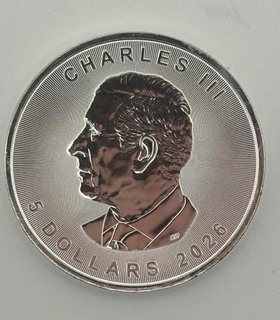
View on eBay

1969 Japan 500 Yen Iwakura Tomomi Mt Fuji Banknote P-95 KH693293V [Est. UNC]

1969 Japan 500 Yen Banknote, Bank of Japan, Pick P-95, KH693293V [Est. UNC]

$28.46 1969 Est. UNC Japan

Description

A Bank of Japan 500 yen, ND (1969), with Iwakura Tomomi and Mt Fuji on the back. Serial KH693293V. Pick P-95 (Numista N#201827).

Read the full description

Historical Context

Iwakura Tomomi (1825-1883) was a Meiji statesman who led the Iwakura Mission to the United States and Europe in 1871-1873.

Condition

[Est. UNC] Looks uncirculated; see the photos. Grade estimated; not professionally graded.

Legal Tender

Still legal tender in Japan at face value (on the Bank of Japan list of valid notes), but worth more to collectors.

Disclaimer

The images and any video show the actual item and are part of the official listing description, so please review them closely. Measurements and weights are approximate, and any maker or material we haven't confirmed is described as assumed. Questions? Message us; we answer quickly.

View on eBay

ca1912 Embossed Thanksgiving Proclamation Postcard Turkey Attleboro Falls Mass

ca1912 Embossed Thanksgiving Postcard, Turkey Reading the Thanksgiving Proclamation Under the Trees, 1¢ Washington Stamp Canceled by Hand in Purple, to Miss Alice Stanley, Attleboro Falls, Massachusetts, Full Message About "a Tram Load of Eggs"

$28.30 Thanksgiving Postcards

Description

A big bronze tom turkey struts down a country lane past a stand of trees toward a white sign that reads "THANKSGIVING PROCLAMATION," with the proclamation's text in tiny print below. Blue sky, green fields, and "GREETING" in red-brown capitals at the bottom inside a ruled border. Embossed. Size approx. 5.50 x 3.55 in. (139 x 90 mm).

The back is a divided back with a gilt "Post Card." 1-cent green George Washington stamp, perforated all around, canceled by hand with a purple pen stroke rather than a postmark. Addressed in ink to Miss Alice Stanley, Towne St, Attleboro Falls, Mass. The message: "You sent me a tram load of eggs showing how much you thought of me, see how much I think of you sending you a turkey mine all in one, so with my best regards I send you this pretty little card. I am feeling some better, hoping to hear from you soon. M. ?.?." (best reading; the word "tram" and the initials are uncertain).

Read the full description

Historical Context

The Proclamation. Thanksgiving was set each year by proclamation, and this turkey has stopped to read his own fate.

The Jewelry Capital. The Attleboro area was once known as "The Jewelry Capital of the World" for its many jewelry makers.

Condition

Good. Front bright and clean with crisp embossing; light corner wear. Back shows scattered foxing and a rust-colored ring around the stamp, with the full ink message.

About The Printing

This card is printed in halftone. Under magnification the greens and yellows of the trees resolve into a regular, even grid of colored dots rather than the irregular hand-drawn stipple of a chromolithograph. The card is embossed, and the turkey and trees stand up in relief on the back.

Provenance

From my family's estate collections, built over more than 60 years by knowledgeable antiques collectors and traders. Stored in a climate-controlled environment.

Also In Our Store

Disclaimer

The images and any video show the actual item and are part of the official listing description, so please review them closely. Measurements and weights are approximate, and any maker or material we haven't confirmed is described as assumed. Questions? Message us; we answer quickly.

View on eBay

1890s Lion Coffee Woolson Spice Midsummer Greeting Trade Card Two Girls Knapp

1890s Lion Coffee Woolson Spice Midsummer Greeting Trade Card Two Girls Knapp — Two girls in large sun bonnets point toward a landscape of mountains and a farmhouse framed in a golden scroll. Approx. 6.91 x 5.00 in.

$28.28 Advertising Sales Trade Cards

Description

Two girls in large sun bonnets point toward a landscape of mountains and a farmhouse framed in a golden scroll. Lettered "The Woolson Spice Co's Midsummer Greeting," with "Knapp & Co. N.Y." at lower right.

The back, printed in brown, is a busy typographic advertisement around a lion's head: "To secure a Picture Card like this you have only to buy a package of LION COFFEE. It is composed of a successful combination of Mocha, Java and Rio ... Sold only in one pound packages. Beautiful Picture Card in every package ... LION is the King of Coffees! Manufactured by Woolson Spice Co., Toledo, Ohio."

Approx. 6.91 x 5.00 in.

Read the full description

Historical Context

The coffee that came with a picture. Lion Coffee began in Toledo, Ohio, in 1864 and became part of the Woolson Spice Company in 1882. Alvin Woolson built the brand by putting picture cards in every package, and the back of this card says so.

Printed by Knapp. Knapp & Co. of New York was one of the great color printers of the period.

Condition

Front: very good, bright color. The top left corner has a small chip with tan board showing and a short crack running in from it. Back: toned. Please see the photos, which are part of the description.

About The Printing

This is an original chromolithograph, and it was slow, exacting work. Each color had to be drawn onto its own separate stone by hand — in monochrome, the artist judging how much stipple each area needed so the colors would combine correctly only once every stone had been printed. The sheet then went through the press once for every color it carries, often a dozen or more, and every pass had to register exactly against the last. A pass out of register showed.

Under magnification the image resolves into irregular hand-drawn stipple, each ink carrying its own dot pattern, the colors mixing in the eye rather than on the paper. There is no regular halftone screen and no four-color rosette, which is what a modern reproduction would show. Modern process printing simulates every color from four inks; chromolithography laid each color down as its own.

The back is printed in a single brown ink.

Provenance

From my family's estate collections, built over more than 60 years by knowledgeable antiques collectors and traders. Stored in a climate-controlled environment.

Also In Our Store

More Lion Coffee cards in our store: https://www.ebay.com/str/tfauctionsintl?_nkw=lion+coffee

More Victorian advertising trade cards are in our store.

Disclaimer

The images and any video show the actual item and are part of the official listing description, so please review them closely. Measurements and weights are approximate, and any maker or material we haven't confirmed is described as assumed. Questions? Message us; we answer quickly.

View on eBay

1890s Lion Coffee Midsummer Greeting Trade Card Children on Swing Roses Gold

1890s Lion Coffee Midsummer Greeting Trade Card Children on Swing Roses Gold — A boy and girl ride a wooden swing inside a large gilt circle, with red roses, blue flowers and a farm vignette, on a metallic gold band. Approx. 6.46 x 4.97 in.

$28.18 Advertising Sales Trade Cards

Description

A boy and girl ride a wooden swing inside a large gilt circle, with red roses, blue flowers and a farm vignette, on a metallic gold band. Lettered "Woolson Spice Co's Midsummer Greeting." Bufford printer's imprint.

The back, printed in black: "To secure a Picture Card like this you have only to buy a package of LION COFFEE. It is composed of a successful combination of Mocha, Java and Rio," around a roundel with a lion's head, flowering branches and "Sold only in one pound packages," and "LION is the King of Coffees! Manufactured by the Woolson Spice Co., Toledo, Ohio."

Approx. 6.46 x 4.97 in.

Read the full description

Historical Context

The coffee that came with a picture. Lion Coffee began in Toledo, Ohio, in 1864 and became part of the Woolson Spice Company in 1882. Alvin Woolson built the brand by putting picture cards in every package, and the back of this card says so.

Condition

Front: good color and gold; card slightly out of square with softly rounded corners. Back: light toning. Please see the photos, which are part of the description.

About The Printing

This is an original chromolithograph, and it was slow, exacting work. Each color had to be drawn onto its own separate stone by hand — in monochrome, the artist judging how much stipple each area needed so the colors would combine correctly only once every stone had been printed. The sheet then went through the press once for every color it carries, often a dozen or more, and every pass had to register exactly against the last. A pass out of register showed.

Under magnification the image resolves into irregular hand-drawn stipple, each ink carrying its own dot pattern, the colors mixing in the eye rather than on the paper. There is no regular halftone screen and no four-color rosette, which is what a modern reproduction would show. Modern process printing simulates every color from four inks; chromolithography laid each color down as its own.

The gold band is printed in metallic ink, and the back is printed in black.

Provenance

From my family's estate collections, built over more than 60 years by knowledgeable antiques collectors and traders. Stored in a climate-controlled environment.

Also In Our Store

More Lion Coffee cards in our store: https://www.ebay.com/str/tfauctionsintl?_nkw=lion+coffee

More Victorian advertising trade cards are in our store.

Disclaimer

The images and any video show the actual item and are part of the official listing description, so please review them closely. Measurements and weights are approximate, and any maker or material we haven't confirmed is described as assumed. Questions? Message us; we answer quickly.

View on eBay

Victorian Trade Card Red Cross Cough Drops 5 Cents Girl Daisies Embossed Gilt

Red Cross Cough Drops — Five Cents per Box

$28.11 Advertising Sales Trade Cards

Original Victorian advertising trade card, chromolithograph on an embossed and gilded ground, c. 1880s-90s. Approx. 4.35 x 2.95 in.

A small girl in a fringed cape and a deep pink bonnet walks a garden path, a basket on one arm, looking back over her shoulder. The scene sits in an inset panel surrounded by white and yellow daisies that spill across the card. Above it a circular device carries the trademark: a red cross, RED CROSS COUGH DROPS, and 5 CTS PER BOX.

The reverse is blank.

Read the full description

Historical Context

A nickel a box, and the card cost the maker a good deal more to produce than the profit on the first sale. That arithmetic only works if the card stays in the house, and this one was built to — embossed, gilded, and prettier than most things a family owned.

The daisies and the child have nothing to do with a sore throat. They were not supposed to. The card's job was to be kept, and a picture worth keeping put the name in front of you every time you opened the album.

Condition

Toning and age typical of the period. The embossing and gilding remain crisp with light rubbing to the high points; minor edge and corner wear; light surface soiling. Colors remain strong. Blank reverse with toning. Please view the images carefully.

About The Printing

This is an original chromolithograph, and it was slow, exacting work. Each color had to be drawn onto its own separate stone by hand — in monochrome, the artist judging how much stipple each area needed so the colors would combine correctly only once every stone had been printed. The sheet then went through the press once for every color it carries, often a dozen or more, and every pass had to register exactly against the last. A pass out of register showed.

Under magnification the image resolves into irregular hand-drawn stipple, each ink carrying its own dot pattern, the colors mixing in the eye rather than on the paper. There is no regular halftone screen and no four-color rosette, which is what a modern reproduction would show. Modern process printing simulates every color from four inks; chromolithography laid each color down as its own.

Provenance

This item comes from the personal collections of my family estate, accumulated over more than 200 years — including items that came west by wagon train to Colorado and later to Oklahoma. Now that my parents have passed we cannot keep all of these cherished items. They were well-educated antiques collectors/traders and continued to build their collections over more than 60 years. The vast majority of the pieces are from the Victorian Era, however there are plenty of older and newer items. Everything has been stored in a climate-controlled environment over time.

Disclaimer

Specifications and detailed item descriptions are provided as a courtesy only and are not guaranteed to be one hundred percent accurate. Please do your own research. There are generally no receipts available for any items from original purchases. Any dimensions and/or weights are approximate. The absence of a more detailed condition report does not imply there are no condition issues with the item(s). Please inspect images carefully as they are part of the official item description and best representation of the actual condition. Additional images may be available upon request depending on time and availability. Not responsible for internet mis-translations or mis-identification of maker's marks if found or assumptions of makers or materials — item descriptions will indicate if it is assumed. If you see a problem, please message us immediately and we will do our best to sort out a solution and confirm the information. With the exception of eBay rules, no returns are accepted.
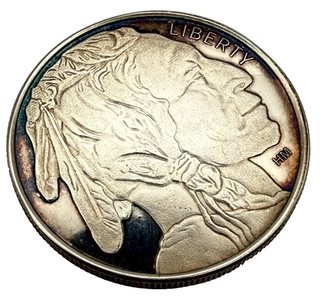
View on eBay

1943 Chevrolet GM WWII Aviation Bomber Ad Engines for Our Eagles of War Military

DESCRIPTION

$27.43 1943 Magazine Advertisement Pages

An original World War II magazine advertisement from Chevrolet, Division of General Motors: "Engines for our eagles of war." A dramatic black-and-white illustration shows a four-engine, twin-tail bomber (it appears to be a B-24 Liberator) flying over a second bomber.

The copy reads: "Now that the all-out air offensive against the Axis is under way—here, too, Chevrolet is playing its part.... For Chevrolet builds huge quantities of Pratt & Whitney airplane engines, as well as anti-aircraft guns, armor-piercing shells, military trucks and countless parts for other war producers." It closes with "VOLUME FOR VICTORY," "BUY U.S. WAR BONDS AND STAMPS" and "Building arms the quality way—for quality means lives today."

A genuine period page, not a reprint: it carries its original page number (5) and the printed footer "April 1943 Good Housekeeping." The back (page 6) is the magazine's "This is Your Guaranty" index of every advertiser in the issue, with Chevrolet Cars & Trucks listed on page 5.

Size approx. 8.45 x 11.50 in.

Read the full description

Historical Context

Detroit at war. Car makers like GM stopped building cars for civilians in early 1942; Ford's civilian car and truck lines shut down on February 10, 1942. GM's Chevy factories turned to aircraft engines, guns, shells and military trucks, and ads like this one told the home front where the cars had gone.

Pratt & Whitney's R-1830 Twin Wasp engine powered the B-24 Liberator.

Buying Power

In 1943, the average factory worker earned about $1.01 an hour. A $25 War Bond, the kind this ad urges readers to buy, cost $18.75: about 18.5 hours of factory pay, or roughly $560 at today's factory wage.

A WWII War Ration Book Four is also available in our store.

Condition

Untrimmed original page with its natural edges: no visible creases or folds, margins intact and ready for framing with a mat to highlight the piece and display your proudly. Made in U.S.A. Small chips along the left edge where the staples were pulled when the page was removed from the magazine. Light spotting in the top margin and a pink stain in the bottom margin, both clear of the image. The black illustration panel is bright and clean. Please study the images; they are part of the description.

About The Printing

Printed in 1943 by the magazine's own press. Under magnification the gray tones resolve into the regular halftone dot screen of period magazine printing on the original paper stock.

Disclaimer

The images and any video show the actual item and are part of the official listing description, so please review them closely. Measurements and weights are approximate, and any maker or material we haven't confirmed is described as assumed. Questions? Message us; we answer quickly.

View on eBay

Victorian Trade Card J H Harkins Millinery Fancy Goods Allentown PA Rose Cushion

Victorian Trade Card J H Harkins Millinery Fancy Goods Allentown PA Rose Cushion — Original Victorian advertising trade card, chromolithograph, c. 1880s-90s. Approx. 3.10 x 2.05 in.

$27.42 Advertising Sales Trade Cards

Description

J. H. Harkins, Millinery and Fancy Goods, Allentown, Pennsylvania

A pink rose with a bud and green leaves rests on a tufted turquoise satin cushion, trimmed with gold cord and tassels, against a bronze-gold ground. The merchant's card lies on the cushion beneath the rose: J. H. HARKINS, Millinery AND FANCY GOODS, 33 Hamilton St., Allentown, Pa.

The reverse is blank.

Read the full description

Historical Context

A milliner sold hats and the trimmings that went on them — ribbons, flowers, feathers, lace — and fancy goods covered the rest of what a well-dressed woman might want from a small shop. The satin cushion and the rose are the shop's own stock, shown at their most luxurious.

This is a single-shop card from one street address. A national brand might print millions; a card like this was printed for one milliner on Hamilton Street and handed out to her customers.

Condition

Toning and age typical of the period. The right edge is rough, with paper loss and small tears; a large brown stain on the blank reverse; minor corner wear. The rose and cushion on the front remain bright and the imprint fully legible. Please view the images carefully.

About The Printing

This is an original chromolithograph, and it was slow, exacting work. Each color had to be drawn onto its own separate stone by hand — in monochrome, the artist judging how much stipple each area needed so the colors would combine correctly only once every stone had been printed. The sheet then went through the press once for every color it carries, often a dozen or more, and every pass had to register exactly against the last. A pass out of register showed.

Under magnification the image resolves into irregular hand-drawn stipple, each ink carrying its own dot pattern, the colors mixing in the eye rather than on the paper. There is no regular halftone screen and no four-color rosette, which is what a modern reproduction would show. Modern process printing simulates every color from four inks; chromolithography laid each color down as its own.

Provenance

From my family's estate collections, built over more than 60 years by knowledgeable antiques collectors and traders. Stored in a climate-controlled environment.

Also In Our Store

More Victorian advertising trade cards are in our store.

Disclaimer

The images and any video show the actual item and are part of the official listing description, so please review them closely. Measurements and weights are approximate, and any maker or material we haven't confirmed is described as assumed. Questions? Message us; we answer quickly.

View on eBay

Victorian Trade Card New York One Price Clothing House Rochester NY Ice Skating

New York One Price Clothing House, Rochester, New York

$27.33 Advertising Sales Trade Cards

Original Victorian advertising trade card, chromolithograph, c. 1880s. Approx. 4.15 x 2.45 in.

Two girls in red winter coats and bonnets skate together on a frozen pond, bare trees and a distant skater behind them. Tall stylized chrysanthemums rise on the left from a red urn at the foot of the card.

The printed text reads: GO TO THE New York One Price Clothing House, Where they are Selling their FALL & WINTER CLOTHING REGARDLESS OF COST! M. H. Carroll, 10 West Main St., Rochester, N.Y.

The reverse is blank.

Read the full description

Historical Context

“One Price” was the selling point, and to a modern reader it looks like no selling point at all. In the 1880s it was the whole pitch. Haggling was still normal in dry goods, which meant the price you paid depended on how hard you argued and how the clerk read you. A one-price house was promising you would not be taken advantage of for being polite.

The picture makes the same argument without saying it. Two children, plainly dressed up warm, out on the ice. Buy the coats here and this is what your winter looks like.

Condition

Toning and age typical of the period. Light surface soiling; minor edge and corner wear; small nicks to the edges. Colors remain strong. Blank reverse with light toning. Please view the images carefully.

About The Printing

This is an original chromolithograph. Each color was drawn onto its own separate stone by hand and printed as its own pass through the press, every pass registering exactly against the last. This card uses the flat-color mode of the process — broad areas of solid, opaque ink with crisp boundaries rather than blended tone. It is the same technique that produced the great poster designs of the period.

Under magnification the colors resolve as solid fields with clean edges and no dot structure at all. There is no halftone screen and no four-color rosette, which is what a modern reproduction would show. Modern process printing simulates every color from four inks; here each color is its own ink, laid down whole.

Provenance

This item comes from the personal collections of my family estate, accumulated over more than 200 years — including items that came west by wagon train to Colorado and later to Oklahoma. Now that my parents have passed we cannot keep all of these cherished items. They were well-educated antiques collectors/traders and continued to build their collections over more than 60 years. The vast majority of the pieces are from the Victorian Era, however there are plenty of older and newer items. Everything has been stored in a climate-controlled environment over time.

Disclaimer

Specifications and detailed item descriptions are provided as a courtesy only and are not guaranteed to be one hundred percent accurate. Please do your own research. There are generally no receipts available for any items from original purchases. Any dimensions and/or weights are approximate. The absence of a more detailed condition report does not imply there are no condition issues with the item(s). Please inspect images carefully as they are part of the official item description and best representation of the actual condition. Additional images may be available upon request depending on time and availability. Not responsible for internet mis-translations or mis-identification of maker's marks if found or assumptions of makers or materials — item descriptions will indicate if it is assumed. If you see a problem, please message us immediately and we will do our best to sort out a solution and confirm the information. With the exception of eBay rules, no returns are accepted.
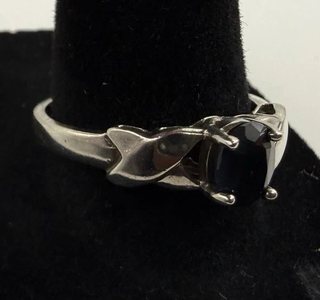
View on eBay

Mid-Century Motor Oil Advertising Card Treat Your Motor Rich Fresh Oil Koch NYC

Mid-Century Motor Oil Advertising Card Treat Your Motor Rich Fresh Oil Koch NYC — Vintage advertising card, printed in two flat colors, mid-century. Approx. 5.35 x 3.50 in.

$27.10 Mid-Century Modern Advertising

Description

“Treat Your Motor to Plenty of Rich, Fresh Oil” — Koch, N.Y.C.

Bold hand-drawn lettering fills the card: treat your motor to plenty of rich, fresh oil.. remember- THE BETTER YOU TREAT YOUR MOTOR.. THE LESS TROUBLE IT WILL GIVE YOU! A cartoon beside it shows a stemmed goblet tipping a golden stream of oil into a boxy engine, a flower-shaped fan at its base, all in black and yellow with a yellow band along the foot. A credit in the lower left reads © KOCH N.Y.C.

The reverse is blank. No oil company or garage is named anywhere on the card.

Read the full description

Historical Context

This is a stock card, drawn to be sold to garages and service stations who wanted something to hand customers at an oil change. The joke is the one the whole design is built on: pour your engine a glass of the good stuff, like a guest you want to keep happy.

It belongs to a different world from the Victorian cards in this collection. By the time this was printed the car was an ordinary part of life, and the advice — change your oil, it costs less than a repair — is advice every mechanic is still giving.

Condition

Clean, with light toning; minor edge and corner wear. No advertiser imprint, stamp or writing on either side. Please view the images carefully.

About The Printing

This is a twentieth-century commercial printing, not a Victorian chromolithograph. It is printed in two flat inks, black and yellow, laid down as solid areas of color with crisp edges rather than blended tone.

Under magnification the ink sits in solid fields with no dot structure and no four-color rosette. The exact press method cannot be determined with certainty from a scan, so none is claimed here.

Provenance

From my family's estate collections, built over more than 60 years by knowledgeable antiques collectors and traders. Stored in a climate-controlled environment.

Also In Our Store

More Victorian advertising trade cards are in our store.

Disclaimer

The images and any video show the actual item and are part of the official listing description, so please review them closely. Measurements and weights are approximate, and any maker or material we haven't confirmed is described as assumed. Questions? Message us; we answer quickly.

View on eBay

ca1885 Die-Cut Fan Trade Card W L Linder Clothing Burlington Iowa Roses

ca1885 Die-Cut Fan Trade Card W L Linder Clothing Burlington Iowa Roses — A die-cut card in the shape of a folding fan, with a yellow and a pink rose and green leaves over the pale ribs, a butterfly at top, and a scalloped edge all the way around. Approx. 4.37 x 5.70 in.

$27.08 Advertising Sales Trade Cards

Description

A die-cut card in the shape of a folding fan, with a yellow and a pink rose and green leaves over the pale ribs, a butterfly at top, and a scalloped edge all the way around.

The back is printed in black: "W. L. LINDER, Undersells Everybody in Men's, Boys' and Children's CLOTHING, 214 Jefferson Street, Burlington, Iowa."

Approx. 4.37 x 5.70 in.

Read the full description

Historical Context

A Burlington clothier. W. L. Linder sold men's, boys' and children's clothing on Jefferson Street in Burlington, Iowa, and promised to undersell everybody.

Die-cut novelties. Shaped cards cost more to make than plain rectangles and were saved as keepsakes.

Condition

Die-cut, irregular outline, cut closely around the fan. Front: a crease across the left side of the fan and small surface losses. Back: light toning. Please see the photos, which are part of the description.

About The Printing

This is an original chromolithograph, and it was slow, exacting work. Each color had to be drawn onto its own separate stone by hand — in monochrome, the artist judging how much stipple each area needed so the colors would combine correctly only once every stone had been printed. The sheet then went through the press once for every color it carries, often a dozen or more, and every pass had to register exactly against the last. A pass out of register showed.

Under magnification the image resolves into irregular hand-drawn stipple, each ink carrying its own dot pattern, the colors mixing in the eye rather than on the paper. There is no regular halftone screen and no four-color rosette, which is what a modern reproduction would show. Modern process printing simulates every color from four inks; chromolithography laid each color down as its own.

The card is die-cut with a scalloped edge, and the back is printed in black.

Provenance

From my family's estate collections, built over more than 60 years by knowledgeable antiques collectors and traders. Stored in a climate-controlled environment.

Also In Our Store

More Victorian advertising trade cards are in our store.

Disclaimer

The images and any video show the actual item and are part of the official listing description, so please review them closely. Measurements and weights are approximate, and any maker or material we haven't confirmed is described as assumed. Questions? Message us; we answer quickly.

View on eBay

1776-1976 Bicentennial Eisenhower Ike Dollar Liberty Bell Type 1 [Est. AU55]

1776-1976 Eisenhower Dollar, Philadelphia Mint (no mint mark), Bicentennial Liberty Bell and Moon Type 1 Reverse, Copper-Nickel Clad, Original Never Cleaned, KM#206 [Est. AU55]

$26.76 1776 Est. AU55 Eisenhower Dollars

Description

A 1776-1976 Eisenhower dollar struck at the Philadelphia Mint (no mint mark). The obverse by Chief Engraver Frank Gasparro shows President Dwight D. Eisenhower facing left; his initials FG are on the neck truncation. The Bicentennial reverse by Dennis R. Williams shows the Liberty Bell against the Moon. This coin has the Type 1 reverse with bold, block lettering. Copper-nickel clad, 22.7 grams, 38.1 mm, reeded edge. The close-ups show the date, the portrait and the Liberty Bell and Moon, and E PLURIBUS UNUM.

Read the full description

Historical Context

The Eisenhower dollar was struck from 1971 to 1978. 1776-1976 was the Bicentennial: coins struck in 1975 and 1976 carry the dual date 1776-1976 and the Liberty Bell against the Moon. Mintage at Philadelphia: 117,337,000.

Buying Power

In 1976 this dollar had the buying power of about $5.89 today.

Condition

[Est. AU55] Circulated, original and never cleaned. Full rims; LIBERTY, IN GOD WE TRUST, the date and ONE DOLLAR are sharp. Light wear on the cheekbone and the hair above the ear; the bell and lettering are sharp. Contact marks and light scratches typical of a large dollar coin that circulated (see the close-ups). Checked for the Type 1 / Type 2 Bicentennial lettering: Type 1. Grade estimated; not professionally graded. Currently still legal tender, but worth more to collectors than face value.

Also In Our Store

More coins: https://www.ebay.com/str/tfauctionsintl?_nkw=coin

Disclaimer

The images and any video show the actual item and are part of the official listing description, so please review them closely. Measurements and weights are approximate, and any maker or material we haven't confirmed is described as assumed. Questions? Message us; we answer quickly.

View on eBay

1776-1976-D Bicentennial Eisenhower Ike Dollar Liberty Bell Type 1 [Est. AU50]

1776-1976-D Eisenhower Dollar, Denver Mint, Bicentennial Liberty Bell and Moon Type 1 Reverse, Copper-Nickel Clad, Original Never Cleaned, KM#206 [Est. AU50]

$26.76 1776 Est. AU50 Eisenhower Dollars

Description

A 1776-1976-D Eisenhower dollar struck at the Denver Mint, with the D mint mark below the neck, above the date. The obverse by Chief Engraver Frank Gasparro shows President Dwight D. Eisenhower facing left; his initials FG are on the neck truncation. The Bicentennial reverse by Dennis R. Williams shows the Liberty Bell against the Moon. This coin has the Type 1 reverse with bold, block lettering. Copper-nickel clad, 22.7 grams, 38.1 mm, reeded edge. The close-ups show the date and mint mark, the portrait and the Liberty Bell and Moon, and E PLURIBUS UNUM.

Read the full description

Historical Context

The Eisenhower dollar was struck from 1971 to 1978. 1776-1976-D was the Bicentennial: coins struck in 1975 and 1976 carry the dual date 1776-1976 and the Liberty Bell against the Moon. Mintage at Denver: 103,228,274.

Buying Power

In 1976 this dollar had the buying power of about $5.89 today.

Condition

[Est. AU50] Circulated, original and never cleaned. Full rims; LIBERTY, IN GOD WE TRUST, the date and ONE DOLLAR are sharp. Light wear on the cheekbone and the hair above the ear; the bell and lettering are sharp. Contact marks and light scratches typical of a large dollar coin that circulated (see the close-ups). Checked for the Type 1 / Type 2 Bicentennial lettering: Type 1. Grade estimated; not professionally graded. Currently still legal tender, but worth more to collectors than face value.

Also In Our Store

More coins: https://www.ebay.com/str/tfauctionsintl?_nkw=coin

Disclaimer

The images and any video show the actual item and are part of the official listing description, so please review them closely. Measurements and weights are approximate, and any maker or material we haven't confirmed is described as assumed. Questions? Message us; we answer quickly.

View on eBay

1912 P. Sander Thanksgiving Postcard Turkey Gold Pumpkin Vines Ludlow Vermont

November 1912 P. Sander No. 761 Embossed "Thanksgiving Greetings" Postcard, Full-Face Turkey with Gold Pumpkin Vines and White Pumpkins, Ludlow, Vermont Postmark, 1¢ Washington Stamp, a Daughter Writes Home: "Irma Grows Fast, Can Sit Up Alone... Am Going to Take the Baby Out"

$26.26 1912 Thanksgiving Postcards

Description

A tom turkey faces the viewer, tail fanned in bronze, cream and rose, between gold pumpkin vines, ears of wheat and white pumpkins outlined in gold. The ground has a fine linen-like texture inside a gold frame with red accents. "Thanksgiving Greetings" with red-and-blue initials and red scrollwork across the top; "P. SANDER ©" at lower left and "761" at lower right.

The back is a divided back, embossed throughout, with a red "POST CARD." 1-cent green George Washington stamp, perforated 12 (Scott #405), tied by a Ludlow, Vt. postmark of November 1912, 8:30 PM. Addressed in pencil to Mrs. C. W. Furman (or Turman; faded pencil, difficult to read), Belmont, Vt. The pencil message (our transcription): "Dear Father & Mother, Your card rec. We will be up Thanksgiving Day. All well. Irma grows fast, can sit up alone for a little while. This is a lovely day, am going to take the baby out. Love, Una [or Uma; difficult to read]."

Read the full description

Historical Context

"Irma grows fast." A daughter writes home to her parents just before Thanksgiving 1912: the family will be up for the holiday, and the baby can sit up alone "for a little while."

Condition

Very good. Bright gold and color, crisp embossing; a small nick at the top edge and light corner wear. Back clean with light toning; pencil "50c" at top left.

About The Printing

This is an original chromolithograph: each color was drawn by hand onto its own stone and printed in its own pass. Under magnification the image resolves into irregular hand-drawn stipple, each ink carrying its own dot pattern, with no regular halftone screen and no four-color rosette, which is what a modern reproduction would show. The gold vines and pumpkins are embossed, and the turkey stands up in relief on the back.

Provenance

From my family's estate collections, built over more than 60 years by knowledgeable antiques collectors and traders. Stored in a climate-controlled environment.

Also In Our Store

More Thanksgiving postcards from this group are in our store.

Disclaimer

The images and any video show the actual item and are part of the official listing description, so please review them closely. Measurements and weights are approximate, and any maker or material we haven't confirmed is described as assumed. Questions? Message us; we answer quickly.

View on eBay

Victorian Advertising Trade Card for Murray & Wiley Dry Goods & Carpets

Antique Victorian Advertising Trade Card for Murray & Wiley Dry Goods & Carpets

$26.24 Advertising Sales Trade Cards

Description

This Vintage Victorian advertising card (not an antique) advertises 'Murray & Wiley, Dry Goods & Carpets' located in Malden, Massachusetts. The imagery of a young girl with flowers and birds was a common motif, evoking themes of domesticity, nature, and innocence, which were appealing to the target audience of the time. Such cards provide a glimpse into the commercial practices and aesthetic sensibilities of the Victorian era.

  • Time Period: Late 19th Century (Victorian Era)
  • Origin: Malden, Massachusetts, United States
  • Composition: Cardstock with color printing
  • Dimensions: H: 2.5" x W: 4.75" (approximately)
  • Please reivew pictures carefully as they are part of the item description and condition.
Read the full description

Historical Context

Victorian trade cards were a popular form of advertising in the late 19th and early 20th centuries, often featuring colorful illustrations of nature, children, or idealized scenes to attract attention. These cards served as a way for businesses to promote their products and services, often distributed with purchases or mailed directly to customers. They are now collected and often framed for their artistic merit and as historical artifacts of consumer culture.

Ref: 1.0525

  • Please visit our store as we are constantly adding more items of all types. Thank you!

View on eBay

1912 Stecher Thanksgiving Postcard Boy Girl Pumpkin Turkeys Gold Embossed Pa

Thanksgiving Day 1912 Stecher Lith. Co. (S L C 1911) Embossed Vertical "Thanksgiving Greetings" Postcard, Girl in Red and Sailor-Suited Boy with a Pumpkin Feeding the Turkeys, Gold Panel and Autumn Leaves, Series 204 F, Pennsylvania Postmark Nov 28, 1912, 1¢ Washington Stamp, to Miss Leona Robinson, Mehoopany, Pa.: "Yes I Love to Go to the Dentist"

$26.17 1912 Thanksgiving Postcards

Description

A vertical card. A girl in a red coat and bonnet and a boy in a pale blue sailor suit with a navy bow stand arm in arm; he holds a pumpkin, and she feeds a big tom turkey from her hand while a second turkey stretches up beside it. An embossed gold panel edged in red, white and blue rises behind them under autumn leaves. "Thanksgiving Greetings" in gold at bottom; the logo "S L C" with © and "1911" at lower right.

The back is a divided back with an ornate "POST CARD" and "Series 204 F." 1-cent green George Washington stamp, perforated 12 with a straight edge at left (Scott #405), with machine bars and an "...UCKSVILLE, PA." postmark of Nov 28, 1912. Addressed in ink to Miss Leona Robinson, Mehoopany, Penna. The message, written up the left side (our transcription): "Dear Leona, Yes I love to go to the dentist. When you are down this way do not forget us. Hope you have a joyful Thanksgiving. Madge."

Read the full description

Historical Context

Mailed on the day. The postmark, Thursday, November 28, 1912, fell on Thanksgiving Day itself.

S L C 1911. The monogram of the Stecher Lithographic Company of Rochester, N.Y. carries the design's 1911 copyright date.

Condition

Very good. Bright colors and crisp gold; light corner wear. Back clean, with the ink message and address clear and a small pencil "20."

About The Printing

This card is printed in halftone. Under magnification the colors resolve into a regular, even grid of dots rather than the irregular hand-drawn stipple of a chromolithograph. The gold panel and figures are embossed and show in relief on the back.

Provenance

From my family's estate collections, built over more than 60 years by knowledgeable antiques collectors and traders. Stored in a climate-controlled environment.

Also In Our Store

Another Stecher Series 204 Thanksgiving card from this group, a landscape design mailed in Rochester on Thanksgiving Day 1916, is also in our store. More Thanksgiving postcards from this group are there too.

Disclaimer

The images and any video show the actual item and are part of the official listing description, so please review them closely. Measurements and weights are approximate, and any maker or material we haven't confirmed is described as assumed. Questions? Message us; we answer quickly.

View on eBay

Victorian Trade Card Comic Farm Scene Julius Rees Clothing Stillwater Minnesota

“Now Give It To 'Em Hard!” — No. 3 of a Comic Series

$25.77 Advertising Sales Trade Cards

Original Victorian advertising trade card, single-color lithograph on tinted stock, c. 1880s. Approx. 4.30 x 3.10 in.

A farm scene in brown ink. Pigs have broken through a rail fence and are loose in the field; a man runs up the hill after them. In the foreground a woman grips a switch behind a fence post while a barefoot boy crouches at the gap with a stick raised, both waiting to ambush the next pig through. Titled at the top: N° 3. “Now give it to 'em hard!”

The reverse advertises THE NEW YORK One Price CLOTHING HOUSE — Carries the Largest and Finest Line of Goods, New Goods Daily Arriving — Julius Rees, Proprietor, Stillwater, Minn. A note at the foot explains that the card is a small copy of one of a series of very humorous pictures on display at the store, and invites the reader to call and see them.

Read the full description

Historical Context

The card is not really selling clothes. It is selling a reason to walk into the shop: the full series is on the wall, and you will have to come in to see the rest. A numbered card that admits it is only a sample of something better elsewhere is an unusually honest piece of advertising, and a clever one.

The scene itself needed no explaining to anyone who kept pigs, which in Stillwater in the 1880s was most people.

Condition

Toning and age typical of the period. A crease to the upper left corner; light surface soiling; minor edge and corner wear. The printed image remains clear and the reverse text fully legible. Please view the images carefully.

About The Printing

This card was printed from a single stone in one ink, on tinted stock — an economical choice, since the colored card supplies a second tone at no extra press pass. The design was drawn by hand in reverse on the stone, the shading built from the density of the drawn marks rather than from color.

Under magnification the tone resolves into drawn line and hatching, not a mechanical screen. There is no halftone screen and no four-color rosette, which is what a modern reproduction would show.

Provenance

This item comes from the personal collections of my family estate, accumulated over more than 200 years — including items that came west by wagon train to Colorado and later to Oklahoma. Now that my parents have passed we cannot keep all of these cherished items. They were well-educated antiques collectors/traders and continued to build their collections over more than 60 years. The vast majority of the pieces are from the Victorian Era, however there are plenty of older and newer items. Everything has been stored in a climate-controlled environment over time.

Disclaimer

Specifications and detailed item descriptions are provided as a courtesy only and are not guaranteed to be one hundred percent accurate. Please do your own research. There are generally no receipts available for any items from original purchases. Any dimensions and/or weights are approximate. The absence of a more detailed condition report does not imply there are no condition issues with the item(s). Please inspect images carefully as they are part of the official item description and best representation of the actual condition. Additional images may be available upon request depending on time and availability. Not responsible for internet mis-translations or mis-identification of maker's marks if found or assumptions of makers or materials — item descriptions will indicate if it is assumed. If you see a problem, please message us immediately and we will do our best to sort out a solution and confirm the information. With the exception of eBay rules, no returns are accepted.
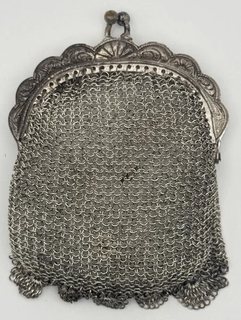
View on eBay

ca1885 Victorian Trade Card Royal Yeast Crescent Moon Snowy Church Red Rose

ca1885 Victorian Trade Card Royal Yeast Crescent Moon Snowy Church Red Rose — A gilt crescent moon frames a snowy village church at night, with a full red rose and buds at right. Approx. 4.09 x 5.89 in.

$25.68 Advertising Sales Trade Cards

Description

A gilt crescent moon frames a snowy village church at night, with a full red rose and buds at right. No printing on the front.

The back is embossed with a rose and printed in blue: "I got this picture card with a 5 cent package of ROYAL YEAST. The Best Yeast I ever used. The Package Contained 8 Cakes."

Approx. 4.09 x 5.89 in.

Read the full description

Historical Context

A card that speaks for the customer. Instead of the maker praising itself, the back is written in the buyer's voice: "The Best Yeast I ever used."

Yeast cakes for home baking. Dry yeast cakes, sold several to a package, were a pantry staple when most bread was baked at home.

Condition

Front: very good, bright gilt and color, light edge wear. Back: surface scuffs and small areas of paper loss from old album removal, light staining at right, embossing intact. Please see the photos, which are part of the description.

About The Printing

This is an original chromolithograph, and it was slow, exacting work. Each color had to be drawn onto its own separate stone by hand — in monochrome, the artist judging how much stipple each area needed so the colors would combine correctly only once every stone had been printed. The sheet then went through the press once for every color it carries, often a dozen or more, and every pass had to register exactly against the last. A pass out of register showed.

Under magnification the image resolves into irregular hand-drawn stipple, each ink carrying its own dot pattern, the colors mixing in the eye rather than on the paper. There is no regular halftone screen and no four-color rosette, which is what a modern reproduction would show. Modern process printing simulates every color from four inks; chromolithography laid each color down as its own.

The back is embossed and printed in a single blue ink.

Provenance

From my family's estate collections, built over more than 60 years by knowledgeable antiques collectors and traders. Stored in a climate-controlled environment.

Also In Our Store

More Victorian advertising trade cards are in our store.

Disclaimer

The images and any video show the actual item and are part of the official listing description, so please review them closely. Measurements and weights are approximate, and any maker or material we haven't confirmed is described as assumed. Questions? Message us; we answer quickly.

View on eBay

ca1912 P. Sander Thanksgiving Postcard Turkey Gold Harvest Bouquet Woodland Cal

ca1912 P. Sander No. 761 Embossed "Thanksgiving Greetings" Postcard, Strutting Turkey and a Big Gold Harvest Bouquet of Corn, Pumpkin, Grapes and Wheat, Woodland, California Postmark, 1¢ Washington Stamp, to Miss Jennie Reusch, Blacks, Cal.: "Guess You Are Good So Santa Will Be Good to You"

$25.56 Thanksgiving Postcards

Description

A bronze tom turkey struts to the left, tail fanned in brown, gold and white, toward a large embossed gold bouquet of corn, a white pumpkin, a diamond-patterned gourd, grapes, leaves and wheat. The ground has a fine linen-like texture inside a gold frame with red corner accents. "Thanksgiving Greetings" with red-and-blue initial blocks at lower left; "P. SANDER ©" at lower left and "761" at lower right.

The back is a divided back, embossed throughout, with a red "POST CARD." 1-cent green George Washington stamp, perforated 12 (Scott #405), affixed at an angle and tied by a Woodland, Cal. postmark of Nov 26, 2 PM, 191? (last digit not legible), with machine bars. Addressed in pencil to Miss Jennie Reusch, Blacks, Cal. The pencil message, written upside down, reads as: "Hello Jennie. How are you these days. Guess you are good so Santa will be good to you. I'm awful good. From your friend Rose V., Woodland, R.F.D. No. 1, Cal." After all these years the pencil is too faint to read reliably, so take our reading as a best effort.

Read the full description

Historical Context

California mail. A Thanksgiving card from Woodland, California, already looking ahead to Christmas: "Santa will be good to you."

The stamp. Washington replaced Franklin on the 1-cent stamp in February 1912, so this perf 12 Washington places the card in 1912 or later.

Condition

Very good. Bright gold and color, crisp embossing, light corner wear; a faint impression of a postmark has transferred to the top center of the front. Back clean; pencil "50c."

About The Printing

This is an original chromolithograph: each color was drawn by hand onto its own stone and printed in its own pass. Under magnification the image resolves into irregular hand-drawn stipple, each ink carrying its own dot pattern, with no regular halftone screen and no four-color rosette, which is what a modern reproduction would show. The gold bouquet is embossed, and the turkey and bouquet stand up in relief on the back.

Provenance

From my family's estate collections, built over more than 60 years by knowledgeable antiques collectors and traders. Stored in a climate-controlled environment.

Also In Our Store

More Thanksgiving postcards from this group are in our store.

Disclaimer

The images and any video show the actual item and are part of the official listing description, so please review them closely. Measurements and weights are approximate, and any maker or material we haven't confirmed is described as assumed. Questions? Message us; we answer quickly.

View on eBay

1909 M.W. Taggart Patriotic Thanksgiving Embossed Postcard Turkey Eagle Gold

DESCRIPTION

$25.47 1909 Thanksgiving Postcards

An embossed patriotic Thanksgiving postcard published by M.W. Taggart of New York, mailed in November 1911. A large tom turkey in full display fills the card, its fanned tail and wings richly feathered in brown, bronze and purple with gold highlights. At upper left a gold eagle with spread wings perches on a shield of stars and stripes (white stars on blue over red and white stripes, edged in gold). The background runs from a white sky through a blue band and a wide gold band to a bright red ground. At the bottom, in gold letters, "Thanksgiving Day", the T and D set in ornamental blue-and-gold initial panels. Front imprints: "SER. T.P. 609" at lower left and, in a small arc at lower right, "DESIGN COPYRIGHT 1909, BY M.W. TAGGART, N.Y." No country of printing is marked. Size approx. 3.40 x 5.40 in.

The back is a divided back headed "This Space For Writing Messages" and "This side for the Address only", with a large "POST CARD" in brown. Green 1-cent Benjamin Franklin stamp ("U.S. Postage, One Cent"); machine cancel with a waving-flag design and circular dater SOUTH BRAINTREE, MASS., NOV 27, 10:30 A, 1911. Addressed in ink to Melvin W. Hutchinson, North Raynham, Mass. The message reads: "From Fred and Aunt Jejie" (best reading of the second name).

Read the full description

Historical Context

Three days before the feast. Mailed in South Braintree, Massachusetts, on November 27, 1911, this family greeting from "Fred and Aunt" went to Melvin Hutchinson of North Raynham, Massachusetts, ahead of Thanksgiving, proclaimed that year for Thursday, November 30.

A turkey in the national colors. The gold eagle and stars-and-stripes shield make the turkey a patriotic emblem as well as a holiday one, and the waving-flag cancel on the back carries the theme through.

1909, a turning point. M.W. Taggart of New York copyrighted this design in 1909, the year the Payne-Aldrich Tariff taxed imported postcards much more heavily. German printers had dominated early postcard printing, and embossing and metallic gold like this were part of the appeal; when World War I ended the German supply, American printers took over. This card carries no country of printing.

The Golden Age of Postcards. From 1907 to 1915 Americans mailed hundreds of millions of postcards a year.

A holiday with more than one story. In the United States Thanksgiving falls on the fourth Thursday of November; Canada gives thanks on the second Monday of October (October 12 in 2026). Since November 26, 1970, Native Americans have gathered at Plymouth, Massachusetts, on Thanksgiving Day for a National Day of Mourning, remembering the Wampanoag people and the history that followed the colonists' arrival. American families still gather each November to give thanks, much as the sender and recipient of this card did more than a century ago.

Condition

Very good. Front: strong, bright color and crisp gold; light corner wear; a few small surface scuffs and faint creasing in the white area at upper left near the shield; a tiny nick on the right edge near the copyright imprint. Back: clean, with light toning and a few small spots; embossing shows through in raised relief; ink address and message as described. Postally used.

About The Printing

This is an original chromolithograph, and it was slow, exacting work. Each color had to be drawn onto its own separate stone by hand — in monochrome, the artist judging how much stipple each area needed so the colors would combine correctly only once every stone had been printed. The sheet then went through the press once for every color it carries, often a dozen or more, and every pass had to register exactly against the last. A pass out of register showed.

Under magnification the image resolves into irregular hand-drawn stipple, each ink carrying its own dot pattern, the colors mixing in the eye rather than on the paper. There is no regular halftone screen and no four-color rosette, which is what a modern reproduction would show. Modern process printing simulates every color from four inks; chromolithography laid each color down as its own.

The red ground and the shield stripes are broad fields of solid color, each laid down from its own stone. The eagle, shield border, lettering and feather highlights are printed in gold, and the whole design is embossed.

Provenance

From my family's estate collections, built over more than 60 years by knowledgeable antiques collectors and traders. Stored in a climate-controlled environment.

Also In Our Store

Another embossed Thanksgiving card mailed in Massachusetts the same week in 1911, to Arlington: https://www.ebay.com/itm/158174526499

The immigrant story behind early American imagery runs through our US silver dollars too: the Morgan dollar was designed by English-born George T. Morgan, the Peace dollar by Sicilian-born Anthony de Francisci.

Disclaimer

Specifications and detailed item descriptions are provided as a courtesy only and are not guaranteed to be one hundred percent accurate. Please do your own research. There are generally no receipts available for any items from original purchases. Any dimensions and/or weights are approximate. The absence of a more detailed condition report does not imply there are no condition issues with the item(s). Please inspect images carefully as they are part of the official item description and best representation of the actual condition. Additional images may be available upon request depending on time and availability. Not responsible for internet mis-translations or mis-identification of maker's marks if found or assumptions of makers or materials — item descriptions will indicate if it is assumed. If you see a problem, please message us immediately and we will do our best to sort out a solution and confirm the information. With the exception of eBay rules, no returns are accepted.
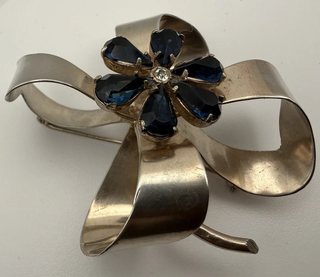
View on eBay

1964 Kennedy Half Dollar 90% Silver First Year Toned Survivor KM#202 [Est. AU+]

1964 Kennedy Half Dollar, Philadelphia Mint, 90% Silver, Natural Blue-Gray Toning [Est. AU+]

$25.43 1964 Est. AU+ Kennedy Half Dollars (1964)

Description

A 1964 Kennedy half dollar from the Philadelphia Mint (no mint mark), with natural blue-gray toning and spots on both sides. Specifications: 12.50 grams, 90% silver, 10% copper, 0.3617 troy oz of silver, 30.6 mm, reeded edge. Raw coin, never professionally graded.

Read the full description

Historical Context

Congress authorized the Kennedy half dollar in December 1963, weeks after President Kennedy's assassination, and the first coins were released in March 1964. Chief Engraver Gilroy Roberts sculpted the portrait (his GR monogram is on the truncation of the neck); Frank Gasparro designed the reverse from the Presidential Seal (his FG is near the eagle's tail feathers). 1964 is the only year the Kennedy half was struck in 90% silver for circulation; from 1965 the silver content dropped to 40%.

Condition

Our conservative estimate AU+ (not professionally graded). Blue-gray toning with spots on both sides; see the photos.

Disclaimer

The images and any video show the actual item and are part of the official listing description, so please review them closely. Measurements and weights are approximate, and any maker or material we haven't confirmed is described as assumed. Questions? Message us; we answer quickly.

View on eBay

ca1910 Gold Thanksgiving Day Postcard Girl Riding Turkey Apponaug Rhode Island

ca1910 "Thanksgiving Day" Postcard, Girl in Red Riding a Turkey on a Rich Gold Ground, No. 4802, Unposted Note to Mr. William Price, Apponaug, Rhode Island: "Dear Brother... Here's Your Turkey"

$25.38 Thanksgiving Postcards

Description

A vertical card on a rich, slightly reflective gold ground. A rosy-cheeked girl in a red sweater and green bonnet hugs a big brown turkey, holding a feather aloft as the bird marches off. "Thanksgiving Day" in white script at lower left; the number "4802" at lower right. The gold has a fine textured pattern under magnification. Size approx. 3.40 x 5.40 in. (86 x 137 mm).

The back is a divided back: "Post Card," "This space may be used for correspondence," "For address only," and a stamp box for "United States and Canada one cent, Foreign two cents." Never stamped or mailed. Addressed in ink to Mr. William Price, Apponaug, R.I. The message, written down the left side: "Dear brother; Many thanks for lovely card received to-night. Here's your turkey. With love, Ira."

Read the full description

Historical Context

Apponaug. A village on Apponaug Cove in central Warwick, Rhode Island; the name comes from a Narragansett word meaning "place of oysters."

A reply in kind. Ira answered a brother's card the same night with this one — "Here's your turkey."

Condition

Very good. Gold ground bright; small white abrasion at the lower right corner and light wear at the other corners. Back clean with even toning.

About The Printing

This is an original chromolithograph, and it was slow, exacting work. Each color had to be drawn onto its own separate stone by hand — in monochrome, the artist judging how much stipple each area needed so the colors would combine correctly only once every stone had been printed. The sheet then went through the press once for every color it carries, often a dozen or more, and every pass had to register exactly against the last. A pass out of register showed.

Under magnification the image resolves into irregular hand-drawn stipple, each ink carrying its own dot pattern, the colors mixing in the eye rather than on the paper. There is no regular halftone screen and no four-color rosette, which is what a modern reproduction would show. Modern process printing simulates every color from four inks; chromolithography laid each color down as its own.

The gold ground carries a fine textured pattern that catches the light.

Provenance

From my family's estate collections, built over more than 60 years by knowledgeable antiques collectors and traders. Stored in a climate-controlled environment.

Also In Our Store

More Thanksgiving postcards from this group are in our store.

Disclaimer

The images and any video show the actual item and are part of the official listing description, so please review them closely. Measurements and weights are approximate, and any maker or material we haven't confirmed is described as assumed. Questions? Message us; we answer quickly.

View on eBay

2015 Bhutan Tiger's Nest 5 Ngultrum Lot of 10 Consecutive Serial UNC Notes P-28c

2015 Bhutan 5 Ngultrum, Tiger's Nest (Taktsang) Monastery and Bja Tshering Birds — Lot of 10 Consecutive Serial Numbers, UNC, P-28c

$25.15 2015 Bhutan

THESE ARE NOT STOCK PHOTOS. THESE ARE THE ACTUAL BANKNOTES YOU WILL RECEIVE.

Serials: J14687658, J14687659, J14687660, J14687661, J14687662, J14687663, J14687664, J14687665, J14687666, J14687667

Read the full description

Description

Ten notes in consecutive (sequential) serial order from the Royal Monetary Authority of Bhutan. The front shows two Bja Tshering, the mythical birds of long life, flanking the Dharma wheel. The back shows Taktsang, the Tiger's Nest monastery clinging to the cliffs above the Paro valley. Series 2015, signed by Governor Daw Tenzin (2010–2015), printed by Giesecke & Devrient. About 125 x 60 mm.

Historical Context

Bhutan is one of the few countries with no formal diplomatic relations with the United States; contact runs through the U.S. Embassy in New Delhi. These notes belong to the current 2006–present series.

Condition

Uncirculated. Crisp, original paper, serials J14687658–J14687667, consecutive.

Also In Our Store

More world banknotes: https://www.ebay.com/str/tfauctionsintl?_nkw=banknote

Disclaimer

The images and any video show the actual item and are part of the official listing description, so please review them closely. Measurements and weights are approximate, and any maker or material we haven't confirmed is described as assumed. Questions? Message us; we answer quickly.

View on eBay

1914-D Barber Liberty Head Dime 90% Silver US 10C Original Never Cleaned KM#113

1914-D Barber Dime, Denver Mint, 90% Silver, 0.0723 oz Silver, Struck the Year the Panama Canal Opened, Full Rims with Bold Date and Lettering, Original Never-Cleaned Surfaces with Gray Toning, Charles Barber Design, KM#113 [Est. G-6]

$25.14 1914 Est. G-6 Barber Dimes (1892-1916)

Description

A 1914-D Barber dime struck at the Denver Mint, with the D mint mark on the reverse below the wreath, KM#113. The obverse shows Liberty facing right, wearing a cap, a laurel wreath and a headband inscribed LIBERTY, with UNITED STATES OF AMERICA around and the date below. The reverse shows ONE DIME within a wreath of corn, wheat, maple and oak leaves. 90% silver, 2.50 grams standard, 17.9 mm, reeded edge. Tested on a Sigma Metalytics precious metal verifier: reading consistent with silver. The close-ups show the date, Liberty, the D mint mark and ONE DIME.

Read the full description

Historical Context

Chief Engraver Charles E. Barber designed the dime, quarter and half dollar introduced in 1892. His dime was struck until 1916, when the Mercury dime replaced it. In 1914 Denver struck 11,908,000 Barber dimes, against about 17.4 million at Philadelphia. That August the Panama Canal opened, and the next year Barber and George T. Morgan designed the Panama-Pacific half dollar for the San Francisco exposition that celebrated it.

Buying Power

In 1914 this dime had the buying power of about $3.37 today.

Condition

[Est. G-6] Circulated, original and never cleaned, with gray toning on the obverse and darker brown toning on the reverse. Full rims on both sides; UNITED STATES OF AMERICA, the date and ONE DIME are bold and clear. LIBERTY on the headband is worn away, as is usual at this grade, and the wreath leaves are worn flat. Scattered scratches from circulation, heaviest on the reverse across the upper wreath and ONE, plus a few small dark spots (see the close-ups). Checked for the six documented 1914-D repunched mint marks: the D appears single. Grade estimated; not professionally graded. Currently still legal tender, but its silver content and collector value are far higher than face value.

Also In Our Store

More coins: https://www.ebay.com/str/tfauctionsintl?_nkw=coin

Disclaimer

The images and any video show the actual item and are part of the official listing description, so please review them closely. Measurements and weights are approximate, and any maker or material we haven't confirmed is described as assumed. Questions? Message us; we answer quickly.

View on eBay

1964 Kennedy Half Dollar 90% Silver Philadelphia 50C KM#202 Hairlines [Est. AU+]

1964 Kennedy Half Dollar, Philadelphia Mint, 90% Silver, Hairlines on the Obverse [Est. AU+]

$25.13 1964 Est. AU+ Kennedy Half Dollars

Description

A 1964 Kennedy half dollar from the Philadelphia Mint (no mint mark). Specifications: 12.50 grams, 90% silver, 10% copper, 0.3617 troy oz of silver, 30.6 mm, reeded edge. Raw coin, never professionally graded.

Read the full description

Historical Context

Congress authorized the Kennedy half dollar in December 1963, weeks after President Kennedy's assassination, and the first coins were released in March 1964. Chief Engraver Gilroy Roberts sculpted the portrait (his GR monogram is on the truncation of the neck); Frank Gasparro designed the reverse from the Presidential Seal (his FG is near the eagle's tail feathers). 1964 is the only year the Kennedy half was struck in 90% silver for circulation; from 1965 the silver content dropped to 40%.

Condition

Our conservative estimate AU+ (not professionally graded). Fine hairlines and contact marks across the obverse face and field, with streaky gray toning; see the photos.

Disclaimer

The images and any video show the actual item and are part of the official listing description, so please review them closely. Measurements and weights are approximate, and any maker or material we haven't confirmed is described as assumed. Questions? Message us; we answer quickly.

View on eBay

1879 Victorian Trade Card France Child Palm Branch Wheaton Printer New Bedford

“France” — W. F. Wheaton, Steam Printer, New Bedford, Massachusetts

$24.87 1879 Advertising Sales Trade Cards

Original Victorian advertising trade card, chromolithograph on a metallic gold ground, copyright 1879. Approx. 4.45 x 2.95 in.

A small child stands as the figure of France, holding a palm branch high in one hand and resting the other on a bundle of rods bound with red and green and fitted with an axe blade. She wears a jeweled headdress, gold bracelets and armlets, a gold bodice with a blue and red rosette at the breast, and a skirt in the blue, white and red of the French flag. She is captioned FRANCE in the lower right corner.

The upper right carries the printer's own imprint: W. F. Wheaton, Steam Printer, 52 William Street, New Bedford, Mass. A line at the foot reads: Copyright, 1879, by John A. Haddock, Phila.

The reverse is blank apart from the marks of an old album mounting.

Read the full description

Historical Context

This is a printer advertising himself. Stock cards like this one were designed and printed in quantity by publishers such as Haddock in Philadelphia, then sold on with the space left open for a local business to add its name. A job printer was the one customer who could put his own imprint on the card and hand it out as a sample of what he could do for yours.

The design belongs to a genre the period loved: children dressed as the nations, each carrying the symbols of the country. The bundle of rods with an axe is the fasces, the old Roman emblem of authority that the French Republic had taken up as its own.

Condition

Toning and age typical of the period. Four round patches of album-mount residue at the corners of the reverse, with faint show-through; light surface soiling; minor edge and corner wear. The metallic ground and the chromolithographed figure on the front remain bright. Please view the images carefully.

About The Printing

This is an original chromolithograph, and it was slow, exacting work. Each color had to be drawn onto its own separate stone by hand — in monochrome, the artist judging how much stipple each area needed so the colors would combine correctly only once every stone had been printed. The sheet then went through the press once for every color it carries, often a dozen or more, and every pass had to register exactly against the last. A pass out of register showed.

Under magnification the image resolves into irregular hand-drawn stipple, each ink carrying its own dot pattern, the colors mixing in the eye rather than on the paper. There is no regular halftone screen and no four-color rosette, which is what a modern reproduction would show. Modern process printing simulates every color from four inks; chromolithography laid each color down as its own.

Provenance

This item comes from the personal collections of my family estate, accumulated over more than 200 years — including items that came west by wagon train to Colorado and later to Oklahoma. Now that my parents have passed we cannot keep all of these cherished items. They were well-educated antiques collectors/traders and continued to build their collections over more than 60 years. The vast majority of the pieces are from the Victorian Era, however there are plenty of older and newer items. Everything has been stored in a climate-controlled environment over time.

Disclaimer

Specifications and detailed item descriptions are provided as a courtesy only and are not guaranteed to be one hundred percent accurate. Please do your own research. There are generally no receipts available for any items from original purchases. Any dimensions and/or weights are approximate. The absence of a more detailed condition report does not imply there are no condition issues with the item(s). Please inspect images carefully as they are part of the official item description and best representation of the actual condition. Additional images may be available upon request depending on time and availability. Not responsible for internet mis-translations or mis-identification of maker's marks if found or assumptions of makers or materials — item descriptions will indicate if it is assumed. If you see a problem, please message us immediately and we will do our best to sort out a solution and confirm the information. With the exception of eBay rules, no returns are accepted.
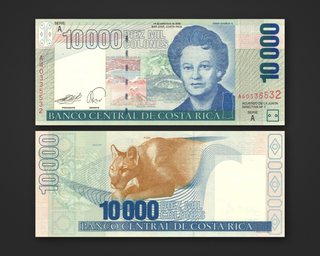
View on eBay

1890s Mennen's Borated Talcum Trade Card Love the Babies Newark NJ Winter Scene

1890s Mennen's Borated Talcum Trade Card Love the Babies Newark NJ Winter Scene — A winter cottage among blossoming trees with a small girl in red on the path. Approx. 3.05 x 4.68 in.

$23.78 Advertising Sales Trade Cards

Description

A winter cottage among blossoming trees with a small girl in red on the path. The front is faded, with faint lettering at the top and some show-through from the back.

The back is printed in black: "LOVE THE BABIES! Mothers who love their Babies use Mennen's Borated Talcum Infant Powder ... Retails at 25 Cents," with "Mennen's Sure Corn Killer" and "G. Mennen, 577 Broad Street, Newark, N.J."

Approx. 3.05 x 4.68 in.

Read the full description

Historical Context

A Newark original. The back is signed by G. Mennen of 577 Broad Street, Newark, the start of a name still on the toiletries shelf.

Powder for the nursery. "Love the Babies!" speaks straight to mothers, the buyers trade cards were made for.

Condition

Front: faded, top lettering faint, show-through from the back. Back: clean, crisp text. Please see the photos, which are part of the description.

About The Printing

This is an original chromolithograph, and it was slow, exacting work. Each color had to be drawn onto its own separate stone by hand — in monochrome, the artist judging how much stipple each area needed so the colors would combine correctly only once every stone had been printed. The sheet then went through the press once for every color it carries, often a dozen or more, and every pass had to register exactly against the last. A pass out of register showed.

Under magnification the image resolves into irregular hand-drawn stipple, each ink carrying its own dot pattern, the colors mixing in the eye rather than on the paper. There is no regular halftone screen and no four-color rosette, which is what a modern reproduction would show. Modern process printing simulates every color from four inks; chromolithography laid each color down as its own.

The back is printed in black.

Provenance

From my family's estate collections, built over more than 60 years by knowledgeable antiques collectors and traders. Stored in a climate-controlled environment.

Also In Our Store

More Victorian advertising trade cards are in our store.

Disclaimer

The images and any video show the actual item and are part of the official listing description, so please review them closely. Measurements and weights are approximate, and any maker or material we haven't confirmed is described as assumed. Questions? Message us; we answer quickly.

View on eBay

2018 Costa Rica 5000 Colones Polymer Capuchin Banknote P-282 [Est. UNC]

14 September 2018 Costa Rica 5000 Colones Banknote, Alfredo Gonzalez Flores / Mangrove with Capuchin Monkey, Pick P-282, Serial C012478607 [Est. UNC]

$23.67 2018 Est. UNC Costa Rica

Description

Polymer note issued by the Banco Central de Costa Rica, with a clear window. Front: Alfredo Gonzalez Flores with the Banco Internacional de Costa Rica building and an outline of Costa Rica in yellow color-changing ink; back: red mangrove with a white-faced capuchin monkey and a mangrove crab. Serial C012478607. Measured on the 1200 dpi scan: 139.4 x 67.6 mm. The close-ups show the serial, the date, Gonzalez Flores, the capuchin monkey, the signatures, the map hologram, the clear window and the mangrove. The last image adds a millimeter scale.

Read the full description

Historical Context

Alfredo Gonzalez Flores, president 1914-1917, founded the International Bank of Costa Rica, today the Banco Nacional. This polymer version entered circulation on 1 December 2020 as the Central Bank moved to polymer, and the cotton-paper notes were withdrawn in 2022.

Condition

[Est. UNC] Polymer note with no creases or ink wear seen. The clear window is bright with no clouding, and the corners are sharp. No marks or tape. Grade estimated from the scans; not professionally graded.

Legal Tender

Legal tender: the BCCR lists this polymer 5,000 colones (series C) as currently circulating.

Disclaimer

The images and any video show the actual item and are part of the official listing description, so please review them closely. Measurements and weights are approximate, and any maker or material we haven't confirmed is described as assumed. Questions? Message us; we answer quickly.

View on eBay

"Freemasonry" (Humanum Genus) by Pope Leo XIII Booklet

Freemasonry (Humanum Genus) by Pope Leo XIII Booklet

$23.57 Booklets

was a significant papal condemnation of Freemasonry, which the Catholic Church viewed as a dangerous and subversive organization. The encyclical outlined the Church's theological and moral objections to Freemasonry, accusing it of promoting naturalism, secularism, and undermining religious and social order. This booklet, "Freemasonry by Pope Leo XIII with Discussion Club Outline by Rev. Gerald C. Treacy, S.J.," appears to be a publication designed to disseminate the Pope's views and facilitate discussion on the topic, likely within Catholic circles. The inclusion of a discussion outline suggests it was intended for educational or apologetic purposes, aiming to inform and persuade readers about the Church's stance against Freemasonry.

  • Description: Copyright 1944, 32 pages — Pamphlet on Freemasonry by Pope Leo XIII with discussion outline. Pope Leo XIII's encyclical "Humanum Genus," issued in 1884,
  • Condition: Great for its age. No major damage or folds.
  • Dimensions (approximate): H: 7.25" x W: 5.00" x D. 0.125" x Weight: 29.52 grams
Read the full description

Thanks!

Ref: 1.0112

View on eBay

1880s Trade Card Brown's Sarsaparilla Arnica Salve Pepsin Tonic Dog Rifle

1880s Trade Card Brown's Sarsaparilla Arnica Salve Pepsin Tonic Dog Rifle — A small, big-eyed dog with tall ears sits up on its haunches, clutching a rifle almost twice its height, against a soft blue cloud of color. Approx. 3.00 x 4.40 in.

$23.28 Advertising Sales Trade Cards

Description

A small, big-eyed dog with tall ears sits up on its haunches, clutching a rifle almost twice its height, against a soft blue cloud of color. The front carries no advertiser imprint; the open space at the top was left for one.

The back is a full page of patent medicine advertising in black for four Brown's remedies. Brown's Arnica Salve "Cures Burns, Cuts, Bruises, Old Sores, Piles, Chapped Hands, Inflamed Sore Eyes", "No Cure. No Pay", "Only 25 cents a box." Brown's Blackberry and Ginger is "A positive remedy for Diarrhoea, Dysentery, Summer Complaint" and "the best remedy known to regulate the bowels of children while teething. Mothers, this Remedy is Entirely Safe." Brown's Pepsin Tonic is "for the Cure of Dyspepsia, Indigestion, Headache and Liver Complaint. Only 50 cents a bottle." Running up the side: "Brown's Sarsaparilla, the World's Best Blood Purifier. TRY IT!" No maker's address or city is printed.

Approx. 3.00 x 4.40 in.

Read the full description

Historical Context

Patent medicine on parade. Four cures on one card: a salve for everything from burns to piles, a blackberry cordial for teething babies, a pepsin tonic for the liver, and a sarsaparilla sold as the world's best blood purifier. Bold promises like "No Cure. No Pay" were the stock in trade of the nineteenth-century medicine business.

One picture, many advertisers. Printers sold stock cards like this with the picture finished and space left blank, and each merchant added his own advertising. Here the front stayed clean and Brown's filled the entire back.

A dog on guard. The little dog standing sentry with a rifle is a charming subject for dog collectors as well as for collectors of patent medicine and pharmacy advertising.

Condition

Very good for its age. Front: clean color; a grey smudge in the lower margin below the dog; a small dark dot at the upper right; a light soft crease and edge wear at the lower right; corners lightly rounded; light toning. Back: clean and bright for its age, with light toning and slight edge wear; no writing. Please see the photos, which are part of the description.

About The Printing

This is an original chromolithograph, and it was slow, exacting work. Each color had to be drawn onto its own separate stone by hand — in monochrome, the artist judging how much stipple each area needed so the colors would combine correctly only once every stone had been printed. The sheet then went through the press once for every color it carries, often a dozen or more, and every pass had to register exactly against the last. A pass out of register showed.

Under magnification the image resolves into irregular hand-drawn stipple, each ink carrying its own dot pattern, the colors mixing in the eye rather than on the paper. There is no regular halftone screen and no four-color rosette, which is what a modern reproduction would show. Modern process printing simulates every color from four inks; chromolithography laid each color down as its own.

The back is printed in black type, separate from the color work on the front.

Provenance

From my family's estate collections, built over more than 60 years by knowledgeable antiques collectors and traders. Stored in a climate-controlled environment.

Also In Our Store

More Victorian advertising trade cards for patent medicines, coffee and baking soda are in our store.

Disclaimer

The images and any video show the actual item and are part of the official listing description, so please review them closely. Measurements and weights are approximate, and any maker or material we haven't confirmed is described as assumed. Questions? Message us; we answer quickly.

View on eBay

1880s Trade Card Kenton Baking Powder Owl Rose Winter Cottage Cincinnati

1880s Trade Card Kenton Baking Powder Owl Rose Winter Cottage Cincinnati — A Victorian trade card for Kenton Baking Powder. Approx. 6.00 x 4.35 in.

$22.92 Advertising Sales Trade Cards

Description

A Victorian trade card for Kenton Baking Powder. The front is a split scene: at left a large pink rose with buds against summer trees, at right a snow-covered cottage, a bare tree, a broken fence and hens scratching in the snow. The front carries no advertiser imprint.

The back is printed in black. The Kenton trademark, an owl on a branch under stars and a smiling moon, sits in a roundel lettered "KENTON BAKING POWDER" and "TRADE MARK," above a price table: "LOOK AT THESE PRICES! 1 lb. Can 20 Cts. ½ lb. Can 10 Cts. ¼ lb. Can 5 Cts." Then: "We guarantee satisfaction at these low Prices or your money refunded. ASK YOUR GROCER FOR IT. POTTER PARLIN & CO., Cincinnati, O." A closing note claims Kenton "is equal to the most costly in quality. Buy KENTON POWDER, and you will not only save money, but have light, sweet and wholesome bread."

Horizontal, approx. 6.00 x 4.35 in.

Read the full description

Historical Context

A Cincinnati brand. Kenton Baking Powder was made by Potter, Parlin & Co. of Cincinnati, and the owl with the smiling moon was its trademark.

Selling on price. Baking powder was one of the most heavily advertised grocery products of the trade card era. Kenton's pitch is plain value: a full pound for twenty cents, with a money-back guarantee.

Summer and winter. Stock designs like this were printed in quantity and sold to merchants, who added their own advertising, here on the back. A summer rose set against a farmyard in snow is a typical decorative pairing of the period.

The trade card craze. In the 1880s grocers handed out colorful cards like this by the thousand, and families saved them in scrapbooks.

Condition

Very good. Colors bright and clean. A short surface crease in the sky at the upper right of the front, near the top edge. A tiny dark speck in the top margin. Corners lightly rounded, with light wear most noticeable at the upper left. The back is evenly toned, with a few short creases at one long edge (left side as shown). No writing. Please see the photos, which are part of the description.

About The Printing

This is an original chromolithograph, and it was slow, exacting work. Each color had to be drawn onto its own separate stone by hand — in monochrome, the artist judging how much stipple each area needed so the colors would combine correctly only once every stone had been printed. The sheet then went through the press once for every color it carries, often a dozen or more, and every pass had to register exactly against the last. A pass out of register showed.

Under magnification the image resolves into irregular hand-drawn stipple, each ink carrying its own dot pattern, the colors mixing in the eye rather than on the paper. There is no regular halftone screen and no four-color rosette, which is what a modern reproduction would show. Modern process printing simulates every color from four inks; chromolithography laid each color down as its own.

The advertising on the back is printed in a single black ink.

Provenance

From my family's estate collections, built over more than 60 years by knowledgeable antiques collectors and traders. Stored in a climate-controlled environment.

Also In Our Store

More Victorian advertising trade cards for grocery products, thread and other household goods are in our store.

Disclaimer

The images and any video show the actual item and are part of the official listing description, so please review them closely. Measurements and weights are approximate, and any maker or material we haven't confirmed is described as assumed. Questions? Message us; we answer quickly.

View on eBay

1916 Stecher Thanksgiving Postcard Turkey in Wheat Wreath Pink Bow Amherst NH

November 1916 Stecher Lith. Co. Embossed Vertical "Thanksgiving Greetings" Postcard, Turkey in an Oval Wreath of Wheat Tied with Pink Ribbons and a Big Pink Bow, Series 1915 C, Stecher Quality Back, Amherst, N.H. Postmark, 1¢ Washington Perf 10 Stamp, Abby C. to Mr. James Thurston, Keene, N.H.

$22.53 1916 Thanksgiving Postcards

Description

A vertical card. A tom turkey stands in an oval wreath of wheat and grasses bound with pink ribbons and tucked with small flowers, finished at the bottom with a big pink bow, on a pale blue ground. "Thanksgiving Greetings" in gold with leafy ornaments across the top; the circle logo "STECHER LITH. CO. ROCH. N.Y." at lower left. Embossed.

The back is a divided back with a six-pointed "STECHER QUALITY" star, "MADE IN U.S.A.," an ornate "POST CARD" and "Series 1915 C." 1-cent green George Washington stamp, perforated 10 (Scott #424 or #462), tied by an Amherst, N.H. postmark of Nov 28, 3 PM, 1916. Addressed in ink to Mr. James Thurston, Keene, N.H. The message (our transcription): "I hope you best wish for Thanksgiving. Write. Abby C."

Read the full description

Historical Context

The stamp. Perf 10 came in with the watermarked Scott #424 in 1914; from September 1916 the same stamp was printed on unwatermarked paper as #462. Examined under a strong back-light with a loupe, this one shows no watermark letters, which points toward #462, though a faint watermark can't be ruled out while it is on the card.

Condition

Very good. Clean, bright front with crisp embossing; light corner wear. Back clean with light toning; pencil "15."

About The Printing

This card is printed in halftone. Under magnification the colors resolve into a regular, even grid of dots rather than the irregular hand-drawn stipple of a chromolithograph. The wreath and turkey are embossed and show in relief on the back.

Provenance

From my family's estate collections, built over more than 60 years by knowledgeable antiques collectors and traders. Stored in a climate-controlled environment.

Also In Our Store

More Thanksgiving postcards from this group are in our store.

Disclaimer

The images and any video show the actual item and are part of the official listing description, so please review them closely. Measurements and weights are approximate, and any maker or material we haven't confirmed is described as assumed. Questions? Message us; we answer quickly.

View on eBay

1880s Trade Card Wheelock's China Store Peoria Illinois Mill Bridge Roses

1880s Trade Card Wheelock's China Store Peoria Illinois Mill Bridge Roses — A Victorian stock trade card imprinted for a Peoria china store. Approx. 4.55 x 3.00 in.

$22.46 Advertising Sales Trade Cards

Description

A Victorian stock trade card imprinted for a Peoria china store. A gilt-framed vignette shows a country scene: a stone arched bridge with a man fishing from it, a horse-drawn hay wagon, and a red-roofed mill with its water wheel beside a river. Pink roses and orange blossoms spill in from the left and white daisies from the upper right, on a sky-blue ground. Printed at lower right: "Don't Fail to Visit Wheelock's China Store, 313 Main St., Peoria, Ill. Special Attention given to the out of town Trade." Design number "1314" at lower left. The reverse is blank.

Approx. 4.55 x 3.00 in.

Read the full description

Historical Context

A Peoria storefront. Peoria sits on the Illinois River, a trading town for the farms around it, and "Special Attention given to the out of town Trade" shows this store courting customers from the surrounding countryside. A china store sold the dinnerware, glass and lamps that furnished a Victorian home.

Stock cards, made to order. Lithographers printed picture cards like this by the thousand, with a design number in the margin, and left space for a local merchant's name to be added in black. The "1314" at lower left is that number.

The trade card craze. In the 1880s cheap color printing put picture cards on every store counter, and families pasted them into scrapbooks by the hundred.

Condition

Very good front. Bright colors. Corners lightly worn; a small nick at the top edge near the center. A small grey smudge in the blue area at right of center. The blank reverse is toned and mottled, with spots of old album residue and paper scuffing at the right side and lower left and a small ink mark at center left. Please see the photos, which are part of the description.

About The Printing

This is an original chromolithograph, and it was slow, exacting work. Each color had to be drawn onto its own separate stone by hand — in monochrome, the artist judging how much stipple each area needed so the colors would combine correctly only once every stone had been printed. The sheet then went through the press once for every color it carries, often a dozen or more, and every pass had to register exactly against the last. A pass out of register showed.

Under magnification the image resolves into irregular hand-drawn stipple, each ink carrying its own dot pattern, the colors mixing in the eye rather than on the paper. There is no regular halftone screen and no four-color rosette, which is what a modern reproduction would show. Modern process printing simulates every color from four inks; chromolithography laid each color down as its own.

The store imprint was added in black over the printed picture, and the reverse is blank.

Provenance

From my family's estate collections, built over more than 60 years by knowledgeable antiques collectors and traders. Stored in a climate-controlled environment.

Also In Our Store

More Victorian advertising trade cards for Illinois merchants and china, glass and household goods are in our store.

Disclaimer

The images and any video show the actual item and are part of the official listing description, so please review them closely. Measurements and weights are approximate, and any maker or material we haven't confirmed is described as assumed. Questions? Message us; we answer quickly.

View on eBay

1913 Thanksgiving Postcard Turkey Sunset Panel Gold Frame Coatsville Missouri

November 1913 Embossed "Thanksgiving Greetings" Postcard, Iridescent Turkey Before a Gold-Framed Sunset Panel with Red Berries, Series 113 E, Coatsville, Missouri Postmark, Miley to Mr. Bird Mathews, Pulaski, Iowa: "Of Course If It Is Storming We Won't..."

$22.41 1913 Thanksgiving Postcards

Description

A richly colored tom turkey in iridescent purple, green, gold and bronze stands before a gold-framed panel showing an orange sun setting behind bare trees. A spray of red berries and green leaves hangs at right, and "Thanksgiving Greetings" is in gold script at lower right on a blue-green ground; the turkey's feathers are touched with gold. A small © at lower left; no publisher is named.

The back is a divided back with an ornate "POST CARD" and "Series 113 E." The stamp is gone, leaving a paler patch in the stamp box, but the card carries a Coatsville, Mo. postmark of November 1913, P.M., with machine bars. Addressed in pencil to Mr. Bird Mathews, Pulaski, Iowa. The pencil message, dated "Coatsville Mo, Nov 29 1913," reads (our transcription): "Hello Bird, received your card. We will be at Downing Dec. 3, Wednesday, if all is well. Of course if it is storming we won't be there, but if not we will be there on that day. From Miley."

Read the full description

Historical Context

Across the state line. Written in Coatsville, Missouri, two days after Thanksgiving 1913 to a friend in Pulaski, Iowa, with plans for a December visit, weather permitting.

Condition

Very good. Bright gold frame, gold feathers and greeting, sharp corners and light wear. Back toned with foxing; stamp missing as described; pencil "75c."

About The Printing

This card is printed in halftone. Under magnification the colors resolve into a regular, even grid of dots rather than the irregular hand-drawn stipple of a chromolithograph. The gold frame and turkey are embossed and show in relief on the back.

Provenance

From my family's estate collections, built over more than 60 years by knowledgeable antiques collectors and traders. Stored in a climate-controlled environment.

Also In Our Store

More Thanksgiving postcards from this group are in our store.

Disclaimer

The images and any video show the actual item and are part of the official listing description, so please review them closely. Measurements and weights are approximate, and any maker or material we haven't confirmed is described as assumed. Questions? Message us; we answer quickly.

View on eBay

ca1900 Newman Bros Piano Organ Trade Card Mother Child Violets Chicago

ca1900 Newman Bros Piano Organ Trade Card Mother Child Violets Chicago — An embossed advertising card for a Chicago piano and organ maker. Approx. 3.55 x 5.40 in.

$22.38 Advertising Sales Trade Cards

Description

An embossed advertising card for a Chicago piano and organ maker. In a gold- and magenta-ruled oval, a dark-haired young mother in a pink gown embraces her small blonde child in a white shift. Sprays of embossed purple violets frame the oval on a deep green ground with a fine linen texture. Printed below: "Compliments of Newman Bros. Co, Chicago. Factory, W. Chicago Ave. and Dix St."

The reverse, printed in blue, pictures an upright "Style Ten Piano" with a "Newman Bros. Co." mat at its feet: "Newman Bros. Co. Manufacturers of Highest Grade Pianos and Organs. … Satisfies the Most Critical … Write for Catalogue and Prices. Factory and Warerooms, Corner W. Chicago Ave. and Dix St., Chicago, Ill."

Approx. 3.55 x 5.40 in.

Read the full description

Historical Context

A Chicago piano maker. Newman Bros. began in Chicago in 1880 building parlor and chapel organs and added high-grade pianos in 1895. The firm built a six-story factory in 1900 and closed in the Great Depression.

The parlor piano. Around 1900 an upright piano was the pride of the middle-class parlor, and makers courted buyers by mail. "Write for Catalogue and Prices" was an invitation to order from the factory.

Mother and child. The tender oval portrait and embossed violets show how far advertising cards had moved toward the sentimental keepsake by the turn of the century.

Condition

Good, with honest wear. Corners softly rounded. A short crease at the top edge near the center and a light crease at the upper right corner of the front. The reverse shows several light creases, most at the upper left and lower right, and light even toning. Embossing intact and colors bright. Please see the photos, which are part of the description.

About The Printing

This is an original chromolithograph, and it was slow, exacting work. Each color had to be drawn onto its own separate stone by hand — in monochrome, the artist judging how much stipple each area needed so the colors would combine correctly only once every stone had been printed. The sheet then went through the press once for every color it carries, often a dozen or more, and every pass had to register exactly against the last. A pass out of register showed.

Under magnification the image resolves into irregular hand-drawn stipple, each ink carrying its own dot pattern, the colors mixing in the eye rather than on the paper. There is no regular halftone screen and no four-color rosette, which is what a modern reproduction would show. Modern process printing simulates every color from four inks; chromolithography laid each color down as its own.

The violets are embossed, and the reverse is printed in a single blue ink.

Provenance

From my family's estate collections, built over more than 60 years by knowledgeable antiques collectors and traders. Stored in a climate-controlled environment.

Also In Our Store

More antique advertising trade cards for musical instruments and Chicago firms are in our store.

Disclaimer

The images and any video show the actual item and are part of the official listing description, so please review them closely. Measurements and weights are approximate, and any maker or material we haven't confirmed is described as assumed. Questions? Message us; we answer quickly.

View on eBay

ca1910 P. Sander Thanksgiving Postcard Gold Leaf Winter Sunset Lilies of Valley

ca1910 P. Sander No. 443 Embossed "Thanksgiving Greetings" Postcard, Winter Sunset Vignette on a Large Gold Leaf with Lilies of the Valley, Red-and-Gold Ribbon Border of Fruit and Pumpkins, Never Mailed, Pencil Note from Isaac Stilwell

$22.26 Thanksgiving Postcards

Description

A round vignette of a snowy cottage and fence under a blazing orange sunset sits on a large embossed gold leaf, surrounded by sprays of white lilies of the valley. The border is bright red and gold with a pale blue ribbon woven through it, apples, pears and grapes at the corners, and a pumpkin at top and bottom. "Thanksgiving Greetings" in gold with ornamented blue initials at upper left; "P. SANDER ©" at lower right and the number "443" at lower left.

The back is a divided back, embossed throughout, with a brown "POST CARD," "This side for Correspondence," "This side for Address," and a stamp box giving the one-cent rate for "Domestic, Canada, Cuba, Mexico, Hawaii, Philippines, Porto Rico." Never stamped or mailed. In pencil: "from your friend Isaac Stilwell," with a faint address to a Miss whose name is only partly legible.

Read the full description

Historical Context

One cent to the islands. The stamp box lists the places a one-cent postcard could reach at the domestic rate, from Cuba and Mexico to Hawaii, the Philippines and "Porto Rico," spelled as printed.

The Golden Age of Postcards. The divided-back years, 1907 to 1915, are known as the Golden Age of Postcards, and German printers dominated the trade.

Condition

Very good. Bright color, crisp gold and deep embossing; light corner wear. Back clean with light toning; faint pencil writing as described.

About The Printing

This is an original chromolithograph: each color was drawn by hand onto its own stone and printed in its own pass. Under magnification the image resolves into irregular hand-drawn stipple, each ink carrying its own dot pattern, with no regular halftone screen and no four-color rosette, which is what a modern reproduction would show. The gold leaf and border are embossed, and the relief shows on the back.

Provenance

From my family's estate collections, built over more than 60 years by knowledgeable antiques collectors and traders. Stored in a climate-controlled environment.

Also In Our Store

More Thanksgiving postcards from this group are in our store.

Disclaimer

The images and any video show the actual item and are part of the official listing description, so please review them closely. Measurements and weights are approximate, and any maker or material we haven't confirmed is described as assumed. Questions? Message us; we answer quickly.

View on eBay

ca1910 Wishing You a Happy Thanksgiving Postcard Turkey Pumpkins No. 4800

ca1910 "Wishing You a Happy Thanksgiving" Postcard, Turkey Among Pumpkins and Corn Shocks, No. 4800, Unposted, "To Ruth from Aunt Loo": "Be Careful and Not Eat Too Much of the Bird Today"

$22.11 Thanksgiving Postcards

Description

A vertical card in rich reds and greens. A red-headed tom turkey stands among bright orange pumpkins in a field of corn shocks, under the red script greeting "Wishing you a Happy Thanksgiving." Green border; the number "4800" at lower right. Size approx. 3.40 x 5.35 in. (86 x 136 mm).

The back is a divided back: "Post Card," "This space may be used for correspondence," "For address only," and a stamp box for "United States and Canada one cent, Foreign two cents." Never stamped or mailed. In pencil: "To Ruth from Aunt Loo," and up the left side, "Be careful and not eat too much of the bird today, Ruth."

Read the full description

Historical Context

Good advice, then and now. Aunt Loo's warning to Ruth is the oldest Thanksgiving joke there is.

Condition

Very good. Bright color, clean surface, light corner wear. Back clean with even toning and a faint pencil message.

About The Printing

This is an original chromolithograph, and it was slow, exacting work. Each color had to be drawn onto its own separate stone by hand — in monochrome, the artist judging how much stipple each area needed so the colors would combine correctly only once every stone had been printed. The sheet then went through the press once for every color it carries, often a dozen or more, and every pass had to register exactly against the last. A pass out of register showed.

Under magnification the image resolves into irregular hand-drawn stipple, each ink carrying its own dot pattern, the colors mixing in the eye rather than on the paper. There is no regular halftone screen and no four-color rosette, which is what a modern reproduction would show. Modern process printing simulates every color from four inks; chromolithography laid each color down as its own.

The green ground is laid with an even pattern of fine red dots over green, a tint effect under the hand-drawn stipple of the turkey and pumpkins.

Provenance

From my family's estate collections, built over more than 60 years by knowledgeable antiques collectors and traders. Stored in a climate-controlled environment.

Also In Our Store

More Thanksgiving postcards from this group are in our store.

Disclaimer

The images and any video show the actual item and are part of the official listing description, so please review them closely. Measurements and weights are approximate, and any maker or material we haven't confirmed is described as assumed. Questions? Message us; we answer quickly.

View on eBay

ca1885 Tiger Mower Advertising Card Onion Skin Signs of Fortune Misfortune Rare

ca1885 Tiger Mower Advertising Card Onion Skin Signs of Fortune Misfortune Rare — "THE TIGER MOWER" with a line drawing of the horse-drawn mowing machine and its cutter bar. Approx. 3.08 x 4.67 in.

$22.08 Advertising Sales Trade Cards

Description

"THE TIGER MOWER" with a line drawing of the horse-drawn mowing machine and its cutter bar. "The Most Durable and Lightest Running Mower Made. 4-ft. 3-in., 4-ft. 6-in., 5-ft. and 6-ft. Cut."

The back is printed with "The Signs of Fortune and Misfortune, As Implicitly Believed by Some, Contemptuously Disbelieved by Many, but Just a Little Heeded by All," a list of old superstitions: "Dream of eggs, sign of money," "If you sing before breakfast you'll cry before supper," "Finding a horse-shoe or a four-leaved clover brings good luck," and many more.

Approx. 3.08 x 4.67 in.

Read the full description

Historical Context

A survivor. This card is printed on paper as thin as onion skin, and it is remarkable that it has lasted well over a century. Farm-implement advertising on paper this fragile seldom survives.

Haying by horse power. The mower's cutter bar sizes, from 4 ft. 3 in. to 6 ft., were the selling points for farmers choosing a machine.

Superstitions for the farmhouse. The back gave the farm family something to keep: a page of folk sayings about luck, love and the weather.

Condition

Fragile and sold as is. Thin onion-skin paper with staining, edge tears and small chips on both sides, and soft creases. Text and illustration remain legible. It will ship in a rigid holder between stiff boards. Please see the photos, which are part of the description.

About The Printing

This card is printed in a single black ink by letterpress from a line cut, on very thin, translucent paper. Under magnification the illustration resolves into engraved lines and hatching, not a dot screen.

Provenance

From my family's estate collections, built over more than 60 years by knowledgeable antiques collectors and traders. Stored in a climate-controlled environment.

Also In Our Store

More Victorian advertising trade cards are in our store.

Disclaimer

The images and any video show the actual item and are part of the official listing description, so please review them closely. Measurements and weights are approximate, and any maker or material we haven't confirmed is described as assumed. Questions? Message us; we answer quickly.

View on eBay

Japan 1000 Yen Hideyo Noguchi Mt Fuji Banknote P-104 AX763996D [Est. VF]

Japan 1000 Yen Banknote, Hideyo Noguchi, Mt. Fuji and Lake Motosu, Bank of Japan, Pick P-104, Serial AX763996D [Est. VF]

$21.92 Est. VF Japan

Description

A Japan 1000 yen banknote from the Bank of Japan, series first issued in 2004, with the portrait of Hideyo Noguchi on the front and Mt. Fuji reflected in Lake Motosu on the back. Serial number AX763996D. Pick P-104 (Numista N#202070).

Read the full description

Historical Context

Hideyo Noguchi (1876-1928) was a Japanese bacteriologist who worked at the Rockefeller Institute in New York and died in Africa while researching yellow fever. In July 2024 Japan began issuing a new 1000 yen note, so the Noguchi design is now the previous series.

Condition

[Est. VF] Light circulation with folds. Grade estimated; not professionally graded.

Legal Tender

Still legal tender in Japan: Bank of Japan notes issued since the series began remain valid, including this Noguchi 1000 yen (Bank of Japan list of valid notes). It is sold as a collectible.

Disclaimer

The images and any video show the actual item and are part of the official listing description, so please review them closely. Measurements and weights are approximate, and any maker or material we haven't confirmed is described as assumed. Questions? Message us; we answer quickly.

View on eBay

1911 P. Sander Patriotic Thanksgiving Postcard Shield Windmill Blue Island Ill

November 1911 P. Sander Patriotic Embossed "Thanksgiving Greetings" Postcard, Stars-and-Stripes Shield with Pink Blossoms, Gold Wheat and Grapevine, Framed Windmill Landscape, Blue Island, Ill. Postmark and Chicago Flag Cancel, 1¢ Franklin Stamp, an Uncle's Blessing to the Weavers of Kirkwood, Warren Co., Ill.

$21.84 1911 Thanksgiving Postcards

Description

A stars-and-stripes shield outlined in gold rises from a spray of pink blossoms, with gold wheat, grape leaves and grapes curving below. At right, a gold-framed square panel shows a windmill among green trees and a fence. "Thanksgiving Greetings" with an ornamented red T and blue G sits at lower left on a gray linen-textured ground. "P. SANDER ©" at lower right; a small red number at lower left is partly worn.

The back is a divided back, embossed throughout, with a red "POST CARD." 1-cent green Benjamin Franklin stamp, perforated 12 with a straight edge at left (Scott #331 or #374; they differ only in the watermark), canceled twice: a Blue Island, Ill. postmark of Nov 29, 9 AM, 1911, and a Chicago flag cancel. Addressed in ink to Mr. and Mrs. Acie Weaver, Kirkwood, Warren Co., Ills. The message, written upside down and dated "11-28-11," reads in part (our transcription): "Dear Acie, Beulah and Louise, How are you all? You surely can thank God for His goodness for little Louise. God is good, God is love, bless His holy name [...] love and kind wishes for you all [...] your loving uncle [...] Write."

Read the full description

Historical Context

Two cancels. The card took a Blue Island postmark and then a Chicago flag cancel on its way to Warren County.

Windmill and flag. An unusual pairing for a Thanksgiving card: a stars-and-stripes shield beside a windmill landscape.

Condition

Good. Colors and gold bright; creases at the lower left corner and along the left edge, faint cancel ink transferred to the upper left of the front, and corner wear. Back with a crease along the right side; message and cancels clear.

About The Printing

This is an original chromolithograph: each color was drawn by hand onto its own stone and printed in its own pass. Under magnification the image resolves into irregular hand-drawn stipple, each ink carrying its own dot pattern, with no regular halftone screen and no four-color rosette, which is what a modern reproduction would show. The shield, wheat and grapes are embossed and gilded, and the relief shows on the back.

Provenance

From my family's estate collections, built over more than 60 years by knowledgeable antiques collectors and traders. Stored in a climate-controlled environment.

Also In Our Store

More Thanksgiving postcards from this group are in our store.

Disclaimer

The images and any video show the actual item and are part of the official listing description, so please review them closely. Measurements and weights are approximate, and any maker or material we haven't confirmed is described as assumed. Questions? Message us; we answer quickly.

View on eBay

1971 Eisenhower Ike Dollar Philadelphia First Year Apollo 11 KM#203 [Est. XF45]

1971 Eisenhower Dollar, Philadelphia Mint (no mint mark), Apollo 11 Eagle Landing on the Moon Reverse, Copper-Nickel Clad, Original Never Cleaned, KM#203 [Est. XF45]

$21.76 1971 Est. XF45 Eisenhower Dollars

Description

A 1971 Eisenhower dollar struck at the Philadelphia Mint (no mint mark). The obverse by Chief Engraver Frank Gasparro shows President Dwight D. Eisenhower facing left; his initials FG are on the neck truncation. The reverse, adapted from the Apollo 11 mission insignia, shows an eagle landing on the Moon with an olive branch, the Earth above. Copper-nickel clad, 22.7 grams, 38.1 mm, reeded edge. The close-ups show the date, the portrait and the Earth and the eagle on the Moon.

Read the full description

Historical Context

The Eisenhower dollar was struck from 1971 to 1978. 1971 was the first year of the Eisenhower dollar, two years after Apollo 11. The eagle-on-the-Moon reverse is adapted from the Apollo 11 mission insignia. Mintage at Philadelphia: 47,799,000.

Buying Power

In 1971 this dollar had the buying power of about $8.25 today.

Condition

[Est. XF45] Circulated, original and never cleaned. Full rims; LIBERTY, IN GOD WE TRUST, the date and ONE DOLLAR are sharp. Light wear on the cheekbone and the hair above the ear; light wear on the eagle's head and breast feathers. Contact marks and light scratches typical of a large dollar coin that circulated (see the close-ups). Checked for listed varieties: none seen. Grade estimated; not professionally graded. Currently still legal tender, but worth more to collectors than face value.

Also In Our Store

More coins: https://www.ebay.com/str/tfauctionsintl?_nkw=coin

Disclaimer

The images and any video show the actual item and are part of the official listing description, so please review them closely. Measurements and weights are approximate, and any maker or material we haven't confirmed is described as assumed. Questions? Message us; we answer quickly.

View on eBay

1906 Barber Dime 90% Silver US 10C Coin Philadelphia Liberty Head KM#113

1906 Barber Dime, Philadelphia Mint, 90% Silver, 0.0723 oz Silver, Full Obverse Rims and Bold Date, Struck the Year Theodore Roosevelt Won the Nobel Peace Prize, Charles Barber Design, KM#113 [Est. G-4]

$21.73 1906 Est. G-4 Barber Dimes (1892-1916)

Description

A 1906 Barber dime struck at the Philadelphia Mint (no mint mark below the wreath), KM#113. The obverse shows Liberty facing right, wearing a cap, a laurel wreath and a headband inscribed LIBERTY, with UNITED STATES OF AMERICA around and the date below. The reverse shows ONE DIME within a wreath of corn, wheat, maple and oak leaves. 90% silver, 2.50 grams standard, 17.9 mm, reeded edge. The close-ups show the date, Liberty, ONE DIME with the empty mint mark spot, and the green spots at the right edge.

Read the full description

Historical Context

Chief Engraver Charles E. Barber designed the dime, quarter and half dollar introduced in 1892; his dime was struck until 1916. Philadelphia struck 19,958,406 Barber dimes in 1906. That December Theodore Roosevelt became the first American to win a Nobel Prize, for the Peace Prize; he was also pushing the Mint for new coin designs, the start of a movement that replaced Barber's dime with the Mercury dime in 1916.

Buying Power

In 1906 this dime had the buying power of about $3.70 today.

Condition

[Est. G-4] Circulated, with gray toning. Full obverse rims; UNITED STATES OF AMERICA, the date and ONE DIME are clear. LIBERTY on the headband is worn away, as is usual at this grade, and the wreath is worn flat. Many fine scratches across Liberty's head and the fields, and green spots along the right edge of both sides (see the close-ups). Grade estimated; not professionally graded. Currently still legal tender, but its silver content and collector value are far higher than face value.

Also In Our Store

More coins: https://www.ebay.com/str/tfauctionsintl?_nkw=coin

Disclaimer

The images and any video show the actual item and are part of the official listing description, so please review them closely. Measurements and weights are approximate, and any maker or material we haven't confirmed is described as assumed. Questions? Message us; we answer quickly.

View on eBay

Victorian Trade Card Dozier Weyl Cracker Co St Louis Parrot Crescent Moon Night

Dozier-Weyl Cracker Co., St. Louis — “Royal Snow Flake”

$21.69 Advertising Sales Trade Cards

Original Victorian advertising trade card, chromolithograph, c. 1880s-90s. Approx. 5.30 x 3.40 in.

A striking night design. Against a deep blue-black sky scattered with stars and a shooting star, a long-tailed green parrot perches on a stand, holding a small card in its beak. A crescent moon hangs below. The lettering reads: IT'S A COLD DREARY NIGHT WHEN I CAN'T EAT THE ROYAL SNOW FLAKE, SOLD ONLY BY DOZIER-WEYL CRACKER CO., ST. LOUIS.

The reverse is blank.

Read the full description

Historical Context

Almost every trade card of this period is bright. Children, flowers, sunshine, pastel skies — the whole genre is relentlessly cheerful, because color was the novelty and printers used all of it they could.

This one goes the other way and prints a night sky. Against a wall of daylight cards it is the one that stops you, which is presumably the entire idea. The talking parrot is doing the selling, but the darkness is doing the work.

Condition

Toning and age typical of the period, mainly to the margins. Light surface soiling; minor edge and corner wear. The dark ground remains deep and even and the design is clean and bright. Blank reverse with toning. Please view the images carefully.

About The Printing

This is an original chromolithograph. Each color was drawn onto its own separate stone by hand and printed as its own pass through the press, every pass registering exactly against the last. This card uses the flat-color mode of the process — broad areas of solid, opaque ink with crisp boundaries rather than blended tone. It is the same technique that produced the great poster designs of the period.

Under magnification the colors resolve as solid fields with clean edges and no dot structure at all. There is no halftone screen and no four-color rosette, which is what a modern reproduction would show. Modern process printing simulates every color from four inks; here each color is its own ink, laid down whole.

Provenance

This item comes from the personal collections of my family estate, accumulated over more than 200 years — including items that came west by wagon train to Colorado and later to Oklahoma. Now that my parents have passed we cannot keep all of these cherished items. They were well-educated antiques collectors/traders and continued to build their collections over more than 60 years. The vast majority of the pieces are from the Victorian Era, however there are plenty of older and newer items. Everything has been stored in a climate-controlled environment over time.

Disclaimer

Specifications and detailed item descriptions are provided as a courtesy only and are not guaranteed to be one hundred percent accurate. Please do your own research. There are generally no receipts available for any items from original purchases. Any dimensions and/or weights are approximate. The absence of a more detailed condition report does not imply there are no condition issues with the item(s). Please inspect images carefully as they are part of the official item description and best representation of the actual condition. Additional images may be available upon request depending on time and availability. Not responsible for internet mis-translations or mis-identification of maker's marks if found or assumptions of makers or materials — item descriptions will indicate if it is assumed. If you see a problem, please message us immediately and we will do our best to sort out a solution and confirm the information. With the exception of eBay rules, no returns are accepted.
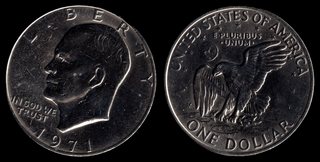
View on eBay

Victorian Trade Card Bush & Gerts Piano Chicago Kittens Playing Horn Fife Music

Bush & Gerts Piano Co., Chicago — Kittens with Cornet and Fife

$21.64 Advertising Sales Trade Cards

Original Victorian advertising trade card, chromolithograph, c. 1880s-90s. Approx. 4.25 x 2.95 in.

Two tabby kittens stand upright in the snow before a wooden picket gate, one playing a brass cornet, the other a fife. The scene is framed inside a gold outline shaped like the strung harp of a grand piano, its strings and tuning pins drawn in, with a pink ribbon bow and a green spray at the left, on a pale blue ground. The corners are rounded. A faint violet rubber stamp at the upper left of the front — likely a local dealer's name — has faded and cannot be read.

The reverse reads: HERE IT IS. A PIANO that wears well, A PIANO that is beautiful, A PIANO that delights, A PIANO that is sweet in tone, A PIANO with perfect repeating action, A PIANO with marvelous volume, A PIANO that leads them all. THE BUSH & GERTS fills the bill. 20000 Made and Sold. The Only Perfect Transposing Keyboard Made, Found only in the Bush & Gerts Piano. A perfect Mandolin Attachment recently introduced. BUSH & GERTS PIANO Co., CHICAGO, ILL.

Read the full description

Historical Context

A piano was the most expensive thing most families would ever buy apart from the house, and the card sells it like one. Seven lines, each starting A PIANO, then the only number that mattered to a nervous buyer: twenty thousand already made and sold.

The transposing keyboard and the mandolin attachment are the period's gadgets. A transposing keyboard let the player shift the key without learning the music again; a mandolin attachment changed the tone. Both were ways of saying this piano could do more than the one down the street.

Condition

Toning and age typical of the period. Mottled blistering and spotting across the blue ground in the upper part of the front; a faded, illegible violet stamp at the upper left; minor edge and corner wear; toning to the reverse. The kittens and the gold frame remain bright and the reverse text fully legible. Please view the images carefully.

About The Printing

This is an original chromolithograph, and it was slow, exacting work. Each color had to be drawn onto its own separate stone by hand — in monochrome, the artist judging how much stipple each area needed so the colors would combine correctly only once every stone had been printed. The sheet then went through the press once for every color it carries, often a dozen or more, and every pass had to register exactly against the last. A pass out of register showed.

Under magnification the image resolves into irregular hand-drawn stipple, each ink carrying its own dot pattern, the colors mixing in the eye rather than on the paper. There is no regular halftone screen and no four-color rosette, which is what a modern reproduction would show. Modern process printing simulates every color from four inks; chromolithography laid each color down as its own.

Provenance

This item comes from the personal collections of my family estate, accumulated over more than 200 years — including items that came west by wagon train to Colorado and later to Oklahoma. Now that my parents have passed we cannot keep all of these cherished items. They were well-educated antiques collectors/traders and continued to build their collections over more than 60 years. The vast majority of the pieces are from the Victorian Era, however there are plenty of older and newer items. Everything has been stored in a climate-controlled environment over time.

Disclaimer

Specifications and detailed item descriptions are provided as a courtesy only and are not guaranteed to be one hundred percent accurate. Please do your own research. There are generally no receipts available for any items from original purchases. Any dimensions and/or weights are approximate. The absence of a more detailed condition report does not imply there are no condition issues with the item(s). Please inspect images carefully as they are part of the official item description and best representation of the actual condition. Additional images may be available upon request depending on time and availability. Not responsible for internet mis-translations or mis-identification of maker's marks if found or assumptions of makers or materials — item descriptions will indicate if it is assumed. If you see a problem, please message us immediately and we will do our best to sort out a solution and confirm the information. With the exception of eBay rules, no returns are accepted.
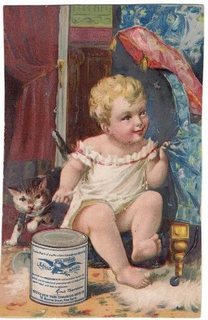
View on eBay

1880s Trade Card Electric-Light Soap Indianapolis Two Girls Cake Flowers

1880s Trade Card Electric-Light Soap Indianapolis Two Girls Cake Flowers — A Victorian soap trade card. Approx. 4.55 x 2.90 in.

$21.52 Advertising Sales Trade Cards

Description

A Victorian soap trade card. Two little girls meet on a garden path, one in a pink dress with a red sash offering a molded cake on a plate, the other in a white pinafore and striped stockings holding up a bouquet in a lace-paper holder. A spray of red wild roses lies across the foreground, on a peach ground with a white margin. Printed at right: "Use Electric-Light Soap. No rubbing required. Electric Soap M'f'g Co., Indianapolis, Ind." The reverse is blank.

Approx. 4.55 x 2.90 in.

Read the full description

Historical Context

Named for the newest wonder. In the 1880s electric light was the marvel of the age, and advertisers borrowed the word "electric" to sell soap, among much else. Dobbins' Electric Soap of Philadelphia was another.

An Indianapolis soap maker. This card comes from a smaller Midwestern maker, the Electric Soap M'f'g Co. of Indianapolis, and its promise, "No rubbing required," spoke straight to the hours of scrubbing on washday.

Victorian girlhood. Little girls with cakes and flowers were a favorite subject on cards that were handed to mothers at the store counter.

Condition

Very good. Bright colors; corners lightly worn. Faint pale lines run vertically and horizontally through the right half of the front, from a light crease or old mounting. A small dark spot above the lettering and a tiny ink fleck near the top. The blank reverse is clean apart from a faint mirror-image offset of printing at the left, scattered tiny red flecks and a small scuff at the lower right corner. Please see the photos, which are part of the description.

About The Printing

This is an original chromolithograph, and it was slow, exacting work. Each color had to be drawn onto its own separate stone by hand — in monochrome, the artist judging how much stipple each area needed so the colors would combine correctly only once every stone had been printed. The sheet then went through the press once for every color it carries, often a dozen or more, and every pass had to register exactly against the last. A pass out of register showed.

Under magnification the image resolves into irregular hand-drawn stipple, each ink carrying its own dot pattern, the colors mixing in the eye rather than on the paper. There is no regular halftone screen and no four-color rosette, which is what a modern reproduction would show. Modern process printing simulates every color from four inks; chromolithography laid each color down as its own.

The soap maker's imprint is printed in black, and the reverse is blank.

Provenance

From my family's estate collections, built over more than 60 years by knowledgeable antiques collectors and traders. Stored in a climate-controlled environment.

Also In Our Store

More Electric-Light Soap cards in our store: https://www.ebay.com/str/tfauctionsintl?_nkw=electric+soap

More Victorian advertising trade cards for soap, laundry and household products are in our store.

Disclaimer

The images and any video show the actual item and are part of the official listing description, so please review them closely. Measurements and weights are approximate, and any maker or material we haven't confirmed is described as assumed. Questions? Message us; we answer quickly.

View on eBay

1880s Trade Card Shaw's Snow Puff Baking Powder Yellow Flowers Bee Small

1880s Trade Card Shaw's Snow Puff Baking Powder Yellow Flowers Bee Small — Yellow wild roses and buds with a bee in flight, beside a blank scroll left for a merchant's name. Approx. 4.17 x 2.55 in.

$21.52 Advertising Sales Trade Cards

Description

Yellow wild roses and buds with a bee in flight, beside a blank scroll left for a merchant's name.

The back is printed in black: "To Consumers of Baking Powder: Try a Can of 'Shaw's Snow Puff' Baking Powder. You get one-half more Powder for your money than offered by any other manufacturer. It is warranted absolutely Pure ... 'SHAW'S SNOW PUFF.' Ask for it!"

Approx. 4.17 x 2.55 in.

Read the full description

Historical Context

Half again as much. Baking powder makers fought hard on price, and Shaw's pitch is more powder for the money.

An open scroll. The blank banner on the front was meant for a local grocer's name, never added on this card.

Condition

Front: good color. Back: staining; text legible. Please see the photos, which are part of the description.

About The Printing

This is an original chromolithograph, and it was slow, exacting work. Each color had to be drawn onto its own separate stone by hand — in monochrome, the artist judging how much stipple each area needed so the colors would combine correctly only once every stone had been printed. The sheet then went through the press once for every color it carries, often a dozen or more, and every pass had to register exactly against the last. A pass out of register showed.

Under magnification the image resolves into irregular hand-drawn stipple, each ink carrying its own dot pattern, the colors mixing in the eye rather than on the paper. There is no regular halftone screen and no four-color rosette, which is what a modern reproduction would show. Modern process printing simulates every color from four inks; chromolithography laid each color down as its own.

The back is printed in black.

Provenance

From my family's estate collections, built over more than 60 years by knowledgeable antiques collectors and traders. Stored in a climate-controlled environment.

Also In Our Store

More Victorian advertising trade cards are in our store.

Disclaimer

The images and any video show the actual item and are part of the official listing description, so please review them closely. Measurements and weights are approximate, and any maker or material we haven't confirmed is described as assumed. Questions? Message us; we answer quickly.

View on eBay

Japan 1000 Yen Hideyo Noguchi Mt Fuji Series E P-104 Pre-2024 Design [Est. VF]

Japan 1000 Yen Banknote, Hideyo Noguchi, Mt. Fuji and Lake Motosu, Bank of Japan, Pick P-104, Serial NT711884A [Est. VF]

$21.46 Est. VF Japan

Description

A Japan 1000 yen banknote from the Bank of Japan, series first issued in 2004, with the portrait of Hideyo Noguchi on the front and Mt. Fuji reflected in Lake Motosu on the back. Serial number NT711884A. Pick P-104 (Numista N#202070).

Read the full description

Historical Context

Hideyo Noguchi (1876-1928) was a Japanese bacteriologist who worked at the Rockefeller Institute in New York and died in Africa while researching yellow fever. In July 2024 Japan began issuing a new 1000 yen note, so the Noguchi design is now the previous series.

Condition

[Est. VF] Light circulation; center fold (was folded in half, now lies flat); small dark spot at the right edge of the reverse. Grade estimated; not professionally graded.

Legal Tender

Still legal tender in Japan: Bank of Japan notes issued since the series began remain valid, including this Noguchi 1000 yen (Bank of Japan list of valid notes). It is sold as a collectible.

Disclaimer

The images and any video show the actual item and are part of the official listing description, so please review them closely. Measurements and weights are approximate, and any maker or material we haven't confirmed is described as assumed. Questions? Message us; we answer quickly.

View on eBay

Japan 1000 Yen Hideyo Noguchi Mt Fuji Banknote P-104 LW507117E [Est. VF]

Japan 1000 Yen Banknote, Hideyo Noguchi, Mt. Fuji and Lake Motosu, Bank of Japan, Pick P-104, Serial LW507117E [Est. VF]

$21.29 Est. VF Japan

Description

A Japan 1000 yen banknote from the Bank of Japan, series first issued in 2004, with the portrait of Hideyo Noguchi on the front and Mt. Fuji reflected in Lake Motosu on the back. Serial number LW507117E. Pick P-104 (Numista N#202070).

Read the full description

Historical Context

Hideyo Noguchi (1876-1928) was a Japanese bacteriologist who worked at the Rockefeller Institute in New York and died in Africa while researching yellow fever. In July 2024 Japan began issuing a new 1000 yen note, so the Noguchi design is now the previous series.

Condition

[Est. VF] Light circulation with folds. Grade estimated; not professionally graded.

Legal Tender

Still legal tender in Japan: Bank of Japan notes issued since the series began remain valid, including this Noguchi 1000 yen (Bank of Japan list of valid notes). It is sold as a collectible.

Disclaimer

The images and any video show the actual item and are part of the official listing description, so please review them closely. Measurements and weights are approximate, and any maker or material we haven't confirmed is described as assumed. Questions? Message us; we answer quickly.

View on eBay

1880s Lion Coffee Victorian Trade Card Birds Bathing at Pond Woolson Spice

1880s Lion Coffee Victorian Trade Card Birds Bathing at Pond Woolson Spice — Small birds bathe and splash in a pond by a fence and trees, with more birds in the sky, inside a pale blue border. Approx. 5.13 x 4.29 in.

$20.28 Advertising Sales Trade Cards

Description

Small birds bathe and splash in a pond by a fence and trees, with more birds in the sky, inside a pale blue border.

The back is printed in black: "If you want a picture card like this buy a package of LION COFFEE. It is composed of a successful combination of Mocha, Java and Rio, and is roasted with the greatest care, but is not ground. Is never sold in bulk. Beautiful picture in every package. Lion is the King of Coffees. Manufactured by Woolson Spice Co., Toledo, O.."

Approx. 5.13 x 4.29 in.

Read the full description

Historical Context

The coffee that came with a picture. Lion Coffee began in Toledo, Ohio, in 1864 and became part of the Woolson Spice Company in 1882. Alvin Woolson built the brand by putting picture cards in every package, and the back of this card says so.

Condition

Front: small chips in the border at the top. Back: edge staining at the top. Please see the photos, which are part of the description.

About The Printing

This is an original chromolithograph, and it was slow, exacting work. Each color had to be drawn onto its own separate stone by hand — in monochrome, the artist judging how much stipple each area needed so the colors would combine correctly only once every stone had been printed. The sheet then went through the press once for every color it carries, often a dozen or more, and every pass had to register exactly against the last. A pass out of register showed.

Under magnification the image resolves into irregular hand-drawn stipple, each ink carrying its own dot pattern, the colors mixing in the eye rather than on the paper. There is no regular halftone screen and no four-color rosette, which is what a modern reproduction would show. Modern process printing simulates every color from four inks; chromolithography laid each color down as its own.

The back is printed in black.

Provenance

From my family's estate collections, built over more than 60 years by knowledgeable antiques collectors and traders. Stored in a climate-controlled environment.

Also In Our Store

More Lion Coffee cards in our store: https://www.ebay.com/str/tfauctionsintl?_nkw=lion+coffee

More Victorian advertising trade cards are in our store.

Disclaimer

The images and any video show the actual item and are part of the official listing description, so please review them closely. Measurements and weights are approximate, and any maker or material we haven't confirmed is described as assumed. Questions? Message us; we answer quickly.

View on eBay

1880s Trade Card Clark's O.N.T. Spool Cotton Tuesday's Child Full of Grace

1880s Trade Card Clark's O.N.T. Spool Cotton Tuesday's Child Full of Grace — An embossed Victorian thread card from the nursery-rhyme theme. Approx. 2.80 x 4.00 in.

$20.18 Advertising Sales Trade Cards

Description

An embossed Victorian thread card from the nursery-rhyme theme. A little girl in grown-up costume, a tall lace cap, blue bodice, red overskirt and a flowered apron with a long trailing hem, poses with a fan. Bronze lettering beside her reads "Tuesday's Child is full of Grace," above the blue "Clark's O.N.T. Spool Cotton" trademark roundel. Verse at the foot: "The dainty costume worn by me / My mamma made with O.N.T." The outlines and lettering are printed in metallic bronze, and the figure and lettering are embossed.

The reverse, printed in black: "Use Clark's O.N.T. Spool Cotton on White Spools! George A. Clark, Sole Agent. It is superior to all others for hand and machine use. Garments sewed with O.N.T. Fast Black will never show white on the seams after being worn or washed."

Approx. 2.80 x 4.00 in.

Read the full description

Historical Context

Our New Thread. O.N.T. stood for "Our New Thread." George A. Clark, of the Paisley, Scotland, thread family, came to the United States in 1856, and the Clarks opened a factory in Newark, New Jersey, in 1864. Clark's O.N.T. spool cotton soon became a recognized American brand.

Thread wars. Clark and its Paisley rival J. & P. Coats competed fiercely for American customers, and both flooded stores with picture cards. In the United States the two finally merged as Coats & Clark in 1952.

Monday's child. The card borrows the old fortune-telling rhyme that begins "Monday's child is fair of face, Tuesday's child is full of grace," a natural for a thread maker selling to mothers who sewed their children's clothes.

Condition

Excellent. Clean, bright front with sharp corners and crisp embossing; the bronze ink is bright. The reverse is clean with light even toning; the embossing shows through as relief, as made. Please see the photos, which are part of the description.

About The Printing

This is an original chromolithograph. Each color was drawn onto its own separate stone by hand and printed as its own pass through the press, every pass registering exactly against the last. This card uses the flat-color mode of the process — broad areas of solid, opaque ink with crisp boundaries rather than blended tone. It is the same technique that produced the great poster designs of the period.

Under magnification the colors resolve as solid fields with clean edges and no dot structure at all. There is no halftone screen and no four-color rosette, which is what a modern reproduction would show. Modern process printing simulates every color from four inks; here each color is its own ink, laid down whole.

The outlines and lettering are printed in metallic bronze ink, the design is embossed, and the reverse is printed in black.

Provenance

From my family's estate collections, built over more than 60 years by knowledgeable antiques collectors and traders. Stored in a climate-controlled environment.

Also In Our Store

More Clark's O.N.T. cards in our store: https://www.ebay.com/str/tfauctionsintl?_nkw=clark

More Victorian advertising trade cards for thread, children and nursery-rhyme subjects are in our store.

Disclaimer

The images and any video show the actual item and are part of the official listing description, so please review them closely. Measurements and weights are approximate, and any maker or material we haven't confirmed is described as assumed. Questions? Message us; we answer quickly.

View on eBay

1880s Lion Coffee Trade Card Forget-Me-Nots Seascape Ships Bufford Woolson

1880s Lion Coffee Trade Card Forget-Me-Nots Seascape Ships Bufford Woolson — Sprays of blue forget-me-nots frame a tilted seascape with sailing ships. Approx. 3.62 x 5.11 in.

$19.92 Advertising Sales Trade Cards

Description

Sprays of blue forget-me-nots frame a tilted seascape with sailing ships. Bufford printer's imprint.

The back is printed in black: "If you want a picture card like this buy a package of LION COFFEE. It is composed of a successful combination of Mocha, Java and Rio, and is roasted with the greatest care, but is not ground. Is never sold in bulk. Beautiful picture in every package. Lion is the King of Coffees. Manufactured by Woolson Spice Co., Toledo, Ohio."

Approx. 3.62 x 5.11 in.

Read the full description

Historical Context

The coffee that came with a picture. Lion Coffee began in Toledo, Ohio, in 1864 and became part of the Woolson Spice Company in 1882. Alvin Woolson built the brand by putting picture cards in every package, and the back of this card says so.

Condition

Front: pink ink dashes and small black dots at upper left; even toning. Back: even toning. Please judge from the photos. Please see the photos, which are part of the description.

About The Printing

This is an original chromolithograph, and it was slow, exacting work. Each color had to be drawn onto its own separate stone by hand — in monochrome, the artist judging how much stipple each area needed so the colors would combine correctly only once every stone had been printed. The sheet then went through the press once for every color it carries, often a dozen or more, and every pass had to register exactly against the last. A pass out of register showed.

Under magnification the image resolves into irregular hand-drawn stipple, each ink carrying its own dot pattern, the colors mixing in the eye rather than on the paper. There is no regular halftone screen and no four-color rosette, which is what a modern reproduction would show. Modern process printing simulates every color from four inks; chromolithography laid each color down as its own.

The back is printed in black.

Provenance

From my family's estate collections, built over more than 60 years by knowledgeable antiques collectors and traders. Stored in a climate-controlled environment.

Also In Our Store

More Lion Coffee cards in our store: https://www.ebay.com/str/tfauctionsintl?_nkw=lion+coffee

More Victorian advertising trade cards are in our store.

Disclaimer

The images and any video show the actual item and are part of the official listing description, so please review them closely. Measurements and weights are approximate, and any maker or material we haven't confirmed is described as assumed. Questions? Message us; we answer quickly.

View on eBay

1935D $1 Silver Certificate Truman Era Blue Seal L55114033F Off Center Circ

Series 1935D $1 Silver Certificate, Blue Seal, No Motto, George Washington, One Dollar in Silver Payable to the Bearer, Truman Era, William A. Julian and John W. Snyder Signatures, Off Center, Serial L55114033F, Fr. 1613, Lightly Circulated [Est. VF]

$19.73 Est. VF Silver Certificates

Description

A Series 1935D $1 Silver Certificate with a blue Treasury seal and blue serial numbers. Signed by William A. Julian, Treasurer of the United States, and John W. Snyder, Secretary of the Treasury. Serial number L55114033F; face plate A7038. Standard small size, about 6.125 x 2.625 in.

Read the full description

Historical Context

Silver certificates promised the bearer one dollar in silver on demand. That promise ended in June 1968, when the Treasury stopped redeeming them for silver; the notes remain legal tender at face value.

Condition

[Est. VF] Few folds; bright paper; strong color; tight bottom margin. Off-center: narrowest margin at the bottom, 1.2 mm. Grade estimated from the scans; not professionally graded. No errors found.

Legal Tender

Yes. United States currency issued since 1861 remains legal tender at face value; this $1 Silver Certificate is still worth one dollar, though it can no longer be exchanged for silver (that ended in June 1968).

Disclaimer

The images and any video show the actual item and are part of the official listing description, so please review them closely. Measurements and weights are approximate, and any maker or material we haven't confirmed is described as assumed. Questions? Message us; we answer quickly.

View on eBay

1948 Campbell's Tomato Soup Print Ad Campbell Kid & Ivory Soap Jane Cartwright

DESCRIPTION

$19.48 1948 Magazine Advertisement Pages

An original magazine page with two full-color ads, one on each side, circa 1948.

Front: Campbell's Tomato Soup, "Calling All Appetites! ... to enjoy 'The Soup Most Folks Like Best.'" Bright red soup pours into bowls on a checked tablecloth. In the corner a Campbell Kid rakes autumn leaves above the verse "When winds do blow / And leaves do swoop, / Then in I go / For good hot soup!" with the red-and-white can and a list of "21 Kinds to Choose From," including "Cream of Chicken (new!)."

Back: Ivory Soap, "Jane Cartwright – Cover Girl of the Year (An Ivory Baby... She's an Ivory Beauty Now)," with a collage of magazine covers, baby Jane in the bath, and the famous "99 44/100% Pure ... It Floats."

Size approx. 8.10 x 11.30 in.

Read the full description

Historical Context

The Campbell Kids. Illustrator Grace Drayton drew the round, rosy Campbell Kids in 1904, and they have appeared in Campbell's advertising ever since.

Ivory. Procter & Gamble first sold Ivory in 1879; "It Floats" arrived in 1891, and "99 44/100% Pure" was in use by 1895.

Dating the page. One of the magazine covers on the Ivory side is dated "Feb 1948," so the page can't be earlier than that; the autumn verse on the Campbell's side suggests a fall issue.

Buying Power

In 1948, the average factory worker earned about $1.43 an hour, so a dollar bought about 42 minutes of factory work, or about $21 at today's factory wage.

In 1948, a 10.5 oz can of Campbell’s Tomato Soup cost about 10 to 11 cents. Today, Walmart lists a single 10.75 oz can for around $1.53.

Condition

Original page removed from the magazine ready for custom framing or scrapbook collectors: the binding edge (left on the front) is torn where the page came out, without reaching either image. No folds or creases found. Light, even toning. Colors are bright on both sides. Please study the images and video; they are part of the description.

Disclaimer

The images and any video show the actual item and are part of the official listing description, so please review them closely. Measurements and weights are approximate, and any maker or material we haven't confirmed is described as assumed. Questions? Message us; we answer quickly.

View on eBay

Victorian Trade Card Hood's Sarsaparilla Pharmacy Scene PT Barnum Circus Back

Hood's Sarsaparilla — “Be Sure You Are Right”

$19.47 Advertising Sales Trade Cards

Original Victorian advertising trade card, chromolithograph, copyright 1886. Approx. 4.10 x 2.65 in.

An elderly man in a yellow overcoat and wide black hat stands outside a pharmacy, umbrella under one arm, holding a package of Hood's Sarsaparilla up to the light and examining it through his glasses. The caption beside him reads “That's all right. Hood's Sarsaparilla. Can't Fool me twice.” A poster for the product hangs in the shop window behind him.

The lower panel carries the advertiser's text in full: the old man was once induced to buy some other preparation when he asked for Hood's, does not propose to be victimized again, and so examines his new purchase carefully. Prepared only by C. I. Hood & Co., Lowell, Mass.

The reverse is given over to a circus advertisement headed “Much for Little,” quoting P. T. Barnum on a big show for a small amount, and naming the performers: Daring Zazel, fired from a huge cannon a distance of 50 feet; Graceful Miss Alita, walking the ceiling like a veritable fly; Beautiful Miss Patricia, dissolving into air before your eyes; The Two Macks Vaudeville Combination; and Whitfield, the man with 100 different faces. It closes by returning to Hood's and its “100 Doses One Dollar.”

Read the full description

Historical Context

Patent medicine and the circus were selling the same thing: a promise that outran the evidence. Putting them on one card was not an accident of printing — both were buying the same attention, and both knew the customer wanted to be amazed before being convinced.

The joke on the front is the more interesting half. The old man is not being told the product works. He is being told he is too shrewd to be fooled, which is a harder sell and a better one. Flattering the buyer's judgment was a new idea in 1886 and it has never gone out of use.

Condition

Toning and age typical of the period. Losses and tearing along one long edge with a chipped area toward the corner; light surface soiling; minor edge and corner wear; scattered foxing, more apparent on the reverse. The chromolithographed image on the front remains bright. Please view the images carefully.

About The Printing

This is an original chromolithograph, and it was slow, exacting work. Each color had to be drawn onto its own separate stone by hand — in monochrome, the artist judging how much stipple each area needed so the colors would combine correctly only once every stone had been printed. The sheet then went through the press once for every color it carries, often a dozen or more, and every pass had to register exactly against the last. A pass out of register showed.

Under magnification the image resolves into irregular hand-drawn stipple, each ink carrying its own dot pattern, the colors mixing in the eye rather than on the paper. There is no regular halftone screen and no four-color rosette, which is what a modern reproduction would show. Modern process printing simulates every color from four inks; chromolithography laid each color down as its own.

Provenance

This item comes from the personal collections of my family estate, accumulated over more than 200 years — including items that came west by wagon train to Colorado and later to Oklahoma. Now that my parents have passed we cannot keep all of these cherished items. They were well-educated antiques collectors/traders and continued to build their collections over more than 60 years. The vast majority of the pieces are from the Victorian Era, however there are plenty of older and newer items. Everything has been stored in a climate-controlled environment over time.

Disclaimer

Specifications and detailed item descriptions are provided as a courtesy only and are not guaranteed to be one hundred percent accurate. Please do your own research. There are generally no receipts available for any items from original purchases. Any dimensions and/or weights are approximate. The absence of a more detailed condition report does not imply there are no condition issues with the item(s). Please inspect images carefully as they are part of the official item description and best representation of the actual condition. Additional images may be available upon request depending on time and availability. Not responsible for internet mis-translations or mis-identification of maker's marks if found or assumptions of makers or materials — item descriptions will indicate if it is assumed. If you see a problem, please message us immediately and we will do our best to sort out a solution and confirm the information. With the exception of eBay rules, no returns are accepted.
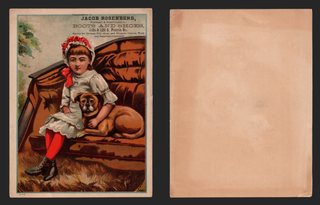
View on eBay

1999 Costa Rica 5000 Colones Pre-Columbian Art Banknote P-268a [Est. F-VF]

24 February 1999 Costa Rica 5000 Colones Banknote, Pre-Columbian Shaman Figure / Toucan, Jaguar and Stone Sphere, Pick P-268a, Serial C00978846 [Est. F-VF]

$19.47 1999 Est. F-VF Costa Rica

Description

Issued by the Banco Central de Costa Rica and printed by Oberthur Fiduciaire. Front: a pre-Columbian figure of a shaman; back: a toucan, a jaguar, a stone sphere and a carved sculpture among ferns. Toucan watermark, woven security thread and microprinting. Serial C00978846. Low serial number, under 1,000,000 in its series. Measured on the 1200 dpi scan: 156.9 x 67.1 mm. The close-ups show the serial, the date, the gold figure and the back vignette. The last image adds a millimeter scale.

Read the full description

Historical Context

The design draws on Costa Rica's indigenous heritage. More than 300 stone spheres like the one on the back are known, mostly from the Diquis Delta in southern Costa Rica, and the chiefdom settlements where they stand became a UNESCO World Heritage site in 2014.

Condition

[Est. F-VF] Circulated, with a horizontal center fold, at least two vertical folds and scattered creases, light overall soiling and rounded corners. A diagonal crease crosses the front top-right corner. No tears, holes, tape or writing. Grade estimated from the scans; not professionally graded.

Legal Tender

No longer legal tender: withdrawn on 31 December 2012; it can still be exchanged or deposited at Costa Rican financial institutions with no time limit (BCCR).

Disclaimer

The images and any video show the actual item and are part of the official listing description, so please review them closely. Measurements and weights are approximate, and any maker or material we haven't confirmed is described as assumed. Questions? Message us; we answer quickly.

View on eBay

1880s Trade Card Jacob Rosenberg Boots and Shoes Children at Fence with Hoop

1880s Trade Card Jacob Rosenberg Boots and Shoes Children at Fence with Hoop — A large Victorian trade card imprinted for a shoe dealer. Approx. 5.70 x 7.60 in.

$19.44 Advertising Sales Trade Cards

Description

A large Victorian trade card imprinted for a shoe dealer. Three children by a split-rail fence: a girl in a straw bonnet, red-and-white cape and long brown dress holds a book and leads a toddler in a white dress with a red sash, red stockings and a straw hat, while a boy in blue lies sprawled on the path beside his red hoop. A large house and trees stand behind. The imprint at upper right reads: "Compliments of JACOB ROSENBERG, Wholesale & Retail Dealer in BOOTS AND SHOES, 1124 & 1126 S. Fourth St. Agency for German Felt Shoes and Slippers, Custom Work and Repairing a Specialty." Stock number "1009" at lower left. No city is printed. The back is blank.

Vertical, approx. 5.70 x 7.60 in.

Read the full description

Historical Context

A neighborhood shoe store. Rosenberg sold wholesale and retail from a double storefront on South Fourth Street, took in custom work and repairs, and advertised an agency for German felt shoes and slippers.

Stock card, local imprint. Designs like this were printed in quantity with open space for a merchant's name; Rosenberg's advertising fills the sky. The number 1009 at lower left is a stock design number.

Children at play. Sweet scenes of children, here a tumble with a hoop on the way home from school, were among the most popular trade card subjects of the 1880s.

Condition

As-is, with honest wear. Front: a diagonal crease across the lower right corner, running into the picture, with a small chip at the corner tip; a short crease at the left edge about halfway down; wear at the upper corners; overall toning to the margins. Back: blank and toned, with a darker vertical band near the left edge; long diagonal creases at the upper left and lower left corners, a small corner chip at lower left, and short edge creases at the right side and bottom. Colors remain strong. No writing. Please see the photos, which are part of the description.

About The Printing

This is an original chromolithograph, and it was slow, exacting work. Each color had to be drawn onto its own separate stone by hand — in monochrome, the artist judging how much stipple each area needed so the colors would combine correctly only once every stone had been printed. The sheet then went through the press once for every color it carries, often a dozen or more, and every pass had to register exactly against the last. A pass out of register showed.

Under magnification the image resolves into irregular hand-drawn stipple, each ink carrying its own dot pattern, the colors mixing in the eye rather than on the paper. There is no regular halftone screen and no four-color rosette, which is what a modern reproduction would show. Modern process printing simulates every color from four inks; chromolithography laid each color down as its own.

The Rosenberg advertising is printed in black type in the sky of the design.

Provenance

From my family's estate collections, built over more than 60 years by knowledgeable antiques collectors and traders. Stored in a climate-controlled environment.

Also In Our Store

More Victorian advertising trade cards for local merchants, with children and other popular subjects, are in our store.

Disclaimer

The images and any video show the actual item and are part of the official listing description, so please review them closely. Measurements and weights are approximate, and any maker or material we haven't confirmed is described as assumed. Questions? Message us; we answer quickly.

View on eBay

1916 Stecher Thanksgiving Postcard Girl Leads Turkey Ribbon Gold West Danby NY

November 1916 Stecher Lith. Co. Embossed "Thanksgiving Greetings" Postcard, Smiling Girl in Blue Leading a Turkey on a White Ribbon Before a Gold Panel, West Danby, N.Y. Postmark the Day Before Thanksgiving, 1¢ Washington Perf 10 Stamp, "Mollie" to Mrs. Ella Benton, Spencer, N.Y.

$19.44 1916 Thanksgiving Postcards

Description

A smiling girl in a pale blue dress with a rose sash, her pink-and-blue bonnet slung behind her, leads a big bronze turkey by a white ribbon. Behind them is an embossed gold panel edged in red; pumpkins dot the field at left. "Thanksgiving Greetings" in gold at lower left, beside the circle logo "STECHER LITH. CO. ROCH. N.Y."

The back is a divided back with an ornate "POST CARD" and "MADE IN U.S.A." 1-cent green George Washington stamp, perforated 10 with a straight edge at left (Scott #424 or #462; they differ only in the watermark, which can't be seen on the card), tied by a West Danby, N.Y. postmark of Nov 29, 1916. Addressed in pencil to Mrs. Ella Benton, Spencer, N.Y. The pencil message, dated "W. Danby 11-27-16," is partly covered by old album corners; it reads in part (our transcription): "Dear Friend, I will drop you a card to let you know I am still here. We have only got our stoves moved, is the reason I have not been down after you. I was sick abed last Friday with one of my old [head]aches... but am better now... With love, Mollie."

Read the full description

Historical Context

The day before. Mollie dated her card on Monday, and it was postmarked Wednesday, November 29, 1916, the day before Thanksgiving.

The stamp. From September 1916 the perf 10 Washington was printed on unwatermarked paper as Scott #462, which philatelic author Max Johl called "one of the most desirable stamps of the 20th century." This one may be either #462 or the watermarked #424.

Condition

Good. Front bright with crisp gold; light corner and edge wear. On the back, three paper album corners remain glued at the corners, with dark glue stains, covering the start of several message lines. The stamp has surface loss across the portrait. Small pencil "28" on the back.

About The Printing

This card is printed in halftone. Under magnification the colors resolve into a regular, even grid of dots rather than the irregular hand-drawn stipple of a chromolithograph. The gold panel is embossed with a hammered texture, and the girl and turkey show in relief on the back.

Provenance

From my family's estate collections, built over more than 60 years by knowledgeable antiques collectors and traders. Stored in a climate-controlled environment.

Also In Our Store

More Thanksgiving postcards from this group are in our store.

Disclaimer

The images and any video show the actual item and are part of the official listing description, so please review them closely. Measurements and weights are approximate, and any maker or material we haven't confirmed is described as assumed. Questions? Message us; we answer quickly.

View on eBay

1912 P. Sander Thanksgiving Postcard Turkey Gold Corn White Pumpkins Missouri

October 1912 P. Sander No. 761 Embossed "Thanksgiving Greetings" Postcard, Bronze Turkey with Gold-Outlined White Pumpkins, Gold Corn and Grapevine, Missouri Postmark, 1¢ Washington Stamp Affixed Upside Down, Minnie Mitchell to Miss Lucile Gumby (or Gunby), Shelbyville, Mo., R.F.D. 4

$19.39 1912 Thanksgiving Postcards

Description

A bronze tom turkey with fanned tail faces a heap of white pumpkins and a gourd outlined in gold, with a gold ear of corn, grape leaves and grapes. The ground has a fine linen-like texture inside a gold frame with red-and-gold corner ornaments. "Thanksgiving Greetings" in red and gold across the top right; "P. SANDER ©" at lower left and "761" at lower right.

The back is a divided back, embossed throughout, with a red "POST CARD." 1-cent green George Washington stamp, perforated 12 (Scott #405), affixed upside down and tied by a Missouri postmark reading "CLARE..." (the rest is under the stamp), Oct 2?, 7 AM, 1912. Addressed in purple pencil to Miss Lucile Gumby (or Gunby; difficult to read), Shelbyville, Mo., R.F.D. 4. The message, written upside down (our transcription): "How are you Lucile? I'm fine, just in a hurry. Minnie Mitchell."

Read the full description

Historical Context

Early greetings. Mailed in October 1912, about a month before Thanksgiving fell on November 28, with both the stamp and the message upside down.

Condition

Good to very good. Bright gold and color; corner wear and light soiling. Back with wear and a small stain at the lower right corner; the purple pencil address and message are clear.

About The Printing

Under magnification the fine color dots could not be read reliably as either hand-drawn chromolithograph stipple or halftone, so no printing method is claimed. The pumpkins, corn and grapes are embossed and gilded, and the turkey stands up in relief on the back.

Provenance

From my family's estate collections, built over more than 60 years by knowledgeable antiques collectors and traders. Stored in a climate-controlled environment.

Also In Our Store

More Thanksgiving postcards from this group are in our store.

Disclaimer

The images and any video show the actual item and are part of the official listing description, so please review them closely. Measurements and weights are approximate, and any maker or material we haven't confirmed is described as assumed. Questions? Message us; we answer quickly.

View on eBay

1935E $1 Silver Certificate Blue Seal Bright Strong Color B05062811I Light Circ

Series 1935E $1 Silver Certificate, Blue Seal, No Motto, George Washington, One Dollar in Silver Payable to the Bearer, Eisenhower Era, Ivy Baker Priest and George M. Humphrey Signatures, Bright Paper, Strong Color, Serial B05062811I, Fr. 1614, Lightly Circulated [Est. VF]

$19.37 Est. VF Silver Certificates

Description

A Series 1935E $1 Silver Certificate with a blue Treasury seal and blue serial numbers. Signed by Ivy Baker Priest, Treasurer of the United States, and George M. Humphrey, Secretary of the Treasury. Serial number B05062811I; face plate B7904. Standard small size, about 6.125 x 2.625 in.

Read the full description

Historical Context

Silver certificates promised the bearer one dollar in silver on demand. That promise ended in June 1968, when the Treasury stopped redeeming them for silver; the notes remain legal tender at face value.

Condition

[Est. VF] Best of batch: few light folds, bright paper, strong color. Off-center: narrowest margin at the bottom, 2.0 mm. Grade estimated from the scans; not professionally graded. No errors found.

Legal Tender

Yes. United States currency issued since 1861 remains legal tender at face value; this $1 Silver Certificate is still worth one dollar, though it can no longer be exchanged for silver (that ended in June 1968).

Disclaimer

The images and any video show the actual item and are part of the official listing description, so please review them closely. Measurements and weights are approximate, and any maker or material we haven't confirmed is described as assumed. Questions? Message us; we answer quickly.

View on eBay

ca1915 Stecher Thanksgiving Postcard Turkeys in Snow Gold Moon Embossed Joys

ca1915 Stecher Lith. Co. "Thanksgiving Joys" Embossed Postcard, Tom and Hen Turkeys in the Snow Among Corn Shocks and a Rail Fence Under a Gold Moon and Lavender Sky, Series 839 F, Made in U.S.A., Unposted

$18.93 Thanksgiving Postcards

Description

A tom turkey with fanned tail and a hen cross the snow among green corn shocks, with a split-rail fence and trees behind them, under a lavender sky and a round gold moon. "Thanksgiving Joys" in gold script at lower right; the circle logo "STECHER LITH. CO. ROCH. N.Y." at lower left. Embossed.

The back is a divided back with an ornate "POST CARD," "MADE IN U.S.A.," a stamp box reading "PLACE STAMP / DOMESTIC 1¢ / FOREIGN 2¢," and "Series 839 F." Never stamped, mailed or written on.

Read the full description

Historical Context

Made in U.S.A. Stecher printed its holiday cards in Rochester, N.Y., in years when German printers dominated the postcard trade. The company grew from a printer of posters, labels and trade cards into a major maker of artist-drawn holiday postcards.

Condition

Very good to excellent. Bright, clean colors and gold, crisp embossing, very light corner wear. Back clean, with two short surface scratches near the top and a faint pencil "50."

About The Printing

This card is printed in halftone. Under magnification the colors resolve into a regular, even grid of dots rather than the irregular hand-drawn stipple of a chromolithograph. The turkeys and corn shocks are embossed and stand up in relief on the back.

Provenance

From my family's estate collections, built over more than 60 years by knowledgeable antiques collectors and traders. Stored in a climate-controlled environment.

Also In Our Store

More Thanksgiving postcards from this group are in our store.

Disclaimer

The images and any video show the actual item and are part of the official listing description, so please review them closely. Measurements and weights are approximate, and any maker or material we haven't confirmed is described as assumed. Questions? Message us; we answer quickly.

View on eBay

1880s Victorian Trade Card J&P Coats Thread Katisha The Mikado Kimono Spool Poem

1880s Victorian Trade Card J&P Coats Thread Katisha The Mikado Kimono Spool Poem — A Victorian thread trade card. Approx. 2.50 x 4.15 in.

$18.92 Advertising Sales Trade Cards

Description

A Victorian thread trade card. A woman stands in costume as Katisha, the formidable lady of Gilbert and Sullivan's "The Mikado," in a crimson and gold kimono embroidered with a crane, waves and flowers, a ribbon ornament in her hair. At her feet sits an oversized spool of thread labeled "J&P COATS 200 YDS 50 BEST SIX CORD." Caption at top: "KATISHA." (the top of the lettering is trimmed). Verse in the panel below: "There is music in the whirling of the spindle — there is music that the clicking needle makes, and a sort of happy feeling comes gently o'er you stealing, — [wh]en you use Coats' Thread that never kinks or breaks."

The reverse is printed in blue with a large engraved spool and "J&P. Coats' Best Six Cord Thread — White, Black and Colors — For Hand and Machine."

Approx. 2.50 x 4.15 in.

Read the full description

Historical Context

Mikado mania. Gilbert and Sullivan's "The Mikado" opened at the Savoy Theatre in London on March 14, 1885, and ran for 672 performances. Katisha is the elderly lady in love with Nanki-Poo. The opera set off a fashion for all things Japanese, and advertisers issued Mikado trade cards to sell all kinds of goods.

Thread wars. J. & P. Coats takes its name from the brothers James and Peter Coats of Paisley, Scotland, who took over their father's thread business in 1830. In 1869 the firm took control of a thread mill in Pawtucket, Rhode Island, and its spools fought for American sewing baskets against Clark's O.N.T. The two rivals merged in the United States as Coats & Clark in 1952.

The trade card craze. In the 1880s cheap color printing put picture cards on every store counter, and families pasted them into scrapbooks by the hundred.

Condition

Heavily handled, sold as is. The lower left corner of the front is missing, taking the first letters of the last line ("[WH]EN"); the same loss shows at the upper right of the reverse. The top edge is trimmed close, clipping the top of the "KATISHA" caption. Light surface soiling and a few small scuffs on the front; colors remain strong. The reverse is toned, with scattered brown stains and spotting, most at the left side. Please see the photos, which are part of the description.

About The Printing

This is an original chromolithograph, and it was slow, exacting work. Each color had to be drawn onto its own separate stone by hand — in monochrome, the artist judging how much stipple each area needed so the colors would combine correctly only once every stone had been printed. The sheet then went through the press once for every color it carries, often a dozen or more, and every pass had to register exactly against the last. A pass out of register showed.

Under magnification the image resolves into irregular hand-drawn stipple, each ink carrying its own dot pattern, the colors mixing in the eye rather than on the paper. There is no regular halftone screen and no four-color rosette, which is what a modern reproduction would show. Modern process printing simulates every color from four inks; chromolithography laid each color down as its own.

The reverse is printed in a single blue ink.

Provenance

From my family's estate collections, built over more than 60 years by knowledgeable antiques collectors and traders. Stored in a climate-controlled environment.

Also In Our Store

More J. & P. Coats cards in our store: https://www.ebay.com/str/tfauctionsintl?_nkw=coats

More Victorian advertising trade cards for thread, soap and theater subjects are in our store.

Disclaimer

The images and any video show the actual item and are part of the official listing description, so please review them closely. Measurements and weights are approximate, and any maker or material we haven't confirmed is described as assumed. Questions? Message us; we answer quickly.

View on eBay

1984 Bolivia 100000 Pesos Bolivianos Agrarian Reform Banknote P-171a [Est. XF]

5 June 1984 Bolivia 100000 Pesos Bolivianos Banknote, Campesina Portrait / Agrarian Reform, Oxen and Tractor, Pick P-171a, Serial 61521875B [Est. XF]

$18.87 1984 Est. XF Bolivia

Description

Issued by the Banco Central de Bolivia under a 1984 supreme decree and printed by Thomas De La Rue. Front: a peasant woman (campesina) with the national arms in a hexagon; back: REFORMA AGRARIA, a man plowing with oxen beside a farmer on a modern tractor. Serial 61521875B. The serial ends with 1875. Measured on the 1200 dpi scan: 155.0 x 66.3 mm. Centering, measured on the scan: front L4.7 R3.6 T3.8 B3.3 mm; back 5.7-7.2 mm: good. Per margins_r01. The close-ups show the serial, the date, the campesina and the agrarian reform scene. The last image adds a millimeter scale.

Read the full description

Historical Context

Issued at the height of Bolivia's mid-1980s hyperinflation, when the peso fell to about 2.2 million per US dollar. The back honors the Agrarian Reform decree of 2 August 1953, which abolished forced peasant labor and redistributed estates. In the 1987 reform, notes of this type were overprinted as 10 centavos of the new boliviano.

Condition

[Est. XF] No hard folds, with light rippling and a faint crease in the top margin on the back. The front is bright; the back is lightly toned with a little soil at the top edge. Corners are sharp and the edges clean. No tears, holes or writing. Grade estimated from the scans; not professionally graded.

Legal Tender

No longer legal tender: demonetized on 31 December 1987.

Disclaimer

The images and any video show the actual item and are part of the official listing description, so please review them closely. Measurements and weights are approximate, and any maker or material we haven't confirmed is described as assumed. Questions? Message us; we answer quickly.

View on eBay

2004 Costa Rica 1000 Colones Soley Guell Banknote P-264e [Est. F-VF]

27 September 2004 Costa Rica 1000 Colones Banknote, Tomas Soley Guell / National Insurance Institute, Pick P-264e, Serial D86216894 [Est. F-VF]

$18.57 2004 Est. F-VF Costa Rica

Description

Serie D note issued by the Banco Central de Costa Rica and printed in France by Francois-Charles Oberthur. Front: Tomas Soley Guell with an ascending-size serial number; back: the Instituto Nacional de Seguros building. Serial D86216894. Measured on the 1200 dpi scan: 156.2 x 67.1 mm. Centering, measured on the scan: front L4.0 R4.0 T4.2 B3.0 mm; back 6.4-7.9 mm: good. Per margins_r01. The close-ups show the serial, the date, Tomas Soley Guell and the INS building. The last image adds a millimeter scale.

Read the full description

Historical Context

Tomas Soley Guell, a postmaster and congressional deputy, promoted the state insurance monopoly and created the National Insurance Bank, today the Instituto Nacional de Seguros. In 1998 some notes of this series were overprinted '50 Aniversario BCCR' for the Central Bank's 50th anniversary, a separate catalog type.

Condition

[Est. F-VF] Several soft folds, including a vertical center fold and a horizontal fold, with many light creases, heaviest on the left half of the back. Light overall soiling and softly rounded corners. No tears, holes or writing. The paper still has some body. Grade estimated from the scans; not professionally graded.

Legal Tender

No longer legal tender: withdrawn on 1 September 2011; it can still be exchanged or deposited at Costa Rican financial institutions with no time limit (BCCR).

Disclaimer

The images and any video show the actual item and are part of the official listing description, so please review them closely. Measurements and weights are approximate, and any maker or material we haven't confirmed is described as assumed. Questions? Message us; we answer quickly.

View on eBay

2009 Costa Rica 5000 Colones Capuchin Monkey Banknote P-276a [Est. VF]

2 September 2009 Costa Rica 5000 Colones Banknote, Alfredo Gonzalez Flores / Mangrove with Capuchin Monkey, Pick P-276a, Serial A020673195 [Est. VF]

$18.47 2009 Est. VF Costa Rica

Description

Cotton-paper note issued by the Banco Central de Costa Rica and printed by Oberthur. Front: Alfredo Gonzalez Flores with the Banco Internacional de Costa Rica building and a color-shifting map of Costa Rica; back: a mangrove (MANGLAR) with a white-faced capuchin monkey, a crab and flowers. Portrait watermark and a color-shifting windowed thread. Serial A020673195. Measured on the 1200 dpi scan: 140.0 x 67.4 mm. The close-ups show the serial, the date, Gonzalez Flores and the capuchin monkey. The last image adds a millimeter scale.

Read the full description

Historical Context

Alfredo Gonzalez Flores (1877-1962) was president from 1914 to 1917. He created the International Bank of Costa Rica, today the Banco Nacional, and introduced direct taxation before his war minister, Federico Tinoco, overthrew him on 27 January 1917. The design entered circulation on 27 August 2012.

Condition

[Est. VF] Several folds, including a strong horizontal fold across the portrait and a vertical fold, with light soiling and lightly rounded corners. A tiny blue dot sits on the building on the front. No tears, holes, tape or writing. Grade estimated from the scans; not professionally graded.

Legal Tender

No longer legal tender: withdrawn on 1 March 2022; it can still be exchanged or deposited at Costa Rican financial institutions with no time limit (BCCR).

Disclaimer

The images and any video show the actual item and are part of the official listing description, so please review them closely. Measurements and weights are approximate, and any maker or material we haven't confirmed is described as assumed. Questions? Message us; we answer quickly.

View on eBay

1984 Costa Rica 50 Colones Bank Centennial Banknote P-251b [Est. VG]

28 August 1984 Costa Rica 50 Colones Banknote, Gaspar Ortuno y Ors / Old Banco de Costa Rica Building, Centennial, Pick P-251b, Serial D07119196 [Est. VG]

$17.83 1984 Est. VG Costa Rica

Description

Circulating commemorative issued by the Banco Central de Costa Rica and printed by Thomas de la Rue. Front: Gaspar Ortuno y Ors with an 1866 50 centimos coin; back: the old Banco de Costa Rica building with a horse carriage, the reverse of the coin, and the legend 1877-CENTENARIO BANCO DE COSTA RICA-1977. Serial D07119196. Measured on the 1200 dpi scan: 153.8 x 66.6 mm. The close-ups show the serial, the date, Gaspar Ortuno and the old bank building. The last image adds a millimeter scale.

Read the full description

Historical Context

The note marks the centennial of the Banco de Costa Rica. Gaspar Ortuno y Ors was a Spanish consul and administrator who was a founding partner of the Banco de la Union and the Banco de Costa Rica. The 50 colones later became a coin, first issued in 1997.

Condition

[Est. VG] Several folds and creases, including a horizontal crease across the portrait, with overall soiling and soft edges. A tear of about 14 mm from the top edge at the upper right is held with old yellowed tape that covers the start of the serial. Small brown staining around the tear on the back. Grade estimated from the scans; not professionally graded.

Legal Tender

No longer legal tender: catalogs list it as demonetized (date not found), and the 50 colones is now a coin.

Disclaimer

The images and any video show the actual item and are part of the official listing description, so please review them closely. Measurements and weights are approximate, and any maker or material we haven't confirmed is described as assumed. Questions? Message us; we answer quickly.

View on eBay

1880s Trade Card James Pyle's Pearline Girl with Lamb and Kitten Wash Poem

DESCRIPTION

$17.67 Advertising Sales Trade Cards

A little girl with long red-gold hair, in a pink dress and white pinafore, cradles a tabby kitten and an armful of fresh grass while a lamb nibbles at it, in a garden of climbing roses beside a doorstep. A small "JAMES PYLE'S PEARLINE" trademark panel sits at upper left. The caption reads: "'MID PLEASURES AND PALACES THOUGH WE MAY ROAM,' THERE'S NOTHING LIKE PEARLINE FOR WASHING AT HOME." The word "OVER" is printed at the top and bottom right edges, partly trimmed.

The back is printed in black with a two-stanza poem, "ONLY WIND." The second stanza warns against a peddler who claims "the washing stuff he's selling / Is as good as PYLE'S PEARLINE," ending "Recollect 'tis only wind." Several words of the second stanza are lost to paper loss (see Condition). Approx. 2.55 x 4.10 in.

Read the full description

Historical Context

Home, sweet home on wash day. The caption borrows the opening line of "Home! Sweet Home!", John Howard Payne's song from his 1823 opera Clari, or the Maid of Milan, with music by Henry Bishop, and turns it into a laundry slogan.

Beware of imitations. Pearline was a washing compound, and the poem on the back is an attack on cheaper rivals sold door to door, comparing a peddler's patter to the wind, however sweet his voice, even one like Jenny Lind's.

Children and animals. A girl, a kitten and a lamb in a rose garden: exactly the sentimental subject Victorian collectors pasted into their albums, and still a favorite with collectors of children and farm animal cards.

Condition

Sold as-is for its image and text. Front: an area of surface paper loss about 0.5 in. across at lower center, over the girl's legs and the grass, exposing white card; small nick at the upper left edge; corners lightly worn; colors bright elsewhere. Back: matching surface loss in the second stanza that removes several words, plus a few small scuffed patches and light marks at the lower right; overall light toning. Please see the photos, which are part of the description.

About The Printing

This is an original chromolithograph, and it was slow, exacting work. Each color had to be drawn onto its own separate stone by hand — in monochrome, the artist judging how much stipple each area needed so the colors would combine correctly only once every stone had been printed. The sheet then went through the press once for every color it carries, often a dozen or more, and every pass had to register exactly against the last. A pass out of register showed.

Under magnification the image resolves into irregular hand-drawn stipple, each ink carrying its own dot pattern, the colors mixing in the eye rather than on the paper. There is no regular halftone screen and no four-color rosette, which is what a modern reproduction would show. Modern process printing simulates every color from four inks; chromolithography laid each color down as its own.

The poem on the back is printed in black letterpress.

Provenance

From my family's estate collections, built over more than 60 years by knowledgeable antiques collectors and traders. Stored in a climate-controlled environment.

Also In Our Store

More Victorian advertising trade cards for soap and laundry, thread and coffee are in our store.

Disclaimer

Specifications and detailed item descriptions are provided as a courtesy only and are not guaranteed to be one hundred percent accurate. Please do your own research. There are generally no receipts available for any items from original purchases. Any dimensions and/or weights are approximate. The absence of a more detailed condition report does not imply there are no condition issues with the item(s). Please inspect images carefully as they are part of the official item description and best representation of the actual condition. Additional images may be available upon request depending on time and availability. Not responsible for internet mis-translations or mis-identification of maker's marks if found or assumptions of makers or materials — item descriptions will indicate if it is assumed. If you see a problem, please message us immediately and we will do our best to sort out a solution and confirm the information. With the exception of eBay rules, no returns are accepted.
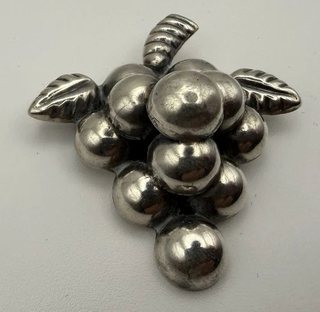
View on eBay

1930 Japan 10 Yen Wake no Kiyomaro Goou Shrine Note P-40a 519048 [Est. VF]

1930 Japan 10 Yen Banknote, Bank of Japan, Pick P-40a, {774} 519048 [Est. VF]

$17.63 1930 Est. VF Japan

Description

A Bank of Japan convertible note, 10 yen, ND (1930), with Wake no Kiyomaro and the Goou Shrine. Block 774, serial 519048. Pick P-40a (Numista N#206992).

Read the full description

Historical Context

Wake no Kiyomaro (733-799) was a court official remembered for his loyalty to the throne.

Condition

[Est. VF] Light circulation, with a diagonal crease at the top-left corner (no tear or chips); see the photos. Grade estimated; not professionally graded.

Legal Tender

No longer legal tender: not on the Bank of Japan list of notes still valid. Sold as a collectible.

Disclaimer

The images and any video show the actual item and are part of the official listing description, so please review them closely. Measurements and weights are approximate, and any maker or material we haven't confirmed is described as assumed. Questions? Message us; we answer quickly.

View on eBay

1916 Japan 1 Yen Silver Note Takenouchi no Sukune P-30c 297143 [Est. VF]

1916 Japan 1 Yen Banknote, Bank of Japan, Pick P-30c, {405} 297143 [Est. VF]

$17.63 1916 Est. VF Japan

Description

A Bank of Japan convertible silver note, 1 yen, ND (1916), with Takenouchi no Sukune. Block 405, serial 297143. Pick P-30c (Numista N#208109).

Read the full description

Historical Context

A convertible silver note, once exchangeable for 1 yen in silver. Takenouchi no Sukune is a legendary statesman of the early Japanese chronicles.

Condition

[Est. VF] Light circulation with folds; see the photos. Grade estimated; not professionally graded.

Legal Tender

Still legal tender in Japan at face value (on the Bank of Japan list of valid notes), but worth more to collectors.

Disclaimer

The images and any video show the actual item and are part of the official listing description, so please review them closely. Measurements and weights are approximate, and any maker or material we haven't confirmed is described as assumed. Questions? Message us; we answer quickly.

View on eBay

1944 Japan 5 Sen WWII Samurai Kusunoki Statue Banknote P-52a Block 5 [Est. UNC]

1944 Japan 5 Sen Banknote, Bank of Japan, WWII, Kusunoki Masashige statue, Pick P-52a, Block 5 [Est. UNC]

$17.47 1944 Est. UNC Japan

Description

A Bank of Japan 5 sen note, ND (1944), Pick P-52a (Numista N#205534). The front shows the equestrian statue of Kusunoki Masashige with two red seals, on an orange underprint; the back is brown with the 5 sen value and a paulownia crest. Block 5, printed in red at upper left and lower right; no serial number on this type. The close-ups show the statue and the seals.

Read the full description

Historical Context

Issued from November 1, 1944, in the last year of World War II. Kusunoki Masashige was a 14th-century samurai remembered in Japan for his loyalty to the emperor; his statue stands outside the Imperial Palace in Tokyo.

Condition

[Est. UNC] Uncirculated (checked in hand). Wartime paper with its natural cream-to-tan tone; see the photos. Grade estimated; not professionally graded.

Legal Tender

No longer legal tender: amounts under 1 yen were voided at the end of 1953 (Bank of Japan). Sold as a collectible.

Disclaimer

The images and any video show the actual item and are part of the official listing description, so please review them closely. Measurements and weights are approximate, and any maker or material we haven't confirmed is described as assumed. Questions? Message us; we answer quickly.

View on eBay

1880s Trade Card Dilworth's Coffee Children Riding Donkeys on the Beach Urn

1880s Trade Card Dilworth's Coffee Children Riding Donkeys on the Beach Urn — Two children ride donkeys along the sand by the sea: a boy in a white sailor suit and blue cap on a dark brown donkey, and a girl in a white bonnet and pink dress on a grey one, holding the reins. Approx. 2.50 x 3.25 in.

$17.44 Advertising Sales Trade Cards

Description

Two children ride donkeys along the sand by the sea: a boy in a white sailor suit and blue cap on a dark brown donkey, and a girl in a white bonnet and pink dress on a grey one, holding the reins. At upper right is a small emblem of an ornate urn on feet, likely a coffee urn (best reading). The front carries no text.

The back is printed in black: "Dilworth's Coffee ✣ BECAUSE: ✣ IS UNEQUALLED". The rest of the back is blank. The back reads across the long side of the card.

Approx. 2.50 x 3.25 in.

Read the full description

Historical Context

Coffee by the package. In the 1880s branded, packaged coffee was pushing out loose beans sold from the grocer's bin, and roasters handed out picture cards to win loyal customers. Dilworth's answer to why its coffee was best: "because" it is unequalled.

Donkey rides on the sand. A sailor-suited boy and a bonneted girl on a pair of shaggy donkeys capture a favorite Victorian seaside pleasure, for collectors of children, beach and donkey subjects.

Condition

Front: very good, with bright color, light toning, light edge wear and lightly rounded corners. Back: water staining with tide lines across the top band and below the printing, several round stain spots near the bottom, a scuffed patch of surface at the upper right corner, a few small specks, and overall toning. Please see the photos, which are part of the description.

About The Printing

This is an original chromolithograph, and it was slow, exacting work. Each color had to be drawn onto its own separate stone by hand — in monochrome, the artist judging how much stipple each area needed so the colors would combine correctly only once every stone had been printed. The sheet then went through the press once for every color it carries, often a dozen or more, and every pass had to register exactly against the last. A pass out of register showed.

Under magnification the image resolves into irregular hand-drawn stipple, each ink carrying its own dot pattern, the colors mixing in the eye rather than on the paper. There is no regular halftone screen and no four-color rosette, which is what a modern reproduction would show. Modern process printing simulates every color from four inks; chromolithography laid each color down as its own.

The back is printed in black type, separate from the color work on the front.

Provenance

From my family's estate collections, built over more than 60 years by knowledgeable antiques collectors and traders. Stored in a climate-controlled environment.

Also In Our Store

More Victorian advertising trade cards for coffee, spices and baking soda are in our store.

Disclaimer

The images and any video show the actual item and are part of the official listing description, so please review them closely. Measurements and weights are approximate, and any maker or material we haven't confirmed is described as assumed. Questions? Message us; we answer quickly.

View on eBay

1930 Japan 10 Yen Wake no Kiyomaro Goou Shrine Note P-40a 068899 [Est. VF]

1930 Japan 10 Yen Banknote, Bank of Japan, Pick P-40a, {940} 068899 [Est. VF]

$17.37 1930 Est. VF Japan

Description

A Bank of Japan convertible note, 10 yen, ND (1930), with Wake no Kiyomaro and the Goou Shrine. Block 940, serial 068899. Pick P-40a (Numista N#206992).

Read the full description

Historical Context

Wake no Kiyomaro (733-799) was a court official remembered for his loyalty to the throne.

Condition

[Est. VF] Light circulation. "33" written in ink on the back (permanent), and a faint, mostly erased pencil "33"; see the photos. Grade estimated; not professionally graded.

Legal Tender

No longer legal tender: not on the Bank of Japan list of notes still valid. Sold as a collectible.

Disclaimer

The images and any video show the actual item and are part of the official listing description, so please review them closely. Measurements and weights are approximate, and any maker or material we haven't confirmed is described as assumed. Questions? Message us; we answer quickly.

View on eBay

Arbuckle Coffee Trade Card No 22 Lisbon Portugal Belem Trip Around the World

Arbuckle Coffee Trade Card No 22 Lisbon Portugal Belem Trip Around the World — Original Victorian advertising trade card, chromolithograph, copyright 1891. Approx. 5.05 x 3.05 in. Printed by Joseph P. Knapp, Lith., N.Y.

$17.33 Advertising Sales Trade Cards

Description

Arbuckle Bros Ariosa Coffee — “Lisbon, Portugal,” No. 22 of 50 Views from a Trip Around the World

A harbor view of Lisbon from Fort Almeida, with sailing ships on the Tagus and the city climbing the hills beyond, is surrounded by vignettes: the Royal Castle; Belem Castle, the fortified tower at the water's edge; A Sport, a mustached man in a wide-brimmed hat; and A Lisbon Lady in a striped headscarf, with bunches of grapes and vine leaves trailing between them. Lettered at the foot: LISBON, PORTUGAL, and along the left edge, COPYRIGHT 1891 BY ARBUCKLE BROS. N.Y.

The reverse is headed One of 50 views from a trip around the world. The left column carries Arbuckle's GRIND YOUR COFFEE AT HOME advice and the ARIOSA COFFEE claim; the right column is a travel sketch of Lisbon and its history, ending with the city's population. The card is numbered 22.

Read the full description

Historical Context

This is the travel series, the same one as the Dublin card: fifty stops on an armchair tour of the world, one to a package of coffee. For a family in Kansas in 1891, the tower at Belem and the grape arbors of Portugal were exactly as far away as the moon, and a card like this was how they arrived.

The grapevine running through the design is the clue to what Portugal meant to an American of the period — wine and port, the country's best-known export.

Condition

Toning and age typical of the period. Light surface soiling; minor edge and corner wear; toning to the reverse. The chromolithographed image remains bright and the reverse text fully legible. Please view the images carefully.

About The Printing

This is an original chromolithograph, and it was slow, exacting work. Each color had to be drawn onto its own separate stone by hand — in monochrome, the artist judging how much stipple each area needed so the colors would combine correctly only once every stone had been printed. The sheet then went through the press once for every color it carries, often a dozen or more, and every pass had to register exactly against the last. A pass out of register showed.

Under magnification the image resolves into irregular hand-drawn stipple, each ink carrying its own dot pattern, the colors mixing in the eye rather than on the paper. There is no regular halftone screen and no four-color rosette, which is what a modern reproduction would show. Modern process printing simulates every color from four inks; chromolithography laid each color down as its own.

Provenance

From my family's estate collections, built over more than 60 years by knowledgeable antiques collectors and traders. Stored in a climate-controlled environment.

Also In Our Store

More Victorian advertising trade cards are in our store.

Disclaimer

The images and any video show the actual item and are part of the official listing description, so please review them closely. Measurements and weights are approximate, and any maker or material we haven't confirmed is described as assumed. Questions? Message us; we answer quickly.

View on eBay

1967-1972 Singapore 1 Dollar Orchid Series Banknote Vanda Orchid HDB Flats

Singapore 1 Dollar Orchid Series Banknote (1967-1972), Vanda Orchid, Lion and Tiger Arms, Housing Board Flats Back, Bradbury Wilkinson

$17.27 1967 Singapore

Description

Front: a spray of pink Vanda orchids and the arms of Singapore. Back: Housing and Development Board flats, printed by Bradbury, Wilkinson & Co., New Malden, Surrey, England.

Read the full description

Details

Issuer: Board of Commissioners of Currency, Singapore

Denomination: 1 Dollar

Series: Orchid Series (first Singapore series, 1967-1972)

Serial: B/71 591695 (best reading)

Signature: Hon Sui Sen (best reading)

Size: approx. 121 x 64 mm

Condition

Crisp, with a faint vertical center fold visible on the back. Please see the photos for condition; the grade has not been certified.

The images and any video show the actual item and are part of the official listing description, so please review them closely. Measurements and weights are approximate, and any maker or material we haven't confirmed is described as assumed. Questions? Message us; we answer quickly.

View on eBay

1889 Arbuckle Coffee Trade Card No 55 Oregon State Map Salmon Fisheries Fishing

1889 Arbuckle Coffee Trade Card No 55 Oregon State Map Salmon Fisheries Fishing — Original Victorian advertising trade card, chromolithograph, copyright 1889 by Arbuckle Bros., N.Y. Approx. 5.05 x 3.05 in.

$17.19 1889 Advertising Sales Trade Cards

Description

Arbuckle Bros Ariosa Coffee — Oregon, State Map No. 55

A colored map of Oregon, its towns and rivers lettered in, with Washington Territory to the north and California, Nevada and Idaho at the borders. Beside it a fisherman in a slouch hat and waders stands in the river landing a salmon in a net, two salmon hang on a line at the left, and a stack of red SALMON cans fills the lower corner. Lettered: SALMON FISHERIES. Area in Sq. Miles 96,030. Population 174,768.

The reverse is headed ARBUCKLES' Ariosa Coffee, COSTS MORE AND IS WORTH MORE THAN OTHER BRANDS OF COFFEE. WHY? Four numbered reasons follow: the coffee is made from green coffee of higher grade; its strength and aroma are retained by the glazing; the glazing is made of choice eggs and pure confectioners' “A” sugar; and it adds richness of flavor. A BEWARE paragraph warns against low-grade package coffee. A second column, READ THIS, explains the series — fifty cards, each showing a correct map of one State or Territory with pictures of its peculiar industries and scenery — and suggests that anyone with two cards of one kind exchange with a neighbor. A list of the states and territories represented follows. Arbuckle Bros. Coffee Company, New York. The card is numbered 55. Printed by Donaldson Brothers, N.Y.

Read the full description

Historical Context

Oregon's picture is its industry: salmon, caught in the rivers and canned for shipment east. The cans in the corner are the whole story of the Columbia River in the 1880s — a fish that had fed the region for thousands of years, turning into a product sold in grocery stores across the country.

Watch the northern border. The card labels Washington T., for Territory. Washington became a state in November 1889, so this map was drawn just before it happened.

Condition

Toning and age typical of the period. Light surface soiling; minor edge and corner wear; toning to the reverse. The chromolithographed image remains bright and the reverse text fully legible. Please view the images carefully.

About The Printing

This is an original chromolithograph, and it was slow, exacting work. Each color had to be drawn onto its own separate stone by hand — in monochrome, the artist judging how much stipple each area needed so the colors would combine correctly only once every stone had been printed. The sheet then went through the press once for every color it carries, often a dozen or more, and every pass had to register exactly against the last. A pass out of register showed.

Under magnification the image resolves into irregular hand-drawn stipple, each ink carrying its own dot pattern, the colors mixing in the eye rather than on the paper. There is no regular halftone screen and no four-color rosette, which is what a modern reproduction would show. Modern process printing simulates every color from four inks; chromolithography laid each color down as its own.

Provenance

From my family's estate collections, built over more than 60 years by knowledgeable antiques collectors and traders. Stored in a climate-controlled environment.

Also In Our Store

More Victorian advertising trade cards are in our store.

Disclaimer

The images and any video show the actual item and are part of the official listing description, so please review them closely. Measurements and weights are approximate, and any maker or material we haven't confirmed is described as assumed. Questions? Message us; we answer quickly.

View on eBay

1889 Arbuckle Coffee Trade Card No 54 Pennsylvania State Map Coal Iron Oil Well

1889 Arbuckle Coffee Trade Card No 54 Pennsylvania State Map Coal Iron Oil Well — Original Victorian advertising trade card, chromolithograph, copyright 1889 by Arbuckle Bros., N.Y. Approx. 5.05 x 3.05 in.

$17.08 1889 Advertising Sales Trade Cards

Description

Arbuckle Bros Ariosa Coffee — Pennsylvania, State Map No. 54

A colored map of Pennsylvania, its towns and ranges lettered in, framed by vignettes of the state's industries: Shooting an Oil Well, with derricks on the hillside; Loading a Coal Barge; a Blast Furnace; Rolling Rails in a steel mill; and an Oil Refinery with a train of tank cars. Lettered at the foot: COAL - IRON - OIL. Area 45,215 Sq. Miles. Population 4,282,891.

The reverse is headed ARBUCKLES' Ariosa Coffee, COSTS MORE AND IS WORTH MORE THAN OTHER BRANDS OF COFFEE. WHY? Four numbered reasons follow: the coffee is made from green coffee of higher grade; its strength and aroma are retained by the glazing; the glazing is made of choice eggs and pure confectioners' “A” sugar; and it adds richness of flavor. A BEWARE paragraph warns against low-grade package coffee. A second column, READ THIS, explains the series — fifty cards, each showing a correct map of one State or Territory with pictures of its peculiar industries and scenery — and suggests that anyone with two cards of one kind exchange with a neighbor. A list of the states and territories represented follows. Arbuckle Bros. Coffee Company, New York. The card is numbered 54. Printed by Donaldson Brothers, N.Y.

Read the full description

Historical Context

COAL - IRON - OIL is Pennsylvania in three words, and in 1889 it was the industrial heart of the country. The first commercial oil well had been drilled in the state thirty years before, and the vignettes follow the chain from the ground to the railroad: dig it, smelt it, roll it, ship it.

“Shooting” an oil well meant dropping explosives down the bore to crack the rock and start the oil flowing — dangerous work, and a spectacle people came to watch.

Condition

Toning and age typical of the period. Light surface soiling; minor edge and corner wear; toning to the reverse. The chromolithographed image remains bright and the reverse text fully legible. Please view the images carefully.

About The Printing

This is an original chromolithograph, and it was slow, exacting work. Each color had to be drawn onto its own separate stone by hand — in monochrome, the artist judging how much stipple each area needed so the colors would combine correctly only once every stone had been printed. The sheet then went through the press once for every color it carries, often a dozen or more, and every pass had to register exactly against the last. A pass out of register showed.

Under magnification the image resolves into irregular hand-drawn stipple, each ink carrying its own dot pattern, the colors mixing in the eye rather than on the paper. There is no regular halftone screen and no four-color rosette, which is what a modern reproduction would show. Modern process printing simulates every color from four inks; chromolithography laid each color down as its own.

Provenance

From my family's estate collections, built over more than 60 years by knowledgeable antiques collectors and traders. Stored in a climate-controlled environment.

Also In Our Store

More Victorian advertising trade cards are in our store.

Disclaimer

The images and any video show the actual item and are part of the official listing description, so please review them closely. Measurements and weights are approximate, and any maker or material we haven't confirmed is described as assumed. Questions? Message us; we answer quickly.

View on eBay

1889 Arbuckle Coffee Trade Card No 61 Kentucky Map Racehorse Whisky Distillery

1889 Arbuckle Coffee Trade Card No 61 Kentucky Map Racehorse Whisky Distillery — Original Victorian advertising trade card, chromolithograph, copyright 1889 by Arbuckle Bros., N.Y. Approx. 5.05 x 3.10 in.

$17.04 1889 Advertising Sales Trade Cards

Description

Arbuckle Bros Ariosa Coffee — Kentucky, State Map No. 61

A colored map of Kentucky, its towns and rivers lettered in, with Ohio, Indiana, Illinois, Missouri, Tennessee, Virginia and West Virginia around it. Above the map a jockey in yellow silks sits a chestnut racehorse in a paddock, captioned THOROUGHBRED STOCK, BLUE GRASS REGION, and a horseshoe frames a second rider. At the right is the interior of a WHISKY DISTILLERY, a copper still and a man tending the fire. Area in Sq. Miles 40,400. Population 1,648,690.

The reverse is headed ARBUCKLES' Ariosa Coffee, COSTS MORE AND IS WORTH MORE THAN OTHER BRANDS OF COFFEE. WHY? Four numbered reasons follow: the coffee is made from green coffee of higher grade; its strength and aroma are retained by the glazing; the glazing is made of choice eggs and pure confectioners' “A” sugar; and it adds richness of flavor. A BEWARE paragraph warns against low-grade package coffee. A second column, READ THIS, explains the series — fifty cards, each showing a correct map of one State or Territory with pictures of its peculiar industries and scenery — and suggests that anyone with two cards of one kind exchange with a neighbor. A list of the states and territories represented follows. Arbuckle Bros. Coffee Company, New York. The card is numbered 61. Printed by Donaldson Brothers, N.Y.

Read the full description

Historical Context

Horses and whiskey — Kentucky's reputation was already fixed by 1889, and the card simply prints it. The Kentucky Derby had been run for fifteen years, and Bluegrass bourbon was sold across the country.

The spelling “whisky,” without the e, is what the card uses. American distillers of the period used both.

Condition

Toning and age typical of the period. White abrasions and small patches of surface loss across the distillery vignette in the upper right; small creases; minor edge and corner wear; toning to the reverse. The racehorse and the map remain bright and the reverse text fully legible. Please view the images carefully.

About The Printing

This is an original chromolithograph, and it was slow, exacting work. Each color had to be drawn onto its own separate stone by hand — in monochrome, the artist judging how much stipple each area needed so the colors would combine correctly only once every stone had been printed. The sheet then went through the press once for every color it carries, often a dozen or more, and every pass had to register exactly against the last. A pass out of register showed.

Under magnification the image resolves into irregular hand-drawn stipple, each ink carrying its own dot pattern, the colors mixing in the eye rather than on the paper. There is no regular halftone screen and no four-color rosette, which is what a modern reproduction would show. Modern process printing simulates every color from four inks; chromolithography laid each color down as its own.

Provenance

From my family's estate collections, built over more than 60 years by knowledgeable antiques collectors and traders. Stored in a climate-controlled environment.

Also In Our Store

More Victorian advertising trade cards are in our store.

Disclaimer

The images and any video show the actual item and are part of the official listing description, so please review them closely. Measurements and weights are approximate, and any maker or material we haven't confirmed is described as assumed. Questions? Message us; we answer quickly.

View on eBay

1889 Arbuckle Coffee Trade Card No 57 West Virginia State Map Oil Refinery Train

1889 Arbuckle Coffee Trade Card No 57 West Virginia State Map Oil Refinery Train — Original Victorian advertising trade card, chromolithograph, copyright 1889 by Arbuckle Bros., N.Y. Approx. 5.05 x 3.05 in.

$17.01 1889 Advertising Sales Trade Cards

Description

Arbuckle Bros Ariosa Coffee — West Virginia, State Map No. 57

A colored map of West Virginia, its towns and rivers lettered in, with Ohio, Pennsylvania, Maryland, Virginia and Kentucky around it. At the right an oil refinery rises behind a train of tank cars, smokestacks and storage tanks under a dark sky, captioned OIL REFINERY. Area in Sq. Miles 24,780. Population 618,457.

The reverse is headed ARBUCKLES' Ariosa Coffee, COSTS MORE AND IS WORTH MORE THAN OTHER BRANDS OF COFFEE. WHY? Four numbered reasons follow: the coffee is made from green coffee of higher grade; its strength and aroma are retained by the glazing; the glazing is made of choice eggs and pure confectioners' “A” sugar; and it adds richness of flavor. A BEWARE paragraph warns against low-grade package coffee. A second column, READ THIS, explains the series — fifty cards, each showing a correct map of one State or Territory with pictures of its peculiar industries and scenery — and suggests that anyone with two cards of one kind exchange with a neighbor. A list of the states and territories represented follows. Arbuckle Bros. Coffee Company, New York. The card is numbered 57. Printed by Donaldson Brothers, N.Y.

Read the full description

Historical Context

West Virginia was barely a quarter-century old when this card was printed, having split from Virginia during the Civil War. The map makes the point quietly, with Virginia drawn as a separate state along the eastern border.

The refinery and the tank cars show what the new state was selling. Oil and gas had been found along its rivers, and the railroad carried it out.

Condition

Toning and age typical of the period. A few small brown spots in the upper part of the image; light surface soiling; minor edge and corner wear; toning to the reverse. The chromolithographed image remains bright and the reverse text fully legible. Please view the images carefully.

About The Printing

This is an original chromolithograph, and it was slow, exacting work. Each color had to be drawn onto its own separate stone by hand — in monochrome, the artist judging how much stipple each area needed so the colors would combine correctly only once every stone had been printed. The sheet then went through the press once for every color it carries, often a dozen or more, and every pass had to register exactly against the last. A pass out of register showed.

Under magnification the image resolves into irregular hand-drawn stipple, each ink carrying its own dot pattern, the colors mixing in the eye rather than on the paper. There is no regular halftone screen and no four-color rosette, which is what a modern reproduction would show. Modern process printing simulates every color from four inks; chromolithography laid each color down as its own.

Provenance

From my family's estate collections, built over more than 60 years by knowledgeable antiques collectors and traders. Stored in a climate-controlled environment.

Also In Our Store

More Victorian advertising trade cards are in our store.

Disclaimer

The images and any video show the actual item and are part of the official listing description, so please review them closely. Measurements and weights are approximate, and any maker or material we haven't confirmed is described as assumed. Questions? Message us; we answer quickly.

View on eBay

2009 Costa Rica 5000 Colones Capuchin Monkey Banknote P-276a [Est. F-VF]

2 September 2009 Costa Rica 5000 Colones Banknote, Alfredo Gonzalez Flores / Mangrove with Capuchin Monkey, Pick P-276a, Serial A017560209 [Est. F-VF]

$16.97 2009 Est. F-VF Costa Rica

Description

Cotton-paper note issued by the Banco Central de Costa Rica and printed by Oberthur. Front: Alfredo Gonzalez Flores with the Banco Internacional de Costa Rica building and a color-shifting map of Costa Rica; back: a mangrove (MANGLAR) with a white-faced capuchin monkey, a crab and flowers. Portrait watermark and a color-shifting windowed thread. Serial A017560209. Measured on the 1200 dpi scan: 140.0 x 67.4 mm. The close-ups show the serial, the date, Gonzalez Flores and the capuchin monkey. The last image adds a millimeter scale.

Read the full description

Historical Context

Alfredo Gonzalez Flores (1877-1962) was president from 1914 to 1917. He created the International Bank of Costa Rica, today the Banco Nacional, and introduced direct taxation before his war minister, Federico Tinoco, overthrew him on 27 January 1917. The design entered circulation on 27 August 2012.

Condition

[Est. F-VF] Circulated, with several folds and creases including a vertical center fold and a horizontal fold, overall soiling and rounded corners. A small handwritten '12' in blue is on the back left panel, and a small brown spot sits at the bottom edge on the front. No tears, holes or tape. Grade estimated from the scans; not professionally graded.

Legal Tender

No longer legal tender: withdrawn on 1 March 2022; it can still be exchanged or deposited at Costa Rican financial institutions with no time limit (BCCR).

Disclaimer

The images and any video show the actual item and are part of the official listing description, so please review them closely. Measurements and weights are approximate, and any maker or material we haven't confirmed is described as assumed. Questions? Message us; we answer quickly.

View on eBay

1971-D Eisenhower Ike Dollar Denver First Year Apollo 11 KM#203 [Est. AU55]

1971-D Eisenhower Dollar, Denver Mint, Apollo 11 Eagle Landing on the Moon Reverse, Copper-Nickel Clad, Original Never Cleaned, KM#203 [Est. AU55]

$16.94 1971 Est. AU55 Eisenhower Dollars

Description

A 1971-D Eisenhower dollar struck at the Denver Mint, with the D mint mark below the neck, above the date. The obverse by Chief Engraver Frank Gasparro shows President Dwight D. Eisenhower facing left; his initials FG are on the neck truncation. The reverse, adapted from the Apollo 11 mission insignia, shows an eagle landing on the Moon with an olive branch, the Earth above. The reverse shows the three islands to the right of Florida (Type 1 Earth); not attributed as a variety. Copper-nickel clad, 22.7 grams, 38.1 mm, reeded edge. The close-ups show the date and mint mark, the portrait and the Earth and the eagle on the Moon.

Read the full description

Historical Context

The Eisenhower dollar was struck from 1971 to 1978. 1971-D was the first year of the Eisenhower dollar, two years after Apollo 11. The eagle-on-the-Moon reverse is adapted from the Apollo 11 mission insignia. Mintage at Denver: 68,587,424.

Buying Power

In 1971 this dollar had the buying power of about $8.25 today.

Condition

[Est. AU55] Circulated, original and never cleaned. Full rims; LIBERTY, IN GOD WE TRUST, the date and ONE DOLLAR are sharp. Light wear on the cheekbone and the hair above the ear; light wear on the eagle's head and breast feathers. Contact marks and light scratches typical of a large dollar coin that circulated (see the close-ups). Checked for the Friendly Eagle variety: not attributed. Grade estimated; not professionally graded. Currently still legal tender, but worth more to collectors than face value.

Also In Our Store

More coins: https://www.ebay.com/str/tfauctionsintl?_nkw=coin

Disclaimer

The images and any video show the actual item and are part of the official listing description, so please review them closely. Measurements and weights are approximate, and any maker or material we haven't confirmed is described as assumed. Questions? Message us; we answer quickly.

View on eBay

1972 Eisenhower Ike Dollar Philadelphia Apollo Moon Landing KM#203 [Est. AU55]

1972 Eisenhower Dollar, Philadelphia Mint (no mint mark), Apollo 11 Eagle Landing on the Moon Reverse, Copper-Nickel Clad, Original Never Cleaned, KM#203 [Est. AU55]

$16.94 1972 Est. AU55 Eisenhower Dollars

Description

A 1972 Eisenhower dollar struck at the Philadelphia Mint (no mint mark). The obverse by Chief Engraver Frank Gasparro shows President Dwight D. Eisenhower facing left; his initials FG are on the neck truncation. The reverse, adapted from the Apollo 11 mission insignia, shows an eagle landing on the Moon with an olive branch, the Earth above. Copper-nickel clad, 22.7 grams, 38.1 mm, reeded edge. The close-ups show the date, the portrait and the Earth and the eagle on the Moon.

Read the full description

Historical Context

The Eisenhower dollar was struck from 1971 to 1978. 1972 was the year of Apollo 16 and Apollo 17. Apollo 17 in December 1972 was the last crewed Moon landing to date. Mintage at Philadelphia: 75,890,000.

Buying Power

In 1972 this dollar had the buying power of about $7.99 today.

Condition

[Est. AU55] Circulated, original and never cleaned. Full rims; LIBERTY, IN GOD WE TRUST, the date and ONE DOLLAR are sharp. Light wear on the cheekbone and the hair above the ear; light wear on the eagle's head and breast feathers. Contact marks and light scratches typical of a large dollar coin that circulated (see the close-ups). Checked for the 1972 Type 2 reverse: islands present, not Type 2. Grade estimated; not professionally graded. Currently still legal tender, but worth more to collectors than face value.

Also In Our Store

More coins: https://www.ebay.com/str/tfauctionsintl?_nkw=coin

Disclaimer

The images and any video show the actual item and are part of the official listing description, so please review them closely. Measurements and weights are approximate, and any maker or material we haven't confirmed is described as assumed. Questions? Message us; we answer quickly.

View on eBay

1972-D Eisenhower Ike Dollar Denver Apollo Moon Landing KM#203 [Est. AU50]

1972-D Eisenhower Dollar, Denver Mint, Apollo 11 Eagle Landing on the Moon Reverse, Copper-Nickel Clad, Original Never Cleaned, KM#203 [Est. AU50]

$16.94 1972 Est. AU50 Eisenhower Dollars

Description

A 1972-D Eisenhower dollar struck at the Denver Mint, with the D mint mark below the neck, above the date. The obverse by Chief Engraver Frank Gasparro shows President Dwight D. Eisenhower facing left; his initials FG are on the neck truncation. The reverse, adapted from the Apollo 11 mission insignia, shows an eagle landing on the Moon with an olive branch, the Earth above. Copper-nickel clad, 22.7 grams, 38.1 mm, reeded edge. The close-ups show the date and mint mark, the portrait and the Earth and the eagle on the Moon.

Read the full description

Historical Context

The Eisenhower dollar was struck from 1971 to 1978. 1972-D was the year of Apollo 16 and Apollo 17. Apollo 17 in December 1972 was the last crewed Moon landing to date. Mintage at Denver: 92,548,511.

Buying Power

In 1972 this dollar had the buying power of about $7.99 today.

Condition

[Est. AU50] Circulated, original and never cleaned. Full rims; LIBERTY, IN GOD WE TRUST, the date and ONE DOLLAR are sharp. Light wear on the cheekbone and the hair above the ear; light wear on the eagle's head and breast feathers. Contact marks and light scratches typical of a large dollar coin that circulated (see the close-ups). Checked for listed varieties: none seen. Grade estimated; not professionally graded. Currently still legal tender, but worth more to collectors than face value.

Also In Our Store

More coins: https://www.ebay.com/str/tfauctionsintl?_nkw=coin

Disclaimer

The images and any video show the actual item and are part of the official listing description, so please review them closely. Measurements and weights are approximate, and any maker or material we haven't confirmed is described as assumed. Questions? Message us; we answer quickly.

View on eBay

1974-D Eisenhower Ike Dollar Denver Apollo Moon Landing KM#203 [Est. AU55]

1974-D Eisenhower Dollar, Denver Mint, Apollo 11 Eagle Landing on the Moon Reverse, Copper-Nickel Clad, Original Never Cleaned, KM#203 [Est. AU55]

$16.94 1974 Est. AU55 Eisenhower Dollars

Description

A 1974-D Eisenhower dollar struck at the Denver Mint, with the D mint mark below the neck, above the date. The obverse by Chief Engraver Frank Gasparro shows President Dwight D. Eisenhower facing left; his initials FG are on the neck truncation. The reverse, adapted from the Apollo 11 mission insignia, shows an eagle landing on the Moon with an olive branch, the Earth above. Copper-nickel clad, 22.7 grams, 38.1 mm, reeded edge. The close-ups show the date and mint mark, the portrait and the Earth and the eagle on the Moon.

Read the full description

Historical Context

The Eisenhower dollar was struck from 1971 to 1978. 1974-D was the year Richard Nixon resigned the presidency (August 1974). Mintage at Denver: 45,517,000.

Buying Power

In 1974 this dollar had the buying power of about $6.77 today.

Condition

[Est. AU55] Circulated, original and never cleaned. Full rims; LIBERTY, IN GOD WE TRUST, the date and ONE DOLLAR are sharp. Light wear on the cheekbone and the hair above the ear; light wear on the eagle's head and breast feathers. Contact marks and light scratches typical of a large dollar coin that circulated (see the close-ups). Checked for listed varieties: none seen. Grade estimated; not professionally graded. Currently still legal tender, but worth more to collectors than face value.

Also In Our Store

More coins: https://www.ebay.com/str/tfauctionsintl?_nkw=coin

Disclaimer

The images and any video show the actual item and are part of the official listing description, so please review them closely. Measurements and weights are approximate, and any maker or material we haven't confirmed is described as assumed. Questions? Message us; we answer quickly.

View on eBay

1977-D Eisenhower Ike Dollar Denver Apollo Moon Landing KM#203 [Est. AU58]

1977-D Eisenhower Dollar, Denver Mint, Apollo 11 Eagle Landing on the Moon Reverse, Copper-Nickel Clad, Original Never Cleaned, KM#203 [Est. AU58]

$16.94 1977 Est. AU58 Eisenhower Dollars

Description

A 1977-D Eisenhower dollar struck at the Denver Mint, with the D mint mark below the neck, above the date. The obverse by Chief Engraver Frank Gasparro shows President Dwight D. Eisenhower facing left; his initials FG are on the neck truncation. The reverse, adapted from the Apollo 11 mission insignia, shows an eagle landing on the Moon with an olive branch, the Earth above. Copper-nickel clad, 22.7 grams, 38.1 mm, reeded edge. The close-ups show the date and mint mark, the portrait and the Earth and the eagle on the Moon.

Read the full description

Historical Context

The Eisenhower dollar was struck from 1971 to 1978. 1977-D was the year Star Wars opened in theaters (May 1977). Mintage at Denver: 32,983,006.

Buying Power

In 1977 this dollar had the buying power of about $5.53 today.

Condition

[Est. AU58] Circulated, original and never cleaned. Full rims; LIBERTY, IN GOD WE TRUST, the date and ONE DOLLAR are sharp. Light wear on the cheekbone and the hair above the ear; light wear on the eagle's head and breast feathers. Contact marks and light scratches typical of a large dollar coin that circulated (see the close-ups). Checked for listed varieties: none seen. Grade estimated; not professionally graded. Currently still legal tender, but worth more to collectors than face value.

Also In Our Store

More coins: https://www.ebay.com/str/tfauctionsintl?_nkw=coin

Disclaimer

The images and any video show the actual item and are part of the official listing description, so please review them closely. Measurements and weights are approximate, and any maker or material we haven't confirmed is described as assumed. Questions? Message us; we answer quickly.

View on eBay

1880s Trade Card J & P Coats Thread Pippin Hill Lady Umbrella Spool Six Cord

1880s Trade Card J & P Coats Thread Pippin Hill Lady Umbrella Spool Six Cord — A lady in a long ruffled dress and bonnet curtsies on a muddy hill path, umbrella in hand, beside a large spool of Coats thread. Approx. 2.51 x 3.70 in.

$16.92 Advertising Sales Trade Cards

Description

A lady in a long ruffled dress and bonnet curtsies on a muddy hill path, umbrella in hand, beside a large spool of Coats thread. Lettered "White, Black & Colors for Hand & Machine," with the rhyme "As I was going up Pippin Hill, Pippin Hill was dirty, there I met a sweet pretty lass, and she dropped me a curtsey."

The back is printed in blue: "J. & P. COATS. Trade Mark for the United States ... Best Six-Cord Thread. For Sale Everywhere," with an engraved scene.

Approx. 2.51 x 3.70 in.

Read the full description

Historical Context

Thread from Paisley. J. & P. Coats was a Scottish thread firm of Paisley, which made its six-cord thread in the United States at Pawtucket, Rhode Island.

A nursery rhyme to sell thread. The old rhyme of Pippin Hill gives the card its charm.

Condition

Front: toning and edge wear, damage at the left edge. Back: toned, edge wear. Please see the photos, which are part of the description.

About The Printing

This is an original chromolithograph, and it was slow, exacting work. Each color had to be drawn onto its own separate stone by hand — in monochrome, the artist judging how much stipple each area needed so the colors would combine correctly only once every stone had been printed. The sheet then went through the press once for every color it carries, often a dozen or more, and every pass had to register exactly against the last. A pass out of register showed.

Under magnification the image resolves into irregular hand-drawn stipple, each ink carrying its own dot pattern, the colors mixing in the eye rather than on the paper. There is no regular halftone screen and no four-color rosette, which is what a modern reproduction would show. Modern process printing simulates every color from four inks; chromolithography laid each color down as its own.

The back is printed in a single blue ink.

Provenance

From my family's estate collections, built over more than 60 years by knowledgeable antiques collectors and traders. Stored in a climate-controlled environment.

Also In Our Store

More J. & P. Coats cards in our store: https://www.ebay.com/str/tfauctionsintl?_nkw=coats

More Victorian advertising trade cards are in our store.

Disclaimer

The images and any video show the actual item and are part of the official listing description, so please review them closely. Measurements and weights are approximate, and any maker or material we haven't confirmed is described as assumed. Questions? Message us; we answer quickly.

View on eBay

ca1922 Stecher Thanksgiving Postcard Turkey Farmhouse Verse Embossed Minnesota

ca1922 Stecher Lith. Co. "Glad Thanksgiving Greetings" Embossed Postcard, Bronze Turkey Before a Farmhouse, Decorative Red-and-Gold G-T-G Initials, Verse "Gratitude and Glee in Fullest Measure Be Yours on Thanksgiving Day," Series 72 B, Never Mailed, from Aunt Mary of Wegdahl to the Molins of Cannon Falls, Minnesota

$16.91 Thanksgiving Postcards

Description

A big bronze turkey, tail fanned and wattle bright red, stands in a green farmyard before a pink farmhouse and a white clapboard shed. The heading "Glad Thanksgiving Greetings" opens each word with a decorative red-and-gold initial, and the verse at lower right reads "Gratitude and Glee In fullest measure be Yours on Thanksgiving Day." Embossed, with a gold rule around the picture; the circle logo "STECHER LITH. CO. ROCH. N.Y." at lower left.

The back is a divided back with an ornate "POST CARD," "MADE IN U.S.A." and "Series 72 B." No stamp or postmark. Addressed in pencil to Mr. & Mrs. Victor Molin, Cannon Falls, Minn., and signed "from Aunt Mary, Wegdahl, Minn." "1922." is written at the top left.

Read the full description

Historical Context

Never mailed. Aunt Mary addressed the card and signed it with her town, but it never went through the post; it may have been delivered by hand or tucked into a letter.

Stecher. The Stecher Lithographic Company of Rochester, N.Y. grew from a printer of posters, labels and trade cards into a major maker of artist-drawn holiday postcards.

Condition

Very good. Bright colors and crisp embossing; light corner wear. Back evenly toned with a few small spots; pencil address and signature, "1922." at top left, and small pencil numbers (a circled "50" and "7").

About The Printing

This card is printed in halftone. Under magnification the colors resolve into a regular, even grid of dots rather than the irregular hand-drawn stipple of a chromolithograph. The turkey, buildings and lettering are embossed and show in relief on the back.

Provenance

From my family's estate collections, built over more than 60 years by knowledgeable antiques collectors and traders. Stored in a climate-controlled environment.

Also In Our Store

More Thanksgiving postcards from this group are in our store.

Disclaimer

The images and any video show the actual item and are part of the official listing description, so please review them closely. Measurements and weights are approximate, and any maker or material we haven't confirmed is described as assumed. Questions? Message us; we answer quickly.

View on eBay

1987 Costa Rica 1000 Colones Soley Guell Banknote P-256c [Est. VG]

1 June 1987 Costa Rica 1000 Colones Banknote, Tomas Soley Guell / National Insurance Institute, Pick P-256c, Serial C07326089 [Est. VG]

$16.89 1987 Est. VG Costa Rica

Description

Serie C note issued by the Banco Central de Costa Rica. Front: Tomas Soley Guell with a red curved-line design; back: the Instituto Nacional de Seguros building. Tree watermark with the legend 'Libre crezca fecundo'. Printed by the American Bank Note Company (1986-1989) or the United States Banknote Company (1990-1994); the printer imprint tells them apart. Serial C07326089. Measured on the 1200 dpi scan: 156.5 x 67.0 mm. Centering, measured on the scan: printed border well centered: front L/R 4.3/3.8, T/B 3.3/3.1 mm; back 7.0/6.9, 7.4/6.2 mm. The close-ups show the serial, the date, Tomas Soley Guell and the INS building. The last image adds a millimeter scale.

Read the full description

Historical Context

Tomas Soley Guell, a postmaster and congressional deputy, promoted the state insurance monopoly and created the National Insurance Bank, today the Instituto Nacional de Seguros. The colon has been Costa Rica's currency since 1896 and has never been redenominated.

Condition

[Est. VG] Heavily circulated, with a vertical center fold, a horizontal fold and two more vertical folds, heavy overall brown soiling and soft, rounded corners. Two strips of clear tape on the back, about 14 x 43 mm and 15 x 46 mm, reinforce splits along the vertical folds; one split, about 40 mm long, shows on the front through the portrait. A small pinkish stain sits at the right edge on the back. No holes or writing. Grade estimated from the scans; not professionally graded.

Legal Tender

No longer legal tender: withdrawn on 1 September 2011; it can still be exchanged or deposited at Costa Rican financial institutions with no time limit (BCCR).

Disclaimer

The images and any video show the actual item and are part of the official listing description, so please review them closely. Measurements and weights are approximate, and any maker or material we haven't confirmed is described as assumed. Questions? Message us; we answer quickly.

View on eBay

1989 Costa Rica 100 Colones Crumpled Survivor Banknote P-254a [Est. VG]

4 October 1989 Costa Rica 100 Colones Banknote, Ricardo Jimenez Oreamuno / Supreme Court Building, Pick P-254a, Serial F01907993 [Est. VG]

$16.89 1989 Est. VG Costa Rica

Description

Issued by the Banco Central de Costa Rica. Front: Ricardo Jimenez Oreamuno; back: the Corte Suprema de Justicia (Supreme Court) building. The design was printed by Thomas de la Rue, American Bank Note and Casa da Moeda do Brasil; the series letter and printer imprint identify the catalog number. Later issues have a repeated BCCR-100 watermark. Serial F01907993. Measured on the 1200 dpi scan: 154.7 x 66.0 mm. The close-ups show the serial, the date, Ricardo Jimenez and the Supreme Court building. The last image adds a millimeter scale.

Read the full description

Historical Context

Ricardo Jimenez Oreamuno (1859-1945) was president three times (1910-1914, 1924-1928 and 1932-1936) and also headed the Supreme Court and Congress, the only person to lead all three branches of government. The 100 colones later became a coin, first dated 1995.

Condition

[Est. VG] Heavy circulation: crumpled all over with a dense network of creases plus vertical, horizontal and diagonal folds. Heavy grey-brown soiling, fuzzy edges and rounded corners. No tears, holes or writing. Grade estimated from the scans; not professionally graded.

Legal Tender

No longer legal tender: catalogs list it as demonetized (date not found), and the 100 colones is now a coin.

Disclaimer

The images and any video show the actual item and are part of the official listing description, so please review them closely. Measurements and weights are approximate, and any maker or material we haven't confirmed is described as assumed. Questions? Message us; we answer quickly.

View on eBay

Victorian Trade Card Round Oak Stove Beckwith Crittendon Wilson West Concord MN

The Round Oak Stove — Crittendon & Wilson, West Concord, Minnesota

$16.68 Advertising Sales Trade Cards

Original Victorian advertising trade card, chromolithograph, c. 1880s-90s. Approx. 4.85 x 3.35 in.

A young woman in profile, her dark hair gathered up, wears a pearl necklace and an apricot gown trimmed with lace and white flowers, against a brushed blue-green ground. Lettered in the upper left: “The Name Tells.”

On the reverse the text is set inside an outline drawing of the stove itself: The ROUND OAK, Makes 'Em Hustle, 5 SIZES FOR COAL OR WOOD, With low down Fire Pot, and air tight Bottom, making a PERFECT FIRE KEEPER. Has Spun Urn, Nickeled Rail and Top Ring, Name Plates, Knobs and Hinge Pins. Fittings strictly first-class. EVERY STOVE FULLY WARRANTED. BEWARE OF IMITATIONS. The Genuine Bears the Name of P. D. BECKWITH, DOWAGIAC, MICH. The local dealer's name is overprinted in heavier type across the foot: CRITTENDON & WILSON, West Concord, Minn.

Read the full description

Historical Context

“The Name Tells” and “Beware of Imitations” are the same message from two sides. The Round Oak was copied widely enough that the maker put his own name on every stove and told customers to look for it. The pretty face on the front is there to be kept; the warning on the back is the reason the card was printed.

The dealer imprint is what makes this one. The stove was sold across the country, but this card was handed across the counter in West Concord, Minnesota, a small town with a hardware store that stocked the Round Oak. National brand, local shop.

Condition

Toning and age typical of the period. A chip to the lower-right corner of the card; a small nick at the left edge; a toned, unprinted strip along the top edge; rounded, worn corners; toning to the reverse. The portrait on the front remains bright and the reverse text fully legible. Please view the images carefully.

About The Printing

This is an original chromolithograph, and it was slow, exacting work. Each color had to be drawn onto its own separate stone by hand — in monochrome, the artist judging how much stipple each area needed so the colors would combine correctly only once every stone had been printed. The sheet then went through the press once for every color it carries, often a dozen or more, and every pass had to register exactly against the last. A pass out of register showed.

Under magnification the image resolves into irregular hand-drawn stipple, each ink carrying its own dot pattern, the colors mixing in the eye rather than on the paper. There is no regular halftone screen and no four-color rosette, which is what a modern reproduction would show. Modern process printing simulates every color from four inks; chromolithography laid each color down as its own.

Provenance

This item comes from the personal collections of my family estate, accumulated over more than 200 years — including items that came west by wagon train to Colorado and later to Oklahoma. Now that my parents have passed we cannot keep all of these cherished items. They were well-educated antiques collectors/traders and continued to build their collections over more than 60 years. The vast majority of the pieces are from the Victorian Era, however there are plenty of older and newer items. Everything has been stored in a climate-controlled environment over time.

Disclaimer

Specifications and detailed item descriptions are provided as a courtesy only and are not guaranteed to be one hundred percent accurate. Please do your own research. There are generally no receipts available for any items from original purchases. Any dimensions and/or weights are approximate. The absence of a more detailed condition report does not imply there are no condition issues with the item(s). Please inspect images carefully as they are part of the official item description and best representation of the actual condition. Additional images may be available upon request depending on time and availability. Not responsible for internet mis-translations or mis-identification of maker's marks if found or assumptions of makers or materials — item descriptions will indicate if it is assumed. If you see a problem, please message us immediately and we will do our best to sort out a solution and confirm the information. With the exception of eBay rules, no returns are accepted.
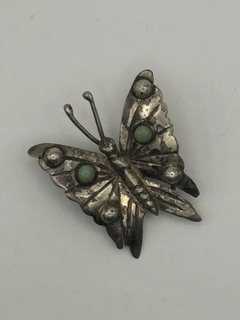
View on eBay

1976 $2 Bill Bicentennial Federal Reserve Note Kansas City J07921666A 666 Circ

Series 1976 $2 Federal Reserve Note, Bicentennial 1776-1976 (200th Anniversary), Thomas Jefferson, Trumbull's Declaration of Independence on the Back, Kansas City (J10), Francine I. Neff and William E. Simon Signatures, Green Seal, Serial Ends 666, Serial J07921666A, Fr. 1935-J, Circulated [Est. F]

$16.66 1976 Est. F Bicentennial $2 Dollar Bills

Description

A Series 1976 $2 Federal Reserve Note with a green Treasury seal, issued through the Federal Reserve Bank of Kansas City: letter J, number 10, shown on the black seal at left and on the "10" in each corner. Signed by Francine I. Neff, Treasurer of the United States, and William E. Simon, Secretary of the Treasury. Serial number J07921666A.

Thomas Jefferson's portrait has appeared on every $2 note since Series 1869, and the front of the $2 is the oldest design on current US currency. The back shows John Trumbull's painting Declaration of Independence. Few $2 notes are printed, and banks usually hand them out only on request, so they are seldom seen in everyday spending and many people simply keep them.

Standard small size, about 6.125 x 2.625 in.

Read the full description

Historical Context

The $2 bill returned on April 13, 1976, Thomas Jefferson's birthday, in the nation's Bicentennial year. For Series 1976 the back was changed from Monticello to the signing of the Declaration of Independence. Printed in Washington, DC; the Fort Worth plant did not open until 1991.

1976 was also the year Viking 2 landed at Utopia Planitia on Mars (September 3). And the serial number ends in 666: THE DEVIL WANTS YOU TO BUY THIS ONE!

Buying Power

In 1976, the average factory worker earned about $5.09 an hour, so this $2 note was about 24 minutes of factory pay, or about $11.85 at today's factory wage. By the consumer price index, $2 in 1976 bought about what $11.77 buys today.

Condition

[Est. F] Circulated. Folds and crinkling. Not a star note and no errors found.

Legal Tender

Yes. United States currency issued since 1861 remains legal tender at face value ($2), whatever the series.

Disclaimer

The images and any video show the actual item and are part of the official listing description, so please review them closely. Measurements and weights are approximate, and any maker or material we haven't confirmed is described as assumed. Questions? Message us; we answer quickly.

View on eBay

Victorian Trade Card Soapine Kendall Mfg Co Providence RI Girl Auburn Hair

Soapine — Kendall Mfg. Co., Providence, Rhode Island

$16.58 Advertising Sales Trade Cards

Original Victorian advertising trade card, chromolithograph, c. 1880s. Approx. 5.20 x 3.60 in.

A young woman shown in profile against a painted sky of blue and violet, her long auburn hair falling loose over a pale gold dress with a lace collar and a deep red sash. The printing on this card is the finest in the group — the flesh tones, the hair and the sky are all built from dense multi-colored stipple.

The reverse reads: For Washing and Cleaning Everything, No Matter What, Soapine Works QUICKER, EASIER, CHEAPER and BETTER Than Soap or anything Else. One Trial will Convince You. Kendall Mfg. Co., Providence, R.I., Established 1827. For sale by all grocers.

Read the full description

Historical Context

Kendall was already sixty years old when this card was printed, and the reverse says so. In an era when anyone could put a name on a box, “Established 1827” was doing real work — it meant somebody had been answering for the product for three generations.

The front makes no argument at all. There is no soap in the picture, no kitchen, no washing. Just a portrait good enough to want on the wall, with the name underneath. The company was buying a place in the house rather than a place in the argument.

Condition

Toning and age typical of the period. A crease to one corner; staining and pale patches to the reverse; light surface soiling; minor edge and corner wear. The chromolithographed portrait on the front remains bright with strong color. Please view the images carefully.

About The Printing

This is an original chromolithograph, and it was slow, exacting work. Each color had to be drawn onto its own separate stone by hand — in monochrome, the artist judging how much stipple each area needed so the colors would combine correctly only once every stone had been printed. The sheet then went through the press once for every color it carries, often a dozen or more, and every pass had to register exactly against the last. A pass out of register showed.

Under magnification the image resolves into irregular hand-drawn stipple, each ink carrying its own dot pattern, the colors mixing in the eye rather than on the paper. There is no regular halftone screen and no four-color rosette, which is what a modern reproduction would show. Modern process printing simulates every color from four inks; chromolithography laid each color down as its own.

Provenance

This item comes from the personal collections of my family estate, accumulated over more than 200 years — including items that came west by wagon train to Colorado and later to Oklahoma. Now that my parents have passed we cannot keep all of these cherished items. They were well-educated antiques collectors/traders and continued to build their collections over more than 60 years. The vast majority of the pieces are from the Victorian Era, however there are plenty of older and newer items. Everything has been stored in a climate-controlled environment over time.

Disclaimer

Specifications and detailed item descriptions are provided as a courtesy only and are not guaranteed to be one hundred percent accurate. Please do your own research. There are generally no receipts available for any items from original purchases. Any dimensions and/or weights are approximate. The absence of a more detailed condition report does not imply there are no condition issues with the item(s). Please inspect images carefully as they are part of the official item description and best representation of the actual condition. Additional images may be available upon request depending on time and availability. Not responsible for internet mis-translations or mis-identification of maker's marks if found or assumptions of makers or materials — item descriptions will indicate if it is assumed. If you see a problem, please message us immediately and we will do our best to sort out a solution and confirm the information. With the exception of eBay rules, no returns are accepted.
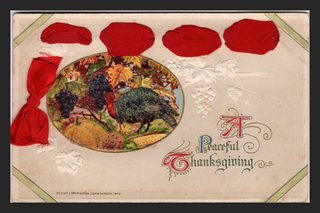
View on eBay

Victorian Trade Card C F Blanke Java Blend Coffee Birds Pansies Rose Calvert

C. F. Blanke Tea & Coffee Co. — Java Blend Coffee

$16.57 Advertising Sales Trade Cards

Original Victorian advertising trade card, chromolithograph, c. 1880s-90s. Approx. 5.40 x 3.60 in. Printed by Calvert Lith. Co., Detroit.

Two small birds, one with a blue head and one a gold finch, share a thorned rose branch above a still lake. Large yellow and maroon pansies fill the left of the card; a pink rose and a deep red rosebud hang at the right. The design sits inside a ruled border, and a printer's design number, C-797, is printed in the lower left corner.

The reverse, printed in blue, reads: C. F. BLANKE TEA & COFFEE CO'S JAVA BLEND COFFEE is a combination of JAVA, MOCHA, MARACAIBO AND SANTOS. It makes a delicious flavored and strong cup of COFFEE. TRY IT. YOU WILL LIKE IT. A BEAUTIFUL PICTURE CARD IN EVERY PACKAGE.

Read the full description

Historical Context

“A beautiful picture card in every package” is the whole strategy in one line. The picture has nothing to do with coffee and was never meant to. The design number in the corner gives it away: this is a printer's stock design, and Blanke bought it to put in the package because a pretty card got the next package bought.

The blend is named by where the beans came from — Java, Mocha, Maracaibo and Santos. Coffee was still sold by its port of origin, and a four-port blend was a way of promising something better than the plain Rio most people drank. The card does not say where Blanke was based; the company is generally associated with St. Louis.

Condition

Toning and age typical of the period. A circular water stain beside the rose in the upper right; fine surface crazing across the lower half of the front; a crease through the lower-left corner running through the design number; small surface losses along the top edge; a stain to the lower left of the reverse. Colors remain strong. Please view the images carefully.

About The Printing

This is an original chromolithograph, and it was slow, exacting work. Each color had to be drawn onto its own separate stone by hand — in monochrome, the artist judging how much stipple each area needed so the colors would combine correctly only once every stone had been printed. The sheet then went through the press once for every color it carries, often a dozen or more, and every pass had to register exactly against the last. A pass out of register showed.

Under magnification the image resolves into irregular hand-drawn stipple, each ink carrying its own dot pattern, the colors mixing in the eye rather than on the paper. There is no regular halftone screen and no four-color rosette, which is what a modern reproduction would show. Modern process printing simulates every color from four inks; chromolithography laid each color down as its own.

Provenance

This item comes from the personal collections of my family estate, accumulated over more than 200 years — including items that came west by wagon train to Colorado and later to Oklahoma. Now that my parents have passed we cannot keep all of these cherished items. They were well-educated antiques collectors/traders and continued to build their collections over more than 60 years. The vast majority of the pieces are from the Victorian Era, however there are plenty of older and newer items. Everything has been stored in a climate-controlled environment over time.

Disclaimer

Specifications and detailed item descriptions are provided as a courtesy only and are not guaranteed to be one hundred percent accurate. Please do your own research. There are generally no receipts available for any items from original purchases. Any dimensions and/or weights are approximate. The absence of a more detailed condition report does not imply there are no condition issues with the item(s). Please inspect images carefully as they are part of the official item description and best representation of the actual condition. Additional images may be available upon request depending on time and availability. Not responsible for internet mis-translations or mis-identification of maker's marks if found or assumptions of makers or materials — item descriptions will indicate if it is assumed. If you see a problem, please message us immediately and we will do our best to sort out a solution and confirm the information. With the exception of eBay rules, no returns are accepted.
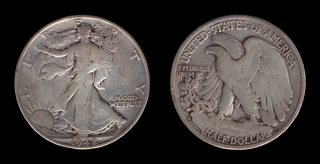
View on eBay

1889 Arbuckle Coffee Trade Card No 85 Wisconsin State Map Beer Brewery Logging

1889 Arbuckle Coffee Trade Card No 85 Wisconsin State Map Beer Brewery Logging — Original Victorian advertising trade card, chromolithograph, copyright 1889 by Arbuckle Bros., N.Y. Approx. 5.05 x 3.05 in.

$16.56 1889 Advertising Sales Trade Cards

Description

Arbuckle Bros Ariosa Coffee — Wisconsin, State Map No. 85

A colored map of Wisconsin, its towns and rivers lettered in, between Lake Superior and Lake Michigan, with Minnesota, Iowa, Illinois and Michigan around it. At the right is the interior of a BEER BREWERY — a great copper brew kettle, vats and workmen — and a roundel below shows lumbermen driving logs down a river toward a mill. Area 56,040 Sq. Miles. Population 1,315,497.

The reverse is headed ARBUCKLES' Ariosa Coffee, COSTS MORE AND IS WORTH MORE THAN OTHER BRANDS OF COFFEE. WHY? Four numbered reasons follow: the coffee is made from green coffee of higher grade; its strength and aroma are retained by the glazing; the glazing is made of choice eggs and pure confectioners' “A” sugar; and it adds richness of flavor. A BEWARE paragraph warns against low-grade package coffee. A second column, READ THIS, explains the series — fifty cards, each showing a correct map of one State or Territory with pictures of its peculiar industries and scenery — and suggests that anyone with two cards of one kind exchange with a neighbor. A list of the states and territories represented follows. Arbuckle Bros. Coffee Company, New York. The card is numbered 85. Printed by Donaldson Brothers, N.Y.

Read the full description

Historical Context

Beer and lumber were Wisconsin's two great industries in 1889, and the card gives one to each half of the picture. Milwaukee's brewers, many of them German immigrants, were already shipping beer nationally; the northern pineries were feeding the sawmills that built the prairie towns.

The copper brew kettle is drawn with real care, which is typical of this series: the artists clearly worked from real industrial scenes rather than inventing them.

Condition

Toning and age typical of the period. Light surface soiling; minor edge and corner wear; toning to the reverse. The chromolithographed image remains bright and the reverse text fully legible. Please view the images carefully.

About The Printing

This is an original chromolithograph, and it was slow, exacting work. Each color had to be drawn onto its own separate stone by hand — in monochrome, the artist judging how much stipple each area needed so the colors would combine correctly only once every stone had been printed. The sheet then went through the press once for every color it carries, often a dozen or more, and every pass had to register exactly against the last. A pass out of register showed.

Under magnification the image resolves into irregular hand-drawn stipple, each ink carrying its own dot pattern, the colors mixing in the eye rather than on the paper. There is no regular halftone screen and no four-color rosette, which is what a modern reproduction would show. Modern process printing simulates every color from four inks; chromolithography laid each color down as its own.

Provenance

From my family's estate collections, built over more than 60 years by knowledgeable antiques collectors and traders. Stored in a climate-controlled environment.

Also In Our Store

More Victorian advertising trade cards are in our store.

Disclaimer

The images and any video show the actual item and are part of the official listing description, so please review them closely. Measurements and weights are approximate, and any maker or material we haven't confirmed is described as assumed. Questions? Message us; we answer quickly.

View on eBay

1993 Costa Rica 50 Colones Gaspar Ortuno Banknote P-257a [Est. AU]

7 July 1993 Costa Rica 50 Colones Banknote, Gaspar Ortuno y Ors / Old Banco de Costa Rica Building, Pick P-257a, Serial E52121995 [Est. AU]

$16.56 1993 Est. AU Costa Rica

Description

Serie E note issued by the Banco Central de Costa Rica and printed by Thomas de la Rue. Front: Gaspar Ortuno y Ors with an 1866 50 centimos coin; back: the ANTIGUO EDIFICIO DEL BANCO DE COSTA RICA with a horse carriage and the reverse of the coin. BCCR 50 watermark. Serial E52121995. The serial ends with 1995. Measured on the 1200 dpi scan: 155.6 x 67.1 mm. Centering, measured on the scan: front L4.5 R3.5 T4.2 B4.0 mm; back 5.3-5.5 mm: well centered. Per margins_r01. The close-ups show the serial, the date, Gaspar Ortuno, the old bank building, the signatures, the 1866 coin and the coin reverse. The last image adds a millimeter scale.

Read the full description

Historical Context

Gaspar Ortuno y Ors was a Spanish consul and administrator and a founding partner of the Banco de la Union and the Banco de Costa Rica. This was the last 50 colones note design; the denomination then became a coin, first issued in 1997.

Condition

[Est. AU] No folds, with only faint handling in the back margins; the paper is bright and crisp with sharp corners. A purple ink line about 34 mm long runs down the portrait from the brow to the collar. No tears, holes or stains. Grade estimated from the scans; not professionally graded.

Legal Tender

No longer legal tender: catalogs list it as demonetized (date not found), and the 50 colones is now a coin.

Disclaimer

The images and any video show the actual item and are part of the official listing description, so please review them closely. Measurements and weights are approximate, and any maker or material we haven't confirmed is described as assumed. Questions? Message us; we answer quickly.

View on eBay

1916 Stecher Thanksgiving Postcard Girls Chase Turkey Gold Embossed Rochester NY

November 30, 1916 Stecher Lith. Co. Embossed "Thanksgiving Greetings" Postcard, Two Little Girls Chasing a Turkey Before a Gold Panel, Series 204 B, Rochester, N.Y. Machine Cancel at 1 AM on Thanksgiving Day, Mary Thayer to Edith and Ruth Randall, Great Bend, N.Y.: "Do You Think I Have Forgotten You?"

$16.52 1916 Thanksgiving Postcards

Description

A girl in a pink dress and big pink hair bow, seen from behind, reaches for a strutting turkey while a second girl in pale blue runs in from the right. Behind the turkey is an embossed gold panel; corn shocks and pumpkins fill the field at left. "Thanksgiving Greetings" in gold at lower right; the circle logo "STECHER LITH. CO. ROCH. N.Y." at lower left.

The back is a divided back with an ornate "POST CARD," "MADE IN U.S.A." and "Series 204 B." The stamp is missing, with paper residue in the box, but the card carries a Rochester, N.Y. machine cancel of Nov 30, 1 AM, 1916. Addressed in ink to Miss Edith & Ruth Randall, Great Bend, N.Y. The message (our transcription): "Dear Edith and Ruth, Do you think I have forgotten you, well I have not. I got here all O.K. but ever since I have been sick with a hard cold. Do you think you will get through school in Jan.? I hope so. Remember me to Miss Gormerly [or Gonnerly; difficult to read] and my boy friends, L. included. I am your friend, Mary Thayer, #1590 E. Main St., Rochester, N.Y."

Read the full description

Historical Context

Stecher. The Stecher Lithographic Company of Rochester, N.Y. grew from a printer of posters, labels and trade cards into a major maker of artist-drawn holiday postcards. This one was canceled in the company's home city at 1 AM on Thanksgiving Day, November 30, 1916.

Bought years before it was mailed? Another card in the same Stecher Series 204 carries a 1911 copyright on its front, so this card may have waited on a shelf or in a drawer for several Thanksgivings before Mary Thayer sent it.

Condition

Good. Bright color and gold. A crease with a small surface chip at lower left by the girl's boots, light creasing at left, corner wear, and faint transferred cancel lines in the sky at upper left. Back toned, with creases along the right side, stamp residue, and a small pencil "20."

About The Printing

This card is printed in halftone. Under magnification the colors resolve into a regular, even grid of dots rather than the irregular hand-drawn stipple of a chromolithograph. The gold panel is embossed with a hammered texture, and the figures stand up in relief on the back.

Provenance

From my family's estate collections, built over more than 60 years by knowledgeable antiques collectors and traders. Stored in a climate-controlled environment.

Also In Our Store

Another Stecher Series 204 Thanksgiving card from this group, a portrait design mailed on Thanksgiving Day 1912, is also in our store. More Thanksgiving postcards from this group are there too.

Disclaimer

The images and any video show the actual item and are part of the official listing description, so please review them closely. Measurements and weights are approximate, and any maker or material we haven't confirmed is described as assumed. Questions? Message us; we answer quickly.

View on eBay

1935G $1 Silver Certificate No Motto Payable in Silver C67021736J Circ

Series 1935G $1 Silver Certificate, Blue Seal, No Motto, George Washington, One Dollar in Silver Payable to the Bearer, Kennedy Era, Elizabeth Rudel Smith and C. Douglas Dillon Signatures, Serial C67021736J, Fr. 1616, Circulated [Est. F-VF]

$16.47 Est. F-VF Silver Certificates

Description

A Series 1935G $1 Silver Certificate with a blue Treasury seal and blue serial numbers. Signed by Elizabeth Rudel Smith, Treasurer of the United States, and C. Douglas Dillon, Secretary of the Treasury. Serial number C67021736J; face plate D8301. This is the earlier Series 1935G printing without the motto IN GOD WE TRUST on the back. Standard small size, about 6.125 x 2.625 in.

Read the full description

Historical Context

Silver certificates promised the bearer one dollar in silver on demand. That promise ended in June 1968, when the Treasury stopped redeeming them for silver; the notes remain legal tender at face value.

Condition

[Est. F-VF] Folds; light crinkling at portrait; good color; no motto. Off-center: narrowest margin at the top, 2.3 mm. Grade estimated from the scans; not professionally graded. No errors found.

Legal Tender

Yes. United States currency issued since 1861 remains legal tender at face value; this $1 Silver Certificate is still worth one dollar, though it can no longer be exchanged for silver (that ended in June 1968).

Disclaimer

The images and any video show the actual item and are part of the official listing description, so please review them closely. Measurements and weights are approximate, and any maker or material we haven't confirmed is described as assumed. Questions? Message us; we answer quickly.

View on eBay

1917 Buffalo Nickel Indian Head 5C US Coin Philadelphia Full Date WWI KM#134

1917 Buffalo Nickel (Indian Head), Philadelphia Mint, Copper-Nickel, Full Date, Struck the Year America Entered World War I, James Earle Fraser Design, KM#134 [Est. VG-10]

$16.43 1917 Est. VG-10 Buffalo Nickels (1913-1938)

Description

A 1917 Buffalo nickel struck at the Philadelphia Mint (no mint mark; on this series it would sit on the reverse below FIVE CENTS), KM#134. The obverse shows a Native American man facing right, with LIBERTY at the right and the date at lower left; the small F below the date is the designer's initial, not a mint mark. The reverse shows an American bison standing on a mound, with UNITED STATES OF AMERICA and E PLURIBUS UNUM above and FIVE CENTS below. Copper-nickel: 75% copper and 25% nickel, 5.00 grams standard, 21.2 mm, plain edge. The close-ups show the date and F initial, the portrait, the bison and FIVE CENTS.

Read the full description

Historical Context

Sculptor James Earle Fraser designed the Buffalo nickel, struck from 1913 to 1938; he said the portrait combined the features of several Native American men who sat for him. Philadelphia struck 51,424,029 in 1917. That April 6 the United States entered World War I.

Buying Power

In 1917 this nickel had the buying power of about $1.30 today.

Condition

[Est. VG-10] Circulated, with even nickel-gray surfaces. The full date is readable, which counts on this series, where the raised date often wears away. LIBERTY is clear and the hair braid and feathers show their outlines. On the reverse the bison's head and shoulder fur show some detail, the horn is worn flat and FIVE CENTS is bold. Light scratches and marks on both sides, including fine lines across the bison (see the close-ups). Checked the date and LIBERTY for doubling: none seen. Grade estimated; not professionally graded. Currently still legal tender, but value to collectors is far higher due to its age.

Also In Our Store

More coins: https://www.ebay.com/str/tfauctionsintl?_nkw=coin

Disclaimer

The images and any video show the actual item and are part of the official listing description, so please review them closely. Measurements and weights are approximate, and any maker or material we haven't confirmed is described as assumed. Questions? Message us; we answer quickly.

View on eBay

1889 Arbuckle Coffee Trade Card No 53 Ireland Map Killarney Jaunting Car

1889 Arbuckle Coffee Trade Card No 53 Ireland Map Killarney Jaunting Car — Original Victorian advertising trade card, chromolithograph, copyright 1889 by Arbuckle Bros., N.Y. Approx. 5.10 x 3.00 in.

$16.33 1889 Advertising Sales Trade Cards

Description

Arbuckle Bros Ariosa Coffee — Ireland, Map Card No. 53

A colored map of Ireland, its counties and towns lettered in, shares the card with a view of Innisfallen, Killarney: a horse-drawn jaunting car with passengers in a red-wheeled cart beside the lake under the trees. The map panel is framed by the Atlantic Ocean, the Irish Sea and St. George's Channel, with Scotland, Wales and the Isle of Man at the edges. A panel at the foot reads: Area 32,531 Sq. M. Pop. 5,174,836. Constitutional Monarchy.

The reverse carries Arbuckle's GRIND YOUR COFFEE AT HOME advice and the ARIOSA claim, closing with the line that rival makers know no higher praise than to say “It's just as good as Arbuckles'.” An EXPLANATORY panel describes the series — fifty cards, each showing a correctly colored map of one of the chief countries of the world with pictures of its industries, scenery and customs — and explains that every package of Arbuckle's coffee contains one of these cards or one of the companion series of fifty Zoological cards. A list of the countries represented follows. Arbuckle Bros. Coffee Co., New York City. The card is numbered 53. Printed by Donaldson Brothers, N.Y.

Read the full description

Historical Context

The foreign map series put a country on one side of a card and its reputation on the other side of the picture. For Ireland, Arbuckle chose Killarney — lakes, trees, and a tourist on a jaunting car — rather than the Dublin they had shown in the travel series.

The government line, Constitutional Monarchy, is a period detail in itself. In 1889 Ireland was part of the United Kingdom, and the card lists it as a country of its own.

Condition

Toning and age typical of the period. Foxing and scattered spots along the top edge of the reverse; light surface soiling; minor edge and corner wear. The chromolithographed image remains bright and the reverse text legible. Please view the images carefully.

About The Printing

This is an original chromolithograph, and it was slow, exacting work. Each color had to be drawn onto its own separate stone by hand — in monochrome, the artist judging how much stipple each area needed so the colors would combine correctly only once every stone had been printed. The sheet then went through the press once for every color it carries, often a dozen or more, and every pass had to register exactly against the last. A pass out of register showed.

Under magnification the image resolves into irregular hand-drawn stipple, each ink carrying its own dot pattern, the colors mixing in the eye rather than on the paper. There is no regular halftone screen and no four-color rosette, which is what a modern reproduction would show. Modern process printing simulates every color from four inks; chromolithography laid each color down as its own.

Provenance

From my family's estate collections, built over more than 60 years by knowledgeable antiques collectors and traders. Stored in a climate-controlled environment.

Also In Our Store

More Victorian advertising trade cards are in our store.

Disclaimer

The images and any video show the actual item and are part of the official listing description, so please review them closely. Measurements and weights are approximate, and any maker or material we haven't confirmed is described as assumed. Questions? Message us; we answer quickly.

View on eBay

1880s Lion Coffee Victorian Trade Card Daffodils Winter Farm Scene Woolson Spice

1880s Lion Coffee Victorian Trade Card Daffodils Winter Farm Scene Woolson Spice — Yellow daffodils in a gilt-ringed circle beside a small winter vignette of a snowy farmhouse, on a pale green ground. Approx. 5.06 x 3.81 in.

$16.32 Advertising Sales Trade Cards

Description

Yellow daffodils in a gilt-ringed circle beside a small winter vignette of a snowy farmhouse, on a pale green ground.

The back is printed in black: "If you want a picture card like this buy a package of LION COFFEE. It is composed of a successful combination of Mocha, Java and Rio, and is roasted with the greatest care, but is not ground. Is never sold in bulk. Beautiful picture in every package. Lion is the King of Coffees. Manufactured by Woolson Spice Co., Toledo, Ohio."

Approx. 5.06 x 3.81 in.

Read the full description

Historical Context

The coffee that came with a picture. Lion Coffee began in Toledo, Ohio, in 1864 and became part of the Woolson Spice Company in 1882. Alvin Woolson built the brand by putting picture cards in every package, and the back of this card says so.

Condition

Front: very good, clean color. Back: small edge losses and scuffing at the corners and along the bottom line of text. Please see the photos, which are part of the description.

About The Printing

This is an original chromolithograph, and it was slow, exacting work. Each color had to be drawn onto its own separate stone by hand — in monochrome, the artist judging how much stipple each area needed so the colors would combine correctly only once every stone had been printed. The sheet then went through the press once for every color it carries, often a dozen or more, and every pass had to register exactly against the last. A pass out of register showed.

Under magnification the image resolves into irregular hand-drawn stipple, each ink carrying its own dot pattern, the colors mixing in the eye rather than on the paper. There is no regular halftone screen and no four-color rosette, which is what a modern reproduction would show. Modern process printing simulates every color from four inks; chromolithography laid each color down as its own.

The back is printed in black.

Provenance

From my family's estate collections, built over more than 60 years by knowledgeable antiques collectors and traders. Stored in a climate-controlled environment.

Also In Our Store

More Lion Coffee cards in our store: https://www.ebay.com/str/tfauctionsintl?_nkw=lion+coffee

More Victorian advertising trade cards are in our store.

Disclaimer

The images and any video show the actual item and are part of the official listing description, so please review them closely. Measurements and weights are approximate, and any maker or material we haven't confirmed is described as assumed. Questions? Message us; we answer quickly.

View on eBay

1935E $1 Silver Certificate Blue Seal 007 Serial Ends 222 A57007222I Circ

Series 1935E $1 Silver Certificate, Blue Seal, No Motto, George Washington, One Dollar in Silver Payable to the Bearer, Eisenhower Era, Ivy Baker Priest and George M. Humphrey Signatures, Serial Ends 222, Serial A57007222I, Fr. 1614, Circulated [Est. F]

$16.29 Est. F Silver Certificates

Description

A Series 1935E $1 Silver Certificate with a blue Treasury seal and blue serial numbers. Signed by Ivy Baker Priest, Treasurer of the United States, and George M. Humphrey, Secretary of the Treasury. Serial number A57007222I; face plate G7937. Standard small size, about 6.125 x 2.625 in.

Serial A57 007 222 I: carries 007 in the middle and ends in triple 2s.

Read the full description

Historical Context

Silver certificates promised the bearer one dollar in silver on demand. That promise ended in June 1968, when the Treasury stopped redeeming them for silver; the notes remain legal tender at face value.

Condition

[Est. F] Several folds; crinkling across portrait and seal; soft. Well centered. Grade estimated from the scans; not professionally graded. No errors found.

Legal Tender

Yes. United States currency issued since 1861 remains legal tender at face value; this $1 Silver Certificate is still worth one dollar, though it can no longer be exchanged for silver (that ended in June 1968).

Disclaimer

The images and any video show the actual item and are part of the official listing description, so please review them closely. Measurements and weights are approximate, and any maker or material we haven't confirmed is described as assumed. Questions? Message us; we answer quickly.

View on eBay

2023 Argentina 2000 Pesos Carrillo Grierson Banknote P-368a [Est. AU]

Undated (issued May 2023) Argentina 2000 Pesos Banknote, Dr. Ramon Carrillo and Dra. Cecilia Grierson / Malbran Institute, Pick P-368a, Serial 79829826A [Est. AU]

$16.27 2023 Est. AU Argentina

Description

Issued by the Banco Central de la Republica Argentina and printed by Casa de Moneda. Front: Dr. Ramon Carrillo and Dra. Cecilia Grierson with a green color-shifting medical symbol; back: the Carlos G. Malbran National Institute of Microbiology building. This is the first, commemorative version, with a multitone watermark of both portraits and no windowed thread. Serial 79829826A. Measured on the 1200 dpi scan: 154.9 x 65.8 mm. The close-ups show the serial, Carrillo and Grierson, the signatures, the security shield and the Malbran Institute. The last image adds a millimeter scale.

Read the full description

Historical Context

Put into circulation on 22 May 2023 to honor pioneers of Argentine medicine and public health. Cecilia Grierson was Argentina's first woman doctor; Ramon Carrillo, a neurosurgeon, was the first national Minister of Health. The Malbran Institute was founded in 1893.

Condition

[Est. AU] No folds; one diagonal crease at a back corner and faint handling otherwise. The paper is bright and crisp with sharp corners and clean edges. A few faint light-brown spots in the watermark panel on the back. No tears, holes or writing. Grade estimated from the scans; not professionally graded.

Legal Tender

Appears to remain legal tender: the BCRA lists it among circulating notes (May 2026) and said the November 2023 version would circulate alongside it.

Disclaimer

The images and any video show the actual item and are part of the official listing description, so please review them closely. Measurements and weights are approximate, and any maker or material we haven't confirmed is described as assumed. Questions? Message us; we answer quickly.

View on eBay

1986 Costa Rica 1000 Colones Soley Guell Banknote P-256a S/N C01078400 [Est. F]

19 November 1986 Costa Rica 1000 Colones Banknote, Tomas Soley Guell / National Insurance Institute, Pick P-256a, Serial C01078400 [Est. F]

$16.27 1986 Est. F Costa Rica

Description

Serie C note issued by the Banco Central de Costa Rica. Front: Tomas Soley Guell with a red curved-line design; back: the Instituto Nacional de Seguros building. Tree watermark with the legend 'Libre crezca fecundo'. Printed by the American Bank Note Company (1986-1989) or the United States Banknote Company (1990-1994); the printer imprint tells them apart. Serial C01078400. Measured on the 1200 dpi scan: 155.9 x 66.8 mm. Centering, measured on the scan: front well centered (L/R 3.8/4.2, T/B 2.3/2.0 mm); back sits slightly low (T/B 7.9/5.3 mm). The close-ups show the serial, the date, Tomas Soley Guell and the INS building. The last image adds a millimeter scale.

Read the full description

Historical Context

Tomas Soley Guell, a postmaster and congressional deputy, promoted the state insurance monopoly and created the National Insurance Bank, today the Instituto Nacional de Seguros. The colon has been Costa Rica's currency since 1896 and has never been redenominated.

Condition

[Est. F] Well circulated, with many folds and creases including a vertical center fold and a horizontal fold, heavy overall soiling and rounded corners. A small handwritten mark in teal ink, about 6 mm, is on the back left panel. No tears, holes or tape. Grade estimated from the scans; not professionally graded.

Legal Tender

No longer legal tender: withdrawn on 1 September 2011; it can still be exchanged or deposited at Costa Rican financial institutions with no time limit (BCCR).

Disclaimer

The images and any video show the actual item and are part of the official listing description, so please review them closely. Measurements and weights are approximate, and any maker or material we haven't confirmed is described as assumed. Questions? Message us; we answer quickly.

View on eBay

Victorian Trade Card Use Niagara Starch Girl Blue Beret Long Hair Lace Collar

Niagara Starch — Girl in a Blue Beret

$16.23 Advertising Sales Trade Cards

Original Victorian advertising trade card, chromolithograph, c. 1880s. Approx. 3.55 x 2.40 in.

A portrait of a young girl with long wavy light-brown hair under a large blue tam with a pompom and a maroon band, wearing a white dress with a ruffled lace collar, set against a soft stippled gray-blue ground. Lettered in script at the foot: Use Niagara Starch.

The reverse is blank.

Read the full description

Historical Context

Starch was a weekly chore product, used on collars, cuffs and shirt fronts, and nobody needed to be told what it was for. So the card does not explain the product at all. It shows a well-kept child in a crisp white dress with a lace collar and lets the reader draw the connection.

A card this plain on the back was meant for the album rather than the kitchen drawer. The name sits at the foot of the picture, where it would be seen every time the page was turned.

Condition

Toning and age typical of the period. The blank reverse has heavy tide-line staining with large pale patches, likely from an old album mounting; a small pale scuff to the right of the face on the front; minor edge and corner wear. The portrait on the front remains bright. Please view the images carefully.

About The Printing

This is an original chromolithograph, and it was slow, exacting work. Each color had to be drawn onto its own separate stone by hand — in monochrome, the artist judging how much stipple each area needed so the colors would combine correctly only once every stone had been printed. The sheet then went through the press once for every color it carries, often a dozen or more, and every pass had to register exactly against the last. A pass out of register showed.

Under magnification the image resolves into irregular hand-drawn stipple, each ink carrying its own dot pattern, the colors mixing in the eye rather than on the paper. There is no regular halftone screen and no four-color rosette, which is what a modern reproduction would show. Modern process printing simulates every color from four inks; chromolithography laid each color down as its own.

Provenance

This item comes from the personal collections of my family estate, accumulated over more than 200 years — including items that came west by wagon train to Colorado and later to Oklahoma. Now that my parents have passed we cannot keep all of these cherished items. They were well-educated antiques collectors/traders and continued to build their collections over more than 60 years. The vast majority of the pieces are from the Victorian Era, however there are plenty of older and newer items. Everything has been stored in a climate-controlled environment over time.

Disclaimer

Specifications and detailed item descriptions are provided as a courtesy only and are not guaranteed to be one hundred percent accurate. Please do your own research. There are generally no receipts available for any items from original purchases. Any dimensions and/or weights are approximate. The absence of a more detailed condition report does not imply there are no condition issues with the item(s). Please inspect images carefully as they are part of the official item description and best representation of the actual condition. Additional images may be available upon request depending on time and availability. Not responsible for internet mis-translations or mis-identification of maker's marks if found or assumptions of makers or materials — item descriptions will indicate if it is assumed. If you see a problem, please message us immediately and we will do our best to sort out a solution and confirm the information. With the exception of eBay rules, no returns are accepted.
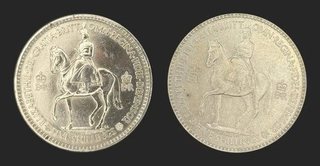
View on eBay

1914 Germany 50 Mark Darlehenskassenschein WWI Loan Note 6-Digit Serial VG

1914 Germany 50 Mark Darlehenskassenschein (Loan Bank Note), Dated August 5, 1914, Start of World War I, 6-Digit Red Serial

$16.21 1914 Germany

Description

A Darlehenskassenschein (loan bank note) of Imperial Germany, dated August 5, 1914, days after World War I began. Green side: ornate gothic "Darlehenskassenschein Fünfzig Mark" with a large "50" and the red serial R·Nr 631907 in two places; the other side carries the Imperial eagle seals.

Read the full description

Details

Issuer: Reichsschuldenverwaltung (Imperial Germany)

Denomination: 50 Mark

Date: August 5, 1914

Serial: R·Nr 631907 (6 digits)

Grade: Very Good (VG), estimated

Historical Context

Loan bank notes were issued against pledged goods and securities rather than gold, to supply cash for the war economy.

Condition

Very Good (estimated): heavy vertical and horizontal center folds with fraying along the folds, rounded corners, small edge nicks and tears, and even age toning. No ink graffiti. Please see the photos for condition; the grade has not been certified.

The images and any video show the actual item and are part of the official listing description, so please review them closely. Measurements and weights are approximate, and any maker or material we haven't confirmed is described as assumed. Questions? Message us; we answer quickly.

View on eBay

1935E $1 Silver Certificate Ivy Baker Priest Humphrey N75408642I Circ

Series 1935E $1 Silver Certificate, Blue Seal, No Motto, George Washington, One Dollar in Silver Payable to the Bearer, Eisenhower Era, Ivy Baker Priest and George M. Humphrey Signatures, Serial N75408642I, Fr. 1614, Circulated [Est. F-VF]

$16.21 Est. F-VF Silver Certificates

Description

A Series 1935E $1 Silver Certificate with a blue Treasury seal and blue serial numbers. Signed by Ivy Baker Priest, Treasurer of the United States, and George M. Humphrey, Secretary of the Treasury. Serial number N75408642I; face plate I7960. Standard small size, about 6.125 x 2.625 in.

Read the full description

Historical Context

Silver certificates promised the bearer one dollar in silver on demand. That promise ended in June 1968, when the Treasury stopped redeeming them for silver; the notes remain legal tender at face value.

Condition

[Est. F-VF] Center fold plus light folds; light soiling; bright reverse. Off-center: narrowest margin at the top, 1.6 mm. Grade estimated from the scans; not professionally graded. No errors found.

Legal Tender

Yes. United States currency issued since 1861 remains legal tender at face value; this $1 Silver Certificate is still worth one dollar, though it can no longer be exchanged for silver (that ended in June 1968).

Disclaimer

The images and any video show the actual item and are part of the official listing description, so please review them closely. Measurements and weights are approximate, and any maker or material we haven't confirmed is described as assumed. Questions? Message us; we answer quickly.

View on eBay

1891 Arbuckle Ariosa Coffee Trade Card Antwerp #6 Trip Around the World Knapp

DESCRIPTION

$16.21 1891 Advertising Sales Trade Cards

Card number 6 from Arbuckle's "Trip Around the World" series, a montage of Antwerp. The tall Gothic spire of "ANTWERP CATHEDRAL" rises at left over a busy square; at upper right a "MILK-MAID" in a white winged bonnet; a pair of skaters on the ice; a long "VIEW OF ANTWERP" skyline with a windmill; "A FISHERMAN" with pipe and cap in a medallion; and "THE FISH MARKET" with a statue fountain. Caption: "ANTWERP, HOLLAND." Small print at lower left: "COPYRIGHT 1891 BY ARBUCKLE BROS. N.Y."

The back is printed in blue: "One of 50 views from a trip around the world." At left, "GRIND YOUR COFFEE AT HOME," with the Ariosa claims: "So long as ARIOSA remains in the whole berry, our glazing, composed of choice eggs and pure confectioners' A sugar, closes the pores of the coffee," and "ARIOSA COFFEE has during 25 years set the standard for all other roasted coffees." Signed "ARBUCKLE BROS. NEW YORK CITY" and "JOSEPH P. KNAPP, LITH. N.Y." At right, a history of Antwerp (Rubens, the Cathedral of Notre Dame, "Population, 221,360"). Number 6 at the foot. Approx. 3.05 x 5.05 in.

Read the full description

Historical Context

The coffee that won the West. The Arbuckle brothers began roasting coffee in Pittsburgh and moved the business to New York City in 1871. John Arbuckle patented an egg-based glaze for roasted beans in 1868, and the packaged Ariosa brand became famous on the frontier. The back of this card explains the glaze in the company's own words.

Fifty views of the world. This is number 6 of the 1891 "Views from a Trip Around the World" series, one of the many numbered sets Arbuckle packed with its coffee to keep families buying, and collecting.

Antwerp, Holland? The front captions the city as being in Holland, while the text on the back correctly calls Antwerp "the chief commercial city of Belgium." A small slip of the period that collectors enjoy.

Printed by Knapp. The card is signed by Joseph P. Knapp, Lith., N.Y., one of the major color printers behind the Arbuckle series.

Condition

Very good. Front: colors bright and clean; corners lightly worn, the upper right slightly soft; light edge wear. Back: even light toning and a few tiny specks; print crisp and fully legible. Please see the photos, which are part of the description.

About The Printing

This is an original chromolithograph, and it was slow, exacting work. Each color had to be drawn onto its own separate stone by hand — in monochrome, the artist judging how much stipple each area needed so the colors would combine correctly only once every stone had been printed. The sheet then went through the press once for every color it carries, often a dozen or more, and every pass had to register exactly against the last. A pass out of register showed.

Under magnification the image resolves into irregular hand-drawn stipple, each ink carrying its own dot pattern, the colors mixing in the eye rather than on the paper. There is no regular halftone screen and no four-color rosette, which is what a modern reproduction would show. Modern process printing simulates every color from four inks; chromolithography laid each color down as its own.

The back is printed in a single blue ink.

Provenance

From my family's estate collections, built over more than 60 years by knowledgeable antiques collectors and traders. Stored in a climate-controlled environment.

Also In Our Store

More Arbuckle and other Victorian coffee trade cards, and trade cards for thread and patent medicines, are in our store.

Disclaimer

Specifications and detailed item descriptions are provided as a courtesy only and are not guaranteed to be one hundred percent accurate. Please do your own research. There are generally no receipts available for any items from original purchases. Any dimensions and/or weights are approximate. The absence of a more detailed condition report does not imply there are no condition issues with the item(s). Please inspect images carefully as they are part of the official item description and best representation of the actual condition. Additional images may be available upon request depending on time and availability. Not responsible for internet mis-translations or mis-identification of maker's marks if found or assumptions of makers or materials — item descriptions will indicate if it is assumed. If you see a problem, please message us immediately and we will do our best to sort out a solution and confirm the information. With the exception of eBay rules, no returns are accepted.
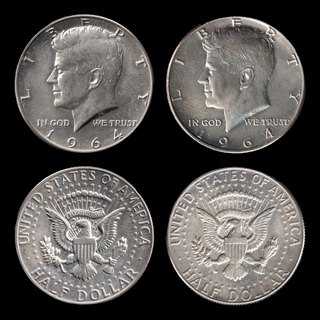
View on eBay

1986 Costa Rica 1000 Colones Soley Guell Banknote P-256a S/N C01342249 [Est. F]

19 November 1986 Costa Rica 1000 Colones Banknote, Tomas Soley Guell / National Insurance Institute, Pick P-256a, Serial C01342249 [Est. F]

$16.21 1986 Est. F Costa Rica

Description

Serie C note issued by the Banco Central de Costa Rica. Front: Tomas Soley Guell with a red curved-line design; back: the Instituto Nacional de Seguros building. Tree watermark with the legend 'Libre crezca fecundo'. Printed by the American Bank Note Company (1986-1989) or the United States Banknote Company (1990-1994); the printer imprint tells them apart. Serial C01342249. Measured on the 1200 dpi scan: 156.7 x 67.1 mm. Centering, measured on the scan: front well centered (L/R 4.0/4.3, T/B 3.5/3.1 mm); back design shifted right and up (L/R 5.2/2.8, T/B 1.8/6.0 mm). The close-ups show the serial, the date, Tomas Soley Guell and the INS building. The last image adds a millimeter scale.

Read the full description

Historical Context

Tomas Soley Guell, a postmaster and congressional deputy, promoted the state insurance monopoly and created the National Insurance Bank, today the Instituto Nacional de Seguros. The colon has been Costa Rica's currency since 1896 and has never been redenominated.

Condition

[Est. F] Well circulated, with many folds and creases including a vertical center fold and a horizontal fold, heavy overall brown soiling and rounded corners. A small grey ink smudge sits above the right-hand signature on the front. No tears, holes or tape. On the back the printed design is noticeably off center toward the top right. Grade estimated from the scans; not professionally graded.

Legal Tender

No longer legal tender: withdrawn on 1 September 2011; it can still be exchanged or deposited at Costa Rican financial institutions with no time limit (BCCR).

Disclaimer

The images and any video show the actual item and are part of the official listing description, so please review them closely. Measurements and weights are approximate, and any maker or material we haven't confirmed is described as assumed. Questions? Message us; we answer quickly.

View on eBay

Victorian Trade Card Electric Light Soap Electro Soap Mfg Co Indianapolis Roses

Electric-Light Soap — Electro Soap Mfg. Co., Indianapolis, Indiana

$16.13 Advertising Sales Trade Cards

Original Victorian advertising trade card, chromolithograph, c. 1880s-90s. Approx. 4.35 x 2.80 in.

A spray of pink and red roses and rosebuds, a yellow tea rose, a red blossom, blue cornflowers and grasses, with a small butterfly and a trailing blue ribbon, sweeps across the left of a white card. The advertiser's text is printed in black at the right: USE ELECTRIC-LIGHT SOAP. No rubbing required. ELECTRO SOAP M'F'G CO. INDIANAPOLIS, IND.

The reverse is blank; the front text shows through faintly.

Read the full description

Historical Context

Calling a soap “Electric-Light” in the 1880s was like calling a product “smart” today. Electric light was the newest and most astonishing thing a town could have, and very few homes did. The name borrowed the excitement without having anything to do with electricity at all.

“No rubbing required” was the real promise. Laundry was hard physical work, and a soap that claimed to take the scrubbing out of it was offering an afternoon back.

Condition

Toning and age typical of the period. A narrow toned band along the top edge of the front; faint show-through of the front text on the blank reverse; minor edge and corner wear. Colors remain strong. Please view the images carefully.

About The Printing

This is an original chromolithograph, and it was slow, exacting work. Each color had to be drawn onto its own separate stone by hand — in monochrome, the artist judging how much stipple each area needed so the colors would combine correctly only once every stone had been printed. The sheet then went through the press once for every color it carries, often a dozen or more, and every pass had to register exactly against the last. A pass out of register showed.

Under magnification the image resolves into irregular hand-drawn stipple, each ink carrying its own dot pattern, the colors mixing in the eye rather than on the paper. There is no regular halftone screen and no four-color rosette, which is what a modern reproduction would show. Modern process printing simulates every color from four inks; chromolithography laid each color down as its own.

Provenance

This item comes from the personal collections of my family estate, accumulated over more than 200 years — including items that came west by wagon train to Colorado and later to Oklahoma. Now that my parents have passed we cannot keep all of these cherished items. They were well-educated antiques collectors/traders and continued to build their collections over more than 60 years. The vast majority of the pieces are from the Victorian Era, however there are plenty of older and newer items. Everything has been stored in a climate-controlled environment over time.

Disclaimer

Specifications and detailed item descriptions are provided as a courtesy only and are not guaranteed to be one hundred percent accurate. Please do your own research. There are generally no receipts available for any items from original purchases. Any dimensions and/or weights are approximate. The absence of a more detailed condition report does not imply there are no condition issues with the item(s). Please inspect images carefully as they are part of the official item description and best representation of the actual condition. Additional images may be available upon request depending on time and availability. Not responsible for internet mis-translations or mis-identification of maker's marks if found or assumptions of makers or materials — item descriptions will indicate if it is assumed. If you see a problem, please message us immediately and we will do our best to sort out a solution and confirm the information. With the exception of eBay rules, no returns are accepted.
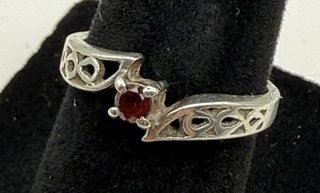
View on eBay

1920s Journal-Post Want Ad Card Lady in Garden Paper Lanterns Phone Main 4000

1920s Journal-Post Want Ad Card Lady in Garden Paper Lanterns Phone Main 4000 — A small vintage advertising card for the want ads of the Journal-Post. Approx. 2.45 x 3.90 in.

$16.02 Advertising Sales Trade Cards

Description

A small vintage advertising card for the want ads of the Journal-Post. A young woman with upswept dark hair, in a red sleeveless bodice and a full white skirt trimmed with red bows, glances back over her shoulder in a garden at dusk hung with Japanese-style paper lanterns. Below, in bold black type: "DO YOU WANT GOOD, RELIABLE HELP? A JOURNAL-POST WANT AD WILL PUT YOU IN TOUCH WITH THE RIGHT KIND. PHONE MAIN 4000." Small print at the foot: a circled-C copyright mark with a circled H and the number 1157, and "MADE IN U.S.A." The back is blank.

Vertical, approx. 2.45 x 3.90 in.

Read the full description

Historical Context

A Kansas City want ad? The card names no city. The best-known paper of the name is the Kansas City Journal-Post. Walter S. Dickey bought the Kansas City Journal and, in 1922, the Kansas City Post, and the two were combined as the Kansas City Journal-Post on October 4, 1928. The paper's last issue appeared on March 31, 1942.

Help wanted. Before employment agencies and job boards, a classified ad was how a household found a cook, a maid or a nurse, and newspapers promoted their want-ad columns with giveaways like this card.

Pocket-size advertising. Small enough for a purse or a desk drawer, the card kept the paper's telephone number at hand. "PHONE MAIN 4000" dates from the era of named telephone exchanges.

Condition

Very good. Front bright and clean, corners lightly rounded, light edge wear, and a tiny orange mark at the bottom edge. The blank back is lightly toned with faint mottling. Please see the photos, which are part of the description.

About The Printing

This is a color lithograph of the twentieth century, printed by a more modern commercial method. The exact process cannot be determined with certainty from a scan, so none is claimed here. Under magnification the image resolves into a regular, fine dot pattern rather than the irregular hand-drawn stipple of an 1880s chromolithograph.

That screen is exactly what a card of this date should show, so it is not a sign of reproduction here. The evidence of an original is the card itself: its printed text, its imprints and the wear of its age.

The want-ad text is printed in solid black type over the color picture.

Provenance

From my family's estate collections, built over more than 60 years by knowledgeable antiques collectors and traders. Stored in a climate-controlled environment.

Also In Our Store

More Journal-Post cards in our store: https://www.ebay.com/str/tfauctionsintl?_nkw=journal-post

A companion Journal-Post want-ad card with a different illustration, and more vintage advertising cards, are in our store.

Disclaimer

The images and any video show the actual item and are part of the official listing description, so please review them closely. Measurements and weights are approximate, and any maker or material we haven't confirmed is described as assumed. Questions? Message us; we answer quickly.

View on eBay

1880s Trade Card Clark's O.N.T. Spool Cotton Sunrise in the Desert Pyramids

1880s Trade Card Clark's O.N.T. Spool Cotton Sunrise in the Desert Pyramids — A large Victorian trade card for Clark's O.N.T. Approx. 7.00 x 5.05 in.

$15.98 Advertising Sales Trade Cards

Description

A large Victorian trade card for Clark's O.N.T. Spool Cotton, titled "Sunrise in the Desert." At left stands a mustached man in a white head wrap and cloak, a red embroidered jacket, a white sash and blue breeches, holding a long rifle. Behind him, in a diamond-shaped panel, the sun rises over the desert behind a camel caravan and two pyramids, with a bleached skull and ribs in the sand in the foreground. The Clark's O.N.T. Spool Cotton trademark roundel, in blue and yellow, is at lower right.

The back is printed in green around a large O.N.T. trademark: "If the Lady who receives this card will buy CLARK'S O.N.T. SPOOL COTTON, SHE WILL GET THE BEST THREAD FOR HAND & MACHINE SEWING. IT IS WOUND ON WHITE SPOOLS. The above label is on the bottom of every spool."

Horizontal, approx. 7.00 x 5.05 in.

Read the full description

Historical Context

Our New Thread. O.N.T. stood for "Our New Thread," the name Clark gave the product when it was introduced. The thread makers were among the busiest trade card advertisers of the 1880s, and Clark's cards were issued in long series.

Made in Newark. The Clark Thread Company's factory stood in Newark, New Jersey, on the west bank of the Passaic River.

Orientalist travel. Egypt and the Near East, with pyramids, caravans and desert guards in rich costume, were favorite subjects of Victorian painters and printers. This large card is a strong example for collectors of Orientalist imagery.

Written for the lady of the house. The back speaks directly to the woman who did the family sewing, and who, in the 1880s, often kept these cards in an album.

Condition

Front very good: clean and bright, corners sharp to lightly worn. A small light stain in the margin to the right of the trademark roundel, and a few tiny surface scuffs and dark flecks in the sand below the skull. The back shows extensive tan streaking from old album glue, with small areas of surface paper loss (thinning) at the upper left and along the left side; the printing remains complete and legible. No writing. Please see the photos, which are part of the description.

About The Printing

This is an original chromolithograph, and it was slow, exacting work. Each color had to be drawn onto its own separate stone by hand — in monochrome, the artist judging how much stipple each area needed so the colors would combine correctly only once every stone had been printed. The sheet then went through the press once for every color it carries, often a dozen or more, and every pass had to register exactly against the last. A pass out of register showed.

Under magnification the image resolves into irregular hand-drawn stipple, each ink carrying its own dot pattern, the colors mixing in the eye rather than on the paper. There is no regular halftone screen and no four-color rosette, which is what a modern reproduction would show. Modern process printing simulates every color from four inks; chromolithography laid each color down as its own.

The advertising on the back is printed in a single green ink.

Provenance

From my family's estate collections, built over more than 60 years by knowledgeable antiques collectors and traders. Stored in a climate-controlled environment.

Also In Our Store

More Clark's O.N.T. cards in our store: https://www.ebay.com/str/tfauctionsintl?_nkw=clark

More Victorian advertising trade cards for thread and sewing, along with other Orientalist and travel subjects, are in our store.

Disclaimer

The images and any video show the actual item and are part of the official listing description, so please review them closely. Measurements and weights are approximate, and any maker or material we haven't confirmed is described as assumed. Questions? Message us; we answer quickly.

View on eBay

1987 Costa Rica 100 Colones Long Years in Circulation Banknote P-248b [Est. VG]

29 April 1987 Costa Rica 100 Colones Banknote, Ricardo Jimenez Oreamuno / Supreme Court Building, Pick P-248b, Serial E41989570 [Est. VG]

$15.87 1987 Est. VG Costa Rica

Description

Issued by the Banco Central de Costa Rica. Front: Ricardo Jimenez Oreamuno; back: the Corte Suprema de Justicia (Supreme Court) building. The design was printed by Thomas de la Rue, American Bank Note and Casa da Moeda do Brasil; the series letter and printer imprint identify the catalog number. Later issues have a repeated BCCR-100 watermark. Serial E41989570. Measured on the 1200 dpi scan: 155.1 x 66.5 mm. The close-ups show the serial, the date, Ricardo Jimenez and the Supreme Court building. The last image adds a millimeter scale.

Read the full description

Historical Context

Ricardo Jimenez Oreamuno (1859-1945) was president three times (1910-1914, 1924-1928 and 1932-1936) and also headed the Supreme Court and Congress, the only person to lead all three branches of government. The 100 colones later became a coin, first dated 1995.

Condition

[Est. VG] Heavy circulation: several folds and many creases, with heavy grey-brown soiling and limp paper. Scattered small rust-brown spots on both sides. The top edge is fuzzy with small nicks. No tears or holes. Grade estimated from the scans; not professionally graded.

Legal Tender

No longer legal tender: catalogs list it as demonetized (date not found), and the 100 colones is now a coin.

Disclaimer

The images and any video show the actual item and are part of the official listing description, so please review them closely. Measurements and weights are approximate, and any maker or material we haven't confirmed is described as assumed. Questions? Message us; we answer quickly.

View on eBay

1889 Arbuckle Coffee Trade Card No 82 South Dakota State Map Elk Herd Prairie

1889 Arbuckle Coffee Trade Card No 82 South Dakota State Map Elk Herd Prairie — Original Victorian advertising trade card, chromolithograph, copyright 1889 by Arbuckle Bros., N.Y. Approx. 5.05 x 3.05 in.

$15.77 1889 Advertising Sales Trade Cards

Description

Arbuckle Bros Ariosa Coffee — South Dakota, State Map No. 82

A colored map of South Dakota, its towns and rivers lettered in, with North Dakota, Minnesota, Nebraska, Wyoming and Montana around it. Below the map a herd of elk grazes across the prairie, and in the foreground a bull elk with a full spread of antlers stands over a resting cow. A scroll at the right reads: Area 74,450 Sq. Miles. Population 67,589.

The reverse is headed ARBUCKLES' Ariosa Coffee, COSTS MORE AND IS WORTH MORE THAN OTHER BRANDS OF COFFEE. WHY? Four numbered reasons follow: the coffee is made from green coffee of higher grade; its strength and aroma are retained by the glazing; the glazing is made of choice eggs and pure confectioners' “A” sugar; and it adds richness of flavor. A BEWARE paragraph warns against low-grade package coffee. A second column, READ THIS, explains the series — fifty cards, each showing a correct map of one State or Territory with pictures of its peculiar industries and scenery — and suggests that anyone with two cards of one kind exchange with a neighbor. A list of the states and territories represented follows. Arbuckle Bros. Coffee Company, New York. The card is numbered 82. Printed by Donaldson Brothers, N.Y.

Read the full description

Historical Context

This card catches South Dakota at the moment it became a state. The Dakota Territory was divided and both halves admitted in November 1889, the same year as the copyright line — and Arbuckle already had a card for each half.

The elk herd is the picture of the country before the settlers finished arriving. The population figure is the other clue. This card prints 67,589 and the North Dakota card 67,588 — together 135,177, the 1880 census count for the whole Dakota Territory. Arbuckle appears simply to have split the old figure in half, because no separate count for either state yet existed.

Condition

Toning and age typical of the period. Light surface soiling; minor edge and corner wear; toning to the reverse. The chromolithographed image remains bright and the reverse text fully legible. Please view the images carefully.

About The Printing

This is an original chromolithograph, and it was slow, exacting work. Each color had to be drawn onto its own separate stone by hand — in monochrome, the artist judging how much stipple each area needed so the colors would combine correctly only once every stone had been printed. The sheet then went through the press once for every color it carries, often a dozen or more, and every pass had to register exactly against the last. A pass out of register showed.

Under magnification the image resolves into irregular hand-drawn stipple, each ink carrying its own dot pattern, the colors mixing in the eye rather than on the paper. There is no regular halftone screen and no four-color rosette, which is what a modern reproduction would show. Modern process printing simulates every color from four inks; chromolithography laid each color down as its own.

Provenance

From my family's estate collections, built over more than 60 years by knowledgeable antiques collectors and traders. Stored in a climate-controlled environment.

Also In Our Store

More Victorian advertising trade cards are in our store.

Disclaimer

The images and any video show the actual item and are part of the official listing description, so please review them closely. Measurements and weights are approximate, and any maker or material we haven't confirmed is described as assumed. Questions? Message us; we answer quickly.

View on eBay

1923 Germany 500 Million Mark Reichsbanknote P-110 Weimar Hyperinflation

1923 Germany 500,000,000 (500 Million) Mark Reichsbanknote, Pick 110, Weimar Republic Hyperinflation, Dated September 1, 1923

$15.74 1923 Germany

Description

A Reichsbank emergency issue dated Berlin, September 1, 1923. Large ornate gothic lettering at left and the value "500" repeated at right. Uniface: the back is blank, a shortcut used as the presses raced to keep up with inflation.

Read the full description

Details

Issuer: Reichsbank, Germany

Denomination: 500,000,000 Mark

Date: September 1, 1923

Catalog: Pick 110 (watermark varieties exist)

Serial: BX-34, 219239 (best reading)

Size: approx. 155 x 85 mm

Historical Context

By autumn 1923 German prices were doubling every few days. Notes like this were printed by the millions and became worthless within weeks; the hyperinflation ended with the Rentenmark in November 1923.

Condition

Please see the photos for condition; the grade has not been certified.

The images and any video show the actual item and are part of the official listing description, so please review them closely. Measurements and weights are approximate, and any maker or material we haven't confirmed is described as assumed. Questions? Message us; we answer quickly.

View on eBay

Sweden 50 Kronor Jenny Lind Sedel Silver Harp Riksbank P-64c 1700467827-Est.AU

Sweden 50 Kronor Banknote, Jenny Lind the Swedish Nightingale, Silver Harp Back, Sveriges Riksbank, Pick P-64c, Serial 1700467827, UV Reactive [Est. AU]

$15.58 Est. AU Sweden

Description

A Sweden 50 kronor banknote from Sveriges Riksbank, the central bank of Sweden. The front shows the singer Jenny Lind with music from Bellini's opera Norma and a drawing of Stockholm's old opera house; the back shows a silver harp, a musical score and a stylized Swedish landscape. Serial number 1700467827. Pick P-64c, the 2004-2011 printing with the foil strip (2011 based on coding system with 1 at beginning of serial number). Watermark of Jenny Lind and the number 50.

Read the full description

Historical Context

Jenny Lind (1820-1887), "the Swedish Nightingale," was Sweden's first singer of international fame. Her 1850-1852 American concert tour, promoted by P.T. Barnum, made her a sensation in the United States. The old 50 kronor became invalid after 30 June 2016.

Condition

[Est. AU] Crisp paper with no folds or creases; one corner is bent over but not creased. Noticeable waviness in the paper from storage humidity. Grade estimated; not professionally graded. No errors found.

UV CHECK: Checked under a UV lamp: UV-reactive fibers and fluorescent printed areas on both sides glow under ultraviolet light (UV reactive, confirmed). UV photos are contrast-enhanced to show the security features.

Legal Tender

No longer legal tender. Older 50 kronor notes became invalid after 30 June 2016 (Sveriges Riksbank). It is sold as a collectible.

Disclaimer

The images and any video show the actual item and are part of the official listing description, so please review them closely. Measurements and weights are approximate, and any maker or material we haven't confirmed is described as assumed. Questions? Message us; we answer quickly.

View on eBay

2009 Costa Rica 5000 Colones Capuchin Monkey Banknote P-276a [Est. F]

2 September 2009 Costa Rica 5000 Colones Banknote, Alfredo Gonzalez Flores / Mangrove with Capuchin Monkey, Pick P-276a, Serial A018868668 [Est. F]

$15.47 2009 Est. F Costa Rica

Description

Cotton-paper note issued by the Banco Central de Costa Rica and printed by Oberthur. Front: Alfredo Gonzalez Flores with the Banco Internacional de Costa Rica building and a color-shifting map of Costa Rica; back: a mangrove (MANGLAR) with a white-faced capuchin monkey, a crab and flowers. Portrait watermark and a color-shifting windowed thread. Serial A018868668. Measured on the 1200 dpi scan: 140.4 x 67.6 mm. The close-ups show the serial, the date, Gonzalez Flores and the capuchin monkey. The last image adds a millimeter scale.

Read the full description

Historical Context

Alfredo Gonzalez Flores (1877-1962) was president from 1914 to 1917. He created the International Bank of Costa Rica, today the Banco Nacional, and introduced direct taxation before his war minister, Federico Tinoco, overthrew him on 27 January 1917. The design entered circulation on 27 August 2012.

Condition

[Est. F] Well circulated, with many folds including a strong vertical center fold and a horizontal fold, overall soiling and rounded corners. No tears, holes, tape or writing. Grade estimated from the scans; not professionally graded.

Legal Tender

No longer legal tender: withdrawn on 1 March 2022; it can still be exchanged or deposited at Costa Rican financial institutions with no time limit (BCCR).

Disclaimer

The images and any video show the actual item and are part of the official listing description, so please review them closely. Measurements and weights are approximate, and any maker or material we haven't confirmed is described as assumed. Questions? Message us; we answer quickly.

View on eBay

ca 1969 Argentina 100 Pesos Moneda Nacional Banknote P-277a [Est. UNC]

Undated (issued 1969) Argentina 100 Pesos Moneda Nacional Banknote, Gen. San Martin / Second Founding of Buenos Aires, Pick P-277a, Serial 15280564G [Est. UNC]

$15.43 1969 Est. UNC Argentina

Description

Issued by the Banco Central de la Republica Argentina, which promises to pay the bearer 'Cien pesos moneda nacional', and printed by Casa de Moneda. Front: General San Martin in uniform in an oval; back: the second founding of Buenos Aires, after the painting by Jose Moreno Carbonero. Watermark of Manuel Belgrano. Serial 15280564G. Measured on the 1200 dpi scan: 161.8 x 82.5 mm. Centering, measured on the scan: front L5.0 R4.7 T6.2 B4.3 mm (slightly low); back 5.0-6.9 mm. Per margins_r01. The close-ups show the serial, San Martin, the back scene, the signatures, the 100 pesos crest and the bank title lettering. The last image adds a millimeter scale.

Read the full description

Historical Context

One of the last moneda nacional notes (1967-1969): on 1 January 1970 the peso ley replaced the old peso at 100 to 1, and leftover stock of this note was overprinted 1 peso ley. The painting shows Juan de Garay founding Buenos Aires on 11 June 1580. Including the 1970 change, Argentina's currency reforms have removed 13 zeros in all.

Condition

[Est. UNC] No folds, creases or handling marks, with bright white paper and sharp corners. Faint grey ink set-off from another note shows in the back top margin, a printing feature rather than a stain. No tears, holes or writing. Grade estimated from the scans; not professionally graded.

Legal Tender

No longer legal tender: demonetized on 29 March 1978.

Disclaimer

The images and any video show the actual item and are part of the official listing description, so please review them closely. Measurements and weights are approximate, and any maker or material we haven't confirmed is described as assumed. Questions? Message us; we answer quickly.

View on eBay

1935E $1 Silver Certificate One Dollar in Silver Washington B22113759I Circ

Series 1935E $1 Silver Certificate, Blue Seal, No Motto, George Washington, One Dollar in Silver Payable to the Bearer, Eisenhower Era, Ivy Baker Priest and George M. Humphrey Signatures, Serial B22113759I, Fr. 1614, Circulated [Est. F]

$15.42 Est. F Silver Certificates

Description

A Series 1935E $1 Silver Certificate with a blue Treasury seal and blue serial numbers. Signed by Ivy Baker Priest, Treasurer of the United States, and George M. Humphrey, Secretary of the Treasury. Serial number B22113759I; face plate H7536. Standard small size, about 6.125 x 2.625 in.

Read the full description

Historical Context

Silver certificates promised the bearer one dollar in silver on demand. That promise ended in June 1968, when the Treasury stopped redeeming them for silver; the notes remain legal tender at face value.

Condition

[Est. F] Folds incl. crease through portrait; small brown spot left of H, obverse. Off-center: narrowest margin at the bottom, 2.1 mm. Grade estimated from the scans; not professionally graded. No errors found.

Legal Tender

Yes. United States currency issued since 1861 remains legal tender at face value; this $1 Silver Certificate is still worth one dollar, though it can no longer be exchanged for silver (that ended in June 1968).

Disclaimer

The images and any video show the actual item and are part of the official listing description, so please review them closely. Measurements and weights are approximate, and any maker or material we haven't confirmed is described as assumed. Questions? Message us; we answer quickly.

View on eBay

1935E One Dollar Silver Certificate Payable in Silver L36309925H Circ

Series 1935E $1 Silver Certificate, Blue Seal, No Motto, George Washington, One Dollar in Silver Payable to the Bearer, Eisenhower Era, Ivy Baker Priest and George M. Humphrey Signatures, Serial L36309925H, Fr. 1614, Circulated [Est. F]

$15.38 Est. F Silver Certificates

Description

A Series 1935E $1 Silver Certificate with a blue Treasury seal and blue serial numbers. Signed by Ivy Baker Priest, Treasurer of the United States, and George M. Humphrey, Secretary of the Treasury. Serial number L36309925H; face plate P7694. Standard small size, about 6.125 x 2.625 in.

Read the full description

Historical Context

Silver certificates promised the bearer one dollar in silver on demand. That promise ended in June 1968, when the Treasury stopped redeeming them for silver; the notes remain legal tender at face value.

Condition

[Est. F] Fine crumpling on obverse; folds; good color. Off-center: narrowest margin at the bottom, 1.7 mm. Grade estimated from the scans; not professionally graded. No errors found.

Legal Tender

Yes. United States currency issued since 1861 remains legal tender at face value; this $1 Silver Certificate is still worth one dollar, though it can no longer be exchanged for silver (that ended in June 1968).

Disclaimer

The images and any video show the actual item and are part of the official listing description, so please review them closely. Measurements and weights are approximate, and any maker or material we haven't confirmed is described as assumed. Questions? Message us; we answer quickly.

View on eBay

1889 Arbuckle Coffee Trade Card No 71 Siberia Map Convicts in Mines Polar Bear

1889 Arbuckle Coffee Trade Card No 71 Siberia Map Convicts in Mines Polar Bear — Original Victorian advertising trade card, chromolithograph, copyright 1889 by Arbuckle Bros., N.Y. Approx. 5.05 x 3.10 in.

$15.31 1889 Advertising Sales Trade Cards

Description

Arbuckle Bros Ariosa Coffee — Siberia, Map Card No. 71

A colored map of Siberia, from the Arctic Ocean to the Chinese Empire, with Persia, Afghanistan and Beloochistan to the south and the Pacific to the east, marked Russian Possession. A polar bear looks out from a red roundel in the corner, and a broken shackle and chain hang below the map. The main scene, captioned CONVICTS AT WORK IN THE MINES, shows a line of convicts swinging picks in the snow under guards in greatcoats and caps, bayonets fixed, icicles hanging overhead. The map panel reads: Area 6,288,000 Sq. M. Pop. 14,697,000. Russian Possession.

The reverse carries Arbuckle's GRIND YOUR COFFEE AT HOME advice and the ARIOSA claim, closing with the line that rival makers know no higher praise than to say “It's just as good as Arbuckles'.” An EXPLANATORY panel describes the series — fifty cards, each showing a correctly colored map of one of the chief countries of the world with pictures of its industries, scenery and customs — and explains that every package of Arbuckle's coffee contains one of these cards or one of the companion series of fifty Zoological cards. A list of the countries represented follows. Arbuckle Bros. Coffee Co., New York City. The card is numbered 71. Printed by Donaldson Brothers, N.Y.

Read the full description

Historical Context

Siberia was the one place on the foreign map series with no industry to show except punishment. Russia sent convicts and political exiles east to the mines, and by the late 1880s American readers knew about it from George Kennan's reports in The Century magazine, which caused a sensation.

The shackle and chain beside the map is not decoration. For an American coffee buyer in 1889, Siberia meant exile.

Condition

Toning and age typical of the period. Light surface soiling; minor edge and corner wear; toning to the reverse. The chromolithographed image remains bright and the reverse text fully legible. Please view the images carefully.

About The Printing

This is an original chromolithograph, and it was slow, exacting work. Each color had to be drawn onto its own separate stone by hand — in monochrome, the artist judging how much stipple each area needed so the colors would combine correctly only once every stone had been printed. The sheet then went through the press once for every color it carries, often a dozen or more, and every pass had to register exactly against the last. A pass out of register showed.

Under magnification the image resolves into irregular hand-drawn stipple, each ink carrying its own dot pattern, the colors mixing in the eye rather than on the paper. There is no regular halftone screen and no four-color rosette, which is what a modern reproduction would show. Modern process printing simulates every color from four inks; chromolithography laid each color down as its own.

Provenance

From my family's estate collections, built over more than 60 years by knowledgeable antiques collectors and traders. Stored in a climate-controlled environment.

Also In Our Store

More Victorian advertising trade cards are in our store.

Disclaimer

The images and any video show the actual item and are part of the official listing description, so please review them closely. Measurements and weights are approximate, and any maker or material we haven't confirmed is described as assumed. Questions? Message us; we answer quickly.

View on eBay

1920s Journal-Post Want Ad Advertising Card Lady in Fur Stole Phone Main 4000

1920s Journal-Post Want Ad Advertising Card Lady in Fur Stole Phone Main 4000 — A small vintage advertising card for the want ads of the Journal-Post. Approx. 2.50 x 3.90 in.

$15.26 Advertising Sales Trade Cards

Description

A small vintage advertising card for the want ads of the Journal-Post. A young woman with bobbed dark hair, in a white gown with a green sash and a dark fur stole over a mauve wrap, holds a posy of purple flowers in an elegant room with a shaded lamp, a fruit compote and a striped chair. Below, in bold black type: "DO YOU WANT GOOD, RELIABLE HELP? A JOURNAL-POST WANT AD WILL PUT YOU IN TOUCH WITH THE RIGHT KIND. PHONE MAIN 4000." Small print at the foot: "MADE IN U.S.A." and a circled-C copyright mark with a circled H and the number 1161 (best reading). The back is blank.

Vertical, approx. 2.50 x 3.90 in.

Read the full description

Historical Context

A Kansas City want ad? The card names no city. The best-known paper of the name is the Kansas City Journal-Post. Walter S. Dickey bought the Kansas City Journal and, in 1922, the Kansas City Post, and the two were combined as the Kansas City Journal-Post on October 4, 1928. The paper's last issue appeared on March 31, 1942.

Help wanted. Before employment agencies and job boards, a classified ad was how a household found a cook, a maid or a nurse, and newspapers promoted their want-ad columns with giveaways like this card.

Pocket-size advertising. Small enough for a purse or a desk drawer, the card kept the paper's telephone number at hand. "PHONE MAIN 4000" dates from the era of named telephone exchanges.

Condition

Very good. Front bright and clean, corners lightly rounded, light edge wear, and a few tiny brown age spots in the margins. The blank back is lightly toned, with a few small brown spots (foxing) toward the upper left. No writing. Please see the photos, which are part of the description.

About The Printing

This is a color lithograph of the twentieth century, printed by a more modern commercial method. The exact process cannot be determined with certainty from a scan, so none is claimed here. Under magnification the image resolves into a regular, fine dot pattern rather than the irregular hand-drawn stipple of an 1880s chromolithograph.

That screen is exactly what a card of this date should show, so it is not a sign of reproduction here. The evidence of an original is the card itself: its printed text, its imprints and the wear of its age.

The want-ad text is printed in solid black type over the color picture.

Provenance

From my family's estate collections, built over more than 60 years by knowledgeable antiques collectors and traders. Stored in a climate-controlled environment.

Also In Our Store

More Journal-Post cards in our store: https://www.ebay.com/str/tfauctionsintl?_nkw=journal-post

A companion Journal-Post want-ad card with a different illustration, and more vintage advertising cards, are in our store.

Disclaimer

The images and any video show the actual item and are part of the official listing description, so please review them closely. Measurements and weights are approximate, and any maker or material we haven't confirmed is described as assumed. Questions? Message us; we answer quickly.

View on eBay

1962-Girl Scouts of the USA - 50th Anniversary Medal - Coin [Est. AU]

1962-50th Anniversary Commemorative - United States of America - Commemorative 50th - Coin [Est. AU]

$15.25 1962 Est. AU Medals/Tokens/Novelty

Thank you!

Ref: 1.0316

  • Please see pictures as they are part of the item description and show the actual condition of the coin you will receive.
  • Issuer: United States of America
  • Composition: Bronze
  • Note: Not responsible for Internet mis-translations. Grading estimates are from CoinSnap. If you see something that is incorrect, please send a message and we'll do our best to correct it.

View on eBay

1935E $1 Silver Cert Eisenhower Era Blue Seal U80729465G Circ

Series 1935E $1 Silver Certificate, Blue Seal, No Motto, George Washington, One Dollar in Silver Payable to the Bearer, Eisenhower Era, Ivy Baker Priest and George M. Humphrey Signatures, Serial U80729465G, Fr. 1614, Circulated [Est. F]

$15.17 Est. F Silver Certificates

Description

A Series 1935E $1 Silver Certificate with a blue Treasury seal and blue serial numbers. Signed by Ivy Baker Priest, Treasurer of the United States, and George M. Humphrey, Secretary of the Treasury. Serial number U80729465G; face plate L7724. Standard small size, about 6.125 x 2.625 in.

Read the full description

Historical Context

Silver certificates promised the bearer one dollar in silver on demand. That promise ended in June 1968, when the Treasury stopped redeeming them for silver; the notes remain legal tender at face value.

Condition

[Est. F] Folds through portrait; soft paper. Off-center: narrowest margin at the bottom, 2.2 mm. Grade estimated from the scans; not professionally graded. No errors found.

Legal Tender

Yes. United States currency issued since 1861 remains legal tender at face value; this $1 Silver Certificate is still worth one dollar, though it can no longer be exchanged for silver (that ended in June 1968).

Disclaimer

The images and any video show the actual item and are part of the official listing description, so please review them closely. Measurements and weights are approximate, and any maker or material we haven't confirmed is described as assumed. Questions? Message us; we answer quickly.

View on eBay

Sweden 50 Kronor Jenny Lind Swedish Nightingale Banknote P-64b 8360280416-Est.AU

Sweden 50 Kronor Banknote, Jenny Lind the Swedish Nightingale, Silver Harp Back, Sveriges Riksbank, Pick P-64b, Serial 8360280416, UV Reactive [Est. AU]

$15.17 Est. AU Sweden

Description

A Sweden 50 kronor banknote from Sveriges Riksbank, the central bank of Sweden. The front shows the singer Jenny Lind with music from Bellini's opera Norma and a drawing of Stockholm's old opera house; the back shows a silver harp, a musical score and a stylized Swedish landscape. Serial number 8360280416. Pick P-64b, the 2004-2011 printing with the foil strip (2008 based on the coding system using 8 at the beginning of the serial number). Watermark of Jenny Lind and the number 50.

Read the full description

Historical Context

Jenny Lind (1820-1887), "the Swedish Nightingale," was Sweden's first singer of international fame. Her 1850-1852 American concert tour, promoted by P.T. Barnum, made her a sensation in the United States. The old 50 kronor became invalid after 30 June 2016.

Condition

[Est. AU] Crisp paper with no folds or creases and sharp corners. Noticeable waviness in the paper from storage humidity. Grade estimated; not professionally graded. No errors found.

UV CHECK: Checked under a UV lamp: UV-reactive fibers and fluorescent printed areas on both sides glow under ultraviolet light (UV reactive, confirmed). UV photos are contrast-enhanced to show the security features.

Legal Tender

No longer legal tender. Older 50 kronor notes became invalid after 30 June 2016 (Sveriges Riksbank). It is sold as a collectible.

Disclaimer

The images and any video show the actual item and are part of the official listing description, so please review them closely. Measurements and weights are approximate, and any maker or material we haven't confirmed is described as assumed. Questions? Message us; we answer quickly.

View on eBay

1935E $1 Silver Certificate Blue Seal Merchant Stamp P37926229I Circ

Series 1935E $1 Silver Certificate, Blue Seal, No Motto, George Washington, One Dollar in Silver Payable to the Bearer, Eisenhower Era, Ivy Baker Priest and George M. Humphrey Signatures, Merchant Stamp, Serial P37926229I, Fr. 1614, Circulated [Est. F-VF]

$15.13 Est. F-VF Silver Certificates

Description

A Series 1935E $1 Silver Certificate with a blue Treasury seal and blue serial numbers. Signed by Ivy Baker Priest, Treasurer of the United States, and George M. Humphrey, Secretary of the Treasury. Serial number P37926229I; face plate G8584. Standard small size, about 6.125 x 2.625 in.

Read the full description

Historical Context

Silver certificates promised the bearer one dollar in silver on demand. That promise ended in June 1968, when the Treasury stopped redeeming them for silver; the notes remain legal tender at face value.

Condition

[Est. F-VF] Several folds; good color; magenta business stamp right of portrait, bleeds to reverse. Off-center: narrowest margin at the top, 2.4 mm. Grade estimated from the scans; not professionally graded. No errors found.

Legal Tender

Yes. United States currency issued since 1861 remains legal tender at face value; this $1 Silver Certificate is still worth one dollar, though it can no longer be exchanged for silver (that ended in June 1968).

Disclaimer

The images and any video show the actual item and are part of the official listing description, so please review them closely. Measurements and weights are approximate, and any maker or material we haven't confirmed is described as assumed. Questions? Message us; we answer quickly.

View on eBay

1935D One Dollar Silver Certificate Julian Snyder Signatures C97536331G Circ

Series 1935D $1 Silver Certificate, Blue Seal, No Motto, George Washington, One Dollar in Silver Payable to the Bearer, Truman Era, William A. Julian and John W. Snyder Signatures, Serial C97536331G, Fr. 1613, Circulated [Est. F]

$15.06 Est. F Silver Certificates

Description

A Series 1935D $1 Silver Certificate with a blue Treasury seal and blue serial numbers. Signed by William A. Julian, Treasurer of the United States, and John W. Snyder, Secretary of the Treasury. Serial number C97536331G; face plate A6436. Standard small size, about 6.125 x 2.625 in.

Read the full description

Historical Context

Silver certificates promised the bearer one dollar in silver on demand. That promise ended in June 1968, when the Treasury stopped redeeming them for silver; the notes remain legal tender at face value.

Condition

[Est. F] Folds; small brownish spots on reverse near pyramid and ONE. Well centered. Grade estimated from the scans; not professionally graded. No errors found.

Legal Tender

Yes. United States currency issued since 1861 remains legal tender at face value; this $1 Silver Certificate is still worth one dollar, though it can no longer be exchanged for silver (that ended in June 1968).

Disclaimer

The images and any video show the actual item and are part of the official listing description, so please review them closely. Measurements and weights are approximate, and any maker or material we haven't confirmed is described as assumed. Questions? Message us; we answer quickly.

View on eBay

Victorian Trade Card BBBB Coffee Acrostic Poem Red Rose Winter Abbey Ruin

Victorian Trade Card BBBB Coffee Acrostic Poem Red Rose Winter Abbey Ruin — Original Victorian advertising trade card, chromolithograph, c. 1880s-90s. Approx. 5.80 x 3.95 in.

$15.01 Advertising Sales Trade Cards

Description

“B.B.B.B.” Coffee — Red Rose with an Acrostic Back

A large deep-red rose with a bud, green leaves, fern and small yellow blossoms spreads across the upper part of the card, above a small winter scene of a turreted stone abbey beside a frozen pond. There is no lettering on the front.

The reverse is an acrostic — the first letter of each line spells out the brand. Do you Think? GOOD COFFEE SHOULD: Be free from all adulterations? Be possessed of considerable strength? Be sure to have a delicious flavor? Be FRESHLY ROASTED? IF SO, WE Certainly agree with you, On these all important points; For no single day passes but that we Freshly roast the “B.B.B.B.” the most Excellent grade of Coffee Ever put up in one-pound packages. Buy “B.B.B.B.”

Read the full description

Historical Context

Read down the left edge of the reverse and it spells B-B-B-B-C-O-F-F-E-E. A word puzzle on the back of a coffee card rewarded the reader for looking twice, and anyone who worked it out remembered the name.

The card does not say who roasted B.B.B.B. Coffee or where. That is part of its interest: a brand confident enough to go by four initials, and small enough that the name has not come down to us attached to a company.

Condition

Toning and age typical of the period. A small brown adhesion spot on the right of the reverse; a soft crease with light damage at the lower-right corner, visible on both sides; some rubbing across the center of the rose; light surface soiling. Colors remain rich. Please view the images carefully.

About The Printing

This is an original chromolithograph, and it was slow, exacting work. Each color had to be drawn onto its own separate stone by hand — in monochrome, the artist judging how much stipple each area needed so the colors would combine correctly only once every stone had been printed. The sheet then went through the press once for every color it carries, often a dozen or more, and every pass had to register exactly against the last. A pass out of register showed.

Under magnification the image resolves into irregular hand-drawn stipple, each ink carrying its own dot pattern, the colors mixing in the eye rather than on the paper. There is no regular halftone screen and no four-color rosette, which is what a modern reproduction would show. Modern process printing simulates every color from four inks; chromolithography laid each color down as its own.

Provenance

From my family's estate collections, built over more than 60 years by knowledgeable antiques collectors and traders. Stored in a climate-controlled environment.

Also In Our Store

More Victorian advertising trade cards are in our store.

Disclaimer

The images and any video show the actual item and are part of the official listing description, so please review them closely. Measurements and weights are approximate, and any maker or material we haven't confirmed is described as assumed. Questions? Message us; we answer quickly.

View on eBay

1935E $1 Silver Certificate Blue Seal L35981425H Off Center Circ

Series 1935E $1 Silver Certificate, Blue Seal, No Motto, George Washington, One Dollar in Silver Payable to the Bearer, Eisenhower Era, Ivy Baker Priest and George M. Humphrey Signatures, Off Center, Serial L35981425H, Fr. 1614, Circulated [Est. F]

$14.94 Est. F Silver Certificates

Description

A Series 1935E $1 Silver Certificate with a blue Treasury seal and blue serial numbers. Signed by Ivy Baker Priest, Treasurer of the United States, and George M. Humphrey, Secretary of the Treasury. Serial number L35981425H; face plate R7575. Standard small size, about 6.125 x 2.625 in.

Read the full description

Historical Context

Silver certificates promised the bearer one dollar in silver on demand. That promise ended in June 1968, when the Treasury stopped redeeming them for silver; the notes remain legal tender at face value.

Condition

[Est. F] Several folds; light toning; most off-center (bottom 1.1 mm). Off-center: narrowest margin at the bottom, 1.1 mm. Grade estimated from the scans; not professionally graded. No errors found.

Legal Tender

Yes. United States currency issued since 1861 remains legal tender at face value; this $1 Silver Certificate is still worth one dollar, though it can no longer be exchanged for silver (that ended in June 1968).

Disclaimer

The images and any video show the actual item and are part of the official listing description, so please review them closely. Measurements and weights are approximate, and any maker or material we haven't confirmed is described as assumed. Questions? Message us; we answer quickly.

View on eBay

1916 Japan 1 Yen Silver Note Takenouchi no Sukune P-30c 717239 [Est. VF]

1916 Japan 1 Yen Banknote, Bank of Japan, Pick P-30c, {443} 717239 [Est. VF]

$14.84 1916 Est. VF Japan

Description

A Bank of Japan convertible silver note, 1 yen, ND (1916), with Takenouchi no Sukune. Block 443, serial 717239. Pick P-30c (Numista N#208109).

Read the full description

Historical Context

A convertible silver note, once exchangeable for 1 yen in silver. Takenouchi no Sukune is a legendary statesman of the early Japanese chronicles.

Condition

[Est. VF] Light circulation; see the photos. Grade estimated; not professionally graded.

Legal Tender

Still legal tender in Japan at face value (on the Bank of Japan list of valid notes), but worth more to collectors.

Disclaimer

The images and any video show the actual item and are part of the official listing description, so please review them closely. Measurements and weights are approximate, and any maker or material we haven't confirmed is described as assumed. Questions? Message us; we answer quickly.

View on eBay

1889 Arbuckle Coffee Trade Card No 77 Illinois Map Watch Making Farm [SEE DESC]

Arbuckle Bros Ariosa Coffee — Illinois, State Map No. 77

$14.58 1889 Advertising Sales Trade Cards

Original Victorian advertising trade card, chromolithograph, copyright 1889 by Arbuckle Bros., N.Y. Approx. 5.05 x 3.05 in.

A colored map of Illinois, its towns and rivers lettered in, with Chicago on Lake Michigan and Wisconsin, Iowa, Missouri, Indiana and Kentucky around it. At the left, captioned WATCH MAKING, women work at benches in a factory under overhead belts, and a gold pocket watch lies open in a red presentation case. At the right, captioned AGRICULTURAL MACHINERY, a plow, a mower and a hay rake stand before a brick factory. Area in Sq. Miles 56,650. Population 3,077,871.

The reverse is headed ARBUCKLES' Ariosa Coffee, COSTS MORE AND IS WORTH MORE THAN OTHER BRANDS OF COFFEE. WHY? Four numbered reasons follow: the coffee is made from green coffee of higher grade; its strength and aroma are retained by the glazing; the glazing is made of choice eggs and pure confectioners' “A” sugar; and it adds richness of flavor. A BEWARE paragraph warns against low-grade package coffee. A second column, READ THIS, explains the series — fifty cards, each showing a correct map of one State or Territory with pictures of its peculiar industries and scenery — and suggests that anyone with two cards of one kind exchange with a neighbor. A list of the states and territories represented follows. Arbuckle Bros. Coffee Company, New York. The card is numbered 77. Printed by Donaldson Brothers, N.Y.

Read the full description

Historical Context

Illinois gets two industries that would both have been instantly recognizable to a buyer in 1889. The Elgin watch works outside Chicago was one of the largest in the world, and Illinois factories were making the plows and reapers that were opening the prairie farms further west.

The women at the watch benches are a detail worth noticing. Fine assembly work of this kind was widely given to women workers, and the card shows it as simply part of the scene.

Condition

Toning and age typical of the period. Light surface soiling; minor edge and corner wear; toning to the reverse. The chromolithographed image remains bright and the reverse text fully legible. Please view the images carefully.

About The Printing

This is an original chromolithograph, and it was slow, exacting work. Each color had to be drawn onto its own separate stone by hand — in monochrome, the artist judging how much stipple each area needed so the colors would combine correctly only once every stone had been printed. The sheet then went through the press once for every color it carries, often a dozen or more, and every pass had to register exactly against the last. A pass out of register showed.

Under magnification the image resolves into irregular hand-drawn stipple, each ink carrying its own dot pattern, the colors mixing in the eye rather than on the paper. There is no regular halftone screen and no four-color rosette, which is what a modern reproduction would show. Modern process printing simulates every color from four inks; chromolithography laid each color down as its own.

Provenance

This item comes from the personal collections of my family estate, accumulated over more than 200 years — including items that came west by wagon train to Colorado and later to Oklahoma. Now that my parents have passed we cannot keep all of these cherished items. They were well-educated antiques collectors/traders and continued to build their collections over more than 60 years. The vast majority of the pieces are from the Victorian Era, however there are plenty of older and newer items. Everything has been stored in a climate-controlled environment over time.

Disclaimer

Specifications and detailed item descriptions are provided as a courtesy only and are not guaranteed to be one hundred percent accurate. Please do your own research. There are generally no receipts available for any items from original purchases. Any dimensions and/or weights are approximate. The absence of a more detailed condition report does not imply there are no condition issues with the item(s). Please inspect images carefully as they are part of the official item description and best representation of the actual condition. Additional images may be available upon request depending on time and availability. Not responsible for internet mis-translations or mis-identification of maker's marks if found or assumptions of makers or materials — item descriptions will indicate if it is assumed. If you see a problem, please message us immediately and we will do our best to sort out a solution and confirm the information. With the exception of eBay rules, no returns are accepted.
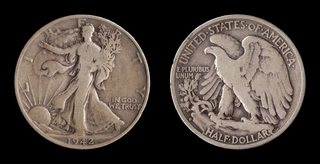
View on eBay

1967 Great Britain Penny Queen Elizabeth II - NGC Certified GENUINE #8355951-199

1967 Great Britain One Penny · NGC Genuine · Queen Elizabeth II portrait by Mary Gillick · bronze · pre-decimal

$14.57 1967 Great Britain/England/UK

Description

A 1967 British one penny, certified and sealed by NGC as Genuine, on an NGC Great Britain label with the Houses of Parliament, reading "(1954-1970) G. Britain Penny, Queen Elizabeth II." NGC's "Genuine" means the coin in the holder matches NGC's description of it; no numeric grade is given. The certification number on the label, 8355951-199, can be checked on the NGC website. The photos show this exact coin and holder.

Specifications: bronze (95.5% copper, 3% tin, 1.5% zinc); 30 mm; 9.4 grams. These are standard figures; the coin has not been removed from its holder.

Read the full description

The Last Pennies

Pennies dated 1967 were the last of the old pennies to go into circulation, and they went on being struck after 1967 still bearing that date. Britain changed to decimal currency on 15 February 1971, and the old penny ceased to be legal tender after 31 August 1971.

The Design

The portrait of Queen Elizabeth II is by Mary Gillick. Britannia on the reverse is by Leonard Charles Wyon, based on an earlier design by his father, William Wyon.

Britain's Royal Mint has a link to American coins too: in 1876 it recommended the English engraver George T. Morgan to the US Mint, where he went on to design the Morgan silver dollar.

Grade And Authenticity

NGC, founded in 1987, has been the American Numismatic Association's official grading service since 1995 and has an office in London. The seller inspected the holder for tampering (none found) and confirmed the certification number on the NGC website.

Also In Our Store

  • Morgan dollars by English-born George T. Morgan.
  • Hong Kong coins with the portrait of Queen Elizabeth II, from the colonial era.
  • More world coins and banknotes.

Disclaimer

Specifications and detailed item descriptions are provided as a courtesy only and are not guaranteed to be one hundred percent accurate. Please do your own research. There are generally no receipts available for any items from original purchases. Any dimensions and/or weights are approximate. The absence of a more detailed condition report does not imply there are no condition issues with the item(s). Please inspect images carefully as they are part of the official item description and best representation of the actual condition. Additional images may be available upon request depending on time and availability. Not responsible for internet mis-translations or mis-identification of maker's marks if found or assumptions of makers or materials — item descriptions will indicate if it is assumed. If you see a problem, please message us immediately and we will do our best to sort out a solution and confirm the information. With the exception of eBay rules, no returns are accepted.
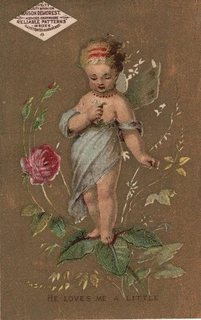
View on eBay

1889 Arbuckle Coffee Trade Card No 96 North Dakota Map Wheat Reaping [SEE DESC]

Arbuckle Bros Ariosa Coffee — North Dakota, State Map No. 96

$14.47 1889 Advertising Sales Trade Cards

Original Victorian advertising trade card, chromolithograph, copyright 1889 by Arbuckle Bros., N.Y. Approx. 5.05 x 3.05 in.

A colored map of North Dakota, its towns, forts and rivers lettered in, with Canada, Minnesota, South Dakota and Montana around it, hung from a ribbon with a sheaf of golden wheat. Captioned WHEAT FIELDS, the scene runs across the whole card: at the left, SOWING, farmers with horse-drawn seed drills, a wagon and sacks of seed; at the right, REAPING, a horse-drawn binder cutting the grain and shocks of wheat standing in the field. A gold cartouche reads: Area 77,000 Sq. Miles. Population 67,588.

The reverse is headed ARBUCKLES' Ariosa Coffee, COSTS MORE AND IS WORTH MORE THAN OTHER BRANDS OF COFFEE. WHY? Four numbered reasons follow: the coffee is made from green coffee of higher grade; its strength and aroma are retained by the glazing; the glazing is made of choice eggs and pure confectioners' “A” sugar; and it adds richness of flavor. A BEWARE paragraph warns against low-grade package coffee. A second column, READ THIS, explains the series — fifty cards, each showing a correct map of one State or Territory with pictures of its peculiar industries and scenery — and suggests that anyone with two cards of one kind exchange with a neighbor. A list of the states and territories represented follows. Arbuckle Bros. Coffee Company, New York. The card is numbered 96. Printed by Donaldson Brothers, N.Y.

Read the full description

Historical Context

North Dakota in 1889 was wheat, and nothing else on the card needs saying. The great bonanza farms of the Red River Valley ran to tens of thousands of acres, worked by gangs of men and machines exactly like the ones drawn here.

Like the South Dakota card, this one arrived just as the territory was divided. Both halves became states in November 1889, and Arbuckle had a map ready for each. The population figures give the game away: this card prints 67,588 and the South Dakota card 67,589. Together they make 135,177, the 1880 census count for the whole Dakota Territory. Arbuckle appears simply to have split the old figure in half.

Condition

Toning and age typical of the period. Light surface soiling; minor edge and corner wear; toning to the reverse. The chromolithographed image remains bright and the reverse text fully legible. Please view the images carefully.

About The Printing

This is an original chromolithograph, and it was slow, exacting work. Each color had to be drawn onto its own separate stone by hand — in monochrome, the artist judging how much stipple each area needed so the colors would combine correctly only once every stone had been printed. The sheet then went through the press once for every color it carries, often a dozen or more, and every pass had to register exactly against the last. A pass out of register showed.

Under magnification the image resolves into irregular hand-drawn stipple, each ink carrying its own dot pattern, the colors mixing in the eye rather than on the paper. There is no regular halftone screen and no four-color rosette, which is what a modern reproduction would show. Modern process printing simulates every color from four inks; chromolithography laid each color down as its own.

Provenance

This item comes from the personal collections of my family estate, accumulated over more than 200 years — including items that came west by wagon train to Colorado and later to Oklahoma. Now that my parents have passed we cannot keep all of these cherished items. They were well-educated antiques collectors/traders and continued to build their collections over more than 60 years. The vast majority of the pieces are from the Victorian Era, however there are plenty of older and newer items. Everything has been stored in a climate-controlled environment over time.

Disclaimer

Specifications and detailed item descriptions are provided as a courtesy only and are not guaranteed to be one hundred percent accurate. Please do your own research. There are generally no receipts available for any items from original purchases. Any dimensions and/or weights are approximate. The absence of a more detailed condition report does not imply there are no condition issues with the item(s). Please inspect images carefully as they are part of the official item description and best representation of the actual condition. Additional images may be available upon request depending on time and availability. Not responsible for internet mis-translations or mis-identification of maker's marks if found or assumptions of makers or materials — item descriptions will indicate if it is assumed. If you see a problem, please message us immediately and we will do our best to sort out a solution and confirm the information. With the exception of eBay rules, no returns are accepted.
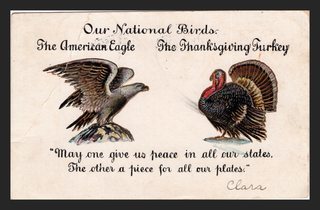
View on eBay

1935E $1 Silver Certificate No Motto Great Seal Back Y66009016H Well Circ

Series 1935E $1 Silver Certificate, Blue Seal, No Motto, George Washington, One Dollar in Silver Payable to the Bearer, Eisenhower Era, Ivy Baker Priest and George M. Humphrey Signatures, Great Seal Back, Serial Y66009016H, Fr. 1614, Well Circulated [Est. VG-F]

$14.46 Est. VG-F Silver Certificates

Description

A Series 1935E $1 Silver Certificate with a blue Treasury seal and blue serial numbers. Signed by Ivy Baker Priest, Treasurer of the United States, and George M. Humphrey, Secretary of the Treasury. Serial number Y66009016H; face plate G8160. Standard small size, about 6.125 x 2.625 in.

Read the full description

Historical Context

Silver certificates promised the bearer one dollar in silver on demand. That promise ended in June 1968, when the Treasury stopped redeeming them for silver; the notes remain legal tender at face value.

Condition

[Est. VG-F] Many folds; soiling; staining on reverse. Off-center: narrowest margin at the bottom, 2.7 mm. Grade estimated from the scans; not professionally graded. No errors found.

Legal Tender

Yes. United States currency issued since 1861 remains legal tender at face value; this $1 Silver Certificate is still worth one dollar, though it can no longer be exchanged for silver (that ended in June 1968).

Disclaimer

The images and any video show the actual item and are part of the official listing description, so please review them closely. Measurements and weights are approximate, and any maker or material we haven't confirmed is described as assumed. Questions? Message us; we answer quickly.

View on eBay

1946 Japan 10 Yen Diet Building Banknote P-87 1192822 [Est. XF-AU]

1946 Japan 10 Yen Banknote, Bank of Japan, Pick P-87, 1192822 [Est. XF-AU]

$14.46 1946 Est. XF-AU Japan

Description

A Bank of Japan 10 yen, ND (1946), with the National Diet Building and a green NIPPON back. Serial 1192822. Pick P-87 (Numista N#208698).

Read the full description

Historical Context

Issued in 1946, during the Allied occupation of Japan, with the National Diet Building as its main design.

Condition

[Est. XF-AU] Lightly handled; see the photos. Grade estimated; not professionally graded.

Legal Tender

Still legal tender in Japan at face value (on the Bank of Japan list of valid notes), but worth more to collectors.

Disclaimer

The images and any video show the actual item and are part of the official listing description, so please review them closely. Measurements and weights are approximate, and any maker or material we haven't confirmed is described as assumed. Questions? Message us; we answer quickly.

View on eBay

Clark's Mile End Thread Trade Card No 6 Bullfinch Poem Giacomelli Song Birds

Clark's Mile-End Spool Cotton — “The Bullfinch,” No. 6 of Twelve Aquarelles after Hector Giacomelli

$14.39 Advertising Sales Trade Cards

Original Victorian advertising trade card, chromolithograph, c. 1880s. Approx. 4.50 x 2.90 in. Printed by Donaldson Brothers, N.Y.

A bullfinch perches on top of a white panel carrying a poem, while two more birds sit in a nest of twigs and grasses below. A Clark's Mile-End spool-end label, numbered 24, sits in the lower left corner. The poem, THE BULLFINCH, is set in blackletter:

The Bullfinch, clad in sober Garb,

Whistles a most melodious lay,

And of all feathered songsters is

The daintiest gourmand, people say.

The ripest grains, most luscious fruits

Into his larder are impressed!

He scorns to eat of common fare;

He will have nothing but the best.

The Bullfinch teaches you a truth,

That if were well to heed, my friend:

Don't buy poor thread, it's worse than none

Purchase the best, 'tis “Clark's Mile End.”

The reverse, printed in blue, explains the series: the proprietors of Clark's Mile End Spool Cotton propose to issue a series of twelve aquarelles from designs by the celebrated Parisian artist Hector Giacomelli, illustrative of our native song birds, and asks the reader to preserve the cards as issued. Below: Families and Dressmakers should use CLARK'S MILE-END SPOOL COTTON, BEST SIX CORD for Machine and Hand Use. Thomas Russell & Co., Sole Agents. The card is numbered 6.

Read the full description

Historical Context

Giacomelli was a real name in Paris, known for his bird illustrations, and the thread company put that name on the back for a reason. A set of twelve fine bird pictures, issued one at a time and each with its own verse, was something a household would keep in order in an album. “Preserve the cards as issued” is the company telling you so.

The poem does the selling the picture will not. Three verses about a bird that will eat only the best, and the last two lines turn it round on the thread.

Condition

Toning and age typical of the period. The printed ground stops a little short of the right edge, leaving a narrow unprinted strip as trimmed at the time; light surface soiling; minor edge and corner wear. The reverse is clean with strong blue printing. Please view the images carefully.

About The Printing

This is an original chromolithograph, and it was slow, exacting work. Each color had to be drawn onto its own separate stone by hand — in monochrome, the artist judging how much stipple each area needed so the colors would combine correctly only once every stone had been printed. The sheet then went through the press once for every color it carries, often a dozen or more, and every pass had to register exactly against the last. A pass out of register showed.

Under magnification the image resolves into irregular hand-drawn stipple, each ink carrying its own dot pattern, the colors mixing in the eye rather than on the paper. There is no regular halftone screen and no four-color rosette, which is what a modern reproduction would show. Modern process printing simulates every color from four inks; chromolithography laid each color down as its own.

Provenance

This item comes from the personal collections of my family estate, accumulated over more than 200 years — including items that came west by wagon train to Colorado and later to Oklahoma. Now that my parents have passed we cannot keep all of these cherished items. They were well-educated antiques collectors/traders and continued to build their collections over more than 60 years. The vast majority of the pieces are from the Victorian Era, however there are plenty of older and newer items. Everything has been stored in a climate-controlled environment over time.

Disclaimer

Specifications and detailed item descriptions are provided as a courtesy only and are not guaranteed to be one hundred percent accurate. Please do your own research. There are generally no receipts available for any items from original purchases. Any dimensions and/or weights are approximate. The absence of a more detailed condition report does not imply there are no condition issues with the item(s). Please inspect images carefully as they are part of the official item description and best representation of the actual condition. Additional images may be available upon request depending on time and availability. Not responsible for internet mis-translations or mis-identification of maker's marks if found or assumptions of makers or materials — item descriptions will indicate if it is assumed. If you see a problem, please message us immediately and we will do our best to sort out a solution and confirm the information. With the exception of eBay rules, no returns are accepted.
View on eBay

1880s Stock Trade Card Boys in Shoe Sleigh Pulled by Dog Holly Winter Scene

1880s Stock Trade Card Boys in Shoe Sleigh Pulled by Dog Holly Winter Scene — A Victorian stock trade card with no advertiser imprint on either side. Approx. 4.40 x 2.80 in.

$14.38 Advertising Sales Trade Cards

Description

A Victorian stock trade card with no advertiser imprint on either side. Two small boys ride a giant black shoe fitted as a sleigh, the older one in a brown hat and red scarf driving with reins and a switch, the younger clinging behind him. A shaggy golden dog in a red harness pulls them at a run across the ice, while a hat flies off behind a load of holly with red berries. Behind them stand a snow-roofed farmhouse and bare winter trees under a blue-grey sky. Dark borders at top and bottom. There is no printed text on the front or the back; the reverse is blank.

Approx. 4.40 x 2.80 in.

Read the full description

Historical Context

A card waiting for a name. Lithographers printed picture cards in quantity and sold them to merchants, who had their names added for their own customers. This one was never imprinted, so it survives exactly as it left the printer.

Dogs and children. A dog in harness pulling children in a shoe brings together two favorite Victorian subjects, with holly for the holidays, and it crosses over to dog, winter and Christmas collectors.

The trade card craze. In the 1880s cheap color printing put picture cards on every store counter, and families pasted them into scrapbooks by the hundred.

Condition

Very good. Bright colors and clean front; corners sharp with light wear. A small dark spot in the sky at upper left. The blank reverse is toned with an overall mottled, wavy staining pattern. Please see the photos, which are part of the description.

About The Printing

This is an original chromolithograph, and it was slow, exacting work. Each color had to be drawn onto its own separate stone by hand — in monochrome, the artist judging how much stipple each area needed so the colors would combine correctly only once every stone had been printed. The sheet then went through the press once for every color it carries, often a dozen or more, and every pass had to register exactly against the last. A pass out of register showed.

Under magnification the image resolves into irregular hand-drawn stipple, each ink carrying its own dot pattern, the colors mixing in the eye rather than on the paper. There is no regular halftone screen and no four-color rosette, which is what a modern reproduction would show. Modern process printing simulates every color from four inks; chromolithography laid each color down as its own.

The reverse is blank.

Provenance

From my family's estate collections, built over more than 60 years by knowledgeable antiques collectors and traders. Stored in a climate-controlled environment.

Also In Our Store

More Victorian trade cards with dogs, children and winter scenes are in our store.

Disclaimer

The images and any video show the actual item and are part of the official listing description, so please review them closely. Measurements and weights are approximate, and any maker or material we haven't confirmed is described as assumed. Questions? Message us; we answer quickly.

View on eBay

1935G $1 Silver Certificate No Motto JFK Era Smith Dillon C33410018J Well Circ

Series 1935G $1 Silver Certificate, Blue Seal, No Motto, George Washington, One Dollar in Silver Payable to the Bearer, Kennedy Era, Elizabeth Rudel Smith and C. Douglas Dillon Signatures, Serial C33410018J, Fr. 1616, Well Circulated [Est. VG-F]

$14.37 Est. VG-F Silver Certificates

Description

A Series 1935G $1 Silver Certificate with a blue Treasury seal and blue serial numbers. Signed by Elizabeth Rudel Smith, Treasurer of the United States, and C. Douglas Dillon, Secretary of the Treasury. Serial number C33410018J; face plate O8319. This is the earlier Series 1935G printing without the motto IN GOD WE TRUST on the back. Standard small size, about 6.125 x 2.625 in.

Read the full description

Historical Context

Silver certificates promised the bearer one dollar in silver on demand. That promise ended in June 1968, when the Treasury stopped redeeming them for silver; the notes remain legal tender at face value.

Condition

[Est. VG-F] Many creases; rounded corners; small nick on right edge near bottom; no motto. Off-center: narrowest margin at the bottom, 3.0 mm. Grade estimated from the scans; not professionally graded. No errors found.

Legal Tender

Yes. United States currency issued since 1861 remains legal tender at face value; this $1 Silver Certificate is still worth one dollar, though it can no longer be exchanged for silver (that ended in June 1968).

Disclaimer

The images and any video show the actual item and are part of the official listing description, so please review them closely. Measurements and weights are approximate, and any maker or material we haven't confirmed is described as assumed. Questions? Message us; we answer quickly.

View on eBay

1935E Silver Certificate $1 Vintage Blue Seal Note L43820497H Well Circ

Series 1935E $1 Silver Certificate, Blue Seal, No Motto, George Washington, One Dollar in Silver Payable to the Bearer, Eisenhower Era, Ivy Baker Priest and George M. Humphrey Signatures, Serial L43820497H, Fr. 1614, Well Circulated [Est. VG-F]

$14.29 Est. VG-F Silver Certificates

Description

A Series 1935E $1 Silver Certificate with a blue Treasury seal and blue serial numbers. Signed by Ivy Baker Priest, Treasurer of the United States, and George M. Humphrey, Secretary of the Treasury. Serial number L43820497H; face plate N7645. Standard small size, about 6.125 x 2.625 in.

Read the full description

Historical Context

Silver certificates promised the bearer one dollar in silver on demand. That promise ended in June 1968, when the Treasury stopped redeeming them for silver; the notes remain legal tender at face value.

Condition

[Est. VG-F] Several folds; crinkling; light soiling. Off-center: narrowest margin at the bottom, 2.8 mm. Grade estimated from the scans; not professionally graded. No errors found.

Legal Tender

Yes. United States currency issued since 1861 remains legal tender at face value; this $1 Silver Certificate is still worth one dollar, though it can no longer be exchanged for silver (that ended in June 1968).

Disclaimer

The images and any video show the actual item and are part of the official listing description, so please review them closely. Measurements and weights are approximate, and any maker or material we haven't confirmed is described as assumed. Questions? Message us; we answer quickly.

View on eBay

1889 Arbuckle Coffee Trade Card No 97 Colorado State Map Pikes Peak Silver Mine

Arbuckle Bros Ariosa Coffee — Colorado, State Map No. 97

$14.28 1889 Advertising Sales Trade Cards

Original Victorian advertising trade card, chromolithograph, copyright 1889 by Arbuckle Bros., N.Y. Approx. 5.05 x 3.00 in.

A colored map of Colorado, its towns, parks and rivers lettered in, with Wyoming, Nebraska, Kansas, New Mexico, Utah, Arizona, Texas and the Public Lands around it. It is flanked by two mountain views, PIKE'S PEAK at the left above a forest of pines, and MT. OF THE HOLY CROSS at the right, with a SILVER MINE and its mill buildings at the foot. A scroll reads: Area 103,925 Sq. Miles. Population 194,327.

The reverse is headed ARBUCKLES' Ariosa Coffee, COSTS MORE AND IS WORTH MORE THAN OTHER BRANDS OF COFFEE. WHY? Four numbered reasons follow: the coffee is made from green coffee of higher grade; its strength and aroma are retained by the glazing; the glazing is made of choice eggs and pure confectioners' “A” sugar; and it adds richness of flavor. A BEWARE paragraph warns against low-grade package coffee. A second column, READ THIS, explains the series — fifty cards, each showing a correct map of one State or Territory with pictures of its peculiar industries and scenery — and suggests that anyone with two cards of one kind exchange with a neighbor. A list of the states and territories represented follows. Arbuckle Bros. Coffee Company, New York. The card is numbered 97. Printed by Donaldson Brothers, N.Y.

Read the full description

Historical Context

Colorado in 1889 meant mountains and silver. Leadville and the other mining camps had made fortunes in the previous decade, and the silver mine at the foot of the card was the reason most people had come.

The Mount of the Holy Cross was famous from William Henry Jackson's photograph of the snow-filled cross on its face, and it was one of the best-known mountain views in America. The card puts it alongside Pike's Peak as the two Colorado landmarks a buyer back east would recognize.

Condition

Toning and age typical of the period. Light surface soiling; minor edge and corner wear; toning to the reverse. The chromolithographed image remains bright and the reverse text fully legible. Please view the images carefully.

About The Printing

This is an original chromolithograph, and it was slow, exacting work. Each color had to be drawn onto its own separate stone by hand — in monochrome, the artist judging how much stipple each area needed so the colors would combine correctly only once every stone had been printed. The sheet then went through the press once for every color it carries, often a dozen or more, and every pass had to register exactly against the last. A pass out of register showed.

Under magnification the image resolves into irregular hand-drawn stipple, each ink carrying its own dot pattern, the colors mixing in the eye rather than on the paper. There is no regular halftone screen and no four-color rosette, which is what a modern reproduction would show. Modern process printing simulates every color from four inks; chromolithography laid each color down as its own.

Provenance

This item comes from the personal collections of my family estate, accumulated over more than 200 years — including items that came west by wagon train to Colorado and later to Oklahoma. Now that my parents have passed we cannot keep all of these cherished items. They were well-educated antiques collectors/traders and continued to build their collections over more than 60 years. The vast majority of the pieces are from the Victorian Era, however there are plenty of older and newer items. Everything has been stored in a climate-controlled environment over time.

Disclaimer

Specifications and detailed item descriptions are provided as a courtesy only and are not guaranteed to be one hundred percent accurate. Please do your own research. There are generally no receipts available for any items from original purchases. Any dimensions and/or weights are approximate. The absence of a more detailed condition report does not imply there are no condition issues with the item(s). Please inspect images carefully as they are part of the official item description and best representation of the actual condition. Additional images may be available upon request depending on time and availability. Not responsible for internet mis-translations or mis-identification of maker's marks if found or assumptions of makers or materials — item descriptions will indicate if it is assumed. If you see a problem, please message us immediately and we will do our best to sort out a solution and confirm the information. With the exception of eBay rules, no returns are accepted.
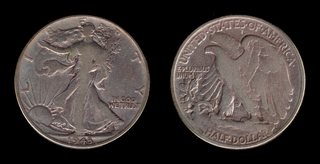
View on eBay

2016-S Richard Nixon Presidential $1 Coin Deep Cameo Proof 37th President KM#619

2016-S Richard M. Nixon Presidential Dollar, San Francisco Mint Proof, Deep Cameo Contrast, 37th President 1969-1974, Statue of Liberty Reverse, Don Everhart Design, Only 1,196,582 Proofs Struck, KM#619 [Est. PF-67 DCAM]

$14.26 2016 Est. PF-67 DCAM Presidential (2007-2020)

Description

A 2016-S Richard M. Nixon Presidential dollar, struck as a proof at the San Francisco Mint, KM#619. The obverse shows Nixon facing left, with RICHARD M. NIXON, IN GOD WE TRUST and 37th PRESIDENT 1969-1974. The reverse shows the Statue of Liberty with her torch, $1 and UNITED STATES OF AMERICA. Don Everhart designed and sculpted both sides; his initials DE are on Nixon's shoulder and beside Liberty's tablet. Manganese brass clad copper (88.5% copper, 6% zinc, 3.5% manganese, 2% nickel), 8.1 grams standard, 26.5 mm. The date, the S mint mark and E PLURIBUS UNUM are lettered on the edge, which is not shown in the photos. The close-ups show the portrait, the 37th PRESIDENT 1969-1974 legend, the Statue of Liberty and the $1.

Read the full description

Historical Context

The Presidential $1 Coin Act of 2005 honored past presidents on dollar coins in the order they served. The Nixon dollar was the first of the three 2016 releases, the final year of the series, and by then the Mint struck these dollars only for collectors: Philadelphia struck 5,460,000, Denver 4,340,000, and San Francisco only 1,196,582 proofs. Nixon served as Dwight D. Eisenhower's vice president, and on December 31, 1970 he signed the law that created the Eisenhower dollar.

Buying Power

In 2016 this dollar had the buying power of about $1.40 today.

Condition

[Est. PF-67 DCAM] Proof, never handled: the coin was slid from its sleeve onto a card and placed on the scanner without being touched. Frosted portrait, statue and lettering against black mirror fields give strong deep cameo contrast. No doubling seen on either face; the lettered edge was not examined, to avoid handling the coin. Please see the photos. Grade estimated; not professionally graded. Currently still legal tender, but worth more to collectors than face value.

Also In Our Store

Eisenhower dollars (Nixon was Eisenhower's vice president): https://www.ebay.com/str/tfauctionsintl?_nkw=eisenhower

Disclaimer

The images and any video show the actual item and are part of the official listing description, so please review them closely. Measurements and weights are approximate, and any maker or material we haven't confirmed is described as assumed. Questions? Message us; we answer quickly.

View on eBay

1935F $1 Silver Certificate Blue Seal Priest Anderson W83357473I Well Circ

Series 1935F $1 Silver Certificate, Blue Seal, No Motto, George Washington, One Dollar in Silver Payable to the Bearer, Eisenhower Era, Ivy Baker Priest and Robert B. Anderson Signatures, Serial W83357473I, Fr. 1615, Well Circulated [Est. VG-F]

$14.21 Est. VG-F Silver Certificates

Description

A Series 1935F $1 Silver Certificate with a blue Treasury seal and blue serial numbers. Signed by Ivy Baker Priest, Treasurer of the United States, and Robert B. Anderson, Secretary of the Treasury. Serial number W83357473I; face plate J8080. Standard small size, about 6.125 x 2.625 in.

Read the full description

Historical Context

Silver certificates promised the bearer one dollar in silver on demand. That promise ended in June 1968, when the Treasury stopped redeeming them for silver; the notes remain legal tender at face value.

Condition

[Est. VG-F] Heavy circulation: center folds, many creases, soft paper, rounded corners, light soiling. Well centered. Grade estimated from the scans; not professionally graded. No errors found.

Legal Tender

Yes. United States currency issued since 1861 remains legal tender at face value; this $1 Silver Certificate is still worth one dollar, though it can no longer be exchanged for silver (that ended in June 1968).

Disclaimer

The images and any video show the actual item and are part of the official listing description, so please review them closely. Measurements and weights are approximate, and any maker or material we haven't confirmed is described as assumed. Questions? Message us; we answer quickly.

View on eBay

1935F One Dollar Silver Certificate Eisenhower Era Q95385818I Well Circ

Series 1935F $1 Silver Certificate, Blue Seal, No Motto, George Washington, One Dollar in Silver Payable to the Bearer, Eisenhower Era, Ivy Baker Priest and Robert B. Anderson Signatures, Serial Q95385818I, Fr. 1615, Well Circulated [Est. VG-F]

$14.18 Est. VG-F Silver Certificates

Description

A Series 1935F $1 Silver Certificate with a blue Treasury seal and blue serial numbers. Signed by Ivy Baker Priest, Treasurer of the United States, and Robert B. Anderson, Secretary of the Treasury. Serial number Q95385818I; face plate R8022. Standard small size, about 6.125 x 2.625 in.

Read the full description

Historical Context

Silver certificates promised the bearer one dollar in silver on demand. That promise ended in June 1968, when the Treasury stopped redeeming them for silver; the notes remain legal tender at face value.

Condition

[Est. VG-F] Many folds; soiling and toning. Off-center: narrowest margin at the bottom, 3.3 mm. Grade estimated from the scans; not professionally graded. No errors found.

Legal Tender

Yes. United States currency issued since 1861 remains legal tender at face value; this $1 Silver Certificate is still worth one dollar, though it can no longer be exchanged for silver (that ended in June 1968).

Disclaimer

The images and any video show the actual item and are part of the official listing description, so please review them closely. Measurements and weights are approximate, and any maker or material we haven't confirmed is described as assumed. Questions? Message us; we answer quickly.

View on eBay

1935G One Dollar Silver Cert No Motto Blue Seal Kennedy Era C46622317J Well Circ

Series 1935G $1 Silver Certificate, Blue Seal, No Motto, George Washington, One Dollar in Silver Payable to the Bearer, Kennedy Era, Elizabeth Rudel Smith and C. Douglas Dillon Signatures, Serial C46622317J, Fr. 1616, Well Circulated [Est. VG-F]

$14.12 Est. VG-F Silver Certificates

Description

A Series 1935G $1 Silver Certificate with a blue Treasury seal and blue serial numbers. Signed by Elizabeth Rudel Smith, Treasurer of the United States, and C. Douglas Dillon, Secretary of the Treasury. Serial number C46622317J; face plate J8632. This is the earlier Series 1935G printing without the motto IN GOD WE TRUST on the back. Standard small size, about 6.125 x 2.625 in.

Read the full description

Historical Context

Silver certificates promised the bearer one dollar in silver on demand. That promise ended in June 1968, when the Treasury stopped redeeming them for silver; the notes remain legal tender at face value.

Condition

[Est. VG-F] Fold through portrait; crinkling; blue ballpoint "77" upper left obverse; no motto. Off-center: narrowest margin at the top, 1.8 mm. Grade estimated from the scans; not professionally graded. No errors found.

Legal Tender

Yes. United States currency issued since 1861 remains legal tender at face value; this $1 Silver Certificate is still worth one dollar, though it can no longer be exchanged for silver (that ended in June 1968).

Disclaimer

The images and any video show the actual item and are part of the official listing description, so please review them closely. Measurements and weights are approximate, and any maker or material we haven't confirmed is described as assumed. Questions? Message us; we answer quickly.

View on eBay

Vintage Meadow Gold Silver Seal Milk Advertising Blotter Cottage Cheese Salad

DESCRIPTION

$14.00 Blotters

A horizontal Meadow Gold dairy advertising card, apparently an ink blotter. A platter of cottage cheese salad sits on lettuce with an orange gelatin or fruit ring, the mounds of cottage cheese wrapped in dark fruit halves, against a lavender ground. A tilted gold panel at left reads: "For health and tasty goodness, serve a Meadow Gold cottage cheese salad every day. USE Meadow Gold Silver Seal Milk." No city or company address is printed.

The back is plain, soft, absorbent stock with no printing. It carries mirror-image ink handwriting at the center, illegible, which is what an ink blotter picks up from a freshly written page, and later notes in red pencil (a list of times). Approx. 6.20 x 3.00 in.

Read the full description

Historical Context

A Tulsa landmark. Meadow Gold is a name Route 66 travelers know: the neon Meadow Gold sign, built in 1934 by the Claude Neon company to advertise Beatrice's Meadow Gold brand, still stands in Tulsa at East 11th Street and South Quaker Avenue, rebuilt in a brick structure of its own after its original building was demolished in 2004.

A name from an employee contest. "Meadow Gold" was trademarked on November 12, 1901, by the Continental Creamery Company, the name chosen by its employees to suggest golden cream. The Beatrice Creamery Company acquired Continental in 1905, and Meadow Gold was a household name across much of America by the Second World War.

Dairy on the menu. Rather than just show a milk bottle, this card sells a whole dish, the kind of serving suggestion dairies used to push cottage cheese alongside the milk.

Condition

Good, used. Front: colors clean and bright; corners softly rounded with light wear, light rubbing along the edges, a faint light vertical crease line in the gold panel at left, and a few tiny dark specks. Back: light toning, faint water tide lines across the upper half, mirror-image ink offset at center, and red pencil notes at the right. Please see the photos, which are part of the description.

About The Printing

This is a color lithograph of the twentieth century, printed by a more modern commercial method. The exact process cannot be determined with certainty from a scan, so none is claimed here. Under magnification the image resolves into a regular, fine dot pattern rather than the irregular hand-drawn stipple of an 1880s chromolithograph.

That screen is exactly what a card of this date should show, so it is not a sign of reproduction here. The evidence of an original is the card itself: its printed text, its imprints and the wear of its age.

The back is plain absorbent stock, as on an ink blotter, and is unprinted.

Provenance

From my family's estate collections, built over more than 60 years by knowledgeable antiques collectors and traders. Stored in a climate-controlled environment.

Also In Our Store

More vintage food and dairy advertising and Victorian advertising trade cards are in our store.

Disclaimer

Specifications and detailed item descriptions are provided as a courtesy only and are not guaranteed to be one hundred percent accurate. Please do your own research. There are generally no receipts available for any items from original purchases. Any dimensions and/or weights are approximate. The absence of a more detailed condition report does not imply there are no condition issues with the item(s). Please inspect images carefully as they are part of the official item description and best representation of the actual condition. Additional images may be available upon request depending on time and availability. Not responsible for internet mis-translations or mis-identification of maker's marks if found or assumptions of makers or materials — item descriptions will indicate if it is assumed. If you see a problem, please message us immediately and we will do our best to sort out a solution and confirm the information. With the exception of eBay rules, no returns are accepted.
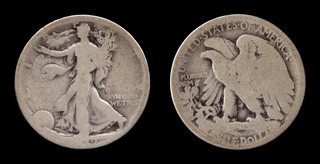
View on eBay

Photos on eBay

Vintage 1940s-Style Gold-Tone Floral Brooch with Dark Blue Stones and Clear Rhinestones

$14.00 Brooches

Description

A floral brooch in gold-tone metal set with dark blue stones and clear rhinestones; style and construction consistent with the 1940s. Pin back with C-clasp that closes securely.

Read the full description

Condition

Nice condition for its age, with no defects identified.

Dimensions

Approx. 3.0 in. high x 1.75 in. wide x 0.75 in. deep. Weight 25.83 g.

Provenance

From my family's estate collections, built over more than 60 years by knowledgeable antiques collectors and traders. Stored in a climate-controlled environment.

Disclaimer

The images and any video show the actual item and are part of the official listing description, so please review them closely. Measurements and weights are approximate, and any maker or material we haven't confirmed is described as assumed. Questions? Message us; we answer quickly.

View on eBay

1880s Trade Card Clark's O.N.T. Spool Cotton Crowd of Babies Milward Needles

DESCRIPTION

$13.90 Advertising Sales Trade Cards

A crowd of eleven babies and small children in lace collars, bonnets and Sunday dresses presses around a large round spool end, the centerpiece an embossed medallion of a little girl in a lace bonnet tied with a blue bow. A doll in a white dress and bonnet sits at lower left. Small artist's or printer's mark at lower left, best reading "M&Co."

The back is printed in blue: "CLARK'S O.N.T. SPOOL COTTON in White, Fast Black and All the New Colors is 'AHEAD OF ALL OF THEM' for Hand and Machine Sewing. Garments sewed with our FAST BLACK will never show white on the Seams af[ter] being worn or washed." Below the rule, partly lost to damage: "MILWARD'S [HEL]IX NE[EDLES] (Est[ablished] ... 1730) EACH NEEDLE PER[FECT]" (best reading). Approx. 2.80 x 4.25 in.

Read the full description

Historical Context

Our New Thread. "O.N.T." stood for "Our New Thread," the Clark Thread Company's famous brand. The Clark family's thread business began at Paisley, Scotland, in 1812, and George A. Clark completed a large new mill in Newark, New Jersey, in 1866; the company even named its soccer team Clark O.N.T.

Fast black. The back's selling point is a dye that would not fade: thread that "will never show white on the Seams" after wear and washing.

Thread and needles together. The back also advertises Milward's needles, an old English needle-making name, on the same card as the thread.

A crowd of babies. Victorian printers loved a crush of round-faced babies, and this embossed example, with its doll and bonneted centerpiece, is a crossover piece for collectors of children and doll imagery.

Condition

Sold as-is for its image. Front: the upper right corner is missing (paper loss about 0.3 in. deep) with grey smudging around the break; a short white surface crease at the bottom center; light rubbing to the embossed medallion; edges toned; colors otherwise strong. Back: paper loss at the upper left corner; a band of surface scuffing and thinning across the lower right that removes parts of the Milward's needle text; light toning overall. Please see the photos, which are part of the description.

About The Printing

This is an original chromolithograph, and it was slow, exacting work. Each color had to be drawn onto its own separate stone by hand — in monochrome, the artist judging how much stipple each area needed so the colors would combine correctly only once every stone had been printed. The sheet then went through the press once for every color it carries, often a dozen or more, and every pass had to register exactly against the last. A pass out of register showed.

Under magnification the image resolves into irregular hand-drawn stipple, each ink carrying its own dot pattern, the colors mixing in the eye rather than on the paper. There is no regular halftone screen and no four-color rosette, which is what a modern reproduction would show. Modern process printing simulates every color from four inks; chromolithography laid each color down as its own.

The central medallion is embossed, and the back is printed in a single blue ink.

Provenance

From my family's estate collections, built over more than 60 years by knowledgeable antiques collectors and traders. Stored in a climate-controlled environment.

Also In Our Store

More Victorian advertising trade cards for thread, sewing notions and patent medicines are in our store.

Disclaimer

Specifications and detailed item descriptions are provided as a courtesy only and are not guaranteed to be one hundred percent accurate. Please do your own research. There are generally no receipts available for any items from original purchases. Any dimensions and/or weights are approximate. The absence of a more detailed condition report does not imply there are no condition issues with the item(s). Please inspect images carefully as they are part of the official item description and best representation of the actual condition. Additional images may be available upon request depending on time and availability. Not responsible for internet mis-translations or mis-identification of maker's marks if found or assumptions of makers or materials — item descriptions will indicate if it is assumed. If you see a problem, please message us immediately and we will do our best to sort out a solution and confirm the information. With the exception of eBay rules, no returns are accepted.
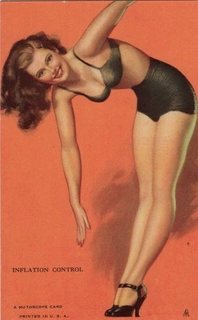
View on eBay

ca1911 Thanksgiving Postcard Girl in Red with Turkeys Gold Panel Embossed 204 C

ca1911 Embossed "Thanksgiving Greetings" Postcard, Little Girl in a Red Dress with Straw Hat, Two Big Turkeys and a Flock Before a Gold Panel, Corn Shocks and Pumpkins, Series 204 C, Unposted

$13.88 Thanksgiving Postcards

Description

A little girl in a red-orange dress with a white collar and belt, a red bow in her hair and a straw hat at her back, raises a hand to her mouth as two big turkeys strut past; a flock of pale turkeys peers over the embossed gold panel behind them, edged in red and blue. Corn shocks and pumpkins fill the field at left. "Thanksgiving Greetings" in gold at lower center; a small © at lower left, with no publisher named.

The back is a divided back with an ornate "POST CARD," "FOR CORRESPONDENCE" and "FOR ADDRESS ONLY," an empty stamp box, and "Series 204 C" at lower left. Never stamped, mailed or written on.

Read the full description

Historical Context

The Golden Age of Postcards. The divided-back years, 1907 to 1915, are known as the Golden Age of Postcards, and German printers dominated the trade.

Condition

Good to very good. Bright colors and gold; corner wear, most at the upper right, and light edge wear. Back toned, with creases at the upper left and lower left; pencil "100" and "75" in the stamp box and a small "a" at top.

About The Printing

This card is printed in halftone. Under magnification the colors resolve into a regular, even grid of dots rather than the irregular hand-drawn stipple of a chromolithograph. The figures and gold panel are embossed and stand up in relief on the back.

Provenance

From my family's estate collections, built over more than 60 years by knowledgeable antiques collectors and traders. Stored in a climate-controlled environment.

Also In Our Store

More Thanksgiving postcards from this group are in our store.

Disclaimer

The images and any video show the actual item and are part of the official listing description, so please review them closely. Measurements and weights are approximate, and any maker or material we haven't confirmed is described as assumed. Questions? Message us; we answer quickly.

View on eBay

1935E $1 Silver Certificate Blue Seal Well Worn T07495560H Heavily Circulated

Series 1935E $1 Silver Certificate, Blue Seal, No Motto, George Washington, One Dollar in Silver Payable to the Bearer, Eisenhower Era, Ivy Baker Priest and George M. Humphrey Signatures, Well Worn, Serial T07495560H, Fr. 1614, Well Circulated [Est. G-VG]

$13.83 Est. G-VG Silver Certificates

Description

A Series 1935E $1 Silver Certificate with a blue Treasury seal and blue serial numbers. Signed by Ivy Baker Priest, Treasurer of the United States, and George M. Humphrey, Secretary of the Treasury. Serial number T07495560H; face plate O7936. Standard small size, about 6.125 x 2.625 in.

Read the full description

Historical Context

Silver certificates promised the bearer one dollar in silver on demand. That promise ended in June 1968, when the Treasury stopped redeeming them for silver; the notes remain legal tender at face value.

Condition

[Est. G-VG] Heavily soiled; many creases; small edge chips; toned reverse. Well centered. Grade estimated from the scans; not professionally graded. No errors found.

Legal Tender

Yes. United States currency issued since 1861 remains legal tender at face value; this $1 Silver Certificate is still worth one dollar, though it can no longer be exchanged for silver (that ended in June 1968).

Disclaimer

The images and any video show the actual item and are part of the official listing description, so please review them closely. Measurements and weights are approximate, and any maker or material we haven't confirmed is described as assumed. Questions? Message us; we answer quickly.

View on eBay

1920 Stecher Thanksgiving Postcard White Turkey Verse Embossed Huntsville Mo

November 1920 Stecher Lith. Co. "A Joyous Thanksgiving Day" Embossed Postcard, White Turkey in Full Display Before a Woodland Under a Pink Sky, Verse "Thankful for Every Blessing, Your Heart Brimful of Cheer," Series 72 F, Huntsville, Missouri Postmark, 1¢ Washington Perf 11 Stamp with Guide Line, from Mabel, Madeline and Churchill

$13.69 1920 Thanksgiving Postcards

Description

A white turkey in full display, its wattle bright red, struts before a woodland under a pink sky. The heading "A Joyous Thanksgiving Day" has red initials and gold leaf ornaments, and the verse at upper right reads "Thankful for every blessing. Your heart brimful of cheer." Embossed, with a gold rule around the picture; the circle logo "STECHER LITH. CO. ROCH. N.Y." at lower left.

The back is a divided back with an ornate "POST CARD," "MADE IN U.S.A." and "Series 72 F." 1-cent green George Washington stamp, perforated 11 (Scott #498), with a straight edge and printed guide line at left; Huntsville, Mo. postmark of November 1920, 12:30 PM (day not legible). Addressed in ink to Mrs. W. D. Thomas, City, and signed "Mabel, Madeline & Churchill."

Read the full description

Historical Context

"City." Addressed simply to "City," the card was meant for local delivery in Huntsville.

The stamp. Scott #498, issued in March 1917, was the first stamp of the 1917-1919 series with 11-gauge perforations, adopted because perf 12 proved too flimsy and perf 10 too hard to separate.

Condition

Very good. Bright, clean colors and crisp embossing; light corner wear. Back clean with light toning, a small crease at the lower right corner, and a pencil "1.00" at the right edge.

About The Printing

This card is printed in halftone. Under magnification the colors resolve into a regular, even grid of dots rather than the irregular hand-drawn stipple of a chromolithograph. The turkey and lettering are embossed and show in relief on the back.

Provenance

From my family's estate collections, built over more than 60 years by knowledgeable antiques collectors and traders. Stored in a climate-controlled environment.

Also In Our Store

More Thanksgiving postcards from this group are in our store.

Disclaimer

The images and any video show the actual item and are part of the official listing description, so please review them closely. Measurements and weights are approximate, and any maker or material we haven't confirmed is described as assumed. Questions? Message us; we answer quickly.

View on eBay

1889 Arbuckle Coffee Trade Card No 92 Mexico Map Bull Fighting Mules [SEE DESC]

Arbuckle Bros Ariosa Coffee — Mexico, Map Card No. 92

$13.66 1889 Advertising Sales Trade Cards

Original Victorian advertising trade card, chromolithograph, copyright 1889 by Arbuckle Bros., N.Y. Approx. 4.95 x 3.15 in.

A colored map of Mexico, its states and towns lettered in, with the United States to the north, the Gulf of Mexico and the Pacific Ocean on either side, and Central America to the south. At the left, captioned BULL FIGHTING, a matador with a red cape and a mounted picador face a charging bull before a stand of spectators hung with flags. An inset at the upper right, captioned MULE TRAIN CROSSING THE MOUNTAINS, shows pack mules on a mountain trail. The map panel gives the government as a Federal Republic, with Pop. 10,000,000 and Area 772,000 Sq. M. printed beneath.

The reverse carries Arbuckle's GRIND YOUR COFFEE AT HOME advice and the ARIOSA claim, closing with the line that rival makers know no higher praise than to say “It's just as good as Arbuckles'.” An EXPLANATORY panel describes the series — fifty cards, each showing a correctly colored map of one of the chief countries of the world with pictures of its industries, scenery and customs — and explains that every package of Arbuckle's coffee contains one of these cards or one of the companion series of fifty Zoological cards. A list of the countries represented follows. Arbuckle Bros. Coffee Co., New York City. The card is numbered 92. Printed by Donaldson Brothers, N.Y.

Read the full description

Historical Context

Mexico in 1889 was drawing American railroads and investment south, and the mule train in the corner shows the country those railroads were replacing — goods carried over the mountains on animals, as they had been for centuries.

The bullfight was the image every American reader associated with Mexico, and the card leads with it. It is the most dramatic scene in the foreign map series.

Condition

Toning and age typical of the period. Light surface soiling; minor edge and corner wear; toning to the reverse. The chromolithographed image remains bright and the reverse text fully legible. Please view the images carefully.

About The Printing

This is an original chromolithograph, and it was slow, exacting work. Each color had to be drawn onto its own separate stone by hand — in monochrome, the artist judging how much stipple each area needed so the colors would combine correctly only once every stone had been printed. The sheet then went through the press once for every color it carries, often a dozen or more, and every pass had to register exactly against the last. A pass out of register showed.

Under magnification the image resolves into irregular hand-drawn stipple, each ink carrying its own dot pattern, the colors mixing in the eye rather than on the paper. There is no regular halftone screen and no four-color rosette, which is what a modern reproduction would show. Modern process printing simulates every color from four inks; chromolithography laid each color down as its own.

Provenance

This item comes from the personal collections of my family estate, accumulated over more than 200 years — including items that came west by wagon train to Colorado and later to Oklahoma. Now that my parents have passed we cannot keep all of these cherished items. They were well-educated antiques collectors/traders and continued to build their collections over more than 60 years. The vast majority of the pieces are from the Victorian Era, however there are plenty of older and newer items. Everything has been stored in a climate-controlled environment over time.

Disclaimer

Specifications and detailed item descriptions are provided as a courtesy only and are not guaranteed to be one hundred percent accurate. Please do your own research. There are generally no receipts available for any items from original purchases. Any dimensions and/or weights are approximate. The absence of a more detailed condition report does not imply there are no condition issues with the item(s). Please inspect images carefully as they are part of the official item description and best representation of the actual condition. Additional images may be available upon request depending on time and availability. Not responsible for internet mis-translations or mis-identification of maker's marks if found or assumptions of makers or materials — item descriptions will indicate if it is assumed. If you see a problem, please message us immediately and we will do our best to sort out a solution and confirm the information. With the exception of eBay rules, no returns are accepted.
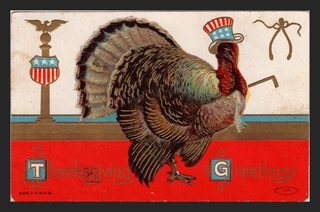
View on eBay

Victorian Trade Card McLaughlin's XXXX Coffee Chicago Boy Portrait Sepia Stipple

McLaughlin's XXXX Coffee — W. F. McLaughlin & Co., Chicago

$13.63 Advertising Sales Trade Cards

Original Victorian advertising trade card, single-color lithograph on tinted stock, c. 1880s. Approx. 3.50 x 2.30 in.

A portrait of a boy with long curling hair and a wide open collar, one hand held to his chest, printed in a single deep brown-violet ink in the manner of a stipple engraving. Lettered in script beside him: McLaughlin's XXXX Coffee.

The reverse reads: McLAUGHLIN'S ROASTED COFFEE, ONE POUND PACKAGES. BEST VALUE FOR YOUR MONEY. It costs the grocer more money than any other package Coffee, but to the consumer is worth at least 5 cents a pound more. Try it once and we will guarantee you will have no other. For sale by all the best grocers. W. F. McLAUGHLIN & CO., Importers, Jobbers and Roasters of Coffee, 82, 84, 86 and 88 South Water St., CHICAGO.

Read the full description

Historical Context

The back makes an unusual confession: this coffee costs the grocer more than any other package brand. Most advertisers hid their price. McLaughlin put it up front and turned it into the argument — the grocer pays more, so the grocer must think it is worth it, and you get five cents a pound of value you did not pay for.

Packaged coffee in one-pound bags was still a new idea. Most people bought coffee loose, often green, and roasted it at home. A card like this was selling the package as much as the coffee.

Condition

Toning and age typical of the period. A paler strip along the left edge of the front; a small stain on the boy's cheek; light foxing to the lower left of the reverse; minor edge and corner wear. The printed image remains clear and the reverse text fully legible. Please view the images carefully.

About The Printing

This card was printed from a single stone in one ink, on tinted stock — an economical choice, since the colored card supplies a second tone at no extra press pass. The design was drawn by hand in reverse on the stone, the shading built from the density of the drawn marks rather than from color.

Under magnification the tone resolves into hand-drawn stipple, not a mechanical screen. There is no halftone screen and no four-color rosette, which is what a modern reproduction would show.

Provenance

This item comes from the personal collections of my family estate, accumulated over more than 200 years — including items that came west by wagon train to Colorado and later to Oklahoma. Now that my parents have passed we cannot keep all of these cherished items. They were well-educated antiques collectors/traders and continued to build their collections over more than 60 years. The vast majority of the pieces are from the Victorian Era, however there are plenty of older and newer items. Everything has been stored in a climate-controlled environment over time.

Disclaimer

Specifications and detailed item descriptions are provided as a courtesy only and are not guaranteed to be one hundred percent accurate. Please do your own research. There are generally no receipts available for any items from original purchases. Any dimensions and/or weights are approximate. The absence of a more detailed condition report does not imply there are no condition issues with the item(s). Please inspect images carefully as they are part of the official item description and best representation of the actual condition. Additional images may be available upon request depending on time and availability. Not responsible for internet mis-translations or mis-identification of maker's marks if found or assumptions of makers or materials — item descriptions will indicate if it is assumed. If you see a problem, please message us immediately and we will do our best to sort out a solution and confirm the information. With the exception of eBay rules, no returns are accepted.
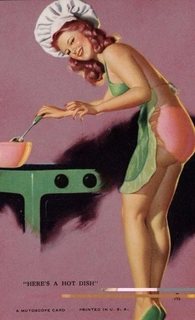
View on eBay

US War Ration Book Four (WWII)

This is a United States War Ration Book Four from the Office of Price Administration.

$13.55 Books in English

  • TIME PERIOD: World War II Era
  • ORIGIN: United States
Read the full description

HISTORY

War Ration Book Four was issued by the United States Office of Price Administration (OPA) during World War II. These books were essential for rationing scarce goods, such as sugar, meat,and gasoline, to ensure fair distribution among the civilian population. The OPA played a crucial role in managing the home front economy during the war effort.

This piece, "War Ration Book Four," was part of a series of ration books distributed to American households. It contained stamps that were exchanged for rationed items, helping to

control consumption and prevent hoarding. These documents are now considered historical artifacts, offering a tangible connection to the wartime experiences of Americans.

Thank you!

Ref: 1.0162

View on eBay

1880s Lion Coffee Trade Card Bullfinch Pink Flower Winter Cottage Woolson Spice

1880s Lion Coffee Trade Card Bullfinch Pink Flower Winter Cottage Woolson Spice — A bullfinch perched on a branch above a pink flower, with a round winter vignette of a snowy cottage. Approx. 3.39 x 5.36 in.

$13.52 Advertising Sales Trade Cards

Description

A bullfinch perched on a branch above a pink flower, with a round winter vignette of a snowy cottage.

The back is printed in black in a mix of decorative typefaces: "If you want a Picture Card like this buy a package of LION COFFEE. It is composed of a successful combination of Mocha, Java and Rio, and is roasted with the greatest care but is not ground. Is never sold in bulk. Beautiful Picture in Every Package. Lion is the King of Coffees. Manufactured by Woolson Spice Co., Toledo, Ohio."

Approx. 3.39 x 5.36 in.

Read the full description

Historical Context

The coffee that came with a picture. Lion Coffee began in Toledo, Ohio, in 1864 and became part of the Woolson Spice Company in 1882. Alvin Woolson built the brand by putting picture cards in every package, and the back of this card says so.

Condition

Front: very good, clean color. Back: heavy staining and scuffing, with small paper losses at the corners; text legible. Please see the photos, which are part of the description.

About The Printing

This is an original chromolithograph, and it was slow, exacting work. Each color had to be drawn onto its own separate stone by hand — in monochrome, the artist judging how much stipple each area needed so the colors would combine correctly only once every stone had been printed. The sheet then went through the press once for every color it carries, often a dozen or more, and every pass had to register exactly against the last. A pass out of register showed.

Under magnification the image resolves into irregular hand-drawn stipple, each ink carrying its own dot pattern, the colors mixing in the eye rather than on the paper. There is no regular halftone screen and no four-color rosette, which is what a modern reproduction would show. Modern process printing simulates every color from four inks; chromolithography laid each color down as its own.

The back is printed in black.

Provenance

From my family's estate collections, built over more than 60 years by knowledgeable antiques collectors and traders. Stored in a climate-controlled environment.

Also In Our Store

More Lion Coffee cards in our store: https://www.ebay.com/str/tfauctionsintl?_nkw=lion+coffee

More Victorian advertising trade cards are in our store.

Disclaimer

The images and any video show the actual item and are part of the official listing description, so please review them closely. Measurements and weights are approximate, and any maker or material we haven't confirmed is described as assumed. Questions? Message us; we answer quickly.

View on eBay

1880s Trade Card Arm & Hammer Soda Beautiful Flowers No. 39 Fuchsia New York

DESCRIPTION

$13.37 Advertising Sales Trade Cards

A small Arm & Hammer flower card: a spray of fuchsias, pink, red, white and deep purple, hanging from a curling stem with broad green leaves, on a cream ground. At lower left is the round Arm & Hammer Brand trademark, "Church & Co. New York", with the arm and hammer at center. Printed at the foot: "Fuchsia" and "39".

The back is printed in black: "New Series / Beautiful Flowers / No. 39", with the note that the card "has no connection with any Lottery, and does not draw a prize" and that "The perfect quality of the Arm & Hammer Brand of Soda and Saleratus is sufficient inducement for all intelligent consumers to BUY ONLY THAT BRAND." A set of 60 could be had by mail for "six two cent stamps". Under "Important Reasons" it argues for package soda over bulk soda "weighed and wrapped by the dealer". Imprint: "The Great Arm & Hammer Brand Soda and Saleratus, 129 Pearl St. New York", with the round Church & Co. trademark. Printer: "Beacon Lith. Co. Boston." A few words at the top of the back are covered by an old piece of paper (see Condition).

Approx. 1.85 x 2.95 in.

Read the full description

Historical Context

A brand older than the box. The Arm & Hammer name and logo date back to the 1860s. Church & Co., whose name is on this card, later joined with John Dwight & Co. as Church & Dwight in 1896, and the arm and hammer is still on the box today.

Collect all sixty. The back says it plainly: a set of these cards, 60 in all, "accumulated in the ordinary course of buying housekeeping supplies will form an interesting collection." Arm & Hammer flower, bird and animal series were saved in albums by the thousands, and collectors still build the sets number by number.

Package versus bulk. The back also makes a case that sounds modern: buy the sealed, branded package, not soda scooped from the grocer's barrel, because the brand carries "the guarantee of a responsible manufacturer."

For the garden collector. The fuchsia, drawn in four colors from bud to full bloom, makes this a natural fit for botanical and flower collectors as well as advertising collectors.

Condition

Used, with honest age wear. Front: bright color; light soiling and a few small grey specks in the cream margin and on the leaves; a small tan strip of old paper residue at the top edge; corners lightly rounded. Back: an old piece of blue-green paper or tape about 0.6 in. wide is stuck at top center, covering part of the heading and first lines; a small dark spot at the left edge; even toning. Please see the photos, which are part of the description.

About The Printing

This is an original chromolithograph, and it was slow, exacting work. Each color had to be drawn onto its own separate stone by hand — in monochrome, the artist judging how much stipple each area needed so the colors would combine correctly only once every stone had been printed. The sheet then went through the press once for every color it carries, often a dozen or more, and every pass had to register exactly against the last. A pass out of register showed.

Under magnification the image resolves into irregular hand-drawn stipple, each ink carrying its own dot pattern, the colors mixing in the eye rather than on the paper. There is no regular halftone screen and no four-color rosette, which is what a modern reproduction would show. Modern process printing simulates every color from four inks; chromolithography laid each color down as its own.

The back is printed in black letterpress-style type, separate from the color work on the front.

Provenance

From my family's estate collections, built over more than 60 years by knowledgeable antiques collectors and traders. Stored in a climate-controlled environment.

Also In Our Store

More Victorian advertising trade cards for baking soda, coffee and patent medicines are in our store.

Disclaimer

Specifications and detailed item descriptions are provided as a courtesy only and are not guaranteed to be one hundred percent accurate. Please do your own research. There are generally no receipts available for any items from original purchases. Any dimensions and/or weights are approximate. The absence of a more detailed condition report does not imply there are no condition issues with the item(s). Please inspect images carefully as they are part of the official item description and best representation of the actual condition. Additional images may be available upon request depending on time and availability. Not responsible for internet mis-translations or mis-identification of maker's marks if found or assumptions of makers or materials — item descriptions will indicate if it is assumed. If you see a problem, please message us immediately and we will do our best to sort out a solution and confirm the information. With the exception of eBay rules, no returns are accepted.
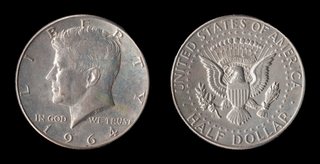
View on eBay

1993 Costa Rica 50 Colones Gaspar Ortuno Banknote P-257a [Est. F]

7 July 1993 Costa Rica 50 Colones Banknote, Gaspar Ortuno y Ors / Old Banco de Costa Rica Building, Pick P-257a, Serial E44360835 [Est. F]

$13.33 1993 Est. F Costa Rica

Description

Serie E note issued by the Banco Central de Costa Rica and printed by Thomas de la Rue. Front: Gaspar Ortuno y Ors with an 1866 50 centimos coin; back: the ANTIGUO EDIFICIO DEL BANCO DE COSTA RICA with a horse carriage and the reverse of the coin. BCCR 50 watermark. Serial E44360835. Measured on the 1200 dpi scan: 156.4 x 66.5 mm. The close-ups show the serial, the date, Gaspar Ortuno and the old bank building. The last image adds a millimeter scale.

Read the full description

Historical Context

Gaspar Ortuno y Ors was a Spanish consul and administrator and a founding partner of the Banco de la Union and the Banco de Costa Rica. This was the last 50 colones note design; the denomination then became a coin, first issued in 1997.

Condition

[Est. F] Many folds and creases, including a horizontal fold across the portrait and several vertical folds. Overall brown soiling, soft edges and rounded corners. No tears, holes or writing. Grade estimated from the scans; not professionally graded.

Legal Tender

No longer legal tender: catalogs list it as demonetized (date not found), and the 50 colones is now a coin.

Disclaimer

The images and any video show the actual item and are part of the official listing description, so please review them closely. Measurements and weights are approximate, and any maker or material we haven't confirmed is described as assumed. Questions? Message us; we answer quickly.

View on eBay

1990 Costa Rica 1000 Colones Soley Guell Banknote P-259a1 [Est. G-VG]

24 April 1990 Costa Rica 1000 Colones Banknote, Tomas Soley Guell / National Insurance Institute, Pick P-259a1, Serial C23258628 [Est. G-VG]

$13.33 1990 Est. G-VG Costa Rica

Description

Serie C note issued by the Banco Central de Costa Rica. Front: Tomas Soley Guell with a red curved-line design; back: the Instituto Nacional de Seguros building. Tree watermark with the legend 'Libre crezca fecundo'. Printed by the American Bank Note Company (1986-1989) or the United States Banknote Company (1990-1994); the printer imprint tells them apart. Serial C23258628. Measured on the 1200 dpi scan: 155.4 x 65.7 mm. Centering, measured on the scan: design sits high on both sides (front T/B 1.6/4.5 mm, back 1.6/8.2 mm); top-edge wear accounts for part of it. The close-ups show the serial, the date, Tomas Soley Guell and the INS building. The last image adds a millimeter scale.

Read the full description

Historical Context

Tomas Soley Guell, a postmaster and congressional deputy, promoted the state insurance monopoly and created the National Insurance Bank, today the Instituto Nacional de Seguros. The colon has been Costa Rica's currency since 1896 and has never been redenominated.

Condition

[Est. G-VG] Very heavily circulated, with many heavy folds and creases, heavy soiling and dark grey stains on the back left panel. The edges are chipped: two small nicks on the top edge and a chip about 5 mm long on the bottom edge, each about 1.5-2 mm deep. Corners are worn round. No tape or writing. Grade estimated from the scans; not professionally graded.

Legal Tender

No longer legal tender: withdrawn on 1 September 2011; it can still be exchanged or deposited at Costa Rican financial institutions with no time limit (BCCR).

Disclaimer

The images and any video show the actual item and are part of the official listing description, so please review them closely. Measurements and weights are approximate, and any maker or material we haven't confirmed is described as assumed. Questions? Message us; we answer quickly.

View on eBay

1916 Japan 1 Yen Convertible Silver Note P-30c Takenouchi no Sukune Taisho Era

1916 Bank of Japan 1 Yen Convertible Silver Note, Takenouchi no Sukune, Taisho Era, "One Yen in Silver" English Back

$13.32 1916 Japan

Description

Front: the legendary statesman Takenouchi no Sukune, with red seals. Back: the English promise "Nippon Ginko Promises to Pay the Bearer on Demand One Yen in Silver" with a large ONE YEN panel and two red seals.

Read the full description

Details

Issuer: Bank of Japan (Nippon Ginko)

Denomination: 1 Yen

Year: 1916 (Taisho 5)

Catalog: Pick 30c

Serial: 151757 (block 398)

Size: approx. 145 x 85 mm

Historical Context

Issued in Japan's Taisho era, during World War I, when the yen was still convertible to silver.

Condition

Estimated Very Fine (VF) to Choice Very Fine: light, even toning; a light vertical center fold and soft corner handling; edges straight. Please see the photos for condition; the grade has not been certified.

The images and any video show the actual item and are part of the official listing description, so please review them closely. Measurements and weights are approximate, and any maker or material we haven't confirmed is described as assumed. Questions? Message us; we answer quickly.

View on eBay

Bangladesh 2 Taka Banknote Sheikh Mujibur Rahman Shaheed Minar 2011-2022

Bangladesh 2 Taka Banknote, Bangabandhu Sheikh Mujibur Rahman, Shaheed Minar, 2011-2022 Issue

$13.31 2011 Bangladesh

Description

Front: Bangabandhu Sheikh Mujibur Rahman (1920-1975), founding father of Bangladesh. Back: the Shaheed Minar in Dhaka, the memorial to those killed in the 1952 Language Movement.

Read the full description

Details

Issuer: Bangladesh

Denomination: 2 Taka

Issued: 2011-2022

Size: approx. 100 x 60 mm

Condition

Please see the photos for condition; the grade has not been certified.

The images and any video show the actual item and are part of the official listing description, so please review them closely. Measurements and weights are approximate, and any maker or material we haven't confirmed is described as assumed. Questions? Message us; we answer quickly.

View on eBay

1988 China Nanbu Sichuan Grain Ration Coupon Lot of 2 Flour Rice 2 kg [Est. UNC]

1988 China Grain Ration Coupons, Lot of 2: Nanbu County, Sichuan, 2 kg Flour and 2 kg Rice [Est. UNC]

$13.26 1988 Est. UNC China

Description

Two local grain ration coupons issued in 1988 for Nanbu County, Sichuan Province, each for 2 kilograms (贰仟克). Flour coupon (南部县面粉券): a long arched bridge over a river, with a pagoda on the wooded hill beyond; orange border, blue-gray back. Rice coupon (南部县大米券): a leaping fish over a heap of produce, and buildings among pine trees; red border, maroon back. Both backs carry the red star seal of the Nanbu County Grain Bureau and four printed rules: the coupon buys grain or grain products anywhere in the county; the face value is in finished grain; the unit is the kilogram; and the coupon may not be bought or sold, is void if forged or altered, and is not replaced if lost. No serial numbers on this type.

Read the full description

Historical Context

China introduced nationwide grain rationing in 1955, and grain coupons were fully abolished by 1993. Counties also printed their own coupons, good only locally, like these two from Nanbu County.

Condition

[Est. UNC] Both crisp and uncirculated with bright colors. Tiny specks show in the photos on the front of the flour coupon (sky, left of the hill) and the back of the rice coupon (left of the text); see the photos. Grade estimated; not professionally graded.

Legal Tender

Not money and not legal tender: ration coupons, no longer usable since grain coupons ended in 1993. Sold as a collectible.

Disclaimer

The images and any video show the actual item and are part of the official listing description, so please review them closely. Measurements and weights are approximate, and any maker or material we haven't confirmed is described as assumed. Questions? Message us; we answer quickly.

View on eBay

1880s Trade Card Royal Snow Flake Crackers Dozier-Weyl St. Louis Parrot

DESCRIPTION

$13.21 Advertising Sales Trade Cards

A bold cracker card: a big green, red and blue macaw on a perch with a seed cup, gripping a paint brush that drips red paint. Lettered: "Give me a Royal Snow Flake or I'll paint this whole town Red. Made only by Dozier-Weyl Cracker Co. St. Louis." Below is a city skyline of smoking factory chimneys, a spire and a domed building under a yellow and orange sky.

The back is blank stock.

Approx. 3.40 x 5.20 in.

Read the full description

Historical Context

Polly wants a cracker. The Dozier-Weyl Cracker Co. of St. Louis put a parrot to work selling its Royal Snowflake crackers. Another card in the same vein, held by Digital Commonwealth, has the bird asking "Polly wanta cracker?" This one threatens to paint the town red if it does not get one.

A St. Louis baker. Dozier-Weyl was an established St. Louis cracker maker; The Metropolitan Museum of Art holds its "Descriptive Sample Book of Goods" of 1881.

For bird and humor collectors. The strong poster-like color, the slang slogan and the parrot make this a card that appeals well beyond cracker and food advertising.

Condition

As-is, with clear wear. Front: a chip with paper loss at the upper left corner and a short tear along the top edge there; a vertical crease with a small split at the bottom edge near the spire; the right edge cut close, touching the last letter of "Flake"; scuffing and light soiling; colors strong. Back: a band of old tape or album paper residue across the bottom edge with some surface loss; a curved crease at the upper left; small surface scrapes at upper center and lower left; ink offset in red, yellow and blue; overall toning. Please see the photos, which are part of the description.

About The Printing

This is an original chromolithograph. Each color was drawn onto its own separate stone by hand and printed as its own pass through the press, every pass registering exactly against the last. This card uses the flat-color mode of the process — broad areas of solid, opaque ink with crisp boundaries rather than blended tone. It is the same technique that produced the great poster designs of the period.

Under magnification the colors resolve as solid fields with clean edges and no dot structure at all. There is no halftone screen and no four-color rosette, which is what a modern reproduction would show. Modern process printing simulates every color from four inks; here each color is its own ink, laid down whole.

The sky and ground are built up from fine ruled lines of overlapping color, a mechanical tint of the period, rather than from dots.

Provenance

From my family's estate collections, built over more than 60 years by knowledgeable antiques collectors and traders. Stored in a climate-controlled environment.

Also In Our Store

More Victorian advertising trade cards for crackers, coffee and patent medicines are in our store.

Disclaimer

Specifications and detailed item descriptions are provided as a courtesy only and are not guaranteed to be one hundred percent accurate. Please do your own research. There are generally no receipts available for any items from original purchases. Any dimensions and/or weights are approximate. The absence of a more detailed condition report does not imply there are no condition issues with the item(s). Please inspect images carefully as they are part of the official item description and best representation of the actual condition. Additional images may be available upon request depending on time and availability. Not responsible for internet mis-translations or mis-identification of maker's marks if found or assumptions of makers or materials — item descriptions will indicate if it is assumed. If you see a problem, please message us immediately and we will do our best to sort out a solution and confirm the information. With the exception of eBay rules, no returns are accepted.
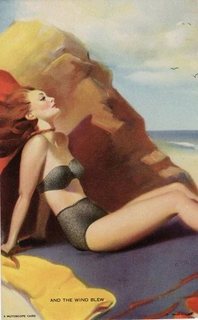
View on eBay

1889 Arbuckle Coffee Trade Card No 95 Netherlands Holland Map Fishing Dairy

Arbuckle Bros Ariosa Coffee — Netherlands, Map Card No. 95

$13.17 1889 Advertising Sales Trade Cards

Original Victorian advertising trade card, chromolithograph, copyright 1889 by Arbuckle Bros., N.Y. Approx. 5.05 x 3.05 in.

A colored map of the Netherlands, its towns lettered in, with the North Sea, Belgium and Germany around it, drawn on an unrolled scroll. At the left, captioned FISHING, Dutch women in white caps and aprons carry baskets along a beach, with fishing boats behind them. At the right, captioned DAIRY PRODUCTS, a brown cow grazes in a green meadow. A line at the foot reads: Gov.: Constitutional Monarchy. Pop. 4,114,000. Area 12,740 Sq. M.

The reverse carries Arbuckle's GRIND YOUR COFFEE AT HOME advice and the ARIOSA claim, closing with the line that rival makers know no higher praise than to say “It's just as good as Arbuckles'.” An EXPLANATORY panel describes the series — fifty cards, each showing a correctly colored map of one of the chief countries of the world with pictures of its industries, scenery and customs — and explains that every package of Arbuckle's coffee contains one of these cards or one of the companion series of fifty Zoological cards. A list of the countries represented follows. Arbuckle Bros. Coffee Co., New York City. The card is numbered 95. Printed by Donaldson Brothers, N.Y.

Read the full description

Historical Context

Fish and dairy, the two things the Dutch sent abroad, are how the card sums up the country. The women on the beach are the fishermen's wives who carried the catch inland to market, and they were a favorite subject for painters of the period.

The map is drawn on a scroll unrolling across the card, one of the more inventive layouts in the foreign series.

Condition

Toning and age typical of the period. A small pencil mark at the upper right of the reverse; light surface soiling; minor edge and corner wear; toning to the reverse. The chromolithographed image remains bright and the reverse text fully legible. Please view the images carefully.

About The Printing

This is an original chromolithograph, and it was slow, exacting work. Each color had to be drawn onto its own separate stone by hand — in monochrome, the artist judging how much stipple each area needed so the colors would combine correctly only once every stone had been printed. The sheet then went through the press once for every color it carries, often a dozen or more, and every pass had to register exactly against the last. A pass out of register showed.

Under magnification the image resolves into irregular hand-drawn stipple, each ink carrying its own dot pattern, the colors mixing in the eye rather than on the paper. There is no regular halftone screen and no four-color rosette, which is what a modern reproduction would show. Modern process printing simulates every color from four inks; chromolithography laid each color down as its own.

Provenance

This item comes from the personal collections of my family estate, accumulated over more than 200 years — including items that came west by wagon train to Colorado and later to Oklahoma. Now that my parents have passed we cannot keep all of these cherished items. They were well-educated antiques collectors/traders and continued to build their collections over more than 60 years. The vast majority of the pieces are from the Victorian Era, however there are plenty of older and newer items. Everything has been stored in a climate-controlled environment over time.

Disclaimer

Specifications and detailed item descriptions are provided as a courtesy only and are not guaranteed to be one hundred percent accurate. Please do your own research. There are generally no receipts available for any items from original purchases. Any dimensions and/or weights are approximate. The absence of a more detailed condition report does not imply there are no condition issues with the item(s). Please inspect images carefully as they are part of the official item description and best representation of the actual condition. Additional images may be available upon request depending on time and availability. Not responsible for internet mis-translations or mis-identification of maker's marks if found or assumptions of makers or materials — item descriptions will indicate if it is assumed. If you see a problem, please message us immediately and we will do our best to sort out a solution and confirm the information. With the exception of eBay rules, no returns are accepted.
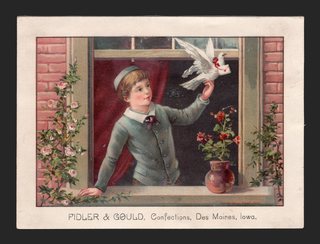
View on eBay

1976 $2 Bicentennial Federal Reserve Note Kansas City J00158544A Low Serial Circ

Series 1976 $2 Federal Reserve Note, Bicentennial 1776-1976 (200th Anniversary), Thomas Jefferson, Trumbull's Declaration of Independence on the Back, Kansas City (J10), Francine I. Neff and William E. Simon Signatures, Green Seal, Low Serial Number, Serial J00158544A, Fr. 1935-J, Lightly Circulated [Est. VF]

$12.97 1976 Est. VF Bicentennial $2 Dollar Bills

Description

A Series 1976 $2 Federal Reserve Note with a green Treasury seal, issued through the Federal Reserve Bank of Kansas City: letter J, number 10, shown on the black seal at left and on the "10" in each corner. Signed by Francine I. Neff, Treasurer of the United States, and William E. Simon, Secretary of the Treasury. Serial number J00158544A.

Thomas Jefferson's portrait has appeared on every $2 note since Series 1869, and the front of the $2 is the oldest design on current US currency. The back shows John Trumbull's painting Declaration of Independence. Few $2 notes are printed, and banks usually hand them out only on request, so they are seldom seen in everyday spending and many people simply keep them.

Standard small size, about 6.125 x 2.625 in.

Read the full description

Historical Context

The $2 bill returned on April 13, 1976, Thomas Jefferson's birthday, in the nation's Bicentennial year. For Series 1976 the back was changed from Monticello to the signing of the Declaration of Independence. Printed in Washington, DC; the Fort Worth plant did not open until 1991.

1976 was also the year One Flew Over the Cuckoo's Nest won five Academy Awards (March 29). This note carries a low serial number, J00158544A.

Buying Power

In 1976, the average factory worker earned about $5.09 an hour, so this $2 note was about 24 minutes of factory pay, or about $11.85 at today's factory wage. By the consumer price index, $2 in 1976 bought about what $11.77 buys today.

Condition

[Est. VF] Lightly circulated. Light folds; bright paper. Not a star note and no errors found.

Legal Tender

Yes. United States currency issued since 1861 remains legal tender at face value ($2), whatever the series.

Disclaimer

The images and any video show the actual item and are part of the official listing description, so please review them closely. Measurements and weights are approximate, and any maker or material we haven't confirmed is described as assumed. Questions? Message us; we answer quickly.

View on eBay

2009 Costa Rica 5000 Colones Capuchin Monkey Banknote P-276a [Est. VG]

2 September 2009 Costa Rica 5000 Colones Banknote, Alfredo Gonzalez Flores / Mangrove with Capuchin Monkey, Pick P-276a, Serial A019191793 [Est. VG]

$12.97 2009 Est. VG Costa Rica

Description

Cotton-paper note issued by the Banco Central de Costa Rica and printed by Oberthur. Front: Alfredo Gonzalez Flores with the Banco Internacional de Costa Rica building and a color-shifting map of Costa Rica; back: a mangrove (MANGLAR) with a white-faced capuchin monkey, a crab and flowers. Portrait watermark and a color-shifting windowed thread. Serial A019191793. Measured on the 1200 dpi scan: 139.9 x 67.1 mm. The close-ups show the serial, the date, Gonzalez Flores and the capuchin monkey. The last image adds a millimeter scale.

Read the full description

Historical Context

Alfredo Gonzalez Flores (1877-1962) was president from 1914 to 1917. He created the International Bank of Costa Rica, today the Banco Nacional, and introduced direct taxation before his war minister, Federico Tinoco, overthrew him on 27 January 1917. The design entered circulation on 27 August 2012.

Condition

[Est. VG] Heavy circulation: two horizontal folds, vertical folds and many creases, with heavy overall soiling and soft paper. Two tiny red dots on the forehead and small red-brown spots and grey smudges on the back. Corners are rounded and the edges fuzzy. No tears or holes. Grade estimated from the scans; not professionally graded.

Legal Tender

No longer legal tender: withdrawn on 1 March 2022; it can still be exchanged or deposited at Costa Rican financial institutions with no time limit (BCCR).

Disclaimer

The images and any video show the actual item and are part of the official listing description, so please review them closely. Measurements and weights are approximate, and any maker or material we haven't confirmed is described as assumed. Questions? Message us; we answer quickly.

View on eBay

1953 Japan 100 Yen Itagaki Taisuke Post-War Survivor Note P-90 [Est. AU-UNC]

1953 Japan 100 Yen Banknote, Bank of Japan, Pick P-90, MR260456H [Est. AU-UNC]

$12.92 1953 Est. AU-UNC Japan

Description

A Bank of Japan 100 yen, ND (1953), with Itagaki Taisuke and the National Diet Building on the back. Serial MR260456H. Pick P-90 (Numista N#202546).

Read the full description

Historical Context

Itagaki Taisuke (1837-1919) was a Meiji-era statesman and founder of Japan's first political party, the Liberal Party.

Condition

[Est. AU-UNC] Crisp; see the photos. Grade estimated; not professionally graded.

Legal Tender

Still legal tender in Japan at face value (on the Bank of Japan list of valid notes), but worth more to collectors.

Disclaimer

The images and any video show the actual item and are part of the official listing description, so please review them closely. Measurements and weights are approximate, and any maker or material we haven't confirmed is described as assumed. Questions? Message us; we answer quickly.

View on eBay

1950s Cracker Jack Prize Paper Toy Girl Driving Kiddie Car with Spinning Wheel

DESCRIPTION

$12.88 Premiums, Prizes & Charms

A small die-cut cardboard prize toy of a little blonde girl at the wheel of a kiddie car, from the era when every box of Cracker Jack carried a surprise. A separate printed wheel, red with a pinwheel pattern, is fixed to the body by a metal grommet, and it still turns freely. The figure is printed in bright color on the front. The reverse is plain dark blue-green stock.

The piece carries no maker's name. It is identified as a Cracker Jack prize of about 1950 from the same design being sold elsewhere as a 1950s Cracker Jack spinning toy; that identification is by design, not by a mark on the piece.

Die-cut, irregular outline, approx. 3.05 x 2.15 in. overall (bounding box, wheel included); wheel approx. 1.2 in. across.

Read the full description

Historical Context

Cracker Jack began putting a prize in every box in 1912, and the toy surprise became as much a part of the brand as the sailor boy and his dog Bingo. In the years after the war, the prizes were often simple paper and cardboard novelties: punch-outs, spinners and little moving figures like this one, made by the millions to be played with and then lost. Few survived the children who found them.

Condition

Age-toning and light surface soiling to the unprinted areas; light edge wear and rubbing at the rim of the wheel. The grommet is intact, with a small split in its flange. A light crease across the narrow tail, visible on both sides, where it was once bent. The reverse shows light scuffs and marks. Colors remain bright on the front. Please view the images carefully, as they are part of the description.

About The Printing

This is a color lithograph of the twentieth century, printed by a more modern commercial method. The exact process cannot be determined with certainty from a scan, so none is claimed here. Under magnification the image resolves into a regular, fine dot pattern rather than the irregular hand-drawn stipple of an 1880s chromolithograph.

That screen is exactly what a piece of this date should show, so it is not a sign of reproduction here. The evidence of an original is the piece itself: its die-cut construction, the metal grommet that holds the turning wheel, and the wear of its age.

Provenance

From my family's estate collections, built over more than 60 years by knowledgeable antiques collectors and traders. Stored in a climate-controlled environment.

Disclaimer

Specifications and detailed item descriptions are provided as a courtesy only and are not guaranteed to be one hundred percent accurate. Please do your own research. There are generally no receipts available for any items from original purchases. Any dimensions and/or weights are approximate. The absence of a more detailed condition report does not imply there are no condition issues with the item(s). Please inspect images carefully as they are part of the official item description and best representation of the actual condition. Additional images may be available upon request depending on time and availability. Not responsible for internet mis-translations or mis-identification of maker's marks if found or assumptions of makers or materials — item descriptions will indicate if it is assumed. If you see a problem, please message us immediately and we will do our best to sort out a solution and confirm the information. With the exception of eBay rules, no returns are accepted.
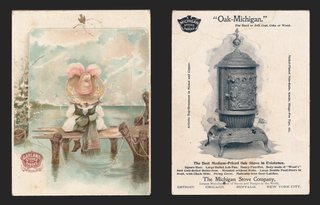
View on eBay

1980 Costa Rica 20 Colones Gonzalez Viquez Banknote P-238c [Est. F-VF]

28 August 1980 Costa Rica 20 Colones Banknote, Cleto Gonzalez Viquez and Barva / Allegory of Justice, Pick P-238c, Serial C16608984 [Est. F-VF]

$12.77 1980 Est. F-VF Costa Rica

Description

Issued by the Banco Central de Costa Rica and printed by the American Bank Note Company. Front: Cleto Gonzalez Viquez with houses and palms captioned BARVA, CUNA DEL PROCER (Barva, cradle of the hero); back: an allegory of Justice with scales and staff above figures on steps. Early printings spell the town BARBA; from 1978 it reads BARVA. Serial C16608984. Measured on the 1200 dpi scan: 155.4 x 67.5 mm. Centering, measured on the scan: front L4.7 R3.5 T4.0 B3.8 mm; back 6.5-7.5 mm: good. Per margins_r01. The close-ups show the serial, the date, Cleto Gonzalez Viquez and the back scene. The last image adds a millimeter scale.

Read the full description

Historical Context

Cleto Gonzalez Viquez (1858-1937), born in Barva, was president in 1906-1910 and 1928-1932; his first term completed the railroad to the Pacific in 1910. The 20 colones was later replaced by a coin introduced in 1982-1983.

Condition

[Est. F-VF] Several soft folds, including a vertical center fold and a horizontal fold, with many light creases and diagonal creases near the corners. Light overall toning and a few small light-brown spots. The colours are good and the paper still has some body. No tears, holes or writing. Grade estimated from the scans; not professionally graded.

Legal Tender

No longer legal tender: catalogs list it as demonetized (date not found), and the 20 colones is now a coin.

Disclaimer

The images and any video show the actual item and are part of the official listing description, so please review them closely. Measurements and weights are approximate, and any maker or material we haven't confirmed is described as assumed. Questions? Message us; we answer quickly.

View on eBay

"Comus, A Mask" by John Milton (with Explanatory Notes) Booklet

"Comus, A Mask" by John Milton (with Explanatory Notes) Booklet

$12.56 Booklets

explores themes of chastity, temptation, and the power of virtue. It is considered one of Milton's most significant early works, showcasing his poetic talent and philosophical depth. Maynard, Merrill, & Co. was a publishing house active in the late 19th and early 20th centuries, known for producing educational texts and classic literature, often in affordable editions for students. Their "English Classic Series" aimed to make important literary works accessible to a wider audience

  • Description: Copyright 1898, 48 pages — Maynard's English Classic Series edition of John Milton's Comus. John Milton's "Comus" is a masque, first performed in 1634, that
  • Condition: Shows signs of wear due to it's age and some flocking on the binding edge fold and bottom left corner is worn. Please see pictures as they are part of the item description.
  • Dimensions: (approximate): H: 6.50" x W: 4.50" x D: 0.20" x Weight: 52.26
Read the full description

Thanks!

Ref: 1.01013

View on eBay

1987 Peru 50 Intis Pierola Oil Rig Banknote P-131b S/N A7133014Q [Est. UNC]

26 June 1987 Peru 50 Intis Banknote, Nicolas de Pierola / Oil Rig and Helicopter, Pick P-131b, Serial A7133014Q [Est. UNC]

$12.49 1987 Est. UNC Peru

Description

Issued by the Banco Central de Reserva del Peru and printed by the Casa da Moeda do Brasil. Front: Nicolas de Pierola with the national arms; back: workers on an oil drilling rig with a helicopter approaching. Pierola watermark; '50 PERU 50' shows under colored light. Serial A7133014Q. Measured on the 1200 dpi scan: 149.9 x 75.4 mm. The close-ups show the serial, the date, Nicolas de Pierola, the oil rig, the signatures, the coat of arms and the printer imprint. The last image adds a millimeter scale.

Read the full description

Historical Context

Nicolas de Pierola, nicknamed 'El Califa', was president of Peru in 1879-1881 and 1895-1899. When the inti replaced the sol de oro at 1,000 to 1 in 1985, this design moved over from the 50,000 soles de oro note. The inti itself gave way to the nuevo sol in 1991.

Condition

[Est. UNC] No folds, creases or handling seen; bright paper with sharp corners. No marks, holes or tape. Grade estimated from the scans; not professionally graded.

Legal Tender

No longer legal tender: demonetized on 1 July 1991, and the BCRP says inti notes cannot be exchanged for soles.

Disclaimer

The images and any video show the actual item and are part of the official listing description, so please review them closely. Measurements and weights are approximate, and any maker or material we haven't confirmed is described as assumed. Questions? Message us; we answer quickly.

View on eBay

1987 Peru 50 Intis Pierola Oil Rig Banknote P-131b S/N A7133039Q [Est. UNC]

26 June 1987 Peru 50 Intis Banknote, Nicolas de Pierola / Oil Rig and Helicopter, Pick P-131b, Serial A7133039Q [Est. UNC]

$12.47 1987 Est. UNC Peru

Description

Issued by the Banco Central de Reserva del Peru and printed by the Casa da Moeda do Brasil. Front: Nicolas de Pierola with the national arms; back: workers on an oil drilling rig with a helicopter approaching. Pierola watermark; '50 PERU 50' shows under colored light. Serial A7133039Q. Measured on the 1200 dpi scan: 149.9 x 75.4 mm. The close-ups show the serial, the date, Nicolas de Pierola, the oil rig, the signatures, the coat of arms and the printer imprint. The last image adds a millimeter scale.

Read the full description

Historical Context

Nicolas de Pierola, nicknamed 'El Califa', was president of Peru in 1879-1881 and 1895-1899. When the inti replaced the sol de oro at 1,000 to 1 in 1985, this design moved over from the 50,000 soles de oro note. The inti itself gave way to the nuevo sol in 1991.

Condition

[Est. UNC] No folds, creases or handling seen; bright paper with sharp corners. No marks, holes or tape. Grade estimated from the scans; not professionally graded.

Legal Tender

No longer legal tender: demonetized on 1 July 1991, and the BCRP says inti notes cannot be exchanged for soles.

Disclaimer

The images and any video show the actual item and are part of the official listing description, so please review them closely. Measurements and weights are approximate, and any maker or material we haven't confirmed is described as assumed. Questions? Message us; we answer quickly.

View on eBay

1943 Philippines Negros 5 Pesos WWII Emergency Currency Certificate Montelibano

1943 Philippines Negros 5 Pesos Treasury Emergency Currency Certificate, Negros Emergency Currency Board, WWII, Signed Alfredo Montelibano

$12.31 1943 Philippines

Description

Front: "Treasury Emergency Currency Certificate, issued by authority of the President of the Philippines", redeemable in silver pesos or legal tender "upon termination of emergency", payable by the Negros Emergency Currency Board. Series of 1943, block V B2, green Commonwealth of the Philippines seal. Signed by the acting treasurer, Alfredo Montelibano (Governor, Chairman) and P. Benedicto (Provincial Auditor). Back: "Five Philippines Pesos" in green.

Read the full description

Details

Issuer: Negros Emergency Currency Board, Commonwealth of the Philippines

Denomination: 5 Pesos

Series: 1943 (printed)

Serial: partly legible

Size: approx. 107 x 66 mm

Historical Context

Printed on Negros during the Japanese occupation by the Commonwealth's resistance government, for use where official currency was unavailable.

Condition

Heavily circulated: soft, toned paper with folds, edge chips and small tears, and scattered stains. Please see the photos for condition; the grade has not been certified.

The images and any video show the actual item and are part of the official listing description, so please review them closely. Measurements and weights are approximate, and any maker or material we haven't confirmed is described as assumed. Questions? Message us; we answer quickly.

View on eBay

Arbuckle Ariosa Coffee Trade Card No 27 Big Horn Sheep Zoological [SEE DESC]

Arbuckle Bros Ariosa Coffee — Zoological Series No. 27, “Big-Horn”

$12.23 Advertising Sales Trade Cards

Original Victorian advertising trade card, chromolithograph, copyright 1890 by Arbuckle Bros. Coffee Co. Approx. 5.10 x 3.05 in. Printed by Knapp & Co. Lith., New York.

A bighorn ram and a younger animal bound down a rocky mountain slope, pine woods behind and a pale sky above. Captioned in the lower margin: BIG-HORN (Capra montana). The card is numbered 27 on the reverse.

The reverse carries three blocks of text. GRIND YOUR COFFEE AT HOME advises keeping a small coffee-mill in the kitchen and grinding one mess at a time, noting that coffee loses more of its strength and aroma in an hour after grinding than in six months before. An EXPLANATORY panel sets out the series: fifty cards, each showing a true picture drawn and colored by an eminent artist of one of the most interesting specimens of the animal kingdom, with the classical appellation together with the English name. It explains that every package of Arbuckle's Coffee contains either one of these cards or one of a companion series of fifty National Geographical cards, distributed so that each package in a hundred-pound case carries a card different from all the others. A third block promotes ARIOSA COFFEE, and a full list of the fifty animals represented runs down the right-hand side.

Read the full description

Historical Context

Arbuckle sold coffee by making the package worth opening. Fifty animals in one series, fifty maps in another, distributed so that no two packages in a case matched — a child who wanted the complete set had to keep the family buying coffee. It is a loyalty scheme a century before the phrase existed, and it worked well enough that Arbuckle became one of the largest coffee businesses in the country.

The reverse contains a small masterpiece of competitive advertising. Arbuckle observes that rival manufacturers, recommending their own goods, have known no higher praise than to say “It's just as good as Arbuckles'.” Quoting your competitors' own words back as proof of your standing is a move that has aged very well.

Condition

Toning and age typical of the period. Creasing and a short split across the upper right of the card; light surface soiling; minor edge and corner wear; toning to the reverse. The chromolithographed image remains bright and the reverse text fully legible. Please view the images carefully.

About The Printing

This is an original chromolithograph, and it was slow, exacting work. Each color had to be drawn onto its own separate stone by hand — in monochrome, the artist judging how much stipple each area needed so the colors would combine correctly only once every stone had been printed. The sheet then went through the press once for every color it carries, often a dozen or more, and every pass had to register exactly against the last. A pass out of register showed.

Under magnification the image resolves into irregular hand-drawn stipple, each ink carrying its own dot pattern, the colors mixing in the eye rather than on the paper. There is no regular halftone screen and no four-color rosette, which is what a modern reproduction would show. Modern process printing simulates every color from four inks; chromolithography laid each color down as its own.

Provenance

This item comes from the personal collections of my family estate, accumulated over more than 200 years — including items that came west by wagon train to Colorado and later to Oklahoma. Now that my parents have passed we cannot keep all of these cherished items. They were well-educated antiques collectors/traders and continued to build their collections over more than 60 years. The vast majority of the pieces are from the Victorian Era, however there are plenty of older and newer items. Everything has been stored in a climate-controlled environment over time.

Disclaimer

Specifications and detailed item descriptions are provided as a courtesy only and are not guaranteed to be one hundred percent accurate. Please do your own research. There are generally no receipts available for any items from original purchases. Any dimensions and/or weights are approximate. The absence of a more detailed condition report does not imply there are no condition issues with the item(s). Please inspect images carefully as they are part of the official item description and best representation of the actual condition. Additional images may be available upon request depending on time and availability. Not responsible for internet mis-translations or mis-identification of maker's marks if found or assumptions of makers or materials — item descriptions will indicate if it is assumed. If you see a problem, please message us immediately and we will do our best to sort out a solution and confirm the information. With the exception of eBay rules, no returns are accepted.
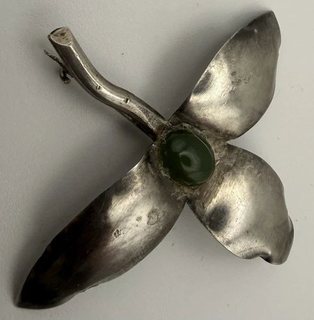
View on eBay

1891 Arbuckle Coffee Trade Card No 29 Dublin Ireland Around World [SEE DESC]

Arbuckle Bros Ariosa Coffee — “Dublin, Ireland,” No. 29 of 50 Views from a Trip Around the World

$12.11 1891 Advertising Sales Trade Cards

Original Victorian advertising trade card, chromolithograph, copyright 1891. Approx. 5.05 x 3.05 in. Printed by Joseph P. Knapp, Lith., N.Y.

A panorama of Dublin from Phoenix Park, with the river, a stone bridge and red-roofed houses, is surrounded by vignettes: a Colleen in a patterned headscarf; the Custom House with sailing ships at the quay; a Laborer with a clay pipe; and An Irish Jaunting Car, a horse-drawn side car with passengers and a girl at the roadside. A sprig of shamrock and pink clover blossoms sits at the center. Lettered at the foot: DUBLIN, IRELAND, and COPYRIGHT 1891 BY ARBUCKLE BROS. N.Y.

The reverse is headed One of 50 views from a trip around the world, and is numbered 29. The left column carries Arbuckle's GRIND YOUR COFFEE AT HOME advice and the ARIOSA COFFEE claim, closing with the line that rival makers know no higher praise than to say “It's just as good as Arbuckles'.” The right column is a travel sketch of Dublin — Sackville Street, the Nelson Monument, Trinity College and its library, Christ Church and St. Patrick's Cathedral, the house where Thomas Moore was born, and Phoenix Park with the Wellington Testimonial — ending with the population as of 1881.

Read the full description

Historical Context

Arbuckle ran several numbered series at once, and this is the travel series: fifty stops on an armchair tour of the world, one per package of coffee. The reverse reads like a guidebook, and for many households in 1891 it was the only guidebook to Dublin they would ever own.

The front shows the working of the series well. A city view, a landmark, and a pair of local types — the colleen and the laborer — each framed like a postcard pinned to a board. It is how most Americans of the period expected to meet a foreign country: as a set of pictures, collected one at a time.

Condition

Toning and age typical of the period. A short split and a small brown spot at the bottom edge below the title; wear to the lower-left corner; light edge toning; minor corner wear elsewhere. The chromolithographed image remains bright and the reverse text fully legible. Please view the images carefully.

About The Printing

This is an original chromolithograph, and it was slow, exacting work. Each color had to be drawn onto its own separate stone by hand — in monochrome, the artist judging how much stipple each area needed so the colors would combine correctly only once every stone had been printed. The sheet then went through the press once for every color it carries, often a dozen or more, and every pass had to register exactly against the last. A pass out of register showed.

Under magnification the image resolves into irregular hand-drawn stipple, each ink carrying its own dot pattern, the colors mixing in the eye rather than on the paper. There is no regular halftone screen and no four-color rosette, which is what a modern reproduction would show. Modern process printing simulates every color from four inks; chromolithography laid each color down as its own.

Provenance

This item comes from the personal collections of my family estate, accumulated over more than 200 years — including items that came west by wagon train to Colorado and later to Oklahoma. Now that my parents have passed we cannot keep all of these cherished items. They were well-educated antiques collectors/traders and continued to build their collections over more than 60 years. The vast majority of the pieces are from the Victorian Era, however there are plenty of older and newer items. Everything has been stored in a climate-controlled environment over time.

Disclaimer

Specifications and detailed item descriptions are provided as a courtesy only and are not guaranteed to be one hundred percent accurate. Please do your own research. There are generally no receipts available for any items from original purchases. Any dimensions and/or weights are approximate. The absence of a more detailed condition report does not imply there are no condition issues with the item(s). Please inspect images carefully as they are part of the official item description and best representation of the actual condition. Additional images may be available upon request depending on time and availability. Not responsible for internet mis-translations or mis-identification of maker's marks if found or assumptions of makers or materials — item descriptions will indicate if it is assumed. If you see a problem, please message us immediately and we will do our best to sort out a solution and confirm the information. With the exception of eBay rules, no returns are accepted.
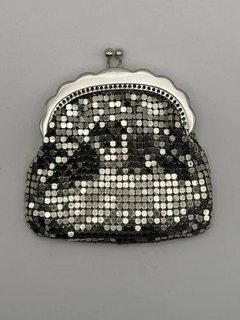
View on eBay

1993 Costa Rica 50 Colones "BEER" Money Banknote P-257a [Est. Fair]

7 July 1993 Costa Rica 50 Colones Banknote, Gaspar Ortuno y Ors / Old Banco de Costa Rica Building, Pick P-257a, Serial E52591733 [Est. Fair]

$11.77 1993 Est. Fair Costa Rica

Somebody wrote BEER right across the date, so there was never any doubt what this one was for. Likely spent accordingly; the stains suggest that's how it was used. The BEER ink shows through, just barely, on the back.

Read the full description

Description

Serie E note issued by the Banco Central de Costa Rica and printed by Thomas de la Rue. Front: Gaspar Ortuno y Ors with an 1866 50 centimos coin; back: the ANTIGUO EDIFICIO DEL BANCO DE COSTA RICA with a horse carriage and the reverse of the coin. BCCR 50 watermark. Serial E52591733. Measured on the 1200 dpi scan: 155.1 x 66.9 mm. The close-ups show the serial, the date, Gaspar Ortuno and the old bank building. The last image adds a millimeter scale.

Historical Context

Gaspar Ortuno y Ors was a Spanish consul and administrator and a founding partner of the Banco de la Union and the Banco de Costa Rica. This was the last 50 colones note design; the denomination then became a coin, first issued in 1997.

Condition

[Est. Fair] Heavy circulation with folds and many creases, and the paper is whole. BEER is written in blue ink across the date at the top of the front, and the ink shows through faintly on the back. The back has three large dark stains and many small red-brown spots, with purple staining along the top edge. Edges are worn with small nicks. Grade estimated from the scans; not professionally graded.

Legal Tender

No longer legal tender: catalogs list it as demonetized (date not found), and the 50 colones is now a coin.

Disclaimer

The images and any video show the actual item and are part of the official listing description, so please review them closely. Measurements and weights are approximate, and any maker or material we haven't confirmed is described as assumed. Questions? Message us; we answer quickly.

View on eBay

“Peace Silver Dollar” Design .999 Copper Round (includes coin flip protector)

Copper "Peace Silver Dollar" Design Copper Round (1 ADVP Ounce, .999 Copper)

$11.54 Copper (.999 Pure)

  • Condition: Proof Life strike. It weighs one Avoirdupois ounce (28.3495 grams) rather than one Troy ounce (31.1035) as copper rounds are not generally traded in the same units of measure. The diameter is 39.20mm. Frankly, it's the best reproduction of the Peace dollar that I have seen, including .999 Fine Silver Rounds that are out there.
  • Testing: The coin has been weighed and measured and is correct for what it is expected to be. It has passed review with Sigma Metalytics Precious Metals analysis as pure copper.
  • Note: This is not legal tender, but a fantastic way to enjoy this fine coin design.
  • Historical Context: The original Peace Silver Dollar design was minted in 90% silver + 10% copper in the US from 1921 to 1928 and again from 1934 to 1935, designed by Anthony de Francisci to commemorate the peace following World War I. The coin features the Goddess Liberty on the obverse and a bald eagle on the reverse, symbolizing peace, and it was created in response to public demand for a coin that represented the end of the war.
Read the full description

Thanks!

Ref: 1.0110

View on eBay

1988 Ecuador 5 Sucres Mariscal Sucre Banknote P-113d S/N IC 06472985 [Est. UNC]

22 November 1988 Ecuador 5 Sucres Banknote, Antonio Jose de Sucre / Arms of Ecuador, Pick P-113d, Serial IC 06472985 [Est. UNC]

$11.17 1988 Est. UNC Ecuador

Description

Issued by the Banco Central del Ecuador, with SOCIEDAD ANONIMA under the bank title, and printed in London by Thomas de la Rue, whose imprint runs along the bottom of the front. Front: Antonio Jose de Sucre in an oval; back: the national arms in red. Colored security fibers show in the paper. Serial IC 06472985. Measured on the 1200 dpi scan: 156.1 x 67.4 mm. Centering, measured on the scan: well centered: front L/R 4.7/3.3, T/B 3.5/3.8 mm; back 6.9/7.7, 6.7/7.4 mm. The close-ups show the serial, the date, Sucre, the national arms, the signatures, the London printer imprint and a corner. The last image adds a millimeter scale.

Read the full description

Historical Context

Antonio Jose de Sucre, the 'Gran Mariscal de Ayacucho', won the Battles of Pichincha (1822) and Ayacucho (1824) and was assassinated in 1830; the sucre currency was named after him. Runaway inflation in 1998-1999 and a March 1999 bank freeze led President Jamil Mahuad to announce dollarization on 9 January 2000, at 25,000 sucres per dollar. Ecuador has used the US dollar ever since.

Condition

[Est. UNC] No folds, creases or handling seen; bright paper with sharp corners. The small colored fibers are part of the paper. No marks, holes or tape. Grade estimated from the scans; not professionally graded.

Legal Tender

No longer legal tender: sucre notes lost legal tender status on 11 September 2000, and exchange at the Banco Central ended on 30 March 2001.

Disclaimer

The images and any video show the actual item and are part of the official listing description, so please review them closely. Measurements and weights are approximate, and any maker or material we haven't confirmed is described as assumed. Questions? Message us; we answer quickly.

View on eBay

"Standing Liberty" Design .999 Copper Bar in Plastic Capsule

Copper "Standing Liberty" Design Copper Bar (1 ADVP Ounce, .999 Copper)

$10.95 Copper (.999 Pure)

  • Condition: Nice strong strike and very nice design. It weighs one Avoirdupois ounce (28.3495 grams) rather than one Troy ounce (31.1035) as copper rounds are not generally traded in the same units of measure. It fits tightly into a standard plastic capsule for a one Troy ounce .999 Fine Silver capsule and it is included.
  • Testing: The bar has been weighed and is correct for what it is expected to be. It has passed review with Sigma Metalytics Precious Metals analysis as copper.
  • Note: This is not legal tender, but a fantastic way to enjoy a nice ingot bar with the kids without having to worry about losing it too much. Copper prices continue to rise and it is nice way to have a pre-measured amount to use for barter or trade or just to simply admire in your collection.
Read the full description

Thanks!

Ref: 1.0111

View on eBay

Victorian Arbuckles Ariosa Coffee Trade Card Winter Mill Red Quince Flowers

Arbuckle Bros Ariosa Coffee — Winter Mill and Flowering Quince

$10.91 Advertising Sales Trade Cards

Original Victorian advertising trade card, chromolithograph, c. 1880s-90s. Approx. 5.00 x 3.05 in.

A branch of red flowering quince, with open blossoms and round buds, sweeps across the foreground. Behind it a snowy mountain valley opens out, a water mill with a snow-covered roof standing beside a stream among dark pines. The front carries no lettering.

The reverse reads: ARBUCKLES' ARIOSA COFFEE COSTS MORE AND IS WORTH MORE THAN OTHER BRANDS OF COFFEE. WHY? Four numbered reasons follow — the higher-grade green coffee, the strength and aroma retained by the glazing, the choice eggs and pure confectioners' “A” sugar used in it, and its richness of flavor — with a BEWARE paragraph against low-grade package coffee. ARBUCKLE BROS. COFFEE CO., NEW YORK. The card is unnumbered.

Read the full description

Historical Context

Not every Arbuckle card belonged to a numbered series. Alongside the maps and the travel views, the company packed plain picture cards like this one, with the full sales argument on the back and nothing on the front but a scene to keep.

The back is the most complete statement of Arbuckle's case: coffee sold roasted and glazed in a sealed package, rather than loose from a barrel. The glaze of egg and sugar kept the beans fresh, and Arbuckle wanted every customer to know it was there.

Condition

Toning and age typical of the period. Several patches of surface paper loss on the reverse, where the card was once glued into an album, passing through parts of the text; a pencil name at the top of the reverse; minor edge and corner wear. The front is clean and bright. Please view the images carefully.

About The Printing

This is an original chromolithograph, and it was slow, exacting work. Each color had to be drawn onto its own separate stone by hand — in monochrome, the artist judging how much stipple each area needed so the colors would combine correctly only once every stone had been printed. The sheet then went through the press once for every color it carries, often a dozen or more, and every pass had to register exactly against the last. A pass out of register showed.
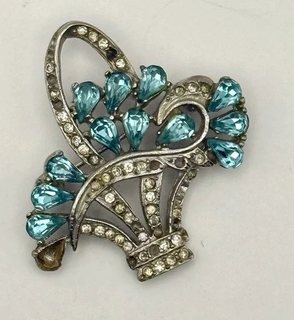
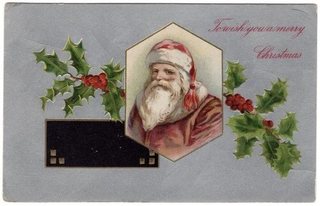
Under magnification the image resolves into irregular hand-drawn stipple, each ink carrying its own dot pattern, the colors mixing in the eye rather than on the paper. There is no regular halftone screen and no four-color rosette, which is what a modern reproduction would show. Modern process printing simulates every color from four inks; chromolithography laid each color down as its own.

Provenance

This item comes from the personal collections of my family estate, accumulated over more than 200 years — including items that came west by wagon train to Colorado and later to Oklahoma. Now that my parents have passed we cannot keep all of these cherished items. They were well-educated antiques collectors/traders and continued to build their collections over more than 60 years. The vast majority of the pieces are from the Victorian Era, however there are plenty of older and newer items. Everything has been stored in a climate-controlled environment over time.

Disclaimer

Specifications and detailed item descriptions are provided as a courtesy only and are not guaranteed to be one hundred percent accurate. Please do your own research. There are generally no receipts available for any items from original purchases. Any dimensions and/or weights are approximate. The absence of a more detailed condition report does not imply there are no condition issues with the item(s). Please inspect images carefully as they are part of the official item description and best representation of the actual condition. Additional images may be available upon request depending on time and availability. Not responsible for internet mis-translations or mis-identification of maker's marks if found or assumptions of makers or materials — item descriptions will indicate if it is assumed. If you see a problem, please message us immediately and we will do our best to sort out a solution and confirm the information. With the exception of eBay rules, no returns are accepted.
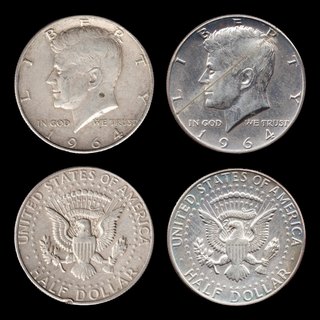
View on eBay

1961-No mintmark - Austria - 5 schilling - Coin [Est. MS64]

1961 Austria 5 Schilling .640 Silver Coin, Lipizzaner Horse and Rider [Est. MS64]

$10.88 1961 Est. MS64 Austria

Description

A 1961 Austrian 5 schilling in .640 silver with a Lipizzaner horse and rider.

Read the full description

Historical Context

The Lipizzaner is the horse of Vienna's Spanish Riding School, which has trained it in classical dressage for more than 450 years.

Condition

[Est. MS64] Little or no wear. The grade is our estimate from the images; the coin has not been professionally graded. Not particularly scarce but high grades are less common, so they're worth more.

Disclaimer

The images and any video show the actual item and are part of the official listing description, so please review them closely. Measurements and weights are approximate, and any maker or material we haven't confirmed is described as assumed. Questions? Message us; we answer quickly.

View on eBay

ca1915 Stecher Thanksgiving Postcard A Thanksgiving Wish Tom and Hen Turkey

ca1915 Stecher Lith. Co. "A Thanksgiving Wish" Postcard, Tom Turkey in Full Display with a Hen in a Harvest Field of Corn Shocks and Pumpkins, Series 777 E, Made in U.S.A., Unposted

$10.60 Thanksgiving Postcards

Description

A tom turkey in full display, his tail fanned in bronze and cream, faces a hen with an iridescent green back in a harvest field, with corn shocks, pumpkins and trees fading into a soft sky. "A Thanksgiving Wish" in brown script at upper right; a small circle logo with an "S" and "STECHER LITH. CO. ROCH. N.Y." at lower left. This card is flat, not embossed.

The back is a divided back with an ornate "POST CARD," "MADE IN U.S.A.," an empty stamp box, and "SERIES 777 E." Never stamped, mailed or written on.

Read the full description

Historical Context

Stecher. The Stecher Lithographic Company of Rochester, N.Y. grew from a printer of posters, labels and trade cards into a major maker of artist-drawn holiday postcards.

Condition

Very good. Clean, bright front with light corner wear. Back toned, with some light, uneven staining; pencil "15" at top right.

About The Printing

This card is printed in halftone. Under magnification the colors resolve into a regular, even grid of dots rather than the irregular hand-drawn stipple of a chromolithograph.

Provenance

From my family's estate collections, built over more than 60 years by knowledgeable antiques collectors and traders. Stored in a climate-controlled environment.

Also In Our Store

More Thanksgiving postcards from this group are in our store.

Disclaimer

The images and any video show the actual item and are part of the official listing description, so please review them closely. Measurements and weights are approximate, and any maker or material we haven't confirmed is described as assumed. Questions? Message us; we answer quickly.

View on eBay

1953 Japan 100 Yen Itagaki Taisuke Diet Banknote P-90 FN153616C [Est. VF]

1953 Japan 100 Yen Banknote, Bank of Japan, Pick P-90, FN153616C [Est. VF]

$10.58 1953 Est. VF Japan

Description

A Bank of Japan 100 yen, ND (1953), with Itagaki Taisuke and the National Diet Building on the back. Serial FN153616C. Pick P-90 (Numista N#202546).

Read the full description

Historical Context

Itagaki Taisuke (1837-1919) was a Meiji-era statesman and founder of Japan's first political party, the Liberal Party.

Condition

[Est. VF] Light circulation; see the photos. Grade estimated; not professionally graded.

Legal Tender

Still legal tender in Japan at face value (on the Bank of Japan list of valid notes), but worth more to collectors.

Disclaimer

The images and any video show the actual item and are part of the official listing description, so please review them closely. Measurements and weights are approximate, and any maker or material we haven't confirmed is described as assumed. Questions? Message us; we answer quickly.

View on eBay

ca1910 A Joyful Thanksgiving Postcard Pilgrim Hunter with Turkey Embossed Gold

ca1910 "A Joyful Thanksgiving" Embossed Postcard, White-Bearded Pilgrim Hunter Holding Up His Turkey in a Gold-Framed Snow Scene, Red Berry Sprays and Gold Ornaments, Series 340 D, Unposted

$10.43 Thanksgiving Postcards

Description

A white-bearded Pilgrim in a tall black hat, blue cape and red waistcoat stands in the snow holding up a turkey by its feet, a bell-mouthed gun under his arm. The scene sits in a gold-ruled upright panel flanked by sprays of red berries, with gold dot-and-circle ornaments and gold corner accents on a cream embossed ground. "A Joyful Thanksgiving" runs across the bottom with gold initials. A small © is printed at lower left; no publisher is named.

The back is a divided back with an ornate "POST CARD," "FOR CORRESPONDENCE" and "FOR ADDRESS ONLY," an empty stamp box, and "Series 340 D" at lower left. Never stamped, mailed or written on.

Read the full description

Historical Context

Pilgrim Thanksgiving. Here the holiday bird comes home over a Pilgrim's shoulder rather than on a platter.

The Golden Age of Postcards. The divided-back years, 1907 to 1915, are known as the Golden Age of Postcards, and German printers dominated the trade.

Condition

Good to very good. Front clean with bright gold and crisp embossing; a diagonal crease crosses the upper right corner, and the corners show light wear. Back toned with scattered foxing, the crease showing at its upper left. Small pencil marks on the back ("25" at top, "//" at lower right).

About The Printing

This is an original chromolithograph: each color was drawn by hand onto its own stone and printed in its own pass. Under magnification the image resolves into irregular hand-drawn stipple, each ink carrying its own dot pattern, with no regular halftone screen and no four-color rosette, which is what a modern reproduction would show. The panel, berries and ornaments are embossed, and the relief shows on the back.

Provenance

From my family's estate collections, built over more than 60 years by knowledgeable antiques collectors and traders. Stored in a climate-controlled environment.

Also In Our Store

More Thanksgiving postcards from this group are in our store.

Disclaimer

The images and any video show the actual item and are part of the official listing description, so please review them closely. Measurements and weights are approximate, and any maker or material we haven't confirmed is described as assumed. Questions? Message us; we answer quickly.

View on eBay

1953 Japan 100 Yen Itagaki Taisuke Diet Banknote P-90 MR385601B [Est. XF]

1953 Japan 100 Yen Banknote, Bank of Japan, Pick P-90, MR385601B [Est. XF]

$10.29 1953 Est. XF Japan

Description

A Bank of Japan 100 yen, ND (1953), with Itagaki Taisuke and the National Diet Building on the back. Serial MR385601B. Pick P-90 (Numista N#202546).

Read the full description

Historical Context

Itagaki Taisuke (1837-1919) was a Meiji-era statesman and founder of Japan's first political party, the Liberal Party.

Condition

[Est. XF] Lightly handled, with foxing and toning spots along the edges on both sides; see the photos. Grade estimated; not professionally graded.

Legal Tender

Still legal tender in Japan at face value (on the Bank of Japan list of valid notes), but worth more to collectors.

Disclaimer

The images and any video show the actual item and are part of the official listing description, so please review them closely. Measurements and weights are approximate, and any maker or material we haven't confirmed is described as assumed. Questions? Message us; we answer quickly.

View on eBay

1880s Trade Card Lion Coffee Woolson Spice Toledo Ohio Rose Winter Cottage

1880s Trade Card Lion Coffee Woolson Spice Toledo Ohio Rose Winter Cottage

$10.00 Advertising Sales Trade Cards

A large embossed card with a full-blown pink rose, two buds and green leaves curling over a turned-back sheet that opens on a winter scene: a yellow cottage with a snow-covered roof and smoking chimney, bare trees and a fir, and a snowy path in the foreground. The front carries no printed text.

The back is printed in blue: "Fine Pictures FREE! Besides the Beautiful Picture Card in every package of LION COFFEE, we also give away many fine pictures, books, games, etc., mailed free, in exchange for large Lion Heads, cut from LION COFFEE Wrappers." It invites the reader to ask the grocer for the latest Illustrated Premium List, or send a 1-cent stamp to "Woolson Spice Co., Huron and Jackson Streets, Toledo, O."

Approx. 3.60 x 5.45 in.

Read the full description

Historical Context

The coffee that came with a picture. Lion Coffee began in Toledo, Ohio, in 1864 and became part of the Woolson Spice Company in 1882. Alvin Woolson built the brand by putting picture cards in every package, and this card says so on its back.

Cut out the lion's head. The premium system printed here, save the lion heads from the wrappers and trade them for pictures, books and games, made Lion one of the best-known coffee brands of its day and filled family albums with cards like this one.

Roses in the snow. A summer rose set against a winter cottage is a favorite Victorian contrast, and the deep embossing makes this one of the more sculptural cards of the period. A good card for collectors of florals, winter scenes and Toledo history.

Condition

Used, with age wear. Front: a crease with a short surface break runs in about 1 in. from the left edge at mid-height, by the lower rosebud; a short crease near the lower right corner and light creasing at the lower left corner; corners lightly worn; a few small specks in the margins; light even toning. Back: light toning, the embossing shows through as expected, light creasing at the lower left and a small crease line at the right edge; no writing. Please see the photos, which are part of the description.

About The Printing

This is an original chromolithograph, and it was slow, exacting work. Each color had to be drawn onto its own separate stone by hand — in monochrome, the artist judging how much stipple each area needed so the colors would combine correctly only once every stone had been printed. The sheet then went through the press once for every color it carries, often a dozen or more, and every pass had to register exactly against the last. A pass out of register showed.

Under magnification the image resolves into irregular hand-drawn stipple, each ink carrying its own dot pattern, the colors mixing in the eye rather than on the paper. There is no regular halftone screen and no four-color rosette, which is what a modern reproduction would show. Modern process printing simulates every color from four inks; chromolithography laid each color down as its own.

The rose, leaves and scene are embossed, and the relief shows through on the back. The back is printed in a single blue ink.

Provenance

From my family's estate collections, built over more than 60 years by knowledgeable antiques collectors and traders. Stored in a climate-controlled environment.

Also In Our Store

More Victorian advertising trade cards for coffee, spices and baking soda are in our store.

Disclaimer

Specifications and detailed item descriptions are provided as a courtesy only and are not guaranteed to be one hundred percent accurate. Please do your own research. There are generally no receipts available for any items from original purchases. Any dimensions and/or weights are approximate. The absence of a more detailed condition report does not imply there are no condition issues with the item(s). Please inspect images carefully as they are part of the official item description and best representation of the actual condition. Additional images may be available upon request depending on time and availability. Not responsible for internet mis-translations or mis-identification of maker's marks if found or assumptions of makers or materials — item descriptions will indicate if it is assumed. If you see a problem, please message us immediately and we will do our best to sort out a solution and confirm the information. With the exception of eBay rules, no returns are accepted.

View on eBay

1880s Trade Card J. & P. Coats Thread Comic Market Women Vegetables Spool

DESCRIPTION

$10.00 Advertising Sales Trade Cards

A comic market scene. Two old market women on wooden stools argue across their baskets of greens, red apples and carrots, both with mouths open and hands raised, one in a white cap and polka-dot kerchief, the other in a spotted orange headscarf. Between them stands a prim lady in spectacles, a beribboned bonnet and a grey dress, a market basket on one arm and a furled red umbrella in hand. A large spool of J. & P. Coats thread hangs at upper left, its label reading "J. & P. COATS 200 YDS 50 BEST SIX CORD."

The back is printed in blue: "J.&P. COATS BEST SIX CORD THREAD FOR HAND AND MACHINE. WHITE, BLACK AND COLORS," with a large engraved spool and sprays of flowers. Approx. 4.05 x 2.75 in.

Read the full description

Historical Context

Thread from Paisley. J. & P. Coats was a Scottish thread firm of Paisley. In 1869 it allied with the Conant thread works of Pawtucket, Rhode Island, which then made the Coats six-cord thread in the United States.

Made for the sewing machine. Six-cord thread was strong enough for machine stitching, and the back of this card says it plainly: "For Hand and Machine."

Comedy sells thread. Instead of showing the product at work, the artist stages a squabble between two market women while a starchy customer waits, and drops a giant spool into the corner. Humorous scenes like this were a staple of the Victorian trade card.

Condition

Fair to good. Front: light soiling and foxing across the sky area, heaviest at upper center, with a few small grey smudges; small dark spot at the left edge; a curved surface crease at the lower right corner and a short crease at the right edge; corners softly rounded, the lower left with a small bump. Colors otherwise bright. Back: overall toning with light staining at the left and center, a few small dark specks, and a light crease at the lower left corner. Please see the photos, which are part of the description.

About The Printing

This is an original chromolithograph, and it was slow, exacting work. Each color had to be drawn onto its own separate stone by hand — in monochrome, the artist judging how much stipple each area needed so the colors would combine correctly only once every stone had been printed. The sheet then went through the press once for every color it carries, often a dozen or more, and every pass had to register exactly against the last. A pass out of register showed.

Under magnification the image resolves into irregular hand-drawn stipple, each ink carrying its own dot pattern, the colors mixing in the eye rather than on the paper. There is no regular halftone screen and no four-color rosette, which is what a modern reproduction would show. Modern process printing simulates every color from four inks; chromolithography laid each color down as its own.

The back is printed in a single blue ink.

Provenance

From my family's estate collections, built over more than 60 years by knowledgeable antiques collectors and traders. Stored in a climate-controlled environment.

Also In Our Store

More Victorian advertising trade cards for thread, sewing and patent medicines are in our store.

Disclaimer

Specifications and detailed item descriptions are provided as a courtesy only and are not guaranteed to be one hundred percent accurate. Please do your own research. There are generally no receipts available for any items from original purchases. Any dimensions and/or weights are approximate. The absence of a more detailed condition report does not imply there are no condition issues with the item(s). Please inspect images carefully as they are part of the official item description and best representation of the actual condition. Additional images may be available upon request depending on time and availability. Not responsible for internet mis-translations or mis-identification of maker's marks if found or assumptions of makers or materials — item descriptions will indicate if it is assumed. If you see a problem, please message us immediately and we will do our best to sort out a solution and confirm the information. With the exception of eBay rules, no returns are accepted.

View on eBay

1982 Bolivia 1000 Pesos Bolivianos Juana Azurduy Banknote P-167a [Est. XF-AU]

25 June 1982 Bolivia 1000 Pesos Bolivianos Banknote, Juana Azurduy de Padilla / Casa de la Libertad, Pick P-167a, Serial A22631384 [Est. XF-AU]

$9.98 1982 Est. XF-AU Bolivia

Description

Issued by the Banco Central de Bolivia under a 1982 supreme decree and printed by Thomas de la Rue. Front: Juana Azurduy de Padilla with the national arms; back: the Casa de la Libertad. Azurduy portrait watermark. Serial A22631384. Measured on the 1200 dpi scan: 155.4 x 66.8 mm. Centering, measured on the scan: front 4.0-4.8 mm, back 5.5-6.5 mm: well centered. Per margins_r01. The close-ups show the serial, the date, Juana Azurduy, the Casa de la Libertad, the signatures and the coat of arms. The last image adds a millimeter scale.

Read the full description

Historical Context

Juana Azurduy de Padilla (1780-1862) led guerrilla forces in the independence war with her husband, Manuel Ascencio Padilla; Argentina posthumously promoted her to general in 2009. The Casa de la Libertad in Sucre is where Bolivia's independence was declared on 6 August 1825. The note belongs to Bolivia's hyperinflation years of the 1980s.

Condition

[Est. XF-AU] No folds, with only faint creases in the watermark panels. The paper is bright and crisp with sharp corners. Faint light-brown spotting in the watermark panel and one small brown spot on the back. No tears, holes or writing. Grade estimated from the scans; not professionally graded.

Legal Tender

No longer legal tender: demonetized on 31 December 1987.

Disclaimer

The images and any video show the actual item and are part of the official listing description, so please review them closely. Measurements and weights are approximate, and any maker or material we haven't confirmed is described as assumed. Questions? Message us; we answer quickly.

View on eBay

1990 Costa Rica 100 Colones Ricardo Jimenez Banknote P-254a [Est. VG]

5 October 1990 Costa Rica 100 Colones Banknote, Ricardo Jimenez Oreamuno / Supreme Court Building, Pick P-254a, Serial F13342690 [Est. VG]

$9.95 1990 Est. VG Costa Rica

Description

Issued by the Banco Central de Costa Rica. Front: Ricardo Jimenez Oreamuno; back: the Corte Suprema de Justicia (Supreme Court) building. The design was printed by Thomas de la Rue, American Bank Note and Casa da Moeda do Brasil; the series letter and printer imprint identify the catalog number. Later issues have a repeated BCCR-100 watermark. Serial F13342690. Measured on the 1200 dpi scan: 157.1 x 66.3 mm. The close-ups show the serial, the date, Ricardo Jimenez and the Supreme Court building. The last image adds a millimeter scale.

Read the full description

Historical Context

Ricardo Jimenez Oreamuno (1859-1945) was president three times (1910-1914, 1924-1928 and 1932-1936) and also headed the Supreme Court and Congress, the only person to lead all three branches of government. The 100 colones later became a coin, first dated 1995.

Condition

[Est. VG] Heavy circulation: folds in both directions and numerous creases, with heavy brown soiling. One corner is ragged and the nearby top edge is nibbled, less than 1.5 mm deep. A brown water stain at the top left of the back and a small dark spot on the front. No tears or holes. Grade estimated from the scans; not professionally graded.

Legal Tender

No longer legal tender: catalogs list it as demonetized (date not found), and the 100 colones is now a coin.

Disclaimer

The images and any video show the actual item and are part of the official listing description, so please review them closely. Measurements and weights are approximate, and any maker or material we haven't confirmed is described as assumed. Questions? Message us; we answer quickly.

View on eBay

1902-No mintmark - USA - 1 cent - Coin [Est. XF40]

1902 Indian Head Cent, Bronze, James B. Longacre Design, Circulated [Est. XF40]

$9.89 1902 Est. XF40 Indian Head (1859-1909)

Description

A 1902 Indian Head cent in bronze, designed by James B. Longacre, Chief Engraver of the US Mint.

Read the full description

Historical Context

The Indian Head cent was struck from 1859 to 1909, when the Lincoln cent replaced it.

Condition

[Est. XF40] Circulated. The grade is our estimate from the images; the coin has not been professionally graded.

Disclaimer

The images and any video show the actual item and are part of the official listing description, so please review them closely. Measurements and weights are approximate, and any maker or material we haven't confirmed is described as assumed. Questions? Message us; we answer quickly.

View on eBay

ca 2017 Argentina 100 Pesos Eva Peron Well Traveled Banknote P-358d [Est. VG]

Undated (issued 2017) Argentina 100 Pesos Banknote, Eva Peron / Ara Pacis Relief, Mother and Children, Pick P-358d, Serial 24462847EA [Est. VG]

$9.87 2017 Est. VG Argentina

Description

Issued by the Banco Central de la Republica Argentina and printed by S.E. Casa de Moneda. Front: Eva Peron in profile with her quote 'Como mujer siento en el alma...'; back: a mother with two children from the Ara Pacis relief in Rome, with text on her work for workers and the women's vote. Eva Peron watermark with EP and a holographic windowed thread reading 'BCRA $100 Eva Peron'. Serial 24462847EA. Measured on the 1200 dpi scan: 155.6 x 64.8 mm. The close-ups show the serial and Eva Peron. The last image adds a millimeter scale.

Read the full description

Historical Context

First issued on 20 September 2012 for the 60th anniversary of her death, the design was printed until 2017. Maria Eva Duarte de Peron (1919-1952) championed workers' rights and women's suffrage, enacted in 1947 and first used in 1951.

Condition

[Est. VG] Heavy circulation: a worn vertical center fold, a horizontal fold and many creases, with crinkled foil patches. Heavy overall soiling, fuzzy edges and rounded corners. A small chip is missing at one corner and there is a small nick at the top of the center fold. No holes or writing. Grade estimated from the scans; not professionally graded.

Legal Tender

Appears to remain legal tender: the BCRA still lists it among circulating notes (May 2026) and catalogs show it as not demonetized.

Disclaimer

The images and any video show the actual item and are part of the official listing description, so please review them closely. Measurements and weights are approximate, and any maker or material we haven't confirmed is described as assumed. Questions? Message us; we answer quickly.

View on eBay

ca 1970 Chile 1 Escudo Arturo Prat Banknote P-136 [Est. UNC]

Undated (issued 1970-1973) Chile 1 Escudo Banknote, Arturo Prat / Founding of Santiago, Pick P-136, Serial 0181392 Q9 [Est. UNC]

$9.77 1970 Est. UNC Chile

Description

Issued by the Banco Central de Chile and printed by the Casa de Moneda de Chile. Front: Arturo Prat in an oval, after a drawing by Luis Fernando Rojas; back: Pedro de Valdivia at the founding of Santiago, a detail of Pedro Lira's 1888 painting, over pale national arms with the motto POR LA RAZON O LA FUERZA. Watermark at left. Serial 0181392 Q9. Measured on the 1200 dpi scan: 145.3 x 68.6 mm. Centering, measured on the scan: front frame L4.7 R4.2 T5.0 mm (bottom reads to the imprint line); back L5.0 R5.2 T5.7 B3.5 mm (slightly low). Per margins_r01. The close-ups show the serial, Arturo Prat, the founding scene, the signatures, the coat of arms and the Casa de Moneda imprint. The last image adds a millimeter scale.

Read the full description

Historical Context

Arturo Prat, naval officer and lawyer, died boarding the Peruvian ironclad Huascar at the Battle of Iquique on 21 May 1879, in the War of the Pacific, and is Chile's national hero. The escudo, worth 1,000 old pesos, was used from 1960 until 1975, when the peso returned at 1,000 escudos to 1.

Condition

[Est. UNC] No folds, creases or handling, with bright white paper and sharp corners. A faint mirrored offset of the serial shows in the oval on the back, an ink set-off from stacking at the printer and common on this issue. No tears, holes or writing. Grade estimated from the scans; not professionally graded.

Legal Tender

No longer legal tender: the escudo was withdrawn on 29 September 1975, when the peso replaced it.

Disclaimer

The images and any video show the actual item and are part of the official listing description, so please review them closely. Measurements and weights are approximate, and any maker or material we haven't confirmed is described as assumed. Questions? Message us; we answer quickly.

View on eBay

1992 Venezuela 10 Bolivares Bolivar Sucre Banknote P-61c [Est. AU]

8 December 1992 Venezuela 10 Bolivares Banknote, Simon Bolivar and Antonio Jose de Sucre / Carabobo Monument, Pick P-61c, Serial N18985561 [Est. AU]

$9.51 1992 Est. AU Venezuela

Description

Issued by the Banco Central de Venezuela and printed by the American Bank Note Company without an imprint. Front: Simon Bolivar (BOLIVAR-LIBERTADOR) at left and Antonio Jose de Sucre (MARISCAL SUCRE, after Arturo Michelena) at right; back: the Carabobo monument by Antonio Rodriguez del Villar, with the national arms. Serial N18985561. The serial begins with 1898. Measured on the 1200 dpi scan: 158.5 x 68.7 mm. Centering, measured on the scan: front slightly low (L/R 5.0/5.0, T/B 4.2/2.6 mm); back centered side to side, slightly low (L/R 9.2/9.4, T/B 8.2/6.9 mm). The close-ups show the serial, the date, Bolivar, Sucre, the monument, the signatures, the central 10, the DIEZ BOLIVARES panel, the large 10 on the back and the coat of arms. The last image adds a millimeter scale.

Read the full description

Historical Context

Bolivar's victory at Carabobo on 24 June 1821 won Venezuela's independence. Sucre won the battles of Pichincha (1822) and Ayacucho (1824). The old bolivar has since been redenominated three times, in 2008, 2018 and 2021, removing 14 zeros.

Condition

[Est. AU] Bright paper with no fold through the note; light handling creases near the top-right corner on the front. A small nick, about 1 mm wide, sits on the top edge about 5 mm from the front top-right corner. No holes, stains, tape or writing. Grade estimated from the scans; not professionally graded.

Legal Tender

No longer legal tender: demonetized on 31 January 2006.

Disclaimer

The images and any video show the actual item and are part of the official listing description, so please review them closely. Measurements and weights are approximate, and any maker or material we haven't confirmed is described as assumed. Questions? Message us; we answer quickly.

View on eBay

ca 1982 Argentina 500 Pesos San Martin Banknote P-303c [Est. VF]

Undated (printed 1982) Argentina 500 Pesos Banknote, Gen. San Martin / Army of the Andes Monument, Mendoza, Pick P-303c, Serial 19262393D [Est. VF]

$9.38 1982 Est. VF Argentina

Description

Issued by the Banco Central de la Republica Argentina and printed by Casa de Moneda de la Nacion. Front: General San Martin with olive branches; back: the Monument to the Army of the Andes on Cerro de la Gloria, Mendoza. A peso ley note, although it reads simply PESOS; watermarked, with no security thread. Serial 19262393D. The serial begins with 1926. Measured on the 1200 dpi scan: 154.5 x 75.9 mm. Centering, measured on the scan: front well centered (about 5.3 mm all round); back 4.5-6.7 mm. Per margins_r01. The close-ups show the serial, San Martin and the monument. The last image adds a millimeter scale.

Read the full description

Historical Context

Jose de San Martin led the Crossing of the Andes and is called the Liberator of Argentina, Chile and Peru. The Cerro de la Gloria monument, by chief sculptor Juan Manuel Ferrari, was inaugurated on 12 February 1914. The peso ley replaced 100 pesos moneda nacional in 1970 and was itself replaced at 10,000 to 1 in 1983.

Condition

[Est. VF] A vertical center fold with a few soft creases in the margins and light even toning. A brown patch of old adhesive or paper residue, about 13 x 15 mm, sits on the front left of QUINIENTOS. Corners are close to sharp and the edges are clean. No tears, holes or writing. Grade estimated from the scans; not professionally graded.

Legal Tender

No longer legal tender: demonetized in 1984 (sources give 2 April or 29 June 1984).

Disclaimer

The images and any video show the actual item and are part of the official listing description, so please review them closely. Measurements and weights are approximate, and any maker or material we haven't confirmed is described as assumed. Questions? Message us; we answer quickly.

View on eBay

1942 Japanese Invasion Money Malaya 50 Cents Palm P-M4b Block MT [Est. AU-UNC]

1942 Japanese Invasion Money, Malaya 50 Cents Banknote, Japanese Government (occupation issue), Pick P-M4b, block MT [Est. AU-UNC]

$9.37 1942 Est. AU-UNC Malaya

Description

A Japanese Government 50 cents for Malaya, ND (1942), block MT, with a traveler's palm. Pick P-M4b (Numista N#208702).

Read the full description

Historical Context

During the Japanese occupation of Malaya (1942-1945) the Japanese Government issued these dollar and cent notes in place of the Malayan dollar. Malaya notes carry block letters beginning with M. The notes became worthless after the war, and many were kept as souvenirs.

Condition

[Est. AU-UNC] Bright and fresh looking; see the photos. Grade estimated; not professionally graded.

Legal Tender

Not legal tender. Japanese occupation money was not redeemed after the war. Sold as a collectible.

Disclaimer

The images and any video show the actual item and are part of the official listing description, so please review them closely. Measurements and weights are approximate, and any maker or material we haven't confirmed is described as assumed. Questions? Message us; we answer quickly.

View on eBay

1968 Indonesia 500 Rupiah Banknote P-109 General Sudirman Yarn Spinning Mill

1968 Indonesia 500 Rupiah Banknote, Pick 109, General Sudirman Portrait, Yarn Spinning Mill Back, Sudirman Series

$9.33 1968 Indonesia

Description

Front: General Sudirman, hero of the Indonesian National Revolution, at left, with the national arms at center and "Limaratus Rupiah". Credits: M. Sadjiroen Del. and P.N. Pertjetakan Kebajoran Imp. Back: workers at a yarn spinning mill, with serial XPT042623 printed twice.

Read the full description

Details

Issuer: Bank Indonesia

Denomination: 500 Rupiah

Year: 1968

Catalog: Pick 109

Serial: XPT042623

Size: approx. 143 x 72 mm

Condition

Circulated: folds, soft corners and light toning. Please see the photos for condition; the grade has not been certified.

The images and any video show the actual item and are part of the official listing description, so please review them closely. Measurements and weights are approximate, and any maker or material we haven't confirmed is described as assumed. Questions? Message us; we answer quickly.

View on eBay

1928-D Lincoln Wheat Penny US $0.01 Coin (1c) - Original Never Cleaned KM#132

1928-D Lincoln Wheat Cent (Penny), Denver Mint, Bronze, Original Never-Cleaned Brown Surfaces, Wheat Lines Showing, Low Denver Mintage of 31 Million, KM#132 [Est. F-12]

$9.28 1928 Est. F-12 Wheat (1909-1958)

Description

A 1928 Lincoln Wheat cent struck at the Denver Mint, with the D mint mark below the date, KM#132. The obverse shows Abraham Lincoln facing right, with IN GOD WE TRUST above, LIBERTY at left and the date at right; the reverse shows ONE CENT and UNITED STATES OF AMERICA between two wheat ears, with E PLURIBUS UNUM at the top. Bronze: 95% copper and 5% tin and zinc, 3.11 grams standard, 19 mm, plain edge. The close-ups show the date and D mint mark, the portrait, LIBERTY, ONE CENT and a wheat ear.

Read the full description

Historical Context

Victor David Brenner designed the Lincoln cent for the centennial of Lincoln's birth in 1909; the wheat-ears reverse ran until 1958. Denver began striking cents in 1911. In 1928 it struck about 31 million, less than a quarter of Philadelphia's 134 million that year.

1928 was the last full year of the Roaring Twenties boom before the 1929 crash. That September Alexander Fleming discovered penicillin, and in November Mickey Mouse made his debut in Steamboat Willie.

Buying Power

In 1928 this one cent had the buying power of about 20 cents today.

Condition

[Est. F-12] Original and never cleaned or polished, with even brown surfaces and no luster. Full rims; all lettering clear, including IN GOD WE TRUST, LIBERTY and E PLURIBUS UNUM; Lincoln's hair, ear and bow tie show; the wheat lines are visible on the upper half of both ears. The D mint mark is clear and open. A few light marks and small dark specks on both sides (see the close-ups). Checked for documented 1928-D varieties and errors: none seen. Grade estimated; not professionally graded. Currently still legal tender, but value to collectors is far higher due to its age and importance to American history.

Also In Our Store

More coins: https://www.ebay.com/str/tfauctionsintl?_nkw=coin

Disclaimer

The images and any video show the actual item and are part of the official listing description, so please review them closely. Measurements and weights are approximate, and any maker or material we haven't confirmed is described as assumed. Questions? Message us; we answer quickly.

View on eBay

1930 Japan 5 Yen Sugawara no Michizane Tenmangu Note P-39a 185175 [Est. F-VG]

1930 Japan 5 Yen Banknote, Bank of Japan, Pick P-39a, {77} 185175 [Est. F-VG]

$9.17 1930 Est. F-VG Japan

Description

A Bank of Japan convertible note, 5 yen, ND (1930), with Sugawara no Michizane and the Kitano Tenmangu shrine. Block 77, serial 185175. Pick P-39a (Numista N#206987).

Read the full description

Historical Context

Sugawara no Michizane (845-903) was a scholar, poet and statesman, honored at Kitano Tenmangu in Kyoto as Tenjin, the patron of learning.

Condition

[Est. F-VG] Circulated, with folds and soiling; see the photos. Grade estimated; not professionally graded.

Legal Tender

No longer legal tender: not on the Bank of Japan list of notes still valid. Sold as a collectible.

Disclaimer

The images and any video show the actual item and are part of the official listing description, so please review them closely. Measurements and weights are approximate, and any maker or material we haven't confirmed is described as assumed. Questions? Message us; we answer quickly.

View on eBay

1988 Ecuador 5 Sucres Mariscal Sucre Banknote P-113d S/N IB 01546899 [Est. UNC]

22 November 1988 Ecuador 5 Sucres Banknote, Antonio Jose de Sucre / Arms of Ecuador, Pick P-113d, Serial IB 01546899 [Est. UNC]

$9.12 1988 Est. UNC Ecuador

Description

Issued by the Banco Central del Ecuador, with SOCIEDAD ANONIMA under the bank title, and printed in London by Thomas de la Rue, whose imprint runs along the bottom of the front. Front: Antonio Jose de Sucre in an oval; back: the national arms in red. Colored security fibers show in the paper. Serial IB 01546899. Measured on the 1200 dpi scan: 156.7 x 67.9 mm. Centering, measured on the scan: front well centered (L/R 4.0/4.2, T/B 4.3/3.5 mm); back shifted slightly right (L/R 8.2/6.4 mm). The close-ups show the serial, the date, Sucre, the national arms, the signatures, the London printer imprint and a corner. The last image adds a millimeter scale.

Read the full description

Historical Context

Antonio Jose de Sucre, the 'Gran Mariscal de Ayacucho', won the Battles of Pichincha (1822) and Ayacucho (1824) and was assassinated in 1830; the sucre currency was named after him. Runaway inflation in 1998-1999 and a March 1999 bank freeze led President Jamil Mahuad to announce dollarization on 9 January 2000, at 25,000 sucres per dollar. Ecuador has used the US dollar ever since.

Condition

[Est. UNC] No folds, creases or handling seen; bright paper with sharp corners. The small colored fibers are part of the paper. No marks, holes or tape. Grade estimated from the scans; not professionally graded.

Legal Tender

No longer legal tender: sucre notes lost legal tender status on 11 September 2000, and exchange at the Banco Central ended on 30 March 2001.

Disclaimer

The images and any video show the actual item and are part of the official listing description, so please review them closely. Measurements and weights are approximate, and any maker or material we haven't confirmed is described as assumed. Questions? Message us; we answer quickly.

View on eBay

1987 Peru 10 Intis Ricardo Palma Banknote P-129a [Est. UNC]

26 June 1987 Peru 10 Intis Banknote, Ricardo Palma / Farm Workers and Cotton Harvest, Pick P-129a, Serial A5980589N [Est. UNC]

$9.11 1987 Est. UNC Peru

Description

Issued by the Banco Central de Reserva del Peru and printed in Rome by the Istituto Poligrafico e Zecca dello Stato. Front: writer Ricardo Palma with the national arms; back: a farmer digging and a worker picking cotton. Palma watermark with '10 PERU 10' beside it. Serial A5980589N. Measured on the 1200 dpi scan: 151.8 x 75.8 mm. The close-ups show the serial, the date, Ricardo Palma, the back vignette, the signatures, the coat of arms and the printer imprint. The last image adds a millimeter scale.

Read the full description

Historical Context

Ricardo Palma (1833-1919) is best known for his 'Tradiciones peruanas'. The inti replaced the sol de oro at 1,000 to 1 on 1 February 1985, but by 1990 it had suffered high inflation of its own and on 1 July 1991 it gave way to the nuevo sol at 1,000,000 intis to 1.

Condition

[Est. UNC] No folds, creases or handling seen; bright paper with sharp corners. No marks, holes or tape. Grade estimated from the scans; not professionally graded.

Legal Tender

No longer legal tender: demonetized on 1 July 1991, and the BCRP says inti notes cannot be exchanged for soles.

Disclaimer

The images and any video show the actual item and are part of the official listing description, so please review them closely. Measurements and weights are approximate, and any maker or material we haven't confirmed is described as assumed. Questions? Message us; we answer quickly.

View on eBay

1776-2026-P Semiquincentennial “Enduring Liberty” Half Dollar — Lot of 2 Coins

1776-2026-P (Dual Date) Semiquincentennial “Enduring Liberty” Half Dollar (Lot of 2) Uncirculated, Mint State - direct from mint roll.

$8.98 2026 Semiquincentennial Half Dollar

The Semiquincentennial Half Dollar is a special coin issued in 2026 to commemorate the 250th anniversary of American independence. It features a design of the Statue of Liberty on the obverse and Liberty passing her torch on the reverse, with inscriptions celebrating American liberty and history. Overview of the Semiquincentennial Half Dollar The Semiquincentennial Half Dollar is a commemorative coin issued in 2026 to celebrate the 250th anniversary of American independence. This coin reflects significant themes of liberty and national pride.

See pictures as they are part of the item description.

Design Features—

Obverse Design

Image: Statue of Liberty

Inscriptions: "UNITED STATES OF AMERICA" "IN GOD WE TRUST" "1776 ~ 2026"

Reverse Design Image: Liberty passing her torch Inscriptions: "E PLURIBUS UNUM" "HALF DOLLAR" "KNOWLEDGE IS THE ONLY GUARDIAN OF TRUE LIBERTY"

Specifications—

Denomination: Half Dollar

Composition: 8.33% nickel, balance copper

Weight: 11.340 grams (each)

Diameter: 1.205 inches (30.61 mm) each

Edge: Reeded

Mint Locations: Philadelphia (P), Denver (D) - these two coins are from Philadelphia Mint

View on eBay

1976 $2 Bill Signing of the Declaration Kansas City MO J07636723A Light Circ

Series 1976 $2 Federal Reserve Note, Bicentennial 1776-1976 (200th Anniversary), Thomas Jefferson, Trumbull's Declaration of Independence on the Back, Kansas City (J10), Francine I. Neff and William E. Simon Signatures, Green Seal, Serial J07636723A, Fr. 1935-J, Lightly Circulated [Est. VF]

$8.98 1976 Est. VF Bicentennial $2 Dollar Bills

Description

A Series 1976 $2 Federal Reserve Note with a green Treasury seal, issued through the Federal Reserve Bank of Kansas City: letter J, number 10, shown on the black seal at left and on the "10" in each corner. Signed by Francine I. Neff, Treasurer of the United States, and William E. Simon, Secretary of the Treasury. Serial number J07636723A.

Thomas Jefferson's portrait has appeared on every $2 note since Series 1869, and the front of the $2 is the oldest design on current US currency. The back shows John Trumbull's painting Declaration of Independence. Few $2 notes are printed, and banks usually hand them out only on request, so they are seldom seen in everyday spending and many people simply keep them.

Standard small size, about 6.125 x 2.625 in.

Read the full description

Historical Context

The $2 bill returned on April 13, 1976, Thomas Jefferson's birthday, in the nation's Bicentennial year. For Series 1976 the back was changed from Monticello to the signing of the Declaration of Independence. Printed in Washington, DC; the Fort Worth plant did not open until 1991.

1976 was also the year Jimmy Carter defeated President Gerald Ford (November 2).

Buying Power

In 1976, the average factory worker earned about $5.09 an hour, so this $2 note was about 24 minutes of factory pay, or about $11.85 at today's factory wage. By the consumer price index, $2 in 1976 bought about what $11.77 buys today.

Condition

[Est. VF] Lightly circulated. A few light folds. Not a star note and no errors found.

Legal Tender

Yes. United States currency issued since 1861 remains legal tender at face value ($2), whatever the series.

Disclaimer

The images and any video show the actual item and are part of the official listing description, so please review them closely. Measurements and weights are approximate, and any maker or material we haven't confirmed is described as assumed. Questions? Message us; we answer quickly.

View on eBay

1776-1976 $2 Bill 200th Anniversary Jefferson Kansas City J07048019A Light Circ

Series 1976 $2 Federal Reserve Note, Bicentennial 1776-1976 (200th Anniversary), Thomas Jefferson, Trumbull's Declaration of Independence on the Back, Kansas City (J10), Francine I. Neff and William E. Simon Signatures, Green Seal, Serial J07048019A, Fr. 1935-J, Lightly Circulated [Est. VF]

$8.97 1776 Est. VF Bicentennial $2 Dollar Bills

Description

A Series 1976 $2 Federal Reserve Note with a green Treasury seal, issued through the Federal Reserve Bank of Kansas City: letter J, number 10, shown on the black seal at left and on the "10" in each corner. Signed by Francine I. Neff, Treasurer of the United States, and William E. Simon, Secretary of the Treasury. Serial number J07048019A.

Thomas Jefferson's portrait has appeared on every $2 note since Series 1869, and the front of the $2 is the oldest design on current US currency. The back shows John Trumbull's painting Declaration of Independence. Few $2 notes are printed, and banks usually hand them out only on request, so they are seldom seen in everyday spending and many people simply keep them.

Standard small size, about 6.125 x 2.625 in.

Read the full description

Historical Context

The $2 bill returned on April 13, 1976, Thomas Jefferson's birthday, in the nation's Bicentennial year. For Series 1976 the back was changed from Monticello to the signing of the Declaration of Independence. Printed in Washington, DC; the Fort Worth plant did not open until 1991.

1976 was also the year Johnny Rutherford won the rain-shortened Indianapolis 500 (May 30).

Buying Power

In 1976, the average factory worker earned about $5.09 an hour, so this $2 note was about 24 minutes of factory pay, or about $11.85 at today's factory wage. By the consumer price index, $2 in 1976 bought about what $11.77 buys today.

Condition

[Est. VF] Lightly circulated. A few light folds; bright paper. Not a star note and no errors found.

Legal Tender

Yes. United States currency issued since 1861 remains legal tender at face value ($2), whatever the series.

Disclaimer

The images and any video show the actual item and are part of the official listing description, so please review them closely. Measurements and weights are approximate, and any maker or material we haven't confirmed is described as assumed. Questions? Message us; we answer quickly.

View on eBay

1927 Buffalo Nickel (Est. VG8)

1927 Buffalo Nickel, James Earle Fraser Design [Est. VG8 Details Polished]

$8.87 1927 Est. VG8 Buffalo Nickels (1913-1938)

Description

A 1927 Buffalo nickel (Indian Head nickel), designed by sculptor James Earle Fraser: a Native American portrait on the obverse and an American bison on the reverse. Copper-nickel (75% copper, 25% nickel), 5 grams, 21.2 mm (Mint standard figures).

Read the full description

Historical Context

In May 1927, Charles Lindbergh flew the Spirit of St. Louis nonstop from New York to Paris.

Condition

[Est. VG8 Details Polished] Circulated. The surfaces appear to have been polished at some point; see the photos. The grade is our estimate from the images; the coin has not been professionally graded.

Disclaimer

The images and any video show the actual item and are part of the official listing description, so please review them closely. Measurements and weights are approximate, and any maker or material we haven't confirmed is described as assumed. Questions? Message us; we answer quickly.

View on eBay

ca 2018 Argentina 50 Pesos Andean Condor Banknote P-363b [Est. VF]

Undated (issued 2018-2020) Argentina 50 Pesos Banknote, Andean Condor / Aconcagua with Condor Chick, Pick P-363b, Serial 33636155B [Est. VF]

$8.78 2018 Est. VF Argentina

Description

Issued by the Banco Central de la Republica Argentina and printed by Casa de Moneda, with a condor watermark. Front: an Andean condor in flight with flowers; back: Mount Aconcagua with a condor chick and a map of Argentina showing the condor's range. The BCRA treats the animal side as the front, designed vertically, with the back designed horizontally, so the two sides read at 90 or 180 degrees to each other; the listing images are turned so both sides read upright. Serial 33636155B. Measured on the 1200 dpi scan: 153.3 x 65.4 mm. The close-ups show the serial, the condor and Aconcagua. The last image adds a millimeter scale.

Read the full description

Historical Context

Released on 15 August 2018 in the BCRA's series of notes showing native animals and their habitats. The BCRA says the condor chick on the back was added with children in mind.

Condition

[Est. VF] A vertical center fold and a few soft creases in the white areas, with light handling soil along the bottom edge of the back. Corners are close to sharp and the edges are clean. No tears, holes or writing. The paper is bright and has good body. Grade estimated from the scans; not professionally graded.

Legal Tender

Appears to remain legal tender: the BCRA still lists it among notes issued for circulation (May 2026) and no withdrawal notice was found, though inflation means it hardly circulates.

Disclaimer

The images and any video show the actual item and are part of the official listing description, so please review them closely. Measurements and weights are approximate, and any maker or material we haven't confirmed is described as assumed. Questions? Message us; we answer quickly.

View on eBay

ca 2019 Argentina 20 Pesos Guanaco Banknote P-361b [Est. VF]

Undated (issued 2019-2020) Argentina 20 Pesos Banknote, Guanaco / Patagonian Steppe, Pick P-361b, Serial 30198412C [Est. VF]

$8.67 2019 Est. VF Argentina

Description

Issued by the Banco Central de la Republica Argentina and printed by Casa de Moneda, with a guanaco watermark. Front: a guanaco head with flowers; back: the Patagonian steppe with a young guanaco and a map of Argentina. The BCRA treats the animal side as the front, designed vertically, with the back designed horizontally, so the two sides read at 90 or 180 degrees to each other; the listing images are turned so both sides read upright. Serial 30198412C. Measured on the 1200 dpi scan: 153.9 x 65.4 mm. The close-ups show the serial and the guanaco. The last image adds a millimeter scale.

Read the full description

Historical Context

Released on 3 October 2017 in the BCRA's native-animal series. The guanaco is a wild South American camelid, a close relative of the llama. The current peso, in use since 1992, is worth 10,000 australes.

Condition

[Est. VF] A vertical fold right of the guanaco, a horizontal crease on the right half and several lighter creases. Light soiling and a small orange-brown mark near one corner on the back. Corners slightly rounded, edges clean. No tears, holes or writing. Grade estimated from the scans; not professionally graded.

Legal Tender

Appears to remain legal tender: the BCRA still lists it among notes issued for circulation (May 2026) and no withdrawal notice was found, though inflation means it hardly circulates.

Disclaimer

The images and any video show the actual item and are part of the official listing description, so please review them closely. Measurements and weights are approximate, and any maker or material we haven't confirmed is described as assumed. Questions? Message us; we answer quickly.

View on eBay

2014 Cambodia 100 Riels Banknote P-65 King Norodom Sihamoni as Young Monk

2014 Cambodia 100 Riels Banknote, Pick 65, King Norodom Sihamoni as a Young Monk, Naga Buddha, Wat Preah Keo

$8.61 2014 Cambodia

Description

Front: a naga Buddha statue and King Norodom Sihamoni as a young monk. Back: a Khmer statue, the Wat Preah Keo temple and a Buddha statue, with "100" and "NATIONALBANKOFCAMBODIA" in micro-script.

Read the full description

Details

Issuer: National Bank of Cambodia

Denomination: 100 Riels

Year: 2014

Catalog: Pick 65

Size: approx. 140 x 65 mm

Condition

Please see the photos for condition; the grade has not been certified.

The images and any video show the actual item and are part of the official listing description, so please review them closely. Measurements and weights are approximate, and any maker or material we haven't confirmed is described as assumed. Questions? Message us; we answer quickly.

View on eBay

2013 United Arab Emirates 5 Dirhams Sharjah Blue Souq Banknote P-26b [Est. VF]

2013 United Arab Emirates 5 Dirhams Banknote, Central Bank of the UAE, Sharjah Central Souq (Blue Souq) / Khor Fakkan bay, Imam Salem Al Mutawa Mosque, Pick P-26b, Serial 099110565 (vertical Arabic serial at left, horizontal at right) [Est. VF]

$8.59 2013 Est. VF United Arab Emirates

Description

A Central Bank of the UAE 5 dirhams note dated AH 1434 (2013), Pick P-26b, with the vertical serial at left. The front shows the Sharjah Central Souq (the Blue Souq); the back shows Khor Fakkan bay and the Imam Salem Al Mutawa Mosque, with a falcon panel. Watermark: falcon head, 5 and a dallah (coffee pot). Signature of Hamdan bin Rashid Al Maktoum, Minister of Finance. Catalog size 143 x 60 mm. Serial 099110565 (vertical Arabic serial at left, horizontal at right). Measured on the 1200 dpi scan: 142.9 x 60.1 mm; printed margins left 1.5, right 1.4, top 4.7, bottom 2.7 mm (design low). The close-ups show the serial, the Blue Souq, Khor Fakkan and the mosque and the date. The last photo adds a millimeter scale.

Read the full description

Historical Context

The 5 dirham note honors the emirate of Sharjah on both of its coasts: the Blue Souq in Sharjah city on the Gulf, and Khor Fakkan on the Gulf of Oman.

Condition

[Est. VF] Folds and light soiling; crisp edges. Grade estimated; not professionally graded.

Legal Tender

Still legal tender: the paper notes circulate alongside the 2022 polymer notes (The National, April 2022).

Disclaimer

The images and any video show the actual item and are part of the official listing description, so please review them closely. Measurements and weights are approximate, and any maker or material we haven't confirmed is described as assumed. Questions? Message us; we answer quickly.

View on eBay

1942 Japanese Invasion Money Philippines 5 Centavos P-103a Block PG [Est. UNC]

1942 Japanese Invasion Money, Philippines 5 Centavos Banknote, Japanese Government (occupation issue), Pick P-103a, block PG [Est. UNC]

$8.58 1942 Est. UNC Philippines

Description

A Japanese Government 5 centavos for the Philippines, ND (1942), block PG. Pick P-103a (Numista N#204413).

Read the full description

Historical Context

Issued by the Japanese Government during the occupation of the Philippines (1942-1945). Philippine notes carry block letters beginning with P. As the occupation went on, these notes lost nearly all their value.

Condition

[Est. UNC] Looks uncirculated; see the photos. Grade estimated; not professionally graded.

Legal Tender

Not legal tender. Japanese occupation money was not redeemed after the war. Sold as a collectible.

Disclaimer

The images and any video show the actual item and are part of the official listing description, so please review them closely. Measurements and weights are approximate, and any maker or material we haven't confirmed is described as assumed. Questions? Message us; we answer quickly.

View on eBay

1976 $2 Bill Bicentennial Kansas City J24748133A Starts 247 Open 24/7 Circ

Series 1976 $2 Federal Reserve Note, Bicentennial 1776-1976 (200th Anniversary), Thomas Jefferson, Trumbull's Declaration of Independence on the Back, Kansas City (J10), Francine I. Neff and William E. Simon Signatures, Green Seal, Serial Starts 247, Open 24/7, Serial J24748133A, Fr. 1935-J, Lightly Circulated [Est. VF]

$8.53 1976 Est. VF Bicentennial $2 Dollar Bills

Description

A Series 1976 $2 Federal Reserve Note with a green Treasury seal, issued through the Federal Reserve Bank of Kansas City: letter J, number 10, shown on the black seal at left and on the "10" in each corner. Signed by Francine I. Neff, Treasurer of the United States, and William E. Simon, Secretary of the Treasury. Serial number J24748133A.

Thomas Jefferson's portrait has appeared on every $2 note since Series 1869, and the front of the $2 is the oldest design on current US currency. The back shows John Trumbull's painting Declaration of Independence. Few $2 notes are printed, and banks usually hand them out only on request, so they are seldom seen in everyday spending and many people simply keep them.

Standard small size, about 6.125 x 2.625 in.

Read the full description

Historical Context

The $2 bill returned on April 13, 1976, Thomas Jefferson's birthday, in the nation's Bicentennial year. For Series 1976 the back was changed from Monticello to the signing of the Declaration of Independence. Printed in Washington, DC; the Fort Worth plant did not open until 1991.

1976 was also the year Steve Jobs and Steve Wozniak founded Apple Computer (April 1). And the serial number starts with 247, like a shop that never closes: open 24/7.

Buying Power

In 1976, the average factory worker earned about $5.09 an hour, so this $2 note was about 24 minutes of factory pay, or about $11.85 at today's factory wage. By the consumer price index, $2 in 1976 bought about what $11.77 buys today.

Condition

[Est. VF] Circulated. Light folds and wavy edges. A small rust-brown spot sits just below and to the right of the J seal. Not a star note and no errors found.

Legal Tender

Yes. United States currency issued since 1861 remains legal tender at face value ($2), whatever the series.

Disclaimer

The images and any video show the actual item and are part of the official listing description, so please review them closely. Measurements and weights are approximate, and any maker or material we haven't confirmed is described as assumed. Questions? Message us; we answer quickly.

View on eBay

1976 $2 Bicentennial Jefferson Deuce Kansas City Missouri J10 J07387952A Circ

Series 1976 $2 Federal Reserve Note, Bicentennial 1776-1976 (200th Anniversary), Thomas Jefferson, Trumbull's Declaration of Independence on the Back, Kansas City (J10), Francine I. Neff and William E. Simon Signatures, Green Seal, The Deuce, Serial J07387952A, Fr. 1935-J, Circulated [Est. F-VF]

$8.48 1976 Est. F-VF Bicentennial $2 Dollar Bills

Description

A Series 1976 $2 Federal Reserve Note with a green Treasury seal, issued through the Federal Reserve Bank of Kansas City: letter J, number 10, shown on the black seal at left and on the "10" in each corner. Signed by Francine I. Neff, Treasurer of the United States, and William E. Simon, Secretary of the Treasury. Serial number J07387952A.

Thomas Jefferson's portrait has appeared on every $2 note since Series 1869, and the front of the $2 is the oldest design on current US currency. The back shows John Trumbull's painting Declaration of Independence. Few $2 notes are printed, and banks usually hand them out only on request, so they are seldom seen in everyday spending and many people simply keep them.

Standard small size, about 6.125 x 2.625 in.

Read the full description

Historical Context

The $2 bill returned on April 13, 1976, Thomas Jefferson's birthday, in the nation's Bicentennial year. For Series 1976 the back was changed from Monticello to the signing of the Declaration of Independence. Printed in Washington, DC; the Fort Worth plant did not open until 1991.

1976 was also the year the Eagles released Their Greatest Hits (1971-1975) (February 17).

Buying Power

In 1976, the average factory worker earned about $5.09 an hour, so this $2 note was about 24 minutes of factory pay, or about $11.85 at today's factory wage. By the consumer price index, $2 in 1976 bought about what $11.77 buys today.

Condition

[Est. F-VF] Circulated. Folds; good color. Not a star note and no errors found.

Legal Tender

Yes. United States currency issued since 1861 remains legal tender at face value ($2), whatever the series.

Disclaimer

The images and any video show the actual item and are part of the official listing description, so please review them closely. Measurements and weights are approximate, and any maker or material we haven't confirmed is described as assumed. Questions? Message us; we answer quickly.

View on eBay

1976 $2 Bill Bicentennial Trumbull Declaration Kansas City J08109066A Circ

Series 1976 $2 Federal Reserve Note, Bicentennial 1776-1976 (200th Anniversary), Thomas Jefferson, Trumbull's Declaration of Independence on the Back, Kansas City (J10), Francine I. Neff and William E. Simon Signatures, Green Seal, Serial J08109066A, Fr. 1935-J, Circulated [Est. F-VF]

$8.47 1976 Est. F-VF Bicentennial $2 Dollar Bills

Description

A Series 1976 $2 Federal Reserve Note with a green Treasury seal, issued through the Federal Reserve Bank of Kansas City: letter J, number 10, shown on the black seal at left and on the "10" in each corner. Signed by Francine I. Neff, Treasurer of the United States, and William E. Simon, Secretary of the Treasury. Serial number J08109066A.

Thomas Jefferson's portrait has appeared on every $2 note since Series 1869, and the front of the $2 is the oldest design on current US currency. The back shows John Trumbull's painting Declaration of Independence. Few $2 notes are printed, and banks usually hand them out only on request, so they are seldom seen in everyday spending and many people simply keep them.

Standard small size, about 6.125 x 2.625 in.

Read the full description

Historical Context

The $2 bill returned on April 13, 1976, Thomas Jefferson's birthday, in the nation's Bicentennial year. For Series 1976 the back was changed from Monticello to the signing of the Declaration of Independence. Printed in Washington, DC; the Fort Worth plant did not open until 1991.

1976 was also the year California wines beat the best of France in the "Judgment of Paris" blind tasting (May 24).

Buying Power

In 1976, the average factory worker earned about $5.09 an hour, so this $2 note was about 24 minutes of factory pay, or about $11.85 at today's factory wage. By the consumer price index, $2 in 1976 bought about what $11.77 buys today.

Condition

[Est. F-VF] Circulated. Light folds; good color. Not a star note and no errors found.

Legal Tender

Yes. United States currency issued since 1861 remains legal tender at face value ($2), whatever the series.

Disclaimer

The images and any video show the actual item and are part of the official listing description, so please review them closely. Measurements and weights are approximate, and any maker or material we haven't confirmed is described as assumed. Questions? Message us; we answer quickly.

View on eBay

1928-D Lincoln Wheat Cent Penny Denver Mint US 1c Coin Original Brown KM#132

1928-D Lincoln Wheat Cent (Penny), Denver Mint, Bronze, Original Brown Surfaces, Low Denver Mintage of 31 Million, Struck the Year Sliced Bread Went on Sale, KM#132 [Est. VG-10]

$8.47 1928 Est. VG-10 Wheat (1909-1958)

Description

A 1928 Lincoln Wheat cent struck at the Denver Mint, with the D mint mark below the date, KM#132. The obverse shows Abraham Lincoln facing right, with IN GOD WE TRUST above, LIBERTY at left and the date at right; the reverse shows ONE CENT and UNITED STATES OF AMERICA between two wheat ears, with E PLURIBUS UNUM at the top. Bronze: 95% copper and 5% tin and zinc, 3.11 grams standard, 19 mm, plain edge. The close-ups show the date and D mint mark, the portrait, ONE CENT and a wheat ear.

Read the full description

Historical Context

Victor David Brenner designed the Lincoln cent for the centennial of Lincoln's birth in 1909; the wheat-ears reverse ran until 1958. In 1928 Denver struck 31,170,000 cents, less than a quarter of Philadelphia's 134 million. That July a bakery in Chillicothe, Missouri, sold the first commercially sliced bread, cut on Otto Rohwedder's new machine.

Buying Power

In 1928 this one cent had the buying power of about 20 cents today.

Condition

[Est. VG-10] Original and never cleaned, with even brown surfaces and no luster. Full rims; IN GOD WE TRUST, the date and ONE CENT are clear, and LIBERTY is weak at the L. Lincoln's cheek and jaw are worn smooth, with some hair detail left above the ear; the wheat lines show faintly on the upper parts of both ears. The D mint mark is clear. Light marks on the obverse and a few fine scratches across ONE CENT on the reverse (see the close-ups). Checked for documented 1928-D varieties and errors: none seen. Grade estimated; not professionally graded. Currently still legal tender, but value to collectors is far higher due to its age.

Also In Our Store

More coins: https://www.ebay.com/str/tfauctionsintl?_nkw=coin

Disclaimer

The images and any video show the actual item and are part of the official listing description, so please review them closely. Measurements and weights are approximate, and any maker or material we haven't confirmed is described as assumed. Questions? Message us; we answer quickly.

View on eBay

1991 Croatia 10 Dinara Banknote Ruder Boskovic Zagreb Cathedral

1991 Croatia 10 Dinara Banknote, Ruđer Bošković, Zagreb Cathedral, First Croatian Dinar Issue

$8.33 1991 Croatia

Description

Front: the scientist Ruđer Bošković with geometric figures. Back: Zagreb Cathedral.

Read the full description

Details

Issuer: Republic of Croatia

Denomination: 10 Dinara

Year: 1991

Size: approx. 105 x 55 mm

Historical Context

Issued in 1991 as Croatia left Yugoslavia; the Croatian dinar was replaced by the kuna in 1994.

Condition

Please see the photos for condition; the grade has not been certified.

The images and any video show the actual item and are part of the official listing description, so please review them closely. Measurements and weights are approximate, and any maker or material we haven't confirmed is described as assumed. Questions? Message us; we answer quickly.

View on eBay

2000 Belarus 500 Rubles Banknote P-27 Trade Unions Palace of Culture Minsk

2000 Belarus 500 Rubles Banknote, Pick 27, Trade Unions' Palace of Culture, Minsk

$8.31 2000 Belarus

Description

Front: the Trade Unions' Palace of Culture in Minsk. Back: a detail of the palace's portico.

Read the full description

Details

Issuer: National Bank of the Republic of Belarus

Denomination: 500 Rubles

Date: 2000 (issued 2000-2011)

Catalog: Pick 27

Size: approx. 150 x 74 mm

Historical Context

Demonetized January 1, 2022.

Condition

Please see the photos for condition; the grade has not been certified.

The images and any video show the actual item and are part of the official listing description, so please review them closely. Measurements and weights are approximate, and any maker or material we haven't confirmed is described as assumed. Questions? Message us; we answer quickly.

View on eBay

1979 Cambodia 20 Riels Water Buffalo Hauling Logs Banknote P-31a [Est. XF-AU]

1979 Cambodia 20 Riels Banknote, People's Republic of Kampuchea, State emblem / Water buffalo hauling logs, Pick P-31a, Serial (Khmer prefix) 4185851 [Est. XF-AU]

$8.29 1979 Est. XF-AU Cambodia

Description

A 20 riels note of the People's Republic of Kampuchea dated 1979 (issued 20 March 1980), Pick P-31a. Purple. The front shows the state emblem inside five-headed naga borders; the back shows a water buffalo hauling logs, with tractors loading timber behind. Watermark: state emblem. Catalog size 148 x 74 mm. Serial (Khmer prefix) 4185851. Measured on the 1200 dpi scan: 149.7 x 74.8 mm; printed margins left 5.2, right 4.7, top 4.4, bottom 4.9 mm (well centered). The close-ups show the serial, the state emblem, the water buffalo hauling logs and the date. The last photo adds a millimeter scale.

Read the full description

Historical Context

This note belongs to the first issue of the restored riel: on 20 March 1980 Cambodia went back to using money after the Khmer Rouge had abolished it.

Condition

[Est. XF-AU] Crisp with light handling; a wavy top edge on the back. Grade estimated; not professionally graded.

Legal Tender

Not demonetized according to the abanknote catalog; we could not confirm this with the National Bank of Cambodia. Sold as a collectible.

Disclaimer

The images and any video show the actual item and are part of the official listing description, so please review them closely. Measurements and weights are approximate, and any maker or material we haven't confirmed is described as assumed. Questions? Message us; we answer quickly.

View on eBay

1944 Japan 1 Yen Takenouchi no Sukune Ube Shrine Note P-54a Block 46 [Est. F-VF]

1944 Japan 1 Yen Banknote, Bank of Japan, Pick P-54a, block {46} [Est. F-VF]

$8.17 1944 Est. F-VF Japan

Description

A Bank of Japan 1 yen, ND (1944), with Takenouchi no Sukune and the Ube Shrine. Block 46; no serial number on this type. Pick P-54a (Numista N#265116).

Read the full description

Historical Context

A wartime 1 yen note. Takenouchi no Sukune is a legendary statesman of the early Japanese chronicles.

Condition

[Est. F-VF] Circulated and wrinkled; see the photos. Grade estimated; not professionally graded.

Legal Tender

May still be legal tender in Japan (the Bank of Japan lists the Takenouchi 1 yen as valid from 1943; not confirmed for this Pick number). Sold as a collectible.

Disclaimer

The images and any video show the actual item and are part of the official listing description, so please review them closely. Measurements and weights are approximate, and any maker or material we haven't confirmed is described as assumed. Questions? Message us; we answer quickly.

View on eBay

1942 Japanese Invasion Money Malaya 10 Cents JIM P-M3b Block M/AN [Est. AU-UNC]

1942 Japanese Invasion Money, Malaya 10 Cents Banknote, Japanese Government (occupation issue), Pick P-M3b, fractional block M/AN [Est. AU-UNC]

$8.17 1942 Est. AU-UNC Malaya

Description

A Japanese Government 10 cents for Malaya, ND (1942), fractional block M/AN. Pick P-M3b (Numista N#205568).

Read the full description

Historical Context

During the Japanese occupation of Malaya (1942-1945) the Japanese Government issued these dollar and cent notes in place of the Malayan dollar. Malaya notes carry block letters beginning with M. The notes became worthless after the war, and many were kept as souvenirs.

Condition

[Est. AU-UNC] Bright and fresh looking; see the photos. Grade estimated; not professionally graded.

Legal Tender

Not legal tender. Japanese occupation money was not redeemed after the war. Sold as a collectible.

Disclaimer

The images and any video show the actual item and are part of the official listing description, so please review them closely. Measurements and weights are approximate, and any maker or material we haven't confirmed is described as assumed. Questions? Message us; we answer quickly.

View on eBay

1940-1950-Die-Cut Bus Center - USA - 1 Fare Token -  [Est. VF]

Vintage Die-Cut Bus Center Fare Token, White Metal, about 1940-1950 [Est. VF]

$8.01 1940 Est. VF Medals/Tokens/Novelty

Description

A die-cut bus fare token marked for a bus center, in white metal (zinc alloy). The 1940-1950 date range is our estimate and is assumed.

Read the full description

Historical Context

Transit tokens let riders pay a fixed fare without making change, and many cities used them through the mid-20th century.

Condition

[Est. VF] Circulated. The grade is our estimate from the images; the coin has not been professionally graded.

Disclaimer

The images and any video show the actual item and are part of the official listing description, so please review them closely. Measurements and weights are approximate, and any maker or material we haven't confirmed is described as assumed. Questions? Message us; we answer quickly.

View on eBay

1976 $2 Federal Reserve Note 200th Anniversary Chicago G7 G67958655A Circ

Series 1976 $2 Federal Reserve Note, Bicentennial 1776-1976 (200th Anniversary), Thomas Jefferson, Trumbull's Declaration of Independence on the Back, Chicago (G7), Francine I. Neff and William E. Simon Signatures, Green Seal, Serial G67958655A, Fr. 1935-G, Circulated [Est. F]

$7.99 1976 Est. F Bicentennial $2 Dollar Bills

Description

A Series 1976 $2 Federal Reserve Note with a green Treasury seal, issued through the Federal Reserve Bank of Chicago: letter G, number 7, shown on the black seal at left and on the "7" in each corner. Signed by Francine I. Neff, Treasurer of the United States, and William E. Simon, Secretary of the Treasury. Serial number G67958655A.

Thomas Jefferson's portrait has appeared on every $2 note since Series 1869, and the front of the $2 is the oldest design on current US currency. The back shows John Trumbull's painting Declaration of Independence. Few $2 notes are printed, and banks usually hand them out only on request, so they are seldom seen in everyday spending and many people simply keep them.

Standard small size, about 6.125 x 2.625 in.

Read the full description

Historical Context

The $2 bill returned on April 13, 1976, Thomas Jefferson's birthday, in the nation's Bicentennial year. For Series 1976 the back was changed from Monticello to the signing of the Declaration of Independence. Printed in Washington, DC; the Fort Worth plant did not open until 1991.

1976 was also the year Detroit Tigers pitcher Mark "The Bird" Fidrych won the American League Rookie of the Year award (November 4).

Buying Power

In 1976, the average factory worker earned about $5.09 an hour, so this $2 note was about 24 minutes of factory pay, or about $11.85 at today's factory wage. By the consumer price index, $2 in 1976 bought about what $11.77 buys today.

Condition

[Est. F] Circulated. Folds and light toning. Not a star note and no errors found.

Legal Tender

Yes. United States currency issued since 1861 remains legal tender at face value ($2), whatever the series.

Disclaimer

The images and any video show the actual item and are part of the official listing description, so please review them closely. Measurements and weights are approximate, and any maker or material we haven't confirmed is described as assumed. Questions? Message us; we answer quickly.

View on eBay

1976 $2 Bill Bicentennial Federal Reserve Note St. Louis H8 H13686950A Circ

Series 1976 $2 Federal Reserve Note, Bicentennial 1776-1976 (200th Anniversary), Thomas Jefferson, Trumbull's Declaration of Independence on the Back, St. Louis (H8), Francine I. Neff and William E. Simon Signatures, Green Seal, Serial H13686950A, Fr. 1935-H, Circulated [Est. F]

$7.98 1976 Est. F Bicentennial $2 Dollar Bills

Description

A Series 1976 $2 Federal Reserve Note with a green Treasury seal, issued through the Federal Reserve Bank of St. Louis: letter H, number 8, shown on the black seal at left and on the "8" in each corner. Signed by Francine I. Neff, Treasurer of the United States, and William E. Simon, Secretary of the Treasury. Serial number H13686950A.

Thomas Jefferson's portrait has appeared on every $2 note since Series 1869, and the front of the $2 is the oldest design on current US currency. The back shows John Trumbull's painting Declaration of Independence. Few $2 notes are printed, and banks usually hand them out only on request, so they are seldom seen in everyday spending and many people simply keep them.

Standard small size, about 6.125 x 2.625 in.

Read the full description

Historical Context

The $2 bill returned on April 13, 1976, Thomas Jefferson's birthday, in the nation's Bicentennial year. For Series 1976 the back was changed from Monticello to the signing of the Declaration of Independence. Printed in Washington, DC; the Fort Worth plant did not open until 1991.

1976 was also the year the first class of women entered the U.S. Naval Academy (July 6).

Buying Power

In 1976, the average factory worker earned about $5.09 an hour, so this $2 note was about 24 minutes of factory pay, or about $11.85 at today's factory wage. By the consumer price index, $2 in 1976 bought about what $11.77 buys today.

Condition

[Est. F] Circulated. Folds and light soiling. Not a star note and no errors found.

Legal Tender

Yes. United States currency issued since 1861 remains legal tender at face value ($2), whatever the series.

Disclaimer

The images and any video show the actual item and are part of the official listing description, so please review them closely. Measurements and weights are approximate, and any maker or material we haven't confirmed is described as assumed. Questions? Message us; we answer quickly.

View on eBay

Series 1976 $2 FRN Neff Simon Signatures Kansas City J10 J07971273A Circ

Series 1976 $2 Federal Reserve Note, Bicentennial 1776-1976 (200th Anniversary), Thomas Jefferson, Trumbull's Declaration of Independence on the Back, Kansas City (J10), Francine I. Neff and William E. Simon Signatures, Green Seal, Serial J07971273A, Fr. 1935-J, Circulated [Est. F]

$7.97 1976 Est. F Bicentennial $2 Dollar Bills

Description

A Series 1976 $2 Federal Reserve Note with a green Treasury seal, issued through the Federal Reserve Bank of Kansas City: letter J, number 10, shown on the black seal at left and on the "10" in each corner. Signed by Francine I. Neff, Treasurer of the United States, and William E. Simon, Secretary of the Treasury. Serial number J07971273A.

Thomas Jefferson's portrait has appeared on every $2 note since Series 1869, and the front of the $2 is the oldest design on current US currency. The back shows John Trumbull's painting Declaration of Independence. Few $2 notes are printed, and banks usually hand them out only on request, so they are seldom seen in everyday spending and many people simply keep them.

Standard small size, about 6.125 x 2.625 in.

Read the full description

Historical Context

The $2 bill returned on April 13, 1976, Thomas Jefferson's birthday, in the nation's Bicentennial year. For Series 1976 the back was changed from Monticello to the signing of the Declaration of Independence. Printed in Washington, DC; the Fort Worth plant did not open until 1991.

1976 was also the year Viking 1 landed on Mars and sent back the first close-up color photos of its surface (July 20).

Buying Power

In 1976, the average factory worker earned about $5.09 an hour, so this $2 note was about 24 minutes of factory pay, or about $11.85 at today's factory wage. By the consumer price index, $2 in 1976 bought about what $11.77 buys today.

Condition

[Est. F] Circulated. Overall crinkling and folds. Not a star note and no errors found.

Legal Tender

Yes. United States currency issued since 1861 remains legal tender at face value ($2), whatever the series.

Disclaimer

The images and any video show the actual item and are part of the official listing description, so please review them closely. Measurements and weights are approximate, and any maker or material we haven't confirmed is described as assumed. Questions? Message us; we answer quickly.

View on eBay

1936 Central Bank of China 10 Yuan Banknote P-214 Sun Yat-sen Confucius Temple

1936 Central Bank of China 10 Yuan Banknote, Pick 214, Dr. Sun Yat-sen, Gateway to the Temple of Confucius, De La Rue Printing

$7.94 1936 China

Description

Chinese side: Dr. Sun Yat-sen at left, with red seals. English side: "The Central Bank of China, Ten Yuan, National Currency" with the gateway to the Kong family cemetery and Temple of Confucius, dated 1936. Printed by Thomas De La Rue & Co., London.

Read the full description

Details

Issuer: The Central Bank of China

Denomination: 10 Yuan

Year: 1936 (Republic Year 25)

Catalog: Pick 214 (sub-variety by signature not checked)

Serial: 814558X

Size: approx. 164 x 82 mm

Condition

Heavily circulated: soft, soiled paper, edge tears and chips, and pieces missing at the top corners. Please see the photos. The grade has not been certified.

The images and any video show the actual item and are part of the official listing description, so please review them closely. Measurements and weights are approximate, and any maker or material we haven't confirmed is described as assumed. Questions? Message us; we answer quickly.

View on eBay

1980 Thailand 10 Baht Rama V Royal Plaza Dusit Bangkok Banknote P-87 [Est. XF]

1980 Thailand 10 Baht Banknote, Bank of Thailand, Rama IX, Supreme Commander uniform / King Chulalongkorn (Rama V) statue, Royal Plaza, Bangkok, Pick P-87, Serial 7D 0973993 [Est. XF]

$7.93 1980 Est. XF Thailand

Description

A Thai 10 baht note, Series 12, undated (issued 20 September 1980), Pick P-87. Brown. The front shows Rama IX in the uniform of the Supreme Commander of the Armed Forces with the Garuda; the back shows the equestrian statue of King Chulalongkorn (Rama V) at the Royal Plaza, Dusit, Bangkok. Watermark: Rama IX. Printed by the Note Printing Works; the signature pair was not identified. Catalog size 132 x 69 mm. Serial 7D 0973993. Measured on the 1200 dpi scan: 132.1 x 69.3 mm; printed margins left 5.1, right 5.1, top 3.6, bottom 5.1 mm (well centered). The close-ups show the serial, the portrait of Rama IX and the Rama V equestrian statue. The last photo adds a millimeter scale.

Read the full description

Historical Context

King Chulalongkorn (Rama V) reigned from 1868 to 1910, abolished slavery and modernized Siam's government and railways. His equestrian statue at the Royal Plaza was unveiled in 1908.

Condition

[Est. XF] A vertical fold and light handling; a tiny red ink dot at the top center. Grade estimated; not professionally graded.

Legal Tender

Withdrawn from circulation, but Thai banknotes keep their legal tender status and can be exchanged at banks (Bank of Thailand FAQ). Sold as a collectible.

Disclaimer

The images and any video show the actual item and are part of the official listing description, so please review them closely. Measurements and weights are approximate, and any maker or material we haven't confirmed is described as assumed. Questions? Message us; we answer quickly.

View on eBay

1942 Japanese Invasion Money Philippines 10 Pesos P-108 PD Handstamp [Est. VG-F]

1942 Japanese Invasion Money, Philippines 10 Pesos Banknote, Japanese Government (occupation issue), Pick P-108, block PD [Est. VG-F]

$7.92 1942 Est. VG-F Philippines

Description

A Japanese Government 10 pesos for the Philippines, ND (1942), block PD. Purple handstamp on the back: the first line reads "Japanese War Notes"; the second line shows "FIVE" and the rest is not legible. Pick P-108 (Numista N#205029).

Read the full description

Historical Context

Issued by the Japanese Government during the occupation of the Philippines (1942-1945). Philippine notes carry block letters beginning with P. As the occupation went on, these notes lost nearly all their value.

Condition

[Est. VG-F] Circulated; see the photos, including the handstamp. Grade estimated; not professionally graded.

Legal Tender

Not legal tender. Japanese occupation money was not redeemed after the war. Sold as a collectible.

Disclaimer

The images and any video show the actual item and are part of the official listing description, so please review them closely. Measurements and weights are approximate, and any maker or material we haven't confirmed is described as assumed. Questions? Message us; we answer quickly.

View on eBay

1991 Croatia 5 Dinara Banknote Ruder Boskovic Zagreb Cathedral Crisp

1991 Croatia 5 Dinara Banknote, Ruđer Bošković, Zagreb Cathedral, Crisp and Clean

$7.89 1991 Croatia

Description

Front: the scientist Ruđer Bošković (1711-1787) with geometric figures. Back: Zagreb Cathedral.

Read the full description

Details

Issuer: Republic of Croatia

Denomination: 5 Dinara

Year: 1991

Size: approx. 105 x 55 mm

Historical Context

Issued in 1991 as Croatia left Yugoslavia; the Croatian dinar was replaced by the kuna in 1994.

Condition

Crisp and clean with even color; appears uncirculated (not certified). Please see the photos for condition; the grade has not been certified.

The images and any video show the actual item and are part of the official listing description, so please review them closely. Measurements and weights are approximate, and any maker or material we haven't confirmed is described as assumed. Questions? Message us; we answer quickly.

View on eBay

ca 1991 Nicaragua 25 Centavos Banknote P-170a.2 S/N A/E 0888075 [Est. UNC]

Undated (issued 1991) Nicaragua 25 Centavos de Cordoba Banknote, Francisco Hernandez de Cordoba / Arms and Sacuanjoche Flower, Pick P-170a.2, Serial A/E 0888075 [Est. UNC]

$7.88 1991 Est. UNC Nicaragua

Description

Issued by the Banco Central de Nicaragua and printed by Harrison & Sons. Front: Francisco Hernandez de Cordoba, founder of Granada and Leon; back: the national arms and the sacuanjoche, Nicaragua's national flower, with the value VEINTICINCO CENTAVOS. Serial A/E 0888075. Measured on the 1200 dpi scan: 119.7 x 53.3 mm. Centering, measured on the scan: front shifted slightly right (L/R 5.0/3.0 mm); back well centered (5.0/4.8, 3.3/2.5 mm). The close-ups show the serial, Hernandez de Cordoba, the national arms, the signatures, the sacuanjoche flower and the printer imprint. The last image adds a millimeter scale.

Read the full description

Historical Context

Part of the first cordoba oro note series, issued after the 1991 reform replaced the old cordoba at 5,000,000 to 1; centavo notes gave way to coins in 1994. Francisco Hernandez de Cordoba (c. 1475-1526), for whom the currency is named, was beheaded on the orders of Pedrarias Davila.

Condition

[Est. UNC] Near-white paper with no folds, creases or handling seen and sharp corners. No marks, holes or tape. Grade estimated from the scans; not professionally graded.

Legal Tender

Legal tender status not confirmed (one catalog lists it as not demonetized, but notes under 1 cordoba were replaced by coins in 1994); treat as a collector item.

Disclaimer

The images and any video show the actual item and are part of the official listing description, so please review them closely. Measurements and weights are approximate, and any maker or material we haven't confirmed is described as assumed. Questions? Message us; we answer quickly.

View on eBay

Spain 100 Pesetas 1953 Romero de Torres Billete P-145a H1744919 [Est. F]

Spain 100 Pesetas Banknote, 7 April 1953, Julio Romero de Torres, Banco de España, Pick P-145a, Serial H1744919 [Est. F]

$7.77 1953 Est. F Spain

Description

A Spain 100 pesetas banknote from the Banco de España, dated 7 April 1953, featuring the painter Julio Romero de Torres. Serial number H1744919. Pick P-145a (Numista N#205484). Watermark present (checked in hand).

Read the full description

Historical Context

Julio Romero de Torres (1874-1930) was a painter from Córdoba, famous for his portraits of Andalusian women; the note reproduces his work.

Condition

[Est. F] Circulated with a center fold. Grade estimated; not professionally graded.

Legal Tender

No longer legal tender. The Banco de España stopped exchanging peseta banknotes on 30 June 2021. It is sold as a collectible.

Disclaimer

The images and any video show the actual item and are part of the official listing description, so please review them closely. Measurements and weights are approximate, and any maker or material we haven't confirmed is described as assumed. Questions? Message us; we answer quickly.

View on eBay

1996 Myanmar 1 Kyat Banknote P-69 Chinthe Kandawgyi Lake Regatta Karaweik Hall

1996 Myanmar 1 Kyat Banknote, Pick 69, Chinthe Guardian Lion, National Regatta on Kandawgyi Lake, Karaweik Hall

$7.76 1996 Myanmar

Description

Front: a chinthe, the mythical guardian lion of Burmese temples. Back: rowing boats in the National Regatta on Kandawgyi Lake, Yangon, with Karaweik Hall behind. Myanmar notes of this series carry no printed date; the year shown is the catalog issue date.

Read the full description

Details

Issuer: Central Bank of Myanmar

Denomination: 1 Kyat

Issued: 1996 (no printed date)

Catalog: Pick 69

Size: approx. 110 x 55 mm

Condition

Please see the photos for condition; the grade has not been certified.

The images and any video show the actual item and are part of the official listing description, so please review them closely. Measurements and weights are approximate, and any maker or material we haven't confirmed is described as assumed. Questions? Message us; we answer quickly.

View on eBay

ca 1991 Nicaragua 25 Centavos Banknote P-170a.2 S/N A/E 7615009 [Est. UNC]

Undated (issued 1991) Nicaragua 25 Centavos de Cordoba Banknote, Francisco Hernandez de Cordoba / Arms and Sacuanjoche Flower, Pick P-170a.2, Serial A/E 7615009 [Est. UNC]

$7.76 1991 Est. UNC Nicaragua

Description

Issued by the Banco Central de Nicaragua and printed by Harrison & Sons. Front: Francisco Hernandez de Cordoba, founder of Granada and Leon; back: the national arms and the sacuanjoche, Nicaragua's national flower, with the value VEINTICINCO CENTAVOS. Serial A/E 7615009. Measured on the 1200 dpi scan: 119.1 x 53.0 mm. Centering, measured on the scan: front well centered (L/R 3.5/3.5, T/B 3.8/3.6 mm); back shifted right and low (L/R 5.5/3.3, T/B 4.8/2.6 mm). The close-ups show the serial, Hernandez de Cordoba, the national arms, the signatures, the sacuanjoche flower and the printer imprint. The last image adds a millimeter scale.

Read the full description

Historical Context

Part of the first cordoba oro note series, issued after the 1991 reform replaced the old cordoba at 5,000,000 to 1; centavo notes gave way to coins in 1994. Francisco Hernandez de Cordoba (c. 1475-1526), for whom the currency is named, was beheaded on the orders of Pedrarias Davila.

Condition

[Est. UNC] Near-white paper with no folds, creases or handling seen and sharp corners. No marks, holes or tape. Grade estimated from the scans; not professionally graded.

Legal Tender

Legal tender status not confirmed (one catalog lists it as not demonetized, but notes under 1 cordoba were replaced by coins in 1994); treat as a collector item.

Disclaimer

The images and any video show the actual item and are part of the official listing description, so please review them closely. Measurements and weights are approximate, and any maker or material we haven't confirmed is described as assumed. Questions? Message us; we answer quickly.

View on eBay

2003 Qatar 10 Riyals Dhow and Dunes Khor al-Udeid Banknote P-22 [Est. F-VF]

2003 Qatar 10 Riyals Banknote, Qatar Central Bank, State emblem: dhow, palms, crossed swords / Dhow and sand dunes at Khor al-Udeid, Pick P-22, Serial 15/dal 047563 (Arabic numerals) [Est. F-VF]

$7.73 2003 Est. F-VF Qatar

Description

A Qatar Central Bank 10 riyals note, undated (issued 15 June 2003), Pick P-22, with no tactile mark; signatures Abdullah bin Khalid Al-Attiya (Governor) and Yousef Hussein Kamal (Minister of Finance). The front shows the state emblem with ornate arches; the back shows a dhow and the sand dunes at Khor al-Udeid. Watermark: falcon head. Printed by De La Rue. Catalog size 146 x 69 mm. Serial 15/dal 047563 (Arabic numerals). Measured on the 1200 dpi scan: 147.3 x 70.3 mm; printed margins left 1.2, right 0.8, top 1.2, bottom 0.8 mm (design runs close to the edges, as on this series). The close-ups show the serial, the state emblem and the dhow and dunes. The last photo adds a millimeter scale.

Read the full description

Historical Context

Khor al-Udeid, the Inland Sea in southern Qatar, is one of the few places in the world where the sea reaches deep into the desert.

Condition

[Est. F-VF] Soiling and folds; a small ink numeral 10 written on the back. Grade estimated; not professionally graded.

Legal Tender

No longer legal tender since 1 July 2021, when Qatar withdrew its fourth series; the Qatar Central Bank redeems these notes for ten years from the withdrawal decision. Sold as a collectible.

Disclaimer

The images and any video show the actual item and are part of the official listing description, so please review them closely. Measurements and weights are approximate, and any maker or material we haven't confirmed is described as assumed. Questions? Message us; we answer quickly.

View on eBay

1992 Costa Rica 100 Colones Ricardo Jimenez Banknote P-258a [Est. VG]

17 June 1992 Costa Rica 100 Colones Banknote, Ricardo Jimenez Oreamuno / Supreme Court Building, Pick P-258a, Serial G16565094 [Est. VG]

$7.72 1992 Est. VG Costa Rica

Description

Issued by the Banco Central de Costa Rica. Front: Ricardo Jimenez Oreamuno; back: the Corte Suprema de Justicia (Supreme Court) building. The design was printed by Thomas de la Rue, American Bank Note and Casa da Moeda do Brasil; the series letter and printer imprint identify the catalog number. Later issues have a repeated BCCR-100 watermark. Serial G16565094. Measured on the 1200 dpi scan: 152.7 x 64.6 mm. The close-ups show the serial, the date, Ricardo Jimenez and the Supreme Court building. The last image adds a millimeter scale.

Read the full description

Historical Context

Ricardo Jimenez Oreamuno (1859-1945) was president three times (1910-1914, 1924-1928 and 1932-1936) and also headed the Supreme Court and Congress, the only person to lead all three branches of government. The 100 colones later became a coin, first dated 1995.

Condition

[Est. VG] Very heavy circulation: several folds in both directions and many creases, with heavy overall brown soiling and limp paper. A magenta scribble and a small dark blot near the top of the back. Corners rounded, edges fuzzy. No tears or holes. Grade estimated from the scans; not professionally graded.

Legal Tender

No longer legal tender: catalogs list it as demonetized (date not found), and the 100 colones is now a coin.

Disclaimer

The images and any video show the actual item and are part of the official listing description, so please review them closely. Measurements and weights are approximate, and any maker or material we haven't confirmed is described as assumed. Questions? Message us; we answer quickly.

View on eBay

1995 Venezuela 10 Bolivares Simon Bolivar and Sucre Banknote P-61d [Est. F]

1995 Venezuela 10 Bolivares Banknote, Banco Central de Venezuela, Simon Bolivar and Antonio Jose de Sucre / Monument to Carabobo, Pick P-61d, Serial R67826038 [Est. F]

$7.67 1995 Est. F Venezuela

Description

A Banco Central de Venezuela 10 bolivares note dated 5 June 1995, Pick P-61d (prefix R). The front shows Simon Bolivar at left and Mariscal Antonio Jose de Sucre at right, after the painting by Arturo Michelena; the back shows the Monument to Carabobo and the coat of arms. Printed by the American Bank Note Company. Catalog size 156 x 69 mm. Serial R67826038. Measured on the 1200 dpi scan: 156.3 x 69.1 mm. The close-ups show the serial, Simon Bolivar, the Carabobo monument, the date and Sucre. The last photo adds a millimeter scale.

Read the full description

Historical Context

The Battle of Carabobo, won by Bolivar on 24 June 1821, secured Venezuela's independence from Spain. Sucre, Bolivar's closest general, later won the decisive battle of Ayacucho in 1824.

Condition

[Est. F] Blue ink handwriting in the top margin; the top-right corner is folded or missing (see the photos); soft edges, corner wear and light soiling. Grade estimated; not professionally graded.

Legal Tender

No longer legal tender since 1 February 2006 (Banco Central de Venezuela). Sold as a collectible.

Disclaimer

The images and any video show the actual item and are part of the official listing description, so please review them closely. Measurements and weights are approximate, and any maker or material we haven't confirmed is described as assumed. Questions? Message us; we answer quickly.

View on eBay

1946 Japan 1 Yen Ninomiya Sontoku Banknote P-85a 185722 [Est. VF]

1946 Japan 1 Yen Banknote, Bank of Japan, Pick P-85a, 185722 [Est. VF]

$7.63 1946 Est. VF Japan

Description

A Bank of Japan 1 yen, ND (1946), with Ninomiya Sontoku. Serial 185722. Pick P-85a (Numista N#207870).

Read the full description

Historical Context

Ninomiya Sontoku (1787-1856) was a farmer and agricultural reformer, long held up in Japan as a model of hard work and thrift.

Condition

[Est. VF] Light circulation, with small red and brown spots on the back corners; see the photos. Grade estimated; not professionally graded.

Legal Tender

Still legal tender in Japan at face value (on the Bank of Japan list of valid notes), but worth more to collectors.

Disclaimer

The images and any video show the actual item and are part of the official listing description, so please review them closely. Measurements and weights are approximate, and any maker or material we haven't confirmed is described as assumed. Questions? Message us; we answer quickly.

View on eBay

2018 Costa Rica 2000 Colones Polymer Bull Shark Banknote P-281 [Est. F]

14 September 2018 Costa Rica 2000 Colones Banknote, Mauro Fernandez Acuna / Coral Reef with Bull Shark, Pick P-281, Serial B012421086 [Est. F]

$7.57 2018 Est. F Costa Rica

Description

Polymer note issued by the Banco Central de Costa Rica, with a clear window strip. Front: Mauro Fernandez Acuna with the Colegio Superior de Senoritas in San Jose and a color-changing outline of Costa Rica; back: a coral reef (ARRECIFE CORALINO) with a bull shark, sea fans and a sea star. The serial number is printed on the shark side. Serial B012421086. Measured on the 1200 dpi scan: 134.1 x 68.2 mm. The close-ups show the serial, the date, Mauro Fernandez and the bull shark. The last image adds a millimeter scale.

Read the full description

Historical Context

Mauro Fernandez Acuna (1843-1905) led the 1885-86 reform of Costa Rican public education. In 1888 he brought in Marian Le Cappellain to found the Colegio Superior de Senoritas, the country's first secondary school for women. The note entered circulation on 1 December 2020.

Condition

[Est. F] A vertical crease left of center with a thin line of ink loss, plus several softer creases. White rubbed wear on the portrait and the map, and both clear areas are clouded and scuffed. Small dark spot near the top edge on the back. No tears, splits, holes or writing. Grade estimated from the scans; not professionally graded.

Legal Tender

Legal tender: the BCCR lists this polymer 2,000 colones (series B) as currently circulating.

Disclaimer

The images and any video show the actual item and are part of the official listing description, so please review them closely. Measurements and weights are approximate, and any maker or material we haven't confirmed is described as assumed. Questions? Message us; we answer quickly.

View on eBay

Spain 100 Pesetas 1970 Manuel de Falla Billete 666 Serial 4J4266634 [Est. VF]

Spain 100 Pesetas Banknote, 17 November 1970, Manuel de Falla, Banco de España, Pick P-152a, Serial 4J4266634 [Est. VF]

$7.53 1970 Est. VF Spain

Description

A Spain 100 pesetas banknote from the Banco de España, dated 17 November 1970, with the portrait of the composer Manuel de Falla. Serial number 4J4266634. Pick P-152a (Numista N#205703, variety 152a.1). Watermark present (checked in hand). Serial number contains "666".

Read the full description

Historical Context

Manuel de Falla (1876-1946) was one of Spain's best-known composers. This 100 pesetas note is dated 17 November 1970 and was printed by the Fábrica Nacional de Moneda y Timbre in Madrid.

Condition

[Est. VF] Light circulation with folds; paper still firm. Grade estimated; not professionally graded.

Legal Tender

No longer legal tender. The Banco de España stopped exchanging peseta banknotes on 30 June 2021. It is sold as a collectible.

Disclaimer

The images and any video show the actual item and are part of the official listing description, so please review them closely. Measurements and weights are approximate, and any maker or material we haven't confirmed is described as assumed. Questions? Message us; we answer quickly.

View on eBay

1976 Two Dollar Bill Spirit of 76 Bicentennial Kansas City J08034461A Well Circ

Series 1976 $2 Federal Reserve Note, Bicentennial 1776-1976 (200th Anniversary), Thomas Jefferson, Trumbull's Declaration of Independence on the Back, Kansas City (J10), Francine I. Neff and William E. Simon Signatures, Green Seal, Spirit of 76, Serial J08034461A, Fr. 1935-J, Well Circulated [Est. VG-F]

$7.48 1976 Est. VG-F Bicentennial $2 Dollar Bills

Description

A Series 1976 $2 Federal Reserve Note with a green Treasury seal, issued through the Federal Reserve Bank of Kansas City: letter J, number 10, shown on the black seal at left and on the "10" in each corner. Signed by Francine I. Neff, Treasurer of the United States, and William E. Simon, Secretary of the Treasury. Serial number J08034461A.

Thomas Jefferson's portrait has appeared on every $2 note since Series 1869, and the front of the $2 is the oldest design on current US currency. The back shows John Trumbull's painting Declaration of Independence. Few $2 notes are printed, and banks usually hand them out only on request, so they are seldom seen in everyday spending and many people simply keep them.

Standard small size, about 6.125 x 2.625 in.

Read the full description

Historical Context

The $2 bill returned on April 13, 1976, Thomas Jefferson's birthday, in the nation's Bicentennial year. For Series 1976 the back was changed from Monticello to the signing of the Declaration of Independence. Printed in Washington, DC; the Fort Worth plant did not open until 1991.

1976 was also the year the first 4.6 miles of the Washington Metro subway opened (March 27).

Buying Power

In 1976, the average factory worker earned about $5.09 an hour, so this $2 note was about 24 minutes of factory pay, or about $11.85 at today's factory wage. By the consumer price index, $2 in 1976 bought about what $11.77 buys today.

Condition

[Est. VG-F] Circulated. Folds, soiling and toning. Crease lines where a corner was unfolded. Not a star note and no errors found.

Legal Tender

Yes. United States currency issued since 1861 remains legal tender at face value ($2), whatever the series.

Disclaimer

The images and any video show the actual item and are part of the official listing description, so please review them closely. Measurements and weights are approximate, and any maker or material we haven't confirmed is described as assumed. Questions? Message us; we answer quickly.

View on eBay

1976 $2 Bill Bicentennial Federal Reserve Note New York B2 B32155571A Circ

Series 1976 $2 Federal Reserve Note, Bicentennial 1776-1976 (200th Anniversary), Thomas Jefferson, Trumbull's Declaration of Independence on the Back, New York (B2), Francine I. Neff and William E. Simon Signatures, Green Seal, Serial B32155571A, Fr. 1935-B, Well Circulated [Est. VG-F]

$7.47 1976 Est. VG-F Bicentennial $2 Dollar Bills

Description

A Series 1976 $2 Federal Reserve Note with a green Treasury seal, issued through the Federal Reserve Bank of New York: letter B, number 2, shown on the black seal at left and on the "2" in each corner. Signed by Francine I. Neff, Treasurer of the United States, and William E. Simon, Secretary of the Treasury. Serial number B32155571A.

Thomas Jefferson's portrait has appeared on every $2 note since Series 1869, and the front of the $2 is the oldest design on current US currency. The back shows John Trumbull's painting Declaration of Independence. Few $2 notes are printed, and banks usually hand them out only on request, so they are seldom seen in everyday spending and many people simply keep them.

Standard small size, about 6.125 x 2.625 in.

Read the full description

Historical Context

The $2 bill returned on April 13, 1976, Thomas Jefferson's birthday, in the nation's Bicentennial year. For Series 1976 the back was changed from Monticello to the signing of the Declaration of Independence. Printed in Washington, DC; the Fort Worth plant did not open until 1991.

1976 was also the year the Cincinnati Reds swept the New York Yankees in four games to win the World Series (October 21); this note comes from the New York Federal Reserve district.

Buying Power

In 1976, the average factory worker earned about $5.09 an hour, so this $2 note was about 24 minutes of factory pay, or about $11.85 at today's factory wage. By the consumer price index, $2 in 1976 bought about what $11.77 buys today.

Condition

[Est. VG-F] Circulated. Folds. An ink line is drawn on the front to the right of the portrait, and there is an ink scribble on the back, left of center. Both are permanent. Not a star note and no errors found.

Legal Tender

Yes. United States currency issued since 1861 remains legal tender at face value ($2), whatever the series.

Disclaimer

The images and any video show the actual item and are part of the official listing description, so please review them closely. Measurements and weights are approximate, and any maker or material we haven't confirmed is described as assumed. Questions? Message us; we answer quickly.

View on eBay

1938 Japan 50 Sen Mt Fuji Cherry Blossoms Banknote P-58a Block 1242 [Est. G-VG]

1938 Japan 50 Sen Banknote, Imperial Japanese Government, Pick P-58a, block {1242} [Est. G-VG]

$7.46 1938 Est. G-VG Japan

Description

A Imperial Japanese Government 50 sen, Showa 13 (1938), with Mt Fuji and cherry blossoms. Also dated Koki 2598 in the imperial calendar. Block 1242. Pick P-58a (Numista N#210259).

Read the full description

Historical Context

Dated Showa 13 (1938), the year after the war with China began. Amounts under 1 yen stopped being legal tender at the end of 1953.

Condition

[Est. G-VG] Well circulated: dark stain on the left of the back, edge wear and small edge losses; see the photos. Grade estimated; not professionally graded.

Legal Tender

No longer legal tender: amounts under 1 yen were voided at the end of 1953 (Bank of Japan). Sold as a collectible.

Disclaimer

The images and any video show the actual item and are part of the official listing description, so please review them closely. Measurements and weights are approximate, and any maker or material we haven't confirmed is described as assumed. Questions? Message us; we answer quickly.

View on eBay

Myanmar 10 Kyats Banknote P-71 Chinthe Karaweik Royal Barge 1996-1997 Issue

Myanmar 10 Kyats Banknote, Pick 71, Chinthe Guardian Lion, Karaweik Royal Barge, 1996-1997 Issue

$7.43 1996 Myanmar

Description

Front: a chinthe, the mythical guardian lion of Burmese temples, in purple. Back: the Karaweik royal barge. Myanmar notes of this series carry no printed date; the year shown is the catalog issue date.

Read the full description

Details

Issuer: Central Bank of Myanmar

Denomination: 10 Kyats

Issued: 1996-1997 (no printed date)

Catalog: Pick 71

Serial: DB 1749528

Size: approx. 130 x 60 mm

Condition

Please see the photos for condition; the grade has not been certified.

The images and any video show the actual item and are part of the official listing description, so please review them closely. Measurements and weights are approximate, and any maker or material we haven't confirmed is described as assumed. Questions? Message us; we answer quickly.

View on eBay

1928-D Lincoln Cent Wheat Ears Penny Denver US $0.01 Coin Full Date KM#132

1928-D Lincoln Wheat Cent (Penny), Denver Mint, Bronze, Original Brown Surfaces, Full Date and Mint Mark, Struck the Year Amelia Earhart Flew the Atlantic, KM#132 [Est. G-6]

$7.38 1928 Est. G-6 Wheat (1909-1958)

Description

A 1928 Lincoln Wheat cent struck at the Denver Mint, with the D mint mark below the date, KM#132. The obverse shows Abraham Lincoln facing right, with IN GOD WE TRUST above, LIBERTY at left and the date at right; the reverse shows ONE CENT and UNITED STATES OF AMERICA between two wheat ears, with E PLURIBUS UNUM at the top. Bronze: 95% copper and 5% tin and zinc, 3.11 grams standard, 19 mm, plain edge. The close-ups show the date and D mint mark, the portrait, ONE CENT and a wheat ear.

Read the full description

Historical Context

Victor David Brenner designed the Lincoln cent for the centennial of Lincoln's birth in 1909; the wheat-ears reverse ran until 1958. Denver struck 31,170,000 cents in 1928. That June Amelia Earhart became the first woman to fly across the Atlantic, as a passenger aboard the Friendship, and came home famous.

Buying Power

In 1928 this one cent had the buying power of about 20 cents today.

Condition

[Est. G-6] Original and never cleaned, with even brown surfaces. Heavily worn but complete: the date, the D mint mark, LIBERTY, IN GOD WE TRUST and ONE CENT are all readable, with full rims. Lincoln's portrait is worn to an outline with little hair detail, the wheat ears are worn nearly flat with only traces of the lines, and the left side of E PLURIBUS UNUM runs into the rim. Scattered light marks (see the close-ups). Checked for documented 1928-D varieties and errors: none seen. Grade estimated; not professionally graded. Currently still legal tender, but value to collectors is far higher due to its age.

Also In Our Store

More coins: https://www.ebay.com/str/tfauctionsintl?_nkw=coin

Disclaimer

The images and any video show the actual item and are part of the official listing description, so please review them closely. Measurements and weights are approximate, and any maker or material we haven't confirmed is described as assumed. Questions? Message us; we answer quickly.

View on eBay

1942 Japanese Invasion Money Burma 10 Rupees JIM Note P-16 Block BA [Est. VF]

1942 Japanese Invasion Money, Burma 10 Rupees Banknote, Japanese Government (occupation issue), Pick P-16, block BA [Est. VF]

$7.29 1942 Est. VF Myanmar

Description

A Japanese Government 10 rupees for Burma, ND (1942-1944), block BA. Pick P-16 (Numista N#203976).

Read the full description

Historical Context

Issued by the Japanese Government during the occupation of Burma (1942-1945). Burma notes carry block letters beginning with B. The notes became worthless after the war.

Condition

[Est. VF] Light folds and a dark speck in the top-left margin of the back; see the photos. Grade estimated; not professionally graded.

Legal Tender

Not legal tender. Japanese occupation money was not redeemed after the war. Sold as a collectible.

Disclaimer

The images and any video show the actual item and are part of the official listing description, so please review them closely. Measurements and weights are approximate, and any maker or material we haven't confirmed is described as assumed. Questions? Message us; we answer quickly.

View on eBay

1989 Costa Rica 100 Colones Witness to History Banknote P-254a [Est. VG]

4 October 1989 Costa Rica 100 Colones Banknote, Ricardo Jimenez Oreamuno / Supreme Court Building, Pick P-254a, Serial F04278094 [Est. VG]

$7.27 1989 Est. VG Costa Rica

Description

Issued by the Banco Central de Costa Rica. Front: Ricardo Jimenez Oreamuno; back: the Corte Suprema de Justicia (Supreme Court) building. The design was printed by Thomas de la Rue, American Bank Note and Casa da Moeda do Brasil; the series letter and printer imprint identify the catalog number. Later issues have a repeated BCCR-100 watermark. Serial F04278094. Measured on the 1200 dpi scan: 155.3 x 66.4 mm. The close-ups show the serial, the date, Ricardo Jimenez and the Supreme Court building. The last image adds a millimeter scale.

Read the full description

Historical Context

Ricardo Jimenez Oreamuno (1859-1945) was president three times (1910-1914, 1924-1928 and 1932-1936) and also headed the Supreme Court and Congress, the only person to lead all three branches of government. The 100 colones later became a coin, first dated 1995.

Condition

[Est. VG] Heavy circulation: a well-worn vertical center fold, a second fold through the date and many creases, with heavy soiling and limp paper. A small split of about 2 mm at the bottom of the center fold and a small nick at the top edge. No holes or writing. Grade estimated from the scans; not professionally graded.

Legal Tender

No longer legal tender: catalogs list it as demonetized (date not found), and the 100 colones is now a coin.

Disclaimer

The images and any video show the actual item and are part of the official listing description, so please review them closely. Measurements and weights are approximate, and any maker or material we haven't confirmed is described as assumed. Questions? Message us; we answer quickly.

View on eBay

1913 Buffalo Nickel (Est. G4)

1913 Buffalo Nickel, First Year of Issue, James Earle Fraser Design [Est. G4 Details Polished]

$7.19 1913 Est. G4 Buffalo Nickels (1913-1938)

Description

A 1913 Buffalo nickel (Indian Head nickel), designed by sculptor James Earle Fraser: a Native American portrait on the obverse and an American bison on the reverse. Copper-nickel (75% copper, 25% nickel), 5 grams, 21.2 mm (Mint standard figures).

Read the full description

Historical Context

1913 was the first year of the Buffalo nickel, struck until 1938 when the Jefferson nickel replaced it. The raised date wore away quickly in circulation, so many surviving examples show heavy wear at the date.

Condition

[Est. G4 Details Polished] Circulated. The surfaces appear to have been polished at some point; see the photos. The grade is our estimate from the images; the coin has not been professionally graded.

Disclaimer

The images and any video show the actual item and are part of the official listing description, so please review them closely. Measurements and weights are approximate, and any maker or material we haven't confirmed is described as assumed. Questions? Message us; we answer quickly.

View on eBay

1917 Lincoln Wheat Penny US $0.01 Coin - Original Never Cleaned KM#132

1917 Lincoln Wheat Cent (Penny), Philadelphia Mint, Bronze, Original Never-Cleaned Brown Surfaces, Struck the Year America Entered World War I, KM#132 [Est. AG-3]

$7.17 1917 Est. AG-3 Wheat (1909-1958)

Description

A 1917 Lincoln Wheat cent struck at the Philadelphia Mint (no mint mark), KM#132. The obverse shows Abraham Lincoln facing right, with IN GOD WE TRUST above, LIBERTY at left and the date at right; the reverse shows ONE CENT and UNITED STATES OF AMERICA between two wheat ears, with E PLURIBUS UNUM at the top. Bronze: 95% copper and 5% tin and zinc, 3.11 grams standard, 19 mm, plain edge. The close-ups show the date, the portrait, LIBERTY and ONE CENT.

Read the full description

Historical Context

Victor David Brenner designed the Lincoln cent for the centennial of Lincoln's birth in 1909, the first regular US coin to show a real person; the wheat-ears reverse ran until 1958. In 1917 Philadelphia struck about 196 million cents.

On April 6, 1917, the United States entered World War I. Cents like this one paid for war-time newspapers, stamps and streetcar fares as the country mobilized.

Buying Power

In 1917 this one cent had the buying power of about 26 cents today.

Condition

[Est. AG-3] Original and never cleaned or polished, with even brown surfaces and no luster. Heavily worn: Lincoln's outline and LIBERTY are clear and the date is readable but weak; IN GOD WE TRUST and E PLURIBUS UNUM are worn into the rims; the wheat ears show as outlines only. Light scratches on both sides (see the close-ups). Checked for the 1917 doubled die obverse: no doubling seen on the date; the motto is too worn to show it. Grade estimated; not professionally graded. Currently still legal tender, but value to collectors is far higher due to its age and importance to American history.

Also In Our Store

More coins: https://www.ebay.com/str/tfauctionsintl?_nkw=coin

Disclaimer

The images and any video show the actual item and are part of the official listing description, so please review them closely. Measurements and weights are approximate, and any maker or material we haven't confirmed is described as assumed. Questions? Message us; we answer quickly.

View on eBay

1943 Japan 10 Yen WWII Wartime Note Wake no Kiyomaro Shrine P-51a [Est. F-VF]

1943 Japan 10 Yen Banknote, Bank of Japan, Pick P-51a, {429} 689871 [Est. F-VF]

$7.17 1943 Est. F-VF Japan

Description

A Bank of Japan 10 yen, ND (1943), with Wake no Kiyomaro and a blue shrine back. Block 429, serial 689871. Pick P-51a (Numista N#204400).

Read the full description

Historical Context

A wartime 10 yen note. Wake no Kiyomaro (733-799) was a court official remembered for his loyalty to the throne.

Condition

[Est. F-VF] Circulated, with a small brown spot at the right edge of the front; see the photos. Grade estimated; not professionally graded.

Legal Tender

No longer legal tender: not on the Bank of Japan list of notes still valid. Sold as a collectible.

Disclaimer

The images and any video show the actual item and are part of the official listing description, so please review them closely. Measurements and weights are approximate, and any maker or material we haven't confirmed is described as assumed. Questions? Message us; we answer quickly.

View on eBay

1994 Myanmar 20 Kyats Banknote P-72 Chinthe Elephant Fountain People's Park

1994 Myanmar 20 Kyats Banknote, Pick 72, Chinthe Guardian Lion, Elephant Fountain in People's Park, Yangon

$7.11 1994 Myanmar

Description

Front: a chinthe, the mythical guardian lion of Burmese temples. Back: the elephant fountain in People's Park, Yangon. Myanmar notes of this series carry no printed date; the year shown is the catalog issue date.

Read the full description

Details

Issuer: Central Bank of Myanmar

Denomination: 20 Kyats

Issued: 1994 (no printed date)

Catalog: Pick 72

Serial: DL 3852892

Size: approx. 145 x 70 mm

Condition

Please see the photos for condition; the grade has not been certified.

The images and any video show the actual item and are part of the official listing description, so please review them closely. Measurements and weights are approximate, and any maker or material we haven't confirmed is described as assumed. Questions? Message us; we answer quickly.

View on eBay

1907 Indian Head "ONE CENT" Penny US $0.01 Coin - Original Never Cleaned KM#90a

1907 Indian Head Cent (Penny), Philadelphia Mint, Bronze, Original Brown Surfaces, Highest Mintage of the Entire Indian Head Series, Struck the Year of the Panic of 1907 and the First Saint-Gaudens Gold Coins, KM#90a [Est. G-6]

$7.07 1907 Est. G-6 Indian Head (1859-1909)

Description

A 1907 Indian Head cent struck at the Philadelphia Mint (no mint mark), KM#90a. The obverse shows Lady Liberty in a feathered headdress inside UNITED STATES OF AMERICA, with the date below; the reverse shows ONE CENT inside an oak wreath with a small shield at the top, the ribbon tied over crossed arrows. Bronze: 95% copper and 5% tin and zinc, 3.11 grams standard, 19.05 mm. The close-ups show the date, the portrait, the shield and ONE CENT.

Read the full description

Historical Context

James B. Longacre designed the Indian Head cent, struck from 1859 to 1909, in bronze from 1864. The 1907 run of about 108 million was the largest of the entire series, the first to pass one hundred million.

1907 was a turning point for American money. In October the Panic of 1907 swept Wall Street, and J.P. Morgan organized the private rescue; the crisis led to the Federal Reserve Act of 1913. The same year, at President Theodore Roosevelt's urging to give the nation "a coinage which would have some beauty," the Mint released Augustus Saint-Gaudens's famous $20 gold double eagle. Two years later Roosevelt's push brought the Lincoln cent, which replaced the Indian Head in 1909.

Buying Power

In 1907 this one cent had the buying power of about 36 cents today.

Condition

[Est. G-6] A strong Good with original medium-brown surfaces and no luster. The denticles around the rims are sharp and complete on both sides; feather tips and separations, the ear and the hair curl show; on the reverse the wreath leaves, ribbon bow, arrows and shield stripes are crisp. LIBERTY is not visible on the headband. Small scratches on the cheek and neck, a thin diagonal line across the reverse near CENT, small green specks on both rims and near the A of AMERICA, a pale blue-green spot below CENT, and a lighter orange-toned area at the right of the reverse (see the close-ups). Grade estimated; not professionally graded. Currently still legal tender, but value to collectors is far higher due to its age and importance to American history.

Also In Our Store

More coins: https://www.ebay.com/str/tfauctionsintl?_nkw=coin

Disclaimer

The images and any video show the actual item and are part of the official listing description, so please review them closely. Measurements and weights are approximate, and any maker or material we haven't confirmed is described as assumed. Questions? Message us; we answer quickly.

View on eBay

1910 Germany 1000 Mark Reichsbanknote P-45b Green Seals Imperial Eagle

1910 Germany 1000 Mark Reichsbanknote, Pick 45b, Green Seals and Serials, Dated Berlin April 21, 1910

$6.94 1910 Germany

Description

Front: "Reichsbanknote, Ein Tausend Mark" in Gothic script, dated Berlin, April 21, 1910, with two green Reichsbank seals and green 7-digit serials. Back: allegorical figures of Navigation and Agriculture beside the Imperial eagle arms.

Read the full description

Details

Issuer: Reichsbank, Imperial Germany

Denomination: 1000 Mark

Date: April 21, 1910

Catalog: Pick 45b (green seals, 7-digit serial)

Serial: 0489738 E

Size: approx. 187 x 110 mm

Condition

Circulated: folds, soft corners, light soiling, and a handwritten name in the top margin. Please see the photos. The grade has not been certified.

The images and any video show the actual item and are part of the official listing description, so please review them closely. Measurements and weights are approximate, and any maker or material we haven't confirmed is described as assumed. Questions? Message us; we answer quickly.

View on eBay

2000 Belarus 100 Rubles Banknote P-26 Bolshoi Opera and Ballet Theatre Minsk

2000 Belarus 100 Rubles Banknote, Pick 26, National Opera and Ballet Theatre of Minsk, Ballet Scene Back

$6.94 2000 Belarus

Description

Front: the National Academic Bolshoi Opera and Ballet Theatre in Minsk. Back: a scene from Glebov's ballet "Vybranitsa" (The Chosen One), after the poem by Yanka Kupala.

Read the full description

Details

Issuer: National Bank of the Republic of Belarus

Denomination: 100 Rubles

Date: 2000

Catalog: Pick 26

Serial: cE 2142063

Size: approx. 150 x 69 mm

Historical Context

Part of the 2000-series ruble, replaced in the 2016 redenomination.

Condition

Please see the photos for condition; the grade has not been certified.

The images and any video show the actual item and are part of the official listing description, so please review them closely. Measurements and weights are approximate, and any maker or material we haven't confirmed is described as assumed. Questions? Message us; we answer quickly.

View on eBay

1980 Thailand 10 Baht King Chulalongkorn Statue Banknote P-87 [Est. XF]

1980 Thailand 10 Baht Banknote, Bank of Thailand, Rama IX, Supreme Commander uniform / King Chulalongkorn (Rama V) statue, Royal Plaza, Bangkok, Pick P-87, Serial 2G 6935687 [Est. XF]

$6.93 1980 Est. XF Thailand

Description

A Thai 10 baht note, Series 12, undated (issued 20 September 1980), Pick P-87. Brown. The front shows Rama IX in the uniform of the Supreme Commander of the Armed Forces with the Garuda; the back shows the equestrian statue of King Chulalongkorn (Rama V) at the Royal Plaza, Dusit, Bangkok. Watermark: Rama IX. Printed by the Note Printing Works; the signature pair was not identified. Catalog size 132 x 69 mm. Serial 2G 6935687. Measured on the 1200 dpi scan: 132.1 x 69.4 mm; printed margins left 5.4, right 4.9, top 3.9, bottom 5.1 mm (well centered). The close-ups show the serial, the portrait of Rama IX and the Rama V equestrian statue. The last photo adds a millimeter scale.

Read the full description

Historical Context

King Chulalongkorn (Rama V) reigned from 1868 to 1910, abolished slavery and modernized Siam's government and railways. His equestrian statue at the Royal Plaza was unveiled in 1908.

Condition

[Est. XF] A vertical center fold only; bright paper. Grade estimated; not professionally graded.

Legal Tender

Withdrawn from circulation, but Thai banknotes keep their legal tender status and can be exchanged at banks (Bank of Thailand FAQ). Sold as a collectible.

Disclaimer

The images and any video show the actual item and are part of the official listing description, so please review them closely. Measurements and weights are approximate, and any maker or material we haven't confirmed is described as assumed. Questions? Message us; we answer quickly.

View on eBay

1943 Japan 50 Sen Yasukuni Shrine Mt Takachiho Banknote P-59b Block 724 [Est. F]

1943 Japan 50 Sen Banknote, Imperial Japanese Government, Pick P-59b, block (724) [Est. F]

$6.92 1943 Est. F Japan

Description

A Imperial Japanese Government 50 sen, Showa 18 (1943), with the Yasukuni Shrine torii on the front and Mt Takachiho on the back. Block 724. Pick P-59b (Numista N#208853).

Read the full description

Historical Context

A wartime government note dated Showa 18 (1943). Amounts under 1 yen stopped being legal tender at the end of 1953.

Condition

[Est. F] Circulated; see the photos. Grade estimated; not professionally graded.

Legal Tender

No longer legal tender: amounts under 1 yen were voided at the end of 1953 (Bank of Japan). Sold as a collectible.

Disclaimer

The images and any video show the actual item and are part of the official listing description, so please review them closely. Measurements and weights are approximate, and any maker or material we haven't confirmed is described as assumed. Questions? Message us; we answer quickly.

View on eBay

2011 Mongolia 20 Tugrik Banknote Sukhbaatar Horses Grazing Mountain Valley

2011 Mongolia 20 Tögrög Banknote, Damdin Sükhbaatar, Paiza, Horses Grazing in a Mountain Valley

$6.87 2011 Mongolia

Description

Front: Damdin Sükhbaatar (1893-1923), leader of the 1921 Mongolian Revolution, with a paiza (gerege) tablet of authority and the national emblem. Back: horses grazing in a mountain valley, dated 2011.

Read the full description

Details

Issuer: Bank of Mongolia (Mongolbank)

Denomination: 20 Tögrög

Date: 2011

Serial: AG 7006562

Size: approx. 130 x 64 mm

Condition

Please see the photos for condition; the grade has not been certified.

The images and any video show the actual item and are part of the official listing description, so please review them closely. Measurements and weights are approximate, and any maker or material we haven't confirmed is described as assumed. Questions? Message us; we answer quickly.

View on eBay

1990-No mintmark - Cayman Islands - 1 cent - Coin QEII [Est. MS62]

1990 Cayman Islands 1 Cent Bronze Coin, Great Caribbean Grackle, Queen Elizabeth II [Est. MS62]

$6.87 1990 Est. MS62 Cayman Islands

Description

A 1990 Cayman Islands 1 cent in bronze with the Great Caribbean grackle on the reverse and Queen Elizabeth II on the obverse.

Read the full description

Historical Context

The Cayman Islands are a British Overseas Territory in the western Caribbean.

Condition

[Est. MS62] Little or no wear. The grade is our estimate from the images; the coin has not been professionally graded. Not particularly scarce but high grades are less common, so they're worth more.

Disclaimer

The images and any video show the actual item and are part of the official listing description, so please review them closely. Measurements and weights are approximate, and any maker or material we haven't confirmed is described as assumed. Questions? Message us; we answer quickly.

View on eBay

1942 Japanese Invasion Money Burma 1 Rupee Pagoda JIM P-14 Block BD [Est. VF-XF]

1942 Japanese Invasion Money, Burma 1 Rupee Banknote, Japanese Government (occupation issue), Pick P-14, block BD [Est. VF-XF]

$6.84 1942 Est. VF-XF Myanmar

Description

A Japanese Government 1 rupee for Burma, ND (1942), block BD, with a pagoda. Pick P-14 (Numista N#207646).

Read the full description

Historical Context

Issued by the Japanese Government during the occupation of Burma (1942-1945). Burma notes carry block letters beginning with B. The notes became worthless after the war.

Condition

[Est. VF-XF] Light circulation; see the photos. Grade estimated; not professionally graded.

Legal Tender

Not legal tender. Japanese occupation money was not redeemed after the war. Sold as a collectible.

Disclaimer

The images and any video show the actual item and are part of the official listing description, so please review them closely. Measurements and weights are approximate, and any maker or material we haven't confirmed is described as assumed. Questions? Message us; we answer quickly.

View on eBay

1943 Japan 10 Yen Wake no Kiyomaro Shrine Banknote P-51a 640069 [Est. F]

1943 Japan 10 Yen Banknote, Bank of Japan, Pick P-51a, {53} 640069 [Est. F]

$6.84 1943 Est. F Japan

Description

A Bank of Japan 10 yen, ND (1943), with Wake no Kiyomaro and a blue shrine back. Block 53, serial 640069. Pick P-51a (Numista N#204400).

Read the full description

Historical Context

A wartime 10 yen note. Wake no Kiyomaro (733-799) was a court official remembered for his loyalty to the throne.

Condition

[Est. F] Circulated, with brown spots at the lower left of the back and an edge wave and small tear at the top center; see the photos. Grade estimated; not professionally graded.

Legal Tender

No longer legal tender: not on the Bank of Japan list of notes still valid. Sold as a collectible.

Disclaimer

The images and any video show the actual item and are part of the official listing description, so please review them closely. Measurements and weights are approximate, and any maker or material we haven't confirmed is described as assumed. Questions? Message us; we answer quickly.

View on eBay

1978 Thailand 100 Baht Naresuan the Great Monument Banknote P-89 [Est. F]

1978 Thailand 100 Baht Banknote, Bank of Thailand, Rama IX in Field Marshal uniform / King Naresuan on war elephant, Don Chedi monument, Pick P-89, Serial 6C 3609160 [Est. F]

$6.81 1978 Est. F Thailand

Description

A Thai 100 baht note, Series 12, undated (issued 6 April 1978), Pick P-89 with a 7-digit serial. Red. The front shows Rama IX in a Field Marshal's uniform with the coat of arms; the back shows King Naresuan the Great on his war elephant, from the Don Chedi monument in Suphan Buri. Watermark: Rama IX. Printed by the Note Printing Works; the signature pair was not identified. Catalog size 154 x 80 mm. Serial 6C 3609160. Measured on the 1200 dpi scan: 155.1 x 79.9 mm; printed margins left 5.2, right 5.8, top 1.2, bottom 5.1 mm (design high). The close-ups show the serial, the portrait of Rama IX and Naresuan on his war elephant. The last photo adds a millimeter scale.

Read the full description

Historical Context

King Naresuan (1555-1605, the dates printed on the back) freed Ayutthaya from Burmese rule. The Don Chedi monument marks his elephant duel with the Burmese crown prince in 1593.

Condition

[Est. F] Soiled and toned paper with many soft creases and a vertical fold. Grade estimated; not professionally graded.

Legal Tender

Withdrawn from circulation, but Thai banknotes keep their legal tender status and can be exchanged at banks (Bank of Thailand FAQ). Sold as a collectible.

Disclaimer

The images and any video show the actual item and are part of the official listing description, so please review them closely. Measurements and weights are approximate, and any maker or material we haven't confirmed is described as assumed. Questions? Message us; we answer quickly.

View on eBay

1944-S Lincoln Wheat Penny WWII Shell Case Cent San Francisco US 1c RB KM#A132

1944-S Lincoln Wheat Cent (Penny), San Francisco Mint, World War II Shell-Case Brass, Red-Brown with Full Wheat Lines, D-Day Year, KM#A132 [Est. AU-58 RB]

$6.79 1944 Est. AU-58 RB Wheat (1909-1958)

Description

A 1944 Lincoln Wheat cent struck at the San Francisco Mint, with the S mint mark below the date, KM#A132. The obverse shows Abraham Lincoln facing right, with IN GOD WE TRUST above, LIBERTY at left and the date at right; the reverse shows ONE CENT and UNITED STATES OF AMERICA between two wheat ears, with E PLURIBUS UNUM at the top. Brass: 95% copper and 5% zinc, 3.11 grams standard, 19 mm, plain edge. The close-ups show the date and S mint mark, the portrait, ONE CENT and a wheat ear.

Read the full description

Historical Context

Victor David Brenner designed the Lincoln cent for the centennial of Lincoln's birth in 1909; the wheat-ears reverse ran until 1958. In 1943 the Mint struck cents in zinc-coated steel to save copper for the war. From 1944 to 1946 it went back to a copper alloy made partly from melted spent cartridge cases, which is why these years are called shell-case cents. San Francisco struck 282,760,000 cents in 1944, the year of the D-Day landings in Normandy.

Buying Power

In 1944 this one cent had the buying power of about 19 cents today.

Condition

[Est. AU-58 RB] Little or no wear, with mostly red-orange color mellowing to brown on Lincoln's face and in spots on the reverse. Full, sharp wheat lines and strong hair detail. Scattered light marks and fine lines on Lincoln's head, a few small dark spots and a short dark line in the left field of the reverse (see the close-ups). The S mint mark appears single. Grade estimated; not professionally graded. Currently still legal tender, but value to collectors is far higher due to its age.

Also In Our Store

More coins: https://www.ebay.com/str/tfauctionsintl?_nkw=coin

Disclaimer

The images and any video show the actual item and are part of the official listing description, so please review them closely. Measurements and weights are approximate, and any maker or material we haven't confirmed is described as assumed. Questions? Message us; we answer quickly.

View on eBay

Spain 100 Pesetas 1970 Manuel de Falla Billete P-152a 1K0744763 [Est. VF]

Spain 100 Pesetas Banknote, 17 November 1970, Manuel de Falla, Banco de España, Pick P-152a, Serial 1K0744763 [Est. VF]

$6.77 1970 Est. VF Spain

Description

A Spain 100 pesetas banknote from the Banco de España, dated 17 November 1970, with the portrait of the composer Manuel de Falla. Serial number 1K0744763. Pick P-152a (Numista N#205703, variety 152a.1). Watermark present (checked in hand).

Read the full description

Historical Context

Manuel de Falla (1876-1946) was one of Spain's best-known composers. This 100 pesetas note is dated 17 November 1970 and was printed by the Fábrica Nacional de Moneda y Timbre in Madrid.

Condition

[Est. VF] Light circulation with folds; paper still firm, corners intact. Grade estimated; not professionally graded.

Legal Tender

No longer legal tender. The Banco de España stopped exchanging peseta banknotes on 30 June 2021. It is sold as a collectible.

Disclaimer

The images and any video show the actual item and are part of the official listing description, so please review them closely. Measurements and weights are approximate, and any maker or material we haven't confirmed is described as assumed. Questions? Message us; we answer quickly.

View on eBay

1978 Thailand 100 Baht Rama IX Field Marshal Banknote P-89 [Est. VF-XF]

1978 Thailand 100 Baht Banknote, Bank of Thailand, Rama IX in Field Marshal uniform / King Naresuan on war elephant, Don Chedi monument, Pick P-89, Serial 9F 5702660 [Est. VF-XF]

$6.77 1978 Est. VF-XF Thailand

Description

A Thai 100 baht note, Series 12, undated (issued 6 April 1978), Pick P-89 with a 7-digit serial. Red. The front shows Rama IX in a Field Marshal's uniform with the coat of arms; the back shows King Naresuan the Great on his war elephant, from the Don Chedi monument in Suphan Buri. Watermark: Rama IX. Printed by the Note Printing Works; the signature pair was not identified. Catalog size 154 x 80 mm. Serial 9F 5702660. Measured on the 1200 dpi scan: 154.1 x 80.6 mm; printed margins left 4.9, right 5.4, top 1.4, bottom 4.4 mm (design high). The close-ups show the serial, the portrait of Rama IX and Naresuan on his war elephant. The last photo adds a millimeter scale.

Read the full description

Historical Context

King Naresuan (1555-1605, the dates printed on the back) freed Ayutthaya from Burmese rule. The Don Chedi monument marks his elephant duel with the Burmese crown prince in 1593.

Condition

[Est. VF-XF] A light vertical fold; crisp paper with light edge waves. Grade estimated; not professionally graded.

Legal Tender

Withdrawn from circulation, but Thai banknotes keep their legal tender status and can be exchanged at banks (Bank of Thailand FAQ). Sold as a collectible.

Disclaimer

The images and any video show the actual item and are part of the official listing description, so please review them closely. Measurements and weights are approximate, and any maker or material we haven't confirmed is described as assumed. Questions? Message us; we answer quickly.

View on eBay

1776-2026 P & D Semiquincentennial Enduring Liberty Half Dollar Pair 50C 2 Coins

2026 Semiquincentennial "Enduring Liberty" Half Dollars, Pair: One Philadelphia (P) and One Denver (D), Dual Date 1776~2026, Uncirculated from Mint Rolls [Est. MS-62]

$6.76 2026 Est. MS-62 Semiquincentennial Half Dollar

Description

Two 2026 half dollars issued for the 250th anniversary of American independence: one struck at Philadelphia (P mint mark) and one at Denver (D mint mark), so you get both mints in one lot. The mint mark sits at the lower left of the obverse, below IN GOD WE TRUST. The obverse shows the face of the Statue of Liberty with the rays of her crown, the dual date 1776~2026, UNITED STATES OF AMERICA and IN GOD WE TRUST. The reverse shows a torch being passed from one hand to another, with KNOWLEDGE IS THE ONLY GUARDIAN OF TRUE LIBERTY around the top, E PLURIBUS UNUM and HALF DOLLAR. Copper-nickel clad over a copper core, reeded edge (standard half dollar specifications: 11.34 grams, 30.61 mm). Photos: both obverses (D left, P right) and both reverses, then each side on its own, both mint marks, the date and a close-up of the marks on the P coin.

Read the full description

Historical Context

July 4, 2026 marks 250 years since the Declaration of Independence was adopted in Philadelphia on July 4, 1776; these halves were struck for that Semiquincentennial, with the dual date on the obverse.

Condition

[Est. MS-62] Both coins are uncirculated: taken from mint rolls, never used in circulation. Disclosed: the P coin has a line of small marks across Liberty's cheek and nose, where the reeded edge of another coin struck it in the bag (see the close-up, photo 8). The D coin shows light contact lines on the neck and in the fields. Both show the bag marks that are normal for coins from mint bags and rolls. Grade estimated; not professionally graded. Currently legal tender.

Also In Our Store

More coins: https://www.ebay.com/str/tfauctionsintl?_nkw=coin

Disclaimer

The images and any video show the actual item and are part of the official listing description, so please review them closely. Measurements and weights are approximate, and any maker or material we haven't confirmed is described as assumed. Questions? Message us; we answer quickly.

View on eBay

1972 Burma 1 Kyat General Aung San Spinning Wheel Banknote P-56 [Est. AU-UNC]

1972 Burma (Myanmar) 1 Kyat Banknote, Union of Burma Bank, General Aung San in uniform with cap / Spinning wheel, Pick P-56, Serial MY 1975876 [Est. AU-UNC]

$6.71 1972 Est. AU-UNC Burma

Description

A Union of Burma Bank 1 kyat note, undated (issued 30 December 1972), Pick P-56. The front shows General Aung San in uniform with cap; the back shows a spinning wheel and the numeral 1 in an ornate circle. Watermark: General Aung San. Printed at the Security Printing Works, Wazi. No signature on this type. Catalog size 125 x 60 mm. Serial MY 1975876. Measured on the 1200 dpi scan: 125.1 x 59.6 mm; printed margins left 2.9, right 5.8, top 4.1, bottom 1.9 mm (design shifted toward the left and low). The close-ups show the serial, the portrait of Aung San and the spinning wheel. The last photo adds a millimeter scale.

Read the full description

Historical Context

General Aung San (1915-1947) led Burma's independence movement and was assassinated in July 1947, six months before independence.

Condition

[Est. AU-UNC] Crisp. A mirror-image ghost of the red serial shows at the top left of the back: ink set-off from the stack at the printer, not later damage. The serial begins 1975, a birth-year number. Grade estimated; not professionally graded.

Legal Tender

Not named in Burma's 1964, 1985 or 1987 demonetizations; the current status was not confirmed with the Central Bank of Myanmar. Sold as a collectible.

Disclaimer

The images and any video show the actual item and are part of the official listing description, so please review them closely. Measurements and weights are approximate, and any maker or material we haven't confirmed is described as assumed. Questions? Message us; we answer quickly.

View on eBay

1988 Vietnam 1000 Dong Banknote P-106 Ho Chi Minh Elephants Logging Teak

1988 Vietnam 1000 Đồng Banknote, Pick 106, Ho Chi Minh, Elephants Hauling Teak Logs

$6.67 1988 Vietnam

Description

Front: Ho Chi Minh, the national emblem and a lotus design, "Một Nghìn Đồng" and 1988. Back: elephants hauling teak logs in a forest, framed by traditional ornament.

Read the full description

Details

Issuer: State Bank of Vietnam

Denomination: 1000 Đồng

Date: 1988 (issued 1989)

Catalog: Pick 106

Serial: AN 5569562

Size: approx. 134 x 65 mm

Condition

Please see the photos for condition; the grade has not been certified.

The images and any video show the actual item and are part of the official listing description, so please review them closely. Measurements and weights are approximate, and any maker or material we haven't confirmed is described as assumed. Questions? Message us; we answer quickly.

View on eBay

1969-No mintmark - Taiwan - 1 dollar - Coin [Est. MS63]

1969 (ROC Year 58) Taiwan 1 Dollar (Yuan) Coin [Est. MS63]

$6.63 1969 Est. MS63 Taiwan

Description

A Taiwan 1 dollar (yuan) coin dated year 58 of the Republic of China, which is 1969.

Read the full description

Historical Context

Taiwan dates its coins from 1912, the founding year of the Republic of China.

Condition

[Est. MS63] Little or no wear. The grade is our estimate from the images; the coin has not been professionally graded. Not particularly scarce but high grades are less common, so they're worth more.

Disclaimer

The images and any video show the actual item and are part of the official listing description, so please review them closely. Measurements and weights are approximate, and any maker or material we haven't confirmed is described as assumed. Questions? Message us; we answer quickly.

View on eBay

2014 Nicaragua 10 Cordobas Polymer La Vaquita Banknote P-209a [Est. VG]

Resolucion CD-BCN-XV-1-14 del 2? de marzo de 201? Nicaragua 10 Cordobas Banknote, Puerto Salvador Allende, Managua / La Vaquita Dancer, Pick P-209a, Serial A16614433 [Est. VG]

$6.59 2014 Est. VG Nicaragua

Description

Polymer note issued by the Banco Central de Nicaragua and printed by Oberthur Technologies, France. Front: Puerto Salvador Allende in Managua, with see-through palm trees at left; back: a La Vaquita dancer from the Fiestas Patronales de Managua, with the national arms. A complex window shifts from gold to green. Serial A16614433. Measured on the 1200 dpi scan: 132.8 x 67.9 mm. The close-ups show the serial, Puerto Salvador Allende and La Vaquita. The last image adds a millimeter scale.

Read the full description

Historical Context

Part of the note family the Central Bank launched in October 2015, in which every note but the 500 is polymer. The current cordoba, the cordoba oro, replaced the old cordoba at 5,000,000 to 1 in 1991.

Condition

[Est. VG] Heavily circulated polymer note with heavy ink wear over both sides, many creases and worn corners. A strip of tape wraps over the left edge at serial height, about 37 x 12 mm on the back and 19 x 4 mm on the front, with brown discolored adhesive. No holes. Grade estimated from the scans; not professionally graded.

Legal Tender

Legal tender: the BCN said in 2021 that 10 and 20 cordoba notes already in circulation keep their legal value and are replaced gradually as they wear.

Disclaimer

The images and any video show the actual item and are part of the official listing description, so please review them closely. Measurements and weights are approximate, and any maker or material we haven't confirmed is described as assumed. Questions? Message us; we answer quickly.

View on eBay

1976 $2 Federal Reserve Note Green Seal Kansas City Missouri J07971391A Circ

Series 1976 $2 Federal Reserve Note, Bicentennial 1776-1976 (200th Anniversary), Thomas Jefferson, Trumbull's Declaration of Independence on the Back, Kansas City (J10), Francine I. Neff and William E. Simon Signatures, Green Seal, Serial J07971391A, Fr. 1935-J, Circulated [Est. F]

$6.53 1976 Est. F Bicentennial $2 Dollar Bills

Description

A Series 1976 $2 Federal Reserve Note with a green Treasury seal, issued through the Federal Reserve Bank of Kansas City: letter J, number 10, shown on the black seal at left and on the "10" in each corner. Signed by Francine I. Neff, Treasurer of the United States, and William E. Simon, Secretary of the Treasury. Serial number J07971391A.

Thomas Jefferson's portrait has appeared on every $2 note since Series 1869, and the front of the $2 is the oldest design on current US currency. The back shows John Trumbull's painting Declaration of Independence. Few $2 notes are printed, and banks usually hand them out only on request, so they are seldom seen in everyday spending and many people simply keep them.

Standard small size, about 6.125 x 2.625 in.

Read the full description

Historical Context

The $2 bill returned on April 13, 1976, Thomas Jefferson's birthday, in the nation's Bicentennial year. For Series 1976 the back was changed from Monticello to the signing of the Declaration of Independence. Printed in Washington, DC; the Fort Worth plant did not open until 1991.

1976 was also the year Stevie Wonder released Songs in the Key of Life (September 28).

Buying Power

In 1976, the average factory worker earned about $5.09 an hour, so this $2 note was about 24 minutes of factory pay, or about $11.85 at today's factory wage. By the consumer price index, $2 in 1976 bought about what $11.77 buys today.

Condition

[Est. F] Circulated. Folds. A small chip at one corner, crease lines where the corners were unfolded, and a stain at the upper right of the back. Not a star note and no errors found.

Legal Tender

Yes. United States currency issued since 1861 remains legal tender at face value ($2), whatever the series.

Disclaimer

The images and any video show the actual item and are part of the official listing description, so please review them closely. Measurements and weights are approximate, and any maker or material we haven't confirmed is described as assumed. Questions? Message us; we answer quickly.

View on eBay

1985-96 Thailand 50 Baht Ananta Samakhom Throne Hall Banknote P-90b [Est. VF-XF]

1985 Thailand 50 Baht Banknote, Bank of Thailand, Rama IX, Supreme Commander uniform / Ananta Samakhom Throne Hall, Pick P-90b, Serial 4 (Thai letter) 7478809 [Est. VF-XF]

$6.51 1985 Est. VF-XF Thailand

Description

A Thai 50 baht note, Series 13, undated (issued 20 September 1985), Pick P-90b: the rounded ear tip on the King's portrait sets 90b apart from 90a. The front shows Rama IX in the uniform of the Supreme Commander of the Armed Forces, with the Garuda and the Chakri Dynasty emblem; the back shows the Ananta Samakhom Throne Hall and a seated statue of King Prajadhipok (Rama VII). Watermark: Rama IX. Printed by the Note Printing Works. Catalog size 144 x 72 mm. Serial 4 (Thai letter) 7478809. Measured on the 1200 dpi scan: 144.1 x 72.0 mm; printed margins left 5.9, right 4.7, top 4.6, bottom 4.1 mm (well centered). The close-ups show the serial, the portrait of Rama IX and the throne hall with the Rama VII statue. The last photo adds a millimeter scale.

Read the full description

Historical Context

King Prajadhipok (Rama VII) reigned during the 1932 revolution that ended absolute monarchy and gave Siam its first constitution. The Ananta Samakhom Throne Hall in Bangkok's Dusit district became the first meeting place of the national assembly.

Condition

[Est. VF-XF] Vertical folds; otherwise bright. Grade estimated; not professionally graded.

Legal Tender

Withdrawn from circulation, but Thai banknotes keep their legal tender status and can be exchanged at banks (Bank of Thailand FAQ). Sold as a collectible.

Disclaimer

The images and any video show the actual item and are part of the official listing description, so please review them closely. Measurements and weights are approximate, and any maker or material we haven't confirmed is described as assumed. Questions? Message us; we answer quickly.

View on eBay

1981 Thailand 20 Baht King Bhumibol Rama IX Taksin Banknote P-88 [Est. VF]

1981 Thailand 20 Baht Banknote, Bank of Thailand, King Bhumibol Adulyadej (Rama IX) / King Taksin the Great Monument, Chanthaburi, Pick P-88, Serial 9A 4479618 [Est. VF]

$6.47 1981 Est. VF Thailand

Description

A Thai 20 baht note, Series 12, undated (issued 28 December 1981), Pick P-88 with a 7-digit serial. Green. The front shows King Bhumibol Adulyadej (Rama IX) with the Garuda emblem; the back shows the King Taksin the Great Monument at Chanthaburi, with Taksin on horseback and four soldiers. Watermark: Rama IX. Printed by the Note Printing Works; the signature pair was not identified. Catalog size 139 x 72 mm. Serial 9A 4479618. Measured on the 1200 dpi scan: 137.7 x 72.0 mm; printed margins left 4.9, right 4.7, top 5.1, bottom 4.6 mm (well centered). The close-ups show the serial, the portrait of Rama IX and the King Taksin monument. The last photo adds a millimeter scale.

Read the full description

Historical Context

King Taksin (1734-1782, the dates printed on the back) drove out the Burmese after the fall of Ayutthaya in 1767 and reunited Siam, ruling from Thonburi.

Condition

[Est. VF] A vertical fold left of center and light handling. Grade estimated; not professionally graded.

Legal Tender

Withdrawn from circulation, but Thai banknotes keep their legal tender status and can be exchanged at banks (Bank of Thailand FAQ). Sold as a collectible.

Disclaimer

The images and any video show the actual item and are part of the official listing description, so please review them closely. Measurements and weights are approximate, and any maker or material we haven't confirmed is described as assumed. Questions? Message us; we answer quickly.

View on eBay

ca 1991 Nicaragua 5 Centavos de Cordoba Banknote P-168a(1) [Est. UNC]

Undated (issued 1991-1992) Nicaragua 5 Centavos de Cordoba Banknote, Francisco Hernandez de Cordoba / Arms and Sacuanjoche Flower, Pick P-168a(1), Serial A/A 4318757 [Est. UNC]

$6.43 1991 Est. UNC Nicaragua

Description

Issued by the Banco Central de Nicaragua and printed by Harrison & Sons. Front: Francisco Hernandez de Cordoba, founder of Granada and Leon; back: the national arms and the sacuanjoche, Nicaragua's national flower. Signed by the BCN President and First Vice-President and the Minister of Finance. Serial A/A 4318757. Measured on the 1200 dpi scan: 119.6 x 52.9 mm. Centering, measured on the scan: front slightly low (L/R 4.3/3.8, T/B 4.8/2.8 mm); back low (L/R 5.8/4.2, T/B 5.8/1.8 mm). The close-ups show the serial, Hernandez de Cordoba, the national arms, the signatures and the sacuanjoche flower. The last image adds a millimeter scale.

Read the full description

Historical Context

Part of the 1991 cordoba oro series, from 1 centavo to 100 cordobas, issued after the cordoba oro replaced the old cordoba at 5,000,000 to 1. Francisco Hernandez de Cordoba (c. 1475-1526), for whom the currency is named, was beheaded on the orders of Pedrarias Davila. Notes under 1 cordoba gave way to coins in 1994.

Condition

[Est. UNC] No folds, creases or handling seen; bright paper with sharp corners. The fine colored fibers are part of the paper. No marks, holes or tape. Grade estimated from the scans; not professionally graded.

Legal Tender

Legal tender status not confirmed (one catalog lists it as not demonetized, but notes under 1 cordoba were replaced by coins in 1994); treat as a collector item.

Disclaimer

The images and any video show the actual item and are part of the official listing description, so please review them closely. Measurements and weights are approximate, and any maker or material we haven't confirmed is described as assumed. Questions? Message us; we answer quickly.

View on eBay

1948 Japan 50 Sen Itagaki Taisuke Diet Building Banknote P-61 224116 [Est. VF]

1948 Japan 50 Sen Banknote, Japanese Government, Pick P-61, 224116 [Est. VF]

$6.37 1948 Est. VF Japan

Description

A Japanese Government 50 sen, ND (1948), with Itagaki Taisuke and the National Diet Building. Serial 224116. Pick P-61 (Numista N#207290).

Read the full description

Historical Context

Itagaki Taisuke (1837-1919) was a Meiji-era statesman and founder of Japan's first political party, the Liberal Party.

Condition

[Est. VF] Light circulation with light toning; see the photos. Grade estimated; not professionally graded.

Legal Tender

No longer legal tender: withdrawn in 1953. Sold as a collectible.

Disclaimer

The images and any video show the actual item and are part of the official listing description, so please review them closely. Measurements and weights are approximate, and any maker or material we haven't confirmed is described as assumed. Questions? Message us; we answer quickly.

View on eBay

2008 Qatar 1 Riyal Dhow Emblem and Birds Banknote P-28 [Est. F]

2008 Qatar 1 Riyal Banknote, Qatar Central Bank, State emblem: dhow, palms, crossed swords / Crested Lark, Eurasian Bee-eater, Lesser Sand Plover, Pick P-28, Serial 127/waw 821869 (Arabic numerals) [Est. F]

$6.37 2008 Est. F Qatar

Description

A Qatar Central Bank 1 riyal note, undated (2008 issue), Pick P-28, with the tactile mark at left; signatures Abdullah Saud Al-Thani (Governor) and Yousef Hussein Kamal (Minister of Finance). The front shows the state emblem (dhow, palms and crossed swords) with an ornate column and arches; the back shows a Crested Lark, a Eurasian Bee-eater and a Lesser Sand Plover. Watermark: falcon head. Catalog size 134 x 66 mm. Serial 127/waw 821869 (Arabic numerals). Measured on the 1200 dpi scan: 134.6 x 66.7 mm; printed margins left 1.2, right 0.8, top 1.2, bottom 0.8 mm (design runs close to the edges, as on this series). The close-ups show the serial, the state emblem and the three birds. The last photo adds a millimeter scale.

Read the full description

Historical Context

Part of Qatar's fourth series of banknotes, which the fifth series replaced from December 2020.

Condition

[Est. F] Soiling, a vertical fold and edge wear. Grade estimated; not professionally graded.

Legal Tender

No longer legal tender since 1 July 2021, when Qatar withdrew its fourth series; the Qatar Central Bank redeems these notes for ten years from the withdrawal decision. Sold as a collectible.

Disclaimer

The images and any video show the actual item and are part of the official listing description, so please review them closely. Measurements and weights are approximate, and any maker or material we haven't confirmed is described as assumed. Questions? Message us; we answer quickly.

View on eBay

1981 Thailand 20 Baht King Taksin Monument Chanthaburi Banknote P-88 [Est. F]

1981 Thailand 20 Baht Banknote, Bank of Thailand, King Bhumibol Adulyadej (Rama IX) / King Taksin the Great Monument, Chanthaburi, Pick P-88, Serial 3E 0746572 [Est. F]

$6.33 1981 Est. F Thailand

Description

A Thai 20 baht note, Series 12, undated (issued 28 December 1981), Pick P-88 with a 7-digit serial. Green. The front shows King Bhumibol Adulyadej (Rama IX) with the Garuda emblem; the back shows the King Taksin the Great Monument at Chanthaburi, with Taksin on horseback and four soldiers. Watermark: Rama IX. Printed by the Note Printing Works; the signature pair was not identified. Catalog size 139 x 72 mm. Serial 3E 0746572. Measured on the 1200 dpi scan: 138.0 x 70.3 mm; printed margins left 6.9, right 3.4, top 1.2, bottom 3.2 mm (design shifted toward the right and high). The close-ups show the serial, the portrait of Rama IX and the King Taksin monument. The last photo adds a millimeter scale.

Read the full description

Historical Context

King Taksin (1734-1782, the dates printed on the back) drove out the Burmese after the fall of Ayutthaya in 1767 and reunited Siam, ruling from Thonburi.

Condition

[Est. F] Two vertical folds and even wear; toned edges and small foxing spots (see the photos). Grade estimated; not professionally graded.

Legal Tender

Withdrawn from circulation, but Thai banknotes keep their legal tender status and can be exchanged at banks (Bank of Thailand FAQ). Sold as a collectible.

Disclaimer

The images and any video show the actual item and are part of the official listing description, so please review them closely. Measurements and weights are approximate, and any maker or material we haven't confirmed is described as assumed. Questions? Message us; we answer quickly.

View on eBay

1947-S Lincoln Wheat Penny San Francisco Mint US $0.01 Coin Red-Brown KM#132

1947-S Lincoln Wheat Cent (Penny), San Francisco Mint, Bronze, Red-Brown with Full Wheat Lines, Jackie Robinson's Rookie Year, KM#132 [Est. AU-58 RB]

$6.33 1947 Est. AU-58 RB Wheat (1909-1958)

Description

A 1947 Lincoln Wheat cent struck at the San Francisco Mint, with the S mint mark below the date, KM#132. The obverse shows Abraham Lincoln facing right, with IN GOD WE TRUST above, LIBERTY at left and the date at right; the reverse shows ONE CENT and UNITED STATES OF AMERICA between two wheat ears, with E PLURIBUS UNUM at the top. Bronze: 95% copper and 5% tin and zinc, 3.11 grams standard, 19 mm, plain edge. The close-ups show the date and S mint mark, the portrait, ONE CENT and a wheat ear.

Read the full description

Historical Context

Victor David Brenner designed the Lincoln cent for the centennial of Lincoln's birth in 1909; the wheat-ears reverse ran until 1958. After the wartime shell-case years, the cent went back to its prewar bronze in 1947, and San Francisco struck 99,000,000 that year. On April 15, 1947, Jackie Robinson took the field for the Brooklyn Dodgers and broke baseball's color line.

Buying Power

In 1947 this one cent had the buying power of about 15 cents today.

Condition

[Est. AU-58 RB] Little or no wear, red-orange with brown toning. Full wheat lines and strong hair detail. Fine scratches across Lincoln's head and neck and a few in the right obverse field, plus a few tiny dark spots near the rims (see the close-ups). The S mint mark appears single. Grade estimated; not professionally graded. Currently still legal tender, but value to collectors is far higher due to its age.

Also In Our Store

More coins: https://www.ebay.com/str/tfauctionsintl?_nkw=coin

Disclaimer

The images and any video show the actual item and are part of the official listing description, so please review them closely. Measurements and weights are approximate, and any maker or material we haven't confirmed is described as assumed. Questions? Message us; we answer quickly.

View on eBay

2017 $1 Bill Dallas K11 Great American Eclipse Year K06288077E Light Circ

Series 2017 $1 Federal Reserve Note, George Washington, Dallas (K11), Fort Worth Printing (FW), Jovita Carranza and Steven T. Mnuchin Signatures, Green Seal, Great American Eclipse Year, Serial K06288077E, Fr. 3004-K, Lightly Circulated [Est. VF-XF]

$6.31 2017 Est. VF-XF Federal Reserve Banknotes

Description

A Series 2017 $1 Federal Reserve Note with a green Treasury seal, issued through the Federal Reserve Bank of Dallas: letter K, number 11, shown on the black seal at left and on the "11" in each corner. Signed by Jovita Carranza, Treasurer of the United States, and Steven T. Mnuchin, Secretary of the Treasury. Serial number K06288077E. Face plate position A2, face plate 38, back plate 35. Standard small size, about 6.125 x 2.625 in.

Read the full description

Historical Context

Printed at the Bureau of Engraving and Printing's Western Currency Facility in Fort Worth, Texas, shown by the small "FW" beside the face plate number. The Fort Worth plant opened in 1991.

Series 2017 dates from the year of the "Great American Eclipse," the first total solar eclipse visible across the entire United States since 1918 (August 21, 2017). It was also the year Britain formally began leaving the European Union (Brexit).

Buying Power

$1 in 2017 bought about what $1.37 buys today (August 2026). A Big Mac cost $4.50 in July 2017 and $6.22 in July 2026.

Condition

[Est. VF-XF] Circulated. Light folds only. Light waviness from storage; the note has been pressed flat. Not a star note, no fancy serial and no errors found.

Legal Tender

Yes. United States currency issued since 1861 remains legal tender at face value ($1), whatever the series.

Disclaimer

The images and any video show the actual item and are part of the official listing description, so please review them closely. Measurements and weights are approximate, and any maker or material we haven't confirmed is described as assumed. Questions? Message us; we answer quickly.

View on eBay

2017 $1 Federal Reserve Note New York B2 Washington DC B33697315D Circ

Series 2017 $1 Federal Reserve Note, George Washington, New York (B2), Washington, DC Printing, Jovita Carranza and Steven T. Mnuchin Signatures, Green Seal, Serial B33697315D, Fr. 3003-B, Lightly Circulated [Est. VF-XF]

$6.30 2017 Est. VF-XF Federal Reserve Banknotes

Description

A Series 2017 $1 Federal Reserve Note with a green Treasury seal, issued through the Federal Reserve Bank of New York: letter B, number 2, shown on the black seal at left and on the "2" in each corner. Signed by Jovita Carranza, Treasurer of the United States, and Steven T. Mnuchin, Secretary of the Treasury. Serial number B33697315D. Face plate position D3, face plate 61, back plate 59. Standard small size, about 6.125 x 2.625 in.

Read the full description

Historical Context

Printed at the Bureau of Engraving and Printing in Washington, DC; there is no "FW" (Fort Worth) mark beside the face plate number.

Series 2017 dates from the year President Donald J. Trump was inaugurated for his first term as the 45th President of the United States (January 20, 2017). It was also the year Britain formally began leaving the European Union (Brexit).

Buying Power

$1 in 2017 bought about what $1.37 buys today (August 2026). A Big Mac cost $4.50 in July 2017 and $6.22 in July 2026.

Condition

[Est. VF-XF] Circulated. Light folds only. Light waviness from storage; the note has been pressed flat. Not a star note, no fancy serial and no errors found.

Legal Tender

Yes. United States currency issued since 1861 remains legal tender at face value ($1), whatever the series.

Disclaimer

The images and any video show the actual item and are part of the official listing description, so please review them closely. Measurements and weights are approximate, and any maker or material we haven't confirmed is described as assumed. Questions? Message us; we answer quickly.

View on eBay

2017 $1 One Dollar Bill Dallas Texas K11 Carranza Mnuchin K03665027A Light Circ

Series 2017 $1 Federal Reserve Note, George Washington, Dallas (K11), Fort Worth Printing (FW), Jovita Carranza and Steven T. Mnuchin Signatures, Green Seal, Serial K03665027A, Fr. 3004-K, Lightly Circulated [Est. VF-XF]

$6.29 2017 Est. VF-XF Federal Reserve Banknotes

Description

A Series 2017 $1 Federal Reserve Note with a green Treasury seal, issued through the Federal Reserve Bank of Dallas: letter K, number 11, shown on the black seal at left and on the "11" in each corner. Signed by Jovita Carranza, Treasurer of the United States, and Steven T. Mnuchin, Secretary of the Treasury. Serial number K03665027A. Face plate position A5, face plate 13, back plate 14. Standard small size, about 6.125 x 2.625 in.

Read the full description

Historical Context

Printed at the Bureau of Engraving and Printing's Western Currency Facility in Fort Worth, Texas, shown by the small "FW" beside the face plate number. The Fort Worth plant opened in 1991.

Series 2017 dates from the year President Donald J. Trump was inaugurated for his first term as the 45th President of the United States (January 20, 2017).

Buying Power

$1 in 2017 bought about what $1.37 buys today (August 2026). A Big Mac cost $4.50 in July 2017 and $6.22 in July 2026.

Condition

[Est. VF-XF] Circulated. Light folds only; the paper is still bright. Light waviness from storage; the note has been pressed flat. Not a star note, no fancy serial and no errors found.

Legal Tender

Yes. United States currency issued since 1861 remains legal tender at face value ($1), whatever the series.

Disclaimer

The images and any video show the actual item and are part of the official listing description, so please review them closely. Measurements and weights are approximate, and any maker or material we haven't confirmed is described as assumed. Questions? Message us; we answer quickly.

View on eBay

Spain 100 Pesetas 1953 Romero de Torres Billete P-145a 3P 967138 [Est. VG-F]

Spain 100 Pesetas Banknote, 7 April 1953, Julio Romero de Torres, Banco de España, Pick P-145a, Serial 3P 967138 [Est. VG-F]

$6.23 1953 Est. VG-F Spain

Description

A Spain 100 pesetas banknote from the Banco de España, dated 7 April 1953, featuring the painter Julio Romero de Torres. Serial number 3P 967138. Pick P-145a (Numista N#205484). Watermark present (checked in hand).

Read the full description

Historical Context

Julio Romero de Torres (1874-1930) was a painter from Córdoba, famous for his portraits of Andalusian women; the note reproduces his work.

Condition

[Est. VG-F] Circulated; brown stains on both sides (see photos). Grade estimated; not professionally graded.

Legal Tender

No longer legal tender. The Banco de España stopped exchanging peseta banknotes on 30 June 2021. It is sold as a collectible.

Disclaimer

The images and any video show the actual item and are part of the official listing description, so please review them closely. Measurements and weights are approximate, and any maker or material we haven't confirmed is described as assumed. Questions? Message us; we answer quickly.

View on eBay

1984 Indonesia 100 Rupiah Victoria Crowned Pigeon Banknote P-122 [Est. AU]

1984 Indonesia 100 Rupiah Banknote, Bank Indonesia, Victoria crowned pigeon (Goura victoria) / Tangga Asahan dam, North Sumatra, Pick P-122, Serial OLT173141 [Est. AU]

$6.23 1984 Est. AU Indonesia

Description

A Bank Indonesia 100 rupiah note dated 1984 (issued 1 February 1985), Pick P-122. The front shows the Victoria crowned pigeon (Goura victoria); the back shows the Tangga Asahan dam (Bendungan Tangga Asahan), both named on the note. Watermark: Garuda Pancasila arms. Printed by Perum Peruri (designer Heru Soeroso); signatures Arifin M. Siregar and Sujitno Siswowidagdo. Catalog size 134 x 64 mm. The engraved (122a) and lithographed (122b) printings were not told apart from the scans. Serial OLT173141. Measured on the 1200 dpi scan: 133.4 x 64.0 mm; printed margins left 3.2, right 4.6, top 3, bottom 3.2 mm (well centered). The close-ups show the serial, the crowned pigeon, the Asahan dam and the date. The last photo adds a millimeter scale.

Read the full description

Historical Context

The Victoria crowned pigeon, one of the largest pigeons in the world, lives in the lowland forests of New Guinea. The Asahan dam on the Asahan River in North Sumatra was built to power an aluminium smelter.

Condition

[Est. AU] Crisp, with a faint handling line at the center. Grade estimated; not professionally graded.

Legal Tender

Withdrawn on 25 September 1995. Bank Indonesia's head office still exchanges these notes until 24 September 2028 (Bank Indonesia). Sold as a collectible.

Disclaimer

The images and any video show the actual item and are part of the official listing description, so please review them closely. Measurements and weights are approximate, and any maker or material we haven't confirmed is described as assumed. Questions? Message us; we answer quickly.

View on eBay

2010 Chile 1000 Pesos Polymer Lot of 3 Carrera Pinto Banknote P-161a [Est. VG-F]

2010 Chile 1000 Pesos Banknotes, Lot of 3, Banco Central de Chile, Ignacio Carrera Pinto / Torres del Paine National Park and guanacos, Pick P-161a [Est. VG to VG-F]

$6.21 2010 Est. VG-F Chile

Description

Three Banco Central de Chile 1000 pesos polymer notes dated 2010, Pick P-161a, signatures De Gregorio and Zurbuchen. The front shows Ignacio Carrera Pinto (1848-1882), with a clear window carrying his portrait and 1000; the back shows Torres del Paine National Park and guanacos. Printed by Casa de Moneda de Chile and Note Printing Australia. Catalog size 120 x 70 mm. Serials AG01415812, DG01820580 and FG02750124. Anti-counterfeiting features (Numista): the clear window with Carrera Pinto's portrait and 1000 repeated 7 times, microprinting, a see-through sun design with 7 rays, and a raised mark for the visually impaired. Scanners refuse to copy notes with these features, so the three notes were photographed in a light box instead of scanned. Each note has its own photo set: stacked front and back, front, back, the serial, the portrait and Torres del Paine.

Read the full description

Historical Context

Ignacio Carrera Pinto died leading the defense of La Concepcion in the War of the Pacific in July 1882. This polymer note entered circulation on 11 May 2011.

Condition

[Est. VG to VG-F] Please read this before buying: all three notes have heavy, permanent creases and folds. Polymer holds a hard crease, and these cannot be pressed or flattened out, so the notes will not lie flat. AG01415812: a hard diagonal fold across the lower left of the front and a folded corner. DG01820580: a crack line in the polymer film at the left of the front, the bottom-left corner hard folded over (it springs back within seconds when unfolded), and a pinhole-size mark in the window. FG02750124: a pink stain at the left on both sides, blue ink lines by MIL PESOS, and creased and folded corners. Light-box photos can soften how creases look, so expect them to be at least as strong in hand as in the photos; please review all 21 photos closely. Sold as is and priced accordingly. Grade estimated; not professionally graded.

Legal Tender

Current design, still in circulation and legal tender in Chile.

Disclaimer

The images and any video show the actual item and are part of the official listing description, so please review them closely. Measurements and weights are approximate, and any maker or material we haven't confirmed is described as assumed. Questions? Message us; we answer quickly.

View on eBay

1993 Kyrgyzstan 1 Tyiyn Banknote P-1 Golden Eagle Tunduk Yurt Crown First Issue

1993 Kyrgyzstan 1 Tyiyn Banknote, Pick 1, Golden Eagle, Tunduk (Yurt Crown) Ornament, First Kyrgyz Issue

$6.19 1993 Kyrgyzstan

Description

Front: a golden eagle in a round medallion, "Кыргыз Республикасы Бир Тыйын" (Kyrgyz Republic, One Tyiyn). Back: a traditional ornament centered on the tunduk, the crown of the yurt that also appears on the national flag.

Read the full description

Details

Issuer: National Bank of the Kyrgyz Republic

Denomination: 1 Tyiyn (1/100 som)

Issued: May 10, 1993 (no printed date)

Catalog: Pick 1

Serial: 30/CH 00528426

Size: approx. 90 x 70 mm

Historical Context

Part of Kyrgyzstan's first currency, introduced in May 1993 when the new som replaced the Soviet ruble.

Condition

Please see the photos for condition; the grade has not been certified.

The images and any video show the actual item and are part of the official listing description, so please review them closely. Measurements and weights are approximate, and any maker or material we haven't confirmed is described as assumed. Questions? Message us; we answer quickly.

View on eBay

ca 2016 Argentina 200 Pesos Southern Right Whale Banknote P-364a [Est. F]

Undated (issued 2016-2018) Argentina 200 Pesos Banknote, Southern Right Whale / Peninsula Valdes, Pick P-364a, Serial 85807040A [Est. F]

$6.19 2016 Est. F Argentina

Description

Issued by the Banco Central de la Republica Argentina and printed by Casa de Moneda, with a whale watermark. Front: a southern right whale; back: Peninsula Valdes with a calf and a map of Argentina showing the whale's range. The BCRA treats the animal side as the front, designed vertically, with the back designed horizontally, so the two sides read at 90 or 180 degrees to each other; the listing images are turned so both sides read upright. Serial 85807040A. Measured on the 1200 dpi scan: 156.1 x 65.3 mm. The close-ups show the serial and the right whale. The last image adds a millimeter scale.

Read the full description

Historical Context

Launched on 26 October 2016 at Puerto Madryn, Chubut, as the second note of the BCRA's native-animal series. The whale is a Natural National Monument, and Peninsula Valdes, its breeding ground, is a World Heritage site.

Condition

[Est. F] A hard horizontal fold across the middle and a vertical center fold, with many smaller creases and wrinkled foil patches. Light to moderate overall soiling and rounded corners. Two small dark spots on the front. No tears, holes or writing. Grade estimated from the scans; not professionally graded.

Legal Tender

Appears to remain legal tender: the BCRA still lists it among notes issued for circulation (May 2026) and no withdrawal notice was found.

Disclaimer

The images and any video show the actual item and are part of the official listing description, so please review them closely. Measurements and weights are approximate, and any maker or material we haven't confirmed is described as assumed. Questions? Message us; we answer quickly.

View on eBay

1906 Indian Head "ONE CENT" Penny US $0.01 Coin - Original Never Cleaned KM#90a

1906 Indian Head Cent (Penny), Philadelphia Mint, Bronze, Original Never-Cleaned Brown Surfaces, Struck the Year of the San Francisco Earthquake, Three Years Before the Lincoln Cent, KM#90a [Est. G-6]

$6.06 1906 Est. G-6 Indian Head (1859-1909)

Description

A 1906 Indian Head cent struck at the Philadelphia Mint (no mint mark). The obverse shows Lady Liberty in a feathered Native American headdress inside UNITED STATES OF AMERICA, with the date below; the reverse shows ONE CENT inside an oak wreath with a small shield at the top. Bronze (95% copper, 5% tin and zinc), 3.11 g standard, 19.05 mm. Still legal tender for one cent, like every US coin, though worth far more to a collector. The close-ups show the date, the portrait, the shield and ONE CENT.

Read the full description

Historical Context

James B. Longacre designed the Indian Head cent, struck from 1859 to 1909, in bronze from 1864. In 1906 the Mint struck about 96 million, one of the largest runs of the series, as coin-operated machines and penny arcades kept the demand for cents growing.

That April, the great San Francisco earthquake and fire leveled much of the city. The San Francisco Mint was one of the few buildings nearby to survive, still holding about a third of the nation's gold reserves, saved by Superintendent Frank A. Leach and his men. Three years later Leach, by then Director of the Mint, hired Victor David Brenner to design the Lincoln cent, which replaced the Indian Head in 1909.

Buying Power

In 1906 this one cent had the buying power of about 37 cents today.

Condition

[Est. G-6] Original and never cleaned or polished: untouched in a family collection for many decades, with even chocolate-brown surfaces and no luster. Full, bold rims all around; legends and date strong; feathers outlined; LIBERTY is not visible on the headband. Two light scratches across the headdress, a lighter spot on the cheek, small orange-red deposits on the upper and lower rim, and a few green specks on the reverse rim (see the close-ups). Grade estimated; not professionally graded.

Also In Our Store

More coins: https://www.ebay.com/str/tfauctionsintl?_nkw=coin

Disclaimer

The images and any video show the actual item and are part of the official listing description, so please review them closely. Measurements and weights are approximate, and any maker or material we haven't confirmed is described as assumed. Questions? Message us; we answer quickly.

View on eBay

1984-No mintmark - Japan - 100 yen - Coin [Est. AU55]

1984 (Showa 59) Japan 100 Yen Copper-Nickel Coin, Cherry Blossom Design, Circulated [Est. AU55]

$5.93 1984 Est. AU55 Japan

Description

Japan's 100 yen coin in copper-nickel, with cherry blossoms (sakura) on the obverse, the design used from 1967 to 1988. Dated Showa 59.

Read the full description

Historical Context

In November 1984, Japan issued new banknotes, including the 10,000 yen note portraying educator Yukichi Fukuzawa.

Condition

[Est. AU55] Circulated. The grade is our estimate from the images; the coin has not been professionally graded.

Disclaimer

The images and any video show the actual item and are part of the official listing description, so please review them closely. Measurements and weights are approximate, and any maker or material we haven't confirmed is described as assumed. Questions? Message us; we answer quickly.

View on eBay

ca 1992 Nicaragua 1/2 Cordoba Hernandez de Cordoba Banknote P-171 [Est. F]

Undated (issued in the early 1990s) Nicaragua 1/2 Cordoba Banknote, Francisco Hernandez de Cordoba / Arms, Anthem Motto and Sacuanjoche, Pick P-171, Serial A66186386 [Est. F]

$5.87 1992 Est. F Nicaragua

Description

Issued by the Banco Central de Nicaragua and printed by the Canadian Bank Note Company. Front: Francisco Hernandez de Cordoba, founder of Granada and Leon, with a plant at right; back: the national arms, the value 0.50 CORDOBA, the motto 'El trabajo es tu digno laurel' signed Salomon Ibarra Mayorga, and the sacuanjoche labeled FLOR NACIONAL. Serial A66186386. Measured on the 1200 dpi scan: 156.3 x 67.2 mm. Centering, measured on the scan: design shifted right on both sides (front L/R 4.5/2.8 mm, back 5.0/3.3 mm). The close-ups show the serial, Hernandez de Cordoba and the back vignette. The last image adds a millimeter scale.

Read the full description

Historical Context

The motto is a line from the national anthem 'Salve a ti, Nicaragua', with lyrics by Salomon Ibarra Mayorga, approved in 1939 and officially adopted in 1971. Francisco Hernandez de Cordoba (c. 1475-1526), for whom the cordoba is named, was beheaded on the orders of Pedrarias Davila. The note belongs to the 1991 cordoba oro series.

Condition

[Est. F] Well circulated and crumpled, with many creases and folds, heavy brown toning and rounded corners. A small black ink dot with a small brown stain beside it sits at the top right on the front, and there are red-brown stains at the bottom right on the back. No tears, holes or tape. Grade estimated from the scans; not professionally graded.

Legal Tender

Legal tender status not confirmed (notes under 1 cordoba were replaced by coins in 1994); treat as a collector item.

Disclaimer

The images and any video show the actual item and are part of the official listing description, so please review them closely. Measurements and weights are approximate, and any maker or material we haven't confirmed is described as assumed. Questions? Message us; we answer quickly.

View on eBay

1993 Mongolia 10 Mongo Banknote P-49 Archer Soyombo Three Manly Sports

1993 Mongolia 10 Möngö Banknote, Pick 49, Archers, Soyombo, Three Manly Sports Series

$5.86 1993 Mongolia

Description

Front: the Soyombo national emblem and archers, with Buddhist eternal knots and Mongolian script. Back: the archers again, with "Монгол Улс, 10 Мөнгө, Монголбанк" in Cyrillic. Archery is one of Mongolia's "three manly sports" with wrestling and horse racing.

Read the full description

Details

Issuer: Bank of Mongolia (Mongolbank)

Denomination: 10 Möngö (1/100 tögrög)

Year: 1993 (no printed date)

Catalog: Pick 49

Size: approx. 90 x 45 mm

Condition

Please see the photos for condition; the grade has not been certified.

The images and any video show the actual item and are part of the official listing description, so please review them closely. Measurements and weights are approximate, and any maker or material we haven't confirmed is described as assumed. Questions? Message us; we answer quickly.

View on eBay

1987 Cambodia 10 Riels Harvest and School Assembly Banknote P-34 [Est. VF-XF]

1987 Cambodia 10 Riels Banknote, People's Republic of Kampuchea, Women harvesting / School assembly at the flagpole, Pick P-34, Serial (Khmer prefix) 5645192 [Est. VF-XF]

$5.83 1987 Est. VF-XF Cambodia

Description

A 10 riels note of the People's Republic of Kampuchea dated 1987, Pick P-34. The front shows women harvesting (tea, according to most catalogs) with the state emblem; the back shows a school assembly at the flagpole outside a school building. Watermark: floral pattern. No signatures on this type. Catalog size 140 x 70 mm. Serial (Khmer prefix) 5645192. Measured on the 1200 dpi scan: 139.9 x 70.6 mm; printed margins left 1.2, right 4.4, top 5.1, bottom 5.1 mm (design shifted toward the left). The close-ups show the serial, the harvest scene, the school assembly and the date. The last photo adds a millimeter scale.

Read the full description

Historical Context

After the fall of the Khmer Rouge, who had closed the country's schools, the People's Republic of Kampuchea brought back the riel in March 1980; this note shows schoolchildren gathered at the flag.

Condition

[Est. VF-XF] A vertical center fold, light handling and light edge toning. Grade estimated; not professionally graded.

Legal Tender

Not demonetized according to the abanknote catalog; we could not confirm this with the National Bank of Cambodia. Sold as a collectible.

Disclaimer

The images and any video show the actual item and are part of the official listing description, so please review them closely. Measurements and weights are approximate, and any maker or material we haven't confirmed is described as assumed. Questions? Message us; we answer quickly.

View on eBay

1961 Taiwan 1 Yuan Note P-1971 Sun Yat-sen Chinshui Cliff Presidential Office

1961 Bank of Taiwan 1 Yuan Banknote, Pick 1971, Dr. Sun Yat-sen, Chinshui Cliff, Presidential Office Building Back

$5.79 1961 Taiwan

Description

Front: Dr. Sun Yat-sen at left and the Chinshui Cliff (Hualien) at right, dated Year 50 of the Republic of China (1961). Back: the Presidential Office Building in Taipei. Green back.

Read the full description

Details

Issuer: Bank of Taiwan

Denomination: 1 Yuan

Year: 1961 (ROC Year 50)

Catalog: Pick 1971 (sub-variety by watermark not checked)

Serial: S983314W

Size: approx. 129 x 53 mm

Historical Context

Withdrawn from circulation in 1976.

Condition

Circulated: folds, soft corners and light soiling. Please see the photos for condition; the grade has not been certified.

The images and any video show the actual item and are part of the official listing description, so please review them closely. Measurements and weights are approximate, and any maker or material we haven't confirmed is described as assumed. Questions? Message us; we answer quickly.

View on eBay

1993 Mongolia 50 Mongo Banknote P-51 Horse Racing Soyombo Three Manly Sports

1993 Mongolia 50 Möngö Banknote, Pick 51, Horse Racing, Soyombo, Three Manly Sports Series

$5.67 1993 Mongolia

Description

Front: the Soyombo national emblem and a horse rider, with Buddhist eternal knots and Mongolian script. Back: the horse rider again, with "Монгол Улс, 50 Мөнгө, Монголбанк" in Cyrillic. Horse racing is one of Mongolia's "three manly sports" with wrestling and archery.

Read the full description

Details

Issuer: Bank of Mongolia (Mongolbank)

Denomination: 50 Möngö (1/100 tögrög)

Year: 1993 (no printed date)

Catalog: Pick 51

Size: approx. 90 x 45 mm

Condition

Please see the photos for condition; the grade has not been certified.

The images and any video show the actual item and are part of the official listing description, so please review them closely. Measurements and weights are approximate, and any maker or material we haven't confirmed is described as assumed. Questions? Message us; we answer quickly.

View on eBay

1980-F - Germany - 1 pfennig - Coin [Est. AU50]

1980-F West Germany 1 Pfennig Coin, Oak Sprig, Stuttgart Mint [Est. AU50]

$5.64 1980 Est. AU50 Germany

Description

A 1980 West German 1 pfennig with the oak sprig design, copper-plated steel, 16.5 mm. The F mintmark is Stuttgart.

Read the full description

Historical Context

The pfennig was the smallest coin of the Deutsche Mark, which was replaced by the euro in 2002.

Condition

[Est. AU50] Circulated. The grade is our estimate from the images; the coin has not been professionally graded.

Disclaimer

The images and any video show the actual item and are part of the official listing description, so please review them closely. Measurements and weights are approximate, and any maker or material we haven't confirmed is described as assumed. Questions? Message us; we answer quickly.

View on eBay

1942 Japanese Invasion Money Malaya 1 Dollar JIM P-M5c Block MO [Est. XF-AU]

1942 Japanese Invasion Money, Malaya 1 Dollar Banknote, Japanese Government (occupation issue), Pick P-M5c, block MO [Est. XF-AU]

$5.63 1942 Est. XF-AU Malaya

Description

A Japanese Government 1 dollar for Malaya, ND (1942), block MO, with breadfruit and coconut trees. Pick P-M5c (Numista N#204451).

Read the full description

Historical Context

During the Japanese occupation of Malaya (1942-1945) the Japanese Government issued these dollar and cent notes in place of the Malayan dollar. Malaya notes carry block letters beginning with M. The notes became worthless after the war, and many were kept as souvenirs.

Condition

[Est. XF-AU] Lightly handled; see the photos. Grade estimated; not professionally graded.

Legal Tender

Not legal tender. Japanese occupation money was not redeemed after the war. Sold as a collectible.

Disclaimer

The images and any video show the actual item and are part of the official listing description, so please review them closely. Measurements and weights are approximate, and any maker or material we haven't confirmed is described as assumed. Questions? Message us; we answer quickly.

View on eBay

1978 Thailand 100 Baht King Naresuan War Elephant Banknote P-89 [Est. VF]

1978 Thailand 100 Baht Banknote, Bank of Thailand, Rama IX in Field Marshal uniform / King Naresuan on war elephant, Don Chedi monument, Pick P-89, Serial 8E 2342307 [Est. VF]

$5.63 1978 Est. VF Thailand

Description

A Thai 100 baht note, Series 12, undated (issued 6 April 1978), Pick P-89 with a 7-digit serial. Red. The front shows Rama IX in a Field Marshal's uniform with the coat of arms; the back shows King Naresuan the Great on his war elephant, from the Don Chedi monument in Suphan Buri. Watermark: Rama IX. Printed by the Note Printing Works; the signature pair was not identified. Catalog size 154 x 80 mm. Serial 8E 2342307. Measured on the 1200 dpi scan: 154.3 x 79.8 mm; printed margins left 4.6, right 6.1, top 4.9, bottom 4.1 mm (well centered). The close-ups show the serial, the portrait of Rama IX and Naresuan on his war elephant. The last photo adds a millimeter scale.

Read the full description

Historical Context

King Naresuan (1555-1605, the dates printed on the back) freed Ayutthaya from Burmese rule. The Don Chedi monument marks his elephant duel with the Burmese crown prince in 1593.

Condition

[Est. VF] A vertical center fold, light toning and edge wear. Grade estimated; not professionally graded.

Legal Tender

Withdrawn from circulation, but Thai banknotes keep their legal tender status and can be exchanged at banks (Bank of Thailand FAQ). Sold as a collectible.

Disclaimer

The images and any video show the actual item and are part of the official listing description, so please review them closely. Measurements and weights are approximate, and any maker or material we haven't confirmed is described as assumed. Questions? Message us; we answer quickly.

View on eBay

1993 Mongolia 20 Mongo Banknote P-50 Wrestlers Soyombo Three Manly Sports

1993 Mongolia 20 Möngö Banknote, Pick 50, Wrestlers, Soyombo, Three Manly Sports Series

$5.59 1993 Mongolia

Description

Front: the Soyombo national emblem and two wrestlers, with Buddhist eternal knots and Mongolian script. Back: the wrestlers again, with "Монгол Улс, 20 Мөнгө, Монголбанк" in Cyrillic. Wrestling is one of Mongolia's "three manly sports" with archery and horse racing.

Read the full description

Details

Issuer: Bank of Mongolia (Mongolbank)

Denomination: 20 Möngö (1/100 tögrög)

Year: 1993 (no printed date)

Catalog: Pick 50

Size: approx. 90 x 45 mm

Condition

Please see the photos for condition; the grade has not been certified.

The images and any video show the actual item and are part of the official listing description, so please review them closely. Measurements and weights are approximate, and any maker or material we haven't confirmed is described as assumed. Questions? Message us; we answer quickly.

View on eBay

2003 $2 Two Dollar Bill Minneapolis I9 FW I02802008A Year Serial 2008 Crisp

Series 2003 $2 Federal Reserve Note, Thomas Jefferson, Trumbull's Declaration of Independence on the Back, Minneapolis (I9), Fort Worth Printing (FW), Rosario Marin and John W. Snow Signatures, Green Seal, Serial I02802008A, Fr. 1937-I, Lightly Circulated [Est. XF-AU]

$5.59 2003 Est. XF-AU $2 Dollar Bills

Description

A Series 2003 $2 Federal Reserve Note with a green Treasury seal, issued through the Federal Reserve Bank of Minneapolis: letter I, number 9, shown on the black seal at left and on the "9" in each corner. Signed by Rosario Marin, Treasurer of the United States, and John W. Snow, Secretary of the Treasury. Serial number I02802008A.

Serial ends in 2008: a year serial for anyone born, married or graduating in 2008.

Thomas Jefferson's portrait has appeared on every $2 note since Series 1869, and the front of the $2 is the oldest design on current US currency. The back shows John Trumbull's painting Declaration of Independence. Few $2 notes are printed, and banks usually hand them out only on request, so they are seldom seen in everyday spending and many people simply keep them.

Standard small size, about 6.125 x 2.625 in.

Read the full description

Historical Context

Series 2003 $2 notes were printed for the Federal Reserve District of Minneapolis, and Minneapolis notes were the only ones of this series released for circulation (121,600,000 printed in 2004). Printed at the Bureau of Engraving and Printing's Western Currency Facility in Fort Worth, Texas, shown by the small "FW" beside the face plate number.

2003 was also the year of the Northeast blackout (August 14, 2003), which left an estimated 55 million people in eight US states and Ontario, Canada, without power. And look at the serial number: it ends in 2008, a subtle salute to the future.

Buying Power

In 2003, the average factory worker earned about $15.74 an hour, so this $2 note was about 7.6 minutes of factory pay. By the consumer price index, $2 in 2003 bought about what $3.64 buys today.

Condition

[Est. XF-AU] Crisp, with bright paper; no folds seen on the scan, though a scan cannot rule out light handling. Not a star note and no errors found.

Legal Tender

Yes. United States currency issued since 1861 remains legal tender at face value ($2), whatever the series.

Disclaimer

The images and any video show the actual item and are part of the official listing description, so please review them closely. Measurements and weights are approximate, and any maker or material we haven't confirmed is described as assumed. Questions? Message us; we answer quickly.

View on eBay

1969-Mo - Mexico - 50 centavos - Coin [Est. AU58]

1969-Mo Mexico 50 Centavos Copper-Nickel Coin, Cuauhtemoc, Mexico City Mint [Est. AU58]

$5.58 1969 Est. AU58 Mexico

Description

A 1969 Mexican 50 centavos in copper-nickel with the portrait of Cuauhtemoc. The Mo mintmark is Mexico City.

Read the full description

Historical Context

Cuauhtemoc was the last Aztec emperor, who defended Tenochtitlan against Hernan Cortes in 1521.

Condition

[Est. AU58] Circulated. The grade is our estimate from the images; the coin has not been professionally graded.

Disclaimer

The images and any video show the actual item and are part of the official listing description, so please review them closely. Measurements and weights are approximate, and any maker or material we haven't confirmed is described as assumed. Questions? Message us; we answer quickly.

View on eBay

1942 Japanese Invasion Money Philippines 10 Pesos JIM P-108 Block PD [Est. G-VG]

1942 Japanese Invasion Money, Philippines 10 Pesos Banknote, Japanese Government (occupation issue), Pick P-108, block PD [Est. G-VG]

$5.58 1942 Est. G-VG Philippines

Description

A Japanese Government 10 pesos for the Philippines, ND (1942), block PD. Pick P-108 (Numista N#205029).

Read the full description

Historical Context

Issued by the Japanese Government during the occupation of the Philippines (1942-1945). Philippine notes carry block letters beginning with P. As the occupation went on, these notes lost nearly all their value.

Condition

[Est. G-VG] Well circulated, with tears and losses along the top edge and edge wear; see the photos. Grade estimated; not professionally graded.

Legal Tender

Not legal tender. Japanese occupation money was not redeemed after the war. Sold as a collectible.

Disclaimer

The images and any video show the actual item and are part of the official listing description, so please review them closely. Measurements and weights are approximate, and any maker or material we haven't confirmed is described as assumed. Questions? Message us; we answer quickly.

View on eBay

1943 Japan 50 Sen Yasukuni Shrine Mt Takachiho Banknote P-59b Block 277 [Est. F]

1943 Japan 50 Sen Banknote, Imperial Japanese Government, Pick P-59b, block (277) [Est. F]

$5.58 1943 Est. F Japan

Description

A Imperial Japanese Government (seifu shihei) 50 sen, Showa 18 (1943), with the Yasukuni Shrine torii on the front and Mt Takachiho on the back. Block 277. Pick P-59b (Numista N#208853).

Read the full description

Historical Context

A wartime government note dated Showa 18 (1943). Amounts under 1 yen stopped being legal tender at the end of 1953.

Condition

[Est. F] Circulated; see the photos. Grade estimated; not professionally graded.

Legal Tender

No longer legal tender: amounts under 1 yen were voided at the end of 1953 (Bank of Japan). Sold as a collectible.

Disclaimer

The images and any video show the actual item and are part of the official listing description, so please review them closely. Measurements and weights are approximate, and any maker or material we haven't confirmed is described as assumed. Questions? Message us; we answer quickly.

View on eBay

2013 Moldova 1 Leu Banknote P-8i Stefan cel Mare Capriana Monastery

2013 Moldova 1 Leu Banknote, Pick 8i, Stephen the Great (Ștefan cel Mare), Căpriana Monastery

$5.54 2013 Moldova

Description

Front: Stephen the Great (Ștefan cel Mare), Prince of Moldavia 1457-1504, with the national arms, dated 2013. Back: the Căpriana Monastery.

Read the full description

Details

Issuer: National Bank of Moldova

Denomination: 1 Leu

Date: 2013

Catalog: Pick 8i

Serial: A.0240 876562

Size: approx. 114 x 58 mm

Condition

Please see the photos for condition; the grade has not been certified.

The images and any video show the actual item and are part of the official listing description, so please review them closely. Measurements and weights are approximate, and any maker or material we haven't confirmed is described as assumed. Questions? Message us; we answer quickly.

View on eBay

2017A $2 Two Dollar Bill Dallas Texas K11 K13286108A Light Circ

Series 2017A $2 Federal Reserve Note, Thomas Jefferson, Trumbull's Declaration of Independence on the Back, Dallas (K11), Fort Worth Printing (FW), Jovita Carranza and Steven T. Mnuchin Signatures, Green Seal, Serial K13286108A, Fr. 1941-K, Lightly Circulated [Est. XF]

$5.54 Est. XF $2 Dollar Bills

Description

A Series 2017A $2 Federal Reserve Note with a green Treasury seal, issued through the Federal Reserve Bank of Dallas: letter K, number 11, shown on the black seal at left and on the "11" in each corner. Signed by Jovita Carranza, Treasurer of the United States, and Steven T. Mnuchin, Secretary of the Treasury. Serial number K13286108A.

Thomas Jefferson's portrait has appeared on every $2 note since Series 1869, and the front of the $2 is the oldest design on current US currency. The back shows John Trumbull's painting Declaration of Independence. Few $2 notes are printed, and banks usually hand them out only on request, so they are seldom seen in everyday spending and many people simply keep them.

Standard small size, about 6.125 x 2.625 in.

Read the full description

Historical Context

Series 2017A is the most recent printing of the $2 note; these notes were first issued to banks in December 2019. Printed at the Bureau of Engraving and Printing's Western Currency Facility in Fort Worth, Texas, shown by the small "FW" beside the face plate number.

Series 2017 dates from the year of the "Great American Eclipse," the first total solar eclipse visible across the entire United States since 1918 (August 21, 2017).

Buying Power

$2 in 2017 bought about what $2.73 buys today. A Big Mac cost $4.50 in July 2017 and $6.22 in July 2026.

Condition

[Est. XF] Lightly circulated. Light handling only; bright paper. Not a star note and no errors found.

Legal Tender

Yes. United States currency issued since 1861 remains legal tender at face value ($2), whatever the series.

Disclaimer

The images and any video show the actual item and are part of the official listing description, so please review them closely. Measurements and weights are approximate, and any maker or material we haven't confirmed is described as assumed. Questions? Message us; we answer quickly.

View on eBay

1987-No mintmark - United Kingdom - 20 pence - Coin [Est. VF]

1987 Great Britain 20 Pence Copper-Nickel Coin, Queen Elizabeth II, Crowned Tudor Rose [Est. VF]

$5.53 1987 Est. VF Great Britain/England/UK

Description

A 1987 British 20 pence in copper-nickel with the crowned Tudor rose, struck in the seven-sided shape.

Read the full description

Historical Context

The 20 pence coin was introduced in 1982; its curved seven sides keep the same width all the way round, so it works in coin machines.

Condition

[Est. VF] Circulated. The grade is our estimate from the images; the coin has not been professionally graded.

Disclaimer

The images and any video show the actual item and are part of the official listing description, so please review them closely. Measurements and weights are approximate, and any maker or material we haven't confirmed is described as assumed. Questions? Message us; we answer quickly.

View on eBay

1987 Cambodia 5 Riels Independence Monument Banknote P-33 [Est. XF-AU]

1987 Cambodia 5 Riels Banknote, People's Republic of Kampuchea, Office worker, farmer, factory worker and soldier / Independence (Victory) Monument, Phnom Penh, Pick P-33, Serial (Khmer prefix) 5468161 [Est. XF-AU]

$5.53 1987 Est. XF-AU Cambodia

Description

A 5 riels note of the People's Republic of Kampuchea dated 1987, Pick P-33. Red-brown. The front shows an office worker, a farmer with rice, a factory worker and a soldier, with a factory and the state emblem; the back shows the Independence Monument in Phnom Penh. No signatures on this type. Catalog size 132 x 67 mm. Serial (Khmer prefix) 5468161. Measured on the 1200 dpi scan: 131.7 x 66.5 mm; printed margins left 4.7, right 5.1, top 1.4, bottom 4.6 mm (design high). The close-ups show the serial, the four workers and the soldier, the Independence Monument and the date. The last photo adds a millimeter scale.

Read the full description

Historical Context

After the fall of the Khmer Rouge, the People's Republic of Kampuchea brought back the riel in March 1980. The Independence Monument was built in 1958 to mark Cambodia's independence from France; the PRK called it the Victory Monument.

Condition

[Est. XF-AU] Crisp with light handling; light edge waves on the back. Grade estimated; not professionally graded.

Legal Tender

Not demonetized according to the abanknote catalog; we could not confirm this with the National Bank of Cambodia. Sold as a collectible.

Disclaimer

The images and any video show the actual item and are part of the official listing description, so please review them closely. Measurements and weights are approximate, and any maker or material we haven't confirmed is described as assumed. Questions? Message us; we answer quickly.

View on eBay

1992 Latvia 5 Rubli Heavily Worn Survivor Banknote P-37 [Est. Poor]

1992 Latvia 5 Rubli Banknote, Latvijas Banka, LATVIJAS BANKAS PAGAIDU NAUDAS ZĪME 1992 panel / Large 5 in a geometric design, Pick P-37, Serial KL 077168 [Est. Poor]

$5.49 1992 Est. Poor Latvia

You thought your dog ate your homework? Something had a go at this one and still couldn't finish it off. Tough like the country that issued it, this note survived serious abuse and is still hanging on.

Read the full description

Description

A Latvijas Banka 5 rubli temporary note (the Latvian ruble) dated 1992, Pick P-37. Both sides carry a large 5 in a geometric design; the front reads LATVIJAS BANKAS PAGAIDU NAUDAS ZĪME 1992, with printed facsimile signatures of Einars Repse and the chief cashier. Designer Kirils Smelkovs. Catalog size 120 x 60 mm. Serial KL 077168. Measured on the 1200 dpi scan: 117.8 x 60.3 mm. The close-ups show the serial, the front panel, the large 5 and the date. The last photo adds a millimeter scale.

Historical Context

Latvia brought in the Latvian ruble in 1992 to replace the Soviet ruble after independence, then switched to the lats in 1993 at 200 rubli to 1 lats.

Condition

[Est. Poor] Torn, with pieces missing along the top and right edges, edge splits, heavy soiling and creases: a heavily worn survivor that passed through a great many hands. Grade estimated; not professionally graded.

Legal Tender

No longer legal tender since 18 October 1993, when the lats replaced the Latvian ruble at 200 rubli to 1 lats (Bank of Latvia). Sold as a collectible.

Disclaimer

The images and any video show the actual item and are part of the official listing description, so please review them closely. Measurements and weights are approximate, and any maker or material we haven't confirmed is described as assumed. Questions? Message us; we answer quickly.

Domājāt, ka suns apēda jūsu mājasdarbu? Kaut kas jau ķērās klāt šai banknotei, bet tā arī nespēja to pieveikt. Izturīga kā valsts, kas to izdeva, šī banknote ir pārcietusi pamatīgus pārbaudījumus un joprojām turas.

View on eBay

1982-No mintmark - Hong Kong - 10 cents - Coin [Est. AU55]

1982 Hong Kong 10 Cents Nickel-Brass Coin, Queen Elizabeth II, Circulated [Est. AU55]

$5.47 1982 Est. AU55 Hong Kong

Description

A 1982 Hong Kong 10 cent coin in nickel-brass with the portrait of Queen Elizabeth II.

Read the full description

Historical Context

In September 1982, British Prime Minister Margaret Thatcher visited Beijing, opening the talks that led to the 1997 handover.

Condition

[Est. AU55] Circulated. The grade is our estimate from the images; the coin has not been professionally graded.

Disclaimer

The images and any video show the actual item and are part of the official listing description, so please review them closely. Measurements and weights are approximate, and any maker or material we haven't confirmed is described as assumed. Questions? Message us; we answer quickly.

View on eBay

1992 Belarus 100 Rubles Banknote P-8 European Bison Wisent Zubr First Ruble UNC

1992 - Belarus - 100 rubles Banknote

$5.46 1992 Belarus

  • Please see pictures as they are part of the item description and show the actual condition of the banknote you will receive.
Read the full description

Obverse

The front side of the banknote features the Wisent, also known as the European Bison (or Buffalo), with the note's value indicated above it.

Reverse

A central depiction of the 'Pahonia' knight mounted on horseback.

Thank you!

Ref: 1.0135

  • Issuer: Belarus
  • Denomination: 100 rubles
  • Size: 105 x 54mm
  • Shape: Rectangular
  • Composition: Paper
  • Note: Not responsible for Internet mis-translations. If you see something that is incorrect, please send a message and we'll do our best to correct it.

View on eBay

1947 Japan 10 Sen Doves Diet Building Banknote P-84 Block 1813 [Est. VF]

1947 Japan 10 Sen Banknote, Bank of Japan, Pick P-84, block 1813 [Est. VF]

$5.46 1947 Est. VF Japan

Description

A Bank of Japan 10 sen, ND (1947), with doves on the front and the National Diet Building on the back. No serial number on this type; block 1813. Pick P-84 (Numista N#204479).

Read the full description

Historical Context

In the years after World War II the Bank of Japan issued small-change notes such as this 10 sen. Amounts under 1 yen stopped being legal tender at the end of 1953.

Condition

[Est. VF] Light circulation; see the photos for folds and edges. Grade estimated; not professionally graded.

Legal Tender

No longer legal tender: amounts under 1 yen were voided at the end of 1953 (Bank of Japan). Sold as a collectible.

Disclaimer

The images and any video show the actual item and are part of the official listing description, so please review them closely. Measurements and weights are approximate, and any maker or material we haven't confirmed is described as assumed. Questions? Message us; we answer quickly.

View on eBay

1935 Buffalo Nickel (Est. VF20)

1935 Buffalo Nickel, James Earle Fraser Design [Est. VF20 Details Polished]

$5.44 1935 Est. VF20 Buffalo Nickels (1913-1938)

Description

A 1935 Buffalo nickel (Indian Head nickel), designed by sculptor James Earle Fraser: a Native American portrait on the obverse and an American bison on the reverse. Copper-nickel (75% copper, 25% nickel), 5 grams, 21.2 mm (Mint standard figures).

Read the full description

Historical Context

In August 1935, President Franklin D. Roosevelt signed the Social Security Act.

Condition

[Est. VF20 Details Polished] Circulated. The surfaces appear to have been polished at some point; see the photos. The grade is our estimate from the images; the coin has not been professionally graded.

Disclaimer

The images and any video show the actual item and are part of the official listing description, so please review them closely. Measurements and weights are approximate, and any maker or material we haven't confirmed is described as assumed. Questions? Message us; we answer quickly.

View on eBay

2013 $1 One Dollar Bill San Francisco L12 Rios Lew Signatures L51062609S Circ

Series 2013 $1 Federal Reserve Note, George Washington, San Francisco (L12), Fort Worth Printing (FW), Rosa Gumataotao Rios and Jacob J. Lew Signatures, Green Seal, Serial L51062609S, Fr. 3001-L, Lightly Circulated [Est. VF]

$5.42 2013 Est. VF Federal Reserve Banknotes

Description

A Series 2013 $1 Federal Reserve Note with a green Treasury seal, issued through the Federal Reserve Bank of San Francisco: letter L, number 12, shown on the black seal at left and on the "12" in each corner. Signed by Rosa Gumataotao Rios, Treasurer of the United States, and Jacob J. Lew, Secretary of the Treasury. Serial number L51062609S. Face plate position G3, face plate 182, back plate 147. Standard small size, about 6.125 x 2.625 in.

Read the full description

Historical Context

Printed at the Bureau of Engraving and Printing's Western Currency Facility in Fort Worth, Texas, shown by the small "FW" beside the face plate number. The Fort Worth plant opened in 1991.

Series 2013 dates from the year President Barack Obama began his second term as President of the United States (January 20, 2013).

Buying Power

$1 in 2013 bought about what $1.44 buys today (August 2026). A Big Mac cost $4.18 in July 2013 and $6.22 in July 2026.

Condition

[Est. VF] Circulated. Folds and light circulation wear. Light waviness from storage; the note has been pressed flat. Not a star note, no fancy serial and no errors found.

Legal Tender

Yes. United States currency issued since 1861 remains legal tender at face value ($1), whatever the series.

Disclaimer

The images and any video show the actual item and are part of the official listing description, so please review them closely. Measurements and weights are approximate, and any maker or material we haven't confirmed is described as assumed. Questions? Message us; we answer quickly.

View on eBay

1951-N - Denmark - 25 øre - Coin [Est. XF40]

1951 Denmark 25 Øre Copper-Nickel Coin, King Frederik IX [Est. XF40]

$5.41 1951 Est. XF40 Denmark

Description

A 1951 Danish 25 øre in copper-nickel, issued under King Frederik IX. The mintmark and initials are shown in the photos.

Read the full description

Historical Context

Frederik IX reigned from 1947 to 1972; he was the father of Queen Margrethe II.

Condition

[Est. XF40] Circulated. The grade is our estimate from the images; the coin has not been professionally graded.

Disclaimer

The images and any video show the actual item and are part of the official listing description, so please review them closely. Measurements and weights are approximate, and any maker or material we haven't confirmed is described as assumed. Questions? Message us; we answer quickly.

View on eBay

2013 $1 One Dollar Bill Cleveland D4 Fort Worth FW D59186707G Circ

Series 2013 $1 Federal Reserve Note, George Washington, Cleveland (D4), Fort Worth Printing (FW), Rosa Gumataotao Rios and Jacob J. Lew Signatures, Green Seal, Serial D59186707G, Fr. 3001-D, Lightly Circulated [Est. VF]

$5.41 2013 Est. VF Federal Reserve Banknotes

Description

A Series 2013 $1 Federal Reserve Note with a green Treasury seal, issued through the Federal Reserve Bank of Cleveland: letter D, number 4, shown on the black seal at left and on the "4" in each corner. Signed by Rosa Gumataotao Rios, Treasurer of the United States, and Jacob J. Lew, Secretary of the Treasury. Serial number D59186707G. Face plate position H4, face plate 169, back plate 127. Standard small size, about 6.125 x 2.625 in.

Read the full description

Historical Context

Printed at the Bureau of Engraving and Printing's Western Currency Facility in Fort Worth, Texas, shown by the small "FW" beside the face plate number. The Fort Worth plant opened in 1991.

Series 2013 dates from the year Britain's Prince George was born in London (July 22, 2013), the first child of Prince William and Catherine, then the Duke and Duchess of Cambridge and now the Prince and Princess of Wales.

Buying Power

$1 in 2013 bought about what $1.44 buys today (August 2026). A Big Mac cost $4.18 in July 2013 and $6.22 in July 2026.

Condition

[Est. VF] Circulated. Light toning. On the back, some grime and a small ink mark in the bottom margin. Light waviness from storage; the note has been pressed flat. Not a star note, no fancy serial and no errors found.

Legal Tender

Yes. United States currency issued since 1861 remains legal tender at face value ($1), whatever the series.

Disclaimer

The images and any video show the actual item and are part of the official listing description, so please review them closely. Measurements and weights are approximate, and any maker or material we haven't confirmed is described as assumed. Questions? Message us; we answer quickly.

View on eBay

2013 $1 Federal Reserve Note Cleveland Ohio D4 Dow 15000 Year D59576966G Circ

Series 2013 $1 Federal Reserve Note, George Washington, Cleveland (D4), Fort Worth Printing (FW), Rosa Gumataotao Rios and Jacob J. Lew Signatures, Green Seal, Dow 15,000 Year, Serial D59576966G, Fr. 3001-D, Lightly Circulated [Est. VF]

$5.40 2013 Est. VF Federal Reserve Banknotes

Description

A Series 2013 $1 Federal Reserve Note with a green Treasury seal, issued through the Federal Reserve Bank of Cleveland: letter D, number 4, shown on the black seal at left and on the "4" in each corner. Signed by Rosa Gumataotao Rios, Treasurer of the United States, and Jacob J. Lew, Secretary of the Treasury. Serial number D59576966G. Face plate position J4, face plate 171, back plate 127. Standard small size, about 6.125 x 2.625 in.

Read the full description

Historical Context

Printed at the Bureau of Engraving and Printing's Western Currency Facility in Fort Worth, Texas, shown by the small "FW" beside the face plate number. The Fort Worth plant opened in 1991.

Series 2013 dates from the year the Dow Jones first closed above 15,000 (May 7, 2013).

Buying Power

$1 in 2013 bought about what $1.44 buys today (August 2026). A Big Mac cost $4.18 in July 2013 and $6.22 in July 2026.

Condition

[Est. VF] Circulated. Center fold and light circulation wear. Light waviness from storage; the note has been pressed flat. Not a star note, no fancy serial and no errors found.

Legal Tender

Yes. United States currency issued since 1861 remains legal tender at face value ($1), whatever the series.

Disclaimer

The images and any video show the actual item and are part of the official listing description, so please review them closely. Measurements and weights are approximate, and any maker or material we haven't confirmed is described as assumed. Questions? Message us; we answer quickly.

View on eBay

2013 $1 Federal Reserve Note San Francisco America's Cup Year L55168630T Circ

Series 2013 $1 Federal Reserve Note, George Washington, San Francisco (L12), Fort Worth Printing (FW), Rosa Gumataotao Rios and Jacob J. Lew Signatures, Green Seal, America's Cup Year, Serial L55168630T, Fr. 3001-L, Lightly Circulated [Est. VF]

$5.39 2013 Est. VF Federal Reserve Banknotes

Description

A Series 2013 $1 Federal Reserve Note with a green Treasury seal, issued through the Federal Reserve Bank of San Francisco: letter L, number 12, shown on the black seal at left and on the "12" in each corner. Signed by Rosa Gumataotao Rios, Treasurer of the United States, and Jacob J. Lew, Secretary of the Treasury. Serial number L55168630T. Face plate position G2, face plate 172, back plate 143. Standard small size, about 6.125 x 2.625 in.

Read the full description

Historical Context

Printed at the Bureau of Engraving and Printing's Western Currency Facility in Fort Worth, Texas, shown by the small "FW" beside the face plate number. The Fort Worth plant opened in 1991.

Series 2013 dates from the year Oracle Team USA won the America's Cup on San Francisco Bay (September 25, 2013), rallying twice from seven-point deficits to beat Emirates Team New Zealand 9-8.

Buying Power

$1 in 2013 bought about what $1.44 buys today (August 2026). A Big Mac cost $4.18 in July 2013 and $6.22 in July 2026.

Condition

[Est. VF] Circulated. Vertical center fold and light, even toning from circulation. Light waviness from storage; the note has been pressed flat. Not a star note, no fancy serial and no errors found.

Legal Tender

Yes. United States currency issued since 1861 remains legal tender at face value ($1), whatever the series.

Disclaimer

The images and any video show the actual item and are part of the official listing description, so please review them closely. Measurements and weights are approximate, and any maker or material we haven't confirmed is described as assumed. Questions? Message us; we answer quickly.

View on eBay

2017 $1 Federal Reserve Note San Francisco L12 Fort Worth L21472338C Circ

Series 2017 $1 Federal Reserve Note, George Washington, San Francisco (L12), Fort Worth Printing (FW), Jovita Carranza and Steven T. Mnuchin Signatures, Green Seal, Serial L21472338C, Fr. 3004-L, Lightly Circulated [Est. VF]

$5.37 2017 Est. VF Federal Reserve Banknotes

Description

A Series 2017 $1 Federal Reserve Note with a green Treasury seal, issued through the Federal Reserve Bank of San Francisco: letter L, number 12, shown on the black seal at left and on the "12" in each corner. Signed by Jovita Carranza, Treasurer of the United States, and Steven T. Mnuchin, Secretary of the Treasury. Serial number L21472338C. Face plate position D3, face plate 73, back plate 50. Standard small size, about 6.125 x 2.625 in.

Read the full description

Historical Context

Printed at the Bureau of Engraving and Printing's Western Currency Facility in Fort Worth, Texas, shown by the small "FW" beside the face plate number. The Fort Worth plant opened in 1991.

Series 2017 dates from the year President Donald J. Trump was inaugurated for his first term as the 45th President of the United States (January 20, 2017).

Buying Power

$1 in 2017 bought about what $1.37 buys today (August 2026). A Big Mac cost $4.50 in July 2017 and $6.22 in July 2026.

Condition

[Est. VF] Circulated. Folds and light circulation wear. Light waviness from storage; the note has been pressed flat. Not a star note, no fancy serial and no errors found.

Legal Tender

Yes. United States currency issued since 1861 remains legal tender at face value ($1), whatever the series.

Disclaimer

The images and any video show the actual item and are part of the official listing description, so please review them closely. Measurements and weights are approximate, and any maker or material we haven't confirmed is described as assumed. Questions? Message us; we answer quickly.

View on eBay

1947 Japan 10 Sen Doves Diet Building Banknote P-84 Block 13333 [Est. VF]

1947 Japan 10 Sen Banknote, Bank of Japan, Pick P-84, block 13333 [Est. VF]

$5.37 1947 Est. VF Japan

Description

A Bank of Japan 10 sen, ND (1947), with doves on the front and the National Diet Building on the back. No serial number on this type; block number 13333 (four 3s). Pick P-84 (Numista N#204479).

Read the full description

Historical Context

In the years after World War II the Bank of Japan issued small-change notes such as this 10 sen. Amounts under 1 yen stopped being legal tender at the end of 1953.

Condition

[Est. VF] Light circulation; see the photos for folds and edges. Grade estimated; not professionally graded.

Legal Tender

No longer legal tender: amounts under 1 yen were voided at the end of 1953 (Bank of Japan). Sold as a collectible.

Disclaimer

The images and any video show the actual item and are part of the official listing description, so please review them closely. Measurements and weights are approximate, and any maker or material we haven't confirmed is described as assumed. Questions? Message us; we answer quickly.

View on eBay

1952-No mintmark - Japan - 10 yen - Coin [Est. MS64]

1952 (Showa 27) Japan 10 Yen Bronze Coin, Byodo-in Phoenix Hall, Reeded Edge [Est. MS64]

$5.35 1952 Est. MS64 Japan

Description

Japan's bronze 10 yen coin, showing the Phoenix Hall (Hoo-do) of Byodo-in Temple in Uji, near Kyoto. Coins dated 1951 to 1958 have a reeded edge (giza-ju), which collectors seek out; later 10 yen coins have a plain edge.

Read the full description

Historical Context

On April 28, 1952, the Treaty of San Francisco took effect, ending the Allied occupation of Japan.

Condition

[Est. MS64] Little or no wear. The grade is our estimate from the images; the coin has not been professionally graded. Not particularly scarce but high grades are less common, so they're worth more.

Disclaimer

The images and any video show the actual item and are part of the official listing description, so please review them closely. Measurements and weights are approximate, and any maker or material we haven't confirmed is described as assumed. Questions? Message us; we answer quickly.

View on eBay

1938 Japan 50 Sen Mt Fuji Cherry Blossoms Banknote P-58a Block 698 [Est. VG]

1938 Japan 50 Sen Banknote, Imperial Japanese Government, Pick P-58a, block {698} [Est. VG]

$5.29 1938 Est. VG Japan

Description

A Imperial Japanese Government 50 sen, Showa 13 (1938), with Mt Fuji and cherry blossoms. Also dated Koki 2598 in the imperial calendar. Block 698. Pick P-58a (Numista N#210259).

Read the full description

Historical Context

Dated Showa 13 (1938), the year after the war with China began. Amounts under 1 yen stopped being legal tender at the end of 1953.

Condition

[Est. VG] Circulated, with a small split at the top of the center fold; see the photos. Grade estimated; not professionally graded.

Legal Tender

No longer legal tender: amounts under 1 yen were voided at the end of 1953 (Bank of Japan). Sold as a collectible.

Disclaimer

The images and any video show the actual item and are part of the official listing description, so please review them closely. Measurements and weights are approximate, and any maker or material we haven't confirmed is described as assumed. Questions? Message us; we answer quickly.

View on eBay

Not Edible - Somebody Already Had a Bite 1976 $2 Bill Kansas City J03078895A

Not Edible - Somebody Already Had a Bite, Series 1976 $2 Federal Reserve Note, Bicentennial 1776-1976 (200th Anniversary), Thomas Jefferson, Trumbull's Declaration of Independence on the Back, Kansas City (J10), Francine I. Neff and William E. Simon Signatures, Green Seal, One Corner Missing, Serial J03078895A, Fr. 1935-J, Well Circulated [Est. VG]

$5.27 1976 Est. VG Bicentennial $2 Dollar Bills

Description

A Series 1976 $2 Federal Reserve Note with a green Treasury seal, issued through the Federal Reserve Bank of Kansas City: letter J, number 10, shown on the black seal at left and on the "10" in each corner. Signed by Francine I. Neff, Treasurer of the United States, and William E. Simon, Secretary of the Treasury. Serial number J03078895A.

Thomas Jefferson's portrait has appeared on every $2 note since Series 1869, and the front of the $2 is the oldest design on current US currency. The back shows John Trumbull's painting Declaration of Independence. Few $2 notes are printed, and banks usually hand them out only on request, so they are seldom seen in everyday spending and many people simply keep them.

Standard small size, about 6.125 x 2.625 in.

Read the full description

Historical Context

The $2 bill returned on April 13, 1976, Thomas Jefferson's birthday, in the nation's Bicentennial year. For Series 1976 the back was changed from Monticello to the signing of the Declaration of Independence. Printed in Washington, DC; the Fort Worth plant did not open until 1991.

1976 was also the year Microsoft was officially registered in New Mexico (November 26).

Buying Power

In 1976, the average factory worker earned about $5.09 an hour, so this $2 note was about 24 minutes of factory pay, or about $11.85 at today's factory wage. By the consumer price index, $2 in 1976 bought about what $11.77 buys today.

Condition

[Est. VG] Well circulated and crumpled. ONE CORNER IS MISSING, visible on both sides. NOT EDIBLE, SOMEONE ALREADY TRIED. Not a star note and no errors found.

Legal Tender

Yes. United States currency issued since 1861 remains legal tender at face value ($2), whatever the series.

Disclaimer

The images and any video show the actual item and are part of the official listing description, so please review them closely. Measurements and weights are approximate, and any maker or material we haven't confirmed is described as assumed. Questions? Message us; we answer quickly.

View on eBay

2013 Bhutan 1 Ngultrum Banknote P-27b Druk Thunder Dragons Simtokha Dzong

2013 Bhutan 1 Ngultrum Banknote, Pick 27b, Dharmachakra and Druk Thunder Dragons, Simtokha Dzong

$5.24 2013 Bhutan

Description

Front: the Dharmachakra (wheel of dharma) between two Druk thunder dragons, marked Series 2013. Back: Simtokha Dzong, the 17th-century fortress-monastery near Thimphu.

Read the full description

Details

Issuer: Royal Monetary Authority of Bhutan

Denomination: 1 Ngultrum

Series: 2013

Catalog: Pick 27b

Serial: I15607571

Size: approx. 120 x 60 mm

Condition

Please see the photos for condition; the grade has not been certified.

The images and any video show the actual item and are part of the official listing description, so please review them closely. Measurements and weights are approximate, and any maker or material we haven't confirmed is described as assumed. Questions? Message us; we answer quickly.

View on eBay

1984 Indonesia 100 Rupiah Asahan Dam Garuda Pancasila Banknote P-122 [Est. AU]

1984 Indonesia 100 Rupiah Banknote, Bank Indonesia, Victoria crowned pigeon (Goura victoria) / Tangga Asahan dam, North Sumatra, Pick P-122, Serial WMN144474 [Est. AU]

$5.23 1984 Est. AU Indonesia

Description

A Bank Indonesia 100 rupiah note dated 1984 (issued 1 February 1985), Pick P-122. The front shows the Victoria crowned pigeon (Goura victoria); the back shows the Tangga Asahan dam (Bendungan Tangga Asahan), both named on the note. Watermark: Garuda Pancasila arms. Printed by Perum Peruri (designer Heru Soeroso); signatures Arifin M. Siregar and Sujitno Siswowidagdo. Catalog size 134 x 64 mm. The engraved (122a) and lithographed (122b) printings were not told apart from the scans. Serial WMN144474. Measured on the 1200 dpi scan: 133.6 x 64.3 mm; printed margins left 5.1, right 3, top 3.7, bottom 2.9 mm (design shifted toward the right). The close-ups show the serial, the crowned pigeon, the Asahan dam and the date. The last photo adds a millimeter scale.

Read the full description

Historical Context

The Victoria crowned pigeon, one of the largest pigeons in the world, lives in the lowland forests of New Guinea. The Asahan dam on the Asahan River in North Sumatra was built to power an aluminium smelter.

Condition

[Est. AU] Crisp, with faint handling. The serial 144474 has four 4s. Grade estimated; not professionally graded.

Legal Tender

Withdrawn on 25 September 1995. Bank Indonesia's head office still exchanges these notes until 24 September 2028 (Bank Indonesia). Sold as a collectible.

Disclaimer

The images and any video show the actual item and are part of the official listing description, so please review them closely. Measurements and weights are approximate, and any maker or material we haven't confirmed is described as assumed. Questions? Message us; we answer quickly.

View on eBay

2013 $2 Two Dollar Bill Federal Reserve Note San Francisco L12 L70932835A Circ

Series 2013 $2 Federal Reserve Note, Thomas Jefferson, Trumbull's Declaration of Independence on the Back, San Francisco (L12), Fort Worth Printing (FW), Rosa Gumataotao Rios and Jacob J. Lew Signatures, Green Seal, Serial L70932835A, Fr. 1940-L, Lightly Circulated [Est. VF-XF]

$5.19 2013 Est. VF-XF $2 Dollar Bills

Description

A Series 2013 $2 Federal Reserve Note with a green Treasury seal, issued through the Federal Reserve Bank of San Francisco: letter L, number 12, shown on the black seal at left and on the "12" in each corner. Signed by Rosa Gumataotao Rios, Treasurer of the United States, and Jacob J. Lew, Secretary of the Treasury. Serial number L70932835A.

Thomas Jefferson's portrait has appeared on every $2 note since Series 1869, and the front of the $2 is the oldest design on current US currency. The back shows John Trumbull's painting Declaration of Independence. Few $2 notes are printed, and banks usually hand them out only on request, so they are seldom seen in everyday spending and many people simply keep them.

Standard small size, about 6.125 x 2.625 in.

Read the full description

Historical Context

Printed at the Bureau of Engraving and Printing's Western Currency Facility in Fort Worth, Texas, shown by the small "FW" beside the face plate number.

Series 2013 dates from the year Daniel Day-Lewis became the only actor to win the Academy Award for Best Actor three times (February 24, 2013).

Buying Power

$2 in 2013 bought about what $2.88 buys today. A Big Mac cost $4.18 in July 2013 and $6.22 in July 2026.

Condition

[Est. VF-XF] Circulated. A light center fold; clean overall. The lower-right corner on the front looks very slightly clipped. Not a star note and no errors found.

Legal Tender

Yes. United States currency issued since 1861 remains legal tender at face value ($2), whatever the series.

Disclaimer

The images and any video show the actual item and are part of the official listing description, so please review them closely. Measurements and weights are approximate, and any maker or material we haven't confirmed is described as assumed. Questions? Message us; we answer quickly.

View on eBay

2017A $2 Federal Reserve Note Thomas Jefferson SF L12 L31986209A Light Circ

Series 2017A $2 Federal Reserve Note, Thomas Jefferson, Trumbull's Declaration of Independence on the Back, San Francisco (L12), Fort Worth Printing (FW), Jovita Carranza and Steven T. Mnuchin Signatures, Green Seal, Serial L31986209A, Fr. 1941-L, Lightly Circulated [Est. VF-XF]

$5.17 Est. VF-XF $2 Dollar Bills

Description

A Series 2017A $2 Federal Reserve Note with a green Treasury seal, issued through the Federal Reserve Bank of San Francisco: letter L, number 12, shown on the black seal at left and on the "12" in each corner. Signed by Jovita Carranza, Treasurer of the United States, and Steven T. Mnuchin, Secretary of the Treasury. Serial number L31986209A.

Thomas Jefferson's portrait has appeared on every $2 note since Series 1869, and the front of the $2 is the oldest design on current US currency. The back shows John Trumbull's painting Declaration of Independence. Few $2 notes are printed, and banks usually hand them out only on request, so they are seldom seen in everyday spending and many people simply keep them.

Standard small size, about 6.125 x 2.625 in.

Read the full description

Historical Context

Series 2017A is the most recent printing of the $2 note; these notes were first issued to banks in December 2019. Printed at the Bureau of Engraving and Printing's Western Currency Facility in Fort Worth, Texas, shown by the small "FW" beside the face plate number.

Series 2017 dates from the year Robert Mugabe was ousted after 37 years leading Zimbabwe (November 2017).

Buying Power

$2 in 2017 bought about what $2.73 buys today. A Big Mac cost $4.50 in July 2017 and $6.22 in July 2026.

Condition

[Est. VF-XF] Circulated. Light folds; bright paper. Not a star note and no errors found.

Legal Tender

Yes. United States currency issued since 1861 remains legal tender at face value ($2), whatever the series.

Disclaimer

The images and any video show the actual item and are part of the official listing description, so please review them closely. Measurements and weights are approximate, and any maker or material we haven't confirmed is described as assumed. Questions? Message us; we answer quickly.

View on eBay

2017A $2 Bill Declaration of Independence San Francisco L18289663B Light Circ

Series 2017A $2 Federal Reserve Note, Thomas Jefferson, Trumbull's Declaration of Independence on the Back, San Francisco (L12), Fort Worth Printing (FW), Jovita Carranza and Steven T. Mnuchin Signatures, Green Seal, Serial L18289663B, Fr. 1941-L, Lightly Circulated [Est. VF-XF]

$5.16 Est. VF-XF $2 Dollar Bills

Description

A Series 2017A $2 Federal Reserve Note with a green Treasury seal, issued through the Federal Reserve Bank of San Francisco: letter L, number 12, shown on the black seal at left and on the "12" in each corner. Signed by Jovita Carranza, Treasurer of the United States, and Steven T. Mnuchin, Secretary of the Treasury. Serial number L18289663B.

Thomas Jefferson's portrait has appeared on every $2 note since Series 1869, and the front of the $2 is the oldest design on current US currency. The back shows John Trumbull's painting Declaration of Independence. Few $2 notes are printed, and banks usually hand them out only on request, so they are seldom seen in everyday spending and many people simply keep them.

Standard small size, about 6.125 x 2.625 in.

Read the full description

Historical Context

Series 2017A is the most recent printing of the $2 note; these notes were first issued to banks in December 2019. Printed at the Bureau of Engraving and Printing's Western Currency Facility in Fort Worth, Texas, shown by the small "FW" beside the face plate number.

Series 2017 dates from the year Britain formally began leaving the European Union (Brexit).

Buying Power

$2 in 2017 bought about what $2.73 buys today. A Big Mac cost $4.50 in July 2017 and $6.22 in July 2026.

Condition

[Est. VF-XF] Circulated. Light folds; bright paper. Not a star note and no errors found.

Legal Tender

Yes. United States currency issued since 1861 remains legal tender at face value ($2), whatever the series.

Disclaimer

The images and any video show the actual item and are part of the official listing description, so please review them closely. Measurements and weights are approximate, and any maker or material we haven't confirmed is described as assumed. Questions? Message us; we answer quickly.

View on eBay

1993 Costa Rica 100 Colones Ricardo Jimenez Note P-261a S/N H21429208 [Est. F]

28 September 1993 Costa Rica 100 Colones Banknote, Ricardo Jimenez Oreamuno / Supreme Court Building, Pick P-261a, Serial H21429208 [Est. F]

$5.14 1993 Est. F Costa Rica

Description

Issued by the Banco Central de Costa Rica. Front: Ricardo Jimenez Oreamuno; back: the Corte Suprema de Justicia (Supreme Court) building. The design was printed by Thomas de la Rue, American Bank Note and Casa da Moeda do Brasil; the series letter and printer imprint identify the catalog number. Later issues have a repeated BCCR-100 watermark. Serial H21429208. Measured on the 1200 dpi scan: 155.6 x 66.6 mm. The close-ups show the serial, the date, Ricardo Jimenez and the Supreme Court building. The last image adds a millimeter scale.

Read the full description

Historical Context

Ricardo Jimenez Oreamuno (1859-1945) was president three times (1910-1914, 1924-1928 and 1932-1936) and also headed the Supreme Court and Congress, the only person to lead all three branches of government. The 100 colones later became a coin, first dated 1995.

Condition

[Est. F] Many folds and creases, including a horizontal center fold and a vertical fold through the date. Overall grey-brown soiling, soft edges and rounded corners. No tears, holes or writing. Grade estimated from the scans; not professionally graded.

Legal Tender

No longer legal tender: catalogs list it as demonetized (date not found), and the 100 colones is now a coin.

Disclaimer

The images and any video show the actual item and are part of the official listing description, so please review them closely. Measurements and weights are approximate, and any maker or material we haven't confirmed is described as assumed. Questions? Message us; we answer quickly.

View on eBay

1993 Costa Rica 100 Colones Ricardo Jimenez Note P-261a S/N H10632748 [Est. F]

28 September 1993 Costa Rica 100 Colones Banknote, Ricardo Jimenez Oreamuno / Supreme Court Building, Pick P-261a, Serial H10632748 [Est. F]

$5.12 1993 Est. F Costa Rica

Description

Issued by the Banco Central de Costa Rica. Front: Ricardo Jimenez Oreamuno; back: the Corte Suprema de Justicia (Supreme Court) building. The design was printed by Thomas de la Rue, American Bank Note and Casa da Moeda do Brasil; the series letter and printer imprint identify the catalog number. Later issues have a repeated BCCR-100 watermark. Serial H10632748. Measured on the 1200 dpi scan: 154.7 x 65.4 mm. The close-ups show the serial, the date, Ricardo Jimenez and the Supreme Court building. The last image adds a millimeter scale.

Read the full description

Historical Context

Ricardo Jimenez Oreamuno (1859-1945) was president three times (1910-1914, 1924-1928 and 1932-1936) and also headed the Supreme Court and Congress, the only person to lead all three branches of government. The 100 colones later became a coin, first dated 1995.

Condition

[Est. F] Many folds and creases, including a vertical fold through the date, with overall soiling. Corners rounded, one slightly chipped, and a small nick at the top edge. No tears, holes or writing. Grade estimated from the scans; not professionally graded.

Legal Tender

No longer legal tender: catalogs list it as demonetized (date not found), and the 100 colones is now a coin.

Disclaimer

The images and any video show the actual item and are part of the official listing description, so please review them closely. Measurements and weights are approximate, and any maker or material we haven't confirmed is described as assumed. Questions? Message us; we answer quickly.

View on eBay

2001 Cambodia 100 Riels Banknote P-53 Independence Monument Phnom Penh School

2001 Cambodia 100 Riels Banknote, Pick 53, Independence Monument in Phnom Penh, School and Students Back

$5.11 2001 Cambodia

Description

Front: the Independence Monument in Phnom Penh. Back: a school building with students in the yard, dated 2001.

Read the full description

Details

Issuer: National Bank of Cambodia

Denomination: 100 Riels

Date: 2001

Catalog: Pick 53

Size: approx. 130 x 60 mm

Condition

Please see the photos for condition; the grade has not been certified.

The images and any video show the actual item and are part of the official listing description, so please review them closely. Measurements and weights are approximate, and any maker or material we haven't confirmed is described as assumed. Questions? Message us; we answer quickly.

View on eBay

2017A $2 Bill Jefferson Federal Reserve Note Dallas K11 Deuce K13308029A Circ

Series 2017A $2 Federal Reserve Note, Thomas Jefferson, Trumbull's Declaration of Independence on the Back, Dallas (K11), Fort Worth Printing (FW), Jovita Carranza and Steven T. Mnuchin Signatures, Green Seal, The Deuce, Serial K13308029A, Fr. 1941-K, Lightly Circulated [Est. VF]

$5.11 Est. VF $2 Dollar Bills

Description

A Series 2017A $2 Federal Reserve Note with a green Treasury seal, issued through the Federal Reserve Bank of Dallas: letter K, number 11, shown on the black seal at left and on the "11" in each corner. Signed by Jovita Carranza, Treasurer of the United States, and Steven T. Mnuchin, Secretary of the Treasury. Serial number K13308029A.

Thomas Jefferson's portrait has appeared on every $2 note since Series 1869, and the front of the $2 is the oldest design on current US currency. The back shows John Trumbull's painting Declaration of Independence. Few $2 notes are printed, and banks usually hand them out only on request, so they are seldom seen in everyday spending and many people simply keep them.

Standard small size, about 6.125 x 2.625 in.

Read the full description

Historical Context

Series 2017A is the most recent printing of the $2 note; these notes were first issued to banks in December 2019. Printed at the Bureau of Engraving and Printing's Western Currency Facility in Fort Worth, Texas, shown by the small "FW" beside the face plate number.

Series 2017 dates from a year when global economic growth picked up.

Buying Power

$2 in 2017 bought about what $2.73 buys today. A Big Mac cost $4.50 in July 2017 and $6.22 in July 2026.

Condition

[Est. VF] Circulated. Light folds; the lower-right corner on the back may have been folded. Not a star note and no errors found.

Legal Tender

Yes. United States currency issued since 1861 remains legal tender at face value ($2), whatever the series.

Disclaimer

The images and any video show the actual item and are part of the official listing description, so please review them closely. Measurements and weights are approximate, and any maker or material we haven't confirmed is described as assumed. Questions? Message us; we answer quickly.

View on eBay

2017A $2 Two Dollar Bill Jefferson Federal Reserve Note Chicago G55293032A Circ

Series 2017A $2 Federal Reserve Note, Thomas Jefferson, Trumbull's Declaration of Independence on the Back, Chicago (G7), Fort Worth Printing (FW), Jovita Carranza and Steven T. Mnuchin Signatures, Green Seal, Serial G55293032A, Fr. 1941-G, Lightly Circulated [Est. VF]

$5.10 Est. VF $2 Dollar Bills

Description

A Series 2017A $2 Federal Reserve Note with a green Treasury seal, issued through the Federal Reserve Bank of Chicago: letter G, number 7, shown on the black seal at left and on the "7" in each corner. Signed by Jovita Carranza, Treasurer of the United States, and Steven T. Mnuchin, Secretary of the Treasury. Serial number G55293032A.

Thomas Jefferson's portrait has appeared on every $2 note since Series 1869, and the front of the $2 is the oldest design on current US currency. The back shows John Trumbull's painting Declaration of Independence. Few $2 notes are printed, and banks usually hand them out only on request, so they are seldom seen in everyday spending and many people simply keep them.

Standard small size, about 6.125 x 2.625 in.

Read the full description

Historical Context

Series 2017A is the most recent printing of the $2 note; these notes were first issued to banks in December 2019. Printed at the Bureau of Engraving and Printing's Western Currency Facility in Fort Worth, Texas, shown by the small "FW" beside the face plate number.

Series 2017 dates from the year the Dow Jones Industrial Average first topped 20,000 (January 25, 2017).

Buying Power

$2 in 2017 bought about what $2.73 buys today. A Big Mac cost $4.50 in July 2017 and $6.22 in July 2026.

Condition

[Est. VF] Circulated. A fold, and a crease at the upper-right corner on the front. Not a star note and no errors found.

Legal Tender

Yes. United States currency issued since 1861 remains legal tender at face value ($2), whatever the series.

Disclaimer

The images and any video show the actual item and are part of the official listing description, so please review them closely. Measurements and weights are approximate, and any maker or material we haven't confirmed is described as assumed. Questions? Message us; we answer quickly.

View on eBay

2017A $2 Two Dollar Bill San Francisco L12 Carranza Mnuchin L15337445B Circ

Series 2017A $2 Federal Reserve Note, Thomas Jefferson, Trumbull's Declaration of Independence on the Back, San Francisco (L12), Fort Worth Printing (FW), Jovita Carranza and Steven T. Mnuchin Signatures, Green Seal, Serial L15337445B, Fr. 1941-L, Lightly Circulated [Est. VF]

$5.09 Est. VF $2 Dollar Bills

Description

A Series 2017A $2 Federal Reserve Note with a green Treasury seal, issued through the Federal Reserve Bank of San Francisco: letter L, number 12, shown on the black seal at left and on the "12" in each corner. Signed by Jovita Carranza, Treasurer of the United States, and Steven T. Mnuchin, Secretary of the Treasury. Serial number L15337445B.

Thomas Jefferson's portrait has appeared on every $2 note since Series 1869, and the front of the $2 is the oldest design on current US currency. The back shows John Trumbull's painting Declaration of Independence. Few $2 notes are printed, and banks usually hand them out only on request, so they are seldom seen in everyday spending and many people simply keep them.

Standard small size, about 6.125 x 2.625 in.

Read the full description

Historical Context

Series 2017A is the most recent printing of the $2 note; these notes were first issued to banks in December 2019. Printed at the Bureau of Engraving and Printing's Western Currency Facility in Fort Worth, Texas, shown by the small "FW" beside the face plate number.

Series 2017 dates from the year President Donald J. Trump was inaugurated for his first term as the 45th President of the United States (January 20, 2017).

Buying Power

$2 in 2017 bought about what $2.73 buys today. A Big Mac cost $4.50 in July 2017 and $6.22 in July 2026.

Condition

[Est. VF] Circulated. A vertical fold through the portrait; otherwise clean. Not a star note and no errors found.

Legal Tender

Yes. United States currency issued since 1861 remains legal tender at face value ($2), whatever the series.

Disclaimer

The images and any video show the actual item and are part of the official listing description, so please review them closely. Measurements and weights are approximate, and any maker or material we haven't confirmed is described as assumed. Questions? Message us; we answer quickly.

View on eBay

1969-No mintmark - Austria - 1 schilling - Coin [Est. AU58]

1969 Austria 1 Schilling Aluminum-Bronze Coin, Edelweiss [Est. AU58]

$5.07 1969 Est. AU58 Austria

Description

A 1969 Austrian 1 schilling in aluminum-bronze with the edelweiss flower.

Read the full description

Historical Context

The 1955 Austrian State Treaty ended the four-power occupation after World War II and restored Austria's full independence.

Condition

[Est. AU58] Circulated. The grade is our estimate from the images; the coin has not been professionally graded.

Disclaimer

The images and any video show the actual item and are part of the official listing description, so please review them closely. Measurements and weights are approximate, and any maker or material we haven't confirmed is described as assumed. Questions? Message us; we answer quickly.

View on eBay

1992 Indonesia 5000 Rupiah Sasando Kelimutu Lakes Banknote P-130a [Est. VF]

1992 Indonesia 5000 Rupiah Banknote, Bank Indonesia, Sasando (Rote Island zither) and Rote woven cloth / Kelimutu volcano and its three crater lakes, Pick P-130a, Serial QFB086985 [Est. VF]

$5.07 1992 Est. VF Indonesia

Description

A Bank Indonesia 5000 rupiah note dated 1992 with the small imprint year 1992, Pick P-130a. The front shows a sasando, the tube zither of Rote Island, with Rote woven cloth (SASANDO ROTE); the back shows Kelimutu volcano and its three colored crater lakes (DANAU KELIMUTU). Printed by Perum Peruri; signatures Adrianus Mooy and Hasudungan Tampubolon. Catalog size 144 x 72 mm. Serial QFB086985. Measured on the 1200 dpi scan: 143.6 x 72.5 mm; printed margins left 4.2, right 2.2, top 3.2, bottom 4.1 mm (design shifted toward the right). The close-ups show the serial, the sasando, the Kelimutu crater lakes and the date. The last photo adds a millimeter scale.

Read the full description

Historical Context

The large 1992 is the date of authority and the small year in the border is the year of printing, so 1992/1992 is the first printing (130a). Kelimutu, on the island of Flores, is known for crater lakes that change color.

Condition

[Est. VF] Folds and light crinkling, light edge soiling; a faint mirror ghost of the serial on the front (ink set-off from printing). Grade estimated; not professionally graded.

Legal Tender

No longer legal tender since 30 November 2006; the exchange window closed on 29 November 2016 (Bank Indonesia Regulation 8/27/PBI/2006). Sold as a collectible.

Disclaimer

The images and any video show the actual item and are part of the official listing description, so please review them closely. Measurements and weights are approximate, and any maker or material we haven't confirmed is described as assumed. Questions? Message us; we answer quickly.

View on eBay

2013 $2 Two Dollar Bill Jefferson Federal Reserve Note Atlanta F21505680A Circ

Series 2013 $2 Federal Reserve Note, Thomas Jefferson, Trumbull's Declaration of Independence on the Back, Atlanta (F6), Fort Worth Printing (FW), Rosa Gumataotao Rios and Jacob J. Lew Signatures, Green Seal, Serial F21505680A, Fr. 1940-F, Circulated [Est. F]

$5.04 2013 Est. F $2 Dollar Bills

Description

A Series 2013 $2 Federal Reserve Note with a green Treasury seal, issued through the Federal Reserve Bank of Atlanta: letter F, number 6, shown on the black seal at left and on the "6" in each corner. Signed by Rosa Gumataotao Rios, Treasurer of the United States, and Jacob J. Lew, Secretary of the Treasury. Serial number F21505680A.

Thomas Jefferson's portrait has appeared on every $2 note since Series 1869, and the front of the $2 is the oldest design on current US currency. The back shows John Trumbull's painting Declaration of Independence. Few $2 notes are printed, and banks usually hand them out only on request, so they are seldom seen in everyday spending and many people simply keep them.

Standard small size, about 6.125 x 2.625 in.

Read the full description

Historical Context

Printed at the Bureau of Engraving and Printing's Western Currency Facility in Fort Worth, Texas, shown by the small "FW" beside the face plate number.

Series 2013 $2 notes were first printed for the Federal Reserve Bank of Atlanta, starting in November 2013, so this Atlanta note comes from the district that launched the series. 2013 was also the year Adam Scott became the first Australian to win the Masters, played in Augusta, Georgia (April 14).

Buying Power

$2 in 2013 bought about what $2.88 buys today. A Big Mac cost $4.18 in July 2013 and $6.22 in July 2026.

Condition

[Est. F] Circulated. Soiled, with folds including a vertical fold through the portrait, a reddish stain on the back and worn corners. Not a star note and no errors found.

Legal Tender

Yes. United States currency issued since 1861 remains legal tender at face value ($2), whatever the series.

Disclaimer

The images and any video show the actual item and are part of the official listing description, so please review them closely. Measurements and weights are approximate, and any maker or material we haven't confirmed is described as assumed. Questions? Message us; we answer quickly.

View on eBay

1984 Indonesia 100 Rupiah Goura Crowned Pigeon Banknote P-122 [Est. XF]

1984 Indonesia 100 Rupiah Banknote, Bank Indonesia, Victoria crowned pigeon (Goura victoria) / Tangga Asahan dam, North Sumatra, Pick P-122, Serial YMQ130416 [Est. XF]

$5.03 1984 Est. XF Indonesia

Description

A Bank Indonesia 100 rupiah note dated 1984 (issued 1 February 1985), Pick P-122. The front shows the Victoria crowned pigeon (Goura victoria); the back shows the Tangga Asahan dam (Bendungan Tangga Asahan), both named on the note. Watermark: Garuda Pancasila arms. Printed by Perum Peruri (designer Heru Soeroso); signatures Arifin M. Siregar and Sujitno Siswowidagdo. Catalog size 134 x 64 mm. The engraved (122a) and lithographed (122b) printings were not told apart from the scans. Serial YMQ130416. Measured on the 1200 dpi scan: 134.1 x 63.7 mm; printed margins left 3.7, right 4.7, top 3.6, bottom 2.4 mm (well centered). The close-ups show the serial, the crowned pigeon, the Asahan dam and the date. The last photo adds a millimeter scale.

Read the full description

Historical Context

The Victoria crowned pigeon, one of the largest pigeons in the world, lives in the lowland forests of New Guinea. The Asahan dam on the Asahan River in North Sumatra was built to power an aluminium smelter.

Condition

[Est. XF] A light vertical fold and light handling. Grade estimated; not professionally graded.

Legal Tender

Withdrawn on 25 September 1995. Bank Indonesia's head office still exchanges these notes until 24 September 2028 (Bank Indonesia). Sold as a collectible.

Disclaimer

The images and any video show the actual item and are part of the official listing description, so please review them closely. Measurements and weights are approximate, and any maker or material we haven't confirmed is described as assumed. Questions? Message us; we answer quickly.

View on eBay

1980-No mintmark - United Kingdom - 2 new pence - Coin [Est. XF40]

1980 Great Britain 2 New Pence Bronze Coin, Queen Elizabeth II, Prince of Wales Feathers [Est. XF40]

$4.98 1980 Est. XF40 Great Britain/England/UK

Description

A 1980 British 2 new pence in bronze with Queen Elizabeth II and the Prince of Wales's feathers.

Read the full description

Historical Context

Coins read NEW PENCE until 1981; from 1982 the word NEW was dropped and they read TWO PENCE.

Condition

[Est. XF40] Circulated. The grade is our estimate from the images; the coin has not been professionally graded.

Disclaimer

The images and any video show the actual item and are part of the official listing description, so please review them closely. Measurements and weights are approximate, and any maker or material we haven't confirmed is described as assumed. Questions? Message us; we answer quickly.

View on eBay

Myanmar 5 Kyats Banknote P-70 Chinthe Chinlone Cane Ball Game 1996-1997 Issue

Myanmar 5 Kyats Banknote, Pick 70, Chinthe Guardian Lion, Chinlone (Cane Ball) Players, 1996-1997 Issue

$4.94 1996 Myanmar

Description

Front: a chinthe, the mythical guardian lion of Burmese temples, in brown and blue. Back: players in a game of chinlone, Myanmar's traditional rattan cane-ball sport. Myanmar notes of this series carry no printed date; the year shown is the catalog issue date.

Read the full description

Details

Issuer: Central Bank of Myanmar

Denomination: 5 Kyats

Issued: 1996-1997 (no printed date)

Catalog: Pick 70 (70a/70b differ by watermark; not checked)

Serial: CX 6760574

Size: approx. 130 x 60 mm

Condition

Please see the photos for condition; the grade has not been certified.

The images and any video show the actual item and are part of the official listing description, so please review them closely. Measurements and weights are approximate, and any maker or material we haven't confirmed is described as assumed. Questions? Message us; we answer quickly.

View on eBay

1936 Buffalo Nickel Indian Head 5C US Coin Philadelphia Bold Date Fraser KM#134

1936 Buffalo Nickel (Indian Head), Philadelphia Mint, Copper-Nickel, Bold Full Date, Highest Mintage of the Series, Jesse Owens Olympic Year, KM#134 [Est. F-12]

$4.93 1936 Est. F-12 Buffalo Nickels (1913-1938)

Description

A 1936 Buffalo nickel struck at the Philadelphia Mint (no mint mark; on this series it would sit on the reverse below FIVE CENTS), KM#134. The obverse shows a Native American man facing right, with LIBERTY at the right and the date at lower left; the small F below the date is the designer's initial, not a mint mark. The reverse shows an American bison standing on a mound, with UNITED STATES OF AMERICA and E PLURIBUS UNUM above and FIVE CENTS below. Copper-nickel: 75% copper and 25% nickel, 5.00 grams standard, 21.2 mm, plain edge. The close-ups show the date and F initial, the portrait, the bison and FIVE CENTS.

Read the full description

Historical Context

Sculptor James Earle Fraser designed the Buffalo nickel, struck from 1913 to 1938; he said the portrait combined the features of several Native American men who sat for him. Philadelphia struck about 119 million in 1936, the highest mintage of the series. That August Jesse Owens won four gold medals at the Berlin Olympics.

Buying Power

In 1936 this nickel had the buying power of about $1.20 today.

Condition

[Est. F-12] Circulated, with gray surfaces and red-brown deposits in the recesses of the portrait, the feathers and the date, with a few on the bison (see the close-ups). Bold full date and clear LIBERTY; the hair braid, the bison's head and its fur show good detail, and the horn is worn. Light marks and fine scratches on both sides. Checked the date and LIBERTY for doubling: none seen. Grade estimated; not professionally graded. Currently still legal tender, but value to collectors is far higher due to its age.

Also In Our Store

More coins: https://www.ebay.com/str/tfauctionsintl?_nkw=coin

Disclaimer

The images and any video show the actual item and are part of the official listing description, so please review them closely. Measurements and weights are approximate, and any maker or material we haven't confirmed is described as assumed. Questions? Message us; we answer quickly.

View on eBay

1986-No mintmark - France - 10 centimes - Coin [Est. AU58]

1986 France 10 Centimes Aluminum-Bronze Coin, Marianne [Est. AU58]

$4.89 1986 Est. AU58 France

Description

A 1986 French 10 centimes in aluminum-bronze with the profile of Marianne, symbol of the French Republic.

Read the full description

Historical Context

French centimes were struck until the euro replaced the franc in 2002.

Condition

[Est. AU58] Circulated. The grade is our estimate from the images; the coin has not been professionally graded.

Disclaimer

The images and any video show the actual item and are part of the official listing description, so please review them closely. Measurements and weights are approximate, and any maker or material we haven't confirmed is described as assumed. Questions? Message us; we answer quickly.

View on eBay

1986 Burma 15 Kyats Aung San Min Thar Puppet Banknote P-62 [Est. AU]

1986 Burma (Myanmar) 15 Kyats Banknote, Union of Burma Bank, General (Bogyoke) Aung San / Seated prince Min Thar, Burmese puppet figure, Pick P-62, Serial DG 5236830 [Est. AU]

$4.89 1986 Est. AU Burma

Description

A Union of Burma Bank 15 kyats note, undated (issued 1 August 1986), Pick P-62. The front shows General (Bogyoke) Aung San; the back shows the seated prince Min Thar, a figure from traditional Burmese puppet theatre. Watermark: General Aung San. Printed at the Security Printing Works, Wazi. No signature on this type. Catalog size 149 x 71 mm. Serial DG 5236830. Measured on the 1200 dpi scan: 149.0 x 71.1 mm; printed margins left 4.9, right 3.4, top 3.2, bottom 3 mm (design shifted toward the right). The close-ups show the serial, the portrait of Aung San and the Min Thar puppet. The last photo adds a millimeter scale.

Read the full description

Historical Context

Burma issued unusual denominations such as 15, 35 and 75 kyats in the 1980s. In September 1987 the government demonetized the 25, 35 and 75 kyat notes without warning; the 15 kyats was not among them.

Condition

[Est. AU] Crisp, with a faint vertical fold. Small blue ink tick marks in the left margin of the front and the right margin of the back, and a faint mirror ghost of the red serial on the back (ink set-off from printing). Grade estimated; not professionally graded.

Legal Tender

Not included in the 5 September 1987 demonetization (25, 35 and 75 kyats); the current status was not confirmed. Sold as a collectible.

Disclaimer

The images and any video show the actual item and are part of the official listing description, so please review them closely. Measurements and weights are approximate, and any maker or material we haven't confirmed is described as assumed. Questions? Message us; we answer quickly.

View on eBay

1999 Costa Rica 1000 Colones Soley Guell Banknote P-264c [Est. F]

24 February 1999 Costa Rica 1000 Colones Banknote, Tomas Soley Guell / National Insurance Institute, Pick P-264c, Serial D40973756 [Est. F]

$4.89 1999 Est. F Costa Rica

Description

Serie D note issued by the Banco Central de Costa Rica and printed in France by Francois-Charles Oberthur. Front: Tomas Soley Guell with an ascending-size serial number; back: the Instituto Nacional de Seguros building. Serial D40973756. Measured on the 1200 dpi scan: 156.0 x 66.6 mm. The close-ups show the serial, the date, Tomas Soley Guell and the INS building. The last image adds a millimeter scale.

Read the full description

Historical Context

Tomas Soley Guell, a postmaster and congressional deputy, promoted the state insurance monopoly and created the National Insurance Bank, today the Instituto Nacional de Seguros. In 1998 some notes of this series were overprinted '50 Aniversario BCCR' for the Central Bank's 50th anniversary, a separate catalog type.

Condition

[Est. F] Many folds and creases, with overall grey-brown soiling. A scatter of small pale spots in the red print on the front left where the ink has lifted. Corners softly rounded. No tears, holes or writing. Grade estimated from the scans; not professionally graded.

Legal Tender

No longer legal tender: withdrawn on 1 September 2011; it can still be exchanged or deposited at Costa Rican financial institutions with no time limit (BCCR).

Disclaimer

The images and any video show the actual item and are part of the official listing description, so please review them closely. Measurements and weights are approximate, and any maker or material we haven't confirmed is described as assumed. Questions? Message us; we answer quickly.

View on eBay

1998 Venezuela 20 Bolivares Jose Antonio Paez Banknote P-63f [Est. UNC]

10 February 1998 Venezuela 20 Bolivares Banknote, Jose Antonio Paez / Carabobo Monument, Pick P-63f, Serial E82007340 [Est. UNC]

$4.89 1998 Est. UNC Venezuela

Description

Issued by the Banco Central de Venezuela and printed by De La Rue without an imprint. Front: Jose Antonio Paez; back: the monument to the Battle of Carabobo with the national arms. Paez watermark and a thin solid security strip. Serial E82007340. Measured on the 1200 dpi scan: 157.3 x 70.3 mm. Centering, measured on the scan: front design shifted right and low (L/R 5.5/3.0, T/B 5.0/2.5 mm); back well centered (5.7/5.8, 6.5/5.0 mm). The close-ups show the serial, the date, Jose Antonio Paez, the back vignette, the signatures, the coat of arms and the monument. The last image adds a millimeter scale.

Read the full description

Historical Context

Jose Antonio Paez was a leading independence general alongside Bolivar and the first president of the State of Venezuela (1830-1835). The Battle of Carabobo on 24 June 1821 was the decisive victory for Venezuelan independence. Three redenominations (2008, 2018, 2021) have since removed 14 zeros from the bolivar.

Condition

[Est. UNC] No folds, creases or handling seen; bright paper with sharp corners. On the front the printed design sits off center toward the bottom right. No marks, holes or tape. Grade estimated from the scans; not professionally graded.

Legal Tender

No longer legal tender: demonetized on 31 January 2006, before the 2008 currency reform.

Disclaimer

The images and any video show the actual item and are part of the official listing description, so please review them closely. Measurements and weights are approximate, and any maker or material we haven't confirmed is described as assumed. Questions? Message us; we answer quickly.

View on eBay

2008 Mongolia 1 Tugrik Banknote P-61Aa Lion Coin Design Paiza Soyombo Mongolbank

2008 Mongolia 1 Tögrög Banknote, Pick 61Aa, Lion in a Coin Design, Paiza, Soyombo Back

$4.84 2008 Mongolia

Description

Front: a lion within a coin design, with a paiza (gerege), the tablet of authority carried by Mongol officials and envoys. Back: the Soyombo national emblem, dated 2008.

Read the full description

Details

Issuer: Bank of Mongolia (Mongolbank)

Denomination: 1 Tögrög

Date: 2008

Catalog: Pick 61Aa

Serial: AE 2319662

Size: approx. 115 x 57 mm

Condition

Please see the photos for condition; the grade has not been certified.

The images and any video show the actual item and are part of the official listing description, so please review them closely. Measurements and weights are approximate, and any maker or material we haven't confirmed is described as assumed. Questions? Message us; we answer quickly.

View on eBay

1938-No mintmark - United Kingdom - 1 penny - Coin [Est. F12]

1938 Great Britain One Penny Bronze Coin, King George VI, Britannia Reverse, Circulated [Est. F12]

$4.82 1938 Est. F12 Great Britain/England/UK

Description

A 1938 British penny in bronze with King George VI on the obverse and Britannia on the reverse.

Read the full description

Historical Context

George VI became king in December 1936 after his brother Edward VIII abdicated; 1938 was the last full year of peace before World War II.

Condition

[Est. F12] Circulated. The grade is our estimate from the images; the coin has not been professionally graded.

Disclaimer

The images and any video show the actual item and are part of the official listing description, so please review them closely. Measurements and weights are approximate, and any maker or material we haven't confirmed is described as assumed. Questions? Message us; we answer quickly.

View on eBay

1980-No mintmark - Japan - 1 yen - Coin [Est. AU55]

1980 (Showa 55) Japan 1 Yen Aluminum Coin, Young Tree Design, Circulated [Est. AU55]

$4.81 1980 Est. AU55 Japan

Description

Japan's 1 yen coin in pure aluminum, with a young tree on the obverse. It weighs exactly 1 gram and measures 20 mm. Dated Showa 55.

Read the full description

Historical Context

Because it weighs exactly 1 gram, the 1 yen coin is sometimes used as a handy test weight for small scales.

Condition

[Est. AU55] Circulated. The grade is our estimate from the images; the coin has not been professionally graded.

Disclaimer

The images and any video show the actual item and are part of the official listing description, so please review them closely. Measurements and weights are approximate, and any maker or material we haven't confirmed is described as assumed. Questions? Message us; we answer quickly.

View on eBay

1991-No mintmark - Thailand - 1 baht - Coin [Est. XF40]

1991 (BE 2534) Thailand 1 Baht Copper-Nickel Coin, King Bhumibol Adulyadej [Est. XF40]

$4.81 1991 Est. XF40 Thailand

Description

A Thai 1 baht in copper-nickel with King Bhumibol Adulyadej (Rama IX), dated BE 2534 in the Buddhist calendar, which is 1991.

Read the full description

Historical Context

King Bhumibol reigned for 70 years, from 1946 to 2016, the longest reign in Thai history.

Condition

[Est. XF40] Circulated. The grade is our estimate from the images; the coin has not been professionally graded.

Disclaimer

The images and any video show the actual item and are part of the official listing description, so please review them closely. Measurements and weights are approximate, and any maker or material we haven't confirmed is described as assumed. Questions? Message us; we answer quickly.

View on eBay

1980-No mintmark - United Kingdom - Rare 1/2 new penny - Coin [Est. XF40]

1980 Great Britain 1/2 New Penny Bronze Coin, Queen Elizabeth II, Crown Reverse [Est. XF40]

$4.80 1980 Est. XF40 Great Britain/England/UK

Description

A 1980 British half new penny in bronze with Queen Elizabeth II and a crown on the reverse.

Read the full description

Historical Context

The half penny was the smallest decimal coin; it was withdrawn from circulation at the end of 1984.

Condition

[Est. XF40] Circulated. The grade is our estimate from the images; the coin has not been professionally graded.

Disclaimer

The images and any video show the actual item and are part of the official listing description, so please review them closely. Measurements and weights are approximate, and any maker or material we haven't confirmed is described as assumed. Questions? Message us; we answer quickly.

View on eBay

1983-No mintmark - Japan - 1 yen - Coin [Est. AU55]

1983 (Showa 58) Japan 1 Yen Aluminum Coin, Young Tree Design, Circulated [Est. AU55]

$4.79 1983 Est. AU55 Japan

Description

Japan's 1 yen coin in pure aluminum, with a young tree on the obverse. It weighs exactly 1 gram and measures 20 mm. Dated Showa 58.

Read the full description

Historical Context

In July 1983, Nintendo launched the Family Computer (Famicom) in Japan, sold abroad as the NES.

Condition

[Est. AU55] Circulated. The grade is our estimate from the images; the coin has not been professionally graded.

Disclaimer

The images and any video show the actual item and are part of the official listing description, so please review them closely. Measurements and weights are approximate, and any maker or material we haven't confirmed is described as assumed. Questions? Message us; we answer quickly.

View on eBay

1980-No mintmark - Hong Kong - 5 dollars - QEII -  Nice Coin! [Est. AU55]

1980 Hong Kong 5 Dollars Copper-Nickel Coin, Queen Elizabeth II, Circulated [Est. AU55]

$4.76 1980 Est. AU55 Hong Kong

Description

A 1980 Hong Kong 5 dollar coin in copper-nickel with the portrait of Queen Elizabeth II.

Read the full description

Historical Context

Since October 17, 1983, the Hong Kong dollar has been pegged to the US dollar, at about 7.8 Hong Kong dollars to one US dollar.

Condition

[Est. AU55] Circulated. The grade is our estimate from the images; the coin has not been professionally graded.

Disclaimer

The images and any video show the actual item and are part of the official listing description, so please review them closely. Measurements and weights are approximate, and any maker or material we haven't confirmed is described as assumed. Questions? Message us; we answer quickly.

View on eBay

1964-No mintmark - France - 1 franc - Coin [Est. AU55]

1964 France 1 Franc Nickel Coin, La Semeuse (The Sower) [Est. AU55]

$4.75 1964 Est. AU55 France

Description

A 1964 French 1 franc in nickel with La Semeuse, the Sower, after Oscar Roty's design.

Read the full description

Historical Context

France introduced the new franc in 1960, worth 100 old francs.

Condition

[Est. AU55] Circulated. The grade is our estimate from the images; the coin has not been professionally graded.

Disclaimer

The images and any video show the actual item and are part of the official listing description, so please review them closely. Measurements and weights are approximate, and any maker or material we haven't confirmed is described as assumed. Questions? Message us; we answer quickly.

View on eBay

1978-No mintmark - Hong Kong - 50 cents - Coin [Est. MS63]

1978 Hong Kong 50 Cents Nickel-Brass Coin, Queen Elizabeth II [Est. MS63]

$4.73 1978 Est. MS63 Hong Kong

Description

A Hong Kong 50 cent coin in nickel-brass with the portrait of Queen Elizabeth II.

Read the full description

Historical Context

Hong Kong was a British colony until it was handed over to China on July 1, 1997, which is why Queen Elizabeth II appears on its coins.

Condition

[Est. MS63] Little or no wear. The grade is our estimate from the images; the coin has not been professionally graded. Not particularly scarce but high grades are less common, so they're worth more.

Disclaimer

The images and any video show the actual item and are part of the official listing description, so please review them closely. Measurements and weights are approximate, and any maker or material we haven't confirmed is described as assumed. Questions? Message us; we answer quickly.

View on eBay

1969-No mintmark - Austria - 1 schilling - Coin [Est. VF25]

1969 Austria 1 Schilling Aluminum-Bronze Coin, Edelweiss [Est. VF25]

$4.69 1969 Est. VF25 Austria

Description

A 1969 Austrian 1 schilling in aluminum-bronze with the edelweiss flower.

Read the full description

Historical Context

The edelweiss grows high in the Alps and is one of Austria's national symbols.

Condition

[Est. VF25] Circulated. The grade is our estimate from the images; the coin has not been professionally graded.

Disclaimer

The images and any video show the actual item and are part of the official listing description, so please review them closely. Measurements and weights are approximate, and any maker or material we haven't confirmed is described as assumed. Questions? Message us; we answer quickly.

View on eBay

1987 Vietnam 200 Dong Ho Chi Minh Tractor Harvest Banknote P-100b [Est. VG-F]

1987 Vietnam 200 Dong Banknote, State Bank of Vietnam, Ho Chi Minh / Farm workers harvesting, tractor, Pick P-100b, Serial JB 7537394 [Est. VG-F]

$4.69 1987 Est. VG-F Vietnam

Description

A State Bank of Vietnam 200 dong note dated 1987 (issued 30 September 1987), Pick P-100b, with sans-serif prefix letters. Dark red on a multicolor underprint. The front shows Ho Chi Minh with the national emblem; the back shows farm workers harvesting, with a tractor. Cotton paper; watermark: lotus flower. Catalog size 130 x 65 mm. Serial JB 7537394. Measured on the 1200 dpi scan: 128.5 x 64.9 mm; printed margins left 4.6, right 3.7, top 1.2, bottom 4.1 mm (design high). The close-ups show the serial, the portrait of Ho Chi Minh, the harvest scene and the date. The last photo adds a millimeter scale.

Read the full description

Historical Context

Ho Chi Minh (1890-1969) led Vietnam's independence movement. This note came out in the Doi Moi years after 1986, when Vietnam began opening its economy.

Condition

[Est. VG-F] Heavy wear, soft paper and soiling, with a brown stain at the left of the back. Grade estimated; not professionally graded.

Legal Tender

Legal tender status unclear: sources disagree on when this note was withdrawn. Sold as a collectible.

Disclaimer

The images and any video show the actual item and are part of the official listing description, so please review them closely. Measurements and weights are approximate, and any maker or material we haven't confirmed is described as assumed. Questions? Message us; we answer quickly.

View on eBay

1965-No mintmark - Portugal - 10 centavos - Coin [Est. AU55]

1965 Portugal 10 Centavos Bronze Coin [Est. AU55]

$4.64 1965 Est. AU55 Portugal

Description

A 1965 Portuguese 10 centavos in bronze.

Read the full description

Historical Context

It was struck under the Estado Novo regime, nine years before the Carnation Revolution of April 25, 1974.

Condition

[Est. AU55] Circulated. The grade is our estimate from the images; the coin has not been professionally graded.

Disclaimer

The images and any video show the actual item and are part of the official listing description, so please review them closely. Measurements and weights are approximate, and any maker or material we haven't confirmed is described as assumed. Questions? Message us; we answer quickly.

View on eBay

1982-No mintmark - Japan - 5 yen - Coin [Est. MS62]

1982 (Showa 57) Japan 5 Yen Holed Brass Coin, Rice Stalk and Gear Design [Est. MS62]

$4.62 1982 Est. MS62 Japan

Description

Japan's brass 5 yen coin with its center hole. The design shows a rice stalk, water and a gear, standing for agriculture, fisheries and industry. Dated Showa 57.

Read the full description

Historical Context

The 5 yen is the only current Japanese coin that shows its value in kanji only, with no Arabic numeral.

Condition

[Est. MS62] Little or no wear. The grade is our estimate from the images; the coin has not been professionally graded. Not particularly scarce but high grades are less common, so they're worth more.

Disclaimer

The images and any video show the actual item and are part of the official listing description, so please review them closely. Measurements and weights are approximate, and any maker or material we haven't confirmed is described as assumed. Questions? Message us; we answer quickly.

View on eBay

1975-No mintmark - Hong Kong - 20 cents - Coin [Est. MS62]

1975 Hong Kong 20 Cents Nickel-Brass Coin, Queen Elizabeth II [Est. MS62]

$4.62 1975 Est. MS62 Hong Kong

Description

A 1975 Hong Kong 20 cent coin in nickel-brass with the portrait of Queen Elizabeth II.

Read the full description

Historical Context

In May 1975, Queen Elizabeth II made her first visit to Hong Kong.

Condition

[Est. MS62] Little or no wear. The grade is our estimate from the images; the coin has not been professionally graded. Not particularly scarce but high grades are less common, so they're worth more.

Disclaimer

The images and any video show the actual item and are part of the official listing description, so please review them closely. Measurements and weights are approximate, and any maker or material we haven't confirmed is described as assumed. Questions? Message us; we answer quickly.

View on eBay

Spain 100 Pesetas 1965 Becquer Heavily Worn Survivor Billete P-150a 1E2679096

Spain 100 Pesetas Banknote, 19 November 1965, Gustavo Adolfo Bécquer, Banco de España, Pick P-150a, Serial 1E2679096 [Est. Poor]

$4.59 1965 Est. Poor Spain

Description

A Spain 100 pesetas banknote from the Banco de España, dated 19 November 1965, with the portrait of the poet Gustavo Adolfo Bécquer and a scene of Seville. Serial number 1E2679096. Pick P-150a (Numista N#206642).

Read the full description

Historical Context

Gustavo Adolfo Bécquer (1836-1870), born in Seville, is one of Spain's most beloved Romantic poets. This note passed through a great many hands before reaching ours.

Condition

[Est. Poor] Heavily worn survivor: center split, pieces missing along the top edge, staining (see photos). Grade estimated; not professionally graded.

Legal Tender

No longer legal tender. The Banco de España stopped exchanging peseta banknotes on 30 June 2021. It is sold as a collectible.

Disclaimer

The images and any video show the actual item and are part of the official listing description, so please review them closely. Measurements and weights are approximate, and any maker or material we haven't confirmed is described as assumed. Questions? Message us; we answer quickly.

View on eBay

1979-No mintmark - Yugoslavia - 1 dinar - Coin [Est. AU55]

1979 Yugoslavia 1 Dinar Coin, Socialist Federal Republic, Coat of Arms [Est. AU55]

$4.58 1979 Est. AU55 Yugoslavia

Description

A 1979 Yugoslav 1 dinar in copper-zinc-nickel with the federal coat of arms.

Read the full description

Historical Context

Yugoslavia broke apart in 1991 and 1992; its former republics are now Slovenia, Croatia, Bosnia and Herzegovina, Serbia, Montenegro and North Macedonia.

Condition

[Est. AU55] Circulated. The grade is our estimate from the images; the coin has not been professionally graded.

Disclaimer

The images and any video show the actual item and are part of the official listing description, so please review them closely. Measurements and weights are approximate, and any maker or material we haven't confirmed is described as assumed. Questions? Message us; we answer quickly.

View on eBay

1987 Indonesia 1000 Rupiah Kraton Yogyakarta Palace Banknote P-124a [Est. VF]

1987 Indonesia 1000 Rupiah Banknote, Bank Indonesia, Raja Sisingamangaraja XII / Siti Hinggil, Kraton Yogyakarta (Sultan's palace), Pick P-124a, Serial ZZP195632 [Est. VF]

$4.57 1987 Est. VF Indonesia

Description

A Bank Indonesia 1000 rupiah note dated 1987 (issued 30 June 1987), Pick P-124a. The front shows Raja Sisingamangaraja XII, the Batak priest-king, with the Garuda Pancasila arms; the back shows the Siti Hinggil of the Kraton Yogyakarta, the Sultan's palace, named on the note. Watermark: Sultan Hasanuddin. Printed by Perum Peruri; signatures Arifin M. Siregar and Sujitno Siswowidagdo. Catalog size 147 x 73 mm. Serial ZZP195632. Measured on the 1200 dpi scan: 145.6 x 72.3 mm; printed margins left 4.1, right 5.1, top 3.9, bottom 3 mm (well centered). The close-ups show the serial, the portrait of Sisingamangaraja XII, the Siti Hinggil of the Kraton Yogyakarta and the date. The last photo adds a millimeter scale.

Read the full description

Historical Context

Sisingamangaraja XII was the last priest-king of the Batak people of North Sumatra. He led the Batak resistance to Dutch rule until his death in 1907 and was named a National Hero of Indonesia in 1961.

Condition

[Est. VF] All-over crinkling and soft folds. The ZZ prefix is a regular prefix, not the X replacement prefix. Grade estimated; not professionally graded.

Legal Tender

Withdrawn on 25 September 1995. Bank Indonesia's head office still exchanges these notes until 24 September 2028 (Bank Indonesia). Sold as a collectible.

Disclaimer

The images and any video show the actual item and are part of the official listing description, so please review them closely. Measurements and weights are approximate, and any maker or material we haven't confirmed is described as assumed. Questions? Message us; we answer quickly.

View on eBay

1980-No mintmark - Hong Kong - 5 dollars - Coin [Est. AU55]

1980 Hong Kong 5 Dollars Copper-Nickel Coin, Queen Elizabeth II, Circulated [Est. AU55]

$4.55 1980 Est. AU55 Hong Kong

Description

A 1980 Hong Kong 5 dollar coin in copper-nickel with the portrait of Queen Elizabeth II.

Read the full description

Historical Context

Hong Kong was a British colony until it was handed over to China on July 1, 1997, which is why Queen Elizabeth II appears on its coins. From 1993 her portrait was replaced by the Bauhinia flower.

Condition

[Est. AU55] Circulated. The grade is our estimate from the images; the coin has not been professionally graded.

Disclaimer

The images and any video show the actual item and are part of the official listing description, so please review them closely. Measurements and weights are approximate, and any maker or material we haven't confirmed is described as assumed. Questions? Message us; we answer quickly.

View on eBay

2013 $1 One Dollar Federal Reserve Note Dallas K11 Fort Worth K02038152H Circ

Series 2013 $1 Federal Reserve Note, George Washington, Dallas (K11), Fort Worth Printing (FW), Rosa Gumataotao Rios and Jacob J. Lew Signatures, Green Seal, Serial K02038152H, Fr. 3001-K, Circulated [Est. F-VF]

$4.48 2013 Est. F-VF Federal Reserve Banknotes

Description

A Series 2013 $1 Federal Reserve Note with a green Treasury seal, issued through the Federal Reserve Bank of Dallas: letter K, number 11, shown on the black seal at left and on the "11" in each corner. Signed by Rosa Gumataotao Rios, Treasurer of the United States, and Jacob J. Lew, Secretary of the Treasury. Serial number K02038152H. Face plate position B2, face plate 144, back plate 119. Standard small size, about 6.125 x 2.625 in.

Read the full description

Historical Context

Printed at the Bureau of Engraving and Printing's Western Currency Facility in Fort Worth, Texas, shown by the small "FW" beside the face plate number. The Fort Worth plant opened in 1991.

Series 2013 dates from the year Detroit filed for Chapter 9 bankruptcy, on debts of $18.5 billion (July 18, 2013).

Buying Power

$1 in 2013 bought about what $1.44 buys today (August 2026). A Big Mac cost $4.18 in July 2013 and $6.22 in July 2026.

Condition

[Est. F-VF] Circulated. A diagonal crease runs across the portrait, with some soiling. Light waviness from storage; the note has been pressed flat. Not a star note, no fancy serial and no errors found.

Legal Tender

Yes. United States currency issued since 1861 remains legal tender at face value ($1), whatever the series.

Disclaimer

The images and any video show the actual item and are part of the official listing description, so please review them closely. Measurements and weights are approximate, and any maker or material we haven't confirmed is described as assumed. Questions? Message us; we answer quickly.

View on eBay

ca 2014 Argentina 10 Pesos Belgrano Banknote P-354b [Est. F]

Undated (issued 2014) Argentina 10 Pesos Banknote, Manuel Belgrano / Flag Memorial, Rosario, Pick P-354b, Serial 33219625Q [Est. F]

$4.47 2014 Est. F Argentina

Description

Issued by the Banco Central de la Republica Argentina and printed by Casa de Moneda. Front: Manuel Belgrano with the statue 'La Patria Abanderada' by Alfredo Bigatti and the text of his 1812 report; back: the Monumento a la Bandera in Rosario, with a drum and laurels for Pedro Rios, the boy drummer of Tacuari. Belgrano watermark with MB and a color-shifting 10. Serial 33219625Q. Measured on the 1200 dpi scan: 156.5 x 65.2 mm. The close-ups show the serial, Belgrano and the Flag Memorial. The last image adds a millimeter scale.

Read the full description

Historical Context

Manuel Belgrano (1770-1820), lawyer and general, created the Argentine flag and first raised it on 27 February 1812 on an island across the river from Rosario. The National Flag Memorial was inaugurated on 20 June 1957, the anniversary of his death.

Condition

[Est. F] A vertical center fold, a horizontal crease across the portrait and many smaller creases, heaviest in the white watermark area. Moderate overall soiling and toning with rounded corners. No tears, holes or writing. Grade estimated from the scans; not professionally graded.

Legal Tender

Appears to remain legal tender: the BCRA still lists it (May 2026) and catalogs show it as not withdrawn, though inflation has left it worth very little.

Disclaimer

The images and any video show the actual item and are part of the official listing description, so please review them closely. Measurements and weights are approximate, and any maker or material we haven't confirmed is described as assumed. Questions? Message us; we answer quickly.

View on eBay

1965-No mintmark - Japan - 10 yen - Coin [Est. AU55]

1965 (Showa 40) Japan 10 Yen Bronze Coin, Byodo-in Phoenix Hall, Circulated [Est. AU55]

$4.45 1965 Est. AU55 Japan

Description

Japan's bronze 10 yen coin, showing the Phoenix Hall (Hoo-do) of Byodo-in Temple in Uji, near Kyoto. Dated Showa 40.

Read the full description

Historical Context

In 1965, Japan and South Korea signed the treaty that normalized relations between the two countries.

Condition

[Est. AU55] Circulated. The grade is our estimate from the images; the coin has not been professionally graded.

Disclaimer

The images and any video show the actual item and are part of the official listing description, so please review them closely. Measurements and weights are approximate, and any maker or material we haven't confirmed is described as assumed. Questions? Message us; we answer quickly.

View on eBay

1950-No mintmark - Netherlands - 10 cents - Coin [Est. AU55]

1950 Netherlands 10 Cents Nickel Coin, Queen Juliana [Est. AU55]

$4.44 1950 Est. AU55 Netherlands

Description

A 1950 Dutch 10 cents (dubbeltje) in nickel with the portrait of Queen Juliana.

Read the full description

Historical Context

Juliana became queen in 1948 when her mother, Queen Wilhelmina, abdicated; she reigned until 1980.

Condition

[Est. AU55] Circulated. The grade is our estimate from the images; the coin has not been professionally graded.

Disclaimer

The images and any video show the actual item and are part of the official listing description, so please review them closely. Measurements and weights are approximate, and any maker or material we haven't confirmed is described as assumed. Questions? Message us; we answer quickly.

View on eBay

1980-No mintmark - Japan - 100 yen - Coin [Est. XF40]

1980 (Showa 55) Japan 100 Yen Copper-Nickel Coin, Cherry Blossom Design, Circulated [Est. XF40]

$4.43 1980 Est. XF40 Japan

Description

Japan's 100 yen coin in copper-nickel, with cherry blossoms (sakura) on the obverse, the design used from 1967 to 1988. Dated Showa 55.

Read the full description

Historical Context

In 1980, Japan passed the United States to become the world's largest car producer.

Condition

[Est. XF40] Circulated. The grade is our estimate from the images; the coin has not been professionally graded.

Disclaimer

The images and any video show the actual item and are part of the official listing description, so please review them closely. Measurements and weights are approximate, and any maker or material we haven't confirmed is described as assumed. Questions? Message us; we answer quickly.

View on eBay

2013 $1 One Dollar Federal Reserve Note Atlanta F6 Washington DC F27172147P Circ

Series 2013 $1 Federal Reserve Note, George Washington, Atlanta (F6), Washington, DC Printing, Rosa Gumataotao Rios and Jacob J. Lew Signatures, Green Seal, Serial F27172147P, Fr. 3002-F, Circulated [Est. F]

$4.43 2013 Est. F Federal Reserve Banknotes

Description

A Series 2013 $1 Federal Reserve Note with a green Treasury seal, issued through the Federal Reserve Bank of Atlanta: letter F, number 6, shown on the black seal at left and on the "6" in each corner. Signed by Rosa Gumataotao Rios, Treasurer of the United States, and Jacob J. Lew, Secretary of the Treasury. Serial number F27172147P. Face plate position B3, face plate 211, back plate 98. Standard small size, about 6.125 x 2.625 in.

Read the full description

Historical Context

Printed at the Bureau of Engraving and Printing in Washington, DC; there is no "FW" (Fort Worth) mark beside the face plate number.

Series 2013 dates from the year Jorge Mario Bergoglio was elected Pope Francis, the first pope from the Americas (Argentina) (March 13, 2013).

Buying Power

$1 in 2013 bought about what $1.44 buys today (August 2026). A Big Mac cost $4.18 in July 2013 and $6.22 in July 2026.

Condition

[Est. F] Circulated. Heavy creases across the portrait from circulation. Light waviness from storage; the note has been pressed flat. Not a star note, no fancy serial and no errors found.

Legal Tender

Yes. United States currency issued since 1861 remains legal tender at face value ($1), whatever the series.

Disclaimer

The images and any video show the actual item and are part of the official listing description, so please review them closely. Measurements and weights are approximate, and any maker or material we haven't confirmed is described as assumed. Questions? Message us; we answer quickly.

View on eBay

1963-65 inside the star - Spain - 1 peseta - Coin [Est. VF20]

1963 (Star 65) Spain 1 Peseta Aluminum-Bronze Coin, Francisco Franco [Est. VF20]

$4.42 1963 Est. VF20 Spain

Description

A 1963 Spanish 1 peseta in aluminum-bronze with the portrait of Francisco Franco and the Spanish arms. The small star on the reverse shows 65, the year the coin was actually struck.

Read the full description

Historical Context

Spanish coins of this period carry two dates: the issue date on the face, and the striking year in tiny numbers inside a star.

Condition

[Est. VF20] Circulated. The grade is our estimate from the images; the coin has not been professionally graded.

Disclaimer

The images and any video show the actual item and are part of the official listing description, so please review them closely. Measurements and weights are approximate, and any maker or material we haven't confirmed is described as assumed. Questions? Message us; we answer quickly.

View on eBay

1984 Indonesia 100 Rupiah Tangga Asahan Dam Banknote P-122 [Est. VF]

1984 Indonesia 100 Rupiah Banknote, Bank Indonesia, Victoria crowned pigeon (Goura victoria) / Tangga Asahan dam, North Sumatra, Pick P-122, Serial YMG144303 [Est. VF]

$4.39 1984 Est. VF Indonesia

Description

A Bank Indonesia 100 rupiah note dated 1984 (issued 1 February 1985), Pick P-122. The front shows the Victoria crowned pigeon (Goura victoria); the back shows the Tangga Asahan dam (Bendungan Tangga Asahan), both named on the note. Watermark: Garuda Pancasila arms. Printed by Perum Peruri (designer Heru Soeroso); signatures Arifin M. Siregar and Sujitno Siswowidagdo. Catalog size 134 x 64 mm. The engraved (122a) and lithographed (122b) printings were not told apart from the scans. Serial YMG144303. Measured on the 1200 dpi scan: 132.6 x 64.3 mm; printed margins left 4.4, right 2.9, top 3.9, bottom 2.5 mm (design shifted toward the right). The close-ups show the serial, the crowned pigeon, the Asahan dam and the date. The last photo adds a millimeter scale.

Read the full description

Historical Context

The Victoria crowned pigeon, one of the largest pigeons in the world, lives in the lowland forests of New Guinea. The Asahan dam on the Asahan River in North Sumatra was built to power an aluminium smelter.

Condition

[Est. VF] Soft folds and crinkles, light wear. Grade estimated; not professionally graded.

Legal Tender

Withdrawn on 25 September 1995. Bank Indonesia's head office still exchanges these notes until 24 September 2028 (Bank Indonesia). Sold as a collectible.

Disclaimer

The images and any video show the actual item and are part of the official listing description, so please review them closely. Measurements and weights are approximate, and any maker or material we haven't confirmed is described as assumed. Questions? Message us; we answer quickly.

View on eBay

1941-S Lincoln Wheat Penny San Francisco US 1c Coin Sharp Wheat KM#132 Coated

1941-S Lincoln Wheat Cent (Penny), San Francisco Mint, Bronze, Sharp Wheat Lines, Struck the Year Mount Rushmore Was Finished, KM#132 [Est. XF Details, Coated]

$4.37 1941 Est. XF Details, Coated Wheat (1909-1958)

Description

A 1941 Lincoln Wheat cent struck at the San Francisco Mint, with the S mint mark below the date, KM#132. The obverse shows Abraham Lincoln facing right, with IN GOD WE TRUST above, LIBERTY at left and the date at right; the reverse shows ONE CENT and UNITED STATES OF AMERICA between two wheat ears, with E PLURIBUS UNUM at the top. Bronze: 95% copper and 5% tin and zinc, 3.11 grams standard, 19 mm, plain edge. The close-ups show the date and S mint mark, the portrait with its coating, ONE CENT and a wheat ear.

Read the full description

Historical Context

Victor David Brenner designed the Lincoln cent for the centennial of Lincoln's birth in 1909; the wheat-ears reverse ran until 1958. San Francisco struck 92,360,000 cents in 1941. Work on Mount Rushmore ended on October 31, 1941, leaving Lincoln's face carved in granite beside Washington, Jefferson and Theodore Roosevelt; Pearl Harbor came five weeks later.

Buying Power

In 1941 this one cent had the buying power of about 23 cents today.

Condition

[Est. XF Details, Coated] A clear coating of some kind, unidentified, gives the coin a glossy shine. On the obverse it has lifted and wrinkled at its edges, with dark, mottled discoloration underneath, heaviest on Lincoln's head and in the left field (see the portrait close-up). LIBERTY, IN GOD WE TRUST and the date are clear; the S mint mark sits under the edge of the coating. The reverse is brown, with full, sharp wheat lines, light wear and a few small marks. Grade estimated; not professionally graded. Currently still legal tender, but value to collectors is far higher due to its age.

Also In Our Store

More coins: https://www.ebay.com/str/tfauctionsintl?_nkw=coin

Disclaimer

The images and any video show the actual item and are part of the official listing description, so please review them closely. Measurements and weights are approximate, and any maker or material we haven't confirmed is described as assumed. Questions? Message us; we answer quickly.

View on eBay

2010-2020-Planet Fitness - USA - 1 Massage Visit Token - [Est. VF]

Planet Fitness Massage Visit Token, Brass, about 2010-2020 [Est. VF]

$4.35 2010 Est. VF Medals/Tokens/Novelty

Description

A brass token for one massage visit at Planet Fitness. The 2010-2020 date range is our estimate and is assumed.

Read the full description

Historical Context

Tokens like this were used to run the massage chairs and beds offered at many gym locations.

Condition

[Est. VF] Circulated. The grade is our estimate from the images; the coin has not been professionally graded.

Disclaimer

The images and any video show the actual item and are part of the official listing description, so please review them closely. Measurements and weights are approximate, and any maker or material we haven't confirmed is described as assumed. Questions? Message us; we answer quickly.

View on eBay

1963-65 inside the star - Spain - 1 peseta - Coin [Est. VF25]

1963 (Star 65) Spain 1 Peseta Aluminum-Bronze Coin, Francisco Franco [Est. VF25]

$4.32 1963 Est. VF25 Spain

Description

A 1963 Spanish 1 peseta in aluminum-bronze with the portrait of Francisco Franco and the Spanish arms. The small star on the reverse shows 65, the year the coin was actually struck.

Read the full description

Historical Context

The 1960s brought Spain's tourism boom, and coins like this one passed through millions of visitors' hands.

Condition

[Est. VF25] Circulated. The grade is our estimate from the images; the coin has not been professionally graded.

Disclaimer

The images and any video show the actual item and are part of the official listing description, so please review them closely. Measurements and weights are approximate, and any maker or material we haven't confirmed is described as assumed. Questions? Message us; we answer quickly.

View on eBay

1970 Brazil 1 Cruzeiro Banknote P-191a Effigy of the Republic Series A

Brazil 1 Cruzeiro Banknote (ND 1970), Pick 191a, Effigy of the Republic, Caixa de Amortização Building, Series A

$4.31 1970 Brazil

Description

Front: the effigy of the Republic facing left in a coin-style medallion, with signatures of Antônio Delfim Netto and Ernane Galvêas. Back: the Caixa de Amortização (Amortization Fund) building in a medallion.

Read the full description

Details

Issuer: Banco Central do Brasil

Denomination: 1 Cruzeiro

Issued: 1970 (no printed date)

Catalog: Pick 191a (Series A00001-A03000)

Serial: A00411 056848

Size: approx. 147 x 66 mm

Historical Context

Demonetized in 1986 when the cruzado replaced the cruzeiro.

Condition

Circulated: folds and a few small spots. Please see the photos. The grade has not been certified.

The images and any video show the actual item and are part of the official listing description, so please review them closely. Measurements and weights are approximate, and any maker or material we haven't confirmed is described as assumed. Questions? Message us; we answer quickly.

View on eBay

1982-No mintmark - Japan - 10 yen - Coin [Est. AU58]

1982 (Showa 57) Japan 10 Yen Bronze Coin, Byodo-in Phoenix Hall, Circulated [Est. AU58]

$4.29 1982 Est. AU58 Japan

Description

Japan's bronze 10 yen coin, showing the Phoenix Hall (Hoo-do) of Byodo-in Temple in Uji, near Kyoto. Dated Showa 57.

Read the full description

Historical Context

In June 1982, the Tohoku Shinkansen bullet train began service north from Tokyo toward Morioka.

Condition

[Est. AU58] Circulated. The grade is our estimate from the images; the coin has not been professionally graded.

Disclaimer

The images and any video show the actual item and are part of the official listing description, so please review them closely. Measurements and weights are approximate, and any maker or material we haven't confirmed is described as assumed. Questions? Message us; we answer quickly.

View on eBay

1987 Indonesia 1000 Rupiah Sisingamangaraja XII Banknote P-124a [Est. VF-XF]

1987 Indonesia 1000 Rupiah Banknote, Bank Indonesia, Raja Sisingamangaraja XII / Siti Hinggil, Kraton Yogyakarta (Sultan's palace), Pick P-124a, Serial PYJ104552 [Est. VF-XF]

$4.27 1987 Est. VF-XF Indonesia

Description

A Bank Indonesia 1000 rupiah note dated 1987 (issued 30 June 1987), Pick P-124a. The front shows Raja Sisingamangaraja XII, the Batak priest-king, with the Garuda Pancasila arms; the back shows the Siti Hinggil of the Kraton Yogyakarta, the Sultan's palace, named on the note. Watermark: Sultan Hasanuddin. Printed by Perum Peruri; signatures Arifin M. Siregar and Sujitno Siswowidagdo. Catalog size 147 x 73 mm. Serial PYJ104552. Measured on the 1200 dpi scan: 146.5 x 72.1 mm; printed margins left 4.1, right 5.6, top 3.9, bottom 2.9 mm (well centered). The close-ups show the serial, the portrait of Sisingamangaraja XII, the Siti Hinggil of the Kraton Yogyakarta and the date. The last photo adds a millimeter scale.

Read the full description

Historical Context

Sisingamangaraja XII was the last priest-king of the Batak people of North Sumatra. He led the Batak resistance to Dutch rule until his death in 1907 and was named a National Hero of Indonesia in 1961.

Condition

[Est. VF-XF] A light vertical fold left of center and soft corner bends; bright paper. Grade estimated; not professionally graded.

Legal Tender

Withdrawn on 25 September 1995. Bank Indonesia's head office still exchanges these notes until 24 September 2028 (Bank Indonesia). Sold as a collectible.

Disclaimer

The images and any video show the actual item and are part of the official listing description, so please review them closely. Measurements and weights are approximate, and any maker or material we haven't confirmed is described as assumed. Questions? Message us; we answer quickly.

View on eBay

1974-No mintmark - Japan - 100 yen - Coin [Est. VF25]

1974 (Showa 49) Japan 100 Yen Copper-Nickel Coin, Cherry Blossom Design, Circulated [Est. VF25]

$4.24 1974 Est. VF25 Japan

Description

Japan's 100 yen coin in copper-nickel, with cherry blossoms (sakura) on the obverse, the design used from 1967 to 1988. Dated Showa 49, the 49th year of Emperor Hirohito's reign.

Read the full description

Historical Context

In 1974, former Prime Minister Eisaku Sato shared the Nobel Peace Prize, the first Japanese to receive it.

Condition

[Est. VF25] Circulated. The grade is our estimate from the images; the coin has not been professionally graded.

Disclaimer

The images and any video show the actual item and are part of the official listing description, so please review them closely. Measurements and weights are approximate, and any maker or material we haven't confirmed is described as assumed. Questions? Message us; we answer quickly.

View on eBay

Spain 100 Ptas 1970 de Falla Not Edible - Somebody Already Had a Bite 5Z3402757

Spain 100 Pesetas Banknote, 17 November 1970, Manuel de Falla, Banco de España, Pick P-152a, Serial 5Z3402757 [Est. G-VG]

$4.23 1970 Est. G-VG Spain

Description

A Spain 100 pesetas banknote from the Banco de España, dated 17 November 1970, with the portrait of the composer Manuel de Falla. Serial number 5Z3402757. Pick P-152a (Numista N#205703, variety 152a.1). Watermark present (checked in hand).

Read the full description

Historical Context

Manuel de Falla (1876-1946) was one of Spain's best-known composers. This 100 pesetas note is dated 17 November 1970 and was printed by the Fábrica Nacional de Moneda y Timbre in Madrid.

Condition

[Est. G-VG] Heavily circulated; bottom-left corner torn away (see photos); small green ink spots. Grade estimated; not professionally graded.

Legal Tender

No longer legal tender. The Banco de España stopped exchanging peseta banknotes on 30 June 2021. It is sold as a collectible.

Disclaimer

The images and any video show the actual item and are part of the official listing description, so please review them closely. Measurements and weights are approximate, and any maker or material we haven't confirmed is described as assumed. Questions? Message us; we answer quickly.

View on eBay

1967 Malaysia 1 Ringgit Banknote P-1 Tuanku Abdul Rahman First Series

Malaysia 1 Ringgit Banknote, First Series (1967), Pick 1, Tuanku Abdul Rahman, First King of Malaysia

$4.21 1967 Malaysia

Description

Front: Tuanku Abdul Rahman, the first Yang di-Pertuan Agong (King) of Malaysia, with "Satu Ringgit" and the signature of Governor Ismail Mohd Ali. Back: the Bank Negara Malaysia emblem, a mouse-deer (kancil) in a shield. Printed by Bradbury Wilkinson, England.

Read the full description

Details

Issuer: Bank Negara Malaysia

Denomination: 1 Ringgit

Series: First Series, 1967 (no printed date)

Catalog: Pick 1 (by prefix)

Serial: B/69 011943

Size: approx. 120 x 65 mm

Condition

Circulated: folds, light toning and soft corners. Please see the photos. The grade has not been certified.

The images and any video show the actual item and are part of the official listing description, so please review them closely. Measurements and weights are approximate, and any maker or material we haven't confirmed is described as assumed. Questions? Message us; we answer quickly.

View on eBay

1994 Iraq 100 Dinars Banknote P-84 Saddam Hussein Al-Ukhaidir Fortress Baghdad

1994 Iraq 100 Dinars Banknote, Pick 84, Saddam Hussein, Al-Ukhaidir Fortress, Baghdad Clock Tower

$4.21 1994 Iraq

Description

Front: Saddam Hussein at right and the Al-Ukhaidir fortress at center, in dark blue on light blue. Back: the Baghdad Clock tower.

Read the full description

Details

Issuer: Central Bank of Iraq

Denomination: 100 Dinars

Date: 1994 (AH 1414)

Catalog: Pick 84

Size: approx. 177 x 84 mm

Historical Context

Saddam-era notes were replaced by the new Iraqi dinar in 2003-2004.

Condition

Circulated: folds and light handling. Please see the photos. The grade has not been certified.

The images and any video show the actual item and are part of the official listing description, so please review them closely. Measurements and weights are approximate, and any maker or material we haven't confirmed is described as assumed. Questions? Message us; we answer quickly.

View on eBay

1988 Peru 1000 Intis Caceres Chan Chan Banknote P-136b [Est. F]

28 June 1988 Peru 1000 Intis Banknote, Mariscal Andres Avelino Caceres / Chan Chan Ruins, Pick P-136b, Serial A6162324P [Est. F]

$4.21 1988 Est. F Peru

Description

Issued by the Banco Central de Reserva del Peru and printed by Thomas De La Rue. Front: Marshal Andres Avelino Caceres with the national arms; back: the ruins of Chan Chan with a Chimu figure. Caceres watermark and a security strip repeating B.C.R.P. Serial A6162324P. Measured on the 1200 dpi scan: 149.7 x 74.8 mm. The close-ups show the serial, the date, Andres Avelino Caceres and Chan Chan. The last image adds a millimeter scale.

Read the full description

Historical Context

Andres Avelino Caceres, three times president of Peru, is a national hero for leading the resistance to the Chilean occupation in the War of the Pacific (1879-1883). Chan Chan, on Peru's north coast, was the capital of the Chimu kingdom (c. 1100-1470) and the largest city in pre-Columbian America.

Condition

[Est. F] Well circulated and crumpled, with many creases, a vertical center fold and a horizontal fold, overall soiling and rounded corners. No tears, holes, tape or writing. Grade estimated from the scans; not professionally graded.

Legal Tender

No longer legal tender: demonetized on 1 July 1991, and the BCRP says inti notes cannot be exchanged for soles.

Disclaimer

The images and any video show the actual item and are part of the official listing description, so please review them closely. Measurements and weights are approximate, and any maker or material we haven't confirmed is described as assumed. Questions? Message us; we answer quickly.

View on eBay

1920-No mintmark - United Kingdom - 1 penny - Coin [Est. VG8]

1920 Great Britain One Penny Bronze Coin, King George V, Britannia Reverse, Circulated [Est. VG8]

$4.20 1920 Est. VG8 Great Britain/England/UK

Description

A 1920 British penny in bronze with King George V on the obverse and Britannia seated with shield and trident on the reverse.

Read the full description

Historical Context

Before decimalization on February 15, 1971, Britain counted 12 pence to the shilling and 240 pence to the pound.

Condition

[Est. VG8] Circulated. The grade is our estimate from the images; the coin has not been professionally graded.

Disclaimer

The images and any video show the actual item and are part of the official listing description, so please review them closely. Measurements and weights are approximate, and any maker or material we haven't confirmed is described as assumed. Questions? Message us; we answer quickly.

View on eBay

1910 Germany 20 Mark Reichsbanknote P-40 Imperial Eagle Dated April 21 1910

1910 Germany 20 Mark Reichsbanknote, Pick 40, Imperial Eagle, Dated Berlin April 21, 1910

$4.19 1910 Germany

Description

Front: "Reichsbanknote, Zwanzig Mark" in Gothic script with the Imperial eagle, dated Berlin, April 21, 1910, with red 7-digit serials. Back: an ornate rosette with the value 20 and the counterfeiting warning.

Read the full description

Details

Issuer: Reichsbank, Imperial Germany

Denomination: 20 Mark

Date: April 21, 1910

Catalog: Pick 40 (40b if no watermark; 7-digit serial)

Serial: H 6384643

Size: approx. 136 x 90 mm

Historical Context

Demonetized in 1925.

Condition

Heavily circulated: splits along the folds, a missing corner piece, edge wear, soiling, and a handwritten name in the top margin. Please see the photos. The grade has not been certified.

The images and any video show the actual item and are part of the official listing description, so please review them closely. Measurements and weights are approximate, and any maker or material we haven't confirmed is described as assumed. Questions? Message us; we answer quickly.

View on eBay

Spain 100 Pesetas 1970 Manuel de Falla Billete P-152a 7V7982759 [Est. F-VG]

Spain 100 Pesetas Banknote, 17 November 1970, Manuel de Falla, Banco de España, Pick P-152a, Serial 7V7982759 [Est. F-VG]

$4.06 1970 Est. F-VG Spain

Description

A Spain 100 pesetas banknote from the Banco de España, dated 17 November 1970, with the portrait of the composer Manuel de Falla. Serial number 7V7982759. Pick P-152a (Numista N#205703, variety 152a.1). Watermark present (checked in hand). Series 7V, near the end of the run.

Read the full description

Historical Context

Manuel de Falla (1876-1946) was one of Spain's best-known composers. This 100 pesetas note is dated 17 November 1970 and was printed by the Fábrica Nacional de Moneda y Timbre in Madrid.

Condition

[Est. F-VG] Circulated with folds and light toning. Series 7V, near the end of the print run. Grade estimated; not professionally graded.

Legal Tender

No longer legal tender. The Banco de España stopped exchanging peseta banknotes on 30 June 2021. It is sold as a collectible.

Disclaimer

The images and any video show the actual item and are part of the official listing description, so please review them closely. Measurements and weights are approximate, and any maker or material we haven't confirmed is described as assumed. Questions? Message us; we answer quickly.

View on eBay

2009 Costa Rica 1000 Colones Patched Polymer Survivor Banknote P-274a [Est. G]

2 September 2009 Costa Rica 1000 Colones Banknote, Braulio Carrillo Colina / Dry Forest with White-tailed Deer, Pick P-274a, Serial A004497706 [Est. G]

$3.99 2009 Est. G Costa Rica

Description

Polymer note issued by the Banco Central de Costa Rica and printed by Oberthur Technologies on Guardian polymer. Front: Braulio Carrillo Colina with the ESTADO DE COSTA RICA shield and a map of Costa Rica in a see-through leaf window; back: the dry forest (BOSQUE SECO) with a white-tailed deer, a Guanacaste tree and pitahaya cactus. Serial A004497706. Measured on the 1200 dpi scan: 126.3 x 68.2 mm. The close-ups show the serial, the date, Braulio Carrillo and the white-tailed deer. The last image adds a millimeter scale.

Read the full description

Historical Context

Braulio Carrillo Colina (1800-1845) was head of state in 1835-1837 and 1838-1842; in November 1838 an assembly he convened separated Costa Rica from the Federal Republic of Central America. This polymer design entered circulation on 20 June 2011.

Condition

[Est. G] A clear tape strip about 55 mm long crosses the window diagonally and covers a split in the polymer film of about 35-40 mm through the window. The window is clouded and the upper part of the tape is yellowed. Light creases, including one across the portrait. Corners square and edges clean. Grade estimated from the scans; not professionally graded.

Legal Tender

No longer legal tender: series A and B were withdrawn on 1 November 2025; it can still be exchanged or deposited at Costa Rican financial institutions with no time limit (BCCR).

Disclaimer

The images and any video show the actual item and are part of the official listing description, so please review them closely. Measurements and weights are approximate, and any maker or material we haven't confirmed is described as assumed. Questions? Message us; we answer quickly.

View on eBay

Spain 100 Pesetas 1970 Manuel de Falla Billete P-152a 1P3529401 [Est. VG]

Spain 100 Pesetas Banknote, 17 November 1970, Manuel de Falla, Banco de España, Pick P-152a, Serial 1P3529401 [Est. VG]

$3.97 1970 Est. VG Spain

Description

A Spain 100 pesetas banknote from the Banco de España, dated 17 November 1970, with the portrait of the composer Manuel de Falla. Serial number 1P3529401. Pick P-152a (Numista N#205703, variety 152a.1). Watermark present (checked in hand).

Read the full description

Historical Context

Manuel de Falla (1876-1946) was one of Spain's best-known composers. This 100 pesetas note is dated 17 November 1970 and was printed by the Fábrica Nacional de Moneda y Timbre in Madrid.

Condition

[Est. VG] Heavily circulated: folds, wear and soft paper. Grade estimated; not professionally graded.

Legal Tender

No longer legal tender. The Banco de España stopped exchanging peseta banknotes on 30 June 2021. It is sold as a collectible.

Disclaimer

The images and any video show the actual item and are part of the official listing description, so please review them closely. Measurements and weights are approximate, and any maker or material we haven't confirmed is described as assumed. Questions? Message us; we answer quickly.

View on eBay

1942 Japanese Invasion Money Philippines 50 Centavos JIM P-105 Block PI [Est. F]

1942 Japanese Invasion Money, Philippines 50 Centavos Banknote, Japanese Government (occupation issue), Pick P-105, block PI [Est. F]

$3.92 1942 Est. F Philippines

Description

A Japanese Government 50 centavos for the Philippines, ND (1942), block PI, with a plantation scene. Pick P-105 (Numista N#206394).

Read the full description

Historical Context

Issued by the Japanese Government during the occupation of the Philippines (1942-1945). Philippine notes carry block letters beginning with P. As the occupation went on, these notes lost nearly all their value.

Condition

[Est. F] Circulated, with heavy toning and a brown stain on the left half of the front; see the photos. Grade estimated; not professionally graded.

Legal Tender

Not legal tender. Japanese occupation money was not redeemed after the war. Sold as a collectible.

Disclaimer

The images and any video show the actual item and are part of the official listing description, so please review them closely. Measurements and weights are approximate, and any maker or material we haven't confirmed is described as assumed. Questions? Message us; we answer quickly.

View on eBay

1969-No mintmark - Austria - 1 schilling - Coin [Est. VF25]

1969 Austria 1 Schilling Aluminum-Bronze Coin, Edelweiss [Est. VF25]

$3.90 1969 Est. VF25 Austria

Description

A 1969 Austrian 1 schilling in aluminum-bronze with the edelweiss flower.

Read the full description

Historical Context

The Austrian schilling was in use from 1925 to 1938 and again from 1945 until the euro replaced it in 2002.

Condition

[Est. VF25] Circulated. The grade is our estimate from the images; the coin has not been professionally graded.

Disclaimer

The images and any video show the actual item and are part of the official listing description, so please review them closely. Measurements and weights are approximate, and any maker or material we haven't confirmed is described as assumed. Questions? Message us; we answer quickly.

View on eBay

Spain 100 Pesetas 1970 Manuel de Falla Billete P-152a 6A6872149 [Est. F]

Spain 100 Pesetas Banknote, 17 November 1970, Manuel de Falla, Banco de España, Pick P-152a, Serial 6A6872149 [Est. F]

$3.89 1970 Est. F Spain

Description

A Spain 100 pesetas banknote from the Banco de España, dated 17 November 1970, with the portrait of the composer Manuel de Falla. Serial number 6A6872149. Pick P-152a (Numista N#205703, variety 152a.1). Watermark present (checked in hand).

Read the full description

Historical Context

Manuel de Falla (1876-1946) was one of Spain's best-known composers. This 100 pesetas note is dated 17 November 1970 and was printed by the Fábrica Nacional de Moneda y Timbre in Madrid.

Condition

[Est. F] Circulated with folds and softened paper. Grade estimated; not professionally graded.

Legal Tender

No longer legal tender. The Banco de España stopped exchanging peseta banknotes on 30 June 2021. It is sold as a collectible.

Disclaimer

The images and any video show the actual item and are part of the official listing description, so please review them closely. Measurements and weights are approximate, and any maker or material we haven't confirmed is described as assumed. Questions? Message us; we answer quickly.

View on eBay

1972-FM - Bahamas - 1 cent - Coin [Est. AU55]

1972-FM Bahamas 1 Cent Coin, Starfish, Franklin Mint [Est. AU55]

$3.87 1972 Est. AU55 Bahamas

Description

A 1972 Bahamas 1 cent with a starfish on the reverse. The FM mintmark is the Franklin Mint in Pennsylvania.

Read the full description

Historical Context

The Bahamas became independent on July 10, 1973, so 1972 coins come from the last full year of British colonial rule.

Condition

[Est. AU55] Circulated. The grade is our estimate from the images; the coin has not been professionally graded.

Disclaimer

The images and any video show the actual item and are part of the official listing description, so please review them closely. Measurements and weights are approximate, and any maker or material we haven't confirmed is described as assumed. Questions? Message us; we answer quickly.

View on eBay

1980-2000-Fun House Arcade Clown / Eagle HM - USA - 1 Token - [Est. VF]

Fun House Arcade Brass Token, Clown and Eagle, HM [Est. VF]

$3.77 1980 Est. VF Medals/Tokens/Novelty

Description

A brass Fun House arcade token with a clown and an eagle, marked HM. The 1980-2000 date range is our estimate and is assumed.

Read the full description

Historical Context

Arcade and amusement tokens were made in endless designs and are collected as exonumia.

Condition

[Est. VF] Circulated. The grade is our estimate from the images; the coin has not been professionally graded.

Disclaimer

The images and any video show the actual item and are part of the official listing description, so please review them closely. Measurements and weights are approximate, and any maker or material we haven't confirmed is described as assumed. Questions? Message us; we answer quickly.

View on eBay

Spain 5 Pesetas 1951 Jaime Balmes Billete Banknote P-140a B6622890 [Est. G]

Spain 5 Pesetas Banknote, 16 August 1951, Jaime Balmes, Banco de España, Pick P-140a, Serial B6622890 [Est. G]

$3.77 1951 Est. G Spain

Description

A Spain 5 pesetas banknote from the Banco de España, dated 16 August 1951, with the portrait of Jaime Balmes and a view of Vich (Vic) on the back. Serial number B6622890 (1 letter, 7 digits). Pick P-140a (Numista N#206658).

Read the full description

Historical Context

Jaime Balmes was a 19th-century Catalan philosopher and priest from Vich, the town shown on the back of this note.

Condition

[Est. G] Heavily circulated: soiling, overall wear and small losses at the edges. A well-traveled survivor. Grade estimated; not professionally graded.

Legal Tender

No longer legal tender. The Banco de España stopped exchanging peseta banknotes on 30 June 2021. It is sold as a collectible.

Disclaimer

The images and any video show the actual item and are part of the official listing description, so please review them closely. Measurements and weights are approximate, and any maker or material we haven't confirmed is described as assumed. Questions? Message us; we answer quickly.

View on eBay

1971-Mo - Mexico - 1 peso - Coin [Est. MS65]

1971-Mo Mexico 1 Peso Copper-Nickel Coin, Jose Maria Morelos, Mexico City Mint [Est. MS65]

$3.65 1971 Est. MS65 Mexico

Description

A 1971 Mexican 1 peso in copper-nickel with the portrait of Jose Maria Morelos and the national arms. The Mo mintmark is Mexico City.

Read the full description

Historical Context

Morelos, a priest, led the fight for Mexican independence after Miguel Hidalgo was captured in 1811.

Condition

[Est. MS65] Little or no wear. The grade is our estimate from the images; the coin has not been professionally graded. Not particularly scarce but high grades are less common, so they're worth more.

Disclaimer

The images and any video show the actual item and are part of the official listing description, so please review them closely. Measurements and weights are approximate, and any maker or material we haven't confirmed is described as assumed. Questions? Message us; we answer quickly.

View on eBay

1979-No mintmark - Hong Kong - 50 cents - Coin [Est. VF25]

1979 Hong Kong 50 Cents Nickel-Brass Coin, Queen Elizabeth II, Circulated [Est. VF25]

$3.59 1979 Est. VF25 Hong Kong

Description

A Hong Kong 50 cent coin in nickel-brass with the portrait of Queen Elizabeth II.

Read the full description

Historical Context

In October 1979, Hong Kong's MTR subway opened its first line.

Condition

[Est. VF25] Circulated. The grade is our estimate from the images; the coin has not been professionally graded.

Disclaimer

The images and any video show the actual item and are part of the official listing description, so please review them closely. Measurements and weights are approximate, and any maker or material we haven't confirmed is described as assumed. Questions? Message us; we answer quickly.

View on eBay

1964-No mintmark - Canada - 5 cents - Coin [Est. XF40]

1964 Canada 5 Cents Nickel Coin, Beaver, Queen Elizabeth II [Est. XF40]

$3.54 1964 Est. XF40 Canada

Description

A 1964 Canadian 5 cents in nickel with the beaver on the reverse and Queen Elizabeth II on the obverse.

Read the full description

Historical Context

Canada adopted its red-and-white Maple Leaf flag on February 15, 1965, the year after this coin was struck.

Condition

[Est. XF40] Circulated. The grade is our estimate from the images; the coin has not been professionally graded.

Disclaimer

The images and any video show the actual item and are part of the official listing description, so please review them closely. Measurements and weights are approximate, and any maker or material we haven't confirmed is described as assumed. Questions? Message us; we answer quickly.

View on eBay

1964 Indonesia 10 Sen Banknote P-92 Woman Volunteer Sukarelawati

1964 Indonesia 10 Sen Banknote, Pick 92, Woman Volunteer (Sukarelawati) Portrait

$3.51 1964 Indonesia

Description

Front: a young woman volunteer (sukarelawati) in uniform cap, "Sepuluh Sen", dated 1964. Back: a large guilloche rosette with the value 10. Printed by P.N. Pertjetakan Kebajoran.

Read the full description

Details

Issuer: Bank Indonesia

Denomination: 10 Sen

Date: 1964

Catalog: Pick 92

Serial: DOG006978

Size: approx. 103 x 52 mm

Condition

Please see the photos for condition; the grade has not been certified.

The images and any video show the actual item and are part of the official listing description, so please review them closely. Measurements and weights are approximate, and any maker or material we haven't confirmed is described as assumed. Questions? Message us; we answer quickly.

View on eBay

1977-No mintmark - Japan - 100 yen - Coin [Est. XF40]

1977 (Showa 52) Japan 100 Yen Copper-Nickel Coin, Cherry Blossom Design, Circulated [Est. XF40]

$3.40 1977 Est. XF40 Japan

Description

Japan's 100 yen coin in copper-nickel, with cherry blossoms (sakura) on the obverse, the design used from 1967 to 1988. Dated Showa 52.

Read the full description

Historical Context

In 1977, Yomiuri Giants slugger Sadaharu Oh hit his 756th home run, passing Hank Aaron's career total.

Condition

[Est. XF40] Circulated. The grade is our estimate from the images; the coin has not been professionally graded.

Disclaimer

The images and any video show the actual item and are part of the official listing description, so please review them closely. Measurements and weights are approximate, and any maker or material we haven't confirmed is described as assumed. Questions? Message us; we answer quickly.

View on eBay

2011 Mongolia 10 Tugrik Banknote P-62f Sukhbaatar Horses Grazing Mountain Valley

2011 Mongolia 10 Tögrög Banknote, Pick 62f, Damdin Sükhbaatar, Paiza, Horses Grazing in a Mountain Valley

$3.38 2011 Mongolia

Description

Front: Damdin Sükhbaatar (1893-1923), leader of the 1921 Mongolian Revolution, with a paiza (gerege) tablet of authority and the national emblem. Back: horses grazing in a mountain valley, dated 2011.

Read the full description

Details

Issuer: Bank of Mongolia (Mongolbank)

Denomination: 10 Tögrög

Date: 2011

Catalog: Pick 62f

Serial: AH 5672562

Size: approx. 125 x 61 mm

Condition

Please see the photos for condition; the grade has not been certified.

The images and any video show the actual item and are part of the official listing description, so please review them closely. Measurements and weights are approximate, and any maker or material we haven't confirmed is described as assumed. Questions? Message us; we answer quickly.

View on eBay

1944 Japan 10 Sen Hakko Ichiu Peace Tower Banknote P-53a Block 7 [Est. F]

1944 Japan 10 Sen Banknote, Bank of Japan, Pick P-53a, block {7} [Est. F]

$3.29 1944 Est. F Japan

Description

A Bank of Japan 10 sen, ND (1944), with the Hakko Ichiu tower (Peace Tower) in Miyazaki. Block 7. Pick P-53a (Numista N#208598).

Read the full description

Historical Context

A wartime small-change note issued by the Bank of Japan in 1944. Amounts under 1 yen stopped being legal tender at the end of 1953.

Condition

[Est. F] Circulated with a fold; see the photos. Grade estimated; not professionally graded.

Legal Tender

No longer legal tender: amounts under 1 yen were voided at the end of 1953 (Bank of Japan). Sold as a collectible.

Disclaimer

The images and any video show the actual item and are part of the official listing description, so please review them closely. Measurements and weights are approximate, and any maker or material we haven't confirmed is described as assumed. Questions? Message us; we answer quickly.

View on eBay

1978-No mintmark - Hong Kong - 50 cents - Coin [Est. AU55]

1978 Hong Kong 50 Cents Nickel-Brass Coin, Queen Elizabeth II, Circulated [Est. AU55]

$3.27 1978 Est. AU55 Hong Kong

Description

A Hong Kong 50 cent coin in nickel-brass with the portrait of Queen Elizabeth II.

Read the full description

Historical Context

The Cross-Harbour Tunnel, opened in 1972, was the first road link under Victoria Harbour between Hong Kong Island and Kowloon.

Condition

[Est. AU55] Circulated. The grade is our estimate from the images; the coin has not been professionally graded.

Disclaimer

The images and any video show the actual item and are part of the official listing description, so please review them closely. Measurements and weights are approximate, and any maker or material we haven't confirmed is described as assumed. Questions? Message us; we answer quickly.

View on eBay

1983-No mintmark - Japan - 10 yen - Coin [Est. MS62]

1983 (Showa 58) Japan 10 Yen Bronze Coin, Byodo-in Phoenix Hall [Est. MS62]

$3.22 1983 Est. MS62 Japan

Description

Japan's bronze 10 yen coin, showing the Phoenix Hall (Hoo-do) of Byodo-in Temple in Uji, near Kyoto. Dated Showa 58.

Read the full description

Historical Context

On April 15, 1983, Tokyo Disneyland opened, the first Disney park outside the United States.

Condition

[Est. MS62] Little or no wear. The grade is our estimate from the images; the coin has not been professionally graded. Not particularly scarce but high grades are less common, so they're worth more.

Disclaimer

The images and any video show the actual item and are part of the official listing description, so please review them closely. Measurements and weights are approximate, and any maker or material we haven't confirmed is described as assumed. Questions? Message us; we answer quickly.

View on eBay

1984-No mintmark - Japan - 10 yen - Coin [Est. AU55]

1984 (Showa 59) Japan 10 Yen Bronze Coin, Byodo-in Phoenix Hall, Circulated [Est. AU55]

$3.14 1984 Est. AU55 Japan

Description

Japan's bronze 10 yen coin, showing the Phoenix Hall (Hoo-do) of Byodo-in Temple in Uji, near Kyoto. Dated Showa 59.

Read the full description

Historical Context

The Phoenix Hall was built in 1053 and is part of the Historic Monuments of Ancient Kyoto, a UNESCO World Heritage Site.

Condition

[Est. AU55] Circulated. The grade is our estimate from the images; the coin has not been professionally graded.

Disclaimer

The images and any video show the actual item and are part of the official listing description, so please review them closely. Measurements and weights are approximate, and any maker or material we haven't confirmed is described as assumed. Questions? Message us; we answer quickly.

View on eBay

1989-No mintmark - Japan - 1 yen - Coin [Est. AU55]

1989 Japan 1 Yen Aluminum Coin, Young Tree Design, Circulated [Est. AU55]

$3.06 1989 Est. AU55 Japan

Description

Japan's 1 yen coin in pure aluminum, with a young tree on the obverse. It weighs exactly 1 gram and measures 20 mm. The era date is shown in the photos.

Read the full description

Historical Context

1989 was the year Japan changed eras: Emperor Hirohito died on January 7, ending the Showa era, and the Heisei era began the next day.

Condition

[Est. AU55] Circulated. The grade is our estimate from the images; the coin has not been professionally graded.

Disclaimer

The images and any video show the actual item and are part of the official listing description, so please review them closely. Measurements and weights are approximate, and any maker or material we haven't confirmed is described as assumed. Questions? Message us; we answer quickly.

View on eBay

1995-No mintmark - Japan - 1 yen - Coin [Est. AU55]

1995 (Heisei 7) Japan 1 Yen Aluminum Coin, Young Tree Design, Circulated [Est. AU55]

$3.04 1995 Est. AU55 Japan

Description

Japan's 1 yen coin in pure aluminum, with a young tree on the obverse. It weighs exactly 1 gram and measures 20 mm. Dated Heisei 7, the seventh year of Emperor Akihito's reign.

Read the full description

Historical Context

In 1995, pitcher Hideo Nomo joined the Los Angeles Dodgers and was named National League Rookie of the Year.

Condition

[Est. AU55] Circulated. The grade is our estimate from the images; the coin has not been professionally graded.

Disclaimer

The images and any video show the actual item and are part of the official listing description, so please review them closely. Measurements and weights are approximate, and any maker or material we haven't confirmed is described as assumed. Questions? Message us; we answer quickly.

View on eBay

1994 Costa Rica 1000 Colones Shredder Survivor Banknote P-259b2 [Est. Fair]

20 April 1994 Costa Rica 1000 Colones Banknote, Tomas Soley Guell / National Insurance Institute, Pick P-259b2, Serial C38220946 [Est. Fair]

$2.99 1994 Est. Fair Costa Rica

The shredder must have jammed on this one. Fitting that the man on the front founded Costa Rica's national insurance bank, and his insurance building is on the back. This note could have used a policy.

Read the full description

Description

Serie C note issued by the Banco Central de Costa Rica. Front: Tomas Soley Guell with a red curved-line design; back: the Instituto Nacional de Seguros building. Tree watermark with the legend 'Libre crezca fecundo'. Printed by the American Bank Note Company (1986-1989) or the United States Banknote Company (1990-1994); the printer imprint tells them apart. Serial C38220946. Measured on the 1200 dpi scan: 152.7 x 66.0 mm. The close-ups show the serial, the date, Tomas Soley Guell and the INS building. The last image adds a millimeter scale.

Historical Context

Tomas Soley Guell, a postmaster and congressional deputy, promoted the state insurance monopoly and created the National Insurance Bank, today the Instituto Nacional de Seguros. The colon has been Costa Rica's currency since 1896 and has never been redenominated.

Condition

[Est. Fair] Heavily circulated with a worn center fold and many creases. All four corners are torn away, the largest about 14 x 10 mm, and the edges are ragged with a bite out of the lower right edge. Heavy soiling and a few small blue pen dots on both sides. No pinholes. Grade estimated from the scans; not professionally graded.

Legal Tender

No longer legal tender: withdrawn on 1 September 2011; it can still be exchanged or deposited at Costa Rican financial institutions with no time limit (BCCR).

Disclaimer

The images and any video show the actual item and are part of the official listing description, so please review them closely. Measurements and weights are approximate, and any maker or material we haven't confirmed is described as assumed. Questions? Message us; we answer quickly.

View on eBay

2011-leaf - Canada - 5 cents - Coin [Est. AU58]

2011 Canada 5 Cents Nickel-Plated Steel Coin, Beaver, Royal Canadian Mint Leaf Mark [Est. AU58]

$2.72 2011 Est. AU58 Canada

Description

A 2011 Canadian 5 cents in nickel-plated steel with the beaver. The small maple leaf is the Royal Canadian Mint's mark.

Read the full description

Historical Context

Canada stopped making the 1 cent coin in 2012, leaving the 5 cents as its smallest coin.

Condition

[Est. AU58] Circulated. The grade is our estimate from the images; the coin has not been professionally graded.

Disclaimer

The images and any video show the actual item and are part of the official listing description, so please review them closely. Measurements and weights are approximate, and any maker or material we haven't confirmed is described as assumed. Questions? Message us; we answer quickly.

View on eBay

1980-2000s-Clown Obverse / Eagle Reverse - USA - 1 Token - [Est. VF]

Vintage Brass Arcade Token, Clown Obverse, Eagle Reverse [Est. VF]

$2.68 1980 Est. VF Medals/Tokens/Novelty

Description

A brass token with a clown on the obverse and an eagle on the reverse. The 1980-2000s date range is our estimate and is assumed.

Read the full description

Historical Context

Arcade and amusement tokens were made in endless designs and are collected as exonumia.

Condition

[Est. VF] Circulated. The grade is our estimate from the images; the coin has not been professionally graded.

Disclaimer

The images and any video show the actual item and are part of the official listing description, so please review them closely. Measurements and weights are approximate, and any maker or material we haven't confirmed is described as assumed. Questions? Message us; we answer quickly.

View on eBay

2000 Belarus 50 Rubles Banknote P-25 Brest Fortress Kholm Gate Memorial

2000 Belarus 50 Rubles Banknote, Pick 25, Brest Hero-Fortress, Kholm Gate and Memorial Entrance

$2.59 2000 Belarus

Description

Front: the Kholm Gate of the Brest Hero-Fortress. Back: the star-shaped main entrance of the Brest Fortress memorial.

Read the full description

Details

Issuer: National Bank of the Republic of Belarus

Denomination: 50 Rubles

Date: 2000

Catalog: Pick 25

Serial: Ba 3551407

Size: approx. 150 x 69 mm

Historical Context

Part of the 2000-series ruble, replaced in the 2016 redenomination.

Condition

Please see the photos for condition; the grade has not been certified.

The images and any video show the actual item and are part of the official listing description, so please review them closely. Measurements and weights are approximate, and any maker or material we haven't confirmed is described as assumed. Questions? Message us; we answer quickly.

View on eBay

1957-D - USA - 1 cent - Coin [Est. XF40]

1957-D Lincoln Wheat Cent, Denver Mint, Bronze, Circulated [Est. XF40]

$2.52 1957 Est. XF40 Wheat (1909-1958)

Description

A 1957 Lincoln cent with the wheat ears reverse, struck at the Denver Mint, in bronze.

Read the full description

Historical Context

The wheat reverse was used from 1909 to 1958; in 1959 it was replaced by the Lincoln Memorial.

Condition

[Est. XF40] Circulated. The grade is our estimate from the images; the coin has not been professionally graded.

Disclaimer

The images and any video show the actual item and are part of the official listing description, so please review them closely. Measurements and weights are approximate, and any maker or material we haven't confirmed is described as assumed. Questions? Message us; we answer quickly.

View on eBay

1978-No mintmark - Japan - 10 yen - Coin [Est. AU55]

1978 (Showa 53) Japan 10 Yen Bronze Coin, Byodo-in Phoenix Hall, Circulated [Est. AU55]

$2.36 1978 Est. AU55 Japan

Description

Japan's bronze 10 yen coin, showing the Phoenix Hall (Hoo-do) of Byodo-in Temple in Uji, near Kyoto. Dated Showa 53.

Read the full description

Historical Context

In May 1978, New Tokyo International Airport at Narita opened.

Condition

[Est. AU55] Circulated. The grade is our estimate from the images; the coin has not been professionally graded.

Disclaimer

The images and any video show the actual item and are part of the official listing description, so please review them closely. Measurements and weights are approximate, and any maker or material we haven't confirmed is described as assumed. Questions? Message us; we answer quickly.

View on eBay

No listings match that search.