DESCRIPTION
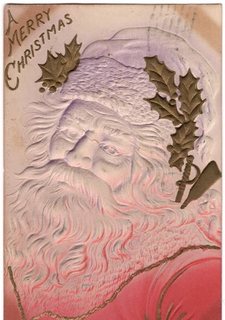
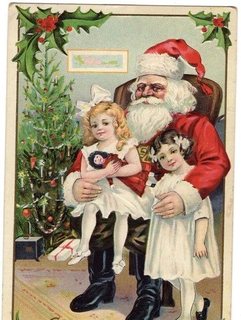
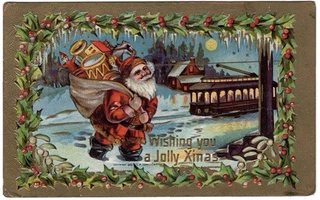
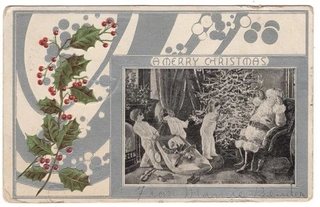
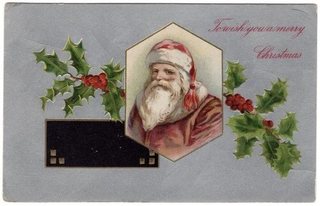
An embossed Christmas postcard on a silver ground textured with fine radiating lines. At center, a gilt-edged hexagonal panel holds a portrait of an Old World Santa Claus in a red-violet robe and a red fur-trimmed hood with a long red tassel, his white beard full and his face weathered and kind. Embossed sprays of holly with clusters of red berries reach in from either side. At lower left, a black panel edged in gold carries small gold squares in the corners, in the Arts and Crafts manner. Red script greeting at upper right: "To wish you a merry Christmas." No publisher's name, logo or copyright line on the front. Size approx. 5.50 x 3.50 in. (140 x 89 mm).
The back is a divided back with "POST CARD" in green between leafy ornaments, "THIS SIDE FOR CORRESPONDENCE" and "THE ADDRESS TO BE WRITTEN ON THIS SIDE." The stamp box reads "PLACE POSTAGE STAMP HERE — DOMESTIC ONE CENT — FOREIGN TWO CENTS," with "PRINTED IN GERMANY" running vertically beside it. Never mailed: no stamp and no postmark. Dated in brown ink "Dec 25 1909" in the stamp box, headed "Breckenridge, Colorado," addressed to Wilbur McClure, Pittsburg, Kansas, and signed "Carp and Irena Bull" (best reading; the first name is uncertain). Two old pencil prices at the top, 17.50 (circled) and 4.50.
Read the full description
Historical Context
Christmas Day in Colorado. Written on Christmas Day 1909 in Breckenridge, Colorado, and addressed to Pittsburg, Kansas. With no stamp or postmark, it was presumably delivered by hand or tucked into an envelope or parcel.
Printed in Germany, the year the tariff came. German printers dominated early postcard printing, producing inexpensive, high-quality lithographs for American publishers. The same year this card was written, the Payne-Aldrich Tariff of 1909 taxed imported postcards at a much higher rate, and with the First World War American printers took over most of the market.
For Old World Santa collectors. A robed, hooded Santa in a gilt hexagon, with an Arts and Crafts panel below.
The Golden Age of Postcards. Usually dated 1907 to 1915, when Americans sent hundreds of millions of postcards every year.
Condition
Very good. Silver ground bright, embossing crisp. A fine curved scratch or hairline in the silver near the top right corner and a faint crease line near the lower left corner of the front, with a small white abrasion near the left edge by the holly and light scuffing on the black panel. Corners softly rounded with light wear; edges slightly toned. Back clean with light, even toning, the ink inscription and two old pencil prices.
About The Printing
This is an original chromolithograph, and it was slow, exacting work. Each color had to be drawn onto its own separate stone by hand — in monochrome, the artist judging how much stipple each area needed so the colors would combine correctly only once every stone had been printed. The sheet then went through the press once for every color it carries, often a dozen or more, and every pass had to register exactly against the last. A pass out of register showed.
Under magnification the image resolves into irregular hand-drawn stipple, each ink carrying its own dot pattern, the colors mixing in the eye rather than on the paper. There is no regular halftone screen and no four-color rosette, which is what a modern reproduction would show. Modern process printing simulates every color from four inks; chromolithography laid each color down as its own.
The holly is embossed, the silver ground carries an embossed line texture, and the hexagon and panel are edged in gold.
Provenance
From my family's estate collections, built over more than 60 years by knowledgeable antiques collectors and traders. Stored in a climate-controlled environment.
Also In Our Store
Another 1909 embossed Christmas card with holly, this one mailed from Baxter Springs, Kansas: https://www.ebay.com/itm/158180868901
Another embossed Christmas card with holly and silver metallic ink: https://www.ebay.com/itm/158180794660
The immigrant story behind early American imagery runs through our US silver dollars too: the Morgan dollar was designed by English-born George T. Morgan, the Peace dollar by Sicilian-born Anthony de Francisci.
Disclaimer
Specifications and detailed item descriptions are provided as a courtesy only and are not guaranteed to be one hundred percent accurate. Please do your own research. There are generally no receipts available for any items from original purchases. Any dimensions and/or weights are approximate. The absence of a more detailed condition report does not imply there are no condition issues with the item(s). Please inspect images carefully as they are part of the official item description and best representation of the actual condition. Additional images may be available upon request depending on time and availability. Not responsible for internet mis-translations or mis-identification of maker's marks if found or assumptions of makers or materials — item descriptions will indicate if it is assumed. If you see a problem, please message us immediately and we will do our best to sort out a solution and confirm the information. With the exception of eBay rules, no returns are accepted.