
DESCRIPTION
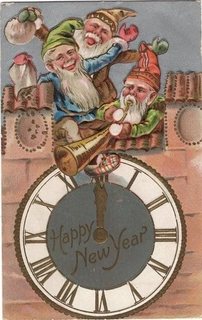
An antique embossed New Year postcard, mailed in December 1909. Three bearded gnomes in pointed caps (green, gold and red) celebrate on top of a brick wall against a silver metallic sky. One in a blue coat holds up a sack, a second laughs with arms raised, and the third, in a green coat, blows a long gold horn. Two money sacks float at upper left; the upper one is marked "1000" in red, and gold coins spill from the lower one. A gnome's plaid slipper rests on a large clock face with gold Roman numerals and a gold scalloped rim, both hands pointing straight up to midnight. The silver center of the dial carries the greeting in gold script: "Happy New Year". Deeply embossed; the clock, horn, lettering and brick trim are picked out in gold. No publisher name, series number or country of printing on either side. Size approx. 3.45 x 5.50 in. (from the scan).
The back is a divided back with the headings "This Space For Writing Messages" and "This side for the Address only" and a large "POST CARD" in brown. Green 1-cent Benjamin Franklin stamp, affixed upside down, cancelled with bars. Circular postmark WAKEFIELD, MICH., DEC [30] P.M. 1909 (day partly struck; 30 is the best reading). Addressed in pencil to Miss Tillie Chadek (best reading of the surname), Yale, Okla.
The message, in pencil sideways in the message space, reads (best reading): "Dearest Tillie, Was so glad to get a card as it worried me as to your getting home. How is your ma? I do hope she is better. Tom has been very sick with bronchitis [best reading], is still in bed. I certainly had my hands full since I came home. I will write later about it. I told Charly N. that your [?] for days, so that's what I wanted so he won't forget me so quick. Love to all, [signature not clearly legible]." Along the top edge: "Did you get a postal from Elda Utley [best reading]?"
Read the full description
Historical Context
From the iron range to a new state. Wakefield, in Gogebic County on Michigan's Upper Peninsula, grew up on the Gogebic iron range after iron ore was found at Sunday Lake in 1881; it was incorporated as a village in 1887.
Oklahoma postal history. Yale, in Payne County, had its post office from 1895 and had become a railroad, farming and cotton-processing town. Oklahoma had been a state for barely two years when this card arrived: Oklahoma Territory and Indian Territory entered the Union together as the 46th state on November 16, 1907.
Made for America, in the German style. German printers dominated early postcard printing, and many cards of the period used embossing, metallic foils and decoration of the kind seen here. The same year this card was mailed, the 1909 Payne-Aldrich Tariff taxed imported postcards much more heavily, and World War I ended the German supply.
The Golden Age of Postcards. From 1907 to 1915 Americans mailed hundreds of millions of cards a year.
Condition
Good antique condition for a mailed card. Front: bright colors and strong embossing; rubbing and small paper loss to the silver sky at the top left corner; light wear to the other corners and edges; light rubbing to the gilt in places. Back: light even toning; pencil message and address as described; a few small red specks near the message; embossing shows through as raised relief. Postally used.
About The Printing
This is an original chromolithograph, and it was slow, exacting work. Each color had to be drawn onto its own separate stone by hand — in monochrome, the artist judging how much stipple each area needed so the colors would combine correctly only once every stone had been printed. The sheet then went through the press once for every color it carries, often a dozen or more, and every pass had to register exactly against the last. A pass out of register showed.
Under magnification the image resolves into irregular hand-drawn stipple, each ink carrying its own dot pattern, the colors mixing in the eye rather than on the paper. There is no regular halftone screen and no four-color rosette, which is what a modern reproduction would show. Modern process printing simulates every color from four inks; chromolithography laid each color down as its own.
The card is also deeply embossed, with gold on the clock, horn and lettering and a silver metallic sky.
Provenance
From my family's estate collections, built over more than 60 years by knowledgeable antiques collectors and traders. Stored in a climate-controlled environment.
Also In Our Store
The immigrant story behind early American imagery runs through our US silver dollars too: the Morgan dollar was designed by English-born George T. Morgan, the Peace dollar by Sicilian-born Anthony de Francisci.
Disclaimer
Specifications and detailed item descriptions are provided as a courtesy only and are not guaranteed to be one hundred percent accurate. Please do your own research. There are generally no receipts available for any items from original purchases. Any dimensions and/or weights are approximate. The absence of a more detailed condition report does not imply there are no condition issues with the item(s). Please inspect images carefully as they are part of the official item description and best representation of the actual condition. Additional images may be available upon request depending on time and availability. Not responsible for internet mis-translations or mis-identification of maker's marks if found or assumptions of makers or materials — item descriptions will indicate if it is assumed. If you see a problem, please message us immediately and we will do our best to sort out a solution and confirm the information. With the exception of eBay rules, no returns are accepted.