DESCRIPTION
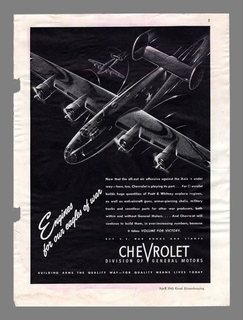
An original World War II magazine advertisement from Chevrolet, Division of General Motors: "Engines for our eagles of war." A dramatic black-and-white illustration shows a four-engine, twin-tail bomber (it appears to be a B-24 Liberator) flying over a second bomber.
The copy reads: "Now that the all-out air offensive against the Axis is under way—here, too, Chevrolet is playing its part.... For Chevrolet builds huge quantities of Pratt & Whitney airplane engines, as well as anti-aircraft guns, armor-piercing shells, military trucks and countless parts for other war producers." It closes with "VOLUME FOR VICTORY," "BUY U.S. WAR BONDS AND STAMPS" and "Building arms the quality way—for quality means lives today."
A genuine period page, not a reprint: it carries its original page number (5) and the printed footer "April 1943 Good Housekeeping." The back (page 6) is the magazine's "This is Your Guaranty" index of every advertiser in the issue, with Chevrolet Cars & Trucks listed on page 5.
Size approx. 8.45 x 11.50 in.
Read the full description
Historical Context
Detroit at war. Car makers like GM stopped building cars for civilians in early 1942; Ford's civilian car and truck lines shut down on February 10, 1942. GM's Chevy factories turned to aircraft engines, guns, shells and military trucks, and ads like this one told the home front where the cars had gone.
Pratt & Whitney's R-1830 Twin Wasp engine powered the B-24 Liberator.
Buying Power
In 1943, the average factory worker earned about $1.01 an hour. A $25 War Bond, the kind this ad urges readers to buy, cost $18.75: about 18.5 hours of factory pay, or roughly $560 at today's factory wage.
A WWII War Ration Book Four is also available in our store.
Condition
Untrimmed original page with its natural edges: no visible creases or folds, margins intact and ready for framing with a mat to highlight the piece and display your proudly. Made in U.S.A. Small chips along the left edge where the staples were pulled when the page was removed from the magazine. Light spotting in the top margin and a pink stain in the bottom margin, both clear of the image. The black illustration panel is bright and clean. Please study the images; they are part of the description.
About The Printing
Printed in 1943 by the magazine's own press. Under magnification the gray tones resolve into the regular halftone dot screen of period magazine printing on the original paper stock.
Disclaimer
The images and any video show the actual item and are part of the official listing description, so please review them closely. Measurements and weights are approximate, and any maker or material we haven't confirmed is described as assumed. Questions? Message us; we answer quickly.