Three on Four International

Bicentennial $2 Dollar Bills

14 listings in Bicentennial $2 Dollar Bills, $5.27 to $16.66. Each one is shown in its own photos and described in full below; buy on eBay.

Prices and availability as of November 3, 2026.

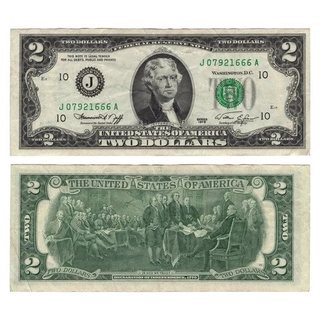
1976 $2 Bill Bicentennial Federal Reserve Note Kansas City J07921666A 666 Circ

Series 1976 $2 Federal Reserve Note, Bicentennial 1776-1976 (200th Anniversary), Thomas Jefferson, Trumbull's Declaration of Independence on the Back, Kansas City (J10), Francine I. Neff and William E. Simon Signatures, Green Seal, Serial Ends 666, Serial J07921666A, Fr. 1935-J, Circulated [Est. F]

$16.66 1976 Est. F

Description

A Series 1976 $2 Federal Reserve Note with a green Treasury seal, issued through the Federal Reserve Bank of Kansas City: letter J, number 10, shown on the black seal at left and on the "10" in each corner. Signed by Francine I. Neff, Treasurer of the United States, and William E. Simon, Secretary of the Treasury. Serial number J07921666A.

Thomas Jefferson's portrait has appeared on every $2 note since Series 1869, and the front of the $2 is the oldest design on current US currency. The back shows John Trumbull's painting Declaration of Independence. Few $2 notes are printed, and banks usually hand them out only on request, so they are seldom seen in everyday spending and many people simply keep them.

Standard small size, about 6.125 x 2.625 in.

Read the full description

Historical Context

The $2 bill returned on April 13, 1976, Thomas Jefferson's birthday, in the nation's Bicentennial year. For Series 1976 the back was changed from Monticello to the signing of the Declaration of Independence. Printed in Washington, DC; the Fort Worth plant did not open until 1991.

1976 was also the year Viking 2 landed at Utopia Planitia on Mars (September 3). And the serial number ends in 666: THE DEVIL WANTS YOU TO BUY THIS ONE!

Buying Power

In 1976, the average factory worker earned about $5.09 an hour, so this $2 note was about 24 minutes of factory pay, or about $11.85 at today's factory wage. By the consumer price index, $2 in 1976 bought about what $11.77 buys today.

Condition

[Est. F] Circulated. Folds and crinkling. Not a star note and no errors found.

Legal Tender

Yes. United States currency issued since 1861 remains legal tender at face value ($2), whatever the series.

Disclaimer

The images and any video show the actual item and are part of the official listing description, so please review them closely. Measurements and weights are approximate, and any maker or material we haven't confirmed is described as assumed. Questions? Message us; we answer quickly.
View on eBay

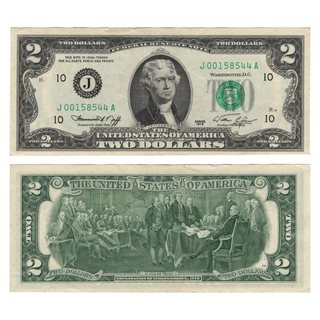
1976 $2 Bicentennial Federal Reserve Note Kansas City J00158544A Low Serial Circ

Series 1976 $2 Federal Reserve Note, Bicentennial 1776-1976 (200th Anniversary), Thomas Jefferson, Trumbull's Declaration of Independence on the Back, Kansas City (J10), Francine I. Neff and William E. Simon Signatures, Green Seal, Low Serial Number, Serial J00158544A, Fr. 1935-J, Lightly Circulated [Est. VF]

$12.97 1976 Est. VF

Description

A Series 1976 $2 Federal Reserve Note with a green Treasury seal, issued through the Federal Reserve Bank of Kansas City: letter J, number 10, shown on the black seal at left and on the "10" in each corner. Signed by Francine I. Neff, Treasurer of the United States, and William E. Simon, Secretary of the Treasury. Serial number J00158544A.

Thomas Jefferson's portrait has appeared on every $2 note since Series 1869, and the front of the $2 is the oldest design on current US currency. The back shows John Trumbull's painting Declaration of Independence. Few $2 notes are printed, and banks usually hand them out only on request, so they are seldom seen in everyday spending and many people simply keep them.

Standard small size, about 6.125 x 2.625 in.

Read the full description

Historical Context

The $2 bill returned on April 13, 1976, Thomas Jefferson's birthday, in the nation's Bicentennial year. For Series 1976 the back was changed from Monticello to the signing of the Declaration of Independence. Printed in Washington, DC; the Fort Worth plant did not open until 1991.

1976 was also the year One Flew Over the Cuckoo's Nest won five Academy Awards (March 29). This note carries a low serial number, J00158544A.

Buying Power

In 1976, the average factory worker earned about $5.09 an hour, so this $2 note was about 24 minutes of factory pay, or about $11.85 at today's factory wage. By the consumer price index, $2 in 1976 bought about what $11.77 buys today.

Condition

[Est. VF] Lightly circulated. Light folds; bright paper. Not a star note and no errors found.

Legal Tender

Yes. United States currency issued since 1861 remains legal tender at face value ($2), whatever the series.

Disclaimer

The images and any video show the actual item and are part of the official listing description, so please review them closely. Measurements and weights are approximate, and any maker or material we haven't confirmed is described as assumed. Questions? Message us; we answer quickly.
View on eBay

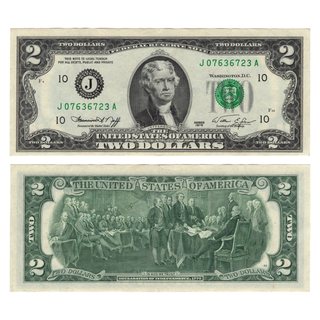
1976 $2 Bill Signing of the Declaration Kansas City MO J07636723A Light Circ

Series 1976 $2 Federal Reserve Note, Bicentennial 1776-1976 (200th Anniversary), Thomas Jefferson, Trumbull's Declaration of Independence on the Back, Kansas City (J10), Francine I. Neff and William E. Simon Signatures, Green Seal, Serial J07636723A, Fr. 1935-J, Lightly Circulated [Est. VF]

$8.98 1976 Est. VF

Description

A Series 1976 $2 Federal Reserve Note with a green Treasury seal, issued through the Federal Reserve Bank of Kansas City: letter J, number 10, shown on the black seal at left and on the "10" in each corner. Signed by Francine I. Neff, Treasurer of the United States, and William E. Simon, Secretary of the Treasury. Serial number J07636723A.

Thomas Jefferson's portrait has appeared on every $2 note since Series 1869, and the front of the $2 is the oldest design on current US currency. The back shows John Trumbull's painting Declaration of Independence. Few $2 notes are printed, and banks usually hand them out only on request, so they are seldom seen in everyday spending and many people simply keep them.

Standard small size, about 6.125 x 2.625 in.

Read the full description

Historical Context

The $2 bill returned on April 13, 1976, Thomas Jefferson's birthday, in the nation's Bicentennial year. For Series 1976 the back was changed from Monticello to the signing of the Declaration of Independence. Printed in Washington, DC; the Fort Worth plant did not open until 1991.

1976 was also the year Jimmy Carter defeated President Gerald Ford (November 2).

Buying Power

In 1976, the average factory worker earned about $5.09 an hour, so this $2 note was about 24 minutes of factory pay, or about $11.85 at today's factory wage. By the consumer price index, $2 in 1976 bought about what $11.77 buys today.

Condition

[Est. VF] Lightly circulated. A few light folds. Not a star note and no errors found.

Legal Tender

Yes. United States currency issued since 1861 remains legal tender at face value ($2), whatever the series.

Disclaimer

The images and any video show the actual item and are part of the official listing description, so please review them closely. Measurements and weights are approximate, and any maker or material we haven't confirmed is described as assumed. Questions? Message us; we answer quickly.
View on eBay

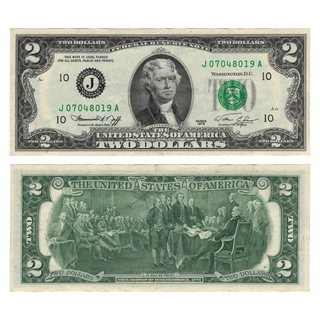
1776-1976 $2 Bill 200th Anniversary Jefferson Kansas City J07048019A Light Circ

Series 1976 $2 Federal Reserve Note, Bicentennial 1776-1976 (200th Anniversary), Thomas Jefferson, Trumbull's Declaration of Independence on the Back, Kansas City (J10), Francine I. Neff and William E. Simon Signatures, Green Seal, Serial J07048019A, Fr. 1935-J, Lightly Circulated [Est. VF]

$8.97 1776 Est. VF

Description

A Series 1976 $2 Federal Reserve Note with a green Treasury seal, issued through the Federal Reserve Bank of Kansas City: letter J, number 10, shown on the black seal at left and on the "10" in each corner. Signed by Francine I. Neff, Treasurer of the United States, and William E. Simon, Secretary of the Treasury. Serial number J07048019A.

Thomas Jefferson's portrait has appeared on every $2 note since Series 1869, and the front of the $2 is the oldest design on current US currency. The back shows John Trumbull's painting Declaration of Independence. Few $2 notes are printed, and banks usually hand them out only on request, so they are seldom seen in everyday spending and many people simply keep them.

Standard small size, about 6.125 x 2.625 in.

Read the full description

Historical Context

The $2 bill returned on April 13, 1976, Thomas Jefferson's birthday, in the nation's Bicentennial year. For Series 1976 the back was changed from Monticello to the signing of the Declaration of Independence. Printed in Washington, DC; the Fort Worth plant did not open until 1991.

1976 was also the year Johnny Rutherford won the rain-shortened Indianapolis 500 (May 30).

Buying Power

In 1976, the average factory worker earned about $5.09 an hour, so this $2 note was about 24 minutes of factory pay, or about $11.85 at today's factory wage. By the consumer price index, $2 in 1976 bought about what $11.77 buys today.

Condition

[Est. VF] Lightly circulated. A few light folds; bright paper. Not a star note and no errors found.

Legal Tender

Yes. United States currency issued since 1861 remains legal tender at face value ($2), whatever the series.

Disclaimer

The images and any video show the actual item and are part of the official listing description, so please review them closely. Measurements and weights are approximate, and any maker or material we haven't confirmed is described as assumed. Questions? Message us; we answer quickly.
View on eBay

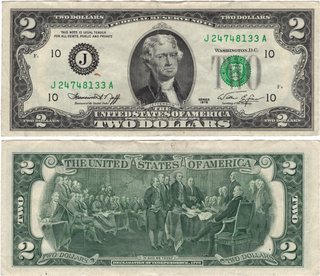
1976 $2 Bill Bicentennial Kansas City J24748133A Starts 247 Open 24/7 Circ

Series 1976 $2 Federal Reserve Note, Bicentennial 1776-1976 (200th Anniversary), Thomas Jefferson, Trumbull's Declaration of Independence on the Back, Kansas City (J10), Francine I. Neff and William E. Simon Signatures, Green Seal, Serial Starts 247, Open 24/7, Serial J24748133A, Fr. 1935-J, Lightly Circulated [Est. VF]

$8.53 1976 Est. VF

Description

A Series 1976 $2 Federal Reserve Note with a green Treasury seal, issued through the Federal Reserve Bank of Kansas City: letter J, number 10, shown on the black seal at left and on the "10" in each corner. Signed by Francine I. Neff, Treasurer of the United States, and William E. Simon, Secretary of the Treasury. Serial number J24748133A.

Thomas Jefferson's portrait has appeared on every $2 note since Series 1869, and the front of the $2 is the oldest design on current US currency. The back shows John Trumbull's painting Declaration of Independence. Few $2 notes are printed, and banks usually hand them out only on request, so they are seldom seen in everyday spending and many people simply keep them.

Standard small size, about 6.125 x 2.625 in.

Read the full description

Historical Context

The $2 bill returned on April 13, 1976, Thomas Jefferson's birthday, in the nation's Bicentennial year. For Series 1976 the back was changed from Monticello to the signing of the Declaration of Independence. Printed in Washington, DC; the Fort Worth plant did not open until 1991.

1976 was also the year Steve Jobs and Steve Wozniak founded Apple Computer (April 1). And the serial number starts with 247, like a shop that never closes: open 24/7.

Buying Power

In 1976, the average factory worker earned about $5.09 an hour, so this $2 note was about 24 minutes of factory pay, or about $11.85 at today's factory wage. By the consumer price index, $2 in 1976 bought about what $11.77 buys today.

Condition

[Est. VF] Circulated. Light folds and wavy edges. A small rust-brown spot sits just below and to the right of the J seal. Not a star note and no errors found.

Legal Tender

Yes. United States currency issued since 1861 remains legal tender at face value ($2), whatever the series.

Disclaimer

The images and any video show the actual item and are part of the official listing description, so please review them closely. Measurements and weights are approximate, and any maker or material we haven't confirmed is described as assumed. Questions? Message us; we answer quickly.
View on eBay

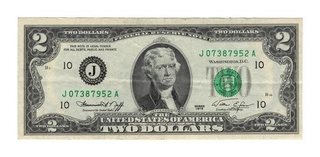
1976 $2 Bicentennial Jefferson Deuce Kansas City Missouri J10 J07387952A Circ

Series 1976 $2 Federal Reserve Note, Bicentennial 1776-1976 (200th Anniversary), Thomas Jefferson, Trumbull's Declaration of Independence on the Back, Kansas City (J10), Francine I. Neff and William E. Simon Signatures, Green Seal, The Deuce, Serial J07387952A, Fr. 1935-J, Circulated [Est. F-VF]

$8.48 1976 Est. F-VF

Description

A Series 1976 $2 Federal Reserve Note with a green Treasury seal, issued through the Federal Reserve Bank of Kansas City: letter J, number 10, shown on the black seal at left and on the "10" in each corner. Signed by Francine I. Neff, Treasurer of the United States, and William E. Simon, Secretary of the Treasury. Serial number J07387952A.

Thomas Jefferson's portrait has appeared on every $2 note since Series 1869, and the front of the $2 is the oldest design on current US currency. The back shows John Trumbull's painting Declaration of Independence. Few $2 notes are printed, and banks usually hand them out only on request, so they are seldom seen in everyday spending and many people simply keep them.

Standard small size, about 6.125 x 2.625 in.

Read the full description

Historical Context

The $2 bill returned on April 13, 1976, Thomas Jefferson's birthday, in the nation's Bicentennial year. For Series 1976 the back was changed from Monticello to the signing of the Declaration of Independence. Printed in Washington, DC; the Fort Worth plant did not open until 1991.

1976 was also the year the Eagles released Their Greatest Hits (1971-1975) (February 17).

Buying Power

In 1976, the average factory worker earned about $5.09 an hour, so this $2 note was about 24 minutes of factory pay, or about $11.85 at today's factory wage. By the consumer price index, $2 in 1976 bought about what $11.77 buys today.

Condition

[Est. F-VF] Circulated. Folds; good color. Not a star note and no errors found.

Legal Tender

Yes. United States currency issued since 1861 remains legal tender at face value ($2), whatever the series.

Disclaimer

The images and any video show the actual item and are part of the official listing description, so please review them closely. Measurements and weights are approximate, and any maker or material we haven't confirmed is described as assumed. Questions? Message us; we answer quickly.
View on eBay

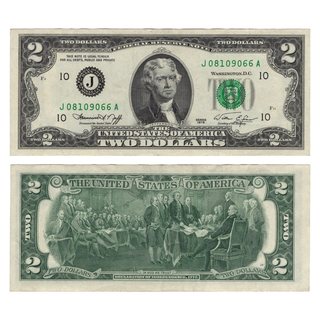
1976 $2 Bill Bicentennial Trumbull Declaration Kansas City J08109066A Circ

Series 1976 $2 Federal Reserve Note, Bicentennial 1776-1976 (200th Anniversary), Thomas Jefferson, Trumbull's Declaration of Independence on the Back, Kansas City (J10), Francine I. Neff and William E. Simon Signatures, Green Seal, Serial J08109066A, Fr. 1935-J, Circulated [Est. F-VF]

$8.47 1976 Est. F-VF

Description

A Series 1976 $2 Federal Reserve Note with a green Treasury seal, issued through the Federal Reserve Bank of Kansas City: letter J, number 10, shown on the black seal at left and on the "10" in each corner. Signed by Francine I. Neff, Treasurer of the United States, and William E. Simon, Secretary of the Treasury. Serial number J08109066A.

Thomas Jefferson's portrait has appeared on every $2 note since Series 1869, and the front of the $2 is the oldest design on current US currency. The back shows John Trumbull's painting Declaration of Independence. Few $2 notes are printed, and banks usually hand them out only on request, so they are seldom seen in everyday spending and many people simply keep them.

Standard small size, about 6.125 x 2.625 in.

Read the full description

Historical Context

The $2 bill returned on April 13, 1976, Thomas Jefferson's birthday, in the nation's Bicentennial year. For Series 1976 the back was changed from Monticello to the signing of the Declaration of Independence. Printed in Washington, DC; the Fort Worth plant did not open until 1991.

1976 was also the year California wines beat the best of France in the "Judgment of Paris" blind tasting (May 24).

Buying Power

In 1976, the average factory worker earned about $5.09 an hour, so this $2 note was about 24 minutes of factory pay, or about $11.85 at today's factory wage. By the consumer price index, $2 in 1976 bought about what $11.77 buys today.

Condition

[Est. F-VF] Circulated. Light folds; good color. Not a star note and no errors found.

Legal Tender

Yes. United States currency issued since 1861 remains legal tender at face value ($2), whatever the series.

Disclaimer

The images and any video show the actual item and are part of the official listing description, so please review them closely. Measurements and weights are approximate, and any maker or material we haven't confirmed is described as assumed. Questions? Message us; we answer quickly.
View on eBay

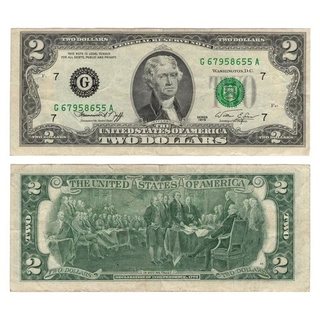
1976 $2 Federal Reserve Note 200th Anniversary Chicago G7 G67958655A Circ

Series 1976 $2 Federal Reserve Note, Bicentennial 1776-1976 (200th Anniversary), Thomas Jefferson, Trumbull's Declaration of Independence on the Back, Chicago (G7), Francine I. Neff and William E. Simon Signatures, Green Seal, Serial G67958655A, Fr. 1935-G, Circulated [Est. F]

$7.99 1976 Est. F

Description

A Series 1976 $2 Federal Reserve Note with a green Treasury seal, issued through the Federal Reserve Bank of Chicago: letter G, number 7, shown on the black seal at left and on the "7" in each corner. Signed by Francine I. Neff, Treasurer of the United States, and William E. Simon, Secretary of the Treasury. Serial number G67958655A.

Thomas Jefferson's portrait has appeared on every $2 note since Series 1869, and the front of the $2 is the oldest design on current US currency. The back shows John Trumbull's painting Declaration of Independence. Few $2 notes are printed, and banks usually hand them out only on request, so they are seldom seen in everyday spending and many people simply keep them.

Standard small size, about 6.125 x 2.625 in.

Read the full description

Historical Context

The $2 bill returned on April 13, 1976, Thomas Jefferson's birthday, in the nation's Bicentennial year. For Series 1976 the back was changed from Monticello to the signing of the Declaration of Independence. Printed in Washington, DC; the Fort Worth plant did not open until 1991.

1976 was also the year Detroit Tigers pitcher Mark "The Bird" Fidrych won the American League Rookie of the Year award (November 4).

Buying Power

In 1976, the average factory worker earned about $5.09 an hour, so this $2 note was about 24 minutes of factory pay, or about $11.85 at today's factory wage. By the consumer price index, $2 in 1976 bought about what $11.77 buys today.

Condition

[Est. F] Circulated. Folds and light toning. Not a star note and no errors found.

Legal Tender

Yes. United States currency issued since 1861 remains legal tender at face value ($2), whatever the series.

Disclaimer

The images and any video show the actual item and are part of the official listing description, so please review them closely. Measurements and weights are approximate, and any maker or material we haven't confirmed is described as assumed. Questions? Message us; we answer quickly.
View on eBay

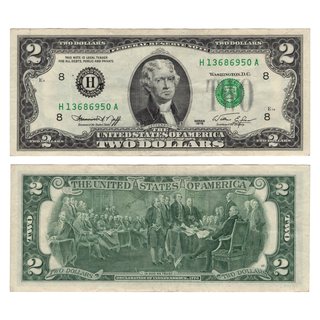
1976 $2 Bill Bicentennial Federal Reserve Note St. Louis H8 H13686950A Circ

Series 1976 $2 Federal Reserve Note, Bicentennial 1776-1976 (200th Anniversary), Thomas Jefferson, Trumbull's Declaration of Independence on the Back, St. Louis (H8), Francine I. Neff and William E. Simon Signatures, Green Seal, Serial H13686950A, Fr. 1935-H, Circulated [Est. F]

$7.98 1976 Est. F

Description

A Series 1976 $2 Federal Reserve Note with a green Treasury seal, issued through the Federal Reserve Bank of St. Louis: letter H, number 8, shown on the black seal at left and on the "8" in each corner. Signed by Francine I. Neff, Treasurer of the United States, and William E. Simon, Secretary of the Treasury. Serial number H13686950A.

Thomas Jefferson's portrait has appeared on every $2 note since Series 1869, and the front of the $2 is the oldest design on current US currency. The back shows John Trumbull's painting Declaration of Independence. Few $2 notes are printed, and banks usually hand them out only on request, so they are seldom seen in everyday spending and many people simply keep them.

Standard small size, about 6.125 x 2.625 in.

Read the full description

Historical Context

The $2 bill returned on April 13, 1976, Thomas Jefferson's birthday, in the nation's Bicentennial year. For Series 1976 the back was changed from Monticello to the signing of the Declaration of Independence. Printed in Washington, DC; the Fort Worth plant did not open until 1991.

1976 was also the year the first class of women entered the U.S. Naval Academy (July 6).

Buying Power

In 1976, the average factory worker earned about $5.09 an hour, so this $2 note was about 24 minutes of factory pay, or about $11.85 at today's factory wage. By the consumer price index, $2 in 1976 bought about what $11.77 buys today.

Condition

[Est. F] Circulated. Folds and light soiling. Not a star note and no errors found.

Legal Tender

Yes. United States currency issued since 1861 remains legal tender at face value ($2), whatever the series.

Disclaimer

The images and any video show the actual item and are part of the official listing description, so please review them closely. Measurements and weights are approximate, and any maker or material we haven't confirmed is described as assumed. Questions? Message us; we answer quickly.
View on eBay

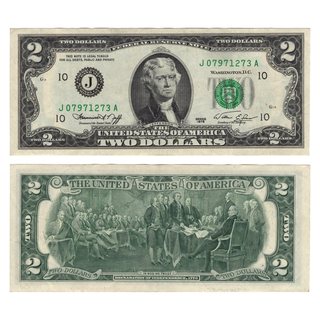
Series 1976 $2 FRN Neff Simon Signatures Kansas City J10 J07971273A Circ

Series 1976 $2 Federal Reserve Note, Bicentennial 1776-1976 (200th Anniversary), Thomas Jefferson, Trumbull's Declaration of Independence on the Back, Kansas City (J10), Francine I. Neff and William E. Simon Signatures, Green Seal, Serial J07971273A, Fr. 1935-J, Circulated [Est. F]

$7.97 1976 Est. F

Description

A Series 1976 $2 Federal Reserve Note with a green Treasury seal, issued through the Federal Reserve Bank of Kansas City: letter J, number 10, shown on the black seal at left and on the "10" in each corner. Signed by Francine I. Neff, Treasurer of the United States, and William E. Simon, Secretary of the Treasury. Serial number J07971273A.

Thomas Jefferson's portrait has appeared on every $2 note since Series 1869, and the front of the $2 is the oldest design on current US currency. The back shows John Trumbull's painting Declaration of Independence. Few $2 notes are printed, and banks usually hand them out only on request, so they are seldom seen in everyday spending and many people simply keep them.

Standard small size, about 6.125 x 2.625 in.

Read the full description

Historical Context

The $2 bill returned on April 13, 1976, Thomas Jefferson's birthday, in the nation's Bicentennial year. For Series 1976 the back was changed from Monticello to the signing of the Declaration of Independence. Printed in Washington, DC; the Fort Worth plant did not open until 1991.

1976 was also the year Viking 1 landed on Mars and sent back the first close-up color photos of its surface (July 20).

Buying Power

In 1976, the average factory worker earned about $5.09 an hour, so this $2 note was about 24 minutes of factory pay, or about $11.85 at today's factory wage. By the consumer price index, $2 in 1976 bought about what $11.77 buys today.

Condition

[Est. F] Circulated. Overall crinkling and folds. Not a star note and no errors found.

Legal Tender

Yes. United States currency issued since 1861 remains legal tender at face value ($2), whatever the series.

Disclaimer

The images and any video show the actual item and are part of the official listing description, so please review them closely. Measurements and weights are approximate, and any maker or material we haven't confirmed is described as assumed. Questions? Message us; we answer quickly.
View on eBay

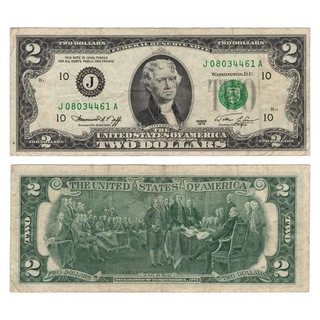
1976 Two Dollar Bill Spirit of 76 Bicentennial Kansas City J08034461A Well Circ

Series 1976 $2 Federal Reserve Note, Bicentennial 1776-1976 (200th Anniversary), Thomas Jefferson, Trumbull's Declaration of Independence on the Back, Kansas City (J10), Francine I. Neff and William E. Simon Signatures, Green Seal, Spirit of 76, Serial J08034461A, Fr. 1935-J, Well Circulated [Est. VG-F]

$7.48 1976 Est. VG-F

Description

A Series 1976 $2 Federal Reserve Note with a green Treasury seal, issued through the Federal Reserve Bank of Kansas City: letter J, number 10, shown on the black seal at left and on the "10" in each corner. Signed by Francine I. Neff, Treasurer of the United States, and William E. Simon, Secretary of the Treasury. Serial number J08034461A.

Thomas Jefferson's portrait has appeared on every $2 note since Series 1869, and the front of the $2 is the oldest design on current US currency. The back shows John Trumbull's painting Declaration of Independence. Few $2 notes are printed, and banks usually hand them out only on request, so they are seldom seen in everyday spending and many people simply keep them.

Standard small size, about 6.125 x 2.625 in.

Read the full description

Historical Context

The $2 bill returned on April 13, 1976, Thomas Jefferson's birthday, in the nation's Bicentennial year. For Series 1976 the back was changed from Monticello to the signing of the Declaration of Independence. Printed in Washington, DC; the Fort Worth plant did not open until 1991.

1976 was also the year the first 4.6 miles of the Washington Metro subway opened (March 27).

Buying Power

In 1976, the average factory worker earned about $5.09 an hour, so this $2 note was about 24 minutes of factory pay, or about $11.85 at today's factory wage. By the consumer price index, $2 in 1976 bought about what $11.77 buys today.

Condition

[Est. VG-F] Circulated. Folds, soiling and toning. Crease lines where a corner was unfolded. Not a star note and no errors found.

Legal Tender

Yes. United States currency issued since 1861 remains legal tender at face value ($2), whatever the series.

Disclaimer

The images and any video show the actual item and are part of the official listing description, so please review them closely. Measurements and weights are approximate, and any maker or material we haven't confirmed is described as assumed. Questions? Message us; we answer quickly.
View on eBay

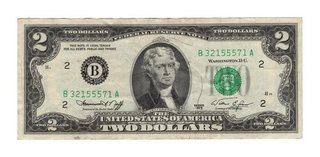
1976 $2 Bill Bicentennial Federal Reserve Note New York B2 B32155571A Circ

Series 1976 $2 Federal Reserve Note, Bicentennial 1776-1976 (200th Anniversary), Thomas Jefferson, Trumbull's Declaration of Independence on the Back, New York (B2), Francine I. Neff and William E. Simon Signatures, Green Seal, Serial B32155571A, Fr. 1935-B, Well Circulated [Est. VG-F]

$7.47 1976 Est. VG-F

Description

A Series 1976 $2 Federal Reserve Note with a green Treasury seal, issued through the Federal Reserve Bank of New York: letter B, number 2, shown on the black seal at left and on the "2" in each corner. Signed by Francine I. Neff, Treasurer of the United States, and William E. Simon, Secretary of the Treasury. Serial number B32155571A.

Thomas Jefferson's portrait has appeared on every $2 note since Series 1869, and the front of the $2 is the oldest design on current US currency. The back shows John Trumbull's painting Declaration of Independence. Few $2 notes are printed, and banks usually hand them out only on request, so they are seldom seen in everyday spending and many people simply keep them.

Standard small size, about 6.125 x 2.625 in.

Read the full description

Historical Context

The $2 bill returned on April 13, 1976, Thomas Jefferson's birthday, in the nation's Bicentennial year. For Series 1976 the back was changed from Monticello to the signing of the Declaration of Independence. Printed in Washington, DC; the Fort Worth plant did not open until 1991.

1976 was also the year the Cincinnati Reds swept the New York Yankees in four games to win the World Series (October 21); this note comes from the New York Federal Reserve district.

Buying Power

In 1976, the average factory worker earned about $5.09 an hour, so this $2 note was about 24 minutes of factory pay, or about $11.85 at today's factory wage. By the consumer price index, $2 in 1976 bought about what $11.77 buys today.

Condition

[Est. VG-F] Circulated. Folds. An ink line is drawn on the front to the right of the portrait, and there is an ink scribble on the back, left of center. Both are permanent. Not a star note and no errors found.

Legal Tender

Yes. United States currency issued since 1861 remains legal tender at face value ($2), whatever the series.

Disclaimer

The images and any video show the actual item and are part of the official listing description, so please review them closely. Measurements and weights are approximate, and any maker or material we haven't confirmed is described as assumed. Questions? Message us; we answer quickly.
View on eBay

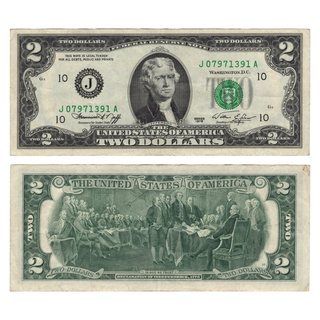
1976 $2 Federal Reserve Note Green Seal Kansas City Missouri J07971391A Circ

Series 1976 $2 Federal Reserve Note, Bicentennial 1776-1976 (200th Anniversary), Thomas Jefferson, Trumbull's Declaration of Independence on the Back, Kansas City (J10), Francine I. Neff and William E. Simon Signatures, Green Seal, Serial J07971391A, Fr. 1935-J, Circulated [Est. F]

$6.53 1976 Est. F

Description

A Series 1976 $2 Federal Reserve Note with a green Treasury seal, issued through the Federal Reserve Bank of Kansas City: letter J, number 10, shown on the black seal at left and on the "10" in each corner. Signed by Francine I. Neff, Treasurer of the United States, and William E. Simon, Secretary of the Treasury. Serial number J07971391A.

Thomas Jefferson's portrait has appeared on every $2 note since Series 1869, and the front of the $2 is the oldest design on current US currency. The back shows John Trumbull's painting Declaration of Independence. Few $2 notes are printed, and banks usually hand them out only on request, so they are seldom seen in everyday spending and many people simply keep them.

Standard small size, about 6.125 x 2.625 in.

Read the full description

Historical Context

The $2 bill returned on April 13, 1976, Thomas Jefferson's birthday, in the nation's Bicentennial year. For Series 1976 the back was changed from Monticello to the signing of the Declaration of Independence. Printed in Washington, DC; the Fort Worth plant did not open until 1991.

1976 was also the year Stevie Wonder released Songs in the Key of Life (September 28).

Buying Power

In 1976, the average factory worker earned about $5.09 an hour, so this $2 note was about 24 minutes of factory pay, or about $11.85 at today's factory wage. By the consumer price index, $2 in 1976 bought about what $11.77 buys today.

Condition

[Est. F] Circulated. Folds. A small chip at one corner, crease lines where the corners were unfolded, and a stain at the upper right of the back. Not a star note and no errors found.

Legal Tender

Yes. United States currency issued since 1861 remains legal tender at face value ($2), whatever the series.

Disclaimer

The images and any video show the actual item and are part of the official listing description, so please review them closely. Measurements and weights are approximate, and any maker or material we haven't confirmed is described as assumed. Questions? Message us; we answer quickly.

View on eBay

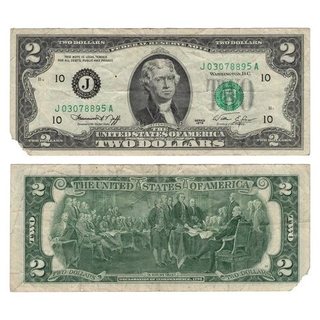
Not Edible - Somebody Already Had a Bite 1976 $2 Bill Kansas City J03078895A

Not Edible - Somebody Already Had a Bite, Series 1976 $2 Federal Reserve Note, Bicentennial 1776-1976 (200th Anniversary), Thomas Jefferson, Trumbull's Declaration of Independence on the Back, Kansas City (J10), Francine I. Neff and William E. Simon Signatures, Green Seal, One Corner Missing, Serial J03078895A, Fr. 1935-J, Well Circulated [Est. VG]

$5.27 1976 Est. VG

Description

A Series 1976 $2 Federal Reserve Note with a green Treasury seal, issued through the Federal Reserve Bank of Kansas City: letter J, number 10, shown on the black seal at left and on the "10" in each corner. Signed by Francine I. Neff, Treasurer of the United States, and William E. Simon, Secretary of the Treasury. Serial number J03078895A.

Thomas Jefferson's portrait has appeared on every $2 note since Series 1869, and the front of the $2 is the oldest design on current US currency. The back shows John Trumbull's painting Declaration of Independence. Few $2 notes are printed, and banks usually hand them out only on request, so they are seldom seen in everyday spending and many people simply keep them.

Standard small size, about 6.125 x 2.625 in.

Read the full description

Historical Context

The $2 bill returned on April 13, 1976, Thomas Jefferson's birthday, in the nation's Bicentennial year. For Series 1976 the back was changed from Monticello to the signing of the Declaration of Independence. Printed in Washington, DC; the Fort Worth plant did not open until 1991.

1976 was also the year Microsoft was officially registered in New Mexico (November 26).

Buying Power

In 1976, the average factory worker earned about $5.09 an hour, so this $2 note was about 24 minutes of factory pay, or about $11.85 at today's factory wage. By the consumer price index, $2 in 1976 bought about what $11.77 buys today.

Condition

[Est. VG] Well circulated and crumpled. ONE CORNER IS MISSING, visible on both sides. NOT EDIBLE, SOMEONE ALREADY TRIED. Not a star note and no errors found.

Legal Tender

Yes. United States currency issued since 1861 remains legal tender at face value ($2), whatever the series.

Disclaimer

The images and any video show the actual item and are part of the official listing description, so please review them closely. Measurements and weights are approximate, and any maker or material we haven't confirmed is described as assumed. Questions? Message us; we answer quickly.

View on eBay

No listings match that search.