Three on Four International

Coffee/Tea/Tobacco

45 listings in Coffee/Tea/Tobacco, $10.00 to $47.48. Each one is shown in its own photos and described in full below; buy on eBay.

Prices and availability as of November 3, 2026.

Victorian Trade Card Garfield Tea Syrup Dressed Pigs Patent Medicine Laxative

DESCRIPTION

$47.48

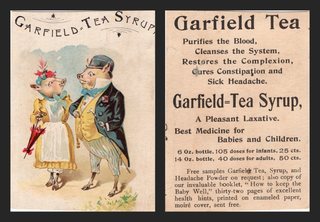
A comic card of two well-dressed pigs out for a stroll. She wears a flowered bonnet, a yellow dress with puffed sleeves, a white apron and a blue bow, and carries a red parasol; he wears a bowler hat, a tailcoat with a flower in the buttonhole, a yellow waistcoat, a blue bow tie and striped trousers, and leans on a cane. Lettered across the top: "Garfield-Tea Syrup" (the final letters run off the right edge, as cut).

The back is printed in black: "Garfield Tea. Purifies the Blood, Cleanses the System, Restores the Complexion, Cures Constipation and Sick Headache. Garfield-Tea Syrup, A Pleasant Laxative. Best Medicine for Babies and Children." It lists a 6 oz. bottle, "105 doses for infants", and a 14 oz. bottle, "40 doses for adults", and offers free samples of Garfield Tea, Syrup and Headache Powder with the booklet "How to keep the Baby Well," thirty-two pages "printed on enameled paper, moiré cover, sent free."

Approx. 2.40 x 3.35 in.

Read the full description

Historical Context

Patent medicine on parade. One remedy to purify the blood, clear the complexion, cure constipation and headache, and serve as the "Best Medicine for Babies and Children": claims like these ran freely before the federal Pure Food and Drug Act of 1906. Garfield Tea and Garfield Tea Syrup were made by the Garfield Tea Company of Brooklyn, New York, and examples of the products are held in the Smithsonian's National Museum of American History.

Pigs in their Sunday best. Dressed animals were among the most popular trade card subjects, and this courting couple, parasol and cane in hand, is a fine example for collectors of pigs and comic animals.

Condition

Very good for its age. Front: bright color; a faint vertical crease line near the right edge in the lower half; the card was cut close at the right, so the end of the heading runs off the edge; light toning; corners sharp to lightly worn. Back: light toning; a small grey smudge by "Cures"; a small dark fleck in "Garfield" in the lower text; a faint round dent in the left margin near the top; partial printing from the neighboring card along the left edge. Please see the photos, which are part of the description.

About The Printing

This is an original chromolithograph, and it was slow, exacting work. Each color had to be drawn onto its own separate stone by hand — in monochrome, the artist judging how much stipple each area needed so the colors would combine correctly only once every stone had been printed. The sheet then went through the press once for every color it carries, often a dozen or more, and every pass had to register exactly against the last. A pass out of register showed.

Under magnification the image resolves into irregular hand-drawn stipple, each ink carrying its own dot pattern, the colors mixing in the eye rather than on the paper. There is no regular halftone screen and no four-color rosette, which is what a modern reproduction would show. Modern process printing simulates every color from four inks; chromolithography laid each color down as its own.

The back is printed in black type, separate from the color work on the front.

Provenance

From my family's estate collections, built over more than 60 years by knowledgeable antiques collectors and traders. Stored in a climate-controlled environment.

Also In Our Store

More Victorian advertising trade cards for patent medicines, coffee and baking soda are in our store.

Disclaimer

Specifications and detailed item descriptions are provided as a courtesy only and are not guaranteed to be one hundred percent accurate. Please do your own research. There are generally no receipts available for any items from original purchases. Any dimensions and/or weights are approximate. The absence of a more detailed condition report does not imply there are no condition issues with the item(s). Please inspect images carefully as they are part of the official item description and best representation of the actual condition. Additional images may be available upon request depending on time and availability. Not responsible for internet mis-translations or mis-identification of maker's marks if found or assumptions of makers or materials — item descriptions will indicate if it is assumed. If you see a problem, please message us immediately and we will do our best to sort out a solution and confirm the information. With the exception of eBay rules, no returns are accepted.
View on eBay

1892 McLaughlin's XXXX Coffee Trade Card Cherries Are Ripe Girls Cosack Large

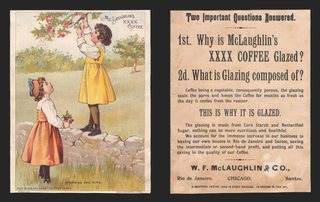
1892 McLaughlin's XXXX Coffee Trade Card Cherries Are Ripe Girls Cosack Large — "Cherries Are Ripe": a girl in a yellow pinafore stands on a stone wall reaching into a cherry tree while her friend in an orange dress waits below. Approx. 5.00 x 6.52 in.

$47.02 1892

Description

"Cherries Are Ripe": a girl in a yellow pinafore stands on a stone wall reaching into a cherry tree while her friend in an orange dress waits below. Foot: "This is one of a set of eighteen cards" and the Cosack & Co. printer's line, copyright 1892.

The back, printed in black, is headed "Two Important Questions Answered. 1st. Why is McLaughlin's XXXX Coffee Glazed? 2d. What is Glazing composed of?" It explains that the glaze of corn starch and reclarified sugar "seals the pores and keeps the Coffee for months as fresh as the day it comes from the roaster," and is signed "W. F. McLaughlin & Co., Rio de Janeiro, Chicago, Santos." The foot reads "A beautiful picture card in every package. 18 designs in this set."

Approx. 5.00 x 6.52 in.

Read the full description

Historical Context

Glazed coffee. Chicago roaster W. F. McLaughlin & Co. sold its XXXX brand roasted in the whole bean and coated with a glaze, and the back of this card makes the case in the company's own words. The firm names its own houses in Rio de Janeiro and Santos, Brazil, the coffee ports.

Collect the set. McLaughlin's issued its picture cards in numbered series, packed one to a package, and families saved them in albums.

Condition

Front: excellent, bright color. Back: light toning. Please see the photos, which are part of the description.

About The Printing

This is an original chromolithograph, and it was slow, exacting work. Each color had to be drawn onto its own separate stone by hand — in monochrome, the artist judging how much stipple each area needed so the colors would combine correctly only once every stone had been printed. The sheet then went through the press once for every color it carries, often a dozen or more, and every pass had to register exactly against the last. A pass out of register showed.

Under magnification the image resolves into irregular hand-drawn stipple, each ink carrying its own dot pattern, the colors mixing in the eye rather than on the paper. There is no regular halftone screen and no four-color rosette, which is what a modern reproduction would show. Modern process printing simulates every color from four inks; chromolithography laid each color down as its own.

The back is printed in black.

Provenance

From my family's estate collections, built over more than 60 years by knowledgeable antiques collectors and traders. Stored in a climate-controlled environment.

Also In Our Store

More McLaughlin's cards in our store: https://www.ebay.com/str/tfauctionsintl?_nkw=mclaughlin

More Victorian advertising trade cards are in our store.

Disclaimer

The images and any video show the actual item and are part of the official listing description, so please review them closely. Measurements and weights are approximate, and any maker or material we haven't confirmed is described as assumed. Questions? Message us; we answer quickly.

View on eBay

1892 McLaughlin's XXXX Coffee Trade Card The First Step Baby Walking Cosack

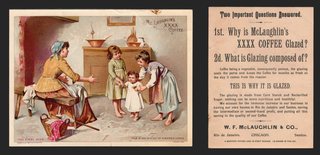
1892 McLaughlin's XXXX Coffee Trade Card The First Step Baby Walking Cosack — "The First Step": in a cottage kitchen a mother kneels with open arms as two older children help the baby take its first steps. Approx. 6.77 x 5.08 in.

$46.68 1892

Description

"The First Step": in a cottage kitchen a mother kneels with open arms as two older children help the baby take its first steps. Foot: "This is one of a set of eighteen cards," Cosack & Co., copyright 1892.

The back, printed in black, is headed "Two Important Questions Answered. 1st. Why is McLaughlin's XXXX Coffee Glazed? 2d. What is Glazing composed of?" It explains that the glaze of corn starch and reclarified sugar "seals the pores and keeps the Coffee for months as fresh as the day it comes from the roaster," and is signed "W. F. McLaughlin & Co., Rio de Janeiro, Chicago, Santos." The foot reads "A beautiful picture card in every package. 18 designs in this set."

Approx. 6.77 x 5.08 in.

Read the full description

Historical Context

Glazed coffee. Chicago roaster W. F. McLaughlin & Co. sold its XXXX brand roasted in the whole bean and coated with a glaze, and the back of this card makes the case in the company's own words. The firm names its own houses in Rio de Janeiro and Santos, Brazil, the coffee ports.

Collect the set. McLaughlin's issued its picture cards in numbered series, packed one to a package, and families saved them in albums.

Condition

Front: excellent, bright color. Back: light toning. Please see the photos, which are part of the description.

About The Printing

This is an original chromolithograph, and it was slow, exacting work. Each color had to be drawn onto its own separate stone by hand — in monochrome, the artist judging how much stipple each area needed so the colors would combine correctly only once every stone had been printed. The sheet then went through the press once for every color it carries, often a dozen or more, and every pass had to register exactly against the last. A pass out of register showed.

Under magnification the image resolves into irregular hand-drawn stipple, each ink carrying its own dot pattern, the colors mixing in the eye rather than on the paper. There is no regular halftone screen and no four-color rosette, which is what a modern reproduction would show. Modern process printing simulates every color from four inks; chromolithography laid each color down as its own.

The back is printed in black.

Provenance

From my family's estate collections, built over more than 60 years by knowledgeable antiques collectors and traders. Stored in a climate-controlled environment.

Also In Our Store

More McLaughlin's cards in our store: https://www.ebay.com/str/tfauctionsintl?_nkw=mclaughlin

More Victorian advertising trade cards are in our store.

Disclaimer

The images and any video show the actual item and are part of the official listing description, so please review them closely. Measurements and weights are approximate, and any maker or material we haven't confirmed is described as assumed. Questions? Message us; we answer quickly.

View on eBay

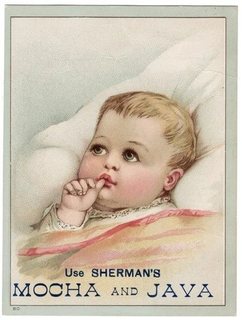
Victorian Trade Card Advertising Sherman's Mocha and Java Coffee

Antique Victorian Trade Card Advertising Sherman's Mocha and Java Coffee

$45.64

Description

Sherman's Mocha and Java likely refers to a brand of coffee or a related product, using the image of a healthy, content baby to associate their product with well-being and domestic comfort. The use of such imagery was common in advertising during this period, aiming to evoke positive emotions and create a memorable brand association. These cards are now sought after by collectors for their historical significance and artistic merit.

  • Time Period: Late 19th Century (Victorian Era)
  • Origin: United States
  • Composition: Cardstock with color printing, back of card is blank
  • Dimensions: H: 4.75" x W: 3.5" (approximately)
  • Please reivew pictures carefully as they are part of the item description and condition.
Read the full description

Historical Context

Victorian promotional trade cards were a popular form of advertising in the late 19th and early 20th centuries, often featuring colorful illustrations of children, animals, or sentimental scenes. These cards were distributed by businesses to showcase their products and services, serving as both an advertisement and a collectible item. They were frequently given away with purchases, encouraging brand loyalty and providing a tangible reminder of the company.

Ref: 1.0526

  • Please visit our store as we are constantly adding more items of all types. Thank you!

View on eBay

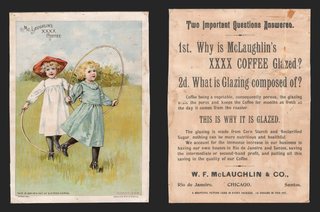
1892 McLaughlin's XXXX Coffee Trade Card Two Girls Jump Rope Hoop Cosack Large

1892 McLaughlin's XXXX Coffee Trade Card Two Girls Jump Rope Hoop Cosack Large — Two little girls in a meadow, one in white with a red hat and one in blue, skipping with a long rope. Approx. 5.15 x 7.01 in.

$44.18 1892

Description

Two little girls in a meadow, one in white with a red hat and one in blue, skipping with a long rope. "McLaughlin's XXXX Coffee" at upper left; foot: "This is one of a set of sixteen cards," Cosack & Co., 1892.

The back, printed in black, is headed "Two Important Questions Answered. 1st. Why is McLaughlin's XXXX Coffee Glazed? 2d. What is Glazing composed of?" It explains that the glaze of corn starch and reclarified sugar "seals the pores and keeps the Coffee for months as fresh as the day it comes from the roaster," and is signed "W. F. McLaughlin & Co., Rio de Janeiro, Chicago, Santos." The foot reads "A beautiful picture card in every package. 16 designs in this set."

Approx. 5.15 x 7.01 in.

Read the full description

Historical Context

Glazed coffee. Chicago roaster W. F. McLaughlin & Co. sold its XXXX brand roasted in the whole bean and coated with a glaze, and the back of this card makes the case in the company's own words. The firm names its own houses in Rio de Janeiro and Santos, Brazil, the coffee ports.

Collect the set. McLaughlin's issued its picture cards in numbered series, packed one to a package, and families saved them in albums.

Condition

Front: excellent, bright color. Back: toned, with a spot. Please see the photos, which are part of the description.

About The Printing

This is an original chromolithograph, and it was slow, exacting work. Each color had to be drawn onto its own separate stone by hand — in monochrome, the artist judging how much stipple each area needed so the colors would combine correctly only once every stone had been printed. The sheet then went through the press once for every color it carries, often a dozen or more, and every pass had to register exactly against the last. A pass out of register showed.

Under magnification the image resolves into irregular hand-drawn stipple, each ink carrying its own dot pattern, the colors mixing in the eye rather than on the paper. There is no regular halftone screen and no four-color rosette, which is what a modern reproduction would show. Modern process printing simulates every color from four inks; chromolithography laid each color down as its own.

The back is printed in black.

Provenance

From my family's estate collections, built over more than 60 years by knowledgeable antiques collectors and traders. Stored in a climate-controlled environment.

Also In Our Store

More McLaughlin's cards in our store: https://www.ebay.com/str/tfauctionsintl?_nkw=mclaughlin

More Victorian advertising trade cards are in our store.

Disclaimer

The images and any video show the actual item and are part of the official listing description, so please review them closely. Measurements and weights are approximate, and any maker or material we haven't confirmed is described as assumed. Questions? Message us; we answer quickly.

View on eBay

1891 Lion Coffee Easter Greetings Trade Card Girl Portrait Rabbits Flowers Large

1891 Lion Coffee Easter Greetings Trade Card Girl Portrait Rabbits Flowers Large — A girl with long hair in a red bodice framed in a lace diamond, with spring flowers and rabbits at her feet. Approx. 5.22 x 6.93 in.

$41.38 1891

Description

A girl with long hair in a red bodice framed in a lace diamond, with spring flowers and rabbits at her feet. Printer's line: "Copyrighted 1891 by Geo. S. Harris & Sons Lith., Phila."

The back is printed in soft brown: "These Beautiful Easter Greetings are found only in the one pound packages of LION COFFEE. Manufactured by Woolson Spice Co., Toledo, Ohio," around a sunburst roundel with the Lion Coffee lion and a bird in flight.

Approx. 5.22 x 6.93 in.

Read the full description

Historical Context

The coffee that came with a picture. Lion Coffee began in Toledo, Ohio, in 1864 and became part of the Woolson Spice Company in 1882. Alvin Woolson built the brand by putting picture cards in every package, and the back of this card says so.

Condition

Front: excellent, bright color. Back: light toning. Please see the photos, which are part of the description.

About The Printing

This is an original chromolithograph, and it was slow, exacting work. Each color had to be drawn onto its own separate stone by hand — in monochrome, the artist judging how much stipple each area needed so the colors would combine correctly only once every stone had been printed. The sheet then went through the press once for every color it carries, often a dozen or more, and every pass had to register exactly against the last. A pass out of register showed.

Under magnification the image resolves into irregular hand-drawn stipple, each ink carrying its own dot pattern, the colors mixing in the eye rather than on the paper. There is no regular halftone screen and no four-color rosette, which is what a modern reproduction would show. Modern process printing simulates every color from four inks; chromolithography laid each color down as its own.

The back is printed in a single brown ink.

Provenance

From my family's estate collections, built over more than 60 years by knowledgeable antiques collectors and traders. Stored in a climate-controlled environment.

Also In Our Store

More Lion Coffee cards in our store: https://www.ebay.com/str/tfauctionsintl?_nkw=lion+coffee

More Victorian advertising trade cards are in our store.

Disclaimer

The images and any video show the actual item and are part of the official listing description, so please review them closely. Measurements and weights are approximate, and any maker or material we haven't confirmed is described as assumed. Questions? Message us; we answer quickly.

View on eBay

1893 Lion Coffee Easter Greetings Trade Card Boy Easter Eggs Chicks Knapp Large

1893 Lion Coffee Easter Greetings Trade Card Boy Easter Eggs Chicks Knapp Large — A smiling boy in a red jacket holds out a straw hat full of colored Easter eggs while a hen and chicks look on. Approx. 7.02 x 5.13 in.

$41.22 1893

Description

A smiling boy in a red jacket holds out a straw hat full of colored Easter eggs while a hen and chicks look on. Printer's line: "Copyrighted 1893" by The Knapp Co., N.Y.

The back is printed in brown: "These Beautiful Easter Greetings are found only in the one pound packages of LION COFFEE," with an angel, the lion, lilies and "Woolson Spice Co., Toledo, Ohio."

Approx. 7.02 x 5.13 in.

Read the full description

Historical Context

The coffee that came with a picture. Lion Coffee began in Toledo, Ohio, in 1864 and became part of the Woolson Spice Company in 1882. Alvin Woolson built the brand by putting picture cards in every package, and the back of this card says so.

Condition

Front: excellent, bright color. Back: light toning. Please see the photos, which are part of the description.

About The Printing

This is an original chromolithograph, and it was slow, exacting work. Each color had to be drawn onto its own separate stone by hand — in monochrome, the artist judging how much stipple each area needed so the colors would combine correctly only once every stone had been printed. The sheet then went through the press once for every color it carries, often a dozen or more, and every pass had to register exactly against the last. A pass out of register showed.

Under magnification the image resolves into irregular hand-drawn stipple, each ink carrying its own dot pattern, the colors mixing in the eye rather than on the paper. There is no regular halftone screen and no four-color rosette, which is what a modern reproduction would show. Modern process printing simulates every color from four inks; chromolithography laid each color down as its own.

The back is printed in a single brown ink.

Provenance

From my family's estate collections, built over more than 60 years by knowledgeable antiques collectors and traders. Stored in a climate-controlled environment.

Also In Our Store

More Lion Coffee cards in our store: https://www.ebay.com/str/tfauctionsintl?_nkw=lion+coffee

More Victorian advertising trade cards are in our store.

Disclaimer

The images and any video show the actual item and are part of the official listing description, so please review them closely. Measurements and weights are approximate, and any maker or material we haven't confirmed is described as assumed. Questions? Message us; we answer quickly.

View on eBay

1891 Lion Coffee Easter Greetings Trade Card Girl in Doorway Lilies Harris Lith

1891 Lion Coffee Easter Greetings Trade Card Girl in Doorway Lilies Harris Lith — A little girl in a pink dress with an armful of flowers stands in an arched doorway, with tall white lilies in the foreground. Approx. 5.19 x 6.91 in.

$32.72 1891

Description

A little girl in a pink dress with an armful of flowers stands in an arched doorway, with tall white lilies in the foreground. Printer's line: "Copyrighted 1891 by Geo. S. Harris & Sons Lith., Phila."

The back is printed in soft brown: "These Beautiful Easter Greetings are found only in the one pound packages of LION COFFEE. Manufactured by Woolson Spice Co., Toledo, Ohio," around a sunburst roundel with the Lion Coffee lion and a bird in flight.

Approx. 5.19 x 6.91 in.

Read the full description

Historical Context

The coffee that came with a picture. Lion Coffee began in Toledo, Ohio, in 1864 and became part of the Woolson Spice Company in 1882. Alvin Woolson built the brand by putting picture cards in every package, and the back of this card says so.

Condition

Front: very good, clean color. Back: light toning. Please see the photos, which are part of the description.

About The Printing

This is an original chromolithograph, and it was slow, exacting work. Each color had to be drawn onto its own separate stone by hand — in monochrome, the artist judging how much stipple each area needed so the colors would combine correctly only once every stone had been printed. The sheet then went through the press once for every color it carries, often a dozen or more, and every pass had to register exactly against the last. A pass out of register showed.

Under magnification the image resolves into irregular hand-drawn stipple, each ink carrying its own dot pattern, the colors mixing in the eye rather than on the paper. There is no regular halftone screen and no four-color rosette, which is what a modern reproduction would show. Modern process printing simulates every color from four inks; chromolithography laid each color down as its own.

The back is printed in a single brown ink.

Provenance

From my family's estate collections, built over more than 60 years by knowledgeable antiques collectors and traders. Stored in a climate-controlled environment.

Also In Our Store

More Lion Coffee cards in our store: https://www.ebay.com/str/tfauctionsintl?_nkw=lion+coffee

More Victorian advertising trade cards are in our store.

Disclaimer

The images and any video show the actual item and are part of the official listing description, so please review them closely. Measurements and weights are approximate, and any maker or material we haven't confirmed is described as assumed. Questions? Message us; we answer quickly.

View on eBay

Victorian Advertising Trade Card of a Girl with Flowers and Letter [Lion Coffee]

Victorian Advertising Trade Card of a Girl with Flowers and a Letter

$31.22

Vintage Lion Coffee Advertising Trade Card Promoting the Coffee's Purity

Read the full description

Description

This advertising trade card, with its depiction of a young girl holding a letter and a basket of flowers, likely served as a greeting card or a promotional item for a company that dealt with correspondence or floral arrangements. The style of the girl's dress, with its puffed sleeves and ruffled hem, along with her hairstyle, places it firmly within the late Victorian or Edwardian period. Such cards are sought after by collectors for their artistic merit, historical significance, and nostalgic appeal.

More Historical Context about Lion Coffee

Lion Coffee was a popular brand in the late 19th and early 20th centuries, known for its distinctive advertising campaigns that often included collectible trade cards. These cards were a common marketing strategy to encourage repeat purchases and build brand loyalty among consumers. The brand's advertising often highlighted the quality and purity of their coffee, differentiating it from competitors. This particular advertisement promotes the idea that Lion Coffee is not glazed, implying a superior, pure flavor compared to other brands that might use a "cheap coating." The mention of a "Picture Card" being included in each package further emphasizes the collectible nature of the brand's promotional materials during the Victorian era. These cards are now sought after by collectors of ephemera and advertising history.

  • Time Period: Circa 1890-1910
  • Origin: United States
  • Composition: Cardstock with color printing
  • Dimensions: H: 4" x W: 2.5" (approximate)
  • Please reivew pictures carefully as they are part of the item description and condition.

Historical Context

Trade cards were a popular form of advertising and collectible ephemera during the late 19th and early 20th centuries. Often featuring colorful illustrations, they were distributed by manufacturers and retailers to promote their products or simply as a form of goodwill. These cards depicted a wide range of subjects, from sentimental scenes and children to patriotic motifs and product advertisements, making them a valuable window into the social and cultural history of the era. Many were beautifully printed using chromolithography, a technique that allowed for vibrant and detailed color reproduction.

Ref: 1.0523

  • Please visit our store as we are constantly adding more items of all types. Thank you!

View on eBay

1890s Lion Coffee Woolson Spice Christmas Greeting Trade Card Sea Captain Holly

1890s Lion Coffee Woolson Spice Christmas Greeting Trade Card Sea Captain Holly — An old sea captain in oilskins and sou'wester at a ship's wheel in driving snow, framed beside a coastal scene, with holly and berries. Approx. 6.85 x 5.43 in.

$30.82

Description

An old sea captain in oilskins and sou'wester at a ship's wheel in driving snow, framed beside a coastal scene, with holly and berries. Lettered "Woolson Spice Co's Christmas Greeting."

The back, printed in black: "To secure a Picture Card like this you have only to buy a package of LION COFFEE! It is composed of a successful combination of Mocha, Java and Rio," around a "MOCHA JAVA RIO" roundel, with "It is roasted with the greatest care but is not ground. LION is the King of Coffees! Manufactured by the Woolson Spice Co., Toledo, Ohio."

Approx. 6.85 x 5.43 in.

Read the full description

Historical Context

The coffee that came with a picture. Lion Coffee began in Toledo, Ohio, in 1864 and became part of the Woolson Spice Company in 1882. Alvin Woolson built the brand by putting picture cards in every package, and the back of this card says so.

A Christmas card in the coffee. Woolson issued large seasonal greeting cards for Christmas, Easter and midsummer.

Condition

Front: very good, bright color; slightly out of square as trimmed. Back: light toning. Please see the photos, which are part of the description.

About The Printing

This is an original chromolithograph, and it was slow, exacting work. Each color had to be drawn onto its own separate stone by hand — in monochrome, the artist judging how much stipple each area needed so the colors would combine correctly only once every stone had been printed. The sheet then went through the press once for every color it carries, often a dozen or more, and every pass had to register exactly against the last. A pass out of register showed.

Under magnification the image resolves into irregular hand-drawn stipple, each ink carrying its own dot pattern, the colors mixing in the eye rather than on the paper. There is no regular halftone screen and no four-color rosette, which is what a modern reproduction would show. Modern process printing simulates every color from four inks; chromolithography laid each color down as its own.

The back is printed in black.

Provenance

From my family's estate collections, built over more than 60 years by knowledgeable antiques collectors and traders. Stored in a climate-controlled environment.

Also In Our Store

More Lion Coffee cards in our store: https://www.ebay.com/str/tfauctionsintl?_nkw=lion+coffee

More Victorian advertising trade cards are in our store.

Disclaimer

The images and any video show the actual item and are part of the official listing description, so please review them closely. Measurements and weights are approximate, and any maker or material we haven't confirmed is described as assumed. Questions? Message us; we answer quickly.

View on eBay

1891 Lion Coffee Easter Greetings Trade Card Children Lilies Harris Lith Large

1891 Lion Coffee Easter Greetings Trade Card Children Lilies Harris Lith Large — Three children in a meadow of white lilies: a girl in blue with a red bow in her hair and two boys in red and white, one holding a basket. Approx. 6.90 x 5.24 in.

$29.42 1891

Description

Three children in a meadow of white lilies: a girl in blue with a red bow in her hair and two boys in red and white, one holding a basket. Printer's line at the foot: "Copyrighted 1891 by Geo. S. Harris & Sons Lith., Phila."

The back is printed in soft brown: "These Beautiful Easter Greetings are found only in the one pound packages of LION COFFEE. Manufactured by Woolson Spice Co., Toledo, Ohio," around a sunburst roundel with the Lion Coffee lion and a bird in flight.

Approx. 6.90 x 5.24 in.

Read the full description

Historical Context

The coffee that came with a picture. Lion Coffee began in Toledo, Ohio, in 1864 and became part of the Woolson Spice Company in 1882. Alvin Woolson built the brand by putting picture cards in every package, and the back of this card says so.

Easter in the coffee can. The large Easter Greetings cards were packed only in the one-pound packages, a reward for the bigger purchase.

Condition

Front: very good, clean color, light edge wear. Back: overall toning with blotchy stains at the center and lower right. Please see the photos, which are part of the description.

About The Printing

This is an original chromolithograph, and it was slow, exacting work. Each color had to be drawn onto its own separate stone by hand — in monochrome, the artist judging how much stipple each area needed so the colors would combine correctly only once every stone had been printed. The sheet then went through the press once for every color it carries, often a dozen or more, and every pass had to register exactly against the last. A pass out of register showed.

Under magnification the image resolves into irregular hand-drawn stipple, each ink carrying its own dot pattern, the colors mixing in the eye rather than on the paper. There is no regular halftone screen and no four-color rosette, which is what a modern reproduction would show. Modern process printing simulates every color from four inks; chromolithography laid each color down as its own.

The back is printed in a single brown ink.

Provenance

From my family's estate collections, built over more than 60 years by knowledgeable antiques collectors and traders. Stored in a climate-controlled environment.

Also In Our Store

More Lion Coffee cards in our store: https://www.ebay.com/str/tfauctionsintl?_nkw=lion+coffee

More Victorian advertising trade cards are in our store.

Disclaimer

The images and any video show the actual item and are part of the official listing description, so please review them closely. Measurements and weights are approximate, and any maker or material we haven't confirmed is described as assumed. Questions? Message us; we answer quickly.

View on eBay

Victorian Trade Card Helme's Railroad Mills Snuff Apple Blossom Tobacco

Helme's Railroad Mills Snuff — Apple Blossom

$28.69

Original Victorian advertising trade card, chromolithograph, c. 1880s. Approx. 4.25 x 3.20 in.

A spray of pink-and-white apple blossom with buds and leaves arches across a pale green panel set inside a soft pink border. Lettered at the foot: Use Helme's Railroad Mills Snuff.

The reverse is blank.

Read the full description

Historical Context

Snuff advertised with apple blossom is a very Victorian combination. Tobacco cards of the period were often at their most delicate, because the advertiser wanted the card kept in a parlor album where a picture of the product itself would never have been welcome.

Helme's Railroad Mills was one of the best-known American snuff brands of its day, and the name alone was the whole message. A card like this needed only to remind.

Condition

Toning and age typical of the period. The blank reverse is toned, with a few faint pencil marks and a small brown fleck at the upper left; minor edge and corner wear. The front is clean and bright. Please view the images carefully.

About The Printing

This is an original chromolithograph, and it was slow, exacting work. Each color had to be drawn onto its own separate stone by hand — in monochrome, the artist judging how much stipple each area needed so the colors would combine correctly only once every stone had been printed. The sheet then went through the press once for every color it carries, often a dozen or more, and every pass had to register exactly against the last. A pass out of register showed.

Under magnification the image resolves into irregular hand-drawn stipple, each ink carrying its own dot pattern, the colors mixing in the eye rather than on the paper. There is no regular halftone screen and no four-color rosette, which is what a modern reproduction would show. Modern process printing simulates every color from four inks; chromolithography laid each color down as its own.

Provenance

This item comes from the personal collections of my family estate, accumulated over more than 200 years — including items that came west by wagon train to Colorado and later to Oklahoma. Now that my parents have passed we cannot keep all of these cherished items. They were well-educated antiques collectors/traders and continued to build their collections over more than 60 years. The vast majority of the pieces are from the Victorian Era, however there are plenty of older and newer items. Everything has been stored in a climate-controlled environment over time.

Disclaimer

Specifications and detailed item descriptions are provided as a courtesy only and are not guaranteed to be one hundred percent accurate. Please do your own research. There are generally no receipts available for any items from original purchases. Any dimensions and/or weights are approximate. The absence of a more detailed condition report does not imply there are no condition issues with the item(s). Please inspect images carefully as they are part of the official item description and best representation of the actual condition. Additional images may be available upon request depending on time and availability. Not responsible for internet mis-translations or mis-identification of maker's marks if found or assumptions of makers or materials — item descriptions will indicate if it is assumed. If you see a problem, please message us immediately and we will do our best to sort out a solution and confirm the information. With the exception of eBay rules, no returns are accepted.
View on eBay

1890s Lion Coffee Woolson Spice Midsummer Greeting Trade Card Two Girls Knapp

1890s Lion Coffee Woolson Spice Midsummer Greeting Trade Card Two Girls Knapp — Two girls in large sun bonnets point toward a landscape of mountains and a farmhouse framed in a golden scroll. Approx. 6.91 x 5.00 in.

$28.28

Description

Two girls in large sun bonnets point toward a landscape of mountains and a farmhouse framed in a golden scroll. Lettered "The Woolson Spice Co's Midsummer Greeting," with "Knapp & Co. N.Y." at lower right.

The back, printed in brown, is a busy typographic advertisement around a lion's head: "To secure a Picture Card like this you have only to buy a package of LION COFFEE. It is composed of a successful combination of Mocha, Java and Rio ... Sold only in one pound packages. Beautiful Picture Card in every package ... LION is the King of Coffees! Manufactured by Woolson Spice Co., Toledo, Ohio."

Approx. 6.91 x 5.00 in.

Read the full description

Historical Context

The coffee that came with a picture. Lion Coffee began in Toledo, Ohio, in 1864 and became part of the Woolson Spice Company in 1882. Alvin Woolson built the brand by putting picture cards in every package, and the back of this card says so.

Printed by Knapp. Knapp & Co. of New York was one of the great color printers of the period.

Condition

Front: very good, bright color. The top left corner has a small chip with tan board showing and a short crack running in from it. Back: toned. Please see the photos, which are part of the description.

About The Printing

This is an original chromolithograph, and it was slow, exacting work. Each color had to be drawn onto its own separate stone by hand — in monochrome, the artist judging how much stipple each area needed so the colors would combine correctly only once every stone had been printed. The sheet then went through the press once for every color it carries, often a dozen or more, and every pass had to register exactly against the last. A pass out of register showed.

Under magnification the image resolves into irregular hand-drawn stipple, each ink carrying its own dot pattern, the colors mixing in the eye rather than on the paper. There is no regular halftone screen and no four-color rosette, which is what a modern reproduction would show. Modern process printing simulates every color from four inks; chromolithography laid each color down as its own.

The back is printed in a single brown ink.

Provenance

From my family's estate collections, built over more than 60 years by knowledgeable antiques collectors and traders. Stored in a climate-controlled environment.

Also In Our Store

More Lion Coffee cards in our store: https://www.ebay.com/str/tfauctionsintl?_nkw=lion+coffee

More Victorian advertising trade cards are in our store.

Disclaimer

The images and any video show the actual item and are part of the official listing description, so please review them closely. Measurements and weights are approximate, and any maker or material we haven't confirmed is described as assumed. Questions? Message us; we answer quickly.

View on eBay

1890s Lion Coffee Midsummer Greeting Trade Card Children on Swing Roses Gold

1890s Lion Coffee Midsummer Greeting Trade Card Children on Swing Roses Gold — A boy and girl ride a wooden swing inside a large gilt circle, with red roses, blue flowers and a farm vignette, on a metallic gold band. Approx. 6.46 x 4.97 in.

$28.18

Description

A boy and girl ride a wooden swing inside a large gilt circle, with red roses, blue flowers and a farm vignette, on a metallic gold band. Lettered "Woolson Spice Co's Midsummer Greeting." Bufford printer's imprint.

The back, printed in black: "To secure a Picture Card like this you have only to buy a package of LION COFFEE. It is composed of a successful combination of Mocha, Java and Rio," around a roundel with a lion's head, flowering branches and "Sold only in one pound packages," and "LION is the King of Coffees! Manufactured by the Woolson Spice Co., Toledo, Ohio."

Approx. 6.46 x 4.97 in.

Read the full description

Historical Context

The coffee that came with a picture. Lion Coffee began in Toledo, Ohio, in 1864 and became part of the Woolson Spice Company in 1882. Alvin Woolson built the brand by putting picture cards in every package, and the back of this card says so.

Condition

Front: good color and gold; card slightly out of square with softly rounded corners. Back: light toning. Please see the photos, which are part of the description.

About The Printing

This is an original chromolithograph, and it was slow, exacting work. Each color had to be drawn onto its own separate stone by hand — in monochrome, the artist judging how much stipple each area needed so the colors would combine correctly only once every stone had been printed. The sheet then went through the press once for every color it carries, often a dozen or more, and every pass had to register exactly against the last. A pass out of register showed.

Under magnification the image resolves into irregular hand-drawn stipple, each ink carrying its own dot pattern, the colors mixing in the eye rather than on the paper. There is no regular halftone screen and no four-color rosette, which is what a modern reproduction would show. Modern process printing simulates every color from four inks; chromolithography laid each color down as its own.

The gold band is printed in metallic ink, and the back is printed in black.

Provenance

From my family's estate collections, built over more than 60 years by knowledgeable antiques collectors and traders. Stored in a climate-controlled environment.

Also In Our Store

More Lion Coffee cards in our store: https://www.ebay.com/str/tfauctionsintl?_nkw=lion+coffee

More Victorian advertising trade cards are in our store.

Disclaimer

The images and any video show the actual item and are part of the official listing description, so please review them closely. Measurements and weights are approximate, and any maker or material we haven't confirmed is described as assumed. Questions? Message us; we answer quickly.

View on eBay

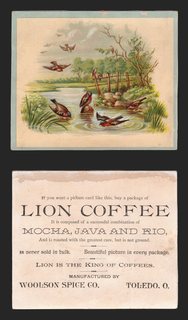
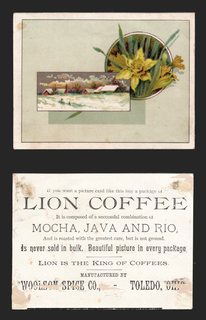
1880s Lion Coffee Victorian Trade Card Birds Bathing at Pond Woolson Spice

1880s Lion Coffee Victorian Trade Card Birds Bathing at Pond Woolson Spice — Small birds bathe and splash in a pond by a fence and trees, with more birds in the sky, inside a pale blue border. Approx. 5.13 x 4.29 in.

$20.28

Description

Small birds bathe and splash in a pond by a fence and trees, with more birds in the sky, inside a pale blue border.

The back is printed in black: "If you want a picture card like this buy a package of LION COFFEE. It is composed of a successful combination of Mocha, Java and Rio, and is roasted with the greatest care, but is not ground. Is never sold in bulk. Beautiful picture in every package. Lion is the King of Coffees. Manufactured by Woolson Spice Co., Toledo, O.."

Approx. 5.13 x 4.29 in.

Read the full description

Historical Context

The coffee that came with a picture. Lion Coffee began in Toledo, Ohio, in 1864 and became part of the Woolson Spice Company in 1882. Alvin Woolson built the brand by putting picture cards in every package, and the back of this card says so.

Condition

Front: small chips in the border at the top. Back: edge staining at the top. Please see the photos, which are part of the description.

About The Printing

This is an original chromolithograph, and it was slow, exacting work. Each color had to be drawn onto its own separate stone by hand — in monochrome, the artist judging how much stipple each area needed so the colors would combine correctly only once every stone had been printed. The sheet then went through the press once for every color it carries, often a dozen or more, and every pass had to register exactly against the last. A pass out of register showed.

Under magnification the image resolves into irregular hand-drawn stipple, each ink carrying its own dot pattern, the colors mixing in the eye rather than on the paper. There is no regular halftone screen and no four-color rosette, which is what a modern reproduction would show. Modern process printing simulates every color from four inks; chromolithography laid each color down as its own.

The back is printed in black.

Provenance

From my family's estate collections, built over more than 60 years by knowledgeable antiques collectors and traders. Stored in a climate-controlled environment.

Also In Our Store

More Lion Coffee cards in our store: https://www.ebay.com/str/tfauctionsintl?_nkw=lion+coffee

More Victorian advertising trade cards are in our store.

Disclaimer

The images and any video show the actual item and are part of the official listing description, so please review them closely. Measurements and weights are approximate, and any maker or material we haven't confirmed is described as assumed. Questions? Message us; we answer quickly.

View on eBay

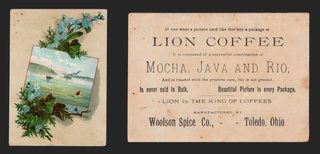
1880s Lion Coffee Trade Card Forget-Me-Nots Seascape Ships Bufford Woolson

1880s Lion Coffee Trade Card Forget-Me-Nots Seascape Ships Bufford Woolson — Sprays of blue forget-me-nots frame a tilted seascape with sailing ships. Approx. 3.62 x 5.11 in.

$19.92

Description

Sprays of blue forget-me-nots frame a tilted seascape with sailing ships. Bufford printer's imprint.

The back is printed in black: "If you want a picture card like this buy a package of LION COFFEE. It is composed of a successful combination of Mocha, Java and Rio, and is roasted with the greatest care, but is not ground. Is never sold in bulk. Beautiful picture in every package. Lion is the King of Coffees. Manufactured by Woolson Spice Co., Toledo, Ohio."

Approx. 3.62 x 5.11 in.

Read the full description

Historical Context

The coffee that came with a picture. Lion Coffee began in Toledo, Ohio, in 1864 and became part of the Woolson Spice Company in 1882. Alvin Woolson built the brand by putting picture cards in every package, and the back of this card says so.

Condition

Front: pink ink dashes and small black dots at upper left; even toning. Back: even toning. Please judge from the photos. Please see the photos, which are part of the description.

About The Printing

This is an original chromolithograph, and it was slow, exacting work. Each color had to be drawn onto its own separate stone by hand — in monochrome, the artist judging how much stipple each area needed so the colors would combine correctly only once every stone had been printed. The sheet then went through the press once for every color it carries, often a dozen or more, and every pass had to register exactly against the last. A pass out of register showed.

Under magnification the image resolves into irregular hand-drawn stipple, each ink carrying its own dot pattern, the colors mixing in the eye rather than on the paper. There is no regular halftone screen and no four-color rosette, which is what a modern reproduction would show. Modern process printing simulates every color from four inks; chromolithography laid each color down as its own.

The back is printed in black.

Provenance

From my family's estate collections, built over more than 60 years by knowledgeable antiques collectors and traders. Stored in a climate-controlled environment.

Also In Our Store

More Lion Coffee cards in our store: https://www.ebay.com/str/tfauctionsintl?_nkw=lion+coffee

More Victorian advertising trade cards are in our store.

Disclaimer

The images and any video show the actual item and are part of the official listing description, so please review them closely. Measurements and weights are approximate, and any maker or material we haven't confirmed is described as assumed. Questions? Message us; we answer quickly.

View on eBay

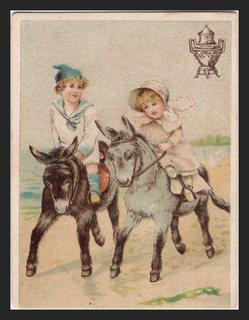
1880s Trade Card Dilworth's Coffee Children Riding Donkeys on the Beach Urn

1880s Trade Card Dilworth's Coffee Children Riding Donkeys on the Beach Urn — Two children ride donkeys along the sand by the sea: a boy in a white sailor suit and blue cap on a dark brown donkey, and a girl in a white bonnet and pink dress on a grey one, holding the reins. Approx. 2.50 x 3.25 in.

$17.44

Description

Two children ride donkeys along the sand by the sea: a boy in a white sailor suit and blue cap on a dark brown donkey, and a girl in a white bonnet and pink dress on a grey one, holding the reins. At upper right is a small emblem of an ornate urn on feet, likely a coffee urn (best reading). The front carries no text.

The back is printed in black: "Dilworth's Coffee ✣ BECAUSE: ✣ IS UNEQUALLED". The rest of the back is blank. The back reads across the long side of the card.

Approx. 2.50 x 3.25 in.

Read the full description

Historical Context

Coffee by the package. In the 1880s branded, packaged coffee was pushing out loose beans sold from the grocer's bin, and roasters handed out picture cards to win loyal customers. Dilworth's answer to why its coffee was best: "because" it is unequalled.

Donkey rides on the sand. A sailor-suited boy and a bonneted girl on a pair of shaggy donkeys capture a favorite Victorian seaside pleasure, for collectors of children, beach and donkey subjects.

Condition

Front: very good, with bright color, light toning, light edge wear and lightly rounded corners. Back: water staining with tide lines across the top band and below the printing, several round stain spots near the bottom, a scuffed patch of surface at the upper right corner, a few small specks, and overall toning. Please see the photos, which are part of the description.

About The Printing

This is an original chromolithograph, and it was slow, exacting work. Each color had to be drawn onto its own separate stone by hand — in monochrome, the artist judging how much stipple each area needed so the colors would combine correctly only once every stone had been printed. The sheet then went through the press once for every color it carries, often a dozen or more, and every pass had to register exactly against the last. A pass out of register showed.

Under magnification the image resolves into irregular hand-drawn stipple, each ink carrying its own dot pattern, the colors mixing in the eye rather than on the paper. There is no regular halftone screen and no four-color rosette, which is what a modern reproduction would show. Modern process printing simulates every color from four inks; chromolithography laid each color down as its own.

The back is printed in black type, separate from the color work on the front.

Provenance

From my family's estate collections, built over more than 60 years by knowledgeable antiques collectors and traders. Stored in a climate-controlled environment.

Also In Our Store

More Victorian advertising trade cards for coffee, spices and baking soda are in our store.

Disclaimer

The images and any video show the actual item and are part of the official listing description, so please review them closely. Measurements and weights are approximate, and any maker or material we haven't confirmed is described as assumed. Questions? Message us; we answer quickly.

View on eBay

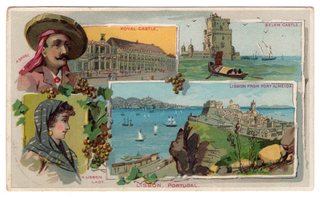
Arbuckle Coffee Trade Card No 22 Lisbon Portugal Belem Trip Around the World

Arbuckle Coffee Trade Card No 22 Lisbon Portugal Belem Trip Around the World — Original Victorian advertising trade card, chromolithograph, copyright 1891. Approx. 5.05 x 3.05 in. Printed by Joseph P. Knapp, Lith., N.Y.

$17.33

Description

Arbuckle Bros Ariosa Coffee — “Lisbon, Portugal,” No. 22 of 50 Views from a Trip Around the World

A harbor view of Lisbon from Fort Almeida, with sailing ships on the Tagus and the city climbing the hills beyond, is surrounded by vignettes: the Royal Castle; Belem Castle, the fortified tower at the water's edge; A Sport, a mustached man in a wide-brimmed hat; and A Lisbon Lady in a striped headscarf, with bunches of grapes and vine leaves trailing between them. Lettered at the foot: LISBON, PORTUGAL, and along the left edge, COPYRIGHT 1891 BY ARBUCKLE BROS. N.Y.

The reverse is headed One of 50 views from a trip around the world. The left column carries Arbuckle's GRIND YOUR COFFEE AT HOME advice and the ARIOSA COFFEE claim; the right column is a travel sketch of Lisbon and its history, ending with the city's population. The card is numbered 22.

Read the full description

Historical Context

This is the travel series, the same one as the Dublin card: fifty stops on an armchair tour of the world, one to a package of coffee. For a family in Kansas in 1891, the tower at Belem and the grape arbors of Portugal were exactly as far away as the moon, and a card like this was how they arrived.

The grapevine running through the design is the clue to what Portugal meant to an American of the period — wine and port, the country's best-known export.

Condition

Toning and age typical of the period. Light surface soiling; minor edge and corner wear; toning to the reverse. The chromolithographed image remains bright and the reverse text fully legible. Please view the images carefully.

About The Printing

This is an original chromolithograph, and it was slow, exacting work. Each color had to be drawn onto its own separate stone by hand — in monochrome, the artist judging how much stipple each area needed so the colors would combine correctly only once every stone had been printed. The sheet then went through the press once for every color it carries, often a dozen or more, and every pass had to register exactly against the last. A pass out of register showed.

Under magnification the image resolves into irregular hand-drawn stipple, each ink carrying its own dot pattern, the colors mixing in the eye rather than on the paper. There is no regular halftone screen and no four-color rosette, which is what a modern reproduction would show. Modern process printing simulates every color from four inks; chromolithography laid each color down as its own.

Provenance

From my family's estate collections, built over more than 60 years by knowledgeable antiques collectors and traders. Stored in a climate-controlled environment.

Also In Our Store

More Victorian advertising trade cards are in our store.

Disclaimer

The images and any video show the actual item and are part of the official listing description, so please review them closely. Measurements and weights are approximate, and any maker or material we haven't confirmed is described as assumed. Questions? Message us; we answer quickly.

View on eBay

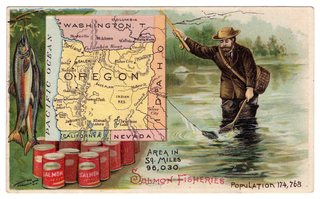
1889 Arbuckle Coffee Trade Card No 55 Oregon State Map Salmon Fisheries Fishing

1889 Arbuckle Coffee Trade Card No 55 Oregon State Map Salmon Fisheries Fishing — Original Victorian advertising trade card, chromolithograph, copyright 1889 by Arbuckle Bros., N.Y. Approx. 5.05 x 3.05 in.

$17.19 1889

Description

Arbuckle Bros Ariosa Coffee — Oregon, State Map No. 55

A colored map of Oregon, its towns and rivers lettered in, with Washington Territory to the north and California, Nevada and Idaho at the borders. Beside it a fisherman in a slouch hat and waders stands in the river landing a salmon in a net, two salmon hang on a line at the left, and a stack of red SALMON cans fills the lower corner. Lettered: SALMON FISHERIES. Area in Sq. Miles 96,030. Population 174,768.

The reverse is headed ARBUCKLES' Ariosa Coffee, COSTS MORE AND IS WORTH MORE THAN OTHER BRANDS OF COFFEE. WHY? Four numbered reasons follow: the coffee is made from green coffee of higher grade; its strength and aroma are retained by the glazing; the glazing is made of choice eggs and pure confectioners' “A” sugar; and it adds richness of flavor. A BEWARE paragraph warns against low-grade package coffee. A second column, READ THIS, explains the series — fifty cards, each showing a correct map of one State or Territory with pictures of its peculiar industries and scenery — and suggests that anyone with two cards of one kind exchange with a neighbor. A list of the states and territories represented follows. Arbuckle Bros. Coffee Company, New York. The card is numbered 55. Printed by Donaldson Brothers, N.Y.

Read the full description

Historical Context

Oregon's picture is its industry: salmon, caught in the rivers and canned for shipment east. The cans in the corner are the whole story of the Columbia River in the 1880s — a fish that had fed the region for thousands of years, turning into a product sold in grocery stores across the country.

Watch the northern border. The card labels Washington T., for Territory. Washington became a state in November 1889, so this map was drawn just before it happened.

Condition

Toning and age typical of the period. Light surface soiling; minor edge and corner wear; toning to the reverse. The chromolithographed image remains bright and the reverse text fully legible. Please view the images carefully.

About The Printing

This is an original chromolithograph, and it was slow, exacting work. Each color had to be drawn onto its own separate stone by hand — in monochrome, the artist judging how much stipple each area needed so the colors would combine correctly only once every stone had been printed. The sheet then went through the press once for every color it carries, often a dozen or more, and every pass had to register exactly against the last. A pass out of register showed.

Under magnification the image resolves into irregular hand-drawn stipple, each ink carrying its own dot pattern, the colors mixing in the eye rather than on the paper. There is no regular halftone screen and no four-color rosette, which is what a modern reproduction would show. Modern process printing simulates every color from four inks; chromolithography laid each color down as its own.

Provenance

From my family's estate collections, built over more than 60 years by knowledgeable antiques collectors and traders. Stored in a climate-controlled environment.

Also In Our Store

More Victorian advertising trade cards are in our store.

Disclaimer

The images and any video show the actual item and are part of the official listing description, so please review them closely. Measurements and weights are approximate, and any maker or material we haven't confirmed is described as assumed. Questions? Message us; we answer quickly.

View on eBay

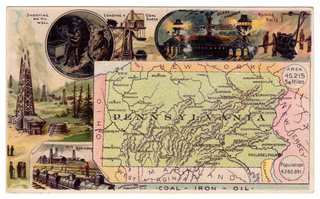
1889 Arbuckle Coffee Trade Card No 54 Pennsylvania State Map Coal Iron Oil Well

1889 Arbuckle Coffee Trade Card No 54 Pennsylvania State Map Coal Iron Oil Well — Original Victorian advertising trade card, chromolithograph, copyright 1889 by Arbuckle Bros., N.Y. Approx. 5.05 x 3.05 in.

$17.08 1889

Description

Arbuckle Bros Ariosa Coffee — Pennsylvania, State Map No. 54

A colored map of Pennsylvania, its towns and ranges lettered in, framed by vignettes of the state's industries: Shooting an Oil Well, with derricks on the hillside; Loading a Coal Barge; a Blast Furnace; Rolling Rails in a steel mill; and an Oil Refinery with a train of tank cars. Lettered at the foot: COAL - IRON - OIL. Area 45,215 Sq. Miles. Population 4,282,891.

The reverse is headed ARBUCKLES' Ariosa Coffee, COSTS MORE AND IS WORTH MORE THAN OTHER BRANDS OF COFFEE. WHY? Four numbered reasons follow: the coffee is made from green coffee of higher grade; its strength and aroma are retained by the glazing; the glazing is made of choice eggs and pure confectioners' “A” sugar; and it adds richness of flavor. A BEWARE paragraph warns against low-grade package coffee. A second column, READ THIS, explains the series — fifty cards, each showing a correct map of one State or Territory with pictures of its peculiar industries and scenery — and suggests that anyone with two cards of one kind exchange with a neighbor. A list of the states and territories represented follows. Arbuckle Bros. Coffee Company, New York. The card is numbered 54. Printed by Donaldson Brothers, N.Y.

Read the full description

Historical Context

COAL - IRON - OIL is Pennsylvania in three words, and in 1889 it was the industrial heart of the country. The first commercial oil well had been drilled in the state thirty years before, and the vignettes follow the chain from the ground to the railroad: dig it, smelt it, roll it, ship it.

“Shooting” an oil well meant dropping explosives down the bore to crack the rock and start the oil flowing — dangerous work, and a spectacle people came to watch.

Condition

Toning and age typical of the period. Light surface soiling; minor edge and corner wear; toning to the reverse. The chromolithographed image remains bright and the reverse text fully legible. Please view the images carefully.

About The Printing

This is an original chromolithograph, and it was slow, exacting work. Each color had to be drawn onto its own separate stone by hand — in monochrome, the artist judging how much stipple each area needed so the colors would combine correctly only once every stone had been printed. The sheet then went through the press once for every color it carries, often a dozen or more, and every pass had to register exactly against the last. A pass out of register showed.

Under magnification the image resolves into irregular hand-drawn stipple, each ink carrying its own dot pattern, the colors mixing in the eye rather than on the paper. There is no regular halftone screen and no four-color rosette, which is what a modern reproduction would show. Modern process printing simulates every color from four inks; chromolithography laid each color down as its own.

Provenance

From my family's estate collections, built over more than 60 years by knowledgeable antiques collectors and traders. Stored in a climate-controlled environment.

Also In Our Store

More Victorian advertising trade cards are in our store.

Disclaimer

The images and any video show the actual item and are part of the official listing description, so please review them closely. Measurements and weights are approximate, and any maker or material we haven't confirmed is described as assumed. Questions? Message us; we answer quickly.

View on eBay

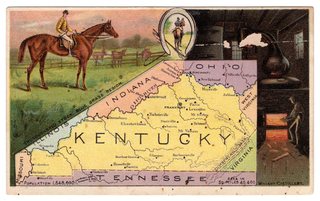
1889 Arbuckle Coffee Trade Card No 61 Kentucky Map Racehorse Whisky Distillery

1889 Arbuckle Coffee Trade Card No 61 Kentucky Map Racehorse Whisky Distillery — Original Victorian advertising trade card, chromolithograph, copyright 1889 by Arbuckle Bros., N.Y. Approx. 5.05 x 3.10 in.

$17.04 1889

Description

Arbuckle Bros Ariosa Coffee — Kentucky, State Map No. 61

A colored map of Kentucky, its towns and rivers lettered in, with Ohio, Indiana, Illinois, Missouri, Tennessee, Virginia and West Virginia around it. Above the map a jockey in yellow silks sits a chestnut racehorse in a paddock, captioned THOROUGHBRED STOCK, BLUE GRASS REGION, and a horseshoe frames a second rider. At the right is the interior of a WHISKY DISTILLERY, a copper still and a man tending the fire. Area in Sq. Miles 40,400. Population 1,648,690.

The reverse is headed ARBUCKLES' Ariosa Coffee, COSTS MORE AND IS WORTH MORE THAN OTHER BRANDS OF COFFEE. WHY? Four numbered reasons follow: the coffee is made from green coffee of higher grade; its strength and aroma are retained by the glazing; the glazing is made of choice eggs and pure confectioners' “A” sugar; and it adds richness of flavor. A BEWARE paragraph warns against low-grade package coffee. A second column, READ THIS, explains the series — fifty cards, each showing a correct map of one State or Territory with pictures of its peculiar industries and scenery — and suggests that anyone with two cards of one kind exchange with a neighbor. A list of the states and territories represented follows. Arbuckle Bros. Coffee Company, New York. The card is numbered 61. Printed by Donaldson Brothers, N.Y.

Read the full description

Historical Context

Horses and whiskey — Kentucky's reputation was already fixed by 1889, and the card simply prints it. The Kentucky Derby had been run for fifteen years, and Bluegrass bourbon was sold across the country.

The spelling “whisky,” without the e, is what the card uses. American distillers of the period used both.

Condition

Toning and age typical of the period. White abrasions and small patches of surface loss across the distillery vignette in the upper right; small creases; minor edge and corner wear; toning to the reverse. The racehorse and the map remain bright and the reverse text fully legible. Please view the images carefully.

About The Printing

This is an original chromolithograph, and it was slow, exacting work. Each color had to be drawn onto its own separate stone by hand — in monochrome, the artist judging how much stipple each area needed so the colors would combine correctly only once every stone had been printed. The sheet then went through the press once for every color it carries, often a dozen or more, and every pass had to register exactly against the last. A pass out of register showed.

Under magnification the image resolves into irregular hand-drawn stipple, each ink carrying its own dot pattern, the colors mixing in the eye rather than on the paper. There is no regular halftone screen and no four-color rosette, which is what a modern reproduction would show. Modern process printing simulates every color from four inks; chromolithography laid each color down as its own.

Provenance

From my family's estate collections, built over more than 60 years by knowledgeable antiques collectors and traders. Stored in a climate-controlled environment.

Also In Our Store

More Victorian advertising trade cards are in our store.

Disclaimer

The images and any video show the actual item and are part of the official listing description, so please review them closely. Measurements and weights are approximate, and any maker or material we haven't confirmed is described as assumed. Questions? Message us; we answer quickly.

View on eBay

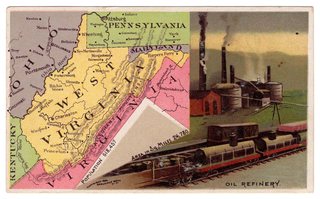
1889 Arbuckle Coffee Trade Card No 57 West Virginia State Map Oil Refinery Train

1889 Arbuckle Coffee Trade Card No 57 West Virginia State Map Oil Refinery Train — Original Victorian advertising trade card, chromolithograph, copyright 1889 by Arbuckle Bros., N.Y. Approx. 5.05 x 3.05 in.

$17.01 1889

Description

Arbuckle Bros Ariosa Coffee — West Virginia, State Map No. 57

A colored map of West Virginia, its towns and rivers lettered in, with Ohio, Pennsylvania, Maryland, Virginia and Kentucky around it. At the right an oil refinery rises behind a train of tank cars, smokestacks and storage tanks under a dark sky, captioned OIL REFINERY. Area in Sq. Miles 24,780. Population 618,457.

The reverse is headed ARBUCKLES' Ariosa Coffee, COSTS MORE AND IS WORTH MORE THAN OTHER BRANDS OF COFFEE. WHY? Four numbered reasons follow: the coffee is made from green coffee of higher grade; its strength and aroma are retained by the glazing; the glazing is made of choice eggs and pure confectioners' “A” sugar; and it adds richness of flavor. A BEWARE paragraph warns against low-grade package coffee. A second column, READ THIS, explains the series — fifty cards, each showing a correct map of one State or Territory with pictures of its peculiar industries and scenery — and suggests that anyone with two cards of one kind exchange with a neighbor. A list of the states and territories represented follows. Arbuckle Bros. Coffee Company, New York. The card is numbered 57. Printed by Donaldson Brothers, N.Y.

Read the full description

Historical Context

West Virginia was barely a quarter-century old when this card was printed, having split from Virginia during the Civil War. The map makes the point quietly, with Virginia drawn as a separate state along the eastern border.

The refinery and the tank cars show what the new state was selling. Oil and gas had been found along its rivers, and the railroad carried it out.

Condition

Toning and age typical of the period. A few small brown spots in the upper part of the image; light surface soiling; minor edge and corner wear; toning to the reverse. The chromolithographed image remains bright and the reverse text fully legible. Please view the images carefully.

About The Printing

This is an original chromolithograph, and it was slow, exacting work. Each color had to be drawn onto its own separate stone by hand — in monochrome, the artist judging how much stipple each area needed so the colors would combine correctly only once every stone had been printed. The sheet then went through the press once for every color it carries, often a dozen or more, and every pass had to register exactly against the last. A pass out of register showed.

Under magnification the image resolves into irregular hand-drawn stipple, each ink carrying its own dot pattern, the colors mixing in the eye rather than on the paper. There is no regular halftone screen and no four-color rosette, which is what a modern reproduction would show. Modern process printing simulates every color from four inks; chromolithography laid each color down as its own.

Provenance

From my family's estate collections, built over more than 60 years by knowledgeable antiques collectors and traders. Stored in a climate-controlled environment.

Also In Our Store

More Victorian advertising trade cards are in our store.

Disclaimer

The images and any video show the actual item and are part of the official listing description, so please review them closely. Measurements and weights are approximate, and any maker or material we haven't confirmed is described as assumed. Questions? Message us; we answer quickly.

View on eBay

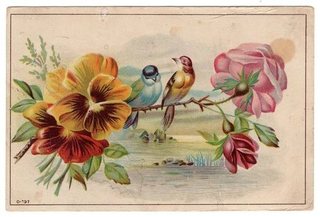
Victorian Trade Card C F Blanke Java Blend Coffee Birds Pansies Rose Calvert

C. F. Blanke Tea & Coffee Co. — Java Blend Coffee

$16.57

Original Victorian advertising trade card, chromolithograph, c. 1880s-90s. Approx. 5.40 x 3.60 in. Printed by Calvert Lith. Co., Detroit.

Two small birds, one with a blue head and one a gold finch, share a thorned rose branch above a still lake. Large yellow and maroon pansies fill the left of the card; a pink rose and a deep red rosebud hang at the right. The design sits inside a ruled border, and a printer's design number, C-797, is printed in the lower left corner.

The reverse, printed in blue, reads: C. F. BLANKE TEA & COFFEE CO'S JAVA BLEND COFFEE is a combination of JAVA, MOCHA, MARACAIBO AND SANTOS. It makes a delicious flavored and strong cup of COFFEE. TRY IT. YOU WILL LIKE IT. A BEAUTIFUL PICTURE CARD IN EVERY PACKAGE.

Read the full description

Historical Context

“A beautiful picture card in every package” is the whole strategy in one line. The picture has nothing to do with coffee and was never meant to. The design number in the corner gives it away: this is a printer's stock design, and Blanke bought it to put in the package because a pretty card got the next package bought.

The blend is named by where the beans came from — Java, Mocha, Maracaibo and Santos. Coffee was still sold by its port of origin, and a four-port blend was a way of promising something better than the plain Rio most people drank. The card does not say where Blanke was based; the company is generally associated with St. Louis.

Condition

Toning and age typical of the period. A circular water stain beside the rose in the upper right; fine surface crazing across the lower half of the front; a crease through the lower-left corner running through the design number; small surface losses along the top edge; a stain to the lower left of the reverse. Colors remain strong. Please view the images carefully.

About The Printing

This is an original chromolithograph, and it was slow, exacting work. Each color had to be drawn onto its own separate stone by hand — in monochrome, the artist judging how much stipple each area needed so the colors would combine correctly only once every stone had been printed. The sheet then went through the press once for every color it carries, often a dozen or more, and every pass had to register exactly against the last. A pass out of register showed.

Under magnification the image resolves into irregular hand-drawn stipple, each ink carrying its own dot pattern, the colors mixing in the eye rather than on the paper. There is no regular halftone screen and no four-color rosette, which is what a modern reproduction would show. Modern process printing simulates every color from four inks; chromolithography laid each color down as its own.

Provenance

This item comes from the personal collections of my family estate, accumulated over more than 200 years — including items that came west by wagon train to Colorado and later to Oklahoma. Now that my parents have passed we cannot keep all of these cherished items. They were well-educated antiques collectors/traders and continued to build their collections over more than 60 years. The vast majority of the pieces are from the Victorian Era, however there are plenty of older and newer items. Everything has been stored in a climate-controlled environment over time.

Disclaimer

Specifications and detailed item descriptions are provided as a courtesy only and are not guaranteed to be one hundred percent accurate. Please do your own research. There are generally no receipts available for any items from original purchases. Any dimensions and/or weights are approximate. The absence of a more detailed condition report does not imply there are no condition issues with the item(s). Please inspect images carefully as they are part of the official item description and best representation of the actual condition. Additional images may be available upon request depending on time and availability. Not responsible for internet mis-translations or mis-identification of maker's marks if found or assumptions of makers or materials — item descriptions will indicate if it is assumed. If you see a problem, please message us immediately and we will do our best to sort out a solution and confirm the information. With the exception of eBay rules, no returns are accepted.
View on eBay

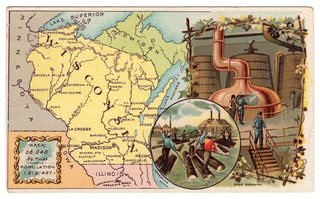
1889 Arbuckle Coffee Trade Card No 85 Wisconsin State Map Beer Brewery Logging

1889 Arbuckle Coffee Trade Card No 85 Wisconsin State Map Beer Brewery Logging — Original Victorian advertising trade card, chromolithograph, copyright 1889 by Arbuckle Bros., N.Y. Approx. 5.05 x 3.05 in.

$16.56 1889

Description

Arbuckle Bros Ariosa Coffee — Wisconsin, State Map No. 85

A colored map of Wisconsin, its towns and rivers lettered in, between Lake Superior and Lake Michigan, with Minnesota, Iowa, Illinois and Michigan around it. At the right is the interior of a BEER BREWERY — a great copper brew kettle, vats and workmen — and a roundel below shows lumbermen driving logs down a river toward a mill. Area 56,040 Sq. Miles. Population 1,315,497.

The reverse is headed ARBUCKLES' Ariosa Coffee, COSTS MORE AND IS WORTH MORE THAN OTHER BRANDS OF COFFEE. WHY? Four numbered reasons follow: the coffee is made from green coffee of higher grade; its strength and aroma are retained by the glazing; the glazing is made of choice eggs and pure confectioners' “A” sugar; and it adds richness of flavor. A BEWARE paragraph warns against low-grade package coffee. A second column, READ THIS, explains the series — fifty cards, each showing a correct map of one State or Territory with pictures of its peculiar industries and scenery — and suggests that anyone with two cards of one kind exchange with a neighbor. A list of the states and territories represented follows. Arbuckle Bros. Coffee Company, New York. The card is numbered 85. Printed by Donaldson Brothers, N.Y.

Read the full description

Historical Context

Beer and lumber were Wisconsin's two great industries in 1889, and the card gives one to each half of the picture. Milwaukee's brewers, many of them German immigrants, were already shipping beer nationally; the northern pineries were feeding the sawmills that built the prairie towns.

The copper brew kettle is drawn with real care, which is typical of this series: the artists clearly worked from real industrial scenes rather than inventing them.

Condition

Toning and age typical of the period. Light surface soiling; minor edge and corner wear; toning to the reverse. The chromolithographed image remains bright and the reverse text fully legible. Please view the images carefully.

About The Printing

This is an original chromolithograph, and it was slow, exacting work. Each color had to be drawn onto its own separate stone by hand — in monochrome, the artist judging how much stipple each area needed so the colors would combine correctly only once every stone had been printed. The sheet then went through the press once for every color it carries, often a dozen or more, and every pass had to register exactly against the last. A pass out of register showed.

Under magnification the image resolves into irregular hand-drawn stipple, each ink carrying its own dot pattern, the colors mixing in the eye rather than on the paper. There is no regular halftone screen and no four-color rosette, which is what a modern reproduction would show. Modern process printing simulates every color from four inks; chromolithography laid each color down as its own.

Provenance

From my family's estate collections, built over more than 60 years by knowledgeable antiques collectors and traders. Stored in a climate-controlled environment.

Also In Our Store

More Victorian advertising trade cards are in our store.

Disclaimer

The images and any video show the actual item and are part of the official listing description, so please review them closely. Measurements and weights are approximate, and any maker or material we haven't confirmed is described as assumed. Questions? Message us; we answer quickly.

View on eBay

1889 Arbuckle Coffee Trade Card No 53 Ireland Map Killarney Jaunting Car

1889 Arbuckle Coffee Trade Card No 53 Ireland Map Killarney Jaunting Car — Original Victorian advertising trade card, chromolithograph, copyright 1889 by Arbuckle Bros., N.Y. Approx. 5.10 x 3.00 in.

$16.33 1889

Description

Arbuckle Bros Ariosa Coffee — Ireland, Map Card No. 53

A colored map of Ireland, its counties and towns lettered in, shares the card with a view of Innisfallen, Killarney: a horse-drawn jaunting car with passengers in a red-wheeled cart beside the lake under the trees. The map panel is framed by the Atlantic Ocean, the Irish Sea and St. George's Channel, with Scotland, Wales and the Isle of Man at the edges. A panel at the foot reads: Area 32,531 Sq. M. Pop. 5,174,836. Constitutional Monarchy.

The reverse carries Arbuckle's GRIND YOUR COFFEE AT HOME advice and the ARIOSA claim, closing with the line that rival makers know no higher praise than to say “It's just as good as Arbuckles'.” An EXPLANATORY panel describes the series — fifty cards, each showing a correctly colored map of one of the chief countries of the world with pictures of its industries, scenery and customs — and explains that every package of Arbuckle's coffee contains one of these cards or one of the companion series of fifty Zoological cards. A list of the countries represented follows. Arbuckle Bros. Coffee Co., New York City. The card is numbered 53. Printed by Donaldson Brothers, N.Y.

Read the full description

Historical Context

The foreign map series put a country on one side of a card and its reputation on the other side of the picture. For Ireland, Arbuckle chose Killarney — lakes, trees, and a tourist on a jaunting car — rather than the Dublin they had shown in the travel series.

The government line, Constitutional Monarchy, is a period detail in itself. In 1889 Ireland was part of the United Kingdom, and the card lists it as a country of its own.

Condition

Toning and age typical of the period. Foxing and scattered spots along the top edge of the reverse; light surface soiling; minor edge and corner wear. The chromolithographed image remains bright and the reverse text legible. Please view the images carefully.

About The Printing

This is an original chromolithograph, and it was slow, exacting work. Each color had to be drawn onto its own separate stone by hand — in monochrome, the artist judging how much stipple each area needed so the colors would combine correctly only once every stone had been printed. The sheet then went through the press once for every color it carries, often a dozen or more, and every pass had to register exactly against the last. A pass out of register showed.

Under magnification the image resolves into irregular hand-drawn stipple, each ink carrying its own dot pattern, the colors mixing in the eye rather than on the paper. There is no regular halftone screen and no four-color rosette, which is what a modern reproduction would show. Modern process printing simulates every color from four inks; chromolithography laid each color down as its own.

Provenance

From my family's estate collections, built over more than 60 years by knowledgeable antiques collectors and traders. Stored in a climate-controlled environment.

Also In Our Store

More Victorian advertising trade cards are in our store.

Disclaimer

The images and any video show the actual item and are part of the official listing description, so please review them closely. Measurements and weights are approximate, and any maker or material we haven't confirmed is described as assumed. Questions? Message us; we answer quickly.

View on eBay

1880s Lion Coffee Victorian Trade Card Daffodils Winter Farm Scene Woolson Spice

1880s Lion Coffee Victorian Trade Card Daffodils Winter Farm Scene Woolson Spice — Yellow daffodils in a gilt-ringed circle beside a small winter vignette of a snowy farmhouse, on a pale green ground. Approx. 5.06 x 3.81 in.

$16.32

Description

Yellow daffodils in a gilt-ringed circle beside a small winter vignette of a snowy farmhouse, on a pale green ground.

The back is printed in black: "If you want a picture card like this buy a package of LION COFFEE. It is composed of a successful combination of Mocha, Java and Rio, and is roasted with the greatest care, but is not ground. Is never sold in bulk. Beautiful picture in every package. Lion is the King of Coffees. Manufactured by Woolson Spice Co., Toledo, Ohio."

Approx. 5.06 x 3.81 in.

Read the full description

Historical Context

The coffee that came with a picture. Lion Coffee began in Toledo, Ohio, in 1864 and became part of the Woolson Spice Company in 1882. Alvin Woolson built the brand by putting picture cards in every package, and the back of this card says so.

Condition

Front: very good, clean color. Back: small edge losses and scuffing at the corners and along the bottom line of text. Please see the photos, which are part of the description.

About The Printing

This is an original chromolithograph, and it was slow, exacting work. Each color had to be drawn onto its own separate stone by hand — in monochrome, the artist judging how much stipple each area needed so the colors would combine correctly only once every stone had been printed. The sheet then went through the press once for every color it carries, often a dozen or more, and every pass had to register exactly against the last. A pass out of register showed.

Under magnification the image resolves into irregular hand-drawn stipple, each ink carrying its own dot pattern, the colors mixing in the eye rather than on the paper. There is no regular halftone screen and no four-color rosette, which is what a modern reproduction would show. Modern process printing simulates every color from four inks; chromolithography laid each color down as its own.

The back is printed in black.

Provenance

From my family's estate collections, built over more than 60 years by knowledgeable antiques collectors and traders. Stored in a climate-controlled environment.

Also In Our Store

More Lion Coffee cards in our store: https://www.ebay.com/str/tfauctionsintl?_nkw=lion+coffee

More Victorian advertising trade cards are in our store.

Disclaimer

The images and any video show the actual item and are part of the official listing description, so please review them closely. Measurements and weights are approximate, and any maker or material we haven't confirmed is described as assumed. Questions? Message us; we answer quickly.

View on eBay

1891 Arbuckle Ariosa Coffee Trade Card Antwerp #6 Trip Around the World Knapp

DESCRIPTION

$16.21 1891

Card number 6 from Arbuckle's "Trip Around the World" series, a montage of Antwerp. The tall Gothic spire of "ANTWERP CATHEDRAL" rises at left over a busy square; at upper right a "MILK-MAID" in a white winged bonnet; a pair of skaters on the ice; a long "VIEW OF ANTWERP" skyline with a windmill; "A FISHERMAN" with pipe and cap in a medallion; and "THE FISH MARKET" with a statue fountain. Caption: "ANTWERP, HOLLAND." Small print at lower left: "COPYRIGHT 1891 BY ARBUCKLE BROS. N.Y."

The back is printed in blue: "One of 50 views from a trip around the world." At left, "GRIND YOUR COFFEE AT HOME," with the Ariosa claims: "So long as ARIOSA remains in the whole berry, our glazing, composed of choice eggs and pure confectioners' A sugar, closes the pores of the coffee," and "ARIOSA COFFEE has during 25 years set the standard for all other roasted coffees." Signed "ARBUCKLE BROS. NEW YORK CITY" and "JOSEPH P. KNAPP, LITH. N.Y." At right, a history of Antwerp (Rubens, the Cathedral of Notre Dame, "Population, 221,360"). Number 6 at the foot. Approx. 3.05 x 5.05 in.

Read the full description

Historical Context

The coffee that won the West. The Arbuckle brothers began roasting coffee in Pittsburgh and moved the business to New York City in 1871. John Arbuckle patented an egg-based glaze for roasted beans in 1868, and the packaged Ariosa brand became famous on the frontier. The back of this card explains the glaze in the company's own words.

Fifty views of the world. This is number 6 of the 1891 "Views from a Trip Around the World" series, one of the many numbered sets Arbuckle packed with its coffee to keep families buying, and collecting.

Antwerp, Holland? The front captions the city as being in Holland, while the text on the back correctly calls Antwerp "the chief commercial city of Belgium." A small slip of the period that collectors enjoy.

Printed by Knapp. The card is signed by Joseph P. Knapp, Lith., N.Y., one of the major color printers behind the Arbuckle series.

Condition

Very good. Front: colors bright and clean; corners lightly worn, the upper right slightly soft; light edge wear. Back: even light toning and a few tiny specks; print crisp and fully legible. Please see the photos, which are part of the description.

About The Printing

This is an original chromolithograph, and it was slow, exacting work. Each color had to be drawn onto its own separate stone by hand — in monochrome, the artist judging how much stipple each area needed so the colors would combine correctly only once every stone had been printed. The sheet then went through the press once for every color it carries, often a dozen or more, and every pass had to register exactly against the last. A pass out of register showed.

Under magnification the image resolves into irregular hand-drawn stipple, each ink carrying its own dot pattern, the colors mixing in the eye rather than on the paper. There is no regular halftone screen and no four-color rosette, which is what a modern reproduction would show. Modern process printing simulates every color from four inks; chromolithography laid each color down as its own.

The back is printed in a single blue ink.

Provenance

From my family's estate collections, built over more than 60 years by knowledgeable antiques collectors and traders. Stored in a climate-controlled environment.

Also In Our Store

More Arbuckle and other Victorian coffee trade cards, and trade cards for thread and patent medicines, are in our store.

Disclaimer

Specifications and detailed item descriptions are provided as a courtesy only and are not guaranteed to be one hundred percent accurate. Please do your own research. There are generally no receipts available for any items from original purchases. Any dimensions and/or weights are approximate. The absence of a more detailed condition report does not imply there are no condition issues with the item(s). Please inspect images carefully as they are part of the official item description and best representation of the actual condition. Additional images may be available upon request depending on time and availability. Not responsible for internet mis-translations or mis-identification of maker's marks if found or assumptions of makers or materials — item descriptions will indicate if it is assumed. If you see a problem, please message us immediately and we will do our best to sort out a solution and confirm the information. With the exception of eBay rules, no returns are accepted.
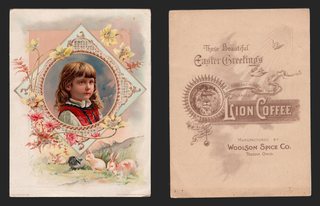
View on eBay

1889 Arbuckle Coffee Trade Card No 82 South Dakota State Map Elk Herd Prairie

1889 Arbuckle Coffee Trade Card No 82 South Dakota State Map Elk Herd Prairie — Original Victorian advertising trade card, chromolithograph, copyright 1889 by Arbuckle Bros., N.Y. Approx. 5.05 x 3.05 in.

$15.77 1889

Description

Arbuckle Bros Ariosa Coffee — South Dakota, State Map No. 82

A colored map of South Dakota, its towns and rivers lettered in, with North Dakota, Minnesota, Nebraska, Wyoming and Montana around it. Below the map a herd of elk grazes across the prairie, and in the foreground a bull elk with a full spread of antlers stands over a resting cow. A scroll at the right reads: Area 74,450 Sq. Miles. Population 67,589.

The reverse is headed ARBUCKLES' Ariosa Coffee, COSTS MORE AND IS WORTH MORE THAN OTHER BRANDS OF COFFEE. WHY? Four numbered reasons follow: the coffee is made from green coffee of higher grade; its strength and aroma are retained by the glazing; the glazing is made of choice eggs and pure confectioners' “A” sugar; and it adds richness of flavor. A BEWARE paragraph warns against low-grade package coffee. A second column, READ THIS, explains the series — fifty cards, each showing a correct map of one State or Territory with pictures of its peculiar industries and scenery — and suggests that anyone with two cards of one kind exchange with a neighbor. A list of the states and territories represented follows. Arbuckle Bros. Coffee Company, New York. The card is numbered 82. Printed by Donaldson Brothers, N.Y.

Read the full description

Historical Context

This card catches South Dakota at the moment it became a state. The Dakota Territory was divided and both halves admitted in November 1889, the same year as the copyright line — and Arbuckle already had a card for each half.

The elk herd is the picture of the country before the settlers finished arriving. The population figure is the other clue. This card prints 67,589 and the North Dakota card 67,588 — together 135,177, the 1880 census count for the whole Dakota Territory. Arbuckle appears simply to have split the old figure in half, because no separate count for either state yet existed.

Condition

Toning and age typical of the period. Light surface soiling; minor edge and corner wear; toning to the reverse. The chromolithographed image remains bright and the reverse text fully legible. Please view the images carefully.

About The Printing

This is an original chromolithograph, and it was slow, exacting work. Each color had to be drawn onto its own separate stone by hand — in monochrome, the artist judging how much stipple each area needed so the colors would combine correctly only once every stone had been printed. The sheet then went through the press once for every color it carries, often a dozen or more, and every pass had to register exactly against the last. A pass out of register showed.

Under magnification the image resolves into irregular hand-drawn stipple, each ink carrying its own dot pattern, the colors mixing in the eye rather than on the paper. There is no regular halftone screen and no four-color rosette, which is what a modern reproduction would show. Modern process printing simulates every color from four inks; chromolithography laid each color down as its own.

Provenance

From my family's estate collections, built over more than 60 years by knowledgeable antiques collectors and traders. Stored in a climate-controlled environment.

Also In Our Store

More Victorian advertising trade cards are in our store.

Disclaimer

The images and any video show the actual item and are part of the official listing description, so please review them closely. Measurements and weights are approximate, and any maker or material we haven't confirmed is described as assumed. Questions? Message us; we answer quickly.

View on eBay

1889 Arbuckle Coffee Trade Card No 71 Siberia Map Convicts in Mines Polar Bear

1889 Arbuckle Coffee Trade Card No 71 Siberia Map Convicts in Mines Polar Bear — Original Victorian advertising trade card, chromolithograph, copyright 1889 by Arbuckle Bros., N.Y. Approx. 5.05 x 3.10 in.

$15.31 1889

Description

Arbuckle Bros Ariosa Coffee — Siberia, Map Card No. 71

A colored map of Siberia, from the Arctic Ocean to the Chinese Empire, with Persia, Afghanistan and Beloochistan to the south and the Pacific to the east, marked Russian Possession. A polar bear looks out from a red roundel in the corner, and a broken shackle and chain hang below the map. The main scene, captioned CONVICTS AT WORK IN THE MINES, shows a line of convicts swinging picks in the snow under guards in greatcoats and caps, bayonets fixed, icicles hanging overhead. The map panel reads: Area 6,288,000 Sq. M. Pop. 14,697,000. Russian Possession.

The reverse carries Arbuckle's GRIND YOUR COFFEE AT HOME advice and the ARIOSA claim, closing with the line that rival makers know no higher praise than to say “It's just as good as Arbuckles'.” An EXPLANATORY panel describes the series — fifty cards, each showing a correctly colored map of one of the chief countries of the world with pictures of its industries, scenery and customs — and explains that every package of Arbuckle's coffee contains one of these cards or one of the companion series of fifty Zoological cards. A list of the countries represented follows. Arbuckle Bros. Coffee Co., New York City. The card is numbered 71. Printed by Donaldson Brothers, N.Y.

Read the full description

Historical Context

Siberia was the one place on the foreign map series with no industry to show except punishment. Russia sent convicts and political exiles east to the mines, and by the late 1880s American readers knew about it from George Kennan's reports in The Century magazine, which caused a sensation.

The shackle and chain beside the map is not decoration. For an American coffee buyer in 1889, Siberia meant exile.

Condition

Toning and age typical of the period. Light surface soiling; minor edge and corner wear; toning to the reverse. The chromolithographed image remains bright and the reverse text fully legible. Please view the images carefully.

About The Printing

This is an original chromolithograph, and it was slow, exacting work. Each color had to be drawn onto its own separate stone by hand — in monochrome, the artist judging how much stipple each area needed so the colors would combine correctly only once every stone had been printed. The sheet then went through the press once for every color it carries, often a dozen or more, and every pass had to register exactly against the last. A pass out of register showed.

Under magnification the image resolves into irregular hand-drawn stipple, each ink carrying its own dot pattern, the colors mixing in the eye rather than on the paper. There is no regular halftone screen and no four-color rosette, which is what a modern reproduction would show. Modern process printing simulates every color from four inks; chromolithography laid each color down as its own.

Provenance

From my family's estate collections, built over more than 60 years by knowledgeable antiques collectors and traders. Stored in a climate-controlled environment.

Also In Our Store

More Victorian advertising trade cards are in our store.

Disclaimer

The images and any video show the actual item and are part of the official listing description, so please review them closely. Measurements and weights are approximate, and any maker or material we haven't confirmed is described as assumed. Questions? Message us; we answer quickly.

View on eBay

Victorian Trade Card BBBB Coffee Acrostic Poem Red Rose Winter Abbey Ruin

Victorian Trade Card BBBB Coffee Acrostic Poem Red Rose Winter Abbey Ruin — Original Victorian advertising trade card, chromolithograph, c. 1880s-90s. Approx. 5.80 x 3.95 in.

$15.01

Description

“B.B.B.B.” Coffee — Red Rose with an Acrostic Back

A large deep-red rose with a bud, green leaves, fern and small yellow blossoms spreads across the upper part of the card, above a small winter scene of a turreted stone abbey beside a frozen pond. There is no lettering on the front.

The reverse is an acrostic — the first letter of each line spells out the brand. Do you Think? GOOD COFFEE SHOULD: Be free from all adulterations? Be possessed of considerable strength? Be sure to have a delicious flavor? Be FRESHLY ROASTED? IF SO, WE Certainly agree with you, On these all important points; For no single day passes but that we Freshly roast the “B.B.B.B.” the most Excellent grade of Coffee Ever put up in one-pound packages. Buy “B.B.B.B.”

Read the full description

Historical Context

Read down the left edge of the reverse and it spells B-B-B-B-C-O-F-F-E-E. A word puzzle on the back of a coffee card rewarded the reader for looking twice, and anyone who worked it out remembered the name.

The card does not say who roasted B.B.B.B. Coffee or where. That is part of its interest: a brand confident enough to go by four initials, and small enough that the name has not come down to us attached to a company.

Condition

Toning and age typical of the period. A small brown adhesion spot on the right of the reverse; a soft crease with light damage at the lower-right corner, visible on both sides; some rubbing across the center of the rose; light surface soiling. Colors remain rich. Please view the images carefully.

About The Printing

This is an original chromolithograph, and it was slow, exacting work. Each color had to be drawn onto its own separate stone by hand — in monochrome, the artist judging how much stipple each area needed so the colors would combine correctly only once every stone had been printed. The sheet then went through the press once for every color it carries, often a dozen or more, and every pass had to register exactly against the last. A pass out of register showed.

Under magnification the image resolves into irregular hand-drawn stipple, each ink carrying its own dot pattern, the colors mixing in the eye rather than on the paper. There is no regular halftone screen and no four-color rosette, which is what a modern reproduction would show. Modern process printing simulates every color from four inks; chromolithography laid each color down as its own.

Provenance

From my family's estate collections, built over more than 60 years by knowledgeable antiques collectors and traders. Stored in a climate-controlled environment.

Also In Our Store

More Victorian advertising trade cards are in our store.

Disclaimer

The images and any video show the actual item and are part of the official listing description, so please review them closely. Measurements and weights are approximate, and any maker or material we haven't confirmed is described as assumed. Questions? Message us; we answer quickly.

View on eBay

1889 Arbuckle Coffee Trade Card No 77 Illinois Map Watch Making Farm [SEE DESC]

Arbuckle Bros Ariosa Coffee — Illinois, State Map No. 77

$14.58 1889

Original Victorian advertising trade card, chromolithograph, copyright 1889 by Arbuckle Bros., N.Y. Approx. 5.05 x 3.05 in.

A colored map of Illinois, its towns and rivers lettered in, with Chicago on Lake Michigan and Wisconsin, Iowa, Missouri, Indiana and Kentucky around it. At the left, captioned WATCH MAKING, women work at benches in a factory under overhead belts, and a gold pocket watch lies open in a red presentation case. At the right, captioned AGRICULTURAL MACHINERY, a plow, a mower and a hay rake stand before a brick factory. Area in Sq. Miles 56,650. Population 3,077,871.

The reverse is headed ARBUCKLES' Ariosa Coffee, COSTS MORE AND IS WORTH MORE THAN OTHER BRANDS OF COFFEE. WHY? Four numbered reasons follow: the coffee is made from green coffee of higher grade; its strength and aroma are retained by the glazing; the glazing is made of choice eggs and pure confectioners' “A” sugar; and it adds richness of flavor. A BEWARE paragraph warns against low-grade package coffee. A second column, READ THIS, explains the series — fifty cards, each showing a correct map of one State or Territory with pictures of its peculiar industries and scenery — and suggests that anyone with two cards of one kind exchange with a neighbor. A list of the states and territories represented follows. Arbuckle Bros. Coffee Company, New York. The card is numbered 77. Printed by Donaldson Brothers, N.Y.

Read the full description

Historical Context

Illinois gets two industries that would both have been instantly recognizable to a buyer in 1889. The Elgin watch works outside Chicago was one of the largest in the world, and Illinois factories were making the plows and reapers that were opening the prairie farms further west.

The women at the watch benches are a detail worth noticing. Fine assembly work of this kind was widely given to women workers, and the card shows it as simply part of the scene.

Condition

Toning and age typical of the period. Light surface soiling; minor edge and corner wear; toning to the reverse. The chromolithographed image remains bright and the reverse text fully legible. Please view the images carefully.

About The Printing

This is an original chromolithograph, and it was slow, exacting work. Each color had to be drawn onto its own separate stone by hand — in monochrome, the artist judging how much stipple each area needed so the colors would combine correctly only once every stone had been printed. The sheet then went through the press once for every color it carries, often a dozen or more, and every pass had to register exactly against the last. A pass out of register showed.

Under magnification the image resolves into irregular hand-drawn stipple, each ink carrying its own dot pattern, the colors mixing in the eye rather than on the paper. There is no regular halftone screen and no four-color rosette, which is what a modern reproduction would show. Modern process printing simulates every color from four inks; chromolithography laid each color down as its own.

Provenance

This item comes from the personal collections of my family estate, accumulated over more than 200 years — including items that came west by wagon train to Colorado and later to Oklahoma. Now that my parents have passed we cannot keep all of these cherished items. They were well-educated antiques collectors/traders and continued to build their collections over more than 60 years. The vast majority of the pieces are from the Victorian Era, however there are plenty of older and newer items. Everything has been stored in a climate-controlled environment over time.

Disclaimer

Specifications and detailed item descriptions are provided as a courtesy only and are not guaranteed to be one hundred percent accurate. Please do your own research. There are generally no receipts available for any items from original purchases. Any dimensions and/or weights are approximate. The absence of a more detailed condition report does not imply there are no condition issues with the item(s). Please inspect images carefully as they are part of the official item description and best representation of the actual condition. Additional images may be available upon request depending on time and availability. Not responsible for internet mis-translations or mis-identification of maker's marks if found or assumptions of makers or materials — item descriptions will indicate if it is assumed. If you see a problem, please message us immediately and we will do our best to sort out a solution and confirm the information. With the exception of eBay rules, no returns are accepted.
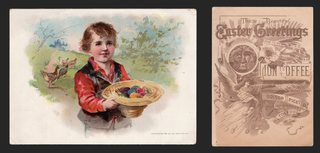
View on eBay

1889 Arbuckle Coffee Trade Card No 96 North Dakota Map Wheat Reaping [SEE DESC]

Arbuckle Bros Ariosa Coffee — North Dakota, State Map No. 96

$14.47 1889

Original Victorian advertising trade card, chromolithograph, copyright 1889 by Arbuckle Bros., N.Y. Approx. 5.05 x 3.05 in.

A colored map of North Dakota, its towns, forts and rivers lettered in, with Canada, Minnesota, South Dakota and Montana around it, hung from a ribbon with a sheaf of golden wheat. Captioned WHEAT FIELDS, the scene runs across the whole card: at the left, SOWING, farmers with horse-drawn seed drills, a wagon and sacks of seed; at the right, REAPING, a horse-drawn binder cutting the grain and shocks of wheat standing in the field. A gold cartouche reads: Area 77,000 Sq. Miles. Population 67,588.

The reverse is headed ARBUCKLES' Ariosa Coffee, COSTS MORE AND IS WORTH MORE THAN OTHER BRANDS OF COFFEE. WHY? Four numbered reasons follow: the coffee is made from green coffee of higher grade; its strength and aroma are retained by the glazing; the glazing is made of choice eggs and pure confectioners' “A” sugar; and it adds richness of flavor. A BEWARE paragraph warns against low-grade package coffee. A second column, READ THIS, explains the series — fifty cards, each showing a correct map of one State or Territory with pictures of its peculiar industries and scenery — and suggests that anyone with two cards of one kind exchange with a neighbor. A list of the states and territories represented follows. Arbuckle Bros. Coffee Company, New York. The card is numbered 96. Printed by Donaldson Brothers, N.Y.

Read the full description

Historical Context

North Dakota in 1889 was wheat, and nothing else on the card needs saying. The great bonanza farms of the Red River Valley ran to tens of thousands of acres, worked by gangs of men and machines exactly like the ones drawn here.

Like the South Dakota card, this one arrived just as the territory was divided. Both halves became states in November 1889, and Arbuckle had a map ready for each. The population figures give the game away: this card prints 67,588 and the South Dakota card 67,589. Together they make 135,177, the 1880 census count for the whole Dakota Territory. Arbuckle appears simply to have split the old figure in half.

Condition

Toning and age typical of the period. Light surface soiling; minor edge and corner wear; toning to the reverse. The chromolithographed image remains bright and the reverse text fully legible. Please view the images carefully.

About The Printing

This is an original chromolithograph, and it was slow, exacting work. Each color had to be drawn onto its own separate stone by hand — in monochrome, the artist judging how much stipple each area needed so the colors would combine correctly only once every stone had been printed. The sheet then went through the press once for every color it carries, often a dozen or more, and every pass had to register exactly against the last. A pass out of register showed.

Under magnification the image resolves into irregular hand-drawn stipple, each ink carrying its own dot pattern, the colors mixing in the eye rather than on the paper. There is no regular halftone screen and no four-color rosette, which is what a modern reproduction would show. Modern process printing simulates every color from four inks; chromolithography laid each color down as its own.

Provenance

This item comes from the personal collections of my family estate, accumulated over more than 200 years — including items that came west by wagon train to Colorado and later to Oklahoma. Now that my parents have passed we cannot keep all of these cherished items. They were well-educated antiques collectors/traders and continued to build their collections over more than 60 years. The vast majority of the pieces are from the Victorian Era, however there are plenty of older and newer items. Everything has been stored in a climate-controlled environment over time.

Disclaimer

Specifications and detailed item descriptions are provided as a courtesy only and are not guaranteed to be one hundred percent accurate. Please do your own research. There are generally no receipts available for any items from original purchases. Any dimensions and/or weights are approximate. The absence of a more detailed condition report does not imply there are no condition issues with the item(s). Please inspect images carefully as they are part of the official item description and best representation of the actual condition. Additional images may be available upon request depending on time and availability. Not responsible for internet mis-translations or mis-identification of maker's marks if found or assumptions of makers or materials — item descriptions will indicate if it is assumed. If you see a problem, please message us immediately and we will do our best to sort out a solution and confirm the information. With the exception of eBay rules, no returns are accepted.
View on eBay

1889 Arbuckle Coffee Trade Card No 97 Colorado State Map Pikes Peak Silver Mine

Arbuckle Bros Ariosa Coffee — Colorado, State Map No. 97

$14.28 1889

Original Victorian advertising trade card, chromolithograph, copyright 1889 by Arbuckle Bros., N.Y. Approx. 5.05 x 3.00 in.

A colored map of Colorado, its towns, parks and rivers lettered in, with Wyoming, Nebraska, Kansas, New Mexico, Utah, Arizona, Texas and the Public Lands around it. It is flanked by two mountain views, PIKE'S PEAK at the left above a forest of pines, and MT. OF THE HOLY CROSS at the right, with a SILVER MINE and its mill buildings at the foot. A scroll reads: Area 103,925 Sq. Miles. Population 194,327.

The reverse is headed ARBUCKLES' Ariosa Coffee, COSTS MORE AND IS WORTH MORE THAN OTHER BRANDS OF COFFEE. WHY? Four numbered reasons follow: the coffee is made from green coffee of higher grade; its strength and aroma are retained by the glazing; the glazing is made of choice eggs and pure confectioners' “A” sugar; and it adds richness of flavor. A BEWARE paragraph warns against low-grade package coffee. A second column, READ THIS, explains the series — fifty cards, each showing a correct map of one State or Territory with pictures of its peculiar industries and scenery — and suggests that anyone with two cards of one kind exchange with a neighbor. A list of the states and territories represented follows. Arbuckle Bros. Coffee Company, New York. The card is numbered 97. Printed by Donaldson Brothers, N.Y.

Read the full description

Historical Context

Colorado in 1889 meant mountains and silver. Leadville and the other mining camps had made fortunes in the previous decade, and the silver mine at the foot of the card was the reason most people had come.

The Mount of the Holy Cross was famous from William Henry Jackson's photograph of the snow-filled cross on its face, and it was one of the best-known mountain views in America. The card puts it alongside Pike's Peak as the two Colorado landmarks a buyer back east would recognize.

Condition

Toning and age typical of the period. Light surface soiling; minor edge and corner wear; toning to the reverse. The chromolithographed image remains bright and the reverse text fully legible. Please view the images carefully.

About The Printing

This is an original chromolithograph, and it was slow, exacting work. Each color had to be drawn onto its own separate stone by hand — in monochrome, the artist judging how much stipple each area needed so the colors would combine correctly only once every stone had been printed. The sheet then went through the press once for every color it carries, often a dozen or more, and every pass had to register exactly against the last. A pass out of register showed.

Under magnification the image resolves into irregular hand-drawn stipple, each ink carrying its own dot pattern, the colors mixing in the eye rather than on the paper. There is no regular halftone screen and no four-color rosette, which is what a modern reproduction would show. Modern process printing simulates every color from four inks; chromolithography laid each color down as its own.

Provenance

This item comes from the personal collections of my family estate, accumulated over more than 200 years — including items that came west by wagon train to Colorado and later to Oklahoma. Now that my parents have passed we cannot keep all of these cherished items. They were well-educated antiques collectors/traders and continued to build their collections over more than 60 years. The vast majority of the pieces are from the Victorian Era, however there are plenty of older and newer items. Everything has been stored in a climate-controlled environment over time.

Disclaimer

Specifications and detailed item descriptions are provided as a courtesy only and are not guaranteed to be one hundred percent accurate. Please do your own research. There are generally no receipts available for any items from original purchases. Any dimensions and/or weights are approximate. The absence of a more detailed condition report does not imply there are no condition issues with the item(s). Please inspect images carefully as they are part of the official item description and best representation of the actual condition. Additional images may be available upon request depending on time and availability. Not responsible for internet mis-translations or mis-identification of maker's marks if found or assumptions of makers or materials — item descriptions will indicate if it is assumed. If you see a problem, please message us immediately and we will do our best to sort out a solution and confirm the information. With the exception of eBay rules, no returns are accepted.
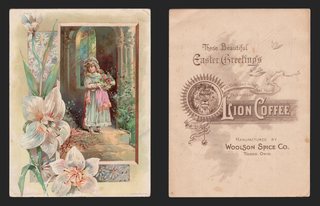
View on eBay

1889 Arbuckle Coffee Trade Card No 92 Mexico Map Bull Fighting Mules [SEE DESC]

Arbuckle Bros Ariosa Coffee — Mexico, Map Card No. 92

$13.66 1889

Original Victorian advertising trade card, chromolithograph, copyright 1889 by Arbuckle Bros., N.Y. Approx. 4.95 x 3.15 in.

A colored map of Mexico, its states and towns lettered in, with the United States to the north, the Gulf of Mexico and the Pacific Ocean on either side, and Central America to the south. At the left, captioned BULL FIGHTING, a matador with a red cape and a mounted picador face a charging bull before a stand of spectators hung with flags. An inset at the upper right, captioned MULE TRAIN CROSSING THE MOUNTAINS, shows pack mules on a mountain trail. The map panel gives the government as a Federal Republic, with Pop. 10,000,000 and Area 772,000 Sq. M. printed beneath.

The reverse carries Arbuckle's GRIND YOUR COFFEE AT HOME advice and the ARIOSA claim, closing with the line that rival makers know no higher praise than to say “It's just as good as Arbuckles'.” An EXPLANATORY panel describes the series — fifty cards, each showing a correctly colored map of one of the chief countries of the world with pictures of its industries, scenery and customs — and explains that every package of Arbuckle's coffee contains one of these cards or one of the companion series of fifty Zoological cards. A list of the countries represented follows. Arbuckle Bros. Coffee Co., New York City. The card is numbered 92. Printed by Donaldson Brothers, N.Y.

Read the full description

Historical Context

Mexico in 1889 was drawing American railroads and investment south, and the mule train in the corner shows the country those railroads were replacing — goods carried over the mountains on animals, as they had been for centuries.

The bullfight was the image every American reader associated with Mexico, and the card leads with it. It is the most dramatic scene in the foreign map series.

Condition

Toning and age typical of the period. Light surface soiling; minor edge and corner wear; toning to the reverse. The chromolithographed image remains bright and the reverse text fully legible. Please view the images carefully.

About The Printing

This is an original chromolithograph, and it was slow, exacting work. Each color had to be drawn onto its own separate stone by hand — in monochrome, the artist judging how much stipple each area needed so the colors would combine correctly only once every stone had been printed. The sheet then went through the press once for every color it carries, often a dozen or more, and every pass had to register exactly against the last. A pass out of register showed.

Under magnification the image resolves into irregular hand-drawn stipple, each ink carrying its own dot pattern, the colors mixing in the eye rather than on the paper. There is no regular halftone screen and no four-color rosette, which is what a modern reproduction would show. Modern process printing simulates every color from four inks; chromolithography laid each color down as its own.

Provenance

This item comes from the personal collections of my family estate, accumulated over more than 200 years — including items that came west by wagon train to Colorado and later to Oklahoma. Now that my parents have passed we cannot keep all of these cherished items. They were well-educated antiques collectors/traders and continued to build their collections over more than 60 years. The vast majority of the pieces are from the Victorian Era, however there are plenty of older and newer items. Everything has been stored in a climate-controlled environment over time.

Disclaimer

Specifications and detailed item descriptions are provided as a courtesy only and are not guaranteed to be one hundred percent accurate. Please do your own research. There are generally no receipts available for any items from original purchases. Any dimensions and/or weights are approximate. The absence of a more detailed condition report does not imply there are no condition issues with the item(s). Please inspect images carefully as they are part of the official item description and best representation of the actual condition. Additional images may be available upon request depending on time and availability. Not responsible for internet mis-translations or mis-identification of maker's marks if found or assumptions of makers or materials — item descriptions will indicate if it is assumed. If you see a problem, please message us immediately and we will do our best to sort out a solution and confirm the information. With the exception of eBay rules, no returns are accepted.
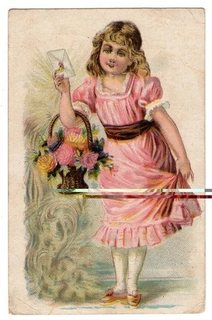
View on eBay

Victorian Trade Card McLaughlin's XXXX Coffee Chicago Boy Portrait Sepia Stipple

McLaughlin's XXXX Coffee — W. F. McLaughlin & Co., Chicago

$13.63

Original Victorian advertising trade card, single-color lithograph on tinted stock, c. 1880s. Approx. 3.50 x 2.30 in.

A portrait of a boy with long curling hair and a wide open collar, one hand held to his chest, printed in a single deep brown-violet ink in the manner of a stipple engraving. Lettered in script beside him: McLaughlin's XXXX Coffee.

The reverse reads: McLAUGHLIN'S ROASTED COFFEE, ONE POUND PACKAGES. BEST VALUE FOR YOUR MONEY. It costs the grocer more money than any other package Coffee, but to the consumer is worth at least 5 cents a pound more. Try it once and we will guarantee you will have no other. For sale by all the best grocers. W. F. McLAUGHLIN & CO., Importers, Jobbers and Roasters of Coffee, 82, 84, 86 and 88 South Water St., CHICAGO.

Read the full description

Historical Context

The back makes an unusual confession: this coffee costs the grocer more than any other package brand. Most advertisers hid their price. McLaughlin put it up front and turned it into the argument — the grocer pays more, so the grocer must think it is worth it, and you get five cents a pound of value you did not pay for.

Packaged coffee in one-pound bags was still a new idea. Most people bought coffee loose, often green, and roasted it at home. A card like this was selling the package as much as the coffee.

Condition

Toning and age typical of the period. A paler strip along the left edge of the front; a small stain on the boy's cheek; light foxing to the lower left of the reverse; minor edge and corner wear. The printed image remains clear and the reverse text fully legible. Please view the images carefully.

About The Printing

This card was printed from a single stone in one ink, on tinted stock — an economical choice, since the colored card supplies a second tone at no extra press pass. The design was drawn by hand in reverse on the stone, the shading built from the density of the drawn marks rather than from color.

Under magnification the tone resolves into hand-drawn stipple, not a mechanical screen. There is no halftone screen and no four-color rosette, which is what a modern reproduction would show.

Provenance

This item comes from the personal collections of my family estate, accumulated over more than 200 years — including items that came west by wagon train to Colorado and later to Oklahoma. Now that my parents have passed we cannot keep all of these cherished items. They were well-educated antiques collectors/traders and continued to build their collections over more than 60 years. The vast majority of the pieces are from the Victorian Era, however there are plenty of older and newer items. Everything has been stored in a climate-controlled environment over time.

Disclaimer

Specifications and detailed item descriptions are provided as a courtesy only and are not guaranteed to be one hundred percent accurate. Please do your own research. There are generally no receipts available for any items from original purchases. Any dimensions and/or weights are approximate. The absence of a more detailed condition report does not imply there are no condition issues with the item(s). Please inspect images carefully as they are part of the official item description and best representation of the actual condition. Additional images may be available upon request depending on time and availability. Not responsible for internet mis-translations or mis-identification of maker's marks if found or assumptions of makers or materials — item descriptions will indicate if it is assumed. If you see a problem, please message us immediately and we will do our best to sort out a solution and confirm the information. With the exception of eBay rules, no returns are accepted.
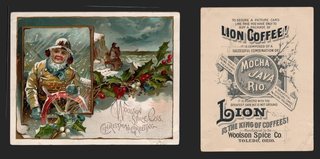
View on eBay

1880s Lion Coffee Trade Card Bullfinch Pink Flower Winter Cottage Woolson Spice

1880s Lion Coffee Trade Card Bullfinch Pink Flower Winter Cottage Woolson Spice — A bullfinch perched on a branch above a pink flower, with a round winter vignette of a snowy cottage. Approx. 3.39 x 5.36 in.

$13.52

Description

A bullfinch perched on a branch above a pink flower, with a round winter vignette of a snowy cottage.

The back is printed in black in a mix of decorative typefaces: "If you want a Picture Card like this buy a package of LION COFFEE. It is composed of a successful combination of Mocha, Java and Rio, and is roasted with the greatest care but is not ground. Is never sold in bulk. Beautiful Picture in Every Package. Lion is the King of Coffees. Manufactured by Woolson Spice Co., Toledo, Ohio."

Approx. 3.39 x 5.36 in.

Read the full description

Historical Context

The coffee that came with a picture. Lion Coffee began in Toledo, Ohio, in 1864 and became part of the Woolson Spice Company in 1882. Alvin Woolson built the brand by putting picture cards in every package, and the back of this card says so.

Condition

Front: very good, clean color. Back: heavy staining and scuffing, with small paper losses at the corners; text legible. Please see the photos, which are part of the description.

About The Printing

This is an original chromolithograph, and it was slow, exacting work. Each color had to be drawn onto its own separate stone by hand — in monochrome, the artist judging how much stipple each area needed so the colors would combine correctly only once every stone had been printed. The sheet then went through the press once for every color it carries, often a dozen or more, and every pass had to register exactly against the last. A pass out of register showed.

Under magnification the image resolves into irregular hand-drawn stipple, each ink carrying its own dot pattern, the colors mixing in the eye rather than on the paper. There is no regular halftone screen and no four-color rosette, which is what a modern reproduction would show. Modern process printing simulates every color from four inks; chromolithography laid each color down as its own.

The back is printed in black.

Provenance

From my family's estate collections, built over more than 60 years by knowledgeable antiques collectors and traders. Stored in a climate-controlled environment.

Also In Our Store

More Lion Coffee cards in our store: https://www.ebay.com/str/tfauctionsintl?_nkw=lion+coffee

More Victorian advertising trade cards are in our store.

Disclaimer

The images and any video show the actual item and are part of the official listing description, so please review them closely. Measurements and weights are approximate, and any maker or material we haven't confirmed is described as assumed. Questions? Message us; we answer quickly.

View on eBay

1889 Arbuckle Coffee Trade Card No 95 Netherlands Holland Map Fishing Dairy

Arbuckle Bros Ariosa Coffee — Netherlands, Map Card No. 95

$13.17 1889

Original Victorian advertising trade card, chromolithograph, copyright 1889 by Arbuckle Bros., N.Y. Approx. 5.05 x 3.05 in.

A colored map of the Netherlands, its towns lettered in, with the North Sea, Belgium and Germany around it, drawn on an unrolled scroll. At the left, captioned FISHING, Dutch women in white caps and aprons carry baskets along a beach, with fishing boats behind them. At the right, captioned DAIRY PRODUCTS, a brown cow grazes in a green meadow. A line at the foot reads: Gov.: Constitutional Monarchy. Pop. 4,114,000. Area 12,740 Sq. M.

The reverse carries Arbuckle's GRIND YOUR COFFEE AT HOME advice and the ARIOSA claim, closing with the line that rival makers know no higher praise than to say “It's just as good as Arbuckles'.” An EXPLANATORY panel describes the series — fifty cards, each showing a correctly colored map of one of the chief countries of the world with pictures of its industries, scenery and customs — and explains that every package of Arbuckle's coffee contains one of these cards or one of the companion series of fifty Zoological cards. A list of the countries represented follows. Arbuckle Bros. Coffee Co., New York City. The card is numbered 95. Printed by Donaldson Brothers, N.Y.

Read the full description

Historical Context

Fish and dairy, the two things the Dutch sent abroad, are how the card sums up the country. The women on the beach are the fishermen's wives who carried the catch inland to market, and they were a favorite subject for painters of the period.

The map is drawn on a scroll unrolling across the card, one of the more inventive layouts in the foreign series.

Condition

Toning and age typical of the period. A small pencil mark at the upper right of the reverse; light surface soiling; minor edge and corner wear; toning to the reverse. The chromolithographed image remains bright and the reverse text fully legible. Please view the images carefully.

About The Printing

This is an original chromolithograph, and it was slow, exacting work. Each color had to be drawn onto its own separate stone by hand — in monochrome, the artist judging how much stipple each area needed so the colors would combine correctly only once every stone had been printed. The sheet then went through the press once for every color it carries, often a dozen or more, and every pass had to register exactly against the last. A pass out of register showed.

Under magnification the image resolves into irregular hand-drawn stipple, each ink carrying its own dot pattern, the colors mixing in the eye rather than on the paper. There is no regular halftone screen and no four-color rosette, which is what a modern reproduction would show. Modern process printing simulates every color from four inks; chromolithography laid each color down as its own.

Provenance

This item comes from the personal collections of my family estate, accumulated over more than 200 years — including items that came west by wagon train to Colorado and later to Oklahoma. Now that my parents have passed we cannot keep all of these cherished items. They were well-educated antiques collectors/traders and continued to build their collections over more than 60 years. The vast majority of the pieces are from the Victorian Era, however there are plenty of older and newer items. Everything has been stored in a climate-controlled environment over time.

Disclaimer

Specifications and detailed item descriptions are provided as a courtesy only and are not guaranteed to be one hundred percent accurate. Please do your own research. There are generally no receipts available for any items from original purchases. Any dimensions and/or weights are approximate. The absence of a more detailed condition report does not imply there are no condition issues with the item(s). Please inspect images carefully as they are part of the official item description and best representation of the actual condition. Additional images may be available upon request depending on time and availability. Not responsible for internet mis-translations or mis-identification of maker's marks if found or assumptions of makers or materials — item descriptions will indicate if it is assumed. If you see a problem, please message us immediately and we will do our best to sort out a solution and confirm the information. With the exception of eBay rules, no returns are accepted.
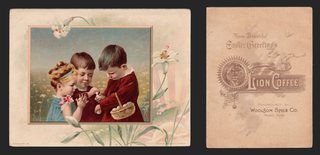
View on eBay

Arbuckle Ariosa Coffee Trade Card No 27 Big Horn Sheep Zoological [SEE DESC]

Arbuckle Bros Ariosa Coffee — Zoological Series No. 27, “Big-Horn”

$12.23

Original Victorian advertising trade card, chromolithograph, copyright 1890 by Arbuckle Bros. Coffee Co. Approx. 5.10 x 3.05 in. Printed by Knapp & Co. Lith., New York.

A bighorn ram and a younger animal bound down a rocky mountain slope, pine woods behind and a pale sky above. Captioned in the lower margin: BIG-HORN (Capra montana). The card is numbered 27 on the reverse.

The reverse carries three blocks of text. GRIND YOUR COFFEE AT HOME advises keeping a small coffee-mill in the kitchen and grinding one mess at a time, noting that coffee loses more of its strength and aroma in an hour after grinding than in six months before. An EXPLANATORY panel sets out the series: fifty cards, each showing a true picture drawn and colored by an eminent artist of one of the most interesting specimens of the animal kingdom, with the classical appellation together with the English name. It explains that every package of Arbuckle's Coffee contains either one of these cards or one of a companion series of fifty National Geographical cards, distributed so that each package in a hundred-pound case carries a card different from all the others. A third block promotes ARIOSA COFFEE, and a full list of the fifty animals represented runs down the right-hand side.

Read the full description

Historical Context

Arbuckle sold coffee by making the package worth opening. Fifty animals in one series, fifty maps in another, distributed so that no two packages in a case matched — a child who wanted the complete set had to keep the family buying coffee. It is a loyalty scheme a century before the phrase existed, and it worked well enough that Arbuckle became one of the largest coffee businesses in the country.

The reverse contains a small masterpiece of competitive advertising. Arbuckle observes that rival manufacturers, recommending their own goods, have known no higher praise than to say “It's just as good as Arbuckles'.” Quoting your competitors' own words back as proof of your standing is a move that has aged very well.

Condition

Toning and age typical of the period. Creasing and a short split across the upper right of the card; light surface soiling; minor edge and corner wear; toning to the reverse. The chromolithographed image remains bright and the reverse text fully legible. Please view the images carefully.

About The Printing

This is an original chromolithograph, and it was slow, exacting work. Each color had to be drawn onto its own separate stone by hand — in monochrome, the artist judging how much stipple each area needed so the colors would combine correctly only once every stone had been printed. The sheet then went through the press once for every color it carries, often a dozen or more, and every pass had to register exactly against the last. A pass out of register showed.

Under magnification the image resolves into irregular hand-drawn stipple, each ink carrying its own dot pattern, the colors mixing in the eye rather than on the paper. There is no regular halftone screen and no four-color rosette, which is what a modern reproduction would show. Modern process printing simulates every color from four inks; chromolithography laid each color down as its own.

Provenance

This item comes from the personal collections of my family estate, accumulated over more than 200 years — including items that came west by wagon train to Colorado and later to Oklahoma. Now that my parents have passed we cannot keep all of these cherished items. They were well-educated antiques collectors/traders and continued to build their collections over more than 60 years. The vast majority of the pieces are from the Victorian Era, however there are plenty of older and newer items. Everything has been stored in a climate-controlled environment over time.

Disclaimer

Specifications and detailed item descriptions are provided as a courtesy only and are not guaranteed to be one hundred percent accurate. Please do your own research. There are generally no receipts available for any items from original purchases. Any dimensions and/or weights are approximate. The absence of a more detailed condition report does not imply there are no condition issues with the item(s). Please inspect images carefully as they are part of the official item description and best representation of the actual condition. Additional images may be available upon request depending on time and availability. Not responsible for internet mis-translations or mis-identification of maker's marks if found or assumptions of makers or materials — item descriptions will indicate if it is assumed. If you see a problem, please message us immediately and we will do our best to sort out a solution and confirm the information. With the exception of eBay rules, no returns are accepted.
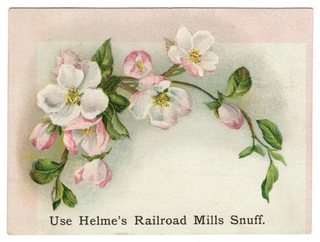
View on eBay

1891 Arbuckle Coffee Trade Card No 29 Dublin Ireland Around World [SEE DESC]

Arbuckle Bros Ariosa Coffee — “Dublin, Ireland,” No. 29 of 50 Views from a Trip Around the World

$12.11 1891

Original Victorian advertising trade card, chromolithograph, copyright 1891. Approx. 5.05 x 3.05 in. Printed by Joseph P. Knapp, Lith., N.Y.

A panorama of Dublin from Phoenix Park, with the river, a stone bridge and red-roofed houses, is surrounded by vignettes: a Colleen in a patterned headscarf; the Custom House with sailing ships at the quay; a Laborer with a clay pipe; and An Irish Jaunting Car, a horse-drawn side car with passengers and a girl at the roadside. A sprig of shamrock and pink clover blossoms sits at the center. Lettered at the foot: DUBLIN, IRELAND, and COPYRIGHT 1891 BY ARBUCKLE BROS. N.Y.

The reverse is headed One of 50 views from a trip around the world, and is numbered 29. The left column carries Arbuckle's GRIND YOUR COFFEE AT HOME advice and the ARIOSA COFFEE claim, closing with the line that rival makers know no higher praise than to say “It's just as good as Arbuckles'.” The right column is a travel sketch of Dublin — Sackville Street, the Nelson Monument, Trinity College and its library, Christ Church and St. Patrick's Cathedral, the house where Thomas Moore was born, and Phoenix Park with the Wellington Testimonial — ending with the population as of 1881.

Read the full description

Historical Context

Arbuckle ran several numbered series at once, and this is the travel series: fifty stops on an armchair tour of the world, one per package of coffee. The reverse reads like a guidebook, and for many households in 1891 it was the only guidebook to Dublin they would ever own.

The front shows the working of the series well. A city view, a landmark, and a pair of local types — the colleen and the laborer — each framed like a postcard pinned to a board. It is how most Americans of the period expected to meet a foreign country: as a set of pictures, collected one at a time.

Condition

Toning and age typical of the period. A short split and a small brown spot at the bottom edge below the title; wear to the lower-left corner; light edge toning; minor corner wear elsewhere. The chromolithographed image remains bright and the reverse text fully legible. Please view the images carefully.

About The Printing

This is an original chromolithograph, and it was slow, exacting work. Each color had to be drawn onto its own separate stone by hand — in monochrome, the artist judging how much stipple each area needed so the colors would combine correctly only once every stone had been printed. The sheet then went through the press once for every color it carries, often a dozen or more, and every pass had to register exactly against the last. A pass out of register showed.

Under magnification the image resolves into irregular hand-drawn stipple, each ink carrying its own dot pattern, the colors mixing in the eye rather than on the paper. There is no regular halftone screen and no four-color rosette, which is what a modern reproduction would show. Modern process printing simulates every color from four inks; chromolithography laid each color down as its own.

Provenance

This item comes from the personal collections of my family estate, accumulated over more than 200 years — including items that came west by wagon train to Colorado and later to Oklahoma. Now that my parents have passed we cannot keep all of these cherished items. They were well-educated antiques collectors/traders and continued to build their collections over more than 60 years. The vast majority of the pieces are from the Victorian Era, however there are plenty of older and newer items. Everything has been stored in a climate-controlled environment over time.

Disclaimer

Specifications and detailed item descriptions are provided as a courtesy only and are not guaranteed to be one hundred percent accurate. Please do your own research. There are generally no receipts available for any items from original purchases. Any dimensions and/or weights are approximate. The absence of a more detailed condition report does not imply there are no condition issues with the item(s). Please inspect images carefully as they are part of the official item description and best representation of the actual condition. Additional images may be available upon request depending on time and availability. Not responsible for internet mis-translations or mis-identification of maker's marks if found or assumptions of makers or materials — item descriptions will indicate if it is assumed. If you see a problem, please message us immediately and we will do our best to sort out a solution and confirm the information. With the exception of eBay rules, no returns are accepted.
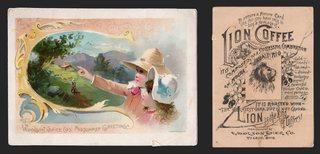
View on eBay

Victorian Arbuckles Ariosa Coffee Trade Card Winter Mill Red Quince Flowers

Arbuckle Bros Ariosa Coffee — Winter Mill and Flowering Quince

$10.91

Original Victorian advertising trade card, chromolithograph, c. 1880s-90s. Approx. 5.00 x 3.05 in.

A branch of red flowering quince, with open blossoms and round buds, sweeps across the foreground. Behind it a snowy mountain valley opens out, a water mill with a snow-covered roof standing beside a stream among dark pines. The front carries no lettering.

The reverse reads: ARBUCKLES' ARIOSA COFFEE COSTS MORE AND IS WORTH MORE THAN OTHER BRANDS OF COFFEE. WHY? Four numbered reasons follow — the higher-grade green coffee, the strength and aroma retained by the glazing, the choice eggs and pure confectioners' “A” sugar used in it, and its richness of flavor — with a BEWARE paragraph against low-grade package coffee. ARBUCKLE BROS. COFFEE CO., NEW YORK. The card is unnumbered.

Read the full description

Historical Context

Not every Arbuckle card belonged to a numbered series. Alongside the maps and the travel views, the company packed plain picture cards like this one, with the full sales argument on the back and nothing on the front but a scene to keep.

The back is the most complete statement of Arbuckle's case: coffee sold roasted and glazed in a sealed package, rather than loose from a barrel. The glaze of egg and sugar kept the beans fresh, and Arbuckle wanted every customer to know it was there.

Condition

Toning and age typical of the period. Several patches of surface paper loss on the reverse, where the card was once glued into an album, passing through parts of the text; a pencil name at the top of the reverse; minor edge and corner wear. The front is clean and bright. Please view the images carefully.

About The Printing

This is an original chromolithograph, and it was slow, exacting work. Each color had to be drawn onto its own separate stone by hand — in monochrome, the artist judging how much stipple each area needed so the colors would combine correctly only once every stone had been printed. The sheet then went through the press once for every color it carries, often a dozen or more, and every pass had to register exactly against the last. A pass out of register showed.

Under magnification the image resolves into irregular hand-drawn stipple, each ink carrying its own dot pattern, the colors mixing in the eye rather than on the paper. There is no regular halftone screen and no four-color rosette, which is what a modern reproduction would show. Modern process printing simulates every color from four inks; chromolithography laid each color down as its own.

Provenance

This item comes from the personal collections of my family estate, accumulated over more than 200 years — including items that came west by wagon train to Colorado and later to Oklahoma. Now that my parents have passed we cannot keep all of these cherished items. They were well-educated antiques collectors/traders and continued to build their collections over more than 60 years. The vast majority of the pieces are from the Victorian Era, however there are plenty of older and newer items. Everything has been stored in a climate-controlled environment over time.

Disclaimer

Specifications and detailed item descriptions are provided as a courtesy only and are not guaranteed to be one hundred percent accurate. Please do your own research. There are generally no receipts available for any items from original purchases. Any dimensions and/or weights are approximate. The absence of a more detailed condition report does not imply there are no condition issues with the item(s). Please inspect images carefully as they are part of the official item description and best representation of the actual condition. Additional images may be available upon request depending on time and availability. Not responsible for internet mis-translations or mis-identification of maker's marks if found or assumptions of makers or materials — item descriptions will indicate if it is assumed. If you see a problem, please message us immediately and we will do our best to sort out a solution and confirm the information. With the exception of eBay rules, no returns are accepted.
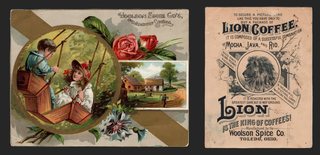
View on eBay

1880s Trade Card Lion Coffee Woolson Spice Toledo Ohio Rose Winter Cottage

1880s Trade Card Lion Coffee Woolson Spice Toledo Ohio Rose Winter Cottage

$10.00

A large embossed card with a full-blown pink rose, two buds and green leaves curling over a turned-back sheet that opens on a winter scene: a yellow cottage with a snow-covered roof and smoking chimney, bare trees and a fir, and a snowy path in the foreground. The front carries no printed text.

The back is printed in blue: "Fine Pictures FREE! Besides the Beautiful Picture Card in every package of LION COFFEE, we also give away many fine pictures, books, games, etc., mailed free, in exchange for large Lion Heads, cut from LION COFFEE Wrappers." It invites the reader to ask the grocer for the latest Illustrated Premium List, or send a 1-cent stamp to "Woolson Spice Co., Huron and Jackson Streets, Toledo, O."

Approx. 3.60 x 5.45 in.

Read the full description

Historical Context

The coffee that came with a picture. Lion Coffee began in Toledo, Ohio, in 1864 and became part of the Woolson Spice Company in 1882. Alvin Woolson built the brand by putting picture cards in every package, and this card says so on its back.

Cut out the lion's head. The premium system printed here, save the lion heads from the wrappers and trade them for pictures, books and games, made Lion one of the best-known coffee brands of its day and filled family albums with cards like this one.

Roses in the snow. A summer rose set against a winter cottage is a favorite Victorian contrast, and the deep embossing makes this one of the more sculptural cards of the period. A good card for collectors of florals, winter scenes and Toledo history.

Condition

Used, with age wear. Front: a crease with a short surface break runs in about 1 in. from the left edge at mid-height, by the lower rosebud; a short crease near the lower right corner and light creasing at the lower left corner; corners lightly worn; a few small specks in the margins; light even toning. Back: light toning, the embossing shows through as expected, light creasing at the lower left and a small crease line at the right edge; no writing. Please see the photos, which are part of the description.

About The Printing

This is an original chromolithograph, and it was slow, exacting work. Each color had to be drawn onto its own separate stone by hand — in monochrome, the artist judging how much stipple each area needed so the colors would combine correctly only once every stone had been printed. The sheet then went through the press once for every color it carries, often a dozen or more, and every pass had to register exactly against the last. A pass out of register showed.

Under magnification the image resolves into irregular hand-drawn stipple, each ink carrying its own dot pattern, the colors mixing in the eye rather than on the paper. There is no regular halftone screen and no four-color rosette, which is what a modern reproduction would show. Modern process printing simulates every color from four inks; chromolithography laid each color down as its own.

The rose, leaves and scene are embossed, and the relief shows through on the back. The back is printed in a single blue ink.

Provenance

From my family's estate collections, built over more than 60 years by knowledgeable antiques collectors and traders. Stored in a climate-controlled environment.

Also In Our Store

More Victorian advertising trade cards for coffee, spices and baking soda are in our store.

Disclaimer

Specifications and detailed item descriptions are provided as a courtesy only and are not guaranteed to be one hundred percent accurate. Please do your own research. There are generally no receipts available for any items from original purchases. Any dimensions and/or weights are approximate. The absence of a more detailed condition report does not imply there are no condition issues with the item(s). Please inspect images carefully as they are part of the official item description and best representation of the actual condition. Additional images may be available upon request depending on time and availability. Not responsible for internet mis-translations or mis-identification of maker's marks if found or assumptions of makers or materials — item descriptions will indicate if it is assumed. If you see a problem, please message us immediately and we will do our best to sort out a solution and confirm the information. With the exception of eBay rules, no returns are accepted.
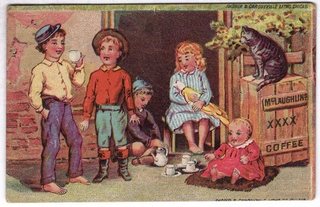
View on eBay

No listings match that search.