Three on Four International

Medical/Medicine

9 listings in Medical/Medicine, $19.47 to $46.12. Each one is shown in its own photos and described in full below; buy on eBay.

Prices and availability as of November 3, 2026.

ca1955 Cytora Roche-Organon Pharmaceutical Ink Blotter Nutley NJ Hematinic

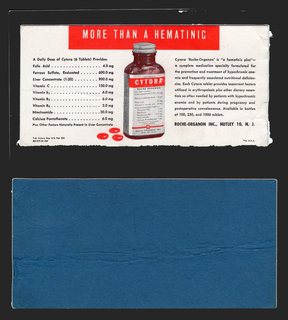
ca1955 Cytora Roche-Organon Pharmaceutical Ink Blotter Nutley NJ Hematinic — "MORE THAN A HEMATINIC": a bottle of Cytora tablets with a list of what a daily dose provides, from folic acid and ferrous sulfate to liver concentrate and B vitamins. Approx. 6.93 x 3.39 in.

$46.12

Description

"MORE THAN A HEMATINIC": a bottle of Cytora tablets with a list of what a daily dose provides, from folic acid and ferrous sulfate to liver concentrate and B vitamins. "Roche-Organon Inc., Nutley 10, N.J." The back is blue blotting paper.

Approx. 6.93 x 3.39 in.

Read the full description

Historical Context

Advertising for doctors. Drug makers sent blotters like this to physicians' offices, where they stayed on the desk.

"Nutley 10, N.J." is a postal zone address from before ZIP codes.

Condition

Front: very good, white margins. Back: blue blotter with a light wrinkle. Please see the photos, which are part of the description.

About The Printing

This is a color print of the twentieth century, made by a modern commercial method. The exact process cannot be determined with certainty from a scan, so none is claimed here. Under magnification the image resolves into a regular dot pattern or flat solid inks, rather than the irregular hand-drawn stipple of an 1880s chromolithograph.

That is exactly what a piece of this date should show, so it is not a sign of reproduction here. The evidence of an original is the piece itself: its printed text, its imprints and the wear of its age.

The back is blue blotting paper.

Provenance

From my family's estate collections, built over more than 60 years by knowledgeable antiques collectors and traders. Stored in a climate-controlled environment.

Also In Our Store

More vintage advertising blotters and cards are in our store.

Disclaimer

The images and any video show the actual item and are part of the official listing description, so please review them closely. Measurements and weights are approximate, and any maker or material we haven't confirmed is described as assumed. Questions? Message us; we answer quickly.
View on eBay

ca1885 Patent Medicine Trade Card Dr H S Woodard Bloomington Illinois Flowers

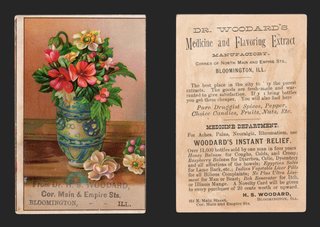
ca1885 Patent Medicine Trade Card Dr H S Woodard Bloomington Illinois Flowers — A blue-green vase of red and pink flowers with pansies at its foot. Approx. 2.98 x 4.50 in.

$38.32

Description

A blue-green vase of red and pink flowers with pansies at its foot. Imprint: "From Dr. H. S. Woodard, Cor. Main & Empire Sts., Bloomington, Ill."

The back is printed in black: "Dr. Woodard's Medicine and Flavoring Extract Manufactory, Corner of North Main and Empire Sts., Bloomington, Ill.," listing "Pure Druggist Spices, Pepper, Choice Candies, Fruits, Nuts," and a Medicine Department for "Aches, Pains, Neuralgia, Rheumatism," promoting "Woodard's Instant Relief" ("Over 11,000 bottles sold by one man in four years") and a long list of remedies.

Approx. 2.98 x 4.50 in.

Read the full description

Historical Context

Patent medicine on parade. Instant relief for aches, pains, neuralgia and rheumatism: claims like these ran freely before the federal Pure Food and Drug Act of 1906.

Medicine and flavoring extracts. Many small-town druggists made both, sold side by side with spices and candy.

Condition

Front: very good, bright color. Back: toned with staining; text legible. Please see the photos, which are part of the description.

About The Printing

This is an original chromolithograph, and it was slow, exacting work. Each color had to be drawn onto its own separate stone by hand — in monochrome, the artist judging how much stipple each area needed so the colors would combine correctly only once every stone had been printed. The sheet then went through the press once for every color it carries, often a dozen or more, and every pass had to register exactly against the last. A pass out of register showed.

Under magnification the image resolves into irregular hand-drawn stipple, each ink carrying its own dot pattern, the colors mixing in the eye rather than on the paper. There is no regular halftone screen and no four-color rosette, which is what a modern reproduction would show. Modern process printing simulates every color from four inks; chromolithography laid each color down as its own.

The back is printed in black.

Provenance

From my family's estate collections, built over more than 60 years by knowledgeable antiques collectors and traders. Stored in a climate-controlled environment.

Also In Our Store

More Victorian advertising trade cards are in our store.

Disclaimer

The images and any video show the actual item and are part of the official listing description, so please review them closely. Measurements and weights are approximate, and any maker or material we haven't confirmed is described as assumed. Questions? Message us; we answer quickly.
View on eBay

Victorian Trade Card Red Cross Cough Drops 5 Cents Girl Daisies Embossed Gilt

Red Cross Cough Drops — Five Cents per Box

$28.11

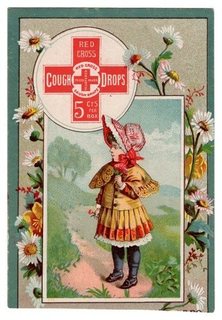
Original Victorian advertising trade card, chromolithograph on an embossed and gilded ground, c. 1880s-90s. Approx. 4.35 x 2.95 in.

A small girl in a fringed cape and a deep pink bonnet walks a garden path, a basket on one arm, looking back over her shoulder. The scene sits in an inset panel surrounded by white and yellow daisies that spill across the card. Above it a circular device carries the trademark: a red cross, RED CROSS COUGH DROPS, and 5 CTS PER BOX.

The reverse is blank.

Read the full description

Historical Context

A nickel a box, and the card cost the maker a good deal more to produce than the profit on the first sale. That arithmetic only works if the card stays in the house, and this one was built to — embossed, gilded, and prettier than most things a family owned.

The daisies and the child have nothing to do with a sore throat. They were not supposed to. The card's job was to be kept, and a picture worth keeping put the name in front of you every time you opened the album.

Condition

Toning and age typical of the period. The embossing and gilding remain crisp with light rubbing to the high points; minor edge and corner wear; light surface soiling. Colors remain strong. Blank reverse with toning. Please view the images carefully.

About The Printing

This is an original chromolithograph, and it was slow, exacting work. Each color had to be drawn onto its own separate stone by hand — in monochrome, the artist judging how much stipple each area needed so the colors would combine correctly only once every stone had been printed. The sheet then went through the press once for every color it carries, often a dozen or more, and every pass had to register exactly against the last. A pass out of register showed.

Under magnification the image resolves into irregular hand-drawn stipple, each ink carrying its own dot pattern, the colors mixing in the eye rather than on the paper. There is no regular halftone screen and no four-color rosette, which is what a modern reproduction would show. Modern process printing simulates every color from four inks; chromolithography laid each color down as its own.

Provenance

This item comes from the personal collections of my family estate, accumulated over more than 200 years — including items that came west by wagon train to Colorado and later to Oklahoma. Now that my parents have passed we cannot keep all of these cherished items. They were well-educated antiques collectors/traders and continued to build their collections over more than 60 years. The vast majority of the pieces are from the Victorian Era, however there are plenty of older and newer items. Everything has been stored in a climate-controlled environment over time.

Disclaimer

Specifications and detailed item descriptions are provided as a courtesy only and are not guaranteed to be one hundred percent accurate. Please do your own research. There are generally no receipts available for any items from original purchases. Any dimensions and/or weights are approximate. The absence of a more detailed condition report does not imply there are no condition issues with the item(s). Please inspect images carefully as they are part of the official item description and best representation of the actual condition. Additional images may be available upon request depending on time and availability. Not responsible for internet mis-translations or mis-identification of maker's marks if found or assumptions of makers or materials — item descriptions will indicate if it is assumed. If you see a problem, please message us immediately and we will do our best to sort out a solution and confirm the information. With the exception of eBay rules, no returns are accepted.

View on eBay

1890s Mennen's Borated Talcum Trade Card Love the Babies Newark NJ Winter Scene

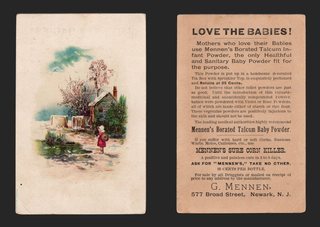
1890s Mennen's Borated Talcum Trade Card Love the Babies Newark NJ Winter Scene — A winter cottage among blossoming trees with a small girl in red on the path. Approx. 3.05 x 4.68 in.

$23.78

Description

A winter cottage among blossoming trees with a small girl in red on the path. The front is faded, with faint lettering at the top and some show-through from the back.

The back is printed in black: "LOVE THE BABIES! Mothers who love their Babies use Mennen's Borated Talcum Infant Powder ... Retails at 25 Cents," with "Mennen's Sure Corn Killer" and "G. Mennen, 577 Broad Street, Newark, N.J."

Approx. 3.05 x 4.68 in.

Read the full description

Historical Context

A Newark original. The back is signed by G. Mennen of 577 Broad Street, Newark, the start of a name still on the toiletries shelf.

Powder for the nursery. "Love the Babies!" speaks straight to mothers, the buyers trade cards were made for.

Condition

Front: faded, top lettering faint, show-through from the back. Back: clean, crisp text. Please see the photos, which are part of the description.

About The Printing

This is an original chromolithograph, and it was slow, exacting work. Each color had to be drawn onto its own separate stone by hand — in monochrome, the artist judging how much stipple each area needed so the colors would combine correctly only once every stone had been printed. The sheet then went through the press once for every color it carries, often a dozen or more, and every pass had to register exactly against the last. A pass out of register showed.

Under magnification the image resolves into irregular hand-drawn stipple, each ink carrying its own dot pattern, the colors mixing in the eye rather than on the paper. There is no regular halftone screen and no four-color rosette, which is what a modern reproduction would show. Modern process printing simulates every color from four inks; chromolithography laid each color down as its own.

The back is printed in black.

Provenance

From my family's estate collections, built over more than 60 years by knowledgeable antiques collectors and traders. Stored in a climate-controlled environment.

Also In Our Store

More Victorian advertising trade cards are in our store.

Disclaimer

The images and any video show the actual item and are part of the official listing description, so please review them closely. Measurements and weights are approximate, and any maker or material we haven't confirmed is described as assumed. Questions? Message us; we answer quickly.
View on eBay

1880s Trade Card Brown's Sarsaparilla Arnica Salve Pepsin Tonic Dog Rifle

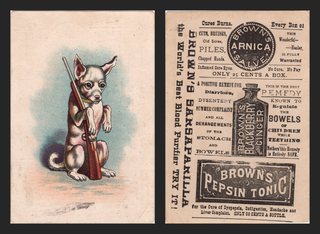
1880s Trade Card Brown's Sarsaparilla Arnica Salve Pepsin Tonic Dog Rifle — A small, big-eyed dog with tall ears sits up on its haunches, clutching a rifle almost twice its height, against a soft blue cloud of color. Approx. 3.00 x 4.40 in.

$23.28

Description

A small, big-eyed dog with tall ears sits up on its haunches, clutching a rifle almost twice its height, against a soft blue cloud of color. The front carries no advertiser imprint; the open space at the top was left for one.

The back is a full page of patent medicine advertising in black for four Brown's remedies. Brown's Arnica Salve "Cures Burns, Cuts, Bruises, Old Sores, Piles, Chapped Hands, Inflamed Sore Eyes", "No Cure. No Pay", "Only 25 cents a box." Brown's Blackberry and Ginger is "A positive remedy for Diarrhoea, Dysentery, Summer Complaint" and "the best remedy known to regulate the bowels of children while teething. Mothers, this Remedy is Entirely Safe." Brown's Pepsin Tonic is "for the Cure of Dyspepsia, Indigestion, Headache and Liver Complaint. Only 50 cents a bottle." Running up the side: "Brown's Sarsaparilla, the World's Best Blood Purifier. TRY IT!" No maker's address or city is printed.

Approx. 3.00 x 4.40 in.

Read the full description

Historical Context

Patent medicine on parade. Four cures on one card: a salve for everything from burns to piles, a blackberry cordial for teething babies, a pepsin tonic for the liver, and a sarsaparilla sold as the world's best blood purifier. Bold promises like "No Cure. No Pay" were the stock in trade of the nineteenth-century medicine business.

One picture, many advertisers. Printers sold stock cards like this with the picture finished and space left blank, and each merchant added his own advertising. Here the front stayed clean and Brown's filled the entire back.

A dog on guard. The little dog standing sentry with a rifle is a charming subject for dog collectors as well as for collectors of patent medicine and pharmacy advertising.

Condition

Very good for its age. Front: clean color; a grey smudge in the lower margin below the dog; a small dark dot at the upper right; a light soft crease and edge wear at the lower right; corners lightly rounded; light toning. Back: clean and bright for its age, with light toning and slight edge wear; no writing. Please see the photos, which are part of the description.

About The Printing

This is an original chromolithograph, and it was slow, exacting work. Each color had to be drawn onto its own separate stone by hand — in monochrome, the artist judging how much stipple each area needed so the colors would combine correctly only once every stone had been printed. The sheet then went through the press once for every color it carries, often a dozen or more, and every pass had to register exactly against the last. A pass out of register showed.

Under magnification the image resolves into irregular hand-drawn stipple, each ink carrying its own dot pattern, the colors mixing in the eye rather than on the paper. There is no regular halftone screen and no four-color rosette, which is what a modern reproduction would show. Modern process printing simulates every color from four inks; chromolithography laid each color down as its own.

The back is printed in black type, separate from the color work on the front.

Provenance

From my family's estate collections, built over more than 60 years by knowledgeable antiques collectors and traders. Stored in a climate-controlled environment.

Also In Our Store

More Victorian advertising trade cards for patent medicines, coffee and baking soda are in our store.

Disclaimer

The images and any video show the actual item and are part of the official listing description, so please review them closely. Measurements and weights are approximate, and any maker or material we haven't confirmed is described as assumed. Questions? Message us; we answer quickly.
View on eBay

Victorian Trade Card Hood's Sarsaparilla Pharmacy Scene PT Barnum Circus Back

Hood's Sarsaparilla — “Be Sure You Are Right”

$19.47

Original Victorian advertising trade card, chromolithograph, copyright 1886. Approx. 4.10 x 2.65 in.

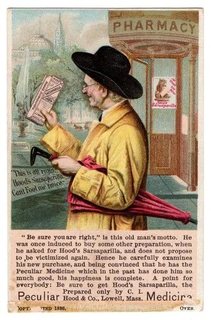
An elderly man in a yellow overcoat and wide black hat stands outside a pharmacy, umbrella under one arm, holding a package of Hood's Sarsaparilla up to the light and examining it through his glasses. The caption beside him reads “That's all right. Hood's Sarsaparilla. Can't Fool me twice.” A poster for the product hangs in the shop window behind him.

The lower panel carries the advertiser's text in full: the old man was once induced to buy some other preparation when he asked for Hood's, does not propose to be victimized again, and so examines his new purchase carefully. Prepared only by C. I. Hood & Co., Lowell, Mass.

The reverse is given over to a circus advertisement headed “Much for Little,” quoting P. T. Barnum on a big show for a small amount, and naming the performers: Daring Zazel, fired from a huge cannon a distance of 50 feet; Graceful Miss Alita, walking the ceiling like a veritable fly; Beautiful Miss Patricia, dissolving into air before your eyes; The Two Macks Vaudeville Combination; and Whitfield, the man with 100 different faces. It closes by returning to Hood's and its “100 Doses One Dollar.”

Read the full description

Historical Context

Patent medicine and the circus were selling the same thing: a promise that outran the evidence. Putting them on one card was not an accident of printing — both were buying the same attention, and both knew the customer wanted to be amazed before being convinced.

The joke on the front is the more interesting half. The old man is not being told the product works. He is being told he is too shrewd to be fooled, which is a harder sell and a better one. Flattering the buyer's judgment was a new idea in 1886 and it has never gone out of use.

Condition

Toning and age typical of the period. Losses and tearing along one long edge with a chipped area toward the corner; light surface soiling; minor edge and corner wear; scattered foxing, more apparent on the reverse. The chromolithographed image on the front remains bright. Please view the images carefully.

About The Printing

This is an original chromolithograph, and it was slow, exacting work. Each color had to be drawn onto its own separate stone by hand — in monochrome, the artist judging how much stipple each area needed so the colors would combine correctly only once every stone had been printed. The sheet then went through the press once for every color it carries, often a dozen or more, and every pass had to register exactly against the last. A pass out of register showed.

Under magnification the image resolves into irregular hand-drawn stipple, each ink carrying its own dot pattern, the colors mixing in the eye rather than on the paper. There is no regular halftone screen and no four-color rosette, which is what a modern reproduction would show. Modern process printing simulates every color from four inks; chromolithography laid each color down as its own.

Provenance

This item comes from the personal collections of my family estate, accumulated over more than 200 years — including items that came west by wagon train to Colorado and later to Oklahoma. Now that my parents have passed we cannot keep all of these cherished items. They were well-educated antiques collectors/traders and continued to build their collections over more than 60 years. The vast majority of the pieces are from the Victorian Era, however there are plenty of older and newer items. Everything has been stored in a climate-controlled environment over time.

Disclaimer

Specifications and detailed item descriptions are provided as a courtesy only and are not guaranteed to be one hundred percent accurate. Please do your own research. There are generally no receipts available for any items from original purchases. Any dimensions and/or weights are approximate. The absence of a more detailed condition report does not imply there are no condition issues with the item(s). Please inspect images carefully as they are part of the official item description and best representation of the actual condition. Additional images may be available upon request depending on time and availability. Not responsible for internet mis-translations or mis-identification of maker's marks if found or assumptions of makers or materials — item descriptions will indicate if it is assumed. If you see a problem, please message us immediately and we will do our best to sort out a solution and confirm the information. With the exception of eBay rules, no returns are accepted.

View on eBay

No listings match that search.