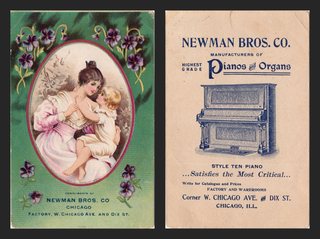
ca1900 Newman Bros Piano Organ Trade Card Mother Child Violets Chicago — An embossed advertising card for a Chicago piano and organ maker. Approx. 3.55 x 5.40 in.
Description
An embossed advertising card for a Chicago piano and organ maker. In a gold- and magenta-ruled oval, a dark-haired young mother in a pink gown embraces her small blonde child in a white shift. Sprays of embossed purple violets frame the oval on a deep green ground with a fine linen texture. Printed below: "Compliments of Newman Bros. Co, Chicago. Factory, W. Chicago Ave. and Dix St."
The reverse, printed in blue, pictures an upright "Style Ten Piano" with a "Newman Bros. Co." mat at its feet: "Newman Bros. Co. Manufacturers of Highest Grade Pianos and Organs. … Satisfies the Most Critical … Write for Catalogue and Prices. Factory and Warerooms, Corner W. Chicago Ave. and Dix St., Chicago, Ill."
Approx. 3.55 x 5.40 in.
Read the full description
Historical Context
A Chicago piano maker. Newman Bros. began in Chicago in 1880 building parlor and chapel organs and added high-grade pianos in 1895. The firm built a six-story factory in 1900 and closed in the Great Depression.
The parlor piano. Around 1900 an upright piano was the pride of the middle-class parlor, and makers courted buyers by mail. "Write for Catalogue and Prices" was an invitation to order from the factory.
Mother and child. The tender oval portrait and embossed violets show how far advertising cards had moved toward the sentimental keepsake by the turn of the century.
Condition
Good, with honest wear. Corners softly rounded. A short crease at the top edge near the center and a light crease at the upper right corner of the front. The reverse shows several light creases, most at the upper left and lower right, and light even toning. Embossing intact and colors bright. Please see the photos, which are part of the description.
About The Printing
This is an original chromolithograph, and it was slow, exacting work. Each color had to be drawn onto its own separate stone by hand — in monochrome, the artist judging how much stipple each area needed so the colors would combine correctly only once every stone had been printed. The sheet then went through the press once for every color it carries, often a dozen or more, and every pass had to register exactly against the last. A pass out of register showed.
Under magnification the image resolves into irregular hand-drawn stipple, each ink carrying its own dot pattern, the colors mixing in the eye rather than on the paper. There is no regular halftone screen and no four-color rosette, which is what a modern reproduction would show. Modern process printing simulates every color from four inks; chromolithography laid each color down as its own.
The violets are embossed, and the reverse is printed in a single blue ink.
Provenance
From my family's estate collections, built over more than 60 years by knowledgeable antiques collectors and traders. Stored in a climate-controlled environment.
Also In Our Store
More antique advertising trade cards for musical instruments and Chicago firms are in our store.
Disclaimer
The images and any video show the actual item and are part of the official listing description, so please review them closely. Measurements and weights are approximate, and any maker or material we haven't confirmed is described as assumed. Questions? Message us; we answer quickly.