Three on Four International

Food, Candy & Grocery

9 listings in Food, Candy & Grocery, $12.88 to $50.78. Each one is shown in its own photos and described in full below; buy on eBay.

Prices and availability as of November 3, 2026.

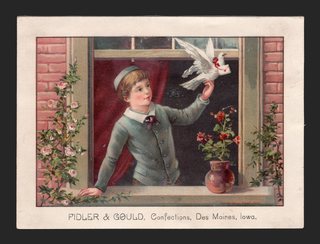
ca1885 Trade Card Fidler & Gould Confections Des Moines Iowa Boy Dove Window

ca1885 Trade Card Fidler & Gould Confections Des Moines Iowa Boy Dove Window — A boy in a sailor-collared suit leans from a brick window framed in roses to release a white dove carrying a letter. Approx. 5.94 x 4.41 in.

$50.78

Description

A boy in a sailor-collared suit leans from a brick window framed in roses to release a white dove carrying a letter. Imprint at the foot: "FIDLER & GOULD, Confections, Des Moines, Iowa." The back is blank.

Approx. 5.94 x 4.41 in.

Read the full description

Historical Context

A Des Moines sweet shop. Fidler & Gould had a stock picture card imprinted with their name, a common way for a local confectioner to advertise.

Sending a message. The boy with his dove and letter is a charming subject for collectors of birds, children and Iowa history.

Condition

Front: very good to excellent, bright color, light edge wear. Blank back with foxing spots. Please see the photos, which are part of the description.

About The Printing

This is an original chromolithograph, and it was slow, exacting work. Each color had to be drawn onto its own separate stone by hand — in monochrome, the artist judging how much stipple each area needed so the colors would combine correctly only once every stone had been printed. The sheet then went through the press once for every color it carries, often a dozen or more, and every pass had to register exactly against the last. A pass out of register showed.

Under magnification the image resolves into irregular hand-drawn stipple, each ink carrying its own dot pattern, the colors mixing in the eye rather than on the paper. There is no regular halftone screen and no four-color rosette, which is what a modern reproduction would show. Modern process printing simulates every color from four inks; chromolithography laid each color down as its own.

The confectioner's imprint is printed in black, and the back is blank.

Provenance

From my family's estate collections, built over more than 60 years by knowledgeable antiques collectors and traders. Stored in a climate-controlled environment.

Also In Our Store

More Victorian advertising trade cards are in our store.

Disclaimer

The images and any video show the actual item and are part of the official listing description, so please review them closely. Measurements and weights are approximate, and any maker or material we haven't confirmed is described as assumed. Questions? Message us; we answer quickly.
View on eBay

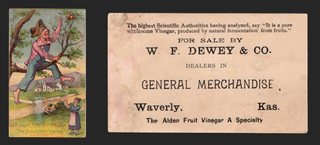
ca1885 Alden Fruit Vinegar Trade Card Fruit High But Falling Dewey Waverly KS

ca1885 Alden Fruit Vinegar Trade Card Fruit High But Falling Dewey Waverly KS — A comic scene: a barefoot boy in a straw hat loses his grip in an apple tree while a woman below holds out her apron. Approx. 3.02 x 5.05 in.

$37.82

Description

A comic scene: a barefoot boy in a straw hat loses his grip in an apple tree while a woman below holds out her apron. Caption: "Fruit High But Falling. The Alden Fruit Vinegar."

The back is printed in black: "The highest Scientific Authorities having analyzed, say 'It is a pure wholesome Vinegar, produced by natural fermentation from fruits.' For sale by W. F. DEWEY & CO., Dealers in General Merchandise, Waverly, Kas. The Alden Fruit Vinegar A Specialty."

Approx. 3.02 x 5.05 in.

Read the full description

Historical Context

A short-lived brand. The Alden Fruit Vinegar company was founded in St. Louis in 1878 and was gone by 1907 (Library Company of Philadelphia).

A Kansas railroad town. Waverly, Kansas, was platted in 1878 on the Ottawa and Burlington Railroad (Cutler, History of the State of Kansas).

Condition

Front: very good, bright color. Back: stains; text legible. Please see the photos, which are part of the description.

About The Printing

This is an original chromolithograph, and it was slow, exacting work. Each color had to be drawn onto its own separate stone by hand — in monochrome, the artist judging how much stipple each area needed so the colors would combine correctly only once every stone had been printed. The sheet then went through the press once for every color it carries, often a dozen or more, and every pass had to register exactly against the last. A pass out of register showed.

Under magnification the image resolves into irregular hand-drawn stipple, each ink carrying its own dot pattern, the colors mixing in the eye rather than on the paper. There is no regular halftone screen and no four-color rosette, which is what a modern reproduction would show. Modern process printing simulates every color from four inks; chromolithography laid each color down as its own.

The back is printed in black.

Provenance

From my family's estate collections, built over more than 60 years by knowledgeable antiques collectors and traders. Stored in a climate-controlled environment.

Also In Our Store

More Victorian advertising trade cards are in our store.

Disclaimer

The images and any video show the actual item and are part of the official listing description, so please review them closely. Measurements and weights are approximate, and any maker or material we haven't confirmed is described as assumed. Questions? Message us; we answer quickly.
View on eBay

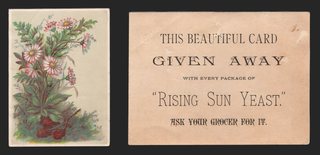
ca1885 Victorian Trade Card Rising Sun Yeast Pink Daisies Given Away Grocer

ca1885 Victorian Trade Card Rising Sun Yeast Pink Daisies Given Away Grocer — A tall spray of pink-tipped daisies and wildflowers rising from a bed of grass. Approx. 4.00 x 5.43 in.

$31.42

Description

A tall spray of pink-tipped daisies and wildflowers rising from a bed of grass. No printing on the front.

The back is printed in black: "This beautiful card GIVEN AWAY with every package of 'RISING SUN YEAST.' Ask your grocer for it."

Approx. 4.00 x 5.43 in.

Read the full description

Historical Context

A free picture with every package. The back says it plainly: the card was the premium, given away to bring the customer back.

Flowers for the album. Botanical cards like this were favorites for scrapbooks and still appeal to flower collectors.

Condition

Front: light toning, bright flowers. Back: toned. Please see the photos, which are part of the description.

About The Printing

This is an original chromolithograph, and it was slow, exacting work. Each color had to be drawn onto its own separate stone by hand — in monochrome, the artist judging how much stipple each area needed so the colors would combine correctly only once every stone had been printed. The sheet then went through the press once for every color it carries, often a dozen or more, and every pass had to register exactly against the last. A pass out of register showed.

Under magnification the image resolves into irregular hand-drawn stipple, each ink carrying its own dot pattern, the colors mixing in the eye rather than on the paper. There is no regular halftone screen and no four-color rosette, which is what a modern reproduction would show. Modern process printing simulates every color from four inks; chromolithography laid each color down as its own.

The back is printed in black.

Provenance

From my family's estate collections, built over more than 60 years by knowledgeable antiques collectors and traders. Stored in a climate-controlled environment.

Also In Our Store

More Victorian advertising trade cards are in our store.

Disclaimer

The images and any video show the actual item and are part of the official listing description, so please review them closely. Measurements and weights are approximate, and any maker or material we haven't confirmed is described as assumed. Questions? Message us; we answer quickly.
View on eBay

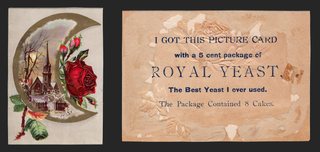
ca1885 Victorian Trade Card Royal Yeast Crescent Moon Snowy Church Red Rose

ca1885 Victorian Trade Card Royal Yeast Crescent Moon Snowy Church Red Rose — A gilt crescent moon frames a snowy village church at night, with a full red rose and buds at right. Approx. 4.09 x 5.89 in.

$25.68

Description

A gilt crescent moon frames a snowy village church at night, with a full red rose and buds at right. No printing on the front.

The back is embossed with a rose and printed in blue: "I got this picture card with a 5 cent package of ROYAL YEAST. The Best Yeast I ever used. The Package Contained 8 Cakes."

Approx. 4.09 x 5.89 in.

Read the full description

Historical Context

A card that speaks for the customer. Instead of the maker praising itself, the back is written in the buyer's voice: "The Best Yeast I ever used."

Yeast cakes for home baking. Dry yeast cakes, sold several to a package, were a pantry staple when most bread was baked at home.

Condition

Front: very good, bright gilt and color, light edge wear. Back: surface scuffs and small areas of paper loss from old album removal, light staining at right, embossing intact. Please see the photos, which are part of the description.

About The Printing

This is an original chromolithograph, and it was slow, exacting work. Each color had to be drawn onto its own separate stone by hand — in monochrome, the artist judging how much stipple each area needed so the colors would combine correctly only once every stone had been printed. The sheet then went through the press once for every color it carries, often a dozen or more, and every pass had to register exactly against the last. A pass out of register showed.

Under magnification the image resolves into irregular hand-drawn stipple, each ink carrying its own dot pattern, the colors mixing in the eye rather than on the paper. There is no regular halftone screen and no four-color rosette, which is what a modern reproduction would show. Modern process printing simulates every color from four inks; chromolithography laid each color down as its own.

The back is embossed and printed in a single blue ink.

Provenance

From my family's estate collections, built over more than 60 years by knowledgeable antiques collectors and traders. Stored in a climate-controlled environment.

Also In Our Store

More Victorian advertising trade cards are in our store.

Disclaimer

The images and any video show the actual item and are part of the official listing description, so please review them closely. Measurements and weights are approximate, and any maker or material we haven't confirmed is described as assumed. Questions? Message us; we answer quickly.
View on eBay

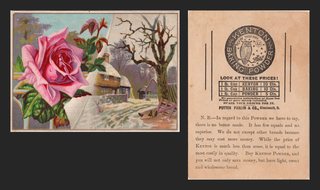
1880s Trade Card Kenton Baking Powder Owl Rose Winter Cottage Cincinnati

1880s Trade Card Kenton Baking Powder Owl Rose Winter Cottage Cincinnati — A Victorian trade card for Kenton Baking Powder. Approx. 6.00 x 4.35 in.

$22.92

Description

A Victorian trade card for Kenton Baking Powder. The front is a split scene: at left a large pink rose with buds against summer trees, at right a snow-covered cottage, a bare tree, a broken fence and hens scratching in the snow. The front carries no advertiser imprint.

The back is printed in black. The Kenton trademark, an owl on a branch under stars and a smiling moon, sits in a roundel lettered "KENTON BAKING POWDER" and "TRADE MARK," above a price table: "LOOK AT THESE PRICES! 1 lb. Can 20 Cts. ½ lb. Can 10 Cts. ¼ lb. Can 5 Cts." Then: "We guarantee satisfaction at these low Prices or your money refunded. ASK YOUR GROCER FOR IT. POTTER PARLIN & CO., Cincinnati, O." A closing note claims Kenton "is equal to the most costly in quality. Buy KENTON POWDER, and you will not only save money, but have light, sweet and wholesome bread."

Horizontal, approx. 6.00 x 4.35 in.

Read the full description

Historical Context

A Cincinnati brand. Kenton Baking Powder was made by Potter, Parlin & Co. of Cincinnati, and the owl with the smiling moon was its trademark.

Selling on price. Baking powder was one of the most heavily advertised grocery products of the trade card era. Kenton's pitch is plain value: a full pound for twenty cents, with a money-back guarantee.

Summer and winter. Stock designs like this were printed in quantity and sold to merchants, who added their own advertising, here on the back. A summer rose set against a farmyard in snow is a typical decorative pairing of the period.

The trade card craze. In the 1880s grocers handed out colorful cards like this by the thousand, and families saved them in scrapbooks.

Condition

Very good. Colors bright and clean. A short surface crease in the sky at the upper right of the front, near the top edge. A tiny dark speck in the top margin. Corners lightly rounded, with light wear most noticeable at the upper left. The back is evenly toned, with a few short creases at one long edge (left side as shown). No writing. Please see the photos, which are part of the description.

About The Printing

This is an original chromolithograph, and it was slow, exacting work. Each color had to be drawn onto its own separate stone by hand — in monochrome, the artist judging how much stipple each area needed so the colors would combine correctly only once every stone had been printed. The sheet then went through the press once for every color it carries, often a dozen or more, and every pass had to register exactly against the last. A pass out of register showed.

Under magnification the image resolves into irregular hand-drawn stipple, each ink carrying its own dot pattern, the colors mixing in the eye rather than on the paper. There is no regular halftone screen and no four-color rosette, which is what a modern reproduction would show. Modern process printing simulates every color from four inks; chromolithography laid each color down as its own.

The advertising on the back is printed in a single black ink.

Provenance

From my family's estate collections, built over more than 60 years by knowledgeable antiques collectors and traders. Stored in a climate-controlled environment.

Also In Our Store

More Victorian advertising trade cards for grocery products, thread and other household goods are in our store.

Disclaimer

The images and any video show the actual item and are part of the official listing description, so please review them closely. Measurements and weights are approximate, and any maker or material we haven't confirmed is described as assumed. Questions? Message us; we answer quickly.
View on eBay

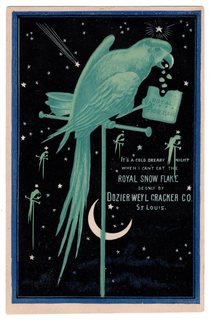
Victorian Trade Card Dozier Weyl Cracker Co St Louis Parrot Crescent Moon Night

Dozier-Weyl Cracker Co., St. Louis — “Royal Snow Flake”

$21.69

Original Victorian advertising trade card, chromolithograph, c. 1880s-90s. Approx. 5.30 x 3.40 in.

A striking night design. Against a deep blue-black sky scattered with stars and a shooting star, a long-tailed green parrot perches on a stand, holding a small card in its beak. A crescent moon hangs below. The lettering reads: IT'S A COLD DREARY NIGHT WHEN I CAN'T EAT THE ROYAL SNOW FLAKE, SOLD ONLY BY DOZIER-WEYL CRACKER CO., ST. LOUIS.

The reverse is blank.

Read the full description

Historical Context

Almost every trade card of this period is bright. Children, flowers, sunshine, pastel skies — the whole genre is relentlessly cheerful, because color was the novelty and printers used all of it they could.

This one goes the other way and prints a night sky. Against a wall of daylight cards it is the one that stops you, which is presumably the entire idea. The talking parrot is doing the selling, but the darkness is doing the work.

Condition

Toning and age typical of the period, mainly to the margins. Light surface soiling; minor edge and corner wear. The dark ground remains deep and even and the design is clean and bright. Blank reverse with toning. Please view the images carefully.

About The Printing

This is an original chromolithograph. Each color was drawn onto its own separate stone by hand and printed as its own pass through the press, every pass registering exactly against the last. This card uses the flat-color mode of the process — broad areas of solid, opaque ink with crisp boundaries rather than blended tone. It is the same technique that produced the great poster designs of the period.

Under magnification the colors resolve as solid fields with clean edges and no dot structure at all. There is no halftone screen and no four-color rosette, which is what a modern reproduction would show. Modern process printing simulates every color from four inks; here each color is its own ink, laid down whole.

Provenance

This item comes from the personal collections of my family estate, accumulated over more than 200 years — including items that came west by wagon train to Colorado and later to Oklahoma. Now that my parents have passed we cannot keep all of these cherished items. They were well-educated antiques collectors/traders and continued to build their collections over more than 60 years. The vast majority of the pieces are from the Victorian Era, however there are plenty of older and newer items. Everything has been stored in a climate-controlled environment over time.

Disclaimer

Specifications and detailed item descriptions are provided as a courtesy only and are not guaranteed to be one hundred percent accurate. Please do your own research. There are generally no receipts available for any items from original purchases. Any dimensions and/or weights are approximate. The absence of a more detailed condition report does not imply there are no condition issues with the item(s). Please inspect images carefully as they are part of the official item description and best representation of the actual condition. Additional images may be available upon request depending on time and availability. Not responsible for internet mis-translations or mis-identification of maker's marks if found or assumptions of makers or materials — item descriptions will indicate if it is assumed. If you see a problem, please message us immediately and we will do our best to sort out a solution and confirm the information. With the exception of eBay rules, no returns are accepted.

View on eBay

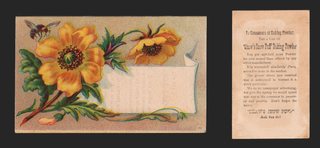
1880s Trade Card Shaw's Snow Puff Baking Powder Yellow Flowers Bee Small

1880s Trade Card Shaw's Snow Puff Baking Powder Yellow Flowers Bee Small — Yellow wild roses and buds with a bee in flight, beside a blank scroll left for a merchant's name. Approx. 4.17 x 2.55 in.

$21.52

Description

Yellow wild roses and buds with a bee in flight, beside a blank scroll left for a merchant's name.

The back is printed in black: "To Consumers of Baking Powder: Try a Can of 'Shaw's Snow Puff' Baking Powder. You get one-half more Powder for your money than offered by any other manufacturer. It is warranted absolutely Pure ... 'SHAW'S SNOW PUFF.' Ask for it!"

Approx. 4.17 x 2.55 in.

Read the full description

Historical Context

Half again as much. Baking powder makers fought hard on price, and Shaw's pitch is more powder for the money.

An open scroll. The blank banner on the front was meant for a local grocer's name, never added on this card.

Condition

Front: good color. Back: staining; text legible. Please see the photos, which are part of the description.

About The Printing

This is an original chromolithograph, and it was slow, exacting work. Each color had to be drawn onto its own separate stone by hand — in monochrome, the artist judging how much stipple each area needed so the colors would combine correctly only once every stone had been printed. The sheet then went through the press once for every color it carries, often a dozen or more, and every pass had to register exactly against the last. A pass out of register showed.

Under magnification the image resolves into irregular hand-drawn stipple, each ink carrying its own dot pattern, the colors mixing in the eye rather than on the paper. There is no regular halftone screen and no four-color rosette, which is what a modern reproduction would show. Modern process printing simulates every color from four inks; chromolithography laid each color down as its own.

The back is printed in black.

Provenance

From my family's estate collections, built over more than 60 years by knowledgeable antiques collectors and traders. Stored in a climate-controlled environment.

Also In Our Store

More Victorian advertising trade cards are in our store.

Disclaimer

The images and any video show the actual item and are part of the official listing description, so please review them closely. Measurements and weights are approximate, and any maker or material we haven't confirmed is described as assumed. Questions? Message us; we answer quickly.
View on eBay

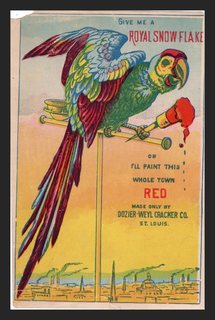
1880s Trade Card Royal Snow Flake Crackers Dozier-Weyl St. Louis Parrot

DESCRIPTION

$13.21

A bold cracker card: a big green, red and blue macaw on a perch with a seed cup, gripping a paint brush that drips red paint. Lettered: "Give me a Royal Snow Flake or I'll paint this whole town Red. Made only by Dozier-Weyl Cracker Co. St. Louis." Below is a city skyline of smoking factory chimneys, a spire and a domed building under a yellow and orange sky.

The back is blank stock.

Approx. 3.40 x 5.20 in.

Read the full description

Historical Context

Polly wants a cracker. The Dozier-Weyl Cracker Co. of St. Louis put a parrot to work selling its Royal Snowflake crackers. Another card in the same vein, held by Digital Commonwealth, has the bird asking "Polly wanta cracker?" This one threatens to paint the town red if it does not get one.

A St. Louis baker. Dozier-Weyl was an established St. Louis cracker maker; The Metropolitan Museum of Art holds its "Descriptive Sample Book of Goods" of 1881.

For bird and humor collectors. The strong poster-like color, the slang slogan and the parrot make this a card that appeals well beyond cracker and food advertising.

Condition

As-is, with clear wear. Front: a chip with paper loss at the upper left corner and a short tear along the top edge there; a vertical crease with a small split at the bottom edge near the spire; the right edge cut close, touching the last letter of "Flake"; scuffing and light soiling; colors strong. Back: a band of old tape or album paper residue across the bottom edge with some surface loss; a curved crease at the upper left; small surface scrapes at upper center and lower left; ink offset in red, yellow and blue; overall toning. Please see the photos, which are part of the description.

About The Printing

This is an original chromolithograph. Each color was drawn onto its own separate stone by hand and printed as its own pass through the press, every pass registering exactly against the last. This card uses the flat-color mode of the process — broad areas of solid, opaque ink with crisp boundaries rather than blended tone. It is the same technique that produced the great poster designs of the period.

Under magnification the colors resolve as solid fields with clean edges and no dot structure at all. There is no halftone screen and no four-color rosette, which is what a modern reproduction would show. Modern process printing simulates every color from four inks; here each color is its own ink, laid down whole.

The sky and ground are built up from fine ruled lines of overlapping color, a mechanical tint of the period, rather than from dots.

Provenance

From my family's estate collections, built over more than 60 years by knowledgeable antiques collectors and traders. Stored in a climate-controlled environment.

Also In Our Store

More Victorian advertising trade cards for crackers, coffee and patent medicines are in our store.

Disclaimer

Specifications and detailed item descriptions are provided as a courtesy only and are not guaranteed to be one hundred percent accurate. Please do your own research. There are generally no receipts available for any items from original purchases. Any dimensions and/or weights are approximate. The absence of a more detailed condition report does not imply there are no condition issues with the item(s). Please inspect images carefully as they are part of the official item description and best representation of the actual condition. Additional images may be available upon request depending on time and availability. Not responsible for internet mis-translations or mis-identification of maker's marks if found or assumptions of makers or materials — item descriptions will indicate if it is assumed. If you see a problem, please message us immediately and we will do our best to sort out a solution and confirm the information. With the exception of eBay rules, no returns are accepted.

View on eBay

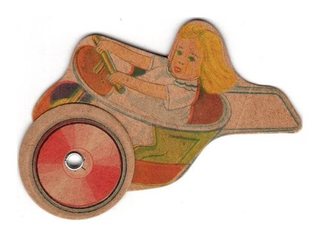
1950s Cracker Jack Prize Paper Toy Girl Driving Kiddie Car with Spinning Wheel

DESCRIPTION

$12.88

A small die-cut cardboard prize toy of a little blonde girl at the wheel of a kiddie car, from the era when every box of Cracker Jack carried a surprise. A separate printed wheel, red with a pinwheel pattern, is fixed to the body by a metal grommet, and it still turns freely. The figure is printed in bright color on the front. The reverse is plain dark blue-green stock.

The piece carries no maker's name. It is identified as a Cracker Jack prize of about 1950 from the same design being sold elsewhere as a 1950s Cracker Jack spinning toy; that identification is by design, not by a mark on the piece.

Die-cut, irregular outline, approx. 3.05 x 2.15 in. overall (bounding box, wheel included); wheel approx. 1.2 in. across.

Read the full description

Historical Context

Cracker Jack began putting a prize in every box in 1912, and the toy surprise became as much a part of the brand as the sailor boy and his dog Bingo. In the years after the war, the prizes were often simple paper and cardboard novelties: punch-outs, spinners and little moving figures like this one, made by the millions to be played with and then lost. Few survived the children who found them.

Condition

Age-toning and light surface soiling to the unprinted areas; light edge wear and rubbing at the rim of the wheel. The grommet is intact, with a small split in its flange. A light crease across the narrow tail, visible on both sides, where it was once bent. The reverse shows light scuffs and marks. Colors remain bright on the front. Please view the images carefully, as they are part of the description.

About The Printing

This is a color lithograph of the twentieth century, printed by a more modern commercial method. The exact process cannot be determined with certainty from a scan, so none is claimed here. Under magnification the image resolves into a regular, fine dot pattern rather than the irregular hand-drawn stipple of an 1880s chromolithograph.

That screen is exactly what a piece of this date should show, so it is not a sign of reproduction here. The evidence of an original is the piece itself: its die-cut construction, the metal grommet that holds the turning wheel, and the wear of its age.

Provenance

From my family's estate collections, built over more than 60 years by knowledgeable antiques collectors and traders. Stored in a climate-controlled environment.

Disclaimer

Specifications and detailed item descriptions are provided as a courtesy only and are not guaranteed to be one hundred percent accurate. Please do your own research. There are generally no receipts available for any items from original purchases. Any dimensions and/or weights are approximate. The absence of a more detailed condition report does not imply there are no condition issues with the item(s). Please inspect images carefully as they are part of the official item description and best representation of the actual condition. Additional images may be available upon request depending on time and availability. Not responsible for internet mis-translations or mis-identification of maker's marks if found or assumptions of makers or materials — item descriptions will indicate if it is assumed. If you see a problem, please message us immediately and we will do our best to sort out a solution and confirm the information. With the exception of eBay rules, no returns are accepted.

View on eBay

No listings match that search.