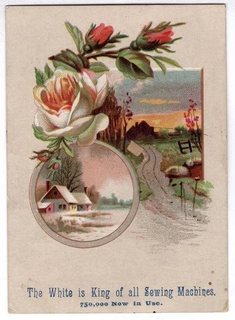
Antique Victorian Trade Card Advertising the White Sewing Machine Company
The full description and all the photos are on the eBay listing.

9 listings in Sewing, $10.00 to $27.97. Each one is shown in its own photos and described in full below; buy on eBay.
Prices and availability as of November 3, 2026.
The full description and all the photos are on the eBay listing.
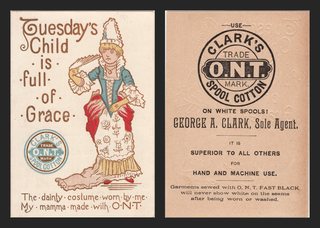
An embossed Victorian thread card from the nursery-rhyme theme. A little girl in grown-up costume, a tall lace cap, blue bodice, red overskirt and a flowered apron with a long trailing hem, poses with a fan. Bronze lettering beside her reads "Tuesday's Child is full of Grace," above the blue "Clark's O.N.T. Spool Cotton" trademark roundel. Verse at the foot: "The dainty costume worn by me / My mamma made with O.N.T." The outlines and lettering are printed in metallic bronze, and the figure and lettering are embossed.
The reverse, printed in black: "Use Clark's O.N.T. Spool Cotton on White Spools! George A. Clark, Sole Agent. It is superior to all others for hand and machine use. Garments sewed with O.N.T. Fast Black will never show white on the seams after being worn or washed."
Approx. 2.80 x 4.00 in.
Our New Thread. O.N.T. stood for "Our New Thread." George A. Clark, of the Paisley, Scotland, thread family, came to the United States in 1856, and the Clarks opened a factory in Newark, New Jersey, in 1864. Clark's O.N.T. spool cotton soon became a recognized American brand.
Thread wars. Clark and its Paisley rival J. & P. Coats competed fiercely for American customers, and both flooded stores with picture cards. In the United States the two finally merged as Coats & Clark in 1952.
Monday's child. The card borrows the old fortune-telling rhyme that begins "Monday's child is fair of face, Tuesday's child is full of grace," a natural for a thread maker selling to mothers who sewed their children's clothes.
Excellent. Clean, bright front with sharp corners and crisp embossing; the bronze ink is bright. The reverse is clean with light even toning; the embossing shows through as relief, as made. Please see the photos, which are part of the description.
This is an original chromolithograph. Each color was drawn onto its own separate stone by hand and printed as its own pass through the press, every pass registering exactly against the last. This card uses the flat-color mode of the process — broad areas of solid, opaque ink with crisp boundaries rather than blended tone. It is the same technique that produced the great poster designs of the period.
Under magnification the colors resolve as solid fields with clean edges and no dot structure at all. There is no halftone screen and no four-color rosette, which is what a modern reproduction would show. Modern process printing simulates every color from four inks; here each color is its own ink, laid down whole.
The outlines and lettering are printed in metallic bronze ink, the design is embossed, and the reverse is printed in black.
From my family's estate collections, built over more than 60 years by knowledgeable antiques collectors and traders. Stored in a climate-controlled environment.
More Clark's O.N.T. cards in our store: https://www.ebay.com/str/tfauctionsintl?_nkw=clark
More Victorian advertising trade cards for thread, children and nursery-rhyme subjects are in our store.
The images and any video show the actual item and are part of the official listing description, so please review them closely. Measurements and weights are approximate, and any maker or material we haven't confirmed is described as assumed. Questions? Message us; we answer quickly.
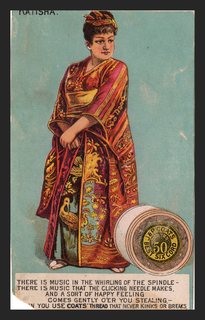
A Victorian thread trade card. A woman stands in costume as Katisha, the formidable lady of Gilbert and Sullivan's "The Mikado," in a crimson and gold kimono embroidered with a crane, waves and flowers, a ribbon ornament in her hair. At her feet sits an oversized spool of thread labeled "J&P COATS 200 YDS 50 BEST SIX CORD." Caption at top: "KATISHA." (the top of the lettering is trimmed). Verse in the panel below: "There is music in the whirling of the spindle — there is music that the clicking needle makes, and a sort of happy feeling comes gently o'er you stealing, — [wh]en you use Coats' Thread that never kinks or breaks."
The reverse is printed in blue with a large engraved spool and "J&P. Coats' Best Six Cord Thread — White, Black and Colors — For Hand and Machine."
Approx. 2.50 x 4.15 in.
Mikado mania. Gilbert and Sullivan's "The Mikado" opened at the Savoy Theatre in London on March 14, 1885, and ran for 672 performances. Katisha is the elderly lady in love with Nanki-Poo. The opera set off a fashion for all things Japanese, and advertisers issued Mikado trade cards to sell all kinds of goods.
Thread wars. J. & P. Coats takes its name from the brothers James and Peter Coats of Paisley, Scotland, who took over their father's thread business in 1830. In 1869 the firm took control of a thread mill in Pawtucket, Rhode Island, and its spools fought for American sewing baskets against Clark's O.N.T. The two rivals merged in the United States as Coats & Clark in 1952.
The trade card craze. In the 1880s cheap color printing put picture cards on every store counter, and families pasted them into scrapbooks by the hundred.
Heavily handled, sold as is. The lower left corner of the front is missing, taking the first letters of the last line ("[WH]EN"); the same loss shows at the upper right of the reverse. The top edge is trimmed close, clipping the top of the "KATISHA" caption. Light surface soiling and a few small scuffs on the front; colors remain strong. The reverse is toned, with scattered brown stains and spotting, most at the left side. Please see the photos, which are part of the description.
This is an original chromolithograph, and it was slow, exacting work. Each color had to be drawn onto its own separate stone by hand — in monochrome, the artist judging how much stipple each area needed so the colors would combine correctly only once every stone had been printed. The sheet then went through the press once for every color it carries, often a dozen or more, and every pass had to register exactly against the last. A pass out of register showed.
Under magnification the image resolves into irregular hand-drawn stipple, each ink carrying its own dot pattern, the colors mixing in the eye rather than on the paper. There is no regular halftone screen and no four-color rosette, which is what a modern reproduction would show. Modern process printing simulates every color from four inks; chromolithography laid each color down as its own.
The reverse is printed in a single blue ink.
From my family's estate collections, built over more than 60 years by knowledgeable antiques collectors and traders. Stored in a climate-controlled environment.
More J. & P. Coats cards in our store: https://www.ebay.com/str/tfauctionsintl?_nkw=coats
More Victorian advertising trade cards for thread, soap and theater subjects are in our store.
The images and any video show the actual item and are part of the official listing description, so please review them closely. Measurements and weights are approximate, and any maker or material we haven't confirmed is described as assumed. Questions? Message us; we answer quickly.
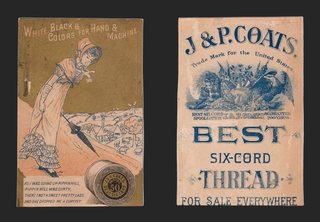
A lady in a long ruffled dress and bonnet curtsies on a muddy hill path, umbrella in hand, beside a large spool of Coats thread. Lettered "White, Black & Colors for Hand & Machine," with the rhyme "As I was going up Pippin Hill, Pippin Hill was dirty, there I met a sweet pretty lass, and she dropped me a curtsey."
The back is printed in blue: "J. & P. COATS. Trade Mark for the United States ... Best Six-Cord Thread. For Sale Everywhere," with an engraved scene.
Approx. 2.51 x 3.70 in.
Thread from Paisley. J. & P. Coats was a Scottish thread firm of Paisley, which made its six-cord thread in the United States at Pawtucket, Rhode Island.
A nursery rhyme to sell thread. The old rhyme of Pippin Hill gives the card its charm.
Front: toning and edge wear, damage at the left edge. Back: toned, edge wear. Please see the photos, which are part of the description.
This is an original chromolithograph, and it was slow, exacting work. Each color had to be drawn onto its own separate stone by hand — in monochrome, the artist judging how much stipple each area needed so the colors would combine correctly only once every stone had been printed. The sheet then went through the press once for every color it carries, often a dozen or more, and every pass had to register exactly against the last. A pass out of register showed.
Under magnification the image resolves into irregular hand-drawn stipple, each ink carrying its own dot pattern, the colors mixing in the eye rather than on the paper. There is no regular halftone screen and no four-color rosette, which is what a modern reproduction would show. Modern process printing simulates every color from four inks; chromolithography laid each color down as its own.
The back is printed in a single blue ink.
From my family's estate collections, built over more than 60 years by knowledgeable antiques collectors and traders. Stored in a climate-controlled environment.
More J. & P. Coats cards in our store: https://www.ebay.com/str/tfauctionsintl?_nkw=coats
More Victorian advertising trade cards are in our store.
The images and any video show the actual item and are part of the official listing description, so please review them closely. Measurements and weights are approximate, and any maker or material we haven't confirmed is described as assumed. Questions? Message us; we answer quickly.
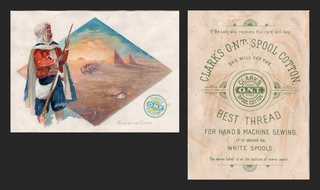
A large Victorian trade card for Clark's O.N.T. Spool Cotton, titled "Sunrise in the Desert." At left stands a mustached man in a white head wrap and cloak, a red embroidered jacket, a white sash and blue breeches, holding a long rifle. Behind him, in a diamond-shaped panel, the sun rises over the desert behind a camel caravan and two pyramids, with a bleached skull and ribs in the sand in the foreground. The Clark's O.N.T. Spool Cotton trademark roundel, in blue and yellow, is at lower right.
The back is printed in green around a large O.N.T. trademark: "If the Lady who receives this card will buy CLARK'S O.N.T. SPOOL COTTON, SHE WILL GET THE BEST THREAD FOR HAND & MACHINE SEWING. IT IS WOUND ON WHITE SPOOLS. The above label is on the bottom of every spool."
Horizontal, approx. 7.00 x 5.05 in.
Our New Thread. O.N.T. stood for "Our New Thread," the name Clark gave the product when it was introduced. The thread makers were among the busiest trade card advertisers of the 1880s, and Clark's cards were issued in long series.
Made in Newark. The Clark Thread Company's factory stood in Newark, New Jersey, on the west bank of the Passaic River.
Orientalist travel. Egypt and the Near East, with pyramids, caravans and desert guards in rich costume, were favorite subjects of Victorian painters and printers. This large card is a strong example for collectors of Orientalist imagery.
Written for the lady of the house. The back speaks directly to the woman who did the family sewing, and who, in the 1880s, often kept these cards in an album.
Front very good: clean and bright, corners sharp to lightly worn. A small light stain in the margin to the right of the trademark roundel, and a few tiny surface scuffs and dark flecks in the sand below the skull. The back shows extensive tan streaking from old album glue, with small areas of surface paper loss (thinning) at the upper left and along the left side; the printing remains complete and legible. No writing. Please see the photos, which are part of the description.
This is an original chromolithograph, and it was slow, exacting work. Each color had to be drawn onto its own separate stone by hand — in monochrome, the artist judging how much stipple each area needed so the colors would combine correctly only once every stone had been printed. The sheet then went through the press once for every color it carries, often a dozen or more, and every pass had to register exactly against the last. A pass out of register showed.
Under magnification the image resolves into irregular hand-drawn stipple, each ink carrying its own dot pattern, the colors mixing in the eye rather than on the paper. There is no regular halftone screen and no four-color rosette, which is what a modern reproduction would show. Modern process printing simulates every color from four inks; chromolithography laid each color down as its own.
The advertising on the back is printed in a single green ink.
From my family's estate collections, built over more than 60 years by knowledgeable antiques collectors and traders. Stored in a climate-controlled environment.
More Clark's O.N.T. cards in our store: https://www.ebay.com/str/tfauctionsintl?_nkw=clark
More Victorian advertising trade cards for thread and sewing, along with other Orientalist and travel subjects, are in our store.
The images and any video show the actual item and are part of the official listing description, so please review them closely. Measurements and weights are approximate, and any maker or material we haven't confirmed is described as assumed. Questions? Message us; we answer quickly.
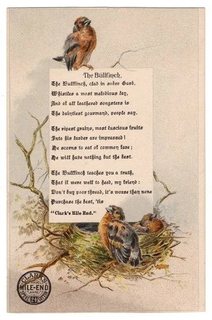
Original Victorian advertising trade card, chromolithograph, c. 1880s. Approx. 4.50 x 2.90 in. Printed by Donaldson Brothers, N.Y.
A bullfinch perches on top of a white panel carrying a poem, while two more birds sit in a nest of twigs and grasses below. A Clark's Mile-End spool-end label, numbered 24, sits in the lower left corner. The poem, THE BULLFINCH, is set in blackletter:
The Bullfinch, clad in sober Garb,
Whistles a most melodious lay,
And of all feathered songsters is
The daintiest gourmand, people say.
The ripest grains, most luscious fruits
Into his larder are impressed!
He scorns to eat of common fare;
He will have nothing but the best.
The Bullfinch teaches you a truth,
That if were well to heed, my friend:
Don't buy poor thread, it's worse than none
Purchase the best, 'tis “Clark's Mile End.”
The reverse, printed in blue, explains the series: the proprietors of Clark's Mile End Spool Cotton propose to issue a series of twelve aquarelles from designs by the celebrated Parisian artist Hector Giacomelli, illustrative of our native song birds, and asks the reader to preserve the cards as issued. Below: Families and Dressmakers should use CLARK'S MILE-END SPOOL COTTON, BEST SIX CORD for Machine and Hand Use. Thomas Russell & Co., Sole Agents. The card is numbered 6.
Giacomelli was a real name in Paris, known for his bird illustrations, and the thread company put that name on the back for a reason. A set of twelve fine bird pictures, issued one at a time and each with its own verse, was something a household would keep in order in an album. “Preserve the cards as issued” is the company telling you so.
The poem does the selling the picture will not. Three verses about a bird that will eat only the best, and the last two lines turn it round on the thread.
Toning and age typical of the period. The printed ground stops a little short of the right edge, leaving a narrow unprinted strip as trimmed at the time; light surface soiling; minor edge and corner wear. The reverse is clean with strong blue printing. Please view the images carefully.
This is an original chromolithograph, and it was slow, exacting work. Each color had to be drawn onto its own separate stone by hand — in monochrome, the artist judging how much stipple each area needed so the colors would combine correctly only once every stone had been printed. The sheet then went through the press once for every color it carries, often a dozen or more, and every pass had to register exactly against the last. A pass out of register showed.
Under magnification the image resolves into irregular hand-drawn stipple, each ink carrying its own dot pattern, the colors mixing in the eye rather than on the paper. There is no regular halftone screen and no four-color rosette, which is what a modern reproduction would show. Modern process printing simulates every color from four inks; chromolithography laid each color down as its own.
This item comes from the personal collections of my family estate, accumulated over more than 200 years — including items that came west by wagon train to Colorado and later to Oklahoma. Now that my parents have passed we cannot keep all of these cherished items. They were well-educated antiques collectors/traders and continued to build their collections over more than 60 years. The vast majority of the pieces are from the Victorian Era, however there are plenty of older and newer items. Everything has been stored in a climate-controlled environment over time.
Specifications and detailed item descriptions are provided as a courtesy only and are not guaranteed to be one hundred percent accurate. Please do your own research. There are generally no receipts available for any items from original purchases. Any dimensions and/or weights are approximate. The absence of a more detailed condition report does not imply there are no condition issues with the item(s). Please inspect images carefully as they are part of the official item description and best representation of the actual condition. Additional images may be available upon request depending on time and availability. Not responsible for internet mis-translations or mis-identification of maker's marks if found or assumptions of makers or materials — item descriptions will indicate if it is assumed. If you see a problem, please message us immediately and we will do our best to sort out a solution and confirm the information. With the exception of eBay rules, no returns are accepted.
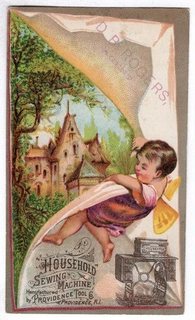
The full description and all the photos are on the eBay listing.
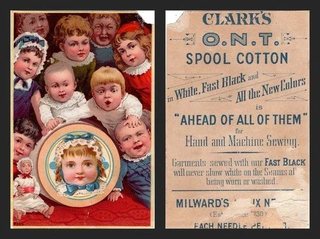
A crowd of eleven babies and small children in lace collars, bonnets and Sunday dresses presses around a large round spool end, the centerpiece an embossed medallion of a little girl in a lace bonnet tied with a blue bow. A doll in a white dress and bonnet sits at lower left. Small artist's or printer's mark at lower left, best reading "M&Co."
The back is printed in blue: "CLARK'S O.N.T. SPOOL COTTON in White, Fast Black and All the New Colors is 'AHEAD OF ALL OF THEM' for Hand and Machine Sewing. Garments sewed with our FAST BLACK will never show white on the Seams af[ter] being worn or washed." Below the rule, partly lost to damage: "MILWARD'S [HEL]IX NE[EDLES] (Est[ablished] ... 1730) EACH NEEDLE PER[FECT]" (best reading). Approx. 2.80 x 4.25 in.
Our New Thread. "O.N.T." stood for "Our New Thread," the Clark Thread Company's famous brand. The Clark family's thread business began at Paisley, Scotland, in 1812, and George A. Clark completed a large new mill in Newark, New Jersey, in 1866; the company even named its soccer team Clark O.N.T.
Fast black. The back's selling point is a dye that would not fade: thread that "will never show white on the Seams" after wear and washing.
Thread and needles together. The back also advertises Milward's needles, an old English needle-making name, on the same card as the thread.
A crowd of babies. Victorian printers loved a crush of round-faced babies, and this embossed example, with its doll and bonneted centerpiece, is a crossover piece for collectors of children and doll imagery.
Sold as-is for its image. Front: the upper right corner is missing (paper loss about 0.3 in. deep) with grey smudging around the break; a short white surface crease at the bottom center; light rubbing to the embossed medallion; edges toned; colors otherwise strong. Back: paper loss at the upper left corner; a band of surface scuffing and thinning across the lower right that removes parts of the Milward's needle text; light toning overall. Please see the photos, which are part of the description.
This is an original chromolithograph, and it was slow, exacting work. Each color had to be drawn onto its own separate stone by hand — in monochrome, the artist judging how much stipple each area needed so the colors would combine correctly only once every stone had been printed. The sheet then went through the press once for every color it carries, often a dozen or more, and every pass had to register exactly against the last. A pass out of register showed.
Under magnification the image resolves into irregular hand-drawn stipple, each ink carrying its own dot pattern, the colors mixing in the eye rather than on the paper. There is no regular halftone screen and no four-color rosette, which is what a modern reproduction would show. Modern process printing simulates every color from four inks; chromolithography laid each color down as its own.
The central medallion is embossed, and the back is printed in a single blue ink.
From my family's estate collections, built over more than 60 years by knowledgeable antiques collectors and traders. Stored in a climate-controlled environment.
More Victorian advertising trade cards for thread, sewing notions and patent medicines are in our store.
Specifications and detailed item descriptions are provided as a courtesy only and are not guaranteed to be one hundred percent accurate. Please do your own research. There are generally no receipts available for any items from original purchases. Any dimensions and/or weights are approximate. The absence of a more detailed condition report does not imply there are no condition issues with the item(s). Please inspect images carefully as they are part of the official item description and best representation of the actual condition. Additional images may be available upon request depending on time and availability. Not responsible for internet mis-translations or mis-identification of maker's marks if found or assumptions of makers or materials — item descriptions will indicate if it is assumed. If you see a problem, please message us immediately and we will do our best to sort out a solution and confirm the information. With the exception of eBay rules, no returns are accepted.
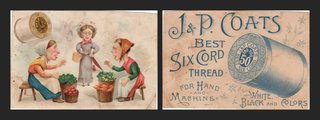
A comic market scene. Two old market women on wooden stools argue across their baskets of greens, red apples and carrots, both with mouths open and hands raised, one in a white cap and polka-dot kerchief, the other in a spotted orange headscarf. Between them stands a prim lady in spectacles, a beribboned bonnet and a grey dress, a market basket on one arm and a furled red umbrella in hand. A large spool of J. & P. Coats thread hangs at upper left, its label reading "J. & P. COATS 200 YDS 50 BEST SIX CORD."
The back is printed in blue: "J.&P. COATS BEST SIX CORD THREAD FOR HAND AND MACHINE. WHITE, BLACK AND COLORS," with a large engraved spool and sprays of flowers. Approx. 4.05 x 2.75 in.
Thread from Paisley. J. & P. Coats was a Scottish thread firm of Paisley. In 1869 it allied with the Conant thread works of Pawtucket, Rhode Island, which then made the Coats six-cord thread in the United States.
Made for the sewing machine. Six-cord thread was strong enough for machine stitching, and the back of this card says it plainly: "For Hand and Machine."
Comedy sells thread. Instead of showing the product at work, the artist stages a squabble between two market women while a starchy customer waits, and drops a giant spool into the corner. Humorous scenes like this were a staple of the Victorian trade card.
Fair to good. Front: light soiling and foxing across the sky area, heaviest at upper center, with a few small grey smudges; small dark spot at the left edge; a curved surface crease at the lower right corner and a short crease at the right edge; corners softly rounded, the lower left with a small bump. Colors otherwise bright. Back: overall toning with light staining at the left and center, a few small dark specks, and a light crease at the lower left corner. Please see the photos, which are part of the description.
This is an original chromolithograph, and it was slow, exacting work. Each color had to be drawn onto its own separate stone by hand — in monochrome, the artist judging how much stipple each area needed so the colors would combine correctly only once every stone had been printed. The sheet then went through the press once for every color it carries, often a dozen or more, and every pass had to register exactly against the last. A pass out of register showed.
Under magnification the image resolves into irregular hand-drawn stipple, each ink carrying its own dot pattern, the colors mixing in the eye rather than on the paper. There is no regular halftone screen and no four-color rosette, which is what a modern reproduction would show. Modern process printing simulates every color from four inks; chromolithography laid each color down as its own.
The back is printed in a single blue ink.
From my family's estate collections, built over more than 60 years by knowledgeable antiques collectors and traders. Stored in a climate-controlled environment.
More Victorian advertising trade cards for thread, sewing and patent medicines are in our store.
Specifications and detailed item descriptions are provided as a courtesy only and are not guaranteed to be one hundred percent accurate. Please do your own research. There are generally no receipts available for any items from original purchases. Any dimensions and/or weights are approximate. The absence of a more detailed condition report does not imply there are no condition issues with the item(s). Please inspect images carefully as they are part of the official item description and best representation of the actual condition. Additional images may be available upon request depending on time and availability. Not responsible for internet mis-translations or mis-identification of maker's marks if found or assumptions of makers or materials — item descriptions will indicate if it is assumed. If you see a problem, please message us immediately and we will do our best to sort out a solution and confirm the information. With the exception of eBay rules, no returns are accepted.
No listings match that search.